1
SWOT and PESTLE Analysis
By.Dr.Mahboob ali khan Phd
SWOT analysis is done after the launching of the business/product/venture, A SWOT analysis
can be carried out for a POST NOT PRE when a company, product, place, industry, or person. It
involves specifying the objectives of the business venture or project and identifying the internal
and external factors that are favorable and unfavorable to achieve that objective.
Assume that a hospital has launched a new derma clinic and its services. Perform a SWOT
analysis for the same.
Objective means purpose
Use the following 8 steps to conduct a SWOT analysis.
1. Decide on the objective of your SWOT analysis. ...
2. Research your business, industry and market. ...
3. List your business's strengths. ...
4. List your business's weaknesses. ...
5. List potential opportunities for your business. ...
6. List potential threats to your business.
7. Establish priorities from the SWOT
8. Develop a strategy to address issues in the SWOT
9.
Strengths and opportunities helpful where as weakness and threats harmful
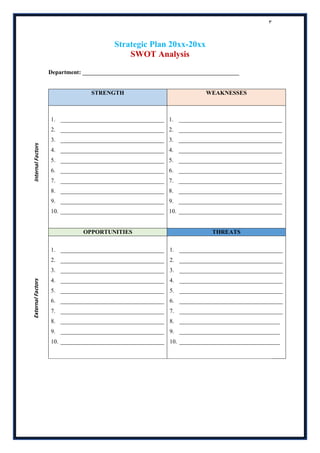
SWOT analysis using SWOT diagrams or matrices is a key part of any business planning or analysis.
SWOT stands for strengths, weaknesses, opportunities, and threats. Strengths and weaknesses are
internal factors and opportunities and threats are external factors. A SWOT diagram analyzes a project
or business venture by focusing on each of these factors. It typically consists of four boxes, one for
each area, but the exact shape may vary depending on the design.
SWOT diagrams can be especially useful when trying to decide whether or not to embark on a
certain venture or strategy by visualizing the pros and cons. By clearly outlining all positives and
negatives of a project, SWOT analysis makes it easier to decide whether or not to move forward.
2
How to Do a SWOT Analysis
 Determine the objective. Decide on a key project or strategy to analyze and place it at the top of the page.
 Create a grid. Draw a large square and then divide it into four smaller squares.
 Label each box. Write the word "Strengths" inside the top left box, "Weaknesses" inside the top right box,
"Opportunities" within the bottom left box, and "Threats" inside the bottom right box. These are titles, so
they should be distinguished from the rest of the text using either color or font size. SmartDraw offers
several SWOT diagram templates designed to make construction quick and easy.
 Add strengths and weaknesses. Add factors that affect the project to the applicable boxes. Components
of a SWOT analysis may be qualitative and anecdotal as well as quantitative and empirical in nature.
Factors are typically listed in a bullet form.
 Draw conclusions. Analyze the finished SWOT diagram. Be sure to note if the positive
outcomes outweigh the negative. If they do, it may be a good decision to carry out the
objective. If they do not, adjustments may need to be made, or else the plan should simply
be abandoned.
3
Strategic Plan 20xx-20xx
SWOT Analysis
Department: _____________________________________________________
STRENGTH WEAKNESSES
1. ___________________________________
2. ___________________________________
3. ___________________________________
4. ___________________________________
5. ___________________________________
6. ___________________________________
7. ___________________________________
8. ___________________________________
9. ___________________________________
10. ___________________________________
1. ___________________________________
2. ___________________________________
3. ___________________________________
4. ___________________________________
5. ___________________________________
6. ___________________________________
7. ___________________________________
8. ___________________________________
9. ___________________________________
10. ___________________________________
OPPORTUNITIES THREATS
1. ___________________________________
2. ___________________________________
3. ___________________________________
4. ___________________________________
5. ___________________________________
6. ___________________________________
7. ___________________________________
8. ___________________________________
9. ___________________________________
10. ___________________________________
1. ___________________________________
2. ___________________________________
3. ___________________________________
4. ___________________________________
5. ___________________________________
6. ___________________________________
7. ___________________________________
8. __________________________________
9. __________________________________
10. __________________________________
InternalFactorsExternalFactors
4
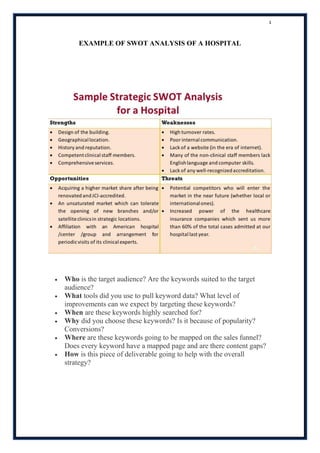
EXAMPLE OF SWOT ANALYSIS OF A HOSPITAL
 Who is the target audience? Are the keywords suited to the target
audience?
 What tools did you use to pull keyword data? What level of
improvements can we expect by targeting these keywords?
 When are these keywords highly searched for?
 Why did you choose these keywords? Is it because of popularity?
Conversions?
 Where are these keywords going to be mapped on the sales funnel?
Does every keyword have a mapped page and are there content gaps?
 How is this piece of deliverable going to help with the overall
strategy?
5
6 W's
WHAT : What will you make/do this?
You will make your road map,mission ,objective and strategy
WHY : Why will you make/do this?
It will help me in getting a clear idea of my challenges ahead
and how to overcome them
WHERE : Where will you make/do this?
On paper
WHO : Who will make/do this?
My self
WHEN : When will you start/stop this (time scheduling)?
Once my objective is clear
WHICH : Which will you make/do this (process, tooling,
material sources etc…)?
strengths ,weakness,opportunity and threats matrix
6
Strategic Plan 20xx-20xx
SWOT Analysis
Department: _____________________________________________________
STRENGTH (Highlight these)
1.Clinician 󠄖 2. 󠄖Academician 󠄖 3.Research
4.Community Services
WEAKNESSES (Mitigate these)
1.Clinician 2. Academician 3.Research
4.Community Services
1. ________________________________
2. ___________________________________
3. ___________________________________
4. ___________________________________
5. ___________________________________
6. ___________________________________
7. ___________________________________
8. ___________________________________
9. ___________________________________
10. ___________________________________
1. ___________________________________
2. ___________________________________
3. ___________________________________
4. ___________________________________
5. ___________________________________
6. ___________________________________
7. ___________________________________
8. ___________________________________
9. ___________________________________
10. ___________________________________
OPPORTUNITIES (Exploit these)
1.Clinician 2. Academician 3.Research
4.Community Services
THREATS (defend against these)
1.Clinician 2. Academician 3.Research
4.Community Services
1. ___________________________________
2. ___________________________________
3. ___________________________________
4. ___________________________________
5. ___________________________________
6. ___________________________________
7. ___________________________________
8. ___________________________________
9. ___________________________________
10. ___________________________________
1. ___________________________________
2. ___________________________________
3. ___________________________________
4. ___________________________________
5. ___________________________________
6. ___________________________________
7. ___________________________________
8. __________________________________
9. __________________________________
10. __________________________________
InternalFactorsExternalFactors
7
PESTLE analysis is a detailed view of the environment a business is situated in. It can be
rightly called a bird’s eye view where a company or an individual tries to ascertain specific
trends of the market from a macroeconomic perspective. PESTLE can be rightly called a
thorough view on the external environment in which an organization is operating in. On the
contrary though, SWOT analysis is the analysis on the internal environment of the
company based on its products etc. SWOT tends to be more product/service specific as an
individual or an entity conducts this analysis based on that product/service.
Every company in a business has certain frameworks that they follow in order to understand
the market they are catering to. They usually keep on checking the nerve of the market where
they want to focus their products upon. Certain companies carry out field work in form of
market research through which they conduct surveys or employ other techniques by which to
gauge the market needs and trends.
PESTLE can be rightly called a thorough view on the external environment in which an
organization is operating in. On the contrary though, SWOT analysis is the analysis on the
internal environment of the company based on its products etc. SWOT tends to be more
product/service specific as an individual or an entity conducts this analysis based on that
product/service.
PEST analysis, which many refer to as a deeper approach into the marketing environment
consists of Political, Economic, Social and Technological features of a market. A more
prolonged form of this analysis is called PESTLE, which incorporates the aspect of Legal and
Environmental factors affecting the marketplace.
Political: It accounts for all the influences that a government may have upon the business
environment, including business cycles, the economy at large and individual business
industries. Tax reforms, fiscal policies and trade tariffs form part of this analysis.
Economic: This analyzes the economy as a whole and its performance owing to global trends
and long term effects that may be evident. Inflation rates, interest rates, economic growth,
demand and supply trends are all analyzed under this head.
Social: This charts the analysis of cultural trends, demographical determinants, age distribution
etc.
Technological: This analyses the technological trends of the business environment. It accounts
for the rate at which the innovations are occurring and how directly and indirectly they’re
influencing the business you’re in.
Legal: There are many laws and policies that directly impact the way your business is run and
the decisions that fuel its propulsion. These laws can be social laws, regulatory laws, certain
standards that need to be met and other such laws.
Environmental: Your business has effects in the environment it operates in, therefore you need
to analyze in depth what implications your business might be having on it. On the other hand,
the environment also influences your business directly or indirectly especially the tourism,
farming or agriculture business. Therefore these factors account for the geographical location,
weather, climate etc. but are not just limited to the study of these only.
8
9

Swot and pestle analysis

  • 1.
    1 SWOT and PESTLEAnalysis By.Dr.Mahboob ali khan Phd SWOT analysis is done after the launching of the business/product/venture, A SWOT analysis can be carried out for a POST NOT PRE when a company, product, place, industry, or person. It involves specifying the objectives of the business venture or project and identifying the internal and external factors that are favorable and unfavorable to achieve that objective. Assume that a hospital has launched a new derma clinic and its services. Perform a SWOT analysis for the same. Objective means purpose Use the following 8 steps to conduct a SWOT analysis. 1. Decide on the objective of your SWOT analysis. ... 2. Research your business, industry and market. ... 3. List your business's strengths. ... 4. List your business's weaknesses. ... 5. List potential opportunities for your business. ... 6. List potential threats to your business. 7. Establish priorities from the SWOT 8. Develop a strategy to address issues in the SWOT 9. Strengths and opportunities helpful where as weakness and threats harmful SWOT analysis using SWOT diagrams or matrices is a key part of any business planning or analysis. SWOT stands for strengths, weaknesses, opportunities, and threats. Strengths and weaknesses are internal factors and opportunities and threats are external factors. A SWOT diagram analyzes a project or business venture by focusing on each of these factors. It typically consists of four boxes, one for each area, but the exact shape may vary depending on the design. SWOT diagrams can be especially useful when trying to decide whether or not to embark on a certain venture or strategy by visualizing the pros and cons. By clearly outlining all positives and negatives of a project, SWOT analysis makes it easier to decide whether or not to move forward.
  • 2.
    2 How to Doa SWOT Analysis  Determine the objective. Decide on a key project or strategy to analyze and place it at the top of the page.  Create a grid. Draw a large square and then divide it into four smaller squares.  Label each box. Write the word "Strengths" inside the top left box, "Weaknesses" inside the top right box, "Opportunities" within the bottom left box, and "Threats" inside the bottom right box. These are titles, so they should be distinguished from the rest of the text using either color or font size. SmartDraw offers several SWOT diagram templates designed to make construction quick and easy.  Add strengths and weaknesses. Add factors that affect the project to the applicable boxes. Components of a SWOT analysis may be qualitative and anecdotal as well as quantitative and empirical in nature. Factors are typically listed in a bullet form.  Draw conclusions. Analyze the finished SWOT diagram. Be sure to note if the positive outcomes outweigh the negative. If they do, it may be a good decision to carry out the objective. If they do not, adjustments may need to be made, or else the plan should simply be abandoned.
  • 3.
    3 Strategic Plan 20xx-20xx SWOTAnalysis Department: _____________________________________________________ STRENGTH WEAKNESSES 1. ___________________________________ 2. ___________________________________ 3. ___________________________________ 4. ___________________________________ 5. ___________________________________ 6. ___________________________________ 7. ___________________________________ 8. ___________________________________ 9. ___________________________________ 10. ___________________________________ 1. ___________________________________ 2. ___________________________________ 3. ___________________________________ 4. ___________________________________ 5. ___________________________________ 6. ___________________________________ 7. ___________________________________ 8. ___________________________________ 9. ___________________________________ 10. ___________________________________ OPPORTUNITIES THREATS 1. ___________________________________ 2. ___________________________________ 3. ___________________________________ 4. ___________________________________ 5. ___________________________________ 6. ___________________________________ 7. ___________________________________ 8. ___________________________________ 9. ___________________________________ 10. ___________________________________ 1. ___________________________________ 2. ___________________________________ 3. ___________________________________ 4. ___________________________________ 5. ___________________________________ 6. ___________________________________ 7. ___________________________________ 8. __________________________________ 9. __________________________________ 10. __________________________________ InternalFactorsExternalFactors
  • 4.
    4 EXAMPLE OF SWOTANALYSIS OF A HOSPITAL  Who is the target audience? Are the keywords suited to the target audience?  What tools did you use to pull keyword data? What level of improvements can we expect by targeting these keywords?  When are these keywords highly searched for?  Why did you choose these keywords? Is it because of popularity? Conversions?  Where are these keywords going to be mapped on the sales funnel? Does every keyword have a mapped page and are there content gaps?  How is this piece of deliverable going to help with the overall strategy?
  • 5.
    5 6 W's WHAT :What will you make/do this? You will make your road map,mission ,objective and strategy WHY : Why will you make/do this? It will help me in getting a clear idea of my challenges ahead and how to overcome them WHERE : Where will you make/do this? On paper WHO : Who will make/do this? My self WHEN : When will you start/stop this (time scheduling)? Once my objective is clear WHICH : Which will you make/do this (process, tooling, material sources etc…)? strengths ,weakness,opportunity and threats matrix
  • 6.
    6 Strategic Plan 20xx-20xx SWOTAnalysis Department: _____________________________________________________ STRENGTH (Highlight these) 1.Clinician 󠄖 2. 󠄖Academician 󠄖 3.Research 4.Community Services WEAKNESSES (Mitigate these) 1.Clinician 2. Academician 3.Research 4.Community Services 1. ________________________________ 2. ___________________________________ 3. ___________________________________ 4. ___________________________________ 5. ___________________________________ 6. ___________________________________ 7. ___________________________________ 8. ___________________________________ 9. ___________________________________ 10. ___________________________________ 1. ___________________________________ 2. ___________________________________ 3. ___________________________________ 4. ___________________________________ 5. ___________________________________ 6. ___________________________________ 7. ___________________________________ 8. ___________________________________ 9. ___________________________________ 10. ___________________________________ OPPORTUNITIES (Exploit these) 1.Clinician 2. Academician 3.Research 4.Community Services THREATS (defend against these) 1.Clinician 2. Academician 3.Research 4.Community Services 1. ___________________________________ 2. ___________________________________ 3. ___________________________________ 4. ___________________________________ 5. ___________________________________ 6. ___________________________________ 7. ___________________________________ 8. ___________________________________ 9. ___________________________________ 10. ___________________________________ 1. ___________________________________ 2. ___________________________________ 3. ___________________________________ 4. ___________________________________ 5. ___________________________________ 6. ___________________________________ 7. ___________________________________ 8. __________________________________ 9. __________________________________ 10. __________________________________ InternalFactorsExternalFactors
  • 7.
    7 PESTLE analysis isa detailed view of the environment a business is situated in. It can be rightly called a bird’s eye view where a company or an individual tries to ascertain specific trends of the market from a macroeconomic perspective. PESTLE can be rightly called a thorough view on the external environment in which an organization is operating in. On the contrary though, SWOT analysis is the analysis on the internal environment of the company based on its products etc. SWOT tends to be more product/service specific as an individual or an entity conducts this analysis based on that product/service. Every company in a business has certain frameworks that they follow in order to understand the market they are catering to. They usually keep on checking the nerve of the market where they want to focus their products upon. Certain companies carry out field work in form of market research through which they conduct surveys or employ other techniques by which to gauge the market needs and trends. PESTLE can be rightly called a thorough view on the external environment in which an organization is operating in. On the contrary though, SWOT analysis is the analysis on the internal environment of the company based on its products etc. SWOT tends to be more product/service specific as an individual or an entity conducts this analysis based on that product/service. PEST analysis, which many refer to as a deeper approach into the marketing environment consists of Political, Economic, Social and Technological features of a market. A more prolonged form of this analysis is called PESTLE, which incorporates the aspect of Legal and Environmental factors affecting the marketplace. Political: It accounts for all the influences that a government may have upon the business environment, including business cycles, the economy at large and individual business industries. Tax reforms, fiscal policies and trade tariffs form part of this analysis. Economic: This analyzes the economy as a whole and its performance owing to global trends and long term effects that may be evident. Inflation rates, interest rates, economic growth, demand and supply trends are all analyzed under this head. Social: This charts the analysis of cultural trends, demographical determinants, age distribution etc. Technological: This analyses the technological trends of the business environment. It accounts for the rate at which the innovations are occurring and how directly and indirectly they’re influencing the business you’re in. Legal: There are many laws and policies that directly impact the way your business is run and the decisions that fuel its propulsion. These laws can be social laws, regulatory laws, certain standards that need to be met and other such laws. Environmental: Your business has effects in the environment it operates in, therefore you need to analyze in depth what implications your business might be having on it. On the other hand, the environment also influences your business directly or indirectly especially the tourism, farming or agriculture business. Therefore these factors account for the geographical location, weather, climate etc. but are not just limited to the study of these only.
  • 8.
  • 9.