Presented By: ARSHAD ALI (10787)
department of electrical engineering
National university of modern languages (NUML)
Islamabad.
Evolution of Operating
System.
Operating System.????
Operating system, is software, that
communicates with the hardware and
allows other programs to run
Or
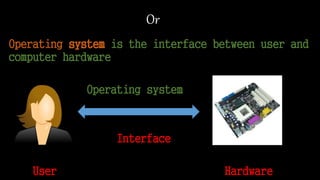
Operating system is the interface between user and
computer hardware
Operating system
Interface
User Hardware
Evolution
• Evolution mean the gradual development of
something.
EVOLUTION OF OPERATING SYSTEM IS
DIVIDED INTO 5 PHASES
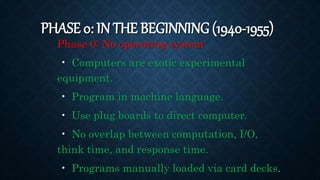
PHASE 0: IN THE BEGINNING (1940-1955)
Phase 0: No operating system
• Computers are exotic experimental
equipment.
• Program in machine language.
• Use plug boards to direct computer.
• No overlap between computation, I/O,
think time, and response time.
• Programs manually loaded via card decks.
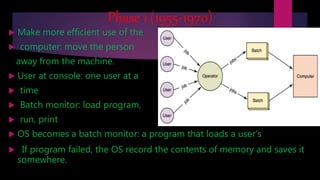
Phase 1 (1955-1970)
 Make more efficient use of the
 computer: move the person
away from the machine.
 User at console: one user at a
 time
 Batch monitor: load program,
 run, print
 OS becomes a batch monitor: a program that loads a user’s
 If program failed, the OS record the contents of memory and saves it
somewhere.
OS/360 WAS INTRODUCED IN 1963;
WORKED IN 1968.
SYSTEMS WERE ENORMOUSLY
COMPLICATED.
THEY WERE WRITTEN IN ASSEMBLY CODE.
NO STRUCTURED PROGRAMMING.
MODIFICATIONS:
 More efficient use of hardware.
 Efficiency increases because it processes
the jobs as a batch collectively rather
than individually.
Limitations
 No protection
 difficult to debug!
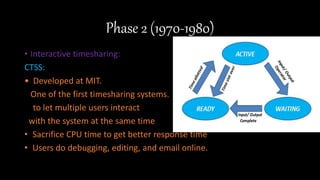
Phase 2 (1970-1980)
• Interactive timesharing:
CTSS:
• Developed at MIT.
One of the first timesharing systems.
to let multiple users interact
with the system at the same time
• Sacrifice CPU time to get better response time
• Users do debugging, editing, and email online.
MODIFICATIONS:
•Better utilization of resources.
•More than one user executes their tasks
simultaneously.
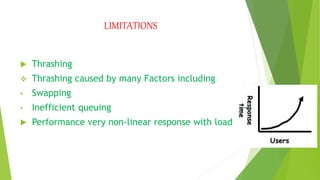
LIMITATIONS
 Thrashing
 Thrashing caused by many Factors including
• Swapping
• Inefficient queuing
 Performance very non-linear response with load
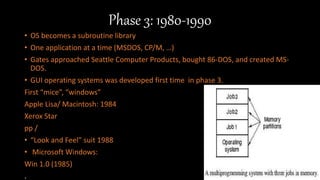
Phase 3: 1980-1990
• OS becomes a subroutine library
• One application at a time (MSDOS, CP/M, …)
• Gates approached Seattle Computer Products, bought 86-DOS, and created MS-
DOS.
• GUI operating systems was developed first time in phase 3.
First “mice”, “windows”
Apple Lisa/ Macintosh: 1984
Xerox Star
pp /
• “Look and Feel” suit 1988
• Microsoft Windows:
Win 1.0 (1985)
.
Modifications:
 OS becomes a subroutine library and
command executive.
 finish quickly and run existing
programs.
Limitations
Eventually PCs become powerful:
OS regains all the complexity of a
“big” OS
memory protection because of
multiprogramming.
Phase 4: (1990-2000)
 Networked Systems:
• Networking (Local Area Networking)
• Different machines share resources
Printers, File Servers, Web Servers
Client – Server Model
Services:
Computing
File Storage
Modifications:
 Internet service providers (service
between OS and apps)
 Information becomes a commodity.
 Advertising becomes a computer
marketplace.
Limitations
 complicated as compare to
uniprograming.
 Required high level protection and
privacy for user data.
Phase 5: 2000??-???? Mobile
Mobile and computer operating systems have been developed in
different ways and for different uses. Computer OS products are older
and more familiar to larger groups of users. Through the last 20 years,
the simple idea of a computer operating system has been continually
built on and improved. Through this time, Microsoft Windows and
Apple's Mac OS have emerged as the two dominant operating system
designs.
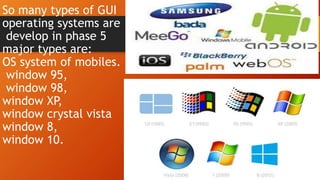
So many types of GUI
operating systems are
develop in phase 5
major types are:
OS system of mobiles.
window 95,
window 98,
window XP,
window crystal vista
window 8,
window 10.
CONCLUSION
• The designers and developers try to develop operating system and
make it user friendly all GUI operating System is user friendly
operating system. it is more easy for the user to use GUI OS as
compared to Unix, Linix, Ms. Dos etc. because while using these OS
user must familiar with its commands .
•The goal in OS development is to make
the machine convenient to use.
THANKS

Evolution of operating system

  • 2.
    Presented By: ARSHADALI (10787) department of electrical engineering National university of modern languages (NUML) Islamabad.
  • 3.
  • 4.
    Operating System.???? Operating system,is software, that communicates with the hardware and allows other programs to run
  • 5.
    Or Operating system isthe interface between user and computer hardware Operating system Interface User Hardware
  • 6.
    Evolution • Evolution meanthe gradual development of something.
  • 7.
    EVOLUTION OF OPERATINGSYSTEM IS DIVIDED INTO 5 PHASES
  • 8.
    PHASE 0: INTHE BEGINNING (1940-1955) Phase 0: No operating system • Computers are exotic experimental equipment. • Program in machine language. • Use plug boards to direct computer. • No overlap between computation, I/O, think time, and response time. • Programs manually loaded via card decks.
  • 9.
    Phase 1 (1955-1970) Make more efficient use of the  computer: move the person away from the machine.  User at console: one user at a  time  Batch monitor: load program,  run, print  OS becomes a batch monitor: a program that loads a user’s  If program failed, the OS record the contents of memory and saves it somewhere.
  • 10.
    OS/360 WAS INTRODUCEDIN 1963; WORKED IN 1968. SYSTEMS WERE ENORMOUSLY COMPLICATED. THEY WERE WRITTEN IN ASSEMBLY CODE. NO STRUCTURED PROGRAMMING.
  • 11.
    MODIFICATIONS:  More efficientuse of hardware.  Efficiency increases because it processes the jobs as a batch collectively rather than individually.
  • 12.
  • 13.
    Phase 2 (1970-1980) •Interactive timesharing: CTSS: • Developed at MIT. One of the first timesharing systems. to let multiple users interact with the system at the same time • Sacrifice CPU time to get better response time • Users do debugging, editing, and email online.
  • 14.
    MODIFICATIONS: •Better utilization ofresources. •More than one user executes their tasks simultaneously.
  • 15.
    LIMITATIONS  Thrashing  Thrashingcaused by many Factors including • Swapping • Inefficient queuing  Performance very non-linear response with load
  • 16.
    Phase 3: 1980-1990 •OS becomes a subroutine library • One application at a time (MSDOS, CP/M, …) • Gates approached Seattle Computer Products, bought 86-DOS, and created MS- DOS. • GUI operating systems was developed first time in phase 3. First “mice”, “windows” Apple Lisa/ Macintosh: 1984 Xerox Star pp / • “Look and Feel” suit 1988 • Microsoft Windows: Win 1.0 (1985) .
  • 17.
    Modifications:  OS becomesa subroutine library and command executive.  finish quickly and run existing programs.
  • 18.
    Limitations Eventually PCs becomepowerful: OS regains all the complexity of a “big” OS memory protection because of multiprogramming.
  • 19.
    Phase 4: (1990-2000) Networked Systems: • Networking (Local Area Networking) • Different machines share resources Printers, File Servers, Web Servers Client – Server Model Services: Computing File Storage
  • 20.
    Modifications:  Internet serviceproviders (service between OS and apps)  Information becomes a commodity.  Advertising becomes a computer marketplace.
  • 21.
    Limitations  complicated ascompare to uniprograming.  Required high level protection and privacy for user data.
  • 22.
    Phase 5: 2000??-????Mobile Mobile and computer operating systems have been developed in different ways and for different uses. Computer OS products are older and more familiar to larger groups of users. Through the last 20 years, the simple idea of a computer operating system has been continually built on and improved. Through this time, Microsoft Windows and Apple's Mac OS have emerged as the two dominant operating system designs.
  • 23.
    So many typesof GUI operating systems are develop in phase 5 major types are: OS system of mobiles. window 95, window 98, window XP, window crystal vista window 8, window 10.
  • 24.
    CONCLUSION • The designersand developers try to develop operating system and make it user friendly all GUI operating System is user friendly operating system. it is more easy for the user to use GUI OS as compared to Unix, Linix, Ms. Dos etc. because while using these OS user must familiar with its commands . •The goal in OS development is to make the machine convenient to use.
  • 25.