Evolution of IT management
Prepared by: Samah SAFI
Agenda
 IT management challenges
 ITIL
 Enterprise architecture
 COBIT
 Process automation
IT management challenges
IT management
 Information technology management (IT management) is the process whereby all
resources related to information technology are managed according to an
organization's priorities and needs. This includes tangible resources like networking
hardware, computers and people, as well as intangible resources like software and
data. The central aim of IT management is to generate value through the use of
technology. To achieve this, business strategies and technology must be aligned.
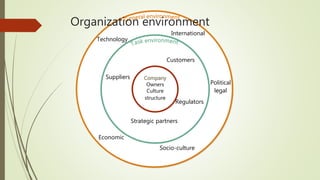
External forcesTechnology
Economic
International
Socio-culture
Political
legal
Internal
forces
Customers
Suppliers
Regulators
Strategic partners
Company
Owners
Culture
structure
Organization environment
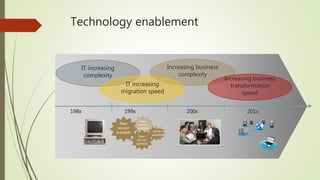
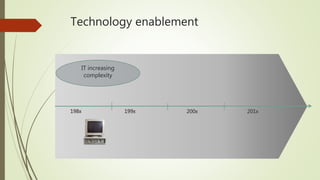
IT increasing
complexity
Increasing business
complexity
IT increasing
migration speed
Increasing business
transformation
speed
198x 199x 200x 201x
New
version
available
New
version
available
New
version
available
New
version
available
Technology enablement
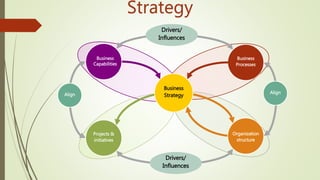
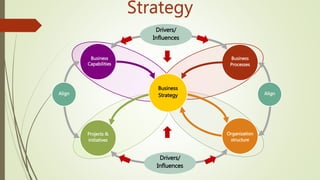
Business
Processes
Drivers/
Influences
Align Align
Business
Strategy
Drivers/
Influences
Business
Capabilities
Projects &
initiatives
Organization
structure
Strategy
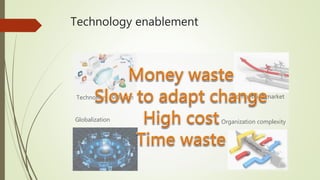
Technology enablement
Technology evolution
Globalization Organization complexity
Competitive market
Business
Processes
Align Align
Business
Strategy
Business
Capabilities
Projects &
initiatives
Organization
structure
Drivers/
Influences
Drivers/
Influences
Strategy
IT increasing
complexity
198x 199x 200x 201x
Technology enablement
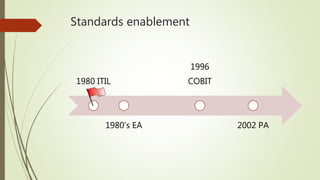
Standards enablement
1980 ITIL
1980’s EA
1996
COBIT
2002 PA
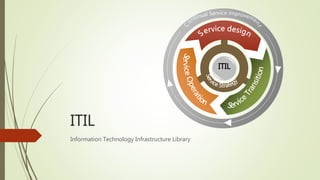
ITIL
Information Technology Infrastructure Library
ITIL
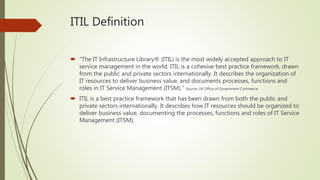
ITIL Definition
 “The IT Infrastructure Library® (ITIL) is the most widely accepted approach to IT
service management in the world. ITIL is a cohesive best practice framework, drawn
from the public and private sectors internationally. It describes the organization of
IT resources to deliver business value, and documents processes, functions and
roles in IT Service Management (ITSM).” Source: UK Office of Government Commerce
 ITIL is a best practice framework that has been drawn from both the public and
private sectors internationally. It describes how IT resources should be organized to
deliver business value, documenting the processes, functions and roles of IT Service
Management (ITSM).
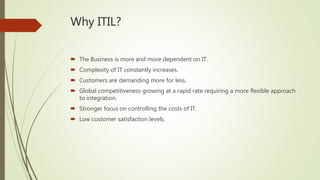
Why ITIL?
 The Business is more and more dependent on IT.
 Complexity of IT constantly increases.
 Customers are demanding more for less.
 Global competitiveness growing at a rapid rate requiring a more flexible approach
to integration.
 Stronger focus on controlling the costs of IT.
 Low customer satisfaction levels.
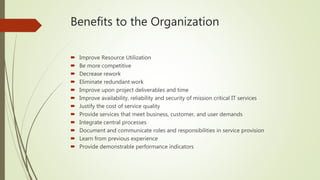
Benefits to the Organization
 Improve Resource Utilization
 Be more competitive
 Decrease rework
 Eliminate redundant work
 Improve upon project deliverables and time
 Improve availability, reliability and security of mission critical IT services
 Justify the cost of service quality
 Provide services that meet business, customer, and user demands
 Integrate central processes
 Document and communicate roles and responsibilities in service provision
 Learn from previous experience
 Provide demonstrable performance indicators
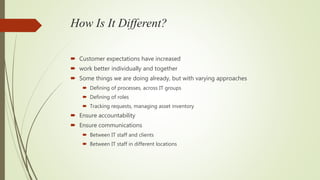
How Is It Different?
 Customer expectations have increased
 work better individually and together
 Some things we are doing already, but with varying approaches
 Defining of processes, across IT groups
 Defining of roles
 Tracking requests, managing asset inventory
 Ensure accountability
 Ensure communications
 Between IT staff and clients
 Between IT staff in different locations
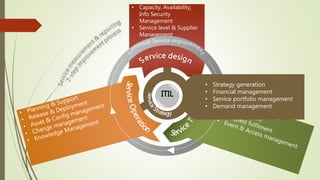
• Capacity, Availability,
Info Security
Management
• Service level & Supplier
Management
ITIL
• Strategy generation
• Financial management
• Service portfolio management
• Demand management
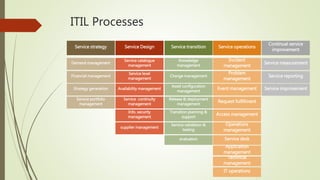
ITIL Processes
Service strategy Service Design Service transition Service operations
Continual service
improvement
Demand management
Financial management
Strategy generation
Service portfolio
management
Service catalogue
management
Service level
management
Availability management
Service continuity
management
Info. security
management
supplier management
Knowledge
management
Change management
Asset configuration
management
Release & deployment
management
Transition planning &
support
Service validation &
testing
evaluation
Incident
management
Problem
management
Event management
Request fulfillment
Access management
Operations
management
Service desk
Application
management
Technical
management
IT operations
Service measurement
Service reporting
Service improvement
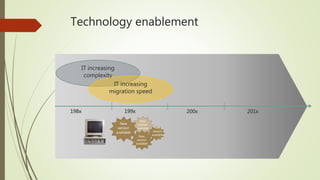
IT increasing
complexity
IT increasing
migration speed
198x 199x 200x 201x
New
version
available
New
version
available
New
version
available
New
version
available
Technology enablement
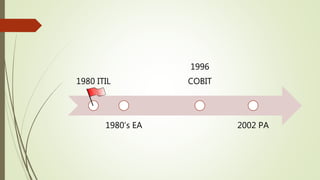
1980 ITIL
1980’s EA
1996
COBIT
2002 PA
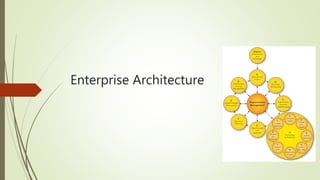
Enterprise Architecture
What is Enterprise Architecture?
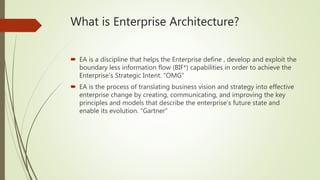
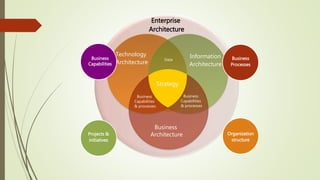
 EA is a discipline that helps the Enterprise define , develop and exploit the
boundary less information flow (BIF*) capabilities in order to achieve the
Enterprise’s Strategic Intent. ”OMG”
 EA is the process of translating business vision and strategy into effective
enterprise change by creating, communicating, and improving the key
principles and models that describe the enterprise’s future state and
enable its evolution. “Gartner”
Business
Strategy
Enterprise
Architecture
Technology
Architecture
Information
Architecture
Data Business
Processes
Business
Capabilities
Projects &
initiatives
Organization
structure
Business
Capabilities
& processes
Business
Architecture
Strategy
Business
Capabilities
& processes
Strategy
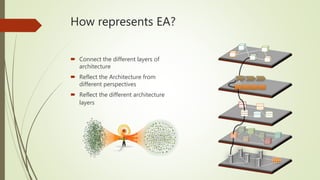
How represents EA?
 Connect the different layers of
architecture
 Reflect the Architecture from
different perspectives
 Reflect the different architecture
layers
Why do we need Enterprise Architecture?
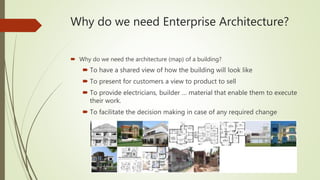
 Why do we need the architecture (map) of a building?
 To have a shared view of how the building will look like
 To present for customers a view to product to sell
 To provide electricians, builder … material that enable them to execute
their work.
 To facilitate the decision making in case of any required change
Why do we need Enterprise Architecture?
 Share the same whole picture
 React rapidly open environment changes
 Assess the performance and harmony inside enterprise
 Share different stakeholders viewpoints
 Enable enterprise usage, fixing, building and further development
Benefits
 Align IT with business
 Efficient IT operation
 Better return on existing
 Reduced risk for future investment
 Faster simpler and cheaper procurement
What is a EA framework?
 Enterprise Architecture Framework defines how to create and use
an enterprise architecture.
 An architecture framework provides principles and practices for creating
and using the architecture description of a system.
 Enterprise architecture framework and strategic planning is the key to
planning, coordinating and implementing an organization's business
objectives.
 It helps in the smooth functioning of different units in an organization,
both inside and outside the information systems architecture.
Enterprise Architecture framework example
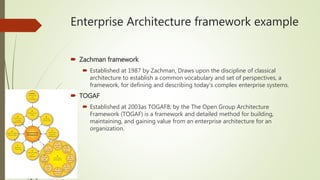
 Zachman framework
 Established at 1987 by Zachman, Draws upon the discipline of classical
architecture to establish a common vocabulary and set of perspectives, a
framework, for defining and describing today's complex enterprise systems.
 TOGAF
 Established at 2003as TOGAF8; by the The Open Group Architecture
Framework (TOGAF) is a framework and detailed method for building,
maintaining, and gaining value from an enterprise architecture for an
organization.
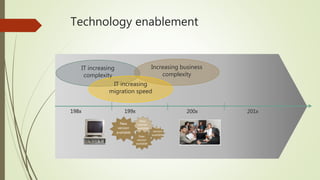
IT increasing
complexity
Increasing business
complexity
IT increasing
migration speed
198x 199x 200x 201x
New
version
available
New
version
available
New
version
available
New
version
available
Technology enablement
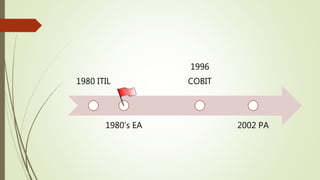
1980 ITIL
1980’s EA
1996
COBIT
2002 PA
COBIT
Control Objectives for IT
What is Cobit5
 COBIT 5 helps enterprises create optimal value from IT by maintaining a balance between
realising benefits and optimising risk levels and resource use.
 COBIT 5 enables information and related technology to be governed and managed in a
holistic manner for the entire enterprise, taking in the full end-to-end business and
functional areas of responsibility, considering the IT-related interests of internal and
external stakeholders.
Information critical asset
 Information is a key resource for all enterprises.
 Information is created, used, retained, disclosed and destroyed.
 Technology plays a key role in these actions.
 Technology is becoming pervasive in all aspects of business and personal life.
Enterprise benefits
 Maintain high quality information to support business decisions
 Generate business value from IT enabled investments
 Achieve operational excellence through the reliable and efficient application of
technology
 Maintain IT-related risk at an acceptable level
 Optimize the cost of IT services and technology
 Comply with ever-increasing relevant laws, regulations, contractual agreements
and policies
Stakeholder value
 Delivering enterprise stakeholder value requires good governance and
management of information and technology (IT) assets.
 Enterprise boards, executives and management have to embrace IT like any other
significant part of the business.
 External legal, regulatory and contractual compliance requirements related to
enterprise use of information and technology are increasing, threatening value if
breached.
 COBIT 5 provides a comprehensive framework that assists enterprises to achieve
their goals and deliver value through effective governance and management of
enterprise IT.
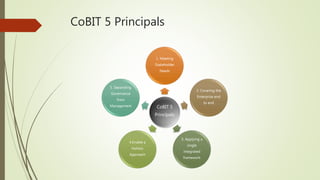
CoBIT 5
Principals
1. Meeting
Stakeholder
Needs
2. Covering the
Enterprise end
to end
3. Applying a
single
integrated
framework
4.Enable a
Holistic
Approach
5. Separating
Governance
from
Management
CoBIT 5 Principals
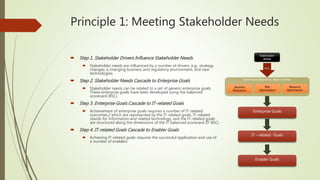
Principle 1: Meeting Stakeholder Needs
 Step 1. Stakeholder Drivers Influence Stakeholder Needs
 Stakeholder needs are influenced by a number of drivers, e.g., strategy
changes, a changing business and regulatory environment, and new
technologies.
 Step 2. Stakeholder Needs Cascade to Enterprise Goals
 Stakeholder needs can be related to a set of generic enterprise goals.
These enterprise goals have been developed using the balanced
scorecard (BSC).
 Step 3. Enterprise Goals Cascade to IT-related Goals
 Achievement of enterprise goals requires a number of IT-related
outcomes,2 which are represented by the IT-related goals. IT-related
stands for information and related technology, and the IT-related goals
are structured along the dimensions of the IT balanced scorecard (IT BSC)
 Step 4. IT-related Goals Cascade to Enabler Goals
 Achieving IT-related goals requires the successful application and use of
a number of enablers
Enterprise Goals
IT – related Goals
Enabler Goals
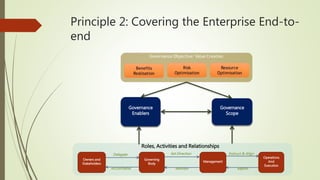
Principle 2: Covering the Enterprise End-to-
end
Governance
Enablers
Governance
Scope
Roles, Activities and Relationships
Owners and
Stakeholders
Management
Governing
Body
Operations
And
Execution
Delegate
Accountable Monitor
Set Direction
Report
Instruct & Align
Principle 3: Applying a Single Integrated
Framework
COBIT 5 is a single and integrated framework because:
1. It aligns with other latest relevant standards and frameworks, and thus allows the
enterprise to use COBIT 5 as the overarching governance and management framework
integrator.
2. It is complete in enterprise coverage, providing a basis to integrate effectively other
frameworks, standards and practices used.
3. A single overarching framework serves as a consistent and integrated source of
guidance in a nontechnical, technology-agnostic common language.
4. It provides a simple architecture for structuring guidance materials and producing a
consistent product set.
5. It integrates all knowledge previously dispersed over different ISACA frameworks.
Resources
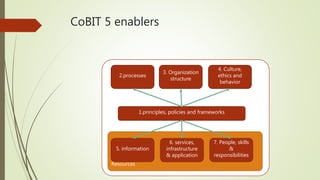
CoBIT 5 enablers
1.principles, policies and frameworks
2.processes
3. Organization
structure
4. Culture,
ethics and
behavior
5. information
6. services,
infrastructure
& application
7. People, skills
&
responsibilities
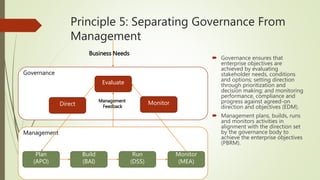
Principle 5: Separating Governance From
Management
 Governance ensures that
enterprise objectives are
achieved by evaluating
stakeholder needs, conditions
and options; setting direction
through prioritization and
decision making; and monitoring
performance, compliance and
progress against agreed-on
direction and objectives (EDM).
 Management plans, builds, runs
and monitors activities in
alignment with the direction set
by the governance body to
achieve the enterprise objectives
(PBRM).
Governance
Management
Evaluate
Plan
(APO)
Build
(BAI)
Run
(DSS)
Monitor
(MEA)
Management
FeedbackDirect Monitor
Business Needs
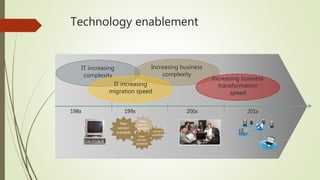
IT increasing
complexity
Increasing business
complexity
IT increasing
migration speed
Increasing business
transformation
speed
198x 199x 200x 201x
New
version
available
New
version
available
New
version
available
New
version
available
Technology enablement
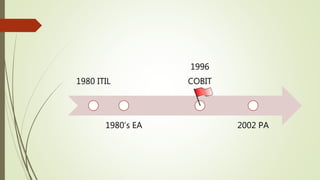
1980 ITIL
1980’s EA
1996
COBIT
2002 PA
Business process
automation
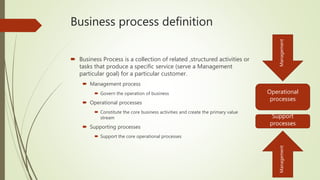
Business process definition
 Business Process is a collection of related ,structured activities or
tasks that produce a specific service (serve a Management
particular goal) for a particular customer.
 Management process
 Govern the operation of business
 Operational processes
 Constitute the core business activities and create the primary value
stream
 Supporting processes
 Support the core operational processes
Operational
processes
Support
processes
ManagementManagement
Why business process automation?
 Business Processes are the central nervous system of organizations,
 Automation accelerate and increase the efficiency and quality of service provided
by these processes
 Management of business processes changes and implications take huge time
 Traditional development of applications based on business processes is complex
 Operational processes differ between organization and other working in the same
domain
Business process automation definition
 Business process automation (BPA) is defined as the automation of complex
business processes and functions beyond conventional data manipulation and
record-keeping activities, usually through the use of advanced technologies. It
focuses on “run the business” as opposed to “count the business” types of
automation efforts and often deals with event-driven, mission-critical, core
processes. BPA usually supports an enterprise’s knowledge workers in satisfying the
needs of its many constituencies. “Gartner”
Business process automation benefits
 Reduce costs
 Streamline work
 Boost productivity
 Track progress
 Deal easily with high volumes of requests
 Reduce errors
 Enforce standards
 Maintain visibility
 Integrate with other systems
 Quick to build and customize
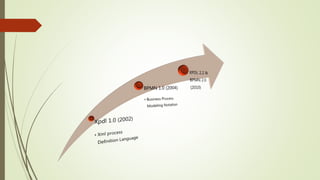
What is BPMN?
 The primary goal of BPMN is to provide a notation that is readily understandable
by all business users, from the business analysts that create the initial drafts of the
process , to the technical developers responsible for implementing the technology
that will perform those processes and finally, to the business people who will
manage and monitor those processes.
 The second goal of BPMN ensure that XML languages designed for the execution
of business language such as WSBPEL, can be visualized with a business-oriented
notation.
What is XPDL & BPEL?
 Xpdl (Xml process Definition Language) is a format standardized by the Workflow
Management Coalition (WfMC) to interchange business process definitions
between different workflow products. XPDL defines an XML schema for specifying
the declarative part of workflow / business process.
 WS-BPEL (Web Services Business Process Execution Language) is an XML based
programming language to describe high level business processes. A 'business
process' is a term used to describe the interaction between two businesses or two
elements in some business.
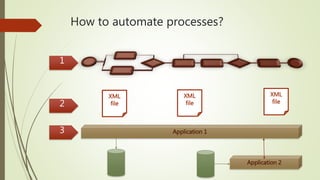
How to automate processes?
Application 1
Application 2
XML
file
XML
file
XML
file
1
2
3
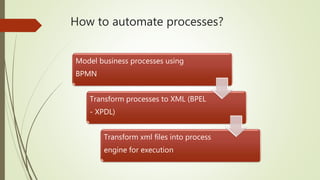
How to automate processes?
Model business processes using
BPMN
Transform processes to XML (BPEL
- XPDL)
Transform xml files into process
engine for execution

Evolution of it management

  • 1.
    Evolution of ITmanagement Prepared by: Samah SAFI
  • 2.
    Agenda  IT managementchallenges  ITIL  Enterprise architecture  COBIT  Process automation
  • 3.
  • 4.
    IT management  Informationtechnology management (IT management) is the process whereby all resources related to information technology are managed according to an organization's priorities and needs. This includes tangible resources like networking hardware, computers and people, as well as intangible resources like software and data. The central aim of IT management is to generate value through the use of technology. To achieve this, business strategies and technology must be aligned.
  • 5.
  • 6.
    IT increasing complexity Increasing business complexity ITincreasing migration speed Increasing business transformation speed 198x 199x 200x 201x New version available New version available New version available New version available Technology enablement
  • 7.
  • 8.
    Technology enablement Technology evolution GlobalizationOrganization complexity Competitive market
  • 9.
  • 10.
    IT increasing complexity 198x 199x200x 201x Technology enablement
  • 11.
  • 12.
  • 13.
    ITIL Definition  “TheIT Infrastructure Library® (ITIL) is the most widely accepted approach to IT service management in the world. ITIL is a cohesive best practice framework, drawn from the public and private sectors internationally. It describes the organization of IT resources to deliver business value, and documents processes, functions and roles in IT Service Management (ITSM).” Source: UK Office of Government Commerce  ITIL is a best practice framework that has been drawn from both the public and private sectors internationally. It describes how IT resources should be organized to deliver business value, documenting the processes, functions and roles of IT Service Management (ITSM).
  • 14.
    Why ITIL?  TheBusiness is more and more dependent on IT.  Complexity of IT constantly increases.  Customers are demanding more for less.  Global competitiveness growing at a rapid rate requiring a more flexible approach to integration.  Stronger focus on controlling the costs of IT.  Low customer satisfaction levels.
  • 15.
    Benefits to theOrganization  Improve Resource Utilization  Be more competitive  Decrease rework  Eliminate redundant work  Improve upon project deliverables and time  Improve availability, reliability and security of mission critical IT services  Justify the cost of service quality  Provide services that meet business, customer, and user demands  Integrate central processes  Document and communicate roles and responsibilities in service provision  Learn from previous experience  Provide demonstrable performance indicators
  • 16.
    How Is ItDifferent?  Customer expectations have increased  work better individually and together  Some things we are doing already, but with varying approaches  Defining of processes, across IT groups  Defining of roles  Tracking requests, managing asset inventory  Ensure accountability  Ensure communications  Between IT staff and clients  Between IT staff in different locations
  • 17.
    • Capacity, Availability, InfoSecurity Management • Service level & Supplier Management ITIL • Strategy generation • Financial management • Service portfolio management • Demand management
  • 18.
    ITIL Processes Service strategyService Design Service transition Service operations Continual service improvement Demand management Financial management Strategy generation Service portfolio management Service catalogue management Service level management Availability management Service continuity management Info. security management supplier management Knowledge management Change management Asset configuration management Release & deployment management Transition planning & support Service validation & testing evaluation Incident management Problem management Event management Request fulfillment Access management Operations management Service desk Application management Technical management IT operations Service measurement Service reporting Service improvement
  • 19.
    IT increasing complexity IT increasing migrationspeed 198x 199x 200x 201x New version available New version available New version available New version available Technology enablement
  • 20.
  • 21.
  • 22.
    What is EnterpriseArchitecture?  EA is a discipline that helps the Enterprise define , develop and exploit the boundary less information flow (BIF*) capabilities in order to achieve the Enterprise’s Strategic Intent. ”OMG”  EA is the process of translating business vision and strategy into effective enterprise change by creating, communicating, and improving the key principles and models that describe the enterprise’s future state and enable its evolution. “Gartner”
  • 23.
  • 24.
    How represents EA? Connect the different layers of architecture  Reflect the Architecture from different perspectives  Reflect the different architecture layers
  • 25.
    Why do weneed Enterprise Architecture?  Why do we need the architecture (map) of a building?  To have a shared view of how the building will look like  To present for customers a view to product to sell  To provide electricians, builder … material that enable them to execute their work.  To facilitate the decision making in case of any required change
  • 26.
    Why do weneed Enterprise Architecture?  Share the same whole picture  React rapidly open environment changes  Assess the performance and harmony inside enterprise  Share different stakeholders viewpoints  Enable enterprise usage, fixing, building and further development
  • 27.
    Benefits  Align ITwith business  Efficient IT operation  Better return on existing  Reduced risk for future investment  Faster simpler and cheaper procurement
  • 28.
    What is aEA framework?  Enterprise Architecture Framework defines how to create and use an enterprise architecture.  An architecture framework provides principles and practices for creating and using the architecture description of a system.  Enterprise architecture framework and strategic planning is the key to planning, coordinating and implementing an organization's business objectives.  It helps in the smooth functioning of different units in an organization, both inside and outside the information systems architecture.
  • 29.
    Enterprise Architecture frameworkexample  Zachman framework  Established at 1987 by Zachman, Draws upon the discipline of classical architecture to establish a common vocabulary and set of perspectives, a framework, for defining and describing today's complex enterprise systems.  TOGAF  Established at 2003as TOGAF8; by the The Open Group Architecture Framework (TOGAF) is a framework and detailed method for building, maintaining, and gaining value from an enterprise architecture for an organization.
  • 30.
    IT increasing complexity Increasing business complexity ITincreasing migration speed 198x 199x 200x 201x New version available New version available New version available New version available Technology enablement
  • 31.
  • 32.
  • 33.
    What is Cobit5 COBIT 5 helps enterprises create optimal value from IT by maintaining a balance between realising benefits and optimising risk levels and resource use.  COBIT 5 enables information and related technology to be governed and managed in a holistic manner for the entire enterprise, taking in the full end-to-end business and functional areas of responsibility, considering the IT-related interests of internal and external stakeholders.
  • 34.
    Information critical asset Information is a key resource for all enterprises.  Information is created, used, retained, disclosed and destroyed.  Technology plays a key role in these actions.  Technology is becoming pervasive in all aspects of business and personal life.
  • 35.
    Enterprise benefits  Maintainhigh quality information to support business decisions  Generate business value from IT enabled investments  Achieve operational excellence through the reliable and efficient application of technology  Maintain IT-related risk at an acceptable level  Optimize the cost of IT services and technology  Comply with ever-increasing relevant laws, regulations, contractual agreements and policies
  • 36.
    Stakeholder value  Deliveringenterprise stakeholder value requires good governance and management of information and technology (IT) assets.  Enterprise boards, executives and management have to embrace IT like any other significant part of the business.  External legal, regulatory and contractual compliance requirements related to enterprise use of information and technology are increasing, threatening value if breached.  COBIT 5 provides a comprehensive framework that assists enterprises to achieve their goals and deliver value through effective governance and management of enterprise IT.
  • 37.
    CoBIT 5 Principals 1. Meeting Stakeholder Needs 2.Covering the Enterprise end to end 3. Applying a single integrated framework 4.Enable a Holistic Approach 5. Separating Governance from Management CoBIT 5 Principals
  • 38.
    Principle 1: MeetingStakeholder Needs  Step 1. Stakeholder Drivers Influence Stakeholder Needs  Stakeholder needs are influenced by a number of drivers, e.g., strategy changes, a changing business and regulatory environment, and new technologies.  Step 2. Stakeholder Needs Cascade to Enterprise Goals  Stakeholder needs can be related to a set of generic enterprise goals. These enterprise goals have been developed using the balanced scorecard (BSC).  Step 3. Enterprise Goals Cascade to IT-related Goals  Achievement of enterprise goals requires a number of IT-related outcomes,2 which are represented by the IT-related goals. IT-related stands for information and related technology, and the IT-related goals are structured along the dimensions of the IT balanced scorecard (IT BSC)  Step 4. IT-related Goals Cascade to Enabler Goals  Achieving IT-related goals requires the successful application and use of a number of enablers Enterprise Goals IT – related Goals Enabler Goals
  • 39.
    Principle 2: Coveringthe Enterprise End-to- end Governance Enablers Governance Scope Roles, Activities and Relationships Owners and Stakeholders Management Governing Body Operations And Execution Delegate Accountable Monitor Set Direction Report Instruct & Align
  • 40.
    Principle 3: Applyinga Single Integrated Framework COBIT 5 is a single and integrated framework because: 1. It aligns with other latest relevant standards and frameworks, and thus allows the enterprise to use COBIT 5 as the overarching governance and management framework integrator. 2. It is complete in enterprise coverage, providing a basis to integrate effectively other frameworks, standards and practices used. 3. A single overarching framework serves as a consistent and integrated source of guidance in a nontechnical, technology-agnostic common language. 4. It provides a simple architecture for structuring guidance materials and producing a consistent product set. 5. It integrates all knowledge previously dispersed over different ISACA frameworks.
  • 41.
    Resources CoBIT 5 enablers 1.principles,policies and frameworks 2.processes 3. Organization structure 4. Culture, ethics and behavior 5. information 6. services, infrastructure & application 7. People, skills & responsibilities
  • 42.
    Principle 5: SeparatingGovernance From Management  Governance ensures that enterprise objectives are achieved by evaluating stakeholder needs, conditions and options; setting direction through prioritization and decision making; and monitoring performance, compliance and progress against agreed-on direction and objectives (EDM).  Management plans, builds, runs and monitors activities in alignment with the direction set by the governance body to achieve the enterprise objectives (PBRM). Governance Management Evaluate Plan (APO) Build (BAI) Run (DSS) Monitor (MEA) Management FeedbackDirect Monitor Business Needs
  • 43.
    IT increasing complexity Increasing business complexity ITincreasing migration speed Increasing business transformation speed 198x 199x 200x 201x New version available New version available New version available New version available Technology enablement
  • 44.
  • 45.
  • 46.
    Business process definition Business Process is a collection of related ,structured activities or tasks that produce a specific service (serve a Management particular goal) for a particular customer.  Management process  Govern the operation of business  Operational processes  Constitute the core business activities and create the primary value stream  Supporting processes  Support the core operational processes Operational processes Support processes ManagementManagement
  • 47.
    Why business processautomation?  Business Processes are the central nervous system of organizations,  Automation accelerate and increase the efficiency and quality of service provided by these processes  Management of business processes changes and implications take huge time  Traditional development of applications based on business processes is complex  Operational processes differ between organization and other working in the same domain
  • 48.
    Business process automationdefinition  Business process automation (BPA) is defined as the automation of complex business processes and functions beyond conventional data manipulation and record-keeping activities, usually through the use of advanced technologies. It focuses on “run the business” as opposed to “count the business” types of automation efforts and often deals with event-driven, mission-critical, core processes. BPA usually supports an enterprise’s knowledge workers in satisfying the needs of its many constituencies. “Gartner”
  • 49.
    Business process automationbenefits  Reduce costs  Streamline work  Boost productivity  Track progress  Deal easily with high volumes of requests  Reduce errors  Enforce standards  Maintain visibility  Integrate with other systems  Quick to build and customize
  • 51.
    What is BPMN? The primary goal of BPMN is to provide a notation that is readily understandable by all business users, from the business analysts that create the initial drafts of the process , to the technical developers responsible for implementing the technology that will perform those processes and finally, to the business people who will manage and monitor those processes.  The second goal of BPMN ensure that XML languages designed for the execution of business language such as WSBPEL, can be visualized with a business-oriented notation.
  • 52.
    What is XPDL& BPEL?  Xpdl (Xml process Definition Language) is a format standardized by the Workflow Management Coalition (WfMC) to interchange business process definitions between different workflow products. XPDL defines an XML schema for specifying the declarative part of workflow / business process.  WS-BPEL (Web Services Business Process Execution Language) is an XML based programming language to describe high level business processes. A 'business process' is a term used to describe the interaction between two businesses or two elements in some business.
  • 53.
    How to automateprocesses? Application 1 Application 2 XML file XML file XML file 1 2 3
  • 54.
    How to automateprocesses? Model business processes using BPMN Transform processes to XML (BPEL - XPDL) Transform xml files into process engine for execution

Editor's Notes

  • #16 Source: Pink Elephant – “The Benefits of ITIL® White Paper”, March 2006
  • #50 Reduce costs – Stop using resource heavy paper trail systems, or consolidate processes on the SharePoint platform to enable you to retire legacy systems, thereby saving licence and maintenance costs. Streamline work – remove bottlenecks and minimise manual actions by using workflows that automate activities and tasks. SharePoint 2010 workflows can quickly apply rules to make decisions and calculations ensuring work progresses smoothly. SharePoint can also alert users when an action is required from them. Boost productivity – reduce the amount of time users spend performing tasks, freeing them up to concentrate on other work activities like serving customers. Users no longer have to remember lengthy processes as the workflow will carry out actions and alert those who need to respond. Track progress – Users can easily view the status of their tasks and requests. Managers can quickly get an overview of the actions completed and outstanding. Communication is simpler with automated alerts and updates, and all users involved having easy access to the information they require. Deal easily with high volumes of requests – Users complete an easy to use form, submit it online and the workflow manages what happens next, so whether you have a single submission or hundreds they all get handled correctly and efficiently. SharePoint 2010 is a great platform for applications gives you the flexibility to repeat and scale processes to meet demand. Reduce errors – Work consistently and reduce mistakes. By automating processes and managing them centrally you provide a framework that intuitively guides users. This minimises the chance for human error, ensuring the correct outcome every time and only involving the people who need to be involved. Enforce standards - workflows help you maintain standards and compliance as you can configure the workflow to make sure all essential activities and outcomes are tracked and escalated. By aligning workflows with policy you make it straightforward for users to comply. Maintain visibility – SharePoint 2010 workflow applications can provide effective auditing and reporting capabilities, giving you the information you need to manage, review and improve your work processes. Workflows can give you greater insights into control, compliance and accountability. Integrate with other systems – Data can be read from or written to other systems automatically, this overcomes information silos, and provides a single point of access for users, saving them time. Quick to build and customise - SharePoint 2010 enables you to design, build and configure workflows without always needing complex code. There are also excellent third party solutions than can enhance these capabilities further. For example, Nintex and K2 give you intuitive drag and drop tools to create powerful workflows in moments. - See more at: http://www.pointbeyond.com/2011/08/12/10-business-benefits-of-automating-processes-with-sharepoint-2010-workflow-applications#sthash.B6oDrQMV.dpuf