The Peppered MothThe Peppered Moth
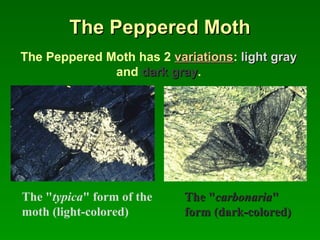
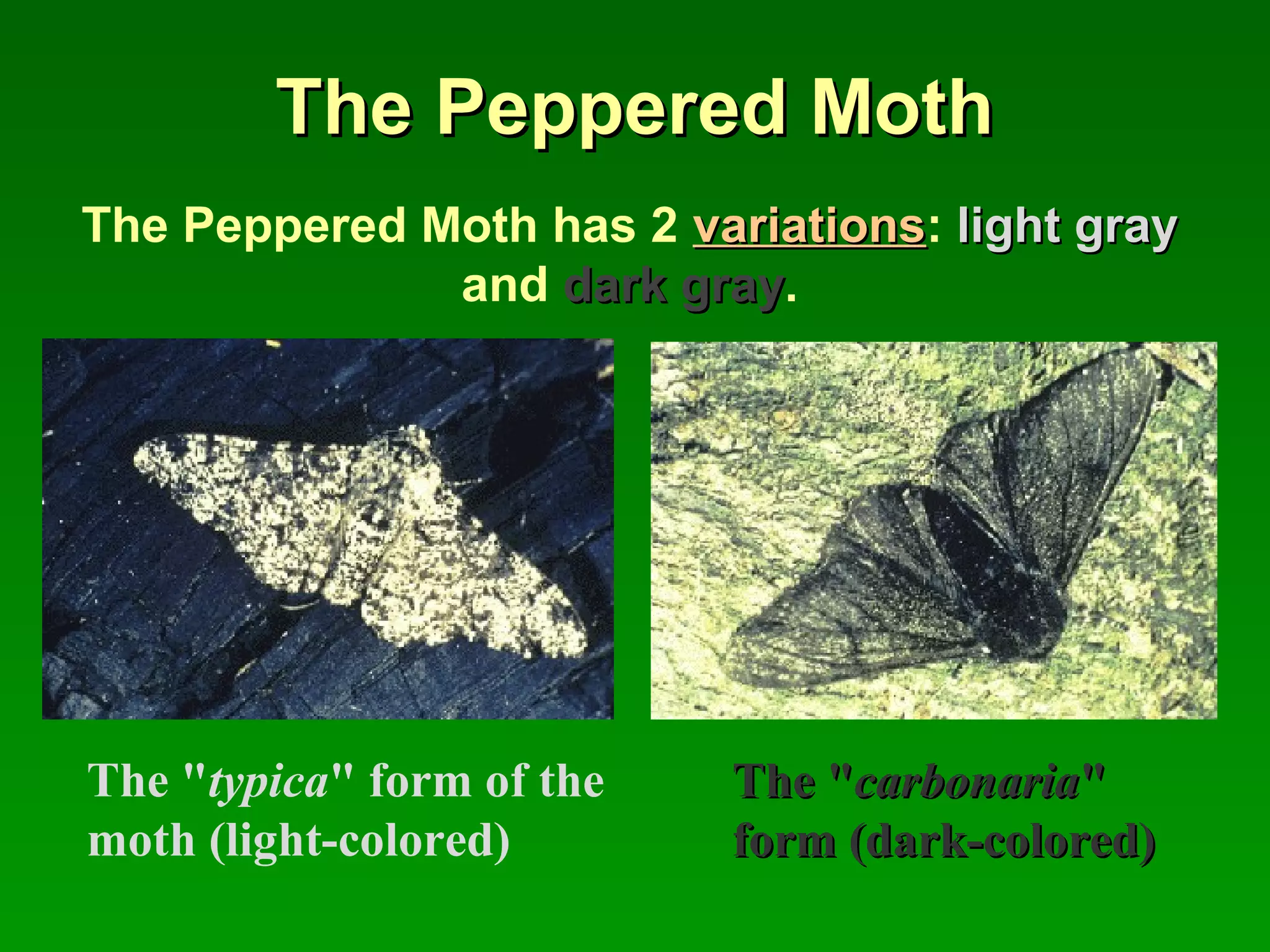
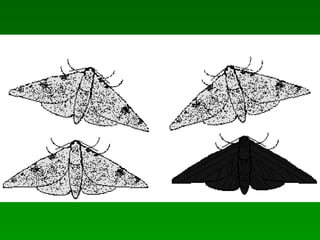
The "typica" form of the
moth (light-colored)
The "The "carbonariacarbonaria""
form (dark-colored)form (dark-colored)
The Peppered Moth has 2 variationsvariations: light graylight gray
and dark graydark gray.
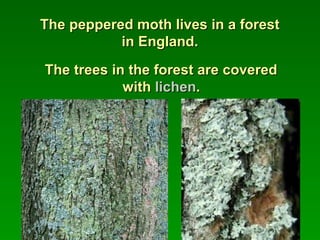
The peppered moth lives in a forestThe peppered moth lives in a forest
in England.in England.
The trees in the forest are coveredThe trees in the forest are covered
withwith lichenlichen..
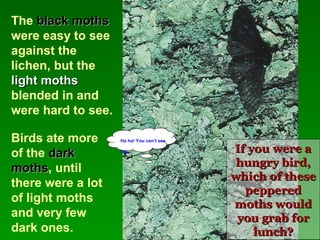
If you were aIf you were a
hungry bird,hungry bird,
which of thesewhich of these
pepperedpeppered
moths wouldmoths would
you grab foryou grab for
lunch?lunch?
The black mothsblack moths
were easy to see
against the
lichen, but the
light mothslight moths
blended in and
were hard to see.
Birds ate more
of the darkdark
mothsmoths, until
there were a lot
of light moths
and very few
dark ones.
Ha ha! You can’t see
me…
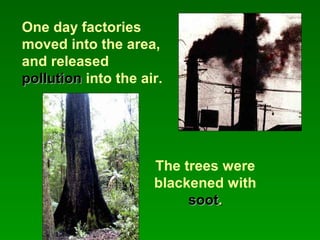
One day factories
moved into the area,
and released
pollutionpollution into the air.
The trees were
blackened with
sootsoot..
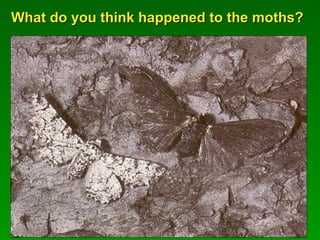
What do you think happened to the moths?What do you think happened to the moths?
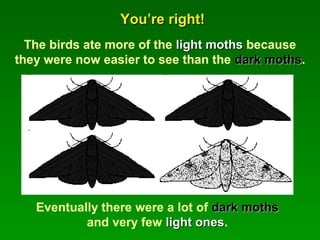
You’re right!You’re right!
The birds ate more of the light mothslight moths because
they were now easier to see than the dark mothsdark moths.
Eventually there were a lot of dark mothsdark moths
and very few light oneslight ones.
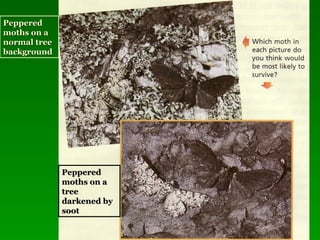
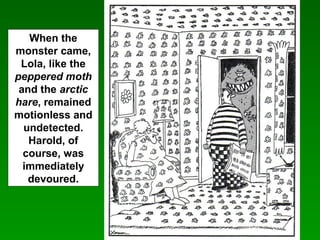
PepperedPeppered
moths on amoths on a
normal treenormal tree
backgroundbackground
PepperedPeppered
moths on amoths on a
treetree
darkened bydarkened by
sootsoot
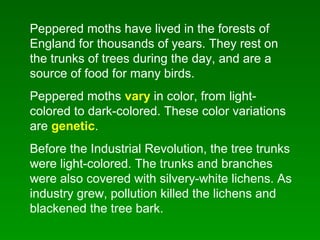
When the
monster came,
Lola, like the
peppered moth
and the arctic
hare, remained
motionless and
undetected.
Harold, of
course, was
immediately
devoured.
Peppered moths have lived in the forests of
England for thousands of years. They rest on
the trunks of trees during the day, and are a
source of food for many birds.
Peppered moths vary in color, from light-
colored to dark-colored. These color variations
are genetic.
Before the Industrial Revolution, the tree trunks
were light-colored. The trunks and branches
were also covered with silvery-white lichens. As
industry grew, pollution killed the lichens and
blackened the tree bark.
In the 1950s, Oxford University professor H.B.D.
Kettlewell and his students performed an
experiment. They released the same number of
light and dark-colored moths in two areas. One
was an unpolluted area that had lichen-coveredunpolluted area that had lichen-covered
oak treesoak trees;; the other was a wooded area that hadwooded area that had
experienced pollution for many yearsexperienced pollution for many years.
After a certain amount of time, they recaptured as
many moths as they could, and counted them.
What do you think the results of the experiment
were?
You’re right!
In the unpollutedunpolluted area (light-colored treelight-colored tree
trunkstrunks), moremore light-colored mothslight-colored moths
survivedsurvived.
In the polluted area (polluted area (dark-colored treedark-colored tree
trunkstrunks), moremore dark-colored mothsdark-colored moths
survivedsurvived.
How does this experiment show the
process of natural selectionnatural selection?
Note that this example illustrates Darwin's fourDarwin's four
points:points:
• moth eggs are over-produced;over-produced; many moths
will not survive to reproduce.
• there is variationvariation among individuals -- some
are black in color, others are light gray
• the variation is geneticgenetic –black moths have
different alleles for color than do gray moths
• the different colors differ in advantageadvantage-- in
industrial environments, black moths survive
to reproduce better than gray moths do. In
unpolluted environments, the opposite is true.

Peppered moth

  • 1.
    The Peppered MothThePeppered Moth The "typica" form of the moth (light-colored) The "The "carbonariacarbonaria"" form (dark-colored)form (dark-colored) The Peppered Moth has 2 variationsvariations: light graylight gray and dark graydark gray.
  • 2.
    The peppered mothlives in a forestThe peppered moth lives in a forest in England.in England. The trees in the forest are coveredThe trees in the forest are covered withwith lichenlichen..
  • 3.
    If you wereaIf you were a hungry bird,hungry bird, which of thesewhich of these pepperedpeppered moths wouldmoths would you grab foryou grab for lunch?lunch? The black mothsblack moths were easy to see against the lichen, but the light mothslight moths blended in and were hard to see. Birds ate more of the darkdark mothsmoths, until there were a lot of light moths and very few dark ones. Ha ha! You can’t see me…
  • 5.
    One day factories movedinto the area, and released pollutionpollution into the air. The trees were blackened with sootsoot..
  • 6.
    What do youthink happened to the moths?What do you think happened to the moths?
  • 7.
    You’re right!You’re right! Thebirds ate more of the light mothslight moths because they were now easier to see than the dark mothsdark moths. Eventually there were a lot of dark mothsdark moths and very few light oneslight ones.
  • 8.
    PepperedPeppered moths on amothson a normal treenormal tree backgroundbackground PepperedPeppered moths on amoths on a treetree darkened bydarkened by sootsoot
  • 9.
    When the monster came, Lola,like the peppered moth and the arctic hare, remained motionless and undetected. Harold, of course, was immediately devoured.
  • 10.
    Peppered moths havelived in the forests of England for thousands of years. They rest on the trunks of trees during the day, and are a source of food for many birds. Peppered moths vary in color, from light- colored to dark-colored. These color variations are genetic. Before the Industrial Revolution, the tree trunks were light-colored. The trunks and branches were also covered with silvery-white lichens. As industry grew, pollution killed the lichens and blackened the tree bark.
  • 11.
    In the 1950s,Oxford University professor H.B.D. Kettlewell and his students performed an experiment. They released the same number of light and dark-colored moths in two areas. One was an unpolluted area that had lichen-coveredunpolluted area that had lichen-covered oak treesoak trees;; the other was a wooded area that hadwooded area that had experienced pollution for many yearsexperienced pollution for many years. After a certain amount of time, they recaptured as many moths as they could, and counted them. What do you think the results of the experiment were?
  • 12.
    You’re right! In theunpollutedunpolluted area (light-colored treelight-colored tree trunkstrunks), moremore light-colored mothslight-colored moths survivedsurvived. In the polluted area (polluted area (dark-colored treedark-colored tree trunkstrunks), moremore dark-colored mothsdark-colored moths survivedsurvived. How does this experiment show the process of natural selectionnatural selection?
  • 13.
    Note that thisexample illustrates Darwin's fourDarwin's four points:points: • moth eggs are over-produced;over-produced; many moths will not survive to reproduce. • there is variationvariation among individuals -- some are black in color, others are light gray • the variation is geneticgenetic –black moths have different alleles for color than do gray moths • the different colors differ in advantageadvantage-- in industrial environments, black moths survive to reproduce better than gray moths do. In unpolluted environments, the opposite is true.