Evidence-Based Prognostication April 2010 Christian Sinclair, MD
Contributors Michelle Affield, MD Fellow, Univ of Kansas – Hem/Onc FellowKansas City Hospice & Palliative Care, Kansas City, MO Michael Salacz, MD Saint Luke’s Hospital, Kansas City, MO Assistant Professor, University of Missouri, Kansas City, MO msalacz@saint-lukes.org  Christian Sinclair, MD Assoc Fellowship Director & Assoc. Med. Dir., Kansas City Hospice & Palliative Care, KC, MO Medical Director, Palliative Care Team, Providence Medical Center, Kansas City, KS [email_address]
Prognosis Links www.pallimed.org http://www.pallimed.org/2007/05/prognosis-links.html
Overview Define the benefits and limitations of open frequent prognostication Understand theories for accurate formulation of prognostication Apply prognostic information to clinical scenarios Discover tools for more accurate prognostication
Medical Triad Diagnosis Prognosis Therapy
A prognosis is an estimation of possible future outcomes of a treatment or a disease process…
What is Prognostication? It is not… Fortune Telling Playing God Precognition Divination
… founded upon a combination of personal experience, statistics, and validated models
Medical Prognostication Role for prognostication Clinical implications Relationship implications Symbolic implications Contextual issues Administrative issues Cost-benefit analysis Futility/bioethics Christakis, Death Foretold Christakis  Death Foretold  1999 Ethics Policy Research Academics Clinical Prognosis
Two Parts to Prognostication Formulation (Foreseeing) Anticipated vs. true Communication (Foretelling) Compassionate To the patient As much as they want to hear Many articles about “Breaking bad news”
Theory for Prognostic Model Clinical Findings Individual Prognosis General Prognosis Diagnosis Pathological Findings Psychosocial Factors Co-morbidities Therapy Adapted from Vigano 2000
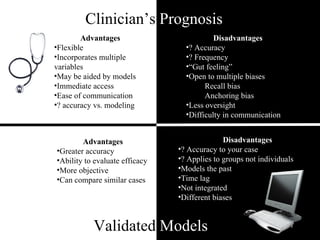
Print separately with above Advantages Flexible Incorporates multiple variables May be aided by models Immediate access Ease of communication ? accuracy vs. modeling Clinician’s  Prognosis Validated  Models Disadvantages ? Accuracy ? Frequency “ Gut feeling” Open to multiple biases Recall bias Anchoring bias Less oversight Difficulty in communication Advantages Greater accuracy Ability to evaluate efficacy More objective Can compare similar cases Disadvantages ? Accuracy to your case ? Applies to groups not individuals Models the past Time lag Not integrated Different biases
Error Is the error random? Does a measurable bias exist? In what direction does a bias exist? What is the magnitude of the error? Few studies MD’s are frequently and largely inaccurate But lack describing a source of the error
Life Expectancy - 1900 47.3 years (both sexes, all races) Caucasian:   All Male Female 47.6 46.6  48.7 African-American: All Male Female 33.0 32.5 33.5 National Center for Health Statistics
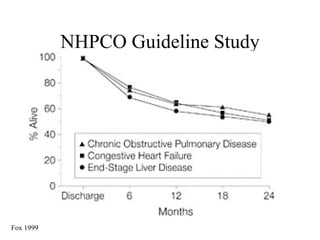
NHPCO Guideline Study Fox 1999
NHPCO Guideline Study Fox 1999 Narrow Inclusion Criteria, n=19 Broad Inclusion Criteria, n=923 Intermediate Inclusion Criteria, n=300 Survived to Hospital Discharge, n=2607
Comparison of SUPPORT and MD survival estimates
General Findings Repeated estimates may be more accurate Possibly more accurate as death is near Clinician experience may increase accuracy Discipline/specialty may not matter Second opinion effect
Prognostic Scales/Tools Palliative Prognostic (PaP) Score Palliative Performance Scale Palliative Prognostic Index Terminal Cancer Prognostic Score Poor Prognostic Indicator Charlson Co-morbidity Index
Palliative Prognostic Score Developed in Italy Validated in cancer patients Outpatient and inpatient Used for short-term survival Pirovano 1999
Palliative Prognostic Score Pirovano 1999, Glare 2004
Palliative Performance Scale Quick classification for functional status Based off Karnofsky Used widely in the Hospice & Palliative Care literature/field
Image from  http://www.victoriahospice.org/pdfs/PPSv2.pdf
PPS in Heterogeneous Population Harold 2005
PPS in Heterogeneous Population Harold 2005 Cancer = Black Non-Cancer = Gray
PPS in Prognostication Lau 2006 PPS Mean Median Range 60 64 40 6-348 50 51 27 1-287 40 36 17 1-347 30 18 9 1-295 20 6 2 1-81 10 2 1 1-12
Palliative Prognostic Index Morita 2001
Terminal Cancer Prognostic (TCP) Yun 2001
The Future of Prognostication Seattle Heart Failure Model Adjuvant Online HD Mortality Predictor Perception of prognostication as a skill
PubMed MESH Search with Limits: English, Human, Core Clinical Journals (Jan 2008) Therapy Diagnosis Prognosis
http://depts.washington.edu/shfm/index.php
www.adjuvantonline.com
REFERENCE:Cohen et al. Predicting Six-Month Mortality for Patients who are on Maintenance Hemodialysis Clin J Am Soc Nephrol. 2009 Dec 3
 
 
Conclusions Physicians have a duty to prognosticate Accurately, openly, dynamically Prognostication can be scientifically based Tools exist to aid clinical prognostication Prognostication is a skill that can be honed
Mortality In Liver Disease Mortality thoroughly studied Organ allocation for liver transplant According to “sickest first” Not location Not waiting times
MELD Score M odel for  E nd stage  L iver  D isease 3 factors Bilirubin INR Creatinine 10  { 0.957 Ln(Scr) + 0.378 Ln(Tbil) + 1.12 Ln(INR) + 0.643 } Online calculator (Mayo Clinic)
 
Three Month Mortality in Hospitalized Patients MELD Score </= 9 10-19 20-29 20-39 >/= 40 Death Rate 4% 27% 76% 83% 100% Kamath 2001
Additional Prognostic Factors Low serum sodium ( MELD-Na )    ability to predict 3 & 6 month mortality Na <126 independent predictor of wait-list mortality Biggins 2005, Ruf 2005
Prognostic Factors in Lung Cancer Staging Performance status Weight loss Gender Tumor histology small cell associated with severe disease and debility Suppressor oncogene mutations – p53 Oncogene overexpression – c-myc, K-ras, erb-B2 NCCN Guidelines 2006
Prognosis in Lung Cancer Only 15% of all lung cancer patients are alive 5 years after diagnosis NCCN Guidelines 2006
5-Year Survival Non-Small Cell Lung Cancer Stage IA 67% Stage IB 57% Stage IIA 55% Stage IIB 38-39% Stage IIIA 23-25% Stage IIIB 3-7% Stage IV 1% NCCN Guidelines 2006
Survival In  Small Cell Lung Cancer Limited Stage Median Survival 15-18 months 2-Year Survival 30-40% 5-Year Survival 10-15% Extensive Stage Median Survival 9-10 months 2-Year Survival < 10% 5-Year Survival  rarely reported Jahan 2002
Malignant Pleural Effusion Indicative of poor prognosis Especially poor if secondary to: GI, lung, or ovarian Survival Average Range  3-6 months Median  4 months 65% mortality in 3 months 80% mortality in 6 months Sahn 2001
Glioma (Astrocytoma) Survival Glioblastoma = 50% of all gliomas Tumor Type 5-Yr (%) 10-Yr (%) Median (y) Pliocytic (1) 91 89 Diffuse (2) 47 39 5 Anaplastic (3) 29 22 2-3 Glioblastoma (4) 3 2 1
Results EORTC Greek RT RT+TMZ RT RT+TMZ Median Survival 12.1m 14.6m 7.7m 13.4m % 12m Survival 50% 61% 16% 56% % 18m Survival 21% 39% 5% 25%
Median Survival Class III 17 months 32% at 2 yr Class IV 15 months  19% at 2 yr Class V 10 months 11% at 2 yr Mirimanoff 2006
Brain Metastases Survival Treatment Survival No primary treatment 1 month Steroids 2-3 months Whole Brian Radiation 3-6 months Surgery/SRS 6-12 months
Brain Mets Prognosis Median Survival Group 1 7.1 months Group 2 4.2 months Group 3 2.3 months Gaspar 1997
Prostate Cancer Gleason Score PSA Level American Cancer Society, www.cancerresearch.uk Stage Description 5-Yr Survival 1 Small local 98% 2 Large local 65% 3 Outside prostate 60% 4 Bladder, bone or LN 30% (mean 2y)
5-Year Cancer Survival Rates ACS 2007 Guidelines   All Stages Local Reg Distant   % % % % Breast 89 98 83 26 Colon 64 90 68 10 Esophagus 16 34 17 3 Kidney 66 90 62 10 Larynx 64 84 50 14 Liver 11 22 7 3 Lung 15 49 16 2 Melanoma 92 99 65 15 Oropharynx 59 81 52 26   All Stages Local Reg Distant   % % % % Ovary 45 93 69 30 Pancreas 5 20 8 2 Prostate 99.9 100 -- 33 Stomach 24 62 22 3 Testis 96 99.5 96 70 Thyroid 97 99.7 97 56 Bladder 81 94 46 6 Cervix 72 92 56 15 Uterine 83 96 67 23
Amyotrophic Lateral Sclerosis NHPCO guidelines available (not validated) Event based decline model Loss of Ambulation Lower vital capacity = vent support Older age = higher mortality Bulbar signs = higher mortality Median time (Dx->death) = 20 months Zoccolella, S et al. 2008
Amyotrophic Lateral Sclerosis Median survival from first symptoms 28 months Median survival from ALS diagnosis 16 months 4-year survival rate 30% No validated prognostic tools Zoccolella, S et al. 2008
Trauma Multiple prognostic tools Traumatic Brain Injury – Online http://www.crash2.lshtm.ac.uk/Risk%20calculator/index.html Risk of 14 d mortality and unfavorable 6 month outcome Based on: Country Age GCS Pupils Extracranial injury CT Scan findings MRC CRASH Trial Collaborators, 2008
Predicting Death From Debility No easy method International Classification of Functioning, Disability and Health Body Functions & Structures Activities and Participation Environmental Factors Personal Factors Palliative Performance Scale Kinzbrunner 1996
Congestive Heart Failure 2 Prognostic Tools available EFFECT Seattle Heart Failure Model NHPCO Criteria Available Event based prediction models Sudden death/arrythmias confound most predictions
Predicting Outcome From Hypoxic-Ischemic Coma First comprehensive multivariate approach Newly constructed, empirically derived guidelines  First few days after a cardiac arrest or similar global hypoxic-ischemic insult Good vs. poor outcome Levy 1985
Signs Related to  ±  Recovery 0/52 patients initially lacking pupillary reflex ever became independent At 3 days absent or posturing motor responses were incompatible with future independence At initial exam most favorable sign - incomprehensible speech Levy 1985
Hypoxic-Ischemic Coma At day 1: Confused or inappropriate speech Orienting spontaneous eye movements Normal OC or OV responses Obedience to commands Each of the above associated with at least 50% chance of gaining independence Levy 1985
Variables Predicting Poor Outcome  100% specific in all studies (no good outcome if factors were present) Absence of pupillary light reflex on the day 3 Absence of motor response to pain on the day 3 Bilateral absence of cortical response to median nerve SSEP (somatosensory evoked potential) < 1 week One variable was 100% specific in 5/6 studies Burst-suppression or iso-electric pattern on EEG within the first week Zandbergen 1998
Cardiac Arrest  As Cause of Coma Survival for pre-hospital cardiac arrest 2 to 33% Survival for inpatient cardiac arrest 0 to 29% Meaningful neurological recovery 10-30% Booth 2004
Hypoxic-Ischemic Coma Post-Cardiac Arrest 11 studies  1914 patients Determine precision and accuracy of the clinical exam  Poor neurological outcome was 77% Booth 2004
Hypoxic-Ischemic Coma Post-Cardiac Arrest  No clinical findings Strongly predicted good neurological outcome No pupillary or corneal reflex at 24 hours and no motor response at 72 hours extremely small chance of neurologic recovery No clinical signs immediately after cardiac arrest accurately predicted outcome Booth 2004
Poor Prognostic Factors In Severe Stroke Most powerful predictors of death and poor outcome Persistent coma Absent pupillary or corneal reflexes at day 2 or 3 Further variables associated with poor outcome Co-morbidities Midline shift Fever Poor outcome specifically in hemorrhagic stroke Volume of blood and intraventricular hemorrhage Hydrocephalus Hypertension Holloway 2005
Favorable Prognostic Factors  In Severe Stroke  More favorable outcome (both types) Intubation for seizure or pulmonary reason Younger age Minimal co-morbidities Spouse at home Early neurological recovery Lower body temp Holloway 2005
PEG Tube In patients with stroke who required PEG tube 6 month mortality is nearly 50% Mortality increases to 80% by 3 years 78% who survived to 6 months had severe disability Holloway 2005
Tracheostomy Of patients who required tracheostomy and survived 1 year: 18% had minimal or no disability 26% had moderate disability 56% had severe disability Holloway 2005
Stroke Syndromes Associated With Poor Outcome Higher mortality Pontine hemorrhage with hyperthermia Basilar artery occlusion with coma and apnea Severe disability Large MCA infarcts Pontine strokes resulting in locked-in syndrome Holloway 2005
Dementia No statistical correlation: Between guidelines or components and 6 month survival Statistically significant: Greater age Greater functional impairment Anorexia Schonwetter 2003, Mitchell 2004
Dementia – MDS-12 ADL > 28 = 1.9 Male =1.9 Cancer = 1.7 O 2 in last 14d = 1.6 CHF =1.6 SOA = 1.5 Total score = 0-19 <25% meals = 1.5 Unstable med cond = 1.5 Bowel incont = 1.5 Bedfast = 1.5 83yo+ = 1.4 Asleep >50% = 1.4 Mitchell 2004
Dementia - MDS-12 AUROC for >6 (0.64) was better than FAST 7c (0.51) Mitchell 2004 Total Risk Score Mortality Estimate @ 6m 0 9% 1-2 10% 3-5 23% 6-8 40% 9-11 57% >12 70%
Delirium 109/393 (28%) palliative care patients Confusion Assessment Method (CAM) Median survival (95%CI) Delirium – 21d (16-27) No Delirium – 39d (33-49) 70% accuracy for 30d survival Delirium + PaP Caraceni 2000
ICU Admission With COPD COPD 61% required invasive mechanical ventilation Expected hospital mortality – 30% Actual hospital mortality – 15% APACHE-II and # of organ failures Independent predictors of hospital outcome Afessa 2002
Mechanical Ventilation 902 ICU Vent patients Young vs. old (70y cut-off) 28d survival rate < 70yo – 75% >70 yo – 50% Ely 2002
Delirium & Ventilation Mechanical ventilation Higher 6-month mortality rates 34% vs. 15%, P =.03 Spent 10 days longer in the hospital (P<.001)  Ely 2004
Ventilator Withdrawal 75 heterogeneous ventilated patients Median survival (range) 35 min (1-890min) Average meds 16 mg/h opioid 7.5 mg/h benzodiazepine Every 1mg increase in benzo… 13 min longer survival (p=0.015) Chan 2004
Tracheostomy 521 patients in ICU requiring mech vent 51 (10%) received trach Mortality less with trach 14% vs. 27% (p=0.48) Longer vent and hospitalization 44 survivors of hospital 86% alive 30d post hospital Kollef 1999
Chronic Kidney Disease Stage 5 (<15mL/min) 1 year survival – 80% (>65y = 65%) 2 year survival – 65% 5 year survival – 38% Multiple independent predictors Albumin Functional status Beddhu 2000
Acute Renal Failure/HD Withdrawal In the ICU Mortality 50-65% Septic Mortality – 75% Bone Marrow Transplant Mortality – 85% Range 1-20d Mean 8d Cohen 2006
Artificial Nutrition & Hydration Improved survival PVS Extreme short-bowel syndrome Bulbar amyotrophic lateral sclerosis. Acute phase of a stroke or head injury  Patients receiving short-term critical care Observational data lacking on survival after W/D of artificial nutrition and/or hydration Casarett 2005
Opioid Use National Hospice Outcomes Project PoPCRN coordinated study 13 hospices, 1300+ patients Significant association with shorter survival: Higher opioid dose Cancer diagnosis Unresponsiveness Pain of <5 on a 0-10 scale  Portenoy 2006
Opioid Use But…. None of them explained more than 10% of the variation Portenoy 2006
Recommended Readings Death Foretold: Prophecy and Prognosis in Medical Care  by Nicholas A. Christakis The Terminal Phase, Chapter 18.  Oxford Textbook of Palliative Medicine , 3 rd  ed.  2004 Predicting survival in patients with advanced disease, Chapter 2.4.  Oxford Textbook of Palliative Medicine , 3 rd  ed.  2004 Storm Watchers  by John D. Cox Stone P, Lund S.  Predicting prognosis in patietns with advanced cancer . Ann Oncol 2006.
References Vigano A, Dorgan M, Buckingham J, Bruera E, Suarez-Almazor ME. Survival prediction in terminal cancer patients: a systematic review of the medical literature.  Palliat Med.  Sep 2000;14(5):363-374. Christakis N.  Death Foretold: Prophecy and Prognosis in Medical Care . Chicago: University of Chicago Press; 1999. Parkes CM. Accuracy of predictions of survival in later stages of cancer.  Br Med J.  Apr 1 1972;2(5804):29-31. Christakis NA, Lamont EB. Extent and determinants of error in doctors' prognoses in terminally ill patients: prospective cohort study.  Bmj.  Feb 19 2000;320(7233):469-472. Detsky AS, Stricker SC, Mulley AG, Thibault GE. Prognosis, survival, and the expenditure of hospital resources for patients in an intensive-care unit.  N Engl J Med.  Sep 17 1981;305(12):667-672. Glare P, Virik K, Jones M, et al. A systematic review of physicians' survival predictions in terminally ill cancer patients.  Bmj.  Jul 26 2003;327(7408):195.
References Fox E, Landrum-McNiff K, Zhong Z, Dawson NV, Wu AW, Lynn J. Evaluation of prognostic criteria for determining hospice eligibility in patients with advanced lung, heart, or liver disease. SUPPORT Investigators. Study to Understand Prognoses and Preferences for Outcomes and Risks of Treatments.  Jama.  Nov 3 1999;282(17):1638-1645. Kamath PS, Wiesner RH, Malinchoc M, et al. A model to predict survival in patients with end-stage liver disease.  Hepatology.  Feb 2001;33(2):464-470. Heuman DM, Abou-Assi SG, Habib A, et al. Persistent ascites and low serum sodium identify patients with cirrhosis and low MELD scores who are at high risk for early death.  Hepatology.  Oct 2004;40(4):802-810. Biggins SW, Rodriguez HJ, Bacchetti P, Bass NM, Roberts JP, Terrault NA. Serum sodium predicts mortality in patients listed for liver transplantation.  Hepatology.  Jan 2005;41(1):32-39. Ruf AE, Kremers WK, Chavez LL, Descalzi VI, Podesta LG, Villamil FG. Addition of serum sodium into the MELD score predicts waiting list mortality better than MELD alone.  Liver Transpl.  Mar 2005;11(3):336-343. Cardenas A. Hepatorenal syndrome: a dreaded complication of end-stage liver disease.  Am J Gastroenterol.  Feb 2005;100(2):460-467.
References Medical Guidelines for Determining Prognosis in Selected Non Cancer Diseases : National Hospice and Palliative Care Organization; 1996. National Comprehensive Cancer Network. NCCN Guidelines; 2006. Jahan T. Small Cell Lung Cancer.  http://www.cancersupportivecare.com/smallcell.html . Accessed February 01, 2007, 2007. Sahn SA. Malignant pleural effusions.  Semin Respir Crit Care Med.  Dec 2001;22(6):607-616. Zoccolella, S et al. for the SLAP Registry. Analysis of survival and prognostic factors in amyotrophic lateral sclerosis: a population based study.  J Neurol Neurosurg Psychiatry . Volume 79(1), January 2008, pp 33-7.
References MRC CRASH Trial Collaborators. Predicting outcome after traumatic brain injury: practical prognostic models based on large cohort of international patients.  BMJ . 2008 February 23; 336(7641): 425–429.  Kinzbrunner BM, Weinreb NJ, Merriman MP. Debility, unspecified: a terminal diagnosis.  Am J Hosp Palliat Care.  1996 Nov-Dec;13(6):38-44. Levy DE, Caronna JJ, Singer BH, Lapinski RH, Frydman H, Plum F. Predicting outcome from hypoxic-ischemic coma.  Jama.  Mar 8 1985;253(10):1420-1426. Zandbergen EG, de Haan RJ, Stoutenbeek CP, Koelman JH, Hijdra A. Systematic review of early prediction of poor outcome in anoxic-ischaemic coma.  Lancet.  Dec 5 1998;352(9143):1808-1812. Booth CM, Boone RH, Tomlinson G, Detsky AS. Is this patient dead, vegetative, or severely neurologically impaired? Assessing outcome for comatose survivors of cardiac arrest.  Jama.  Feb 18 2004;291(7):870-879.
References Zandbergen EG, Hijdra A, Koelman JH, et al. Prediction of poor outcome within the first 3 days of postanoxic coma.  Neurology.  Jan 10 2006;66(1):62-68. Holloway RG, Benesch CG, Burgin WS, Zentner JB. Prognosis and decision making in severe stroke.  Jama.  Aug 10 2005;294(6):725-733. Schonwetter RS, Han B, Small BJ, Martin B, Tope K, Haley WE. Predictors of six-month survival among patients with dementia: an evaluation of hospice Medicare guidelines.  Am J Hosp Palliat Care.  Mar-Apr 2003;20(2):105-113. Mitchell SL, Kiely DK, Hamel MB, Park PS, Morris JN, Fries BE. Estimating prognosis for nursing home residents with advanced dementia.  Jama.  Jun 9 2004;291(22):2734-2740. Caraceni A, Nanni O, Maltoni M, et al. Impact of delirium on the short term prognosis of advanced cancer patients. Italian Multicenter Study Group on Palliative Care. Cancer. Sep 1 2000;89(5):1145-1149. Afessa B, Morales IJ, Scanlon PD, Peters SG. Prognostic factors, clinical course, and hospital outcome of patients with chronic obstructive pulmonary disease admitted to an intensive care unit for acute respiratory failure. Crit Care Med. Jul 2002;30(7):1610-1615.
References Stupp R et al.  Radiotherapy plus concomitant and adjuvant temozolomide for glioblastoma. N Engl J Med. 2005 Mar 10;352(10):987-96.  Athanassiou H et al.  Randomized phase II study of temozolomide and radiotherapy compared with radiotherapy alone in newly diagnosed glioblastoma multiforme.J Clin Oncol. 2005 Apr 1;23(10):2372-7. Mirimanoff RO et al. Radiotherapy and temozolomide for newly diagnosed glioblastoma: recursive partitioning analysis of the EORTC 26981/22981-NCIC CE3 phase III randomized trial. J Clin Oncol. 2006 Jun 1;24(16):2563-9.  Gaspar L et al.  Recursive partitioning analysis (RPA) of prognostic factors in three Radiation Therapy Oncology Group (RTOG) brain metastases trials. Int J Radiat Oncol Biol Phys. 1997 Mar 1;37(4):745-51.
References Ely EW, Shintani A, Truman B, et al. Delirium as a predictor of mortality in mechanically ventilated patients in the intensive care unit.  Jama.  Apr 14 2004;291(14):1753-1762. Beddhu S, Bruns FJ, Saul M, Seddon P, Zeidel ML. A simple comorbidity scale predicts clinical outcomes and costs in dialysis patients.  Am J Med.  Jun 1 2000;108(8):609-613. Chan JD, Treece PD, Engelberg RA, et al. Narcotic and benzodiazepine use after withdrawal of life support: association with time to death?  Chest.  Jul 2004;126(1):286-293. Kollef MH, Ahrens TS, Shannon W. Clinical predictors and outcomes for patients requiring tracheostomy in the intensive care unit.  Crit Care Med.  Sep 1999;27(9):1714-1720. Cohen LM, Moss AH, Weisbord SD, Germain MJ. Renal palliative care.  J Palliat Med.  Aug 2006;9(4):977-992. Casarett D, Kapo J, Caplan A. Appropriate use of artificial nutrition and hydration--fundamental principles and recommendations.  N Engl J Med.  Dec 15 2005;353(24):2607-2612.
References Portenoy RK, Sibirceva U, Smout R, et al. Opioid use and survival at the end of life: a survey of a hospice population.  J Pain Symptom Manage.  Dec 2006;32(6):532-540. Kohara H, Ueoka H, Takeyama H, Murakami T, Morita T. Sedation for terminally ill patients with cancer with uncontrollable physical distress.  J Palliat Med.  Feb 2005;8(1):20-25. Pirovano M, Maltoni M, Nanni O, et al. A new palliative prognostic score: a first step for the staging of terminally ill cancer patients. Italian Multicenter and Study Group on Palliative Care.  J Pain Symptom Manage.  Apr 1999;17(4):231-239. Ely EW, Wheeler AP, Thompson BT, Ancukiewicz M, Steinberg KP, Bernard GR. Recovery rate and prognosis in older persons who develop acute lung injury and the acute respiratory distress syndrome.  Ann Intern Med.  Jan 1 2002;136(1):25-36. Glare PA, Eychmueller S, McMahon P. Diagnostic accuracy of the palliative prognostic score in hospitalized patients with advanced cancer. J Clin Oncol. Dec 1 2004;22(23):4823-4828.
References Virik K, Glare P. Validation of the palliative performance scale for inpatients admitted to a palliative care unit in Sydney, Australia. J Pain Symptom Manage. Jun 2002;23(6):455-457. Anderson F, Downing GM, Hill J, Casorso L, Lerch N. Palliative performance scale (PPS): a new tool. J Palliat Care. Spring 1996;12(1):5-11. Morita T, Tsunoda J, Inoue S, Chihara S. Validity of the palliative performance scale from a survival perspective. J Pain Symptom Manage. Jul 1999;18(1):2-3. Harrold J, Rickerson E, Carroll JT, et al. Is the palliative performance scale a useful predictor of mortality in a heterogeneous hospice population? J Palliat Med. Jun 2005;8(3):503-509.  Lau F, Downing GM, Lesperance M, Shaw J, Kuziemsky C. Use of Palliative Performance Scale in end-of-life prognostication.  J Palliat Med.  Oct 2006;9(5):1066-1075. Morita T, Tsunoda J, Inoue S, Chihara S. Improved accuracy of physicians' survival prediction for terminally ill cancer patients using the Palliative Prognostic Index.  Palliat Med.  Sep 2001;15(5):419-424.
References Yun YH, Heo DS, Heo BY, Yoo TW, Bae JM, Ahn SH. Development of terminal cancer prognostic score as an index in terminally ill cancer patients.  Oncol Rep.  Jul-Aug 2001;8(4):795-800. Lichter I, Hunt E. The last 48 hours of life.  J Palliat Care.  Winter 1990;6(4):7-15. Nauck F. Symptom control during the last three days of life.  European Journal of Palliative Care.  2001;10:81-84. Conill C. Symptom prevalence in the last week of life.  Journal of Pain and Symptom Management.  1997;21:12-17.   Grond S, Zech D, Schug SA, Lynch J, Lehmann KA. Validation of World Health Organization guidelines for cancer pain relief during the last days and hours of life.  J Pain Symptom Manage.  Oct 1991;6(7):411-422. Ellershaw J, Smith C, Overill S, Walker SE, Aldridge J. Care of the dying: setting standards for symptom control in the last 48 hours of life.  J Pain Symptom Manage.  Jan 2001;21(1):12-17. Fainsinger R, Miller MJ, Bruera E, Hanson J, Maceachern T. Symptom control during the last week of life on a palliative care unit.  J Palliat Care.  Spring 1991;7(1):5-11.

Evidence Based Prognostication Peoria 2010 (1)

  • 1.
    Evidence-Based Prognostication April2010 Christian Sinclair, MD
  • 2.
    Contributors Michelle Affield,MD Fellow, Univ of Kansas – Hem/Onc FellowKansas City Hospice & Palliative Care, Kansas City, MO Michael Salacz, MD Saint Luke’s Hospital, Kansas City, MO Assistant Professor, University of Missouri, Kansas City, MO msalacz@saint-lukes.org Christian Sinclair, MD Assoc Fellowship Director & Assoc. Med. Dir., Kansas City Hospice & Palliative Care, KC, MO Medical Director, Palliative Care Team, Providence Medical Center, Kansas City, KS [email_address]
  • 3.
    Prognosis Links www.pallimed.orghttp://www.pallimed.org/2007/05/prognosis-links.html
  • 4.
    Overview Define thebenefits and limitations of open frequent prognostication Understand theories for accurate formulation of prognostication Apply prognostic information to clinical scenarios Discover tools for more accurate prognostication
  • 5.
    Medical Triad DiagnosisPrognosis Therapy
  • 6.
    A prognosis isan estimation of possible future outcomes of a treatment or a disease process…
  • 7.
    What is Prognostication?It is not… Fortune Telling Playing God Precognition Divination
  • 8.
    … founded upona combination of personal experience, statistics, and validated models
  • 9.
    Medical Prognostication Rolefor prognostication Clinical implications Relationship implications Symbolic implications Contextual issues Administrative issues Cost-benefit analysis Futility/bioethics Christakis, Death Foretold Christakis Death Foretold 1999 Ethics Policy Research Academics Clinical Prognosis
  • 10.
    Two Parts toPrognostication Formulation (Foreseeing) Anticipated vs. true Communication (Foretelling) Compassionate To the patient As much as they want to hear Many articles about “Breaking bad news”
  • 11.
    Theory for PrognosticModel Clinical Findings Individual Prognosis General Prognosis Diagnosis Pathological Findings Psychosocial Factors Co-morbidities Therapy Adapted from Vigano 2000
  • 12.
    Print separately withabove Advantages Flexible Incorporates multiple variables May be aided by models Immediate access Ease of communication ? accuracy vs. modeling Clinician’s Prognosis Validated Models Disadvantages ? Accuracy ? Frequency “ Gut feeling” Open to multiple biases Recall bias Anchoring bias Less oversight Difficulty in communication Advantages Greater accuracy Ability to evaluate efficacy More objective Can compare similar cases Disadvantages ? Accuracy to your case ? Applies to groups not individuals Models the past Time lag Not integrated Different biases
  • 13.
    Error Is theerror random? Does a measurable bias exist? In what direction does a bias exist? What is the magnitude of the error? Few studies MD’s are frequently and largely inaccurate But lack describing a source of the error
  • 14.
    Life Expectancy -1900 47.3 years (both sexes, all races) Caucasian: All Male Female 47.6 46.6 48.7 African-American: All Male Female 33.0 32.5 33.5 National Center for Health Statistics
  • 15.
  • 16.
    NHPCO Guideline StudyFox 1999 Narrow Inclusion Criteria, n=19 Broad Inclusion Criteria, n=923 Intermediate Inclusion Criteria, n=300 Survived to Hospital Discharge, n=2607
  • 17.
    Comparison of SUPPORTand MD survival estimates
  • 18.
    General Findings Repeatedestimates may be more accurate Possibly more accurate as death is near Clinician experience may increase accuracy Discipline/specialty may not matter Second opinion effect
  • 19.
    Prognostic Scales/Tools PalliativePrognostic (PaP) Score Palliative Performance Scale Palliative Prognostic Index Terminal Cancer Prognostic Score Poor Prognostic Indicator Charlson Co-morbidity Index
  • 20.
    Palliative Prognostic ScoreDeveloped in Italy Validated in cancer patients Outpatient and inpatient Used for short-term survival Pirovano 1999
  • 21.
    Palliative Prognostic ScorePirovano 1999, Glare 2004
  • 22.
    Palliative Performance ScaleQuick classification for functional status Based off Karnofsky Used widely in the Hospice & Palliative Care literature/field
  • 23.
    Image from http://www.victoriahospice.org/pdfs/PPSv2.pdf
  • 24.
    PPS in HeterogeneousPopulation Harold 2005
  • 25.
    PPS in HeterogeneousPopulation Harold 2005
  • 26.
    PPS in HeterogeneousPopulation Harold 2005 Cancer = Black Non-Cancer = Gray
  • 27.
    PPS in PrognosticationLau 2006 PPS Mean Median Range 60 64 40 6-348 50 51 27 1-287 40 36 17 1-347 30 18 9 1-295 20 6 2 1-81 10 2 1 1-12
  • 28.
  • 29.
  • 30.
    The Future ofPrognostication Seattle Heart Failure Model Adjuvant Online HD Mortality Predictor Perception of prognostication as a skill
  • 31.
    PubMed MESH Searchwith Limits: English, Human, Core Clinical Journals (Jan 2008) Therapy Diagnosis Prognosis
  • 32.
  • 33.
  • 34.
    REFERENCE:Cohen et al.Predicting Six-Month Mortality for Patients who are on Maintenance Hemodialysis Clin J Am Soc Nephrol. 2009 Dec 3
  • 35.
  • 36.
  • 37.
    Conclusions Physicians havea duty to prognosticate Accurately, openly, dynamically Prognostication can be scientifically based Tools exist to aid clinical prognostication Prognostication is a skill that can be honed
  • 38.
    Mortality In LiverDisease Mortality thoroughly studied Organ allocation for liver transplant According to “sickest first” Not location Not waiting times
  • 39.
    MELD Score Model for E nd stage L iver D isease 3 factors Bilirubin INR Creatinine 10 { 0.957 Ln(Scr) + 0.378 Ln(Tbil) + 1.12 Ln(INR) + 0.643 } Online calculator (Mayo Clinic)
  • 40.
  • 41.
    Three Month Mortalityin Hospitalized Patients MELD Score </= 9 10-19 20-29 20-39 >/= 40 Death Rate 4% 27% 76% 83% 100% Kamath 2001
  • 42.
    Additional Prognostic FactorsLow serum sodium ( MELD-Na )  ability to predict 3 & 6 month mortality Na <126 independent predictor of wait-list mortality Biggins 2005, Ruf 2005
  • 43.
    Prognostic Factors inLung Cancer Staging Performance status Weight loss Gender Tumor histology small cell associated with severe disease and debility Suppressor oncogene mutations – p53 Oncogene overexpression – c-myc, K-ras, erb-B2 NCCN Guidelines 2006
  • 44.
    Prognosis in LungCancer Only 15% of all lung cancer patients are alive 5 years after diagnosis NCCN Guidelines 2006
  • 45.
    5-Year Survival Non-SmallCell Lung Cancer Stage IA 67% Stage IB 57% Stage IIA 55% Stage IIB 38-39% Stage IIIA 23-25% Stage IIIB 3-7% Stage IV 1% NCCN Guidelines 2006
  • 46.
    Survival In Small Cell Lung Cancer Limited Stage Median Survival 15-18 months 2-Year Survival 30-40% 5-Year Survival 10-15% Extensive Stage Median Survival 9-10 months 2-Year Survival < 10% 5-Year Survival rarely reported Jahan 2002
  • 47.
    Malignant Pleural EffusionIndicative of poor prognosis Especially poor if secondary to: GI, lung, or ovarian Survival Average Range 3-6 months Median 4 months 65% mortality in 3 months 80% mortality in 6 months Sahn 2001
  • 48.
    Glioma (Astrocytoma) SurvivalGlioblastoma = 50% of all gliomas Tumor Type 5-Yr (%) 10-Yr (%) Median (y) Pliocytic (1) 91 89 Diffuse (2) 47 39 5 Anaplastic (3) 29 22 2-3 Glioblastoma (4) 3 2 1
  • 49.
    Results EORTC GreekRT RT+TMZ RT RT+TMZ Median Survival 12.1m 14.6m 7.7m 13.4m % 12m Survival 50% 61% 16% 56% % 18m Survival 21% 39% 5% 25%
  • 50.
    Median Survival ClassIII 17 months 32% at 2 yr Class IV 15 months 19% at 2 yr Class V 10 months 11% at 2 yr Mirimanoff 2006
  • 51.
    Brain Metastases SurvivalTreatment Survival No primary treatment 1 month Steroids 2-3 months Whole Brian Radiation 3-6 months Surgery/SRS 6-12 months
  • 52.
    Brain Mets PrognosisMedian Survival Group 1 7.1 months Group 2 4.2 months Group 3 2.3 months Gaspar 1997
  • 53.
    Prostate Cancer GleasonScore PSA Level American Cancer Society, www.cancerresearch.uk Stage Description 5-Yr Survival 1 Small local 98% 2 Large local 65% 3 Outside prostate 60% 4 Bladder, bone or LN 30% (mean 2y)
  • 54.
    5-Year Cancer SurvivalRates ACS 2007 Guidelines   All Stages Local Reg Distant   % % % % Breast 89 98 83 26 Colon 64 90 68 10 Esophagus 16 34 17 3 Kidney 66 90 62 10 Larynx 64 84 50 14 Liver 11 22 7 3 Lung 15 49 16 2 Melanoma 92 99 65 15 Oropharynx 59 81 52 26   All Stages Local Reg Distant   % % % % Ovary 45 93 69 30 Pancreas 5 20 8 2 Prostate 99.9 100 -- 33 Stomach 24 62 22 3 Testis 96 99.5 96 70 Thyroid 97 99.7 97 56 Bladder 81 94 46 6 Cervix 72 92 56 15 Uterine 83 96 67 23
  • 55.
    Amyotrophic Lateral SclerosisNHPCO guidelines available (not validated) Event based decline model Loss of Ambulation Lower vital capacity = vent support Older age = higher mortality Bulbar signs = higher mortality Median time (Dx->death) = 20 months Zoccolella, S et al. 2008
  • 56.
    Amyotrophic Lateral SclerosisMedian survival from first symptoms 28 months Median survival from ALS diagnosis 16 months 4-year survival rate 30% No validated prognostic tools Zoccolella, S et al. 2008
  • 57.
    Trauma Multiple prognostictools Traumatic Brain Injury – Online http://www.crash2.lshtm.ac.uk/Risk%20calculator/index.html Risk of 14 d mortality and unfavorable 6 month outcome Based on: Country Age GCS Pupils Extracranial injury CT Scan findings MRC CRASH Trial Collaborators, 2008
  • 58.
    Predicting Death FromDebility No easy method International Classification of Functioning, Disability and Health Body Functions & Structures Activities and Participation Environmental Factors Personal Factors Palliative Performance Scale Kinzbrunner 1996
  • 59.
    Congestive Heart Failure2 Prognostic Tools available EFFECT Seattle Heart Failure Model NHPCO Criteria Available Event based prediction models Sudden death/arrythmias confound most predictions
  • 60.
    Predicting Outcome FromHypoxic-Ischemic Coma First comprehensive multivariate approach Newly constructed, empirically derived guidelines First few days after a cardiac arrest or similar global hypoxic-ischemic insult Good vs. poor outcome Levy 1985
  • 61.
    Signs Related to ± Recovery 0/52 patients initially lacking pupillary reflex ever became independent At 3 days absent or posturing motor responses were incompatible with future independence At initial exam most favorable sign - incomprehensible speech Levy 1985
  • 62.
    Hypoxic-Ischemic Coma Atday 1: Confused or inappropriate speech Orienting spontaneous eye movements Normal OC or OV responses Obedience to commands Each of the above associated with at least 50% chance of gaining independence Levy 1985
  • 63.
    Variables Predicting PoorOutcome 100% specific in all studies (no good outcome if factors were present) Absence of pupillary light reflex on the day 3 Absence of motor response to pain on the day 3 Bilateral absence of cortical response to median nerve SSEP (somatosensory evoked potential) < 1 week One variable was 100% specific in 5/6 studies Burst-suppression or iso-electric pattern on EEG within the first week Zandbergen 1998
  • 64.
    Cardiac Arrest As Cause of Coma Survival for pre-hospital cardiac arrest 2 to 33% Survival for inpatient cardiac arrest 0 to 29% Meaningful neurological recovery 10-30% Booth 2004
  • 65.
    Hypoxic-Ischemic Coma Post-CardiacArrest 11 studies 1914 patients Determine precision and accuracy of the clinical exam Poor neurological outcome was 77% Booth 2004
  • 66.
    Hypoxic-Ischemic Coma Post-CardiacArrest No clinical findings Strongly predicted good neurological outcome No pupillary or corneal reflex at 24 hours and no motor response at 72 hours extremely small chance of neurologic recovery No clinical signs immediately after cardiac arrest accurately predicted outcome Booth 2004
  • 67.
    Poor Prognostic FactorsIn Severe Stroke Most powerful predictors of death and poor outcome Persistent coma Absent pupillary or corneal reflexes at day 2 or 3 Further variables associated with poor outcome Co-morbidities Midline shift Fever Poor outcome specifically in hemorrhagic stroke Volume of blood and intraventricular hemorrhage Hydrocephalus Hypertension Holloway 2005
  • 68.
    Favorable Prognostic Factors In Severe Stroke More favorable outcome (both types) Intubation for seizure or pulmonary reason Younger age Minimal co-morbidities Spouse at home Early neurological recovery Lower body temp Holloway 2005
  • 69.
    PEG Tube Inpatients with stroke who required PEG tube 6 month mortality is nearly 50% Mortality increases to 80% by 3 years 78% who survived to 6 months had severe disability Holloway 2005
  • 70.
    Tracheostomy Of patientswho required tracheostomy and survived 1 year: 18% had minimal or no disability 26% had moderate disability 56% had severe disability Holloway 2005
  • 71.
    Stroke Syndromes AssociatedWith Poor Outcome Higher mortality Pontine hemorrhage with hyperthermia Basilar artery occlusion with coma and apnea Severe disability Large MCA infarcts Pontine strokes resulting in locked-in syndrome Holloway 2005
  • 72.
    Dementia No statisticalcorrelation: Between guidelines or components and 6 month survival Statistically significant: Greater age Greater functional impairment Anorexia Schonwetter 2003, Mitchell 2004
  • 73.
    Dementia – MDS-12ADL > 28 = 1.9 Male =1.9 Cancer = 1.7 O 2 in last 14d = 1.6 CHF =1.6 SOA = 1.5 Total score = 0-19 <25% meals = 1.5 Unstable med cond = 1.5 Bowel incont = 1.5 Bedfast = 1.5 83yo+ = 1.4 Asleep >50% = 1.4 Mitchell 2004
  • 74.
    Dementia - MDS-12AUROC for >6 (0.64) was better than FAST 7c (0.51) Mitchell 2004 Total Risk Score Mortality Estimate @ 6m 0 9% 1-2 10% 3-5 23% 6-8 40% 9-11 57% >12 70%
  • 75.
    Delirium 109/393 (28%)palliative care patients Confusion Assessment Method (CAM) Median survival (95%CI) Delirium – 21d (16-27) No Delirium – 39d (33-49) 70% accuracy for 30d survival Delirium + PaP Caraceni 2000
  • 76.
    ICU Admission WithCOPD COPD 61% required invasive mechanical ventilation Expected hospital mortality – 30% Actual hospital mortality – 15% APACHE-II and # of organ failures Independent predictors of hospital outcome Afessa 2002
  • 77.
    Mechanical Ventilation 902ICU Vent patients Young vs. old (70y cut-off) 28d survival rate < 70yo – 75% >70 yo – 50% Ely 2002
  • 78.
    Delirium & VentilationMechanical ventilation Higher 6-month mortality rates 34% vs. 15%, P =.03 Spent 10 days longer in the hospital (P<.001) Ely 2004
  • 79.
    Ventilator Withdrawal 75heterogeneous ventilated patients Median survival (range) 35 min (1-890min) Average meds 16 mg/h opioid 7.5 mg/h benzodiazepine Every 1mg increase in benzo… 13 min longer survival (p=0.015) Chan 2004
  • 80.
    Tracheostomy 521 patientsin ICU requiring mech vent 51 (10%) received trach Mortality less with trach 14% vs. 27% (p=0.48) Longer vent and hospitalization 44 survivors of hospital 86% alive 30d post hospital Kollef 1999
  • 81.
    Chronic Kidney DiseaseStage 5 (<15mL/min) 1 year survival – 80% (>65y = 65%) 2 year survival – 65% 5 year survival – 38% Multiple independent predictors Albumin Functional status Beddhu 2000
  • 82.
    Acute Renal Failure/HDWithdrawal In the ICU Mortality 50-65% Septic Mortality – 75% Bone Marrow Transplant Mortality – 85% Range 1-20d Mean 8d Cohen 2006
  • 83.
    Artificial Nutrition &Hydration Improved survival PVS Extreme short-bowel syndrome Bulbar amyotrophic lateral sclerosis. Acute phase of a stroke or head injury Patients receiving short-term critical care Observational data lacking on survival after W/D of artificial nutrition and/or hydration Casarett 2005
  • 84.
    Opioid Use NationalHospice Outcomes Project PoPCRN coordinated study 13 hospices, 1300+ patients Significant association with shorter survival: Higher opioid dose Cancer diagnosis Unresponsiveness Pain of <5 on a 0-10 scale Portenoy 2006
  • 85.
    Opioid Use But….None of them explained more than 10% of the variation Portenoy 2006
  • 86.
    Recommended Readings DeathForetold: Prophecy and Prognosis in Medical Care by Nicholas A. Christakis The Terminal Phase, Chapter 18. Oxford Textbook of Palliative Medicine , 3 rd ed. 2004 Predicting survival in patients with advanced disease, Chapter 2.4. Oxford Textbook of Palliative Medicine , 3 rd ed. 2004 Storm Watchers by John D. Cox Stone P, Lund S. Predicting prognosis in patietns with advanced cancer . Ann Oncol 2006.
  • 87.
    References Vigano A,Dorgan M, Buckingham J, Bruera E, Suarez-Almazor ME. Survival prediction in terminal cancer patients: a systematic review of the medical literature. Palliat Med. Sep 2000;14(5):363-374. Christakis N. Death Foretold: Prophecy and Prognosis in Medical Care . Chicago: University of Chicago Press; 1999. Parkes CM. Accuracy of predictions of survival in later stages of cancer. Br Med J. Apr 1 1972;2(5804):29-31. Christakis NA, Lamont EB. Extent and determinants of error in doctors' prognoses in terminally ill patients: prospective cohort study. Bmj. Feb 19 2000;320(7233):469-472. Detsky AS, Stricker SC, Mulley AG, Thibault GE. Prognosis, survival, and the expenditure of hospital resources for patients in an intensive-care unit. N Engl J Med. Sep 17 1981;305(12):667-672. Glare P, Virik K, Jones M, et al. A systematic review of physicians' survival predictions in terminally ill cancer patients. Bmj. Jul 26 2003;327(7408):195.
  • 88.
    References Fox E,Landrum-McNiff K, Zhong Z, Dawson NV, Wu AW, Lynn J. Evaluation of prognostic criteria for determining hospice eligibility in patients with advanced lung, heart, or liver disease. SUPPORT Investigators. Study to Understand Prognoses and Preferences for Outcomes and Risks of Treatments. Jama. Nov 3 1999;282(17):1638-1645. Kamath PS, Wiesner RH, Malinchoc M, et al. A model to predict survival in patients with end-stage liver disease. Hepatology. Feb 2001;33(2):464-470. Heuman DM, Abou-Assi SG, Habib A, et al. Persistent ascites and low serum sodium identify patients with cirrhosis and low MELD scores who are at high risk for early death. Hepatology. Oct 2004;40(4):802-810. Biggins SW, Rodriguez HJ, Bacchetti P, Bass NM, Roberts JP, Terrault NA. Serum sodium predicts mortality in patients listed for liver transplantation. Hepatology. Jan 2005;41(1):32-39. Ruf AE, Kremers WK, Chavez LL, Descalzi VI, Podesta LG, Villamil FG. Addition of serum sodium into the MELD score predicts waiting list mortality better than MELD alone. Liver Transpl. Mar 2005;11(3):336-343. Cardenas A. Hepatorenal syndrome: a dreaded complication of end-stage liver disease. Am J Gastroenterol. Feb 2005;100(2):460-467.
  • 89.
    References Medical Guidelinesfor Determining Prognosis in Selected Non Cancer Diseases : National Hospice and Palliative Care Organization; 1996. National Comprehensive Cancer Network. NCCN Guidelines; 2006. Jahan T. Small Cell Lung Cancer. http://www.cancersupportivecare.com/smallcell.html . Accessed February 01, 2007, 2007. Sahn SA. Malignant pleural effusions. Semin Respir Crit Care Med. Dec 2001;22(6):607-616. Zoccolella, S et al. for the SLAP Registry. Analysis of survival and prognostic factors in amyotrophic lateral sclerosis: a population based study. J Neurol Neurosurg Psychiatry . Volume 79(1), January 2008, pp 33-7.
  • 90.
    References MRC CRASHTrial Collaborators. Predicting outcome after traumatic brain injury: practical prognostic models based on large cohort of international patients. BMJ . 2008 February 23; 336(7641): 425–429. Kinzbrunner BM, Weinreb NJ, Merriman MP. Debility, unspecified: a terminal diagnosis. Am J Hosp Palliat Care. 1996 Nov-Dec;13(6):38-44. Levy DE, Caronna JJ, Singer BH, Lapinski RH, Frydman H, Plum F. Predicting outcome from hypoxic-ischemic coma. Jama. Mar 8 1985;253(10):1420-1426. Zandbergen EG, de Haan RJ, Stoutenbeek CP, Koelman JH, Hijdra A. Systematic review of early prediction of poor outcome in anoxic-ischaemic coma. Lancet. Dec 5 1998;352(9143):1808-1812. Booth CM, Boone RH, Tomlinson G, Detsky AS. Is this patient dead, vegetative, or severely neurologically impaired? Assessing outcome for comatose survivors of cardiac arrest. Jama. Feb 18 2004;291(7):870-879.
  • 91.
    References Zandbergen EG,Hijdra A, Koelman JH, et al. Prediction of poor outcome within the first 3 days of postanoxic coma. Neurology. Jan 10 2006;66(1):62-68. Holloway RG, Benesch CG, Burgin WS, Zentner JB. Prognosis and decision making in severe stroke. Jama. Aug 10 2005;294(6):725-733. Schonwetter RS, Han B, Small BJ, Martin B, Tope K, Haley WE. Predictors of six-month survival among patients with dementia: an evaluation of hospice Medicare guidelines. Am J Hosp Palliat Care. Mar-Apr 2003;20(2):105-113. Mitchell SL, Kiely DK, Hamel MB, Park PS, Morris JN, Fries BE. Estimating prognosis for nursing home residents with advanced dementia. Jama. Jun 9 2004;291(22):2734-2740. Caraceni A, Nanni O, Maltoni M, et al. Impact of delirium on the short term prognosis of advanced cancer patients. Italian Multicenter Study Group on Palliative Care. Cancer. Sep 1 2000;89(5):1145-1149. Afessa B, Morales IJ, Scanlon PD, Peters SG. Prognostic factors, clinical course, and hospital outcome of patients with chronic obstructive pulmonary disease admitted to an intensive care unit for acute respiratory failure. Crit Care Med. Jul 2002;30(7):1610-1615.
  • 92.
    References Stupp Ret al. Radiotherapy plus concomitant and adjuvant temozolomide for glioblastoma. N Engl J Med. 2005 Mar 10;352(10):987-96. Athanassiou H et al. Randomized phase II study of temozolomide and radiotherapy compared with radiotherapy alone in newly diagnosed glioblastoma multiforme.J Clin Oncol. 2005 Apr 1;23(10):2372-7. Mirimanoff RO et al. Radiotherapy and temozolomide for newly diagnosed glioblastoma: recursive partitioning analysis of the EORTC 26981/22981-NCIC CE3 phase III randomized trial. J Clin Oncol. 2006 Jun 1;24(16):2563-9. Gaspar L et al. Recursive partitioning analysis (RPA) of prognostic factors in three Radiation Therapy Oncology Group (RTOG) brain metastases trials. Int J Radiat Oncol Biol Phys. 1997 Mar 1;37(4):745-51.
  • 93.
    References Ely EW,Shintani A, Truman B, et al. Delirium as a predictor of mortality in mechanically ventilated patients in the intensive care unit. Jama. Apr 14 2004;291(14):1753-1762. Beddhu S, Bruns FJ, Saul M, Seddon P, Zeidel ML. A simple comorbidity scale predicts clinical outcomes and costs in dialysis patients. Am J Med. Jun 1 2000;108(8):609-613. Chan JD, Treece PD, Engelberg RA, et al. Narcotic and benzodiazepine use after withdrawal of life support: association with time to death? Chest. Jul 2004;126(1):286-293. Kollef MH, Ahrens TS, Shannon W. Clinical predictors and outcomes for patients requiring tracheostomy in the intensive care unit. Crit Care Med. Sep 1999;27(9):1714-1720. Cohen LM, Moss AH, Weisbord SD, Germain MJ. Renal palliative care. J Palliat Med. Aug 2006;9(4):977-992. Casarett D, Kapo J, Caplan A. Appropriate use of artificial nutrition and hydration--fundamental principles and recommendations. N Engl J Med. Dec 15 2005;353(24):2607-2612.
  • 94.
    References Portenoy RK,Sibirceva U, Smout R, et al. Opioid use and survival at the end of life: a survey of a hospice population. J Pain Symptom Manage. Dec 2006;32(6):532-540. Kohara H, Ueoka H, Takeyama H, Murakami T, Morita T. Sedation for terminally ill patients with cancer with uncontrollable physical distress. J Palliat Med. Feb 2005;8(1):20-25. Pirovano M, Maltoni M, Nanni O, et al. A new palliative prognostic score: a first step for the staging of terminally ill cancer patients. Italian Multicenter and Study Group on Palliative Care. J Pain Symptom Manage. Apr 1999;17(4):231-239. Ely EW, Wheeler AP, Thompson BT, Ancukiewicz M, Steinberg KP, Bernard GR. Recovery rate and prognosis in older persons who develop acute lung injury and the acute respiratory distress syndrome. Ann Intern Med. Jan 1 2002;136(1):25-36. Glare PA, Eychmueller S, McMahon P. Diagnostic accuracy of the palliative prognostic score in hospitalized patients with advanced cancer. J Clin Oncol. Dec 1 2004;22(23):4823-4828.
  • 95.
    References Virik K,Glare P. Validation of the palliative performance scale for inpatients admitted to a palliative care unit in Sydney, Australia. J Pain Symptom Manage. Jun 2002;23(6):455-457. Anderson F, Downing GM, Hill J, Casorso L, Lerch N. Palliative performance scale (PPS): a new tool. J Palliat Care. Spring 1996;12(1):5-11. Morita T, Tsunoda J, Inoue S, Chihara S. Validity of the palliative performance scale from a survival perspective. J Pain Symptom Manage. Jul 1999;18(1):2-3. Harrold J, Rickerson E, Carroll JT, et al. Is the palliative performance scale a useful predictor of mortality in a heterogeneous hospice population? J Palliat Med. Jun 2005;8(3):503-509. Lau F, Downing GM, Lesperance M, Shaw J, Kuziemsky C. Use of Palliative Performance Scale in end-of-life prognostication. J Palliat Med. Oct 2006;9(5):1066-1075. Morita T, Tsunoda J, Inoue S, Chihara S. Improved accuracy of physicians' survival prediction for terminally ill cancer patients using the Palliative Prognostic Index. Palliat Med. Sep 2001;15(5):419-424.
  • 96.
    References Yun YH,Heo DS, Heo BY, Yoo TW, Bae JM, Ahn SH. Development of terminal cancer prognostic score as an index in terminally ill cancer patients. Oncol Rep. Jul-Aug 2001;8(4):795-800. Lichter I, Hunt E. The last 48 hours of life. J Palliat Care. Winter 1990;6(4):7-15. Nauck F. Symptom control during the last three days of life. European Journal of Palliative Care. 2001;10:81-84. Conill C. Symptom prevalence in the last week of life. Journal of Pain and Symptom Management. 1997;21:12-17. Grond S, Zech D, Schug SA, Lynch J, Lehmann KA. Validation of World Health Organization guidelines for cancer pain relief during the last days and hours of life. J Pain Symptom Manage. Oct 1991;6(7):411-422. Ellershaw J, Smith C, Overill S, Walker SE, Aldridge J. Care of the dying: setting standards for symptom control in the last 48 hours of life. J Pain Symptom Manage. Jan 2001;21(1):12-17. Fainsinger R, Miller MJ, Bruera E, Hanson J, Maceachern T. Symptom control during the last week of life on a palliative care unit. J Palliat Care. Spring 1991;7(1):5-11.

Editor's Notes

  • #2 Evidence Based Prognostication - AAHPM Annual Assembly 2007 February 14, 2007 Sinclair, Salacz, Affield 11.     Prognosis (Evidence-based) A.      Disease specific i.      Cancer ii.     COPD iii.    CHF iv.     ALS v.      Stroke (Acute vs chronic) vi.     Dementia B.      Debility i.      Wt loss ii.     Decubiti Als Trauma Debility End stage heart
  • #3 Evidence Based Prognostication - AAHPM Annual Assembly 2007 February 14, 2007 Sinclair, Salacz, Affield
  • #4 Evidence Based Prognostication - AAHPM Annual Assembly 2007 February 14, 2007 Sinclair, Salacz, Affield
  • #5 Evidence Based Prognostication - AAHPM Annual Assembly 2007 February 14, 2007 Sinclair, Salacz, Affield
  • #6 Evidence Based Prognostication - AAHPM Annual Assembly 2007 February 14, 2007 Sinclair, Salacz, Affield Common responses to what is the prognosis?, obliged to perform many other unpleasant tasks, prognosis can seem mysterious powerful, final like death, routine versus serious prognosis (prognosis with moral overtones) PubMed results Jan 2007 Diagnosis 5.5mil Therapy 4.8 mil Prognosis 600k Ellipses of prognosis The Principles and Practices of Medicine 1892-1988
  • #7 Evidence Based Prognostication - AAHPM Annual Assembly 2007 February 14, 2007 Sinclair, Salacz, Affield Estimation of possible future outcomes of a treatment or a disease process Founded upon a combination of personal experience, statistics, and validated models
  • #8 Evidence Based Prognostication - AAHPM Annual Assembly 2007 February 14, 2007 Sinclair, Salacz, Affield
  • #9 Evidence Based Prognostication - AAHPM Annual Assembly 2007 February 14, 2007 Sinclair, Salacz, Affield Estimation of possible future outcomes of a treatment or a disease process Founded upon a combination of personal experience, statistics, and validated models
  • #10 Evidence Based Prognostication - AAHPM Annual Assembly 2007 February 14, 2007 Sinclair, Salacz, Affield Failure to prognosticate may lead to harm (unwanted therapies, flogging, etc.) threat versus reassurance
  • #11 Evidence Based Prognostication - AAHPM Annual Assembly 2007 February 14, 2007 Sinclair, Salacz, Affield Concept of natural course – problematic – impact of therapy interventions and the doctors role in responsibility in clinical course Prognostication as reassuring/comforting Prognosis as managing death – avoiding responsibility Predicting controls death but also associates you with death
  • #12 Evidence Based Prognostication - AAHPM Annual Assembly 2007 February 14, 2007 Sinclair, Salacz, Affield
  • #13 Evidence Based Prognostication - AAHPM Annual Assembly 2007 February 14, 2007 Sinclair, Salacz, Affield Clinical prediction vs. statistical modeling Accuracy Applicability to clinical situation Description of outcomes clinically irrelevant Inconsistent application
  • #14 Evidence Based Prognostication - AAHPM Annual Assembly 2007 February 14, 2007 Sinclair, Salacz, Affield
  • #15 Evidence Based Prognostication - AAHPM Annual Assembly 2007 February 14, 2007 Sinclair, Salacz, Affield
  • #16 Evidence Based Prognostication - AAHPM Annual Assembly 2007 February 14, 2007 Sinclair, Salacz, Affield
  • #17 Evidence Based Prognostication - AAHPM Annual Assembly 2007 February 14, 2007 Sinclair, Salacz, Affield
  • #18 Evidence Based Prognostication - AAHPM Annual Assembly 2007 February 14, 2007 Sinclair, Salacz, Affield During the phase II intervention, patients experienced no improvement in patient-physician communication (eg, 37% of control patients and 40% of intervention patients discussed CPR preferences) or in the five targeted outcomes, i.e., incidence of timing of written DNR orders (adjusted ratio, 1.02; 95% confidence interval [CI], 0.90 to 1.15) physicians&apos; knowledge of their patients&apos; preferences not to be resuscitated (adjusted ratio, 1.22; 95% CI, 0.99 to 1.49), number of days spent in an ICU, receiving mechanical ventilation, or comatose before death (adjusted ratio, 0.97; 95% CI, 0.87 to 1.07), or level of reported pain (adjusted ratio, 1.15; 95% CI, 1.00 to 1.33). The intervention also did not reduce use of hospital resources (adjusted ratio, 1.05; 95% CI, 0.99 to 1.12).
  • #19 Evidence Based Prognostication - AAHPM Annual Assembly 2007 February 14, 2007 Sinclair, Salacz, Affield
  • #20 Evidence Based Prognostication - AAHPM Annual Assembly 2007 February 14, 2007 Sinclair, Salacz, Affield
  • #21 Evidence Based Prognostication - AAHPM Annual Assembly 2007 February 14, 2007 Sinclair, Salacz, Affield
  • #22 Evidence Based Prognostication - AAHPM Annual Assembly 2007 February 14, 2007 Sinclair, Salacz, Affield
  • #23 Evidence Based Prognostication - AAHPM Annual Assembly 2007 February 14, 2007 Sinclair, Salacz, Affield
  • #24 Evidence Based Prognostication - AAHPM Annual Assembly 2007 February 14, 2007 Sinclair, Salacz, Affield
  • #25 Evidence Based Prognostication - AAHPM Annual Assembly 2007 February 14, 2007 Sinclair, Salacz, Affield
  • #26 Evidence Based Prognostication - AAHPM Annual Assembly 2007 February 14, 2007 Sinclair, Salacz, Affield
  • #27 Evidence Based Prognostication - AAHPM Annual Assembly 2007 February 14, 2007 Sinclair, Salacz, Affield Black is cancer, gray in non-cancer
  • #28 Evidence Based Prognostication - AAHPM Annual Assembly 2007 February 14, 2007 Sinclair, Salacz, Affield
  • #29 Evidence Based Prognostication - AAHPM Annual Assembly 2007 February 14, 2007 Sinclair, Salacz, Affield Validated by Morita Complex, 6 week breakpoint Palliative performance scale (modified Karnofsky) 10–20 4 30–50 2.5 ‡ 60 0 Oral intake Severely reduced 2.5 Moderately reduced 1.0 Normal 0 Oedema Present 1.0 Absent 0.0 Dyspnoea at rest Present 3.5 Absent 0.0 Delirium Present 4.0 Absent 0.0 Interpretation of the PPI score Total score PPV for 6-week survival NPV for 6-week survival &gt;4 0.83 0.71
  • #30 Evidence Based Prognostication - AAHPM Annual Assembly 2007 February 14, 2007 Sinclair, Salacz, Affield
  • #31 Evidence Based Prognostication - AAHPM Annual Assembly 2007 February 14, 2007 Sinclair, Salacz, Affield Adjuvant Online Breast Colon Lung
  • #32 Evidence Based Prognostication - AAHPM Annual Assembly 2007 February 14, 2007 Sinclair, Salacz, Affield Pubmed research Prognosis 660k Therapy 5.1m Diagnosis 5.9m
  • #33 Evidence Based Prognostication - AAHPM Annual Assembly 2007 February 14, 2007 Sinclair, Salacz, Affield
  • #34 Evidence Based Prognostication - AAHPM Annual Assembly 2007 February 14, 2007 Sinclair, Salacz, Affield
  • #35 Evidence Based Prognostication - AAHPM Annual Assembly 2007 February 14, 2007 Sinclair, Salacz, Affield
  • #36 Evidence Based Prognostication - AAHPM Annual Assembly 2007 February 14, 2007 Sinclair, Salacz, Affield
  • #37 Evidence Based Prognostication - AAHPM Annual Assembly 2007 February 14, 2007 Sinclair, Salacz, Affield
  • #38 Evidence Based Prognostication - AAHPM Annual Assembly 2007 February 14, 2007 Sinclair, Salacz, Affield We must know the art and the science, be willing to make decisions in the face of error
  • #39 Evidence Based Prognostication - AAHPM Annual Assembly 2007 February 14, 2007 Sinclair, Salacz, Affield Mortality thoroughly studied Organ allocation for liver transplant Great effort to allocate organs according to “sickest first” instead of location and waiting times
  • #40 Evidence Based Prognostication - AAHPM Annual Assembly 2007 February 14, 2007 Sinclair, Salacz, Affield
  • #41 Evidence Based Prognostication - AAHPM Annual Assembly 2007 February 14, 2007 Sinclair, Salacz, Affield
  • #42 Evidence Based Prognostication - AAHPM Annual Assembly 2007 February 14, 2007 Sinclair, Salacz, Affield Reliably predicts death within 1 week, 3 months, and 1 year Kamath et al. Hepatology, 2001 Do we want to standardize the citations in the lower left corner?
  • #43 Evidence Based Prognostication - AAHPM Annual Assembly 2007 February 14, 2007 Sinclair, Salacz, Affield Hepatology/Liver Transplantation Serum sodium, direct measure of severity of portal hypertension. Portal htn -&gt; splanchnic arterial dilation -&gt; decreased svr -&gt; increased sympathetic, adh, renin-ang-ald system
  • #44 Evidence Based Prognostication - AAHPM Annual Assembly 2007 February 14, 2007 Sinclair, Salacz, Affield Involuntary weight loss of 5% or more
  • #45 Evidence Based Prognostication - AAHPM Annual Assembly 2007 February 14, 2007 Sinclair, Salacz, Affield Found in NCCN guidelines
  • #46 Evidence Based Prognostication - AAHPM Annual Assembly 2007 February 14, 2007 Sinclair, Salacz, Affield Taken from National Comprehensive Cancer Network guidelines 2006
  • #47 Evidence Based Prognostication - AAHPM Annual Assembly 2007 February 14, 2007 Sinclair, Salacz, Affield Limited stage = disease confined to ipsilateral hemithorax and one radiation field Only 33% of diagnoses are limited stage As reported on a mesothelioma website, I couldn’t find references on that website so maybe I shouldn’t use this data…it was the only place I found thorough numbers… I also found a website with article entitled “small cell lung cancer” by Jahan, T et al. www.cancersupportivecare.com that quoted the following numbers Limited stage 2 year survival 20% Extensive stage 2 year survival 5% Recurrence after remission 2-3 months
  • #48 Evidence Based Prognostication - AAHPM Annual Assembly 2007 February 14, 2007 Sinclair, Salacz, Affield Sahn in Seminars in Respiratory and Critical Care 2001
  • #49 Evidence Based Prognostication - AAHPM Annual Assembly 2007 February 14, 2007 Sinclair, Salacz, Affield
  • #50 Evidence Based Prognostication - AAHPM Annual Assembly 2007 February 14, 2007 Sinclair, Salacz, Affield
  • #51 Evidence Based Prognostication - AAHPM Annual Assembly 2007 February 14, 2007 Sinclair, Salacz, Affield
  • #52 Evidence Based Prognostication - AAHPM Annual Assembly 2007 February 14, 2007 Sinclair, Salacz, Affield
  • #53 Evidence Based Prognostication - AAHPM Annual Assembly 2007 February 14, 2007 Sinclair, Salacz, Affield
  • #54 Evidence Based Prognostication - AAHPM Annual Assembly 2007 February 14, 2007 Sinclair, Salacz, Affield
  • #55 Evidence Based Prognostication - AAHPM Annual Assembly 2007 February 14, 2007 Sinclair, Salacz, Affield
  • #56 Evidence Based Prognostication - AAHPM Annual Assembly 2007 February 14, 2007 Sinclair, Salacz, Affield New 2008
  • #57 Evidence Based Prognostication - AAHPM Annual Assembly 2007 February 14, 2007 Sinclair, Salacz, Affield New 2008
  • #58 Evidence Based Prognostication - AAHPM Annual Assembly 2007 February 14, 2007 Sinclair, Salacz, Affield New for 2008
  • #59 Evidence Based Prognostication - AAHPM Annual Assembly 2007 February 14, 2007 Sinclair, Salacz, Affield New for 2008
  • #60 Evidence Based Prognostication - AAHPM Annual Assembly 2007 February 14, 2007 Sinclair, Salacz, Affield
  • #61 Evidence Based Prognostication - AAHPM Annual Assembly 2007 February 14, 2007 Sinclair, Salacz, Affield First comprehensive multivariate approach Good vs poor outcome Poor includes severe disability, vegetative state, and death Good is moderate disability, independent but unable to resume prior activity and good recovery 20 seconds no O2, 5 min no ATP no glucose Old text - “Predicting Outcome From Hypoxic-Ischemic Coma” Levy et al. JAMA 1985 Study developed newly constructed, empirically derived guidelines to predict outcome within the first few days after a cardiac arrest or similar global hypoxic-ischemic insult
  • #62 Evidence Based Prognostication - AAHPM Annual Assembly 2007 February 14, 2007 Sinclair, Salacz, Affield Signs related to recovery/lack of recovery 0/52 patients initially lacking pupillary reflex ever became independent, only 3 regained consciousness At three days absent or posturing motor responses were incompatible with future independence At initial exam, most favorable sign was incomprehensible speech
  • #63 Evidence Based Prognostication - AAHPM Annual Assembly 2007 February 14, 2007 Sinclair, Salacz, Affield
  • #64 Evidence Based Prognostication - AAHPM Annual Assembly 2007 February 14, 2007 Sinclair, Salacz, Affield Proposed that patients with absent pupil and motor response no better than flexion at 72 hr undergo ssep, if no response no chance of recovery and further care regarded as futile, palliative care given.
  • #65 Evidence Based Prognostication - AAHPM Annual Assembly 2007 February 14, 2007 Sinclair, Salacz, Affield O2 and consciousness lost within 20 seconds, glucose and atp depleted by 5 minutes Citatations? Booth JAMA 2004
  • #66 Evidence Based Prognostication - AAHPM Annual Assembly 2007 February 14, 2007 Sinclair, Salacz, Affield
  • #67 Evidence Based Prognostication - AAHPM Annual Assembly 2007 February 14, 2007 Sinclair, Salacz, Affield Item 1 &amp; 3 sound the same
  • #68 Evidence Based Prognostication - AAHPM Annual Assembly 2007 February 14, 2007 Sinclair, Salacz, Affield Severe = requiring mechanical ventilation
  • #69 Evidence Based Prognostication - AAHPM Annual Assembly 2007 February 14, 2007 Sinclair, Salacz, Affield Also lower body temp
  • #70 Evidence Based Prognostication - AAHPM Annual Assembly 2007 February 14, 2007 Sinclair, Salacz, Affield Citation Also Holloway
  • #71 Evidence Based Prognostication - AAHPM Annual Assembly 2007 February 14, 2007 Sinclair, Salacz, Affield Citation Also holloway
  • #72 Evidence Based Prognostication - AAHPM Annual Assembly 2007 February 14, 2007 Sinclair, Salacz, Affield Citation Holloway
  • #73 Evidence Based Prognostication - AAHPM Annual Assembly 2007 February 14, 2007 Sinclair, Salacz, Affield 325 patients with dementia
  • #74 Evidence Based Prognostication - AAHPM Annual Assembly 2007 February 14, 2007 Sinclair, Salacz, Affield Activities of Daily Living Scale = 28∗ 1.9 ––––– Male Sex 1.9 ––––– Cancer 1.7 ––––– Oxygen Therapy Needed in Prior 14 Days 1.6 ––––– Congestive Heart Failure 1.6 ––––– Shortness of Breath 1.5 ––––– &lt;25% of Food Eaten at Most Meals 1.5 ––––– Unstable Medical Condition 1.5 ––––– Bowel Incontinence 1.5 ––––– Bedfast 1.5 ––––– Age &gt;83 y 1.4 ––––– Not Awake Most of the Day 1.4 –––––
  • #75 Evidence Based Prognostication - AAHPM Annual Assembly 2007 February 14, 2007 Sinclair, Salacz, Affield If Total Risk Score is… 0 1 or 2 3, 4, or 5 6, 7, or 8 9, 10, or 11 Risk Estimate of Death Within 6 Months, % 8.9 10.8 23.2 40.4 57.0 ≥ 12 70.0
  • #76 Evidence Based Prognostication - AAHPM Annual Assembly 2007 February 14, 2007 Sinclair, Salacz, Affield Impact of delirium on the short term prognosis of advanced cancer patients. Italian Multicenter Study Group on Palliative Care. Caraceni A , Nanni O , Maltoni M , Piva L , Indelli M , Arnoldi E , Monti M , Montanari L , Amadori D , De Conno F . Unita&apos; di Riabilitazione e Terapie Palliative, Department of Anesthesia and Critical Care, National Cancer Institute of Milan, Italy. BACKGROUND: The objective of this study was to evaluate the impact of delirium on the survival of advanced cancer patients also assessed with a validated prognostic score (the palliative prognostic [PaP] score). METHODS: The study population was a prospective multicenter consecutive case series of advanced cancer patients for whom chemotherapy was no longer considered viable and who were referred to palliative care programs. Clinical and biologic prognostic factors included in the PaP score were assessed at study entry. The Confusion Assessment Method criteria were applied to screen patients presenting with delirium. Survival times were measured from time of enrollment and death taken as an outcome. Survival curves were traced with the Kaplan-Meier method and comparison were based on log rank tests. RESULTS: Delirium was found in 109 cases among 393 consecutive patients (27.7%). The diagnosis of delirium was independently associated with male gender, central nervous system metastases, lower performance status, worse clinical prediction of survival, and progestational treatment. The survival curve of patients with delirium was significantly different from the nondelirious patients curve (log rank, 31.6, P &lt; 0.0001). The median survival time was 21 days (95% confidence interval [CI], 16-27) for the delirious patients and 39 days (95% CI 33-49) for the others. Multivariate analysis showed that the diagnosis of delirium and PaP score were independently associated with prognosis. CONCLUSIONS: The diagnosis of delirium significantly worsens life expectancy prognosticated with the PaP score. By using the PaP score together with the assessment of cognitive status, physicians can correctly predict patients 30-day survival in greater than 70% of cases.
  • #77 Evidence Based Prognostication - AAHPM Annual Assembly 2007 February 14, 2007 Sinclair, Salacz, Affield Prognostic factors, clinical course, and hospital outcome of patients with chronic obstructive pulmonary disease admitted to an intensive care unit for acute respiratory failure. Afessa B , Morales IJ , Scanlon PD , Peters SG . Department of Internal Medicine, Division of Pulmonary and Critical Care, University of Florida Health Science Center, Jacksonville, FL, USA. afessa.bekele@mayo.edu OBJECTIVE: To describe prognostic factors, clinical course, and hospital outcome of patients with chronic obstructive pulmonary disease admitted to an intensive care unit for acute respiratory failure. DESIGN: Analysis of prospectively collected data. SETTING: A multidisciplinary intensive care unit of an inner-city university hospital. PATIENTS: Patients with chronic obstructive pulmonary disease admitted to an intensive care unit for acute respiratory failure from August 1995 through July 1998. MEASUREMENTS AND MAIN RESULTS: Data were obtained concerning demographics, arterial blood gas, Acute Physiology and Chronic Health Evaluation (APACHE) II score, sepsis, mechanical ventilation, organ failure, complications, and hospital mortality rate. Fifty-nine percent of patients were male, 63% white, and 36% African-American; the mean age was 63.1 +/- 8.9 yrs. Noninvasive mechanical ventilation was tried in 40% of patients and was successful in 54% of them. Invasive mechanical ventilation was required in 61% of the 250 admissions. Sepsis developed in 31% of patients, nonpulmonary organ failure in 20%, pneumothorax in 3%, and acute respiratory distress syndrome in 2%. Multiple organ failure developed in 31% of patients with sepsis compared with 3% without sepsis (p &lt;.0001). Predicted and observed hospital mortality rates were 30% and 15%, respectively. Differences in age and arterial carbon dioxide and oxygen tensions between survivors and nonsurvivors were not significant. Arterial pH was lower in nonsurvivors than in survivors (7.21 vs. 7.25, p =.0408). The APACHE II-predicted mortality rate (p =.0001; odds ratio, 1.046; 95% confidence interval, 1.022-1.070) and number of organ failures (p &lt;.0001; odds ratio, 5.524; 95% confidence interval, 3.041-10.031) were independent predictors of hospital outcome; invasive mechanical ventilation was not an independent predictor. CONCLUSIONS: Physiologic abnormalities at admission to an intensive care unit and development of nonrespiratory organ failure are important predictors of hospital outcome for critically ill patients with chronic obstructive pulmonary disease who have acute respiratory failure. Improved outcome would require prevention and appropriate treatment of sepsis and multiple organ failure.
  • #78 Evidence Based Prognostication - AAHPM Annual Assembly 2007 February 14, 2007 Sinclair, Salacz, Affield
  • #79 Evidence Based Prognostication - AAHPM Annual Assembly 2007 February 14, 2007 Sinclair, Salacz, Affield Impact of delirium on the short term prognosis of advanced cancer patients. Italian Multicenter Study Group on Palliative Care. Caraceni A , Nanni O , Maltoni M , Piva L , Indelli M , Arnoldi E , Monti M , Montanari L , Amadori D , De Conno F . Unita&apos; di Riabilitazione e Terapie Palliative, Department of Anesthesia and Critical Care, National Cancer Institute of Milan, Italy. BACKGROUND: The objective of this study was to evaluate the impact of delirium on the survival of advanced cancer patients also assessed with a validated prognostic score (the palliative prognostic [PaP] score). METHODS: The study population was a prospective multicenter consecutive case series of advanced cancer patients for whom chemotherapy was no longer considered viable and who were referred to palliative care programs. Clinical and biologic prognostic factors included in the PaP score were assessed at study entry. The Confusion Assessment Method criteria were applied to screen patients presenting with delirium. Survival times were measured from time of enrollment and death taken as an outcome. Survival curves were traced with the Kaplan-Meier method and comparison were based on log rank tests. RESULTS: Delirium was found in 109 cases among 393 consecutive patients (27.7%). The diagnosis of delirium was independently associated with male gender, central nervous system metastases, lower performance status, worse clinical prediction of survival, and progestational treatment. The survival curve of patients with delirium was significantly different from the nondelirious patients curve (log rank, 31.6, P &lt; 0.0001). The median survival time was 21 days (95% confidence interval [CI], 16-27) for the delirious patients and 39 days (95% CI 33-49) for the others. Multivariate analysis showed that the diagnosis of delirium and PaP score were independently associated with prognosis. CONCLUSIONS: The diagnosis of delirium significantly worsens life expectancy prognosticated with the PaP score. By using the PaP score together with the assessment of cognitive status, physicians can correctly predict patients 30-day survival in greater than 70% of cases.
  • #80 Evidence Based Prognostication - AAHPM Annual Assembly 2007 February 14, 2007 Sinclair, Salacz, Affield Narcotic and benzodiazepine use after withdrawal of life support: association with time to death? Chan JD , Treece PD , Engelberg RA , Crowley L , Rubenfeld GD , Steinberg KP , Curtis JR . Department of Epidemiology, School of Public Health and Community Medicine, University of Washington, Seattle, USA. jdchan@u.washington.edu OBJECTIVE: To determine whether the dose of narcotics and benzodiazepines is associated with length of time from mechanical ventilation withdrawal to death in the setting of withdrawal of life-sustaining treatment in the ICU. DESIGN: Retrospective chart review. SETTING: University-affiliated, level I trauma center. PATIENTS: Consecutive critically ill patients who had mechanical ventilation withdrawn and subsequently died in the ICU during two study time periods. RESULTS: There were 75 eligible patients with a mean age of 59 years. The primary ICU admission diagnoses included intracranial hemorrhage (37%), trauma (27%), acute respiratory failure (27%), and acute renal failure (20%). Patients died during a median of 35 min (range, 1 to 890 min) after ventilator withdrawal. On average, 16.2 mg/h opiates in morphine equivalents and 7.5 mg/h benzodiazepine in lorazepam equivalents were administered during the time period starting 1 h before ventilator withdrawal and ending at death. There was no statistically significant relationship between the average hourly narcotic and benzodiazepine use during the 1-h period prior to ventilator withdrawal until death, and the time from ventilator withdrawal to death. The restriction of medication assessment in the last 2 h of life showed an inverse association between the use of benzodiazepines and time to death. For every 1 mg/h increase in benzodiazepine use, time to death was increased by 13 min (p = 0.015). There was no relationship between narcotic dose and time to death during the last 2 h of life (p = 0.11). CONCLUSIONS: We found no evidence that the use of narcotics or benzodiazepines to treat discomfort after the withdrawal of life support hastens death in critically ill patients at our center. Clinicians should strive to control patient symptoms in this setting and should document the rationale for escalating drug doses. PMID: 15249473 [PubMed - indexed for MEDLINE]
  • #81 Evidence Based Prognostication - AAHPM Annual Assembly 2007 February 14, 2007 Sinclair, Salacz, Affield Clinical predictors and outcomes for patients requiring tracheostomy in the intensive care unit. Kollef MH , Ahrens TS , Shannon W . Department of Medicine, Washington University School of Medicine, St.Louis, MO, USA. OBJECTIVE: To identify clinical predictors for tracheostomy among patients requiring mechanical ventilation in the intensive care unit (ICU) setting and to describe the outcomes of patients receiving a tracheostomy. DESIGN: Prospective cohort study. SETTING: Intensive care units of Barnes-Jewish Hospital, an urban teaching hospital. PATIENTS: 521 patients requiring mechanical ventilation in an ICU for &gt;12 hours. INTERVENTIONS: Prospective patient surveillance and data collection. MEASUREMENTS AND MAIN RESULTS: The main variables studied were hospital mortality, duration of mechanical ventilation, length of stay in the ICU and the hospital, and acquired organ-system derangements. Fifty-one (9.8%) patients received a tracheostomy. The hospital mortality of patients with a tracheostomy was statistically less than the hospital mortality of patients not receiving a tracheostomy (13.7% vs. 26.4%; p = .048), despite having a similar severity of illness at the time of admission to the ICU (Acute Physiology and Chronic Health Evaluation [APACHE] II scores, 19.2 +/- 6.1 vs. 17.8 +/- 7.2; p = .173). Patients receiving a tracheostomy had significantly longer durations of mechanical ventilation (19.5 +/- 15.7 days vs. 4.1 +/- 5.3 days; p &lt; .001) and hospitalization (30.9 +/- 18.1 days vs. 12.8 +/- 10.1 days; p &lt; .001) compared with patients not receiving a tracheostomy. Similarly, the average duration of intensive care was significantly longer among the hospital nonsurvivors receiving a tracheostomy (n = 7) compared with the hospital nonsurvivors without a tracheostomy (n = 124; 30.9 +/- 16.3 days vs. 7.9 +/- 7.3 days; p &lt; .001). Multiple logistic regression analysis demonstrated that the development of nosocomial pneumonia (adjusted odds ratio [AOR], 4.72; 95% confidence interval [CI], 3.24-6.87; p &lt; .001), the administration of aerosol treatments (AOR, 3.00; 95% CI, 2.184.13; p &lt; .001), having a witnessed aspiration event (AOR, 3.79; 95% CI, 2.30-6.24; p = .008), and requiring reintubation (AOR, 2.21; 95% CI, 1.54-3.18; p = .028) were variables independently associated with patients undergoing tracheostomy and receiving prolonged ventilatory support. Among the 44 survivors receiving a tracheostomy in the ICU, 38 (86.4%) were alive 30 days after hospital discharge and 31 (70.5%) were living at home. CONCLUSIONS: Despite having longer lengths of stay in the ICU and hospital, patients with respiratory failure who received a tracheostomy had favorable outcomes compared with patients who did not receive a tracheostomy. These data suggest that physicians are capable of selecting critically ill patients who most likely will benefit from placement of a tracheostomy. Additionally, specific clinical variables were identified as risk factors for prolonged ventilatory assistance and the need for tracheostomy.
  • #82 Evidence Based Prognostication - AAHPM Annual Assembly 2007 February 14, 2007 Sinclair, Salacz, Affield 5 year 65% with cancer For example, a serum albumin of less than 3.0 g/dL versus greater than 4.0 g/dL confers a 4.4 times greater risk of death; a serum albumin level of less than 3.5 g/dL is associated with a 1–year mortality of approximately 50%. For stage 5 CKD patients, poor functional status is also highly predictive of early death. Fifteen studies examining the relationship between functional status and mortality found a significant association with early death. Measures used to assess functional status have included the Karnofsky or Modified Karnofsky Scale, the Gutman functional status, activities of daily living, and Medical Outcomes Study 36-item Short Form (SF-36).2 In 2000, Beddhu
  • #83 Evidence Based Prognostication - AAHPM Annual Assembly 2007 February 14, 2007 Sinclair, Salacz, Affield JPMrenal pall care article
  • #90 Evidence Based Prognostication - AAHPM Annual Assembly 2007 February 14, 2007 Sinclair, Salacz, Affield Added for 2008 Zoccolella, S et al. for the SLAP Registry. Analysis of survival and prognostic factors in amyotrophic lateral sclerosis: a population based study. J Neurol Neurosurg Psychiatry . Volume 79(1), January 2008, pp 33-7. MRC CRASH Trial Collaborators. Predicting outcome after traumatic brain injury: practical prognostic models based on large cohort of international patients. BMJ . 2008 February 23; 336(7641): 425–429. Kinzbrunner BM, Weinreb NJ, Merriman MP. Debility, unspecified: a terminal diagnosis. Am J Hosp Palliat Care. 1996 Nov-Dec;13(6):38-44.
  • #91 Evidence Based Prognostication - AAHPM Annual Assembly 2007 February 14, 2007 Sinclair, Salacz, Affield Added for 2008 Zoccolella, S et al. for the SLAP Registry. Analysis of survival and prognostic factors in amyotrophic lateral sclerosis: a population based study. J Neurol Neurosurg Psychiatry . Volume 79(1), January 2008, pp 33-7. MRC CRASH Trial Collaborators. Predicting outcome after traumatic brain injury: practical prognostic models based on large cohort of international patients. BMJ . 2008 February 23; 336(7641): 425–429. Kinzbrunner BM, Weinreb NJ, Merriman MP. Debility, unspecified: a terminal diagnosis. Am J Hosp Palliat Care. 1996 Nov-Dec;13(6):38-44.
  • #92 Evidence Based Prognostication - AAHPM Annual Assembly 2007 February 14, 2007 Sinclair, Salacz, Affield   1: Mirimanoff RO, Gorlia T, Mason W, Van den Bent MJ, Kortmann RD, Fisher B, Reni M, Brandes AA, Curschmann J, Villa S, Cairncross G, Allgeier A, Lacombe D, Stupp R.Related Articles, Links Radiotherapy and temozolomide for newly diagnosed glioblastoma: recursive partitioning analysis of the EORTC 26981/22981-NCIC CE3 phase III randomized trial. J Clin Oncol. 2006 Jun 1;24(16):2563-9. PMID: 16735709 [PubMed - indexed for MEDLINE] 2: Stupp R, Mason WP, van den Bent MJ, Weller M, Fisher B, Taphoorn MJ, Belanger K, Brandes AA, Marosi C, Bogdahn U, Curschmann J, Janzer RC, Ludwin SK, Gorlia T, Allgeier A, Lacombe D, Cairncross JG, Eisenhauer E, Mirimanoff RO; European Organisation for Research and Treatment of Cancer Brain Tumor and Radiotherapy Groups; National Cancer Institute of Canada Clinical Trials Group.Related Articles, Links Radiotherapy plus concomitant and adjuvant temozolomide for glioblastoma. N Engl J Med. 2005 Mar 10;352(10):987-96. PMID: 15758009 [PubMed - indexed for MEDLINE] 3: Gaspar L, Scott C, Rotman M, Asbell S, Phillips T, Wasserman T, McKenna WG, Byhardt R.Related Articles, Links Recursive partitioning analysis (RPA) of prognostic factors in three Radiation Therapy Oncology Group (RTOG) brain metastases trials. Int J Radiat Oncol Biol Phys. 1997 Mar 1;37(4):745-51. PMID: 9128946 [PubMed - indexed for MEDLINE] 4: Athanassiou H, Synodinou M, Maragoudakis E, Paraskevaidis M, Verigos C, Misailidou D, Antonadou D, Saris G, Beroukas K, Karageorgis P.Related Articles, Links Randomized phase II study of temozolomide and radiotherapy compared with radiotherapy alone in newly diagnosed glioblastoma multiforme. J Clin Oncol. 2005 Apr 1;23(10):2372-7. PMID: 15800329 [PubMed - indexed for MEDLINE]