GOOD AFTERNOON
EVIDENCE BASED NURSING
PRACTICE - BEST PRACTICES
SUBMITTED TO
MRS TANIMA VERMA
CLINICAL INSTRUCTOR
K.G.M.U COLLEGE OF NURSING
SUBMITTED BY
POOJA BAGHARI
MSC NURSING I YEAR
K.G.M.U COLLEGE OF NURSING
“Knowledge is of no value unless you
put it into practice,,,,,
Anton Chekhov
OBJECTIVES OF EVIDENCE BASED
NURSING PRACTICE
 INTRODUCTION
 DEFINITION
 NEEDS
 BARRIERS
 STEPS
 MODELS
 ADVANTAGES
 DISADVANTAGE
 GOALS
 RECENT RESEARCH
INTRODUCTION
Evidence Based Nursing Practice involves integrating best
available research evidence with professional expertise
while also taking account of patient preference, the
patient state, setting, circumstances and health care
resources. It has become a major concern of health care
policymaker, care provider and professional groups.
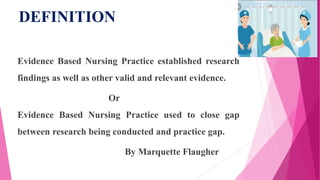
DEFINITION
Evidence Based Nursing Practice established research
findings as well as other valid and relevant evidence.
Or
Evidence Based Nursing Practice used to close gap
between research being conducted and practice gap.
By Marquette Flaugher
NEEDS
 For making sure that each client get the best
possible services.
 Update knowledge and is essential for lifelong
learning.
 Provide clinical judgment.
 Improvement care provided and save lives.
BARRIERS
 Difficulty in bringing change.
 Lack of administrative support.
 Lack of knowledge mentors.
 Lack of time for research.
 Lack of knowledge for research.
LACK OF
KNOWLEDGE
MENTORS
CONT……
 Research report not easily available.
 Complexity of research reports.
 Lack of knowledge about Evidence Based Practice.
STEPS
PRACTICE
RESEARCH
• Experimental
• Quasi –experimental
• Qualitative
NON-RESEARCH
• Organizational
experience-Quality
improvement
• Financial data
PRACTICE
INTERNAL
FACTORS
Culture
Environment
Equipment
supplies
Staffing
EXTERNAL
FACTORS
Accreditation
Legislation
Licensing
Standards
EDUCATION RESEARCH
JOHN HOPKINS NURSING EVIDENCE BASED PRACTICE
MODEL
ADVANTAGES
 Provide better information to practitioner
 Enable the consistency of care
 Better care outcome
 Provide client focused care
 Structured process
 Increase confidence in decision making
CONT……
 Generalize information
 Contribute to science of nursing
 Provide guidelines for further research
 Helps nurse to provide high quality patient care
DISADVANTAGES
 Not enough evidence for evidence
based nursing practice
 Time consuming
 Reduced client choice
 Reduced professional judgment/autonomy
CONT….
 Suppress creativity
 Public bias
 Influence legal proceedings
GOALS OF EVIDENCE BASE
NURSING PRACTICE
 Provide practicing nurse the evidence based data to
deliver effective care.
 Resolve problem in clinical setting.
 Achieve excellence in care delivery.
 Reduce variation in nursing care and assist with
efficient and effective decision making.

I.RECENT RESEACH
Improving evidence based practice in postgraduate nursing
programs: A systematic review: Bridging the evidence practice
gap (BRIDGE project)
Author links open overlay panel Louise D, Hickmana
Michelle, Jane Phillips, Angela Raoc Phillip
ABSTRACT
BACKGROUND: The nursing profession has a significant
evidence to practice gap in an increasingly complex and
dynamic health care environment.
OBJECTIVE: To evaluate effectiveness of teaching
and learning strategies related to a capstone project within a
Masters of Nursing program that encourage the development
of evidence based practice capabilities.
DESIGN: Systematic review that conforms to the PRISMA
statement. Sample: Master's Nursing programs that include
elements of a capstone project within a university setting.
DATA SOURCES/REVIEW METHODS :
MEDLINE, CINAHL, Cochrane Database of Systematic
Reviews, ERIC and Psyc Info were used to search for RCT's
or quasi experimental studies conducted and 9 June 2017,
published in a peer reviewed journal in English.
RESULTS: There are 592 studies, no RCT's specifically addressed
the development of evidence based practice capabilities within the
university teaching environment. Five quasi-experimental studies
integrated blended learning, guided design processes, small group
work, role play and structured debate into Masters of Nursing
research courses. All five studies demonstrated some improvements
in evidence based practice skills and/or research knowledge
translation, with three out of five studies demonstrating significant
improvements.
CONCLUSION:There is a paucity of empirical evidence
supporting the best strategies to use in developing evidence
based practice skills and/or research knowledge translation skills
for Master's Nursing students. As a profession, nursing requires
methodologically robust studies that are discipline specific to
identify the best approaches for developing evidence-based
practice skills and/or research knowledge translation skills
within the university teaching environment. Provision of these
strategies will enable the nursing profession to integrate the best
empirical evidence into nursing practice.
II . RECENT RESEARCH
Leadership practices of nurse managers for implementing
evidence‐based nursing
AIM : To explore leadership of nurse managers in
evidence‐based nursing implementation.
BACKGROUND : Despite much in the literature that
highlights the significance of involving nurse managers, the
qualitative nature of how their leadership practices influence
the evidence implementation has not yet been fully explored.
METHODS : A qualitative secondary data analysis
was conducted on 15 transcripts of interviews of nurse
managers from a parent grounded theory study. The
method for analysis employed the directed content analysis
approach, using the framework of Kouzes & Posner's Five
Practices of Exemplary Leadership model.
RESULTS :
All the leadership practice categories of Five Practices of
Exemplary Leadership® were observed in the data. Two
additional categories “getting oneself prepared” and “keep
it going” were also identified as important leadership
practices of nurse managers to exhibit during
evidence‐based practice implementation.
CONCLUSION :
This study advances the leadership model by
providing validation of existing exemplars and
suggests two new practices with exemplars for a
better understanding of the nurse managers’ role
during evidence implementation
SUMMARY
THANK YOU

EVIDENCE BASED PRACTICE-BEST PRACTICES PPT.pptx

  • 1.
  • 2.
    EVIDENCE BASED NURSING PRACTICE- BEST PRACTICES SUBMITTED TO MRS TANIMA VERMA CLINICAL INSTRUCTOR K.G.M.U COLLEGE OF NURSING SUBMITTED BY POOJA BAGHARI MSC NURSING I YEAR K.G.M.U COLLEGE OF NURSING
  • 3.
    “Knowledge is ofno value unless you put it into practice,,,,, Anton Chekhov
  • 4.
    OBJECTIVES OF EVIDENCEBASED NURSING PRACTICE  INTRODUCTION  DEFINITION  NEEDS  BARRIERS  STEPS  MODELS  ADVANTAGES  DISADVANTAGE  GOALS  RECENT RESEARCH
  • 5.
    INTRODUCTION Evidence Based NursingPractice involves integrating best available research evidence with professional expertise while also taking account of patient preference, the patient state, setting, circumstances and health care resources. It has become a major concern of health care policymaker, care provider and professional groups.
  • 6.
    DEFINITION Evidence Based NursingPractice established research findings as well as other valid and relevant evidence. Or Evidence Based Nursing Practice used to close gap between research being conducted and practice gap. By Marquette Flaugher
  • 7.
    NEEDS  For makingsure that each client get the best possible services.  Update knowledge and is essential for lifelong learning.  Provide clinical judgment.  Improvement care provided and save lives.
  • 8.
    BARRIERS  Difficulty inbringing change.  Lack of administrative support.  Lack of knowledge mentors.  Lack of time for research.  Lack of knowledge for research. LACK OF KNOWLEDGE MENTORS
  • 9.
    CONT……  Research reportnot easily available.  Complexity of research reports.  Lack of knowledge about Evidence Based Practice.
  • 10.
  • 11.
    PRACTICE RESEARCH • Experimental • Quasi–experimental • Qualitative NON-RESEARCH • Organizational experience-Quality improvement • Financial data PRACTICE INTERNAL FACTORS Culture Environment Equipment supplies Staffing EXTERNAL FACTORS Accreditation Legislation Licensing Standards EDUCATION RESEARCH JOHN HOPKINS NURSING EVIDENCE BASED PRACTICE MODEL
  • 12.
    ADVANTAGES  Provide betterinformation to practitioner  Enable the consistency of care  Better care outcome  Provide client focused care  Structured process  Increase confidence in decision making
  • 13.
    CONT……  Generalize information Contribute to science of nursing  Provide guidelines for further research  Helps nurse to provide high quality patient care
  • 14.
    DISADVANTAGES  Not enoughevidence for evidence based nursing practice  Time consuming  Reduced client choice  Reduced professional judgment/autonomy
  • 15.
    CONT….  Suppress creativity Public bias  Influence legal proceedings
  • 16.
    GOALS OF EVIDENCEBASE NURSING PRACTICE  Provide practicing nurse the evidence based data to deliver effective care.  Resolve problem in clinical setting.  Achieve excellence in care delivery.  Reduce variation in nursing care and assist with efficient and effective decision making. 
  • 17.
    I.RECENT RESEACH Improving evidencebased practice in postgraduate nursing programs: A systematic review: Bridging the evidence practice gap (BRIDGE project) Author links open overlay panel Louise D, Hickmana Michelle, Jane Phillips, Angela Raoc Phillip ABSTRACT BACKGROUND: The nursing profession has a significant evidence to practice gap in an increasingly complex and dynamic health care environment.
  • 18.
    OBJECTIVE: To evaluateeffectiveness of teaching and learning strategies related to a capstone project within a Masters of Nursing program that encourage the development of evidence based practice capabilities. DESIGN: Systematic review that conforms to the PRISMA statement. Sample: Master's Nursing programs that include elements of a capstone project within a university setting.
  • 19.
    DATA SOURCES/REVIEW METHODS: MEDLINE, CINAHL, Cochrane Database of Systematic Reviews, ERIC and Psyc Info were used to search for RCT's or quasi experimental studies conducted and 9 June 2017, published in a peer reviewed journal in English.
  • 20.
    RESULTS: There are592 studies, no RCT's specifically addressed the development of evidence based practice capabilities within the university teaching environment. Five quasi-experimental studies integrated blended learning, guided design processes, small group work, role play and structured debate into Masters of Nursing research courses. All five studies demonstrated some improvements in evidence based practice skills and/or research knowledge translation, with three out of five studies demonstrating significant improvements.
  • 21.
    CONCLUSION:There is apaucity of empirical evidence supporting the best strategies to use in developing evidence based practice skills and/or research knowledge translation skills for Master's Nursing students. As a profession, nursing requires methodologically robust studies that are discipline specific to identify the best approaches for developing evidence-based practice skills and/or research knowledge translation skills within the university teaching environment. Provision of these strategies will enable the nursing profession to integrate the best empirical evidence into nursing practice.
  • 22.
    II . RECENTRESEARCH Leadership practices of nurse managers for implementing evidence‐based nursing AIM : To explore leadership of nurse managers in evidence‐based nursing implementation. BACKGROUND : Despite much in the literature that highlights the significance of involving nurse managers, the qualitative nature of how their leadership practices influence the evidence implementation has not yet been fully explored.
  • 23.
    METHODS : Aqualitative secondary data analysis was conducted on 15 transcripts of interviews of nurse managers from a parent grounded theory study. The method for analysis employed the directed content analysis approach, using the framework of Kouzes & Posner's Five Practices of Exemplary Leadership model.
  • 24.
    RESULTS : All theleadership practice categories of Five Practices of Exemplary Leadership® were observed in the data. Two additional categories “getting oneself prepared” and “keep it going” were also identified as important leadership practices of nurse managers to exhibit during evidence‐based practice implementation.
  • 25.
    CONCLUSION : This studyadvances the leadership model by providing validation of existing exemplars and suggests two new practices with exemplars for a better understanding of the nurse managers’ role during evidence implementation
  • 26.
  • 27.