EVIDENCEBASED
PRACTICE
Presented by
Monika Devi
Msc.(N)
HCN, SRHU
INTRODUCTION
 Evidence based practice is an approach that enables
clinicians to provide the highest quality of care in
meeting the multiphase needs to their parents and
family.
DEFINITION
 Evidence based practice (EBP) is the process of making
clinical decisions based upon evidence, combined with
clinical experience and patients expectations.
 Evidence based practice is the conscientious explicit and
judicious use of current. Best evidence in making decision
about the care of individual patients. The practice of evidence
based medicine means integrating individual clinical
expertise with the best available external clinical evidence fro
systematic research.
(Sackett. et al 1996)
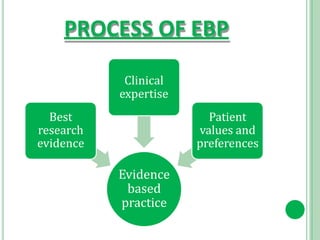
PROCESS OF EBP
Evidence
based
practice
Best
research
evidence
Clinical
expertise
Patient
values and
preferences
AIMS OF EBP
 To provide the high quality and most cast efficient
nursing care possible.
 To advance quality of care provided b health worker.
 To increase satisfaction among patients.
 To focus on nursing practice away from habits and
tradition to evidence and research.
 It results in better patient outcomes.
 It contributes to the science of nursing.
 It keeps practice current and relevant.
 It increases confidence is decision making.
OBJECTIVES AND PURPOSES OF EBP
 Evidence based practice seeks to replace practice as usual
with practice guided by rigorous outcomes oriented research
ideally randomized controlled trials.
 It also seeks to make practice a less subjective enterprise
and to rise it to a higher level of accountability.
 Reduces the variations in nursing care and assist with
efficient and effective decision making.
 Providing practice to the nurse evidence based data to
deliver effective care.
NEED FOR EBP
 For making sure that each client get the best possible
services.
 Update knowledge and is essential for lifelong learning.
 Provide clinical judgment.
 Improvement care provided and save lives
 To provide framework for understanding the evidence
based practice process.
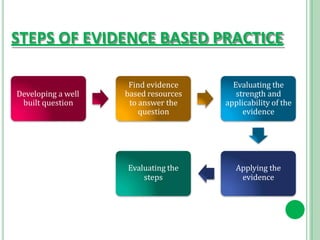
STEPS OF EVIDENCE BASED PRACTICE
Developing a well
built question
Find evidence
based resources
to answer the
question
Evaluating the
strength and
applicability of the
evidence
Applying the
evidence
Evaluating the
steps
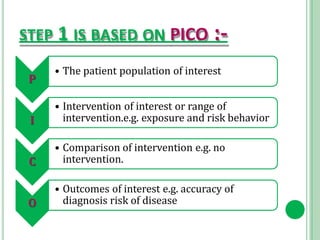
STEP 1 IS BASED ON PICO :-
P
• The patient population of interest
I
• Intervention of interest or range of
intervention.e.g. exposure and risk behavior
C
• Comparison of intervention e.g. no
intervention.
O
• Outcomes of interest e.g. accuracy of
diagnosis risk of disease
MODELS FOR EVIDENCE BASED PRACTICE
1. The steler model
2. IOWA model
3. Ross worm and lama bee model
1. STELTER MODEL
 It was developed as practitioner oriented model in 1994.
 It was revised in 2001 without changes in its focus on
critical thinking.
 It raised awareness about the importance of applying
research finding in nursing practice.
Meaning of evidence as per stelter model:-
Evidence is define as information or facts that are obtained
systematically evidence comes from two different sources
1. External evidence
2. Internal evidence
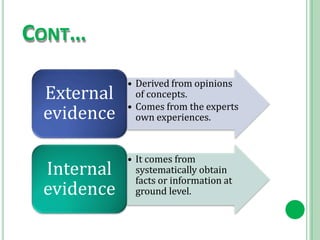
CONT…
• Derived from opinions
of concepts.
• Comes from the experts
own experiences.
• It comes from
systematically obtain
facts or information at
ground level.
External
evidence
Internal
evidence
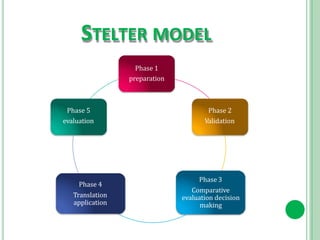
STELTER MODEL
Phase 1
preparation
Phase 2
Validation
Phase 3
Comparative
evaluation decision
making
Phase 4
Translation
application
Phase 5
evaluation
2. IOWA MODEL
 Successfully implanted since 1994 intervention ally.
 Infuses research into practice to improve quality of care.
 Planned change principles integrated research and
practice.
 Utilizes a multidisciplinary team approach.
Highlights of the models :-
 it incorporates the use of research and other forms of
evidence.
 Interference to support research use might involve every
level of the organization.
 Evidence based practice is linked to quality assurance.
CONT…
 Staff are given recognition for research work.
 Clinicians are given time and resources for research work.
 This model explains how organizations changes practice
based on research.
 It gives a systemic design.
 It includes both the practitioner and organizational
perceptive.
 It provides guide for regarding implementation of evidence
based practice.
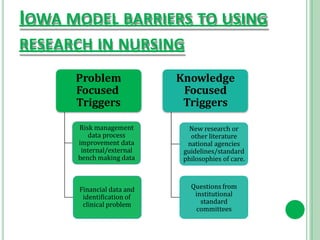
IOWA MODEL BARRIERS TO USING
RESEARCH IN NURSING
Problem
Focused
Triggers
Risk management
data process
improvement data
internal/external
bench making data
Financial data and
identification of
clinical problem
Knowledge
Focused
Triggers
New research or
other literature
national agencies
guidelines/standard
philosophies of care.
Questions from
institutional
standard
committees
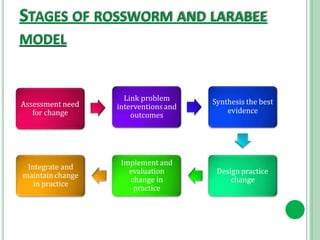
3. ROSS WORM AND LAREE MODEL
 Develop by rossworm and larabee in 1999. it is based
on theoretical and research literature.
 It begins with the assessment of need and integration
of an evidence based protocol.
 Focuses on the use of change theory, principles of
research and standardizations nursing nomenclature.
STAGES OF ROSSWORM AND LARABEE
MODEL
Assessment need
for change
Link problem
interventions and
outcomes
Synthesis the best
evidence
Design practice
change
Implement and
evaluation
change in
practice
Integrate and
maintainchange
in practice
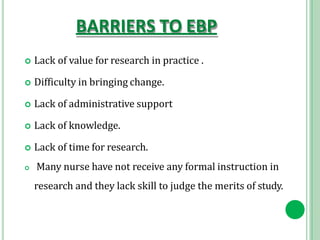
BARRIERS TO EBP
 Lack of value for research in practice .
 Difficulty in bringing change.
 Lack of administrative support
 Lack of knowledge.
 Lack of time for research.
 Many nurse have not receive any formal instruction in
research and they lack skill to judge the merits of study.
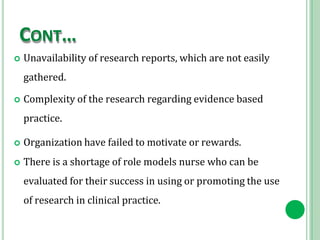
CONT…
 Unavailability of research reports, which are not easily
gathered.
 Complexity of the research regarding evidence based
practice.
 Organization have failed to motivate or rewards.
 There is a shortage of role models nurse who can be
evaluated for their success in using or promoting the use
of research in clinical practice.
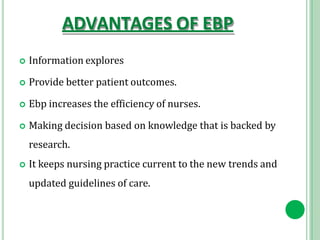
ADVANTAGES OF EBP
 Information explores
 Provide better patient outcomes.
 Ebp increases the efficiency of nurses.
 Making decision based on knowledge that is backed by
research.
 It keeps nursing practice current to the new trends and
updated guidelines of care.
CONT…
 It provides variations in practice because it can help
determine high quality cast effective intervention that
actually work.
 It promotes high quality and cast effective
intervention and treatment.
 Using EBP to provide care to patients increases the
nurses confidence.
SUMMARY
 The State of Evidence-Based Practice in US
Nurses: Critical Implications for Nurse Leaders
and Educators
 Melnyk, Bernadette Mazurek PhD, RN, CPNP/PMHNP,
FNAP, FAAN; Fineout-Overholt, Ellen PhD, RN, FNAP,
FAAN; Gallagher-Ford, Lynn PhD, RN; Kaplan, Louise
PhD, RN, ARNP, FNP-BC, FAANP
 This descriptive survey assessed the perception of evidence-based
practice (EBP) among nurses in the United States. Although
evidence-based healthcare results in improved patient outcomes
and reduced costs, nurses do not consistently implement evidence-
based best practices. A descriptive survey was conducted with a
random sample of 1015 RNs who are members of the American
Nurses Association. Although nurses believe in evidence-based
care, barriers remain prevalent, including resistance from
colleagues, nurse leaders, and managers. Differences existed in
responses of nurses from Magnet® versus non-Magnet institutions
as well as nurses with master’s versus nonmaster’s degrees. Nurse
leaders and educators must provide learning opportunities
regarding EBP and facilitate supportive cultures to achieve the
Institute of Medicine’s 2020 goal that 90% of clinical decisions be
evidence-based.
 Evidence-Based Practice and the Role of Nursing
Leadership
 Stetler, Cheryl B. PhD, RN, FAAN; Brunell, Mary MS,
RN; Giuliano, Karen K. MSN, RN, CCRN; Morsi,
Deborah MS, RN; Prince, Lorna MS, RN; Newell-
Stokes, Virginia MS, RN
 A new term, evidence-based practice, is beginning to
appear both in the healthcare literature and at
professional conferences. Its meaning, however, is not
always clear, nor is its full implication for nurse
administrators explained. This article provides a
pragmatic definition of evidence-based practice
developed in the nursing division at Baystate Medical
Center, Springfield, Massachusetts. It outlines steps
required to institutionalize evidence as a routine part
of nursing practice and provides examples of its use.
Nurses' Perceived Knowledge, Beliefs, Skills, and Needs
Regarding Evidence‐Based Practice: Implications for
Accelerating the Paradigm Shift
 Bernadette Mazurek Melnyk RN, PhD, CPNP/NPP, FAAN,
FNAP
 Ellen Fineout‐Overholt RN, PhD
 Nancy Fischbeck Feinstein RN‐C, PhD
 Hong Li RN, PhD
 Background:-The paradigm shift to evidence‐based nursing practice in
the United States has been slow. Although multiple barriers to
evidence‐based practice (EBP) have been identified through prior studies,
there is a gap in the literature specifically identifying key variables (e.g.,
belief that EBP produces quality outcomes) that are correlated with the
extent to which nurses engage in EBP.
 Aim: The primary aims of this study were to (1) describe nurses'
knowledge, beliefs, skills, and needs regarding EBP; (2) determine
whether relationships exist among these variables; and (3) describe major
barriers and facilitators to EBP.
 Methods: A descriptive survey was conducted with a convenience sample
of 160 nurses who were attending EBP conferences or workshops in four
states located within the Eastern Region of the United States.
 Results: Although participant beliefs about the benefit of EBP
were high, knowledge of EBP was relatively low. Significant
relationships were found between the extent to which the nurses'
practice is evidence‐based and (1) nurses' knowledge of EBP, (2)
nurses' beliefs about the benefits of EBP, (3) having an EBP mentor,
and (4) using the Cochrane Database of Systematic Reviews and
the National Guideline Clearinghouse.
 Conclusion and Implications: Health care systems need to
implement interventions that not only increase nurses' EBP
knowledge and skills, but also strengthen their beliefs about the
benefit of evidence‐based care. EBP mentors may be key in
accelerating a more rapid shift toward evidence‐based nursing
practice. Theoretically driven randomized controlled trials are
urgently needed to test the effectiveness of interventions on
advancing evidence‐based care.
CONCLUSION
REFERENCES
 Brae Kour Navdeep ; HC Rawat, textbook of advance
nursing practice first edition . Jaypee publisher ; page
no 533-541.
 Basheer. P
, shabeerkhan . Yasmeen S. A concise
textbook of advanced nursing practice first edition;
EM-ESS medical publisher; page no . 751-757.
 Polit. F. Denise ; back tatano cheryl nursing research ;
generating and assessing evidence for nursing
practice ; tenth edition, wolters kumars publisher
page no 30-41.
NURSING evidencebasedpracticeL SUNEETHA-.pptx

NURSING evidencebasedpracticeL SUNEETHA-.pptx

  • 1.
  • 2.
    INTRODUCTION  Evidence basedpractice is an approach that enables clinicians to provide the highest quality of care in meeting the multiphase needs to their parents and family.
  • 3.
    DEFINITION  Evidence basedpractice (EBP) is the process of making clinical decisions based upon evidence, combined with clinical experience and patients expectations.  Evidence based practice is the conscientious explicit and judicious use of current. Best evidence in making decision about the care of individual patients. The practice of evidence based medicine means integrating individual clinical expertise with the best available external clinical evidence fro systematic research. (Sackett. et al 1996)
  • 4.
  • 5.
    AIMS OF EBP To provide the high quality and most cast efficient nursing care possible.  To advance quality of care provided b health worker.  To increase satisfaction among patients.  To focus on nursing practice away from habits and tradition to evidence and research.  It results in better patient outcomes.  It contributes to the science of nursing.  It keeps practice current and relevant.  It increases confidence is decision making.
  • 6.
    OBJECTIVES AND PURPOSESOF EBP  Evidence based practice seeks to replace practice as usual with practice guided by rigorous outcomes oriented research ideally randomized controlled trials.  It also seeks to make practice a less subjective enterprise and to rise it to a higher level of accountability.  Reduces the variations in nursing care and assist with efficient and effective decision making.  Providing practice to the nurse evidence based data to deliver effective care.
  • 7.
    NEED FOR EBP For making sure that each client get the best possible services.  Update knowledge and is essential for lifelong learning.  Provide clinical judgment.  Improvement care provided and save lives  To provide framework for understanding the evidence based practice process.
  • 8.
    STEPS OF EVIDENCEBASED PRACTICE Developing a well built question Find evidence based resources to answer the question Evaluating the strength and applicability of the evidence Applying the evidence Evaluating the steps
  • 9.
    STEP 1 ISBASED ON PICO :- P • The patient population of interest I • Intervention of interest or range of intervention.e.g. exposure and risk behavior C • Comparison of intervention e.g. no intervention. O • Outcomes of interest e.g. accuracy of diagnosis risk of disease
  • 10.
    MODELS FOR EVIDENCEBASED PRACTICE 1. The steler model 2. IOWA model 3. Ross worm and lama bee model
  • 11.
    1. STELTER MODEL It was developed as practitioner oriented model in 1994.  It was revised in 2001 without changes in its focus on critical thinking.  It raised awareness about the importance of applying research finding in nursing practice. Meaning of evidence as per stelter model:- Evidence is define as information or facts that are obtained systematically evidence comes from two different sources 1. External evidence 2. Internal evidence
  • 12.
    CONT… • Derived fromopinions of concepts. • Comes from the experts own experiences. • It comes from systematically obtain facts or information at ground level. External evidence Internal evidence
  • 13.
    STELTER MODEL Phase 1 preparation Phase2 Validation Phase 3 Comparative evaluation decision making Phase 4 Translation application Phase 5 evaluation
  • 14.
    2. IOWA MODEL Successfully implanted since 1994 intervention ally.  Infuses research into practice to improve quality of care.  Planned change principles integrated research and practice.  Utilizes a multidisciplinary team approach. Highlights of the models :-  it incorporates the use of research and other forms of evidence.  Interference to support research use might involve every level of the organization.  Evidence based practice is linked to quality assurance.
  • 15.
    CONT…  Staff aregiven recognition for research work.  Clinicians are given time and resources for research work.  This model explains how organizations changes practice based on research.  It gives a systemic design.  It includes both the practitioner and organizational perceptive.  It provides guide for regarding implementation of evidence based practice.
  • 16.
    IOWA MODEL BARRIERSTO USING RESEARCH IN NURSING Problem Focused Triggers Risk management data process improvement data internal/external bench making data Financial data and identification of clinical problem Knowledge Focused Triggers New research or other literature national agencies guidelines/standard philosophies of care. Questions from institutional standard committees
  • 17.
    3. ROSS WORMAND LAREE MODEL  Develop by rossworm and larabee in 1999. it is based on theoretical and research literature.  It begins with the assessment of need and integration of an evidence based protocol.  Focuses on the use of change theory, principles of research and standardizations nursing nomenclature.
  • 18.
    STAGES OF ROSSWORMAND LARABEE MODEL Assessment need for change Link problem interventions and outcomes Synthesis the best evidence Design practice change Implement and evaluation change in practice Integrate and maintainchange in practice
  • 19.
    BARRIERS TO EBP Lack of value for research in practice .  Difficulty in bringing change.  Lack of administrative support  Lack of knowledge.  Lack of time for research.  Many nurse have not receive any formal instruction in research and they lack skill to judge the merits of study.
  • 20.
    CONT…  Unavailability ofresearch reports, which are not easily gathered.  Complexity of the research regarding evidence based practice.  Organization have failed to motivate or rewards.  There is a shortage of role models nurse who can be evaluated for their success in using or promoting the use of research in clinical practice.
  • 21.
    ADVANTAGES OF EBP Information explores  Provide better patient outcomes.  Ebp increases the efficiency of nurses.  Making decision based on knowledge that is backed by research.  It keeps nursing practice current to the new trends and updated guidelines of care.
  • 22.
    CONT…  It providesvariations in practice because it can help determine high quality cast effective intervention that actually work.  It promotes high quality and cast effective intervention and treatment.  Using EBP to provide care to patients increases the nurses confidence.
  • 23.
  • 24.
     The Stateof Evidence-Based Practice in US Nurses: Critical Implications for Nurse Leaders and Educators  Melnyk, Bernadette Mazurek PhD, RN, CPNP/PMHNP, FNAP, FAAN; Fineout-Overholt, Ellen PhD, RN, FNAP, FAAN; Gallagher-Ford, Lynn PhD, RN; Kaplan, Louise PhD, RN, ARNP, FNP-BC, FAANP
  • 25.
     This descriptivesurvey assessed the perception of evidence-based practice (EBP) among nurses in the United States. Although evidence-based healthcare results in improved patient outcomes and reduced costs, nurses do not consistently implement evidence- based best practices. A descriptive survey was conducted with a random sample of 1015 RNs who are members of the American Nurses Association. Although nurses believe in evidence-based care, barriers remain prevalent, including resistance from colleagues, nurse leaders, and managers. Differences existed in responses of nurses from Magnet® versus non-Magnet institutions as well as nurses with master’s versus nonmaster’s degrees. Nurse leaders and educators must provide learning opportunities regarding EBP and facilitate supportive cultures to achieve the Institute of Medicine’s 2020 goal that 90% of clinical decisions be evidence-based.
  • 26.
     Evidence-Based Practiceand the Role of Nursing Leadership  Stetler, Cheryl B. PhD, RN, FAAN; Brunell, Mary MS, RN; Giuliano, Karen K. MSN, RN, CCRN; Morsi, Deborah MS, RN; Prince, Lorna MS, RN; Newell- Stokes, Virginia MS, RN
  • 27.
     A newterm, evidence-based practice, is beginning to appear both in the healthcare literature and at professional conferences. Its meaning, however, is not always clear, nor is its full implication for nurse administrators explained. This article provides a pragmatic definition of evidence-based practice developed in the nursing division at Baystate Medical Center, Springfield, Massachusetts. It outlines steps required to institutionalize evidence as a routine part of nursing practice and provides examples of its use.
  • 28.
    Nurses' Perceived Knowledge,Beliefs, Skills, and Needs Regarding Evidence‐Based Practice: Implications for Accelerating the Paradigm Shift  Bernadette Mazurek Melnyk RN, PhD, CPNP/NPP, FAAN, FNAP  Ellen Fineout‐Overholt RN, PhD  Nancy Fischbeck Feinstein RN‐C, PhD  Hong Li RN, PhD
  • 29.
     Background:-The paradigmshift to evidence‐based nursing practice in the United States has been slow. Although multiple barriers to evidence‐based practice (EBP) have been identified through prior studies, there is a gap in the literature specifically identifying key variables (e.g., belief that EBP produces quality outcomes) that are correlated with the extent to which nurses engage in EBP.  Aim: The primary aims of this study were to (1) describe nurses' knowledge, beliefs, skills, and needs regarding EBP; (2) determine whether relationships exist among these variables; and (3) describe major barriers and facilitators to EBP.  Methods: A descriptive survey was conducted with a convenience sample of 160 nurses who were attending EBP conferences or workshops in four states located within the Eastern Region of the United States.
  • 30.
     Results: Althoughparticipant beliefs about the benefit of EBP were high, knowledge of EBP was relatively low. Significant relationships were found between the extent to which the nurses' practice is evidence‐based and (1) nurses' knowledge of EBP, (2) nurses' beliefs about the benefits of EBP, (3) having an EBP mentor, and (4) using the Cochrane Database of Systematic Reviews and the National Guideline Clearinghouse.  Conclusion and Implications: Health care systems need to implement interventions that not only increase nurses' EBP knowledge and skills, but also strengthen their beliefs about the benefit of evidence‐based care. EBP mentors may be key in accelerating a more rapid shift toward evidence‐based nursing practice. Theoretically driven randomized controlled trials are urgently needed to test the effectiveness of interventions on advancing evidence‐based care.
  • 31.
  • 32.
    REFERENCES  Brae KourNavdeep ; HC Rawat, textbook of advance nursing practice first edition . Jaypee publisher ; page no 533-541.  Basheer. P , shabeerkhan . Yasmeen S. A concise textbook of advanced nursing practice first edition; EM-ESS medical publisher; page no . 751-757.  Polit. F. Denise ; back tatano cheryl nursing research ; generating and assessing evidence for nursing practice ; tenth edition, wolters kumars publisher page no 30-41.