1
EVIDENCE
BASED STUDIES
AT PUERPERIUM PRESENTED BY
MRS.THANGAM JAYARANI J
M Sc (N),
FIRST YEAR,
GCON,CUDDALORE.
2
INTRODUCTION
Evidence based studies is the integration
of the best research evidence with clinical
expertise and patient values to deliver
optimal care. Best research studies means
clinically relevant and patient centered
research studies.
3
DEFINITION OF PUERPERIUM
The puerperium is defined as the six (6) weeks
period commencing after the completion of
third stage of labour.
E M SYMONDS
The puerperium is refers to the six (6) weeks
period following child birth, with considerable
adjustment occur before return to the
pregnant state.
PHILIP N.BAKER
4
DEFINITION OF EVIDENCE
Evidence is something that
furnishes proof or testimony or
something legally submitted to
ascertain in the truth of matter.
5
DEFINITION OF EVIDENCE BASED
STUDIES
It is systematic inter connecting
of scientifically generated evidence with
the tacit knowledge of the expert
practitioner to achieve a change in a
particular practice for the benefit of a
well-being defined client/patient group
FRENCH (1999)
6
DEFINITION OF EVIDENCE BASED
NURSING
Evidence based nursing is a process by
which nurses make clinical decisions
using the best available research
evidence, their clinical expertise and
patient preference.
MULLHALL (1998)
7
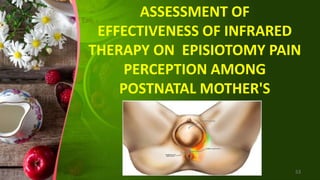
DEFINITION OF EVIDENCE BASED
MEDICINE OR PRACTICE
Evidence based medicine or practice is
the conscientious, explicit and judicious
use of current best evidence in making
decision about the care of individual
patient.
DR.DAVID SACKETT,ROSENBERG.
8
DEFINITION OF MIDWIFERY
PRACTICE
Midwifery practice is underpinned by
values that guide the way in which
midwives provide care. Midwives are the
most appreciate care providers to attend
women during pregnancy,labour,birth
and the postnatal period and in
collaboration with other health care
professions when required. 9
10
MEANING OF EVIDENCE BASED
STUDIES
Evidence based studies is the use of
prior research in a systematic and
transparent way to inform a new
study.so,that it is answering questions
that matter in a valid ,efficient , and
accessible manner.
11
12
OBJECTIVES OF EVIDENCE BASED STUDIES
Evidence based studies seeks to replace practice
as usual with practice guided by rigorous
outcomes oriented research ideally randomized
controlled trails.
It also seeks to make practice a less subjective
enterprise and to rise it to a highest level of
accountability. 13
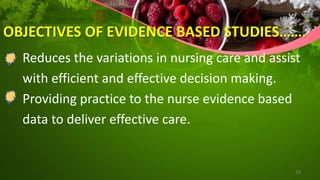
OBJECTIVES OF EVIDENCE BASED STUDIES…….
Reduces the variations in nursing care and assist
with efficient and effective decision making.
Providing practice to the nurse evidence based
data to deliver effective care.
14
15
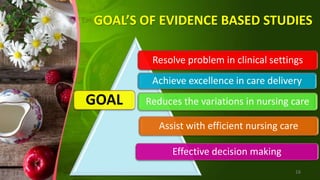
GOAL’S OF EVIDENCE BASED STUDIES
16
GOAL
Resolve problem in clinical settings
Reduces the variations in nursing care
Achieve excellence in care delivery
Assist with efficient nursing care
Effective decision making
17
AIMS OF EVIDENCE BASED STUDIES
To provide the high quality and most cost
efficient nursing care possible.
To advance quality of care provided to
health worker.
To increase satisfaction among patients.
To focus on nursing practice away from
habits and tradition to evidence and
research. 18
AIMS OF EVIDENCE BASED STUDIES..
It results in better patient outcomes.
It contributes to the science of
nursing.
It helps practice current and relevant.
It increase confidence in decision
making.
19
NEEDS OF EVIDENCE BASED STUDIES
20
For making sure that
each client get the
best possible
essential services
Update
knowledge and is
essential for life
long learning
Improvement care
provided and save
lives
Provide clinical
judgment
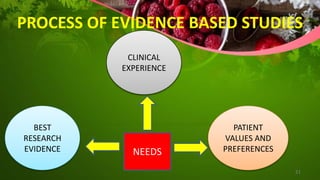
PROCESS OF EVIDENCE BASED STUDIES
21
BEST
RESEARCH
EVIDENCE
PATIENT
VALUES AND
PREFERENCES
CLINICAL
EXPERIENCE
NEEDS
STEPS OF EVIDENCE BASED STUDIES
22
ASK- Frame focused questions to be answered by the evidence review
ACQUIRE-Find evidence based recourses to answer the question
APPRAISE-Evaluating the strength and applicability of the evidence
ANALYZE-Standardize,summarize,and rate strength of body of evidence
APPLY-Applying the evidence
AUDIT/ASSESS
COMPONENTS OF EVIDENCE BASED
STUDIES
23
COMPONENTS
BEST AVILABLE EVIDENCED
CLINICIANS KNOWLEDGE AND
SKILLS
PATIENTS WANTS AND NEEDS
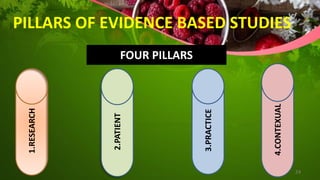
PILLARS OF EVIDENCE BASED STUDIES
24
1.RESEARCH
2.PATIENT
3.PRACTICE
4.CONTEXUAL
FOUR PILLARS
PRINCIPLES OF
EVIDENCE BASED STUDIES
Eight evidence based principles for
effective intervention,
1.Assess actuarial risk/needs
2.Enhance intrinsic motivation.
3.Increase positive reinforcement.
4.Provide measurement feedback.
25
PRINCIPLES…
5.Target interventions
a. Risk principle:
Prioritize supervision and treatment resources
for higher risk offenders.
b. Responding principle:
Be responsive to temperament, learning ,
style, motivation, culture, and gender when
assigning programs.
26
PRINCIPLES……
c. Need principle:
Target interventions to criminogenic needs.
d. Dosage :
Structure 40-70 % of high risk offenders time
for 3-9 months.
e. Treatment :
Integrate treatment into the full
sentence/sanction requirement. 27
PRINCIPLES……
6.Skill train with directed practice ( use
cognitive behavioral treatment method)
7.Engage ongoing support in natural
communities.
8.Measure relevant process / practices.
28
SOURCES OF EVIDENCE BASED
STUDIES
SOURCES
PEER-REVIEWED
RANDOMIZES
CLINICAL
TRIALS
CLINICAL TRIALS
JOURNAL
ARTICLES
29
THE EVIDENCE BASED MIDWIFERY
PRACTICES ARE AS FOLLOW
Antenatal immunization.
Estimation of haemoglobulin.
Iron and folic acid supplementation.
Vaginal examination during pregnancy.
Eating and drinking in labour.
Position during labour.
Enema during labour
30
THE EVIDENCE BASED MIDWIFERY
PRACTICES ARE AS FOLLOW
Psychological support in labour.
Use of epidural during labour.
Episiotomy.
Use of uterine stimulants.
Water bath.
Management in obstetrics.
Caesarean birth.
31
THE EVIDENCE BASED MIDWIFERY
PRACTICES ARE AS FOLLOW
Cord clamping.
Breast feeding.
Kangaroo mother care.
Antenatal and postnatal exercise.
Natural therapies.
Teaching programs etc…
32
BARRIERS TO EVIDENCE BASED STUDIES
Lack of value for research in practice.
Difficulty in bringing change.
Lack of administrative support.
Lack of knowledge.
Lack of time for research.
Many nurse have not receive any formal
instruction in research and they lack skill
to judge.
33
BARRIERS TO EVIDENCE BASED STUDIES
Unavailability of research reports, which are
not easily gathered.
Complexity of the research regarding evidence
based studies.
Organization have failed to motivate or
rewards.
There is a shortage of role model nurse who
can be evaluated for their success in nursing or
promoting the use of research in clinical
practice. 34
ADVANTAGES OF EVIDENCE BASED
STUDIES
Provide better information to practitioner.
Enable consistency of care.
Better patient outcome.
Provide client focus care.
Structural process.
Increase confidence in decision making.
35
ADVANTAGES OF EVIDENCE BASED
STUDIES
Generalize information.
Contribute to science of nursing.
Provide guidelines to further
research.
Helps nurses to provide high quality
of patient care. 36
DISADVANTAGES OF EVIDENCE
BASED STUDIES
Time consuming.
Reduced client choice.
Reduced professional judgment /autonomy.
Suppress creativity.
Influences legal proceedings.
Publication bios.
37
A STUDY TO ASSESS THE EFFECTIVENESS OF
LUKEWARM WATER COMPRESSION ON NIPPLE
PAIN AND BREAST ENGORGEMENT AMONG
POSTNATAL MOTHERS
38
ABSTRACT
INTRODUCTION:
• The common problems affect in breast
feeding is breast engorgement and nipple
pain.
AIM OF THE STUDY:
• To evaluate the effectiveness of lukewarm
water compression
39
• Lukewarm water compression on nipple
pain and breast enlargement among post
natal mothers and to find out the
association between the nipple pain and
breast enlargement among Post with their
selected demographic variables.
40
Methods:
• Pre experimental one group pre-test
,post -test design was adopted for this
study.
Conducted at:
• Maruthi hospital Namakkal.
Sample size:
• 50 post natal mothers.
Sample technique
• Purposive save sample technique. 41
The Nature after study
• Study was briefed to participants and
consent was obtained warm water
compression two part of boiling water and
one part of cold water was applied with the
sponge cloth, Over the engorged breast and
which was replaced every 5 minutes for a
total duration of 20 minutes 10 minutes
before and 10 minutes after breastfeeding
for two times on 3rd 4th and 5th postnatal
day. 42
Results
• There was here significant difference
between the post test scores .
conclusion
• The study Conducted that the application
of luke warm water compression is effective
in reducing the nipple pain and breast
engorgement among post natal mothers.
43
ASSES THE EFFECTIVENESS
OF FOOT AND HAND
MASSAGE ON CAESAREAN
PAIN AMONG POSTNATAL
MOTHER'S
44
ABSTRACT
Introduction:
• The birth of the child is generally viewed
as a time of rejoicing despite the physical
pain and exhaustion experienced by the
mother at the time the mother needs lots
of help for the realization and acceptance
of child birth.
•
45
• As normal physiological phenomenon.
Recently many complementary therapies
such as music reflexology has proved
effective in managing caesarean section
pain foot and hand massage has the
potential to aid in relaxation as well as the
pain relief.
46
AIMS
• To determine the effectiveness of foot and
hand massage on cesarean pain among
postnatal mother's in the experimental
group
Findings
• Qualitative approach quasi experimental
time series design.
47
• Assessment of caesarean pain perception
was done by numerical rating scale pre
intervention pain level and post operative
parameters where assessed for
experimental group foot and hand
massage for 20 minutes for two sessions
with an interval of 60 minutes was
provided and the post intervention pain
level post operative parameters for
assessed for both the groups.
48
Results:
Foot and hand massage is easy to apply,
costless and doesn't need special
equipment. Midwives are responsible to
pain management; hence their practice.
The results show that foot and hand
massage significant effect to relieve pain.
49
50
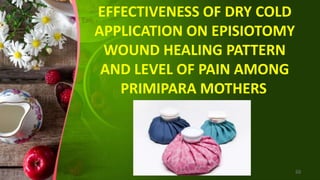
EFFECTIVENESS OF DRY COLD
APPLICATION ON EPISIOTOMY
WOUND HEALING PATTERN
AND LEVEL OF PAIN AMONG
PRIMIPARA MOTHERS.
ABSTRACT
Introduction:
• Episiotomy a simple surgical procedure
during childbirth results in severe pain and
other complications in postnatal period.
Aims:
• The reduced pain and improve wound
healing pattern by dry and cold application
on episiotomy wound.
51
Evaluation approach:
• Quasi experimental study
• Pilot study
Findings:
• Dry cold application was given only to the
experimental group mother’s after delivery
within 2 to 8 hours on 2nd,3rd,4th and 5th day.
The major findings of the study where in
experimental group regarding pain score was
highly significant at the level of all days
regarding wound healing pattern is
experimental group significant differences
found in the aspects of redness oedema .
52
ASSESSMENT OF
EFFECTIVENESS OF INFRARED
THERAPY ON EPISIOTOMY PAIN
PERCEPTION AMONG
POSTNATAL MOTHER'S
53
ABSTRACT
Introduction
• A quantitative approach true experimental pre-test and
the post test control group design was chosen to assess
there effectiveness of infrared therapy in episiotomy pain
perception among postnatal mothers.

Methods:
• Quantitative approach.
Conducted at:
• Government Rajaji hospital Madurai.
Sample size:
• 60 post mortal mothers.
Sample technique:
• simple random sampling and lottery .
54
The nature of the study:
The pre-test level of episiotomy pain
was assessed by using the numerical
pain scale and the level of episiotomy
pain perception among postnatal
mothers in both groups were perceived
severe. Infrared therapy 245 volts 10
minutes twice a day, for 3 days was
given to experimental group.
55
EFFECTIVENESS OF FOOT
REFLEXOLOGY ON LACTATION
AMONG POST NATAL MOTHERS
IN SELECTED HOSPITALS.
56
ABSTRACT
Introduction:
In Indian culture mothers are considered a
Visible God, because they give birth to a life
as well as take care of the baby by feeding
their own milk. Lactation is very important
for successful breast feeding. Reflexology
also helps to regain and maintain health that
is lost due to stress from surgery.
57
Aims:
To evaluate the effectiveness of foot
reflexology on lactation among post natal
mothers.
Methods:
A quantitative research approach
Sample size:
20 postnatal mothers.
Conducted at:
kanyakumari district hospitals,
Tamilnadu. 58
The nature of the study:
Mother laches breastfeeding assessment
tool was used to access the level of Lactation
among the postnatal mothers.
Results :
The results shown that Reflexology had
significant affecting promotion of lactation
among postnatal mothers.
59
EFFECTIVENESS OF LAVENDER
OIL SITZ BATH ON EPISIOTOMY
WOUND HEALING AMONG
POSTNATAL MOTHER'S.
60
ABSTRACT
Introduction:
• Episiotomy is the most common
perineal incision in obstetric and
midwifery. After the delivery most
women have some degree of
discomfort during the first stage of
postpartum days because of
episiotomy. Nowadays alternative and
complementary therapies such as using
essential oils are established in
alternative therapy. 61
Aims:
• This research was carried out and assess
the effectiveness of lavender oil sitz bath
in episiotomy wound healing and pain.
Methods:
• Quasi experimental design
Sample size:
• 60 postnatal mothers.
Conducted at:
• George mission hospital Nagercoil. 62
The nature of the study:
• The episiotomy wound healing and pain
perception were assessed on the 1st,2nd
and 5th postnatal days in both groups.
Results :
• This study concludes lavender oil sitz bath
is effective in episiotomy wound healing
and reduction in pain perception.
63
64
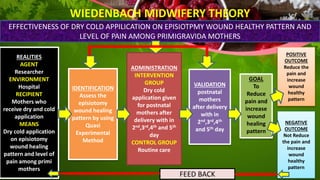
WIEDENBACH MIDWIFERY THEORY
EFFECTIVENESS OF DRY COLD APPILICATION ON EPISIOTPMY WOUND HEALTHY PATTERN AND
LEVEL OF PAIN AMONG PRIMIGRAVIDA MOTHERS
REALITIES
AGENT
Researcher
ENVIRONMENT
Hospital
RECIPIENT
Mothers who
receive dry and cold
application
MEANS
Dry cold application
on episiotomy
wound healing
pattern and level of
pain among primi
mothers
IDENTIFICATION
Assess the
episiotomy
wound healing
pattern by using
Quasi
Experimental
Method
ADMINISTRATION
INTERVENTION
GROUP
Dry cold
application given
for postnatal
mothers after
delivery with in
2nd,3rd,4th and 5th
day
CONTROL GROUP
Routine care
VALIDATION
postnatal
mothers
after delivery
with in
2nd,3rd,4th
and 5th day
GOAL
To
Reduce
pain and
increase
wound
healing
pattern
NEGATIVE
OUTCOME
Not Reduce
the pain and
increase
wound
healthy
pattern
POSITIVE
OUTCOME
Reduce the
pain and
increase
wound
healthy
pattern
FEED BACK
ASSIGNMENT
TIME:1 HOUR 10×2=20
1.Explain about the evidence based studies
at puerperium.
2.How to apply the theory on evidence
based studies in midwifery practice.
66
67
1. Sheebeer.p.Basheer ,S. Yasmin Khan, (2022)."A
concise textbook of advanced nursing
practice".(3rded).Bangalore; EMMESS Medical
publisher. 748-754.
2. Navdeep Kaur brar,HC Rawat,(2015),"Text book of
Advanced nursing practice",(1st ed),New delhi:
Jaypee brothers medical publishers (P)ltd.533-542.
68
69

Evidence based nursing in pureperium obg

  • 1.
  • 2.
    EVIDENCE BASED STUDIES AT PUERPERIUMPRESENTED BY MRS.THANGAM JAYARANI J M Sc (N), FIRST YEAR, GCON,CUDDALORE. 2
  • 3.
    INTRODUCTION Evidence based studiesis the integration of the best research evidence with clinical expertise and patient values to deliver optimal care. Best research studies means clinically relevant and patient centered research studies. 3
  • 4.
    DEFINITION OF PUERPERIUM Thepuerperium is defined as the six (6) weeks period commencing after the completion of third stage of labour. E M SYMONDS The puerperium is refers to the six (6) weeks period following child birth, with considerable adjustment occur before return to the pregnant state. PHILIP N.BAKER 4
  • 5.
    DEFINITION OF EVIDENCE Evidenceis something that furnishes proof or testimony or something legally submitted to ascertain in the truth of matter. 5
  • 6.
    DEFINITION OF EVIDENCEBASED STUDIES It is systematic inter connecting of scientifically generated evidence with the tacit knowledge of the expert practitioner to achieve a change in a particular practice for the benefit of a well-being defined client/patient group FRENCH (1999) 6
  • 7.
    DEFINITION OF EVIDENCEBASED NURSING Evidence based nursing is a process by which nurses make clinical decisions using the best available research evidence, their clinical expertise and patient preference. MULLHALL (1998) 7
  • 8.
    DEFINITION OF EVIDENCEBASED MEDICINE OR PRACTICE Evidence based medicine or practice is the conscientious, explicit and judicious use of current best evidence in making decision about the care of individual patient. DR.DAVID SACKETT,ROSENBERG. 8
  • 9.
    DEFINITION OF MIDWIFERY PRACTICE Midwiferypractice is underpinned by values that guide the way in which midwives provide care. Midwives are the most appreciate care providers to attend women during pregnancy,labour,birth and the postnatal period and in collaboration with other health care professions when required. 9
  • 10.
  • 11.
    MEANING OF EVIDENCEBASED STUDIES Evidence based studies is the use of prior research in a systematic and transparent way to inform a new study.so,that it is answering questions that matter in a valid ,efficient , and accessible manner. 11
  • 12.
  • 13.
    OBJECTIVES OF EVIDENCEBASED STUDIES Evidence based studies seeks to replace practice as usual with practice guided by rigorous outcomes oriented research ideally randomized controlled trails. It also seeks to make practice a less subjective enterprise and to rise it to a highest level of accountability. 13
  • 14.
    OBJECTIVES OF EVIDENCEBASED STUDIES……. Reduces the variations in nursing care and assist with efficient and effective decision making. Providing practice to the nurse evidence based data to deliver effective care. 14
  • 15.
  • 16.
    GOAL’S OF EVIDENCEBASED STUDIES 16 GOAL Resolve problem in clinical settings Reduces the variations in nursing care Achieve excellence in care delivery Assist with efficient nursing care Effective decision making
  • 17.
  • 18.
    AIMS OF EVIDENCEBASED STUDIES To provide the high quality and most cost efficient nursing care possible. To advance quality of care provided to health worker. To increase satisfaction among patients. To focus on nursing practice away from habits and tradition to evidence and research. 18
  • 19.
    AIMS OF EVIDENCEBASED STUDIES.. It results in better patient outcomes. It contributes to the science of nursing. It helps practice current and relevant. It increase confidence in decision making. 19
  • 20.
    NEEDS OF EVIDENCEBASED STUDIES 20 For making sure that each client get the best possible essential services Update knowledge and is essential for life long learning Improvement care provided and save lives Provide clinical judgment
  • 21.
    PROCESS OF EVIDENCEBASED STUDIES 21 BEST RESEARCH EVIDENCE PATIENT VALUES AND PREFERENCES CLINICAL EXPERIENCE NEEDS
  • 22.
    STEPS OF EVIDENCEBASED STUDIES 22 ASK- Frame focused questions to be answered by the evidence review ACQUIRE-Find evidence based recourses to answer the question APPRAISE-Evaluating the strength and applicability of the evidence ANALYZE-Standardize,summarize,and rate strength of body of evidence APPLY-Applying the evidence AUDIT/ASSESS
  • 23.
    COMPONENTS OF EVIDENCEBASED STUDIES 23 COMPONENTS BEST AVILABLE EVIDENCED CLINICIANS KNOWLEDGE AND SKILLS PATIENTS WANTS AND NEEDS
  • 24.
    PILLARS OF EVIDENCEBASED STUDIES 24 1.RESEARCH 2.PATIENT 3.PRACTICE 4.CONTEXUAL FOUR PILLARS
  • 25.
    PRINCIPLES OF EVIDENCE BASEDSTUDIES Eight evidence based principles for effective intervention, 1.Assess actuarial risk/needs 2.Enhance intrinsic motivation. 3.Increase positive reinforcement. 4.Provide measurement feedback. 25
  • 26.
    PRINCIPLES… 5.Target interventions a. Riskprinciple: Prioritize supervision and treatment resources for higher risk offenders. b. Responding principle: Be responsive to temperament, learning , style, motivation, culture, and gender when assigning programs. 26
  • 27.
    PRINCIPLES…… c. Need principle: Targetinterventions to criminogenic needs. d. Dosage : Structure 40-70 % of high risk offenders time for 3-9 months. e. Treatment : Integrate treatment into the full sentence/sanction requirement. 27
  • 28.
    PRINCIPLES…… 6.Skill train withdirected practice ( use cognitive behavioral treatment method) 7.Engage ongoing support in natural communities. 8.Measure relevant process / practices. 28
  • 29.
    SOURCES OF EVIDENCEBASED STUDIES SOURCES PEER-REVIEWED RANDOMIZES CLINICAL TRIALS CLINICAL TRIALS JOURNAL ARTICLES 29
  • 30.
    THE EVIDENCE BASEDMIDWIFERY PRACTICES ARE AS FOLLOW Antenatal immunization. Estimation of haemoglobulin. Iron and folic acid supplementation. Vaginal examination during pregnancy. Eating and drinking in labour. Position during labour. Enema during labour 30
  • 31.
    THE EVIDENCE BASEDMIDWIFERY PRACTICES ARE AS FOLLOW Psychological support in labour. Use of epidural during labour. Episiotomy. Use of uterine stimulants. Water bath. Management in obstetrics. Caesarean birth. 31
  • 32.
    THE EVIDENCE BASEDMIDWIFERY PRACTICES ARE AS FOLLOW Cord clamping. Breast feeding. Kangaroo mother care. Antenatal and postnatal exercise. Natural therapies. Teaching programs etc… 32
  • 33.
    BARRIERS TO EVIDENCEBASED STUDIES Lack of value for research in practice. Difficulty in bringing change. Lack of administrative support. Lack of knowledge. Lack of time for research. Many nurse have not receive any formal instruction in research and they lack skill to judge. 33
  • 34.
    BARRIERS TO EVIDENCEBASED STUDIES Unavailability of research reports, which are not easily gathered. Complexity of the research regarding evidence based studies. Organization have failed to motivate or rewards. There is a shortage of role model nurse who can be evaluated for their success in nursing or promoting the use of research in clinical practice. 34
  • 35.
    ADVANTAGES OF EVIDENCEBASED STUDIES Provide better information to practitioner. Enable consistency of care. Better patient outcome. Provide client focus care. Structural process. Increase confidence in decision making. 35
  • 36.
    ADVANTAGES OF EVIDENCEBASED STUDIES Generalize information. Contribute to science of nursing. Provide guidelines to further research. Helps nurses to provide high quality of patient care. 36
  • 37.
    DISADVANTAGES OF EVIDENCE BASEDSTUDIES Time consuming. Reduced client choice. Reduced professional judgment /autonomy. Suppress creativity. Influences legal proceedings. Publication bios. 37
  • 38.
    A STUDY TOASSESS THE EFFECTIVENESS OF LUKEWARM WATER COMPRESSION ON NIPPLE PAIN AND BREAST ENGORGEMENT AMONG POSTNATAL MOTHERS 38
  • 39.
    ABSTRACT INTRODUCTION: • The commonproblems affect in breast feeding is breast engorgement and nipple pain. AIM OF THE STUDY: • To evaluate the effectiveness of lukewarm water compression 39
  • 40.
    • Lukewarm watercompression on nipple pain and breast enlargement among post natal mothers and to find out the association between the nipple pain and breast enlargement among Post with their selected demographic variables. 40
  • 41.
    Methods: • Pre experimentalone group pre-test ,post -test design was adopted for this study. Conducted at: • Maruthi hospital Namakkal. Sample size: • 50 post natal mothers. Sample technique • Purposive save sample technique. 41
  • 42.
    The Nature afterstudy • Study was briefed to participants and consent was obtained warm water compression two part of boiling water and one part of cold water was applied with the sponge cloth, Over the engorged breast and which was replaced every 5 minutes for a total duration of 20 minutes 10 minutes before and 10 minutes after breastfeeding for two times on 3rd 4th and 5th postnatal day. 42
  • 43.
    Results • There washere significant difference between the post test scores . conclusion • The study Conducted that the application of luke warm water compression is effective in reducing the nipple pain and breast engorgement among post natal mothers. 43
  • 44.
    ASSES THE EFFECTIVENESS OFFOOT AND HAND MASSAGE ON CAESAREAN PAIN AMONG POSTNATAL MOTHER'S 44
  • 45.
    ABSTRACT Introduction: • The birthof the child is generally viewed as a time of rejoicing despite the physical pain and exhaustion experienced by the mother at the time the mother needs lots of help for the realization and acceptance of child birth. • 45
  • 46.
    • As normalphysiological phenomenon. Recently many complementary therapies such as music reflexology has proved effective in managing caesarean section pain foot and hand massage has the potential to aid in relaxation as well as the pain relief. 46
  • 47.
    AIMS • To determinethe effectiveness of foot and hand massage on cesarean pain among postnatal mother's in the experimental group Findings • Qualitative approach quasi experimental time series design. 47
  • 48.
    • Assessment ofcaesarean pain perception was done by numerical rating scale pre intervention pain level and post operative parameters where assessed for experimental group foot and hand massage for 20 minutes for two sessions with an interval of 60 minutes was provided and the post intervention pain level post operative parameters for assessed for both the groups. 48
  • 49.
    Results: Foot and handmassage is easy to apply, costless and doesn't need special equipment. Midwives are responsible to pain management; hence their practice. The results show that foot and hand massage significant effect to relieve pain. 49
  • 50.
    50 EFFECTIVENESS OF DRYCOLD APPLICATION ON EPISIOTOMY WOUND HEALING PATTERN AND LEVEL OF PAIN AMONG PRIMIPARA MOTHERS.
  • 51.
    ABSTRACT Introduction: • Episiotomy asimple surgical procedure during childbirth results in severe pain and other complications in postnatal period. Aims: • The reduced pain and improve wound healing pattern by dry and cold application on episiotomy wound. 51
  • 52.
    Evaluation approach: • Quasiexperimental study • Pilot study Findings: • Dry cold application was given only to the experimental group mother’s after delivery within 2 to 8 hours on 2nd,3rd,4th and 5th day. The major findings of the study where in experimental group regarding pain score was highly significant at the level of all days regarding wound healing pattern is experimental group significant differences found in the aspects of redness oedema . 52
  • 53.
    ASSESSMENT OF EFFECTIVENESS OFINFRARED THERAPY ON EPISIOTOMY PAIN PERCEPTION AMONG POSTNATAL MOTHER'S 53
  • 54.
    ABSTRACT Introduction • A quantitativeapproach true experimental pre-test and the post test control group design was chosen to assess there effectiveness of infrared therapy in episiotomy pain perception among postnatal mothers. Methods: • Quantitative approach. Conducted at: • Government Rajaji hospital Madurai. Sample size: • 60 post mortal mothers. Sample technique: • simple random sampling and lottery . 54

  • 55.
    The nature ofthe study: The pre-test level of episiotomy pain was assessed by using the numerical pain scale and the level of episiotomy pain perception among postnatal mothers in both groups were perceived severe. Infrared therapy 245 volts 10 minutes twice a day, for 3 days was given to experimental group. 55
  • 56.
    EFFECTIVENESS OF FOOT REFLEXOLOGYON LACTATION AMONG POST NATAL MOTHERS IN SELECTED HOSPITALS. 56
  • 57.
    ABSTRACT Introduction: In Indian culturemothers are considered a Visible God, because they give birth to a life as well as take care of the baby by feeding their own milk. Lactation is very important for successful breast feeding. Reflexology also helps to regain and maintain health that is lost due to stress from surgery. 57
  • 58.
    Aims: To evaluate theeffectiveness of foot reflexology on lactation among post natal mothers. Methods: A quantitative research approach Sample size: 20 postnatal mothers. Conducted at: kanyakumari district hospitals, Tamilnadu. 58
  • 59.
    The nature ofthe study: Mother laches breastfeeding assessment tool was used to access the level of Lactation among the postnatal mothers. Results : The results shown that Reflexology had significant affecting promotion of lactation among postnatal mothers. 59
  • 60.
    EFFECTIVENESS OF LAVENDER OILSITZ BATH ON EPISIOTOMY WOUND HEALING AMONG POSTNATAL MOTHER'S. 60
  • 61.
    ABSTRACT Introduction: • Episiotomy isthe most common perineal incision in obstetric and midwifery. After the delivery most women have some degree of discomfort during the first stage of postpartum days because of episiotomy. Nowadays alternative and complementary therapies such as using essential oils are established in alternative therapy. 61
  • 62.
    Aims: • This researchwas carried out and assess the effectiveness of lavender oil sitz bath in episiotomy wound healing and pain. Methods: • Quasi experimental design Sample size: • 60 postnatal mothers. Conducted at: • George mission hospital Nagercoil. 62

  • 63.
    The nature ofthe study: • The episiotomy wound healing and pain perception were assessed on the 1st,2nd and 5th postnatal days in both groups. Results : • This study concludes lavender oil sitz bath is effective in episiotomy wound healing and reduction in pain perception. 63

  • 64.
  • 65.
    WIEDENBACH MIDWIFERY THEORY EFFECTIVENESSOF DRY COLD APPILICATION ON EPISIOTPMY WOUND HEALTHY PATTERN AND LEVEL OF PAIN AMONG PRIMIGRAVIDA MOTHERS REALITIES AGENT Researcher ENVIRONMENT Hospital RECIPIENT Mothers who receive dry and cold application MEANS Dry cold application on episiotomy wound healing pattern and level of pain among primi mothers IDENTIFICATION Assess the episiotomy wound healing pattern by using Quasi Experimental Method ADMINISTRATION INTERVENTION GROUP Dry cold application given for postnatal mothers after delivery with in 2nd,3rd,4th and 5th day CONTROL GROUP Routine care VALIDATION postnatal mothers after delivery with in 2nd,3rd,4th and 5th day GOAL To Reduce pain and increase wound healing pattern NEGATIVE OUTCOME Not Reduce the pain and increase wound healthy pattern POSITIVE OUTCOME Reduce the pain and increase wound healthy pattern FEED BACK
  • 66.
    ASSIGNMENT TIME:1 HOUR 10×2=20 1.Explainabout the evidence based studies at puerperium. 2.How to apply the theory on evidence based studies in midwifery practice. 66
  • 67.
  • 68.
    1. Sheebeer.p.Basheer ,S.Yasmin Khan, (2022)."A concise textbook of advanced nursing practice".(3rded).Bangalore; EMMESS Medical publisher. 748-754. 2. Navdeep Kaur brar,HC Rawat,(2015),"Text book of Advanced nursing practice",(1st ed),New delhi: Jaypee brothers medical publishers (P)ltd.533-542. 68
  • 69.