IMMEDIATE NEWBORN
CARE
Outlines
 Introduction
 Components and purposes
 Resuscitation
 Essential newborn care
 Essential newborn care components
 APGAR score
2
11/21/24
Prep by Areg A
Session Objective
3
 Define immediate new born care
 Discuss the elements of early newborn care
 Describe the steps of new born resuscitation
 Explain the components of essential newborn care
 Identify the elements of APGAR score
11/21/24
Prep by Areg A
Newborn Deaths
4
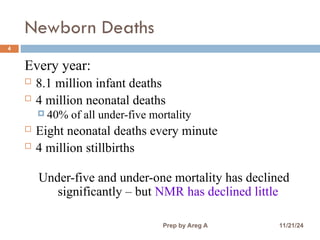
Every year:
 8.1 million infant deaths
 4 million neonatal deaths
 40% of all under-five mortality
 Eight neonatal deaths every minute
 4 million stillbirths
Under-five and under-one mortality has declined
significantly – but NMR has declined little
11/21/24
Prep by Areg A
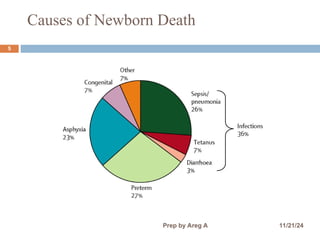
Causes of Newborn Death
5
11/21/24
Prep by Areg A
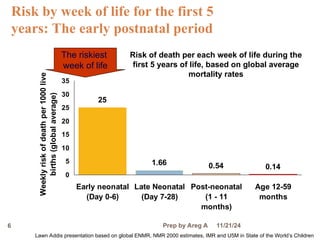
6
25
1.66 0.54 0.14
0
5
10
15
20
25
30
35
Early neonatal
(Day 0-6)
Late Neonatal
(Day 7-28)
Post-neonatal
(1 - 11
months)
Age 12-59
months
Weekly
risk
of
death
per
1000
live
births
(global
average)
Risk by week of life for the first 5
years: The early postnatal period
Lawn Addis presentation based on global ENMR, NMR 2000 estimates, IMR and U5M in State of the World’s Children
The riskiest
week of life
Risk of death per each week of life during the
first 5 years of life, based on global average
mortality rates
11/21/24
Prep by Areg A
Newborn Deaths (continued)
7
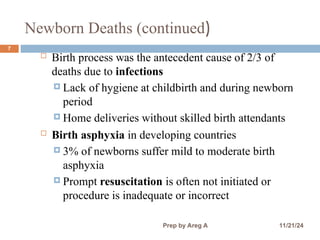
 Birth process was the antecedent cause of 2/3 of
deaths due to infections
 Lack of hygiene at childbirth and during newborn
period
 Home deliveries without skilled birth attendants
 Birth asphyxia in developing countries
 3% of newborns suffer mild to moderate birth
asphyxia
 Prompt resuscitation is often not initiated or
procedure is inadequate or incorrect
11/21/24
Prep by Areg A
Newborn Deaths (continued)
8
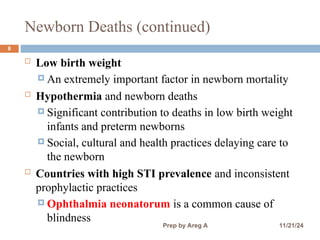
 Low birth weight
 An extremely important factor in newborn mortality
 Hypothermia and newborn deaths
 Significant contribution to deaths in low birth weight
infants and preterm newborns
 Social, cultural and health practices delaying care to
the newborn
 Countries with high STI prevalence and inconsistent
prophylactic practices
 Ophthalmia neonatorum is a common cause of
blindness
11/21/24
Prep by Areg A
Newborn Deaths (continued)
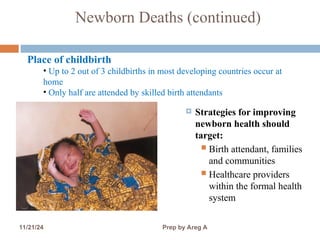
 Strategies for improving
newborn health should
target:
 Birth attendant, families
and communities
 Healthcare providers
within the formal health
system
9
Place of childbirth
• Up to 2 out of 3 childbirths in most developing countries occur at
home
• Only half are attended by skilled birth attendants
11/21/24 Prep by Areg A
Essential Newborn Care Interventions
10
 Clean childbirth and cord care
 Prevent newborn infection
 Thermal protection
 Prevent and manage newborn hypo/hyperthermia
 Initiation of breathing and resuscitation
 Early asphyxia identification and management
 Early and exclusive breastfeeding
 Started within 1 hour after childbirth 11/21/24
Prep by Areg A
IMMEDIATE NEW BORN CARE
 Immediate newborn care is the care given to a newborn
immediately after birth, while essential newborn care
includes immediate care and care throughout the
newborn period:
 Immediate newborn care is given in the delivery room
by qualified personnel and includes a brief physical
exam, Apgar scoring, and thermal care
11/21/24 Prep by Areg A 11
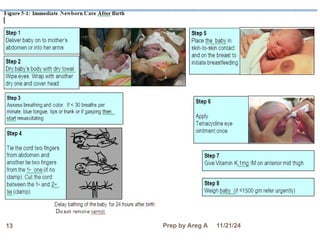
Immediate new born care steps
1. Deliver the baby on to the mothers abdomen
2. Dry and wrap the baby with dry towel, wipe eyes and cover the head
3. Asses breathing and color. If <30b/m, blue tongue, lip or trunk, if
gasping start resuscitation
4. Tie the cord two fingers from the abdomen and another tie two
fingers from the first tie if no clamp. Cut in between two ties
5. Place the baby in skin to skin contact to breast to intiate early and
exclusive breastfeeding
6. Apply tetracycline eye ointment
7. Give Vitamin K 1mg Im on anterior mid thigh
8. Immunizations and Weighing(refer urgently if <1500gm)
11/21/24 Prep by Areg A 12
13 11/21/24
Prep by Areg A
Essential Newborn Care
Interventions (continued)
14
 Eye care
 Prevent and manage ophthalmia neonatorum
 Immunization
 At birth: bacille Calmette-Guerin (BCG) vaccine, oral
poliovirus vaccine (OPV) and hepatitis B virus (HBV)
vaccine (WHO)
 Identification and management of sick newborn
 Care of preterm and/or low birth weight newborn
11/21/24
Prep by Areg A
Cleanliness to Prevent Infection
15
 Principles of cleanliness essential in both home and
health facilities childbirths
 Principles of cleanliness at childbirth
 Clean hands
 Clean perineum
 Nothing unclean introduced vaginally
 Clean delivery surface
 Cleanliness in cord clamping and cutting
 Cleanliness for cord care
11/21/24
Prep by Areg A
Cleanliness to Prevent Infection (cont’d)
16
 Infection prevention/control measures at healthcare
facilities and after discharge
 Caretaker and all others should wash hands before
touching or caring for baby
 Avoid contact with sick children and adults
11/21/24
Prep by Areg A
Cord Care
17
 Do not apply dressings or substances of any kind
 If cord bleeds, re-tie
 Usually falls off 4-7 days after birth
 Until the cord falls off, place the cord outside the
nappy to prevent contamination with urine/feces
 Wash with soap and clean water only (if soiled)
11/21/24
Prep by Areg A
Thermal Protection
18
 Newborn physiology
 Normal temperature: 36.5–37.5°C
 Hypothermia: < 36.5°C
 Stabilization period: 1st 6–12 hours after birth
 Large surface area
 Poor thermal insulation
 Small body mass to produce and conserve heat
 Inability to change posture or adjust clothing to respond to
thermal stress
 Increased hypothermia
 Newborn left wet while waiting for delivery of placenta
 Early bathing of newborn (within 24 hours)
11/21/24
Prep by Areg A
Hypothermia Prevention
19
 Deliver in a warm room
 Dry newborn thoroughly and wrap in dry, warm cloth
 Give to mother as soon as possible
 Skin-to-skin contact first few hours after childbirth
 Promotes bonding
 Enables early breastfeeding
 Check warmth by feeling newborn’s feet every 15
minutes
 Bathe after temperature is stable (after 24 hours)
11/21/24
Prep by Areg A
Early and Exclusive Breastfeeding
20
 Early contact between mother and newborn
 Enables breastfeeding
 Rooming-in policies in health facilities prevents
nosocomial infection
 Best practices
 No prelacteal feeds or other supplement
 Giving first breastfeed within one hour of birth
 Correct positioning to enable good attachment of the
newborn
 Breastfeeding on demand
 Psycho-social support to breastfeeding mother
11/21/24
Prep by Areg A
Early and Exclusive Breastfeeding
(cont.)
21
 Starting to breastfeed
 Colostrum is the first milk secreted and is important for the baby
for nutrition and disease protection
 Most babies are ready to feed 15-55 minutes after birth.
Success at the first feeding often indicates successful later
breastfeeding
 Self-attachment
 Place baby face down on mother’s abdomen
 Support baby as it moves towards breast
 Allow the baby time to mouth the nipple before taking it into the
mouth
SNL, 2004
11/21/24
Prep by Areg A
Early and Exclusive Breastfeeding
(cont.)
22
Signs that baby is getting enough milk
 The baby passes urine at least 6 times in 24 hours
 You can hear the baby swallow the feeding
 The mother’s breast feels softer after a feed
 The baby gains weight over time (after the first
week)
 The baby seems content after feeding.
SNL, 2004
11/21/24
Prep by Areg A
Breathing Initiation and
Resuscitation
23
 Spontaneous breathing (> 30 breaths/min.) in most babies
 Gentle stimulation, if at all
 Newborn resuscitation may be needed
 Fetal distress
 Thick meconium staining
 Vaginal breech deliveries
 Preterm
 Effectiveness of routine oro-nasal suctioning unknown
 Biologically plausible advantages – clear airway
 Potentially real disadvantages – cardiac arrhythmia
 Bulb suctioning preferred (but every baby should have own
bulb to prevent infection transmission)
Hamilton 1999.
11/21/24
Prep by Areg A
Immunization
24
 BCG vaccinations in all population at high risk of
tuberculosis infection
 Single dose of OPV at birth or in the two weeks
after birth
 HBV vaccination as soon as possible where
perinatal infections are common
11/21/24
Prep by Areg A
Counseling
25
Even if the mother is being discharged a few hours
after childbirth, she should be counseled about:
 Exclusive breastfeeding
 Hygiene – eye and cord care
 Thermal protection
 Danger signs and what to do about them
11/21/24
Prep by Areg A
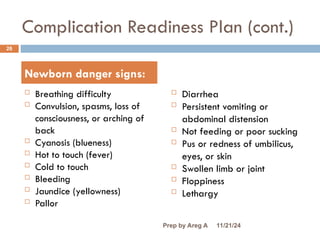
Complication Readiness Plan (cont.)
 Breathing difficulty
 Convulsion, spasms, loss of
consciousness, or arching of
back
 Cyanosis (blueness)
 Hot to touch (fever)
 Cold to touch
 Bleeding
 Jaundice (yellowness)
 Pallor
 Diarrhea
 Persistent vomiting or
abdominal distension
 Not feeding or poor sucking
 Pus or redness of umbilicus,
eyes, or skin
 Swollen limb or joint
 Floppiness
 Lethargy
26
Newborn danger signs:
11/21/24
Prep by Areg A
Immediate newborn care power point presentation .ppt

Immediate newborn care power point presentation .ppt

  • 1.
  • 2.
    Outlines  Introduction  Componentsand purposes  Resuscitation  Essential newborn care  Essential newborn care components  APGAR score 2 11/21/24 Prep by Areg A
  • 3.
    Session Objective 3  Defineimmediate new born care  Discuss the elements of early newborn care  Describe the steps of new born resuscitation  Explain the components of essential newborn care  Identify the elements of APGAR score 11/21/24 Prep by Areg A
  • 4.
    Newborn Deaths 4 Every year: 8.1 million infant deaths  4 million neonatal deaths  40% of all under-five mortality  Eight neonatal deaths every minute  4 million stillbirths Under-five and under-one mortality has declined significantly – but NMR has declined little 11/21/24 Prep by Areg A
  • 5.
    Causes of NewbornDeath 5 11/21/24 Prep by Areg A
  • 6.
    6 25 1.66 0.54 0.14 0 5 10 15 20 25 30 35 Earlyneonatal (Day 0-6) Late Neonatal (Day 7-28) Post-neonatal (1 - 11 months) Age 12-59 months Weekly risk of death per 1000 live births (global average) Risk by week of life for the first 5 years: The early postnatal period Lawn Addis presentation based on global ENMR, NMR 2000 estimates, IMR and U5M in State of the World’s Children The riskiest week of life Risk of death per each week of life during the first 5 years of life, based on global average mortality rates 11/21/24 Prep by Areg A
  • 7.
    Newborn Deaths (continued) 7 Birth process was the antecedent cause of 2/3 of deaths due to infections  Lack of hygiene at childbirth and during newborn period  Home deliveries without skilled birth attendants  Birth asphyxia in developing countries  3% of newborns suffer mild to moderate birth asphyxia  Prompt resuscitation is often not initiated or procedure is inadequate or incorrect 11/21/24 Prep by Areg A
  • 8.
    Newborn Deaths (continued) 8 Low birth weight  An extremely important factor in newborn mortality  Hypothermia and newborn deaths  Significant contribution to deaths in low birth weight infants and preterm newborns  Social, cultural and health practices delaying care to the newborn  Countries with high STI prevalence and inconsistent prophylactic practices  Ophthalmia neonatorum is a common cause of blindness 11/21/24 Prep by Areg A
  • 9.
    Newborn Deaths (continued) Strategies for improving newborn health should target:  Birth attendant, families and communities  Healthcare providers within the formal health system 9 Place of childbirth • Up to 2 out of 3 childbirths in most developing countries occur at home • Only half are attended by skilled birth attendants 11/21/24 Prep by Areg A
  • 10.
    Essential Newborn CareInterventions 10  Clean childbirth and cord care  Prevent newborn infection  Thermal protection  Prevent and manage newborn hypo/hyperthermia  Initiation of breathing and resuscitation  Early asphyxia identification and management  Early and exclusive breastfeeding  Started within 1 hour after childbirth 11/21/24 Prep by Areg A
  • 11.
    IMMEDIATE NEW BORNCARE  Immediate newborn care is the care given to a newborn immediately after birth, while essential newborn care includes immediate care and care throughout the newborn period:  Immediate newborn care is given in the delivery room by qualified personnel and includes a brief physical exam, Apgar scoring, and thermal care 11/21/24 Prep by Areg A 11
  • 12.
    Immediate new borncare steps 1. Deliver the baby on to the mothers abdomen 2. Dry and wrap the baby with dry towel, wipe eyes and cover the head 3. Asses breathing and color. If <30b/m, blue tongue, lip or trunk, if gasping start resuscitation 4. Tie the cord two fingers from the abdomen and another tie two fingers from the first tie if no clamp. Cut in between two ties 5. Place the baby in skin to skin contact to breast to intiate early and exclusive breastfeeding 6. Apply tetracycline eye ointment 7. Give Vitamin K 1mg Im on anterior mid thigh 8. Immunizations and Weighing(refer urgently if <1500gm) 11/21/24 Prep by Areg A 12
  • 13.
  • 14.
    Essential Newborn Care Interventions(continued) 14  Eye care  Prevent and manage ophthalmia neonatorum  Immunization  At birth: bacille Calmette-Guerin (BCG) vaccine, oral poliovirus vaccine (OPV) and hepatitis B virus (HBV) vaccine (WHO)  Identification and management of sick newborn  Care of preterm and/or low birth weight newborn 11/21/24 Prep by Areg A
  • 15.
    Cleanliness to PreventInfection 15  Principles of cleanliness essential in both home and health facilities childbirths  Principles of cleanliness at childbirth  Clean hands  Clean perineum  Nothing unclean introduced vaginally  Clean delivery surface  Cleanliness in cord clamping and cutting  Cleanliness for cord care 11/21/24 Prep by Areg A
  • 16.
    Cleanliness to PreventInfection (cont’d) 16  Infection prevention/control measures at healthcare facilities and after discharge  Caretaker and all others should wash hands before touching or caring for baby  Avoid contact with sick children and adults 11/21/24 Prep by Areg A
  • 17.
    Cord Care 17  Donot apply dressings or substances of any kind  If cord bleeds, re-tie  Usually falls off 4-7 days after birth  Until the cord falls off, place the cord outside the nappy to prevent contamination with urine/feces  Wash with soap and clean water only (if soiled) 11/21/24 Prep by Areg A
  • 18.
    Thermal Protection 18  Newbornphysiology  Normal temperature: 36.5–37.5°C  Hypothermia: < 36.5°C  Stabilization period: 1st 6–12 hours after birth  Large surface area  Poor thermal insulation  Small body mass to produce and conserve heat  Inability to change posture or adjust clothing to respond to thermal stress  Increased hypothermia  Newborn left wet while waiting for delivery of placenta  Early bathing of newborn (within 24 hours) 11/21/24 Prep by Areg A
  • 19.
    Hypothermia Prevention 19  Deliverin a warm room  Dry newborn thoroughly and wrap in dry, warm cloth  Give to mother as soon as possible  Skin-to-skin contact first few hours after childbirth  Promotes bonding  Enables early breastfeeding  Check warmth by feeling newborn’s feet every 15 minutes  Bathe after temperature is stable (after 24 hours) 11/21/24 Prep by Areg A
  • 20.
    Early and ExclusiveBreastfeeding 20  Early contact between mother and newborn  Enables breastfeeding  Rooming-in policies in health facilities prevents nosocomial infection  Best practices  No prelacteal feeds or other supplement  Giving first breastfeed within one hour of birth  Correct positioning to enable good attachment of the newborn  Breastfeeding on demand  Psycho-social support to breastfeeding mother 11/21/24 Prep by Areg A
  • 21.
    Early and ExclusiveBreastfeeding (cont.) 21  Starting to breastfeed  Colostrum is the first milk secreted and is important for the baby for nutrition and disease protection  Most babies are ready to feed 15-55 minutes after birth. Success at the first feeding often indicates successful later breastfeeding  Self-attachment  Place baby face down on mother’s abdomen  Support baby as it moves towards breast  Allow the baby time to mouth the nipple before taking it into the mouth SNL, 2004 11/21/24 Prep by Areg A
  • 22.
    Early and ExclusiveBreastfeeding (cont.) 22 Signs that baby is getting enough milk  The baby passes urine at least 6 times in 24 hours  You can hear the baby swallow the feeding  The mother’s breast feels softer after a feed  The baby gains weight over time (after the first week)  The baby seems content after feeding. SNL, 2004 11/21/24 Prep by Areg A
  • 23.
    Breathing Initiation and Resuscitation 23 Spontaneous breathing (> 30 breaths/min.) in most babies  Gentle stimulation, if at all  Newborn resuscitation may be needed  Fetal distress  Thick meconium staining  Vaginal breech deliveries  Preterm  Effectiveness of routine oro-nasal suctioning unknown  Biologically plausible advantages – clear airway  Potentially real disadvantages – cardiac arrhythmia  Bulb suctioning preferred (but every baby should have own bulb to prevent infection transmission) Hamilton 1999. 11/21/24 Prep by Areg A
  • 24.
    Immunization 24  BCG vaccinationsin all population at high risk of tuberculosis infection  Single dose of OPV at birth or in the two weeks after birth  HBV vaccination as soon as possible where perinatal infections are common 11/21/24 Prep by Areg A
  • 25.
    Counseling 25 Even if themother is being discharged a few hours after childbirth, she should be counseled about:  Exclusive breastfeeding  Hygiene – eye and cord care  Thermal protection  Danger signs and what to do about them 11/21/24 Prep by Areg A
  • 26.
    Complication Readiness Plan(cont.)  Breathing difficulty  Convulsion, spasms, loss of consciousness, or arching of back  Cyanosis (blueness)  Hot to touch (fever)  Cold to touch  Bleeding  Jaundice (yellowness)  Pallor  Diarrhea  Persistent vomiting or abdominal distension  Not feeding or poor sucking  Pus or redness of umbilicus, eyes, or skin  Swollen limb or joint  Floppiness  Lethargy 26 Newborn danger signs: 11/21/24 Prep by Areg A

Editor's Notes

  • #4 Newborn care is important because major causes of newborn death are birth asphyxia and infection. A skilled attendant at childbirth who can assess the newborn correctly, perform essential interventions and does not delay resuscitation if indicated, is crucial. The attendant should also be able to care for or transport a sick newborn if needed. Diarrhea and immunization programs account for the drop in IMR, but NMR remains high
  • #18 Newborns are uniquely susceptible to hypothermia because they have a large body surface area, which helps heat loss; they lack insulation; and lack the body mass to produce and save heat. They are also dependent on caregivers to keep them warm and dry. Care of the newborn at childbirth includes keeping it warm by drying immediately after birth and delaying a bath until the temperature is stabilized.
  • #23 Remember that every newborn should be considered at risk for needing resuscitation (i.e., the attendant should be prepared at every childbirth). Certain conditions may increase the likelihood that resuscitation will be necessary. For example, if there is evidence of fetal distress during the labor or childbirth, thick meconium, breech delivery or a preterm birth.