INTRODUCTION TO
CONCEPT OF OBSTETRICS
NURSING
SRIDEVI D
MSc Nursing (OBG)
2/16/2018 Sridevi Devaraj 1
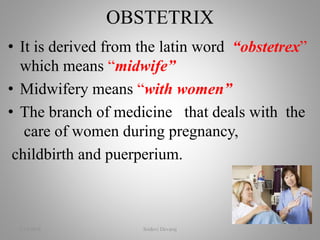
• It is derived from the latin word “obstetrex”
which means “midwife”
• Midwifery means “with women”
• The branch of medicine that deals with the
care of women during pregnancy,
childbirth and puerperium.
OBSTETRIX
2/16/2018 Sridevi Devaraj 2
• The branch of physiology and medicine
which deals with the functions and diseases
specific to female reproductive system
including breasts.
• {study of diseases particular to female
reproductive organs, including breasts. }
GYNAECOLOGY
2/16/2018 Sridevi Devaraj 3
MIDWIFE
“Midwife is a person who, having been regularly
admitted to a midwifery educational programme, duly
recognized in the country in which it is located ,has
successfully completed the prescribed course or studies in
midwifery and has acquired the requisite qualification to be
registered and legally licensed to practice midwifery.”
- International confederation of midwifes 1992
2/16/2018 Sridevi Devaraj 4
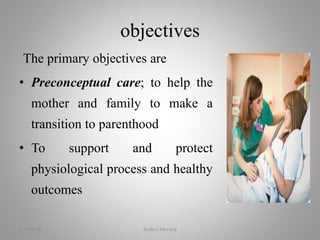
The primary objectives are
• Preconceptual care; to help the
mother and family to make a
transition to parenthood
• To support and protect
physiological process and healthy
outcomes
objectives
2/16/2018 Sridevi Devaraj 5
• To provide care of women during three
trimesters of pregnancy and the puerperium to
provide comfort .
• To prepare and educate all expectant mothers
• To provide education about the care of the
child and about their growth and development
2/16/2018 Sridevi Devaraj 6
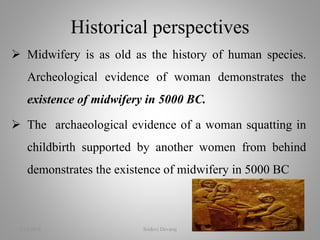
 Midwifery is as old as the history of human species.
Archeological evidence of woman demonstrates the
existence of midwifery in 5000 BC.
 The archaeological evidence of a woman squatting in
childbirth supported by another women from behind
demonstrates the existence of midwifery in 5000 BC
Historical perspectives
2/16/2018 Sridevi Devaraj 7
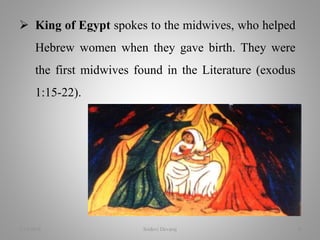
 King of Egypt spokes to the midwives, who helped
Hebrew women when they gave birth. They were
the first midwives found in the Literature (exodus
1:15-22).
2/16/2018 Sridevi Devaraj 8
• In Egypt and in most Muslim countries women
were attended only by women, men were
excluded from the places where the women
were labouring.
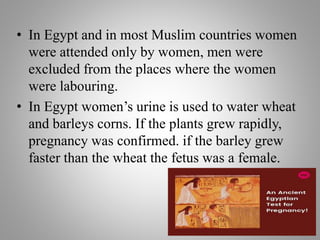
• In Egypt women’s urine is used to water wheat
and barleys corns. If the plants grew rapidly,
pregnancy was confirmed. if the barley grew
faster than the wheat the fetus was a female.
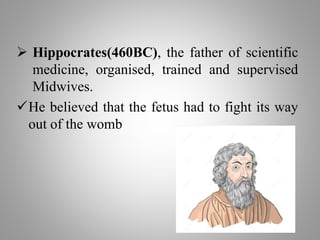
 Hippocrates(460BC), the father of scientific
medicine, organised, trained and supervised
Midwives.
He believed that the fetus had to fight its way
out of the womb
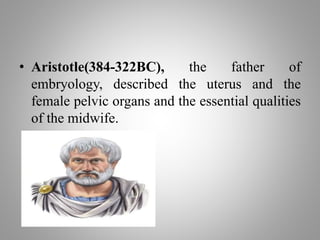
• Aristotle(384-322BC), the father of
embryology, described the uterus and the
female pelvic organs and the essential qualities
of the midwife.
 Soranus in the second century was the
first to specialize in obstetrics and
gynecology. His book was used for
1,500 years. He used vaginal
speculum, advised on cord care,
 Leonardo da Vinci(1452-1519) made
anatomical drawings of pregnant
uterus
2/16/2018 Sridevi Devaraj 12
 In 1513, the first book on midwifery was
printed in Germany, based on the teachings
of Soranus.
 In 1540, the book was translated into
English.
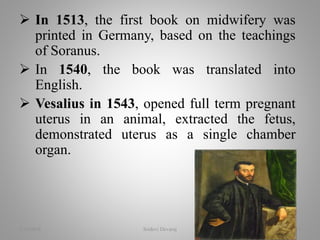
 Vesalius in 1543, opened full term pregnant
uterus in an animal, extracted the fetus,
demonstrated uterus as a single chamber
organ.
2/16/2018 Sridevi Devaraj 13
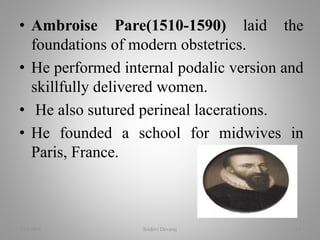
• Ambroise Pare(1510-1590) laid the
foundations of modern obstetrics.
• He performed internal podalic version and
skillfully delivered women.
• He also sutured perineal lacerations.
• He founded a school for midwives in
Paris, France.
2/16/2018 Sridevi Devaraj 14
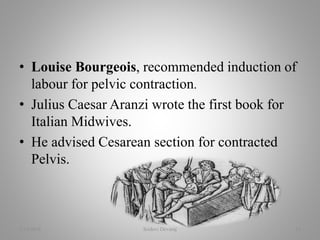
• Louise Bourgeois, recommended induction of
labour for pelvic contraction.
• Julius Caesar Aranzi wrote the first book for
Italian Midwives.
• He advised Cesarean section for contracted
Pelvis.
2/16/2018 Sridevi Devaraj 15
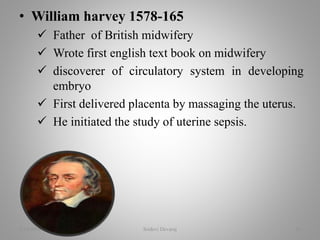
• William harvey 1578-165
 Father of British midwifery
 Wrote first english text book on midwifery
 discoverer of circulatory system in developing
embryo
 First delivered placenta by massaging the uterus.
 He initiated the study of uterine sepsis.
2/16/2018 Sridevi Devaraj 16
• Francosis mauriceau 1637-1657
o observed puerperal fever was epidemic
o described mechanism of breech extraction
o advocated delivery in bed rather than on stool
• The French King Louis XIV in 1663, employed a
Paris surgeon to attend one of his mistresses in
labour and pleased with the result.
• the King honored the surgeon with the title
'accoucheur'
• 'accoucheur' a person who assists women in
childbirth
• The french 'accoucheur‘ build a school of
midwifery.
• Mauriceau was the greatest physician of the
17th century. .He described the attitude of the
fetus in uterus
• Chamberlen in 1675, designed obstetric
forceps.
• William Smellie (1697-1763) is called the
Father of British Midwifery.
• He explained labour to be a mechanical
process and described pelvimetry,
cephalometry and forceps delivery of the after
coming head of a breech.
• He devised a lock for the obstetric forceps
• In 1772, John Leake replaced the obstetric
stool by special delivery beds.
• Charles White in 1773, stated that puerperal
fever was infectious. He used lime as
disinfectant and to clean linen, isolation,
adequate ventilation and setting posture to
facilitate drainage.
• Fielding Ould (1710-1789) described the
mechanism of normal labour and performed the
first episiotomy.
• Laennec in 1816, invented a stethoscope
• Francois in 1818, first recognized fetal heart
sounds in the pregnant uterus.
• James young Simpson in 1847 used
chloroform first in obstetrics for anesthesia.
• Semmelweis in 1861, demonstrated the cause
of puerperal sepsis and suggested preventive
measures.
• Florence Nightingale in 1862, organized
a small training school in connection with
King's College Hospital, where she
conducted training for midwives.
• Louis Pasteur in 1879, wrote a thesis on
puerperal sepsis demonstrating the presence
of streptococci in the lochia, blood.
• Spencer and Ballantyne promoted the
concept of antenatal care for pregnant
women.
• The first antenatal clinic was started
about the time of the First World War.
• The French obstetrician Mauricieac first
reported the caesarean section in1668.
• In 1876 Porro performed subtotal
hysterectomy.
• Max Sanger in 1882, first sutured the
abdominal wall.
2/16/2018 Sridevi Devaraj 26
• In 1912, Kronig introduced lower segmental
vertical incision.
• Munro Kerr in 1926 introduced the present
technique of LSCS and popularized it
2/16/2018 Sridevi Devaraj 27
19- 20th century
• Up to 1935 the midwives attended 50% of birth
and it slowly declined to 12.5%.
• The doctors convinced people that the midwives
were dirty, illiterate, and ignorant and the mothers
would be safe only in the hands of physicians.
• Gradually by the 20th century the midwives lost
their importance in the society.
• In the 20th century the physicians started being
trained in the specialty of obstetrics.
• Hospital is considered as a good place for birth.
• Birth evolved from a physiologic event in to a
medical procedure.
• It was projected as a dangerous process because
of pathological conditions requiring a program of
routine medical interventions including
Anesthesia, episiotomy, and instrumental delivery.
• Following reformation in 16th century the Church of
England accepted the responsibility to issue the
License of midwives to practice
• The chair of midwifery was created in Edenburgh in
1726 to give instructions to the midwives.
• Courses of instructions were given to the midwives
through out Britain and some Hospitals issued
certificates.
Development of maternity service
2/16/2018 Sridevi Devaraj 30
• In 1756 Dr John Douglas recommended that proper
instructions to be given to the midwives and an
examination to be held before certificate to practice was
given.
• The Ladies’ Obstetrical college London was founded in
1864.
• In 1902, the first English midwives’ act was passed and
state registration of midwives became mandatory by law.
• From 1700 to 1800, the time of rapid development.
• In ancient India the untrained dais were
responsible for conducting delivery
• This system leads to various
complications & increased maternal and
infant deaths.
• 1885 – An association for medical aid by
the women of India was established by the
Countess of Dufferin.
• Training of dais were established in 1903
Development of midwifery in India
2/16/2018 Sridevi Devaraj 32
• 1918 – Lady Reading Health School was started in
Delhi, offering health visitors course, which was another
stepping stone in MCH Services
• 1921 – Lady Chelmsford League was formed in India
for developing maternity and child welfare services.
• 1931 – The Indian Red Cross society established MCH
Bureau in association with the Lady Chelmsford League
& Victories memorial Scholarship Fund and co-
ordinated the MCH work throughout the country
• Madras was the first state then to set up a
separate section for maternal and child welfare
in the public health department under the
charge of an Assistant Director of Public
Health. It was again Madras state which first
attempted to replace by the better qualified
personnel such as midwives and nurse
midwives.
2/16/2018 Sridevi Devaraj 34
• 1938 – Indian Research Fund Association was
established which formed a committee that
undertook the investigation into the incidence
and cause of Maternal and infant morbidity
and mortality. Sir A. Mudaliar was the key
person of the committee.
• 1911 ANM programmes
• 1931 the Indian red cross society established
MCH bureau
• 1940’s Rooming in
• Nurses league in 1946 had two boards of
nursing education ,
The mid India board of nursing education
and the board of nursing education.
• 1947: Indian nursing council enacted
• INC constituted in 1949. STD’s of nursing
education.
• 1954: Shetty committee was appointed by the
government of India to strengthen the training and
positioning of Auxiliary nurse midwife.
• 1960’s obstetric care to maternity care
• 1959-1961-Mudaliar committee recommended
that one midwife was to be appointed for every
100 births in a hospital setup and one midwife for
a population of 5000 in a community.
• 1972: A committee of multipurpose health
workers (Kartar Singh Committee)
• 1973: Training for multipurpose health
workers male and female was started.
• 1978: The Alma-Ata Declaration identified
eight essential elements of primary health care.
MCH and Family panning were one of the
major elements.
• 1986-1987: The Ministry of health and Family
welfare government of India, set up a
committee knows as Bajaj Committee which
laid emphasis on health related courses ANM
and vocational education after X11 grade in
school.
• 1992: The child survival and safe motherhood
(CSSM) program was launched by the government of
India
• 1997 Reproductive child health(RCH) shifted the
focus of health policy.
• The RCH program emphasizes promotion of maternal
care to ensure safe mother hood increases aspects of
contraceptive care, to prevent unwanted pregnancies.
Prevention and treatment of reproductive tract
infection.
• 2006: An extension of RCH the government
launched national rural health mission. (NRHM)
• The country also strives to achieve Millennium
Development Goals (MDG) 4 and 5. MDG 4
strives to reduce child mortality (the under five
mortality rate)with the targets to reduce in to
Two-Thirds between 1990-and 2015.
• MDG 5 aims to improve maternal health and
reduce MMR by three- fourth by 2015.
Health care professionals available
at present
• Basic health worker-auxiliary nurse
• RN,RM Post Graduate nurses and PBBSc nurses
• Independent nurse midwifery program (INP) Course
• Nurse midwifery practitioner(NP)
• Skilled birth attendant(SBA): They are accredited
health professionals such as midwives ,doctors, and
nurses who have been educated and trained in
obstetrical skills needed to manage normal
uncomplicated pregnancy, WHO advocates skilled
care at every birth.
TRENDS IN MATERNAL
HEALTH NURSING
• Midwifery a separate profession
• Entry to midwifery practice- a degree in
midwifery from University
• Epidural analgesia in labour
• Birthing centers
• Team midwifery practice
• Family centered care:-Family unity, Counselling
etc.
• Women –friendly services
• Complementary and alternative medicine-
Aroma Therapy, Music Therapy, Acupuncture,
Acupressure, Hot Packs, Yoga and Meditation,
Massages
• Natural child birth- Without medication
• Water birth
• Nursing was separated in to 3 specialties:- One
nurse caring for the mother during labour and
delivery ,Another handling post partum
mothers, and third caring for the babies.
• In 1940 rooming in concept was devised.
• Reduction in neonatal infection and greater
breast feeding success.
• 1.Technological advances
• sophisticated computers reduced the “hands on
care ‘so also is the quality nursing care.
• Fetal monitoring has progressed from the use of
fetoscope to electronic fetal monitoring
• Experts believe that in coming years births are
going to be by high- tech innovations resulting in
low perinatal mortality and morbidity. So in
future there are challenges for nurses
2. Increased cost of high- tech care
3. Changing pattern of child birth:- Working women,
Early and late marriage practice etc leads to
complications during pregnancy such as preterm
delivery, LBW etc.
4. Perinatal risk factors-Eg.AIDS, LBW
5. Rising cesarean birth rates
6. Early discharge
7. Role of fathers
• Decreased length of hospital stay: - leads to ill
health of the mother, also challenge to the nurse to
prepare for early discharge
• Higher patient Acuities;-
• Multiple socio economic problems coupled with
lack of knowledge contributed to increasing
number of women who have neglected their health.
• Lack of facilities in the rural areas:-about 30% of
all births in India are conducted by Dais. This
results in lack of detection of prenatal problems
early enough for adequate management lack of
facilities to deal with child birth complications and
adequate reporting of morbidity.
• Changes in maternal newborn nursing:-
• Child birth as a familial process with less
technological interference
• Natural birth process
• Mother Baby bonding
• Family centered care
• Single room maternity care LDRP (Labour,
Delivery, Recovery and Postpartum care) Mother
labours , delivers and recovers in the same room same
bed.
• Economical issues and trends
• Women of child bearing age are employed
outside the home than ever before.
• The cost of things was raised .
Trends related to technology
• Fertility concerns: Pregnancy can be planned,
infertile women or men can be become parents (
IVF, artificial insemination, surrogacy )and
unwanted pregnancies can be prevented.
• Genetic counseling : Look at the genetic
structures of individuals and predict the
occurrence of gene related disorder.
• Diagnostic testing :The condition of the
mother and baby can be assessed more closely
then even before. Technology helps to early
detection of diagnosis and treatment of the
problems.
Demographic issues and trends
1.shift in population distribution Shift of health
care services from rural to urban areas.
2. Availability of maternity care Services are
extended from the adolescence to motherhood.
family centered care is focused.
3.Increased cultural diversity New population
introduces new concerns about beliefs and
practices of childbirth.
4.Vital statistics Maternal mortality rate is
reduced (due to improvement In medical
management, early detection), Birth rate is
increased.
Trends in health care settings
1.Managed care
2.Community based care (technologies available
in home setting same as health care settings).
3.Shortening of hospital stay.
Other trends
1. Increase high risk pregnancies Alcoholism –
abortion, MR,LBWB.
2. High cost of health care
3.Family centered care It foster family unity
while maintaining the physical safety of the
child-bearing unit-the mother, father and the
infant.
CURRENT
PROBLEMS/CHALLENGES
• Decreased length of Hospital Stay
• Lack of facilities in the rural areas
• Family- centered care
• Labor, delivery, recovery and postpartum
care(LDRP)
Historical perspectives and current trends

Historical perspectives and current trends

  • 1.
    INTRODUCTION TO CONCEPT OFOBSTETRICS NURSING SRIDEVI D MSc Nursing (OBG) 2/16/2018 Sridevi Devaraj 1
  • 2.
    • It isderived from the latin word “obstetrex” which means “midwife” • Midwifery means “with women” • The branch of medicine that deals with the care of women during pregnancy, childbirth and puerperium. OBSTETRIX 2/16/2018 Sridevi Devaraj 2
  • 3.
    • The branchof physiology and medicine which deals with the functions and diseases specific to female reproductive system including breasts. • {study of diseases particular to female reproductive organs, including breasts. } GYNAECOLOGY 2/16/2018 Sridevi Devaraj 3
  • 4.
    MIDWIFE “Midwife is aperson who, having been regularly admitted to a midwifery educational programme, duly recognized in the country in which it is located ,has successfully completed the prescribed course or studies in midwifery and has acquired the requisite qualification to be registered and legally licensed to practice midwifery.” - International confederation of midwifes 1992 2/16/2018 Sridevi Devaraj 4
  • 5.
    The primary objectivesare • Preconceptual care; to help the mother and family to make a transition to parenthood • To support and protect physiological process and healthy outcomes objectives 2/16/2018 Sridevi Devaraj 5
  • 6.
    • To providecare of women during three trimesters of pregnancy and the puerperium to provide comfort . • To prepare and educate all expectant mothers • To provide education about the care of the child and about their growth and development 2/16/2018 Sridevi Devaraj 6
  • 7.
     Midwifery isas old as the history of human species. Archeological evidence of woman demonstrates the existence of midwifery in 5000 BC.  The archaeological evidence of a woman squatting in childbirth supported by another women from behind demonstrates the existence of midwifery in 5000 BC Historical perspectives 2/16/2018 Sridevi Devaraj 7
  • 8.
     King ofEgypt spokes to the midwives, who helped Hebrew women when they gave birth. They were the first midwives found in the Literature (exodus 1:15-22). 2/16/2018 Sridevi Devaraj 8
  • 9.
    • In Egyptand in most Muslim countries women were attended only by women, men were excluded from the places where the women were labouring. • In Egypt women’s urine is used to water wheat and barleys corns. If the plants grew rapidly, pregnancy was confirmed. if the barley grew faster than the wheat the fetus was a female.
  • 10.
     Hippocrates(460BC), thefather of scientific medicine, organised, trained and supervised Midwives. He believed that the fetus had to fight its way out of the womb
  • 11.
    • Aristotle(384-322BC), thefather of embryology, described the uterus and the female pelvic organs and the essential qualities of the midwife.
  • 12.
     Soranus inthe second century was the first to specialize in obstetrics and gynecology. His book was used for 1,500 years. He used vaginal speculum, advised on cord care,  Leonardo da Vinci(1452-1519) made anatomical drawings of pregnant uterus 2/16/2018 Sridevi Devaraj 12
  • 13.
     In 1513,the first book on midwifery was printed in Germany, based on the teachings of Soranus.  In 1540, the book was translated into English.  Vesalius in 1543, opened full term pregnant uterus in an animal, extracted the fetus, demonstrated uterus as a single chamber organ. 2/16/2018 Sridevi Devaraj 13
  • 14.
    • Ambroise Pare(1510-1590)laid the foundations of modern obstetrics. • He performed internal podalic version and skillfully delivered women. • He also sutured perineal lacerations. • He founded a school for midwives in Paris, France. 2/16/2018 Sridevi Devaraj 14
  • 15.
    • Louise Bourgeois,recommended induction of labour for pelvic contraction. • Julius Caesar Aranzi wrote the first book for Italian Midwives. • He advised Cesarean section for contracted Pelvis. 2/16/2018 Sridevi Devaraj 15
  • 16.
    • William harvey1578-165  Father of British midwifery  Wrote first english text book on midwifery  discoverer of circulatory system in developing embryo  First delivered placenta by massaging the uterus.  He initiated the study of uterine sepsis. 2/16/2018 Sridevi Devaraj 16
  • 17.
    • Francosis mauriceau1637-1657 o observed puerperal fever was epidemic o described mechanism of breech extraction o advocated delivery in bed rather than on stool
  • 18.
    • The FrenchKing Louis XIV in 1663, employed a Paris surgeon to attend one of his mistresses in labour and pleased with the result. • the King honored the surgeon with the title 'accoucheur' • 'accoucheur' a person who assists women in childbirth • The french 'accoucheur‘ build a school of midwifery.
  • 19.
    • Mauriceau wasthe greatest physician of the 17th century. .He described the attitude of the fetus in uterus • Chamberlen in 1675, designed obstetric forceps.
  • 20.
    • William Smellie(1697-1763) is called the Father of British Midwifery. • He explained labour to be a mechanical process and described pelvimetry, cephalometry and forceps delivery of the after coming head of a breech. • He devised a lock for the obstetric forceps
  • 21.
    • In 1772,John Leake replaced the obstetric stool by special delivery beds. • Charles White in 1773, stated that puerperal fever was infectious. He used lime as disinfectant and to clean linen, isolation, adequate ventilation and setting posture to facilitate drainage.
  • 22.
    • Fielding Ould(1710-1789) described the mechanism of normal labour and performed the first episiotomy. • Laennec in 1816, invented a stethoscope • Francois in 1818, first recognized fetal heart sounds in the pregnant uterus.
  • 23.
    • James youngSimpson in 1847 used chloroform first in obstetrics for anesthesia. • Semmelweis in 1861, demonstrated the cause of puerperal sepsis and suggested preventive measures.
  • 24.
    • Florence Nightingalein 1862, organized a small training school in connection with King's College Hospital, where she conducted training for midwives. • Louis Pasteur in 1879, wrote a thesis on puerperal sepsis demonstrating the presence of streptococci in the lochia, blood.
  • 25.
    • Spencer andBallantyne promoted the concept of antenatal care for pregnant women. • The first antenatal clinic was started about the time of the First World War.
  • 26.
    • The Frenchobstetrician Mauricieac first reported the caesarean section in1668. • In 1876 Porro performed subtotal hysterectomy. • Max Sanger in 1882, first sutured the abdominal wall. 2/16/2018 Sridevi Devaraj 26
  • 27.
    • In 1912,Kronig introduced lower segmental vertical incision. • Munro Kerr in 1926 introduced the present technique of LSCS and popularized it 2/16/2018 Sridevi Devaraj 27
  • 28.
    19- 20th century •Up to 1935 the midwives attended 50% of birth and it slowly declined to 12.5%. • The doctors convinced people that the midwives were dirty, illiterate, and ignorant and the mothers would be safe only in the hands of physicians. • Gradually by the 20th century the midwives lost their importance in the society.
  • 29.
    • In the20th century the physicians started being trained in the specialty of obstetrics. • Hospital is considered as a good place for birth. • Birth evolved from a physiologic event in to a medical procedure. • It was projected as a dangerous process because of pathological conditions requiring a program of routine medical interventions including Anesthesia, episiotomy, and instrumental delivery.
  • 30.
    • Following reformationin 16th century the Church of England accepted the responsibility to issue the License of midwives to practice • The chair of midwifery was created in Edenburgh in 1726 to give instructions to the midwives. • Courses of instructions were given to the midwives through out Britain and some Hospitals issued certificates. Development of maternity service 2/16/2018 Sridevi Devaraj 30
  • 31.
    • In 1756Dr John Douglas recommended that proper instructions to be given to the midwives and an examination to be held before certificate to practice was given. • The Ladies’ Obstetrical college London was founded in 1864. • In 1902, the first English midwives’ act was passed and state registration of midwives became mandatory by law. • From 1700 to 1800, the time of rapid development.
  • 32.
    • In ancientIndia the untrained dais were responsible for conducting delivery • This system leads to various complications & increased maternal and infant deaths. • 1885 – An association for medical aid by the women of India was established by the Countess of Dufferin. • Training of dais were established in 1903 Development of midwifery in India 2/16/2018 Sridevi Devaraj 32
  • 33.
    • 1918 –Lady Reading Health School was started in Delhi, offering health visitors course, which was another stepping stone in MCH Services • 1921 – Lady Chelmsford League was formed in India for developing maternity and child welfare services. • 1931 – The Indian Red Cross society established MCH Bureau in association with the Lady Chelmsford League & Victories memorial Scholarship Fund and co- ordinated the MCH work throughout the country
  • 34.
    • Madras wasthe first state then to set up a separate section for maternal and child welfare in the public health department under the charge of an Assistant Director of Public Health. It was again Madras state which first attempted to replace by the better qualified personnel such as midwives and nurse midwives. 2/16/2018 Sridevi Devaraj 34
  • 35.
    • 1938 –Indian Research Fund Association was established which formed a committee that undertook the investigation into the incidence and cause of Maternal and infant morbidity and mortality. Sir A. Mudaliar was the key person of the committee.
  • 36.
    • 1911 ANMprogrammes • 1931 the Indian red cross society established MCH bureau • 1940’s Rooming in • Nurses league in 1946 had two boards of nursing education , The mid India board of nursing education and the board of nursing education. • 1947: Indian nursing council enacted • INC constituted in 1949. STD’s of nursing education.
  • 37.
    • 1954: Shettycommittee was appointed by the government of India to strengthen the training and positioning of Auxiliary nurse midwife. • 1960’s obstetric care to maternity care • 1959-1961-Mudaliar committee recommended that one midwife was to be appointed for every 100 births in a hospital setup and one midwife for a population of 5000 in a community.
  • 38.
    • 1972: Acommittee of multipurpose health workers (Kartar Singh Committee) • 1973: Training for multipurpose health workers male and female was started. • 1978: The Alma-Ata Declaration identified eight essential elements of primary health care. MCH and Family panning were one of the major elements.
  • 39.
    • 1986-1987: TheMinistry of health and Family welfare government of India, set up a committee knows as Bajaj Committee which laid emphasis on health related courses ANM and vocational education after X11 grade in school.
  • 40.
    • 1992: Thechild survival and safe motherhood (CSSM) program was launched by the government of India • 1997 Reproductive child health(RCH) shifted the focus of health policy. • The RCH program emphasizes promotion of maternal care to ensure safe mother hood increases aspects of contraceptive care, to prevent unwanted pregnancies. Prevention and treatment of reproductive tract infection.
  • 41.
    • 2006: Anextension of RCH the government launched national rural health mission. (NRHM) • The country also strives to achieve Millennium Development Goals (MDG) 4 and 5. MDG 4 strives to reduce child mortality (the under five mortality rate)with the targets to reduce in to Two-Thirds between 1990-and 2015. • MDG 5 aims to improve maternal health and reduce MMR by three- fourth by 2015.
  • 42.
    Health care professionalsavailable at present • Basic health worker-auxiliary nurse • RN,RM Post Graduate nurses and PBBSc nurses • Independent nurse midwifery program (INP) Course • Nurse midwifery practitioner(NP) • Skilled birth attendant(SBA): They are accredited health professionals such as midwives ,doctors, and nurses who have been educated and trained in obstetrical skills needed to manage normal uncomplicated pregnancy, WHO advocates skilled care at every birth.
  • 43.
  • 44.
    • Midwifery aseparate profession • Entry to midwifery practice- a degree in midwifery from University • Epidural analgesia in labour • Birthing centers • Team midwifery practice • Family centered care:-Family unity, Counselling etc.
  • 45.
    • Women –friendlyservices • Complementary and alternative medicine- Aroma Therapy, Music Therapy, Acupuncture, Acupressure, Hot Packs, Yoga and Meditation, Massages • Natural child birth- Without medication • Water birth
  • 46.
    • Nursing wasseparated in to 3 specialties:- One nurse caring for the mother during labour and delivery ,Another handling post partum mothers, and third caring for the babies. • In 1940 rooming in concept was devised. • Reduction in neonatal infection and greater breast feeding success.
  • 47.
    • 1.Technological advances •sophisticated computers reduced the “hands on care ‘so also is the quality nursing care. • Fetal monitoring has progressed from the use of fetoscope to electronic fetal monitoring • Experts believe that in coming years births are going to be by high- tech innovations resulting in low perinatal mortality and morbidity. So in future there are challenges for nurses
  • 48.
    2. Increased costof high- tech care 3. Changing pattern of child birth:- Working women, Early and late marriage practice etc leads to complications during pregnancy such as preterm delivery, LBW etc. 4. Perinatal risk factors-Eg.AIDS, LBW 5. Rising cesarean birth rates 6. Early discharge 7. Role of fathers
  • 49.
    • Decreased lengthof hospital stay: - leads to ill health of the mother, also challenge to the nurse to prepare for early discharge • Higher patient Acuities;- • Multiple socio economic problems coupled with lack of knowledge contributed to increasing number of women who have neglected their health. • Lack of facilities in the rural areas:-about 30% of all births in India are conducted by Dais. This results in lack of detection of prenatal problems early enough for adequate management lack of facilities to deal with child birth complications and adequate reporting of morbidity.
  • 50.
    • Changes inmaternal newborn nursing:- • Child birth as a familial process with less technological interference • Natural birth process • Mother Baby bonding • Family centered care • Single room maternity care LDRP (Labour, Delivery, Recovery and Postpartum care) Mother labours , delivers and recovers in the same room same bed.
  • 51.
    • Economical issuesand trends • Women of child bearing age are employed outside the home than ever before. • The cost of things was raised .
  • 52.
    Trends related totechnology • Fertility concerns: Pregnancy can be planned, infertile women or men can be become parents ( IVF, artificial insemination, surrogacy )and unwanted pregnancies can be prevented. • Genetic counseling : Look at the genetic structures of individuals and predict the occurrence of gene related disorder.
  • 53.
    • Diagnostic testing:The condition of the mother and baby can be assessed more closely then even before. Technology helps to early detection of diagnosis and treatment of the problems.
  • 54.
    Demographic issues andtrends 1.shift in population distribution Shift of health care services from rural to urban areas. 2. Availability of maternity care Services are extended from the adolescence to motherhood. family centered care is focused.
  • 55.
    3.Increased cultural diversityNew population introduces new concerns about beliefs and practices of childbirth. 4.Vital statistics Maternal mortality rate is reduced (due to improvement In medical management, early detection), Birth rate is increased.
  • 56.
    Trends in healthcare settings 1.Managed care 2.Community based care (technologies available in home setting same as health care settings). 3.Shortening of hospital stay.
  • 57.
    Other trends 1. Increasehigh risk pregnancies Alcoholism – abortion, MR,LBWB. 2. High cost of health care 3.Family centered care It foster family unity while maintaining the physical safety of the child-bearing unit-the mother, father and the infant.
  • 58.
    CURRENT PROBLEMS/CHALLENGES • Decreased lengthof Hospital Stay • Lack of facilities in the rural areas • Family- centered care • Labor, delivery, recovery and postpartum care(LDRP)

Editor's Notes

  • #3 The art of assisting women in childbirth
  • #8 Genesis 35:17 fear not rachel , it is another boy in bible.