Learning Objectives
By theend of this session, students will be able to:
• Describe the magnitude and trends of perinatal,
newborn, and child health problems.
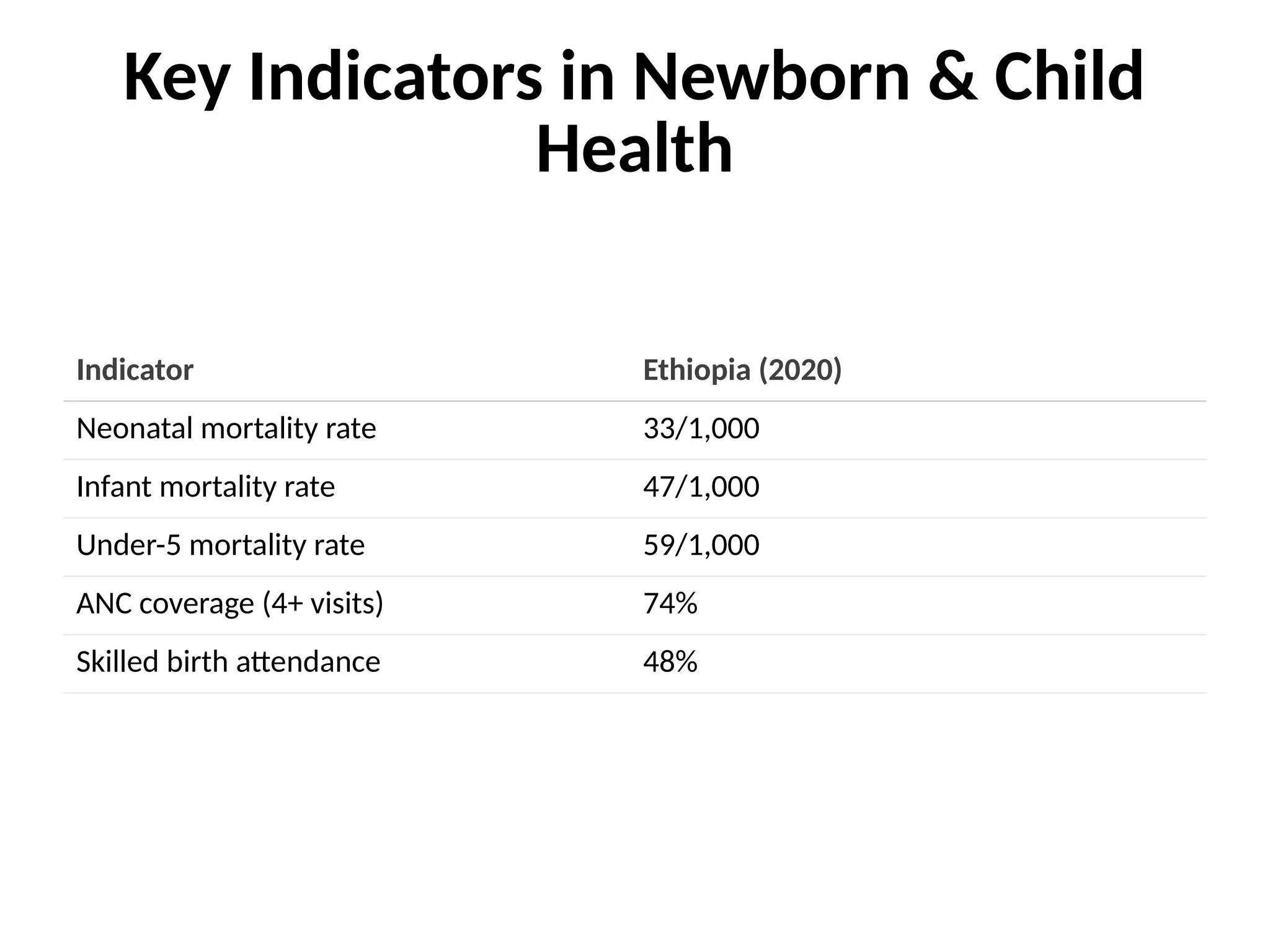
• Explain key indicators in newborn and child
health.
• Discuss neonatal survival strategies (ENC,
resuscitation, KMC, breastfeeding).
• Identify key interventions (antibiotics,
corticosteroids, immunization).
7
Essential Newborn Care(ENC)
• Majority of babies born healthy and at term
• Care during first hours, days and weeks of life
determine whether they remain healthy
• Basic care given to support survival and wellbeing to
the newborn is called ENC
• It includes immediate care at birth, care during the
first day and up to 28 days
8.
8
Four basic needsof ALL newborns
• To breath normally
• To be protected
• To be warm
• To be fed
9.
9
Essential Newborn CareInterventions
• Clean childbirth and cord care
– Prevent newborn infection
• Thermal protection
– Prevent & manage newborn hypo/hyperthermia
• Early and exclusive breastfeeding
– Started within 1 hour after childbirth
• Initiation of breathing and resuscitation
– Early asphyxia identification and management
10.
10
Care of thebaby at the time of
birth
(Until around 1 hour after birth)
• Provide routine care at birth for all
newborns
• Identify and manage newborns who may
need special care
11.
11
Routine Care
• Callout time of birth
• Place baby on mother’s abdomen
• Dry baby with warm clean sheet
• Wipe mouth and nose with clean cloth
• Assess baby’s breathing while drying
• Clamp cord after 1-3 min, cut with sterile
instrument, put sterile tie
• Put identity label on the baby
12.
12
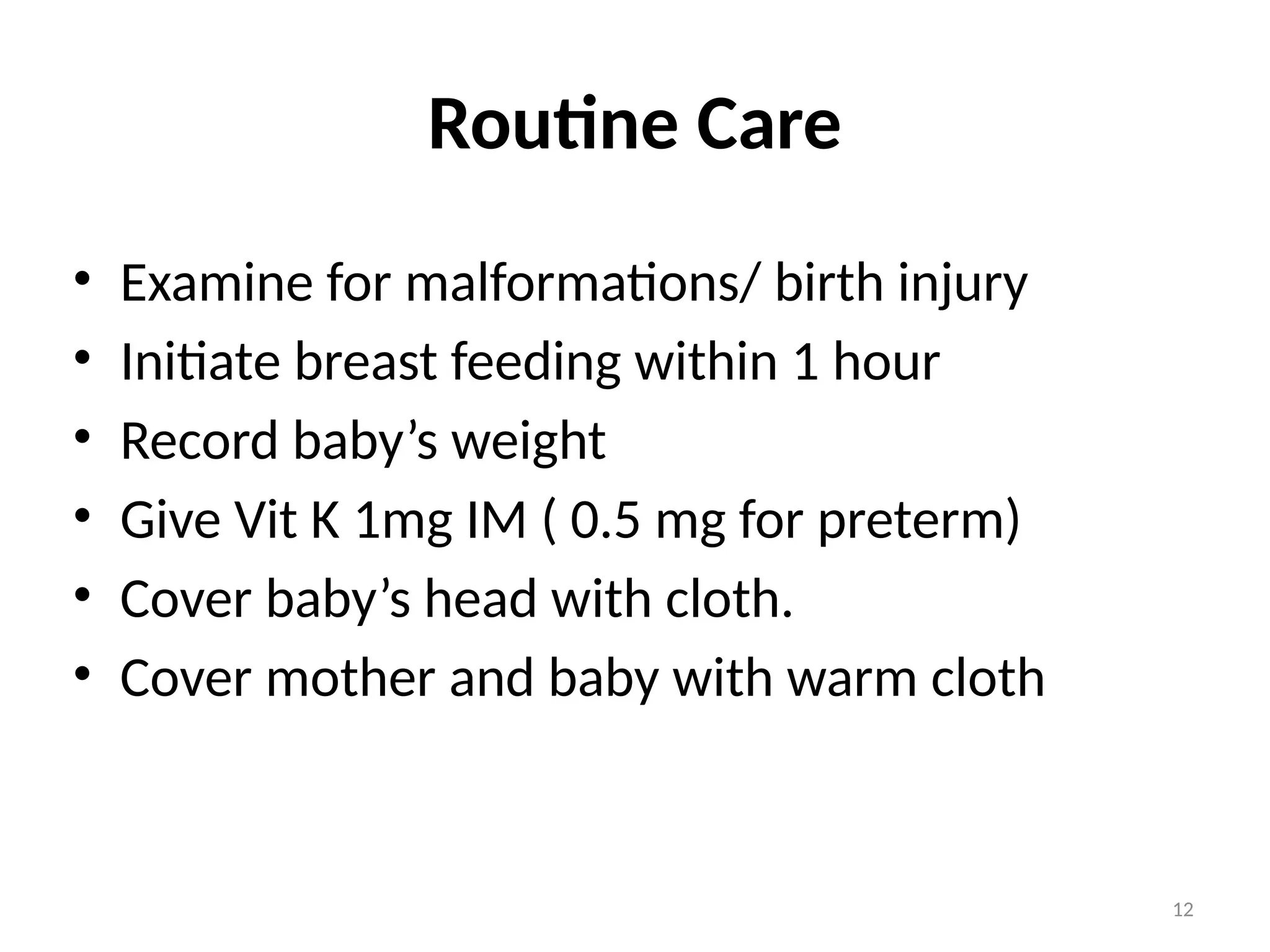
Routine Care
• Examinefor malformations/ birth injury
• Initiate breast feeding within 1 hour
• Record baby’s weight
• Give Vit K 1mg IM ( 0.5 mg for preterm)
• Cover baby’s head with cloth.
• Cover mother and baby with warm cloth
13.
13
Resuscitation
• All babiesmust be assessed for need of
resuscitation at birth
• At least 1 person skilled in providing resuscitation
must be present
• Ventilation must start within 1 minute of birth
• First golden minute
14.
14
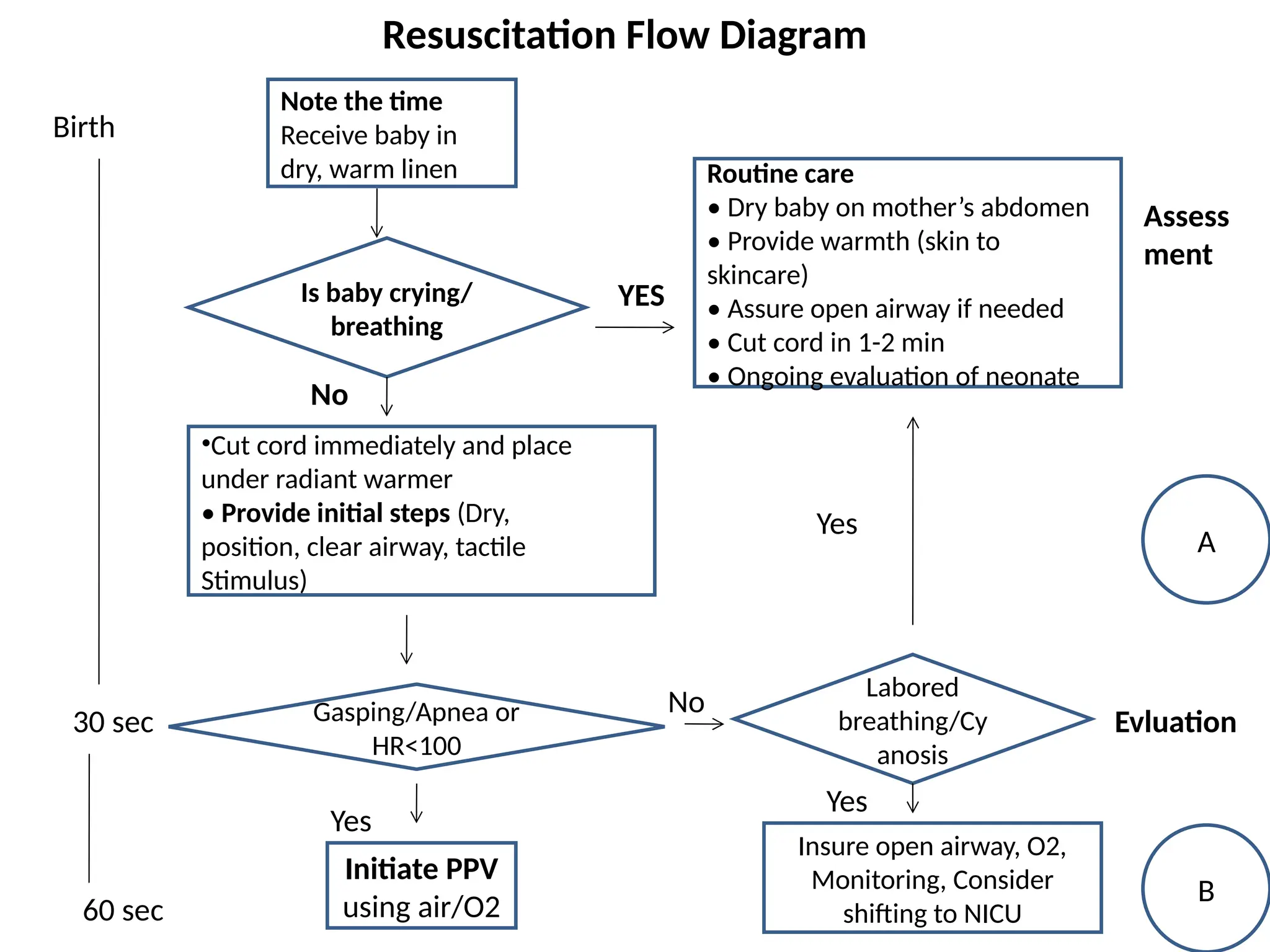
Note the time
Receivebaby in
dry, warm linen
Is baby crying/
breathing
Routine care
• Dry baby on mother’s abdomen
• Provide warmth (skin to
skincare)
• Assure open airway if needed
• Cut cord in 1-2 min
• Ongoing evaluation of neonate
•Cut cord immediately and place
under radiant warmer
• Provide initial steps (Dry,
position, clear airway, tactile
Stimulus)
Gasping/Apnea or
HR<100
Initiate PPV
using air/O2
Labored
breathing/Cy
anosis
Insure open airway, O2,
Monitoring, Consider
shifting to NICU
YES
Birth
30 sec
60 sec
Resuscitation Flow Diagram
Assess
ment
A
Evluation
B
Yes
No
No
Yes
Yes
15.
15
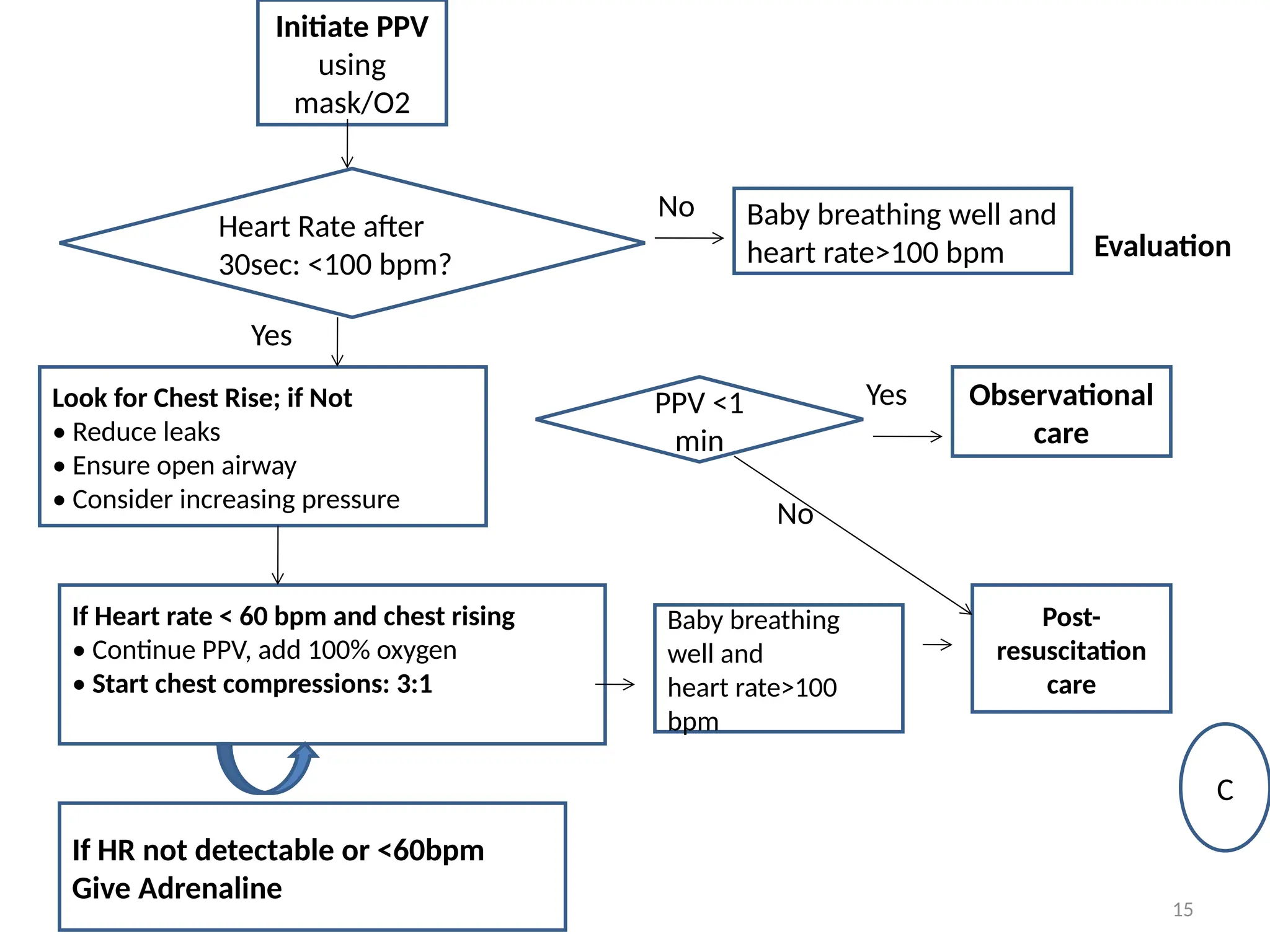
Initiate PPV
using
mask/O2
Heart Rateafter
30sec: <100 bpm?
Baby breathing well and
heart rate>100 bpm
Look for Chest Rise; if Not
• Reduce leaks
• Ensure open airway
• Consider increasing pressure
If Heart rate < 60 bpm and chest rising
• Continue PPV, add 100% oxygen
• Start chest compressions: 3:1
Baby breathing
well and
heart rate>100
bpm
Post-
resuscitation
care
PPV <1
min
Observational
care
Evaluation
C
Yes
No
Yes
No
If HR not detectable or <60bpm
Give Adrenaline
16.
16
Where do babiesgo from delivery room?
A) Refer if:
• Birth weight <2500 gms, <34 weeks
• Major congenital malformation
• Severe birth injury
• Respiratory distress
• PPV >1 minutes or needing chest
compression or drugs
18
Immediate cord care
•Clamp and cut cord with a sterile
instrument.
• Tie the cord between 2 to 3 cms
from the base and cut the
remaining cord.
• Observe for oozing blood.
• DO NOT apply any substance to
stump.
• DO NOT bind or bandage stump.
• Leave stump uncovered.
20
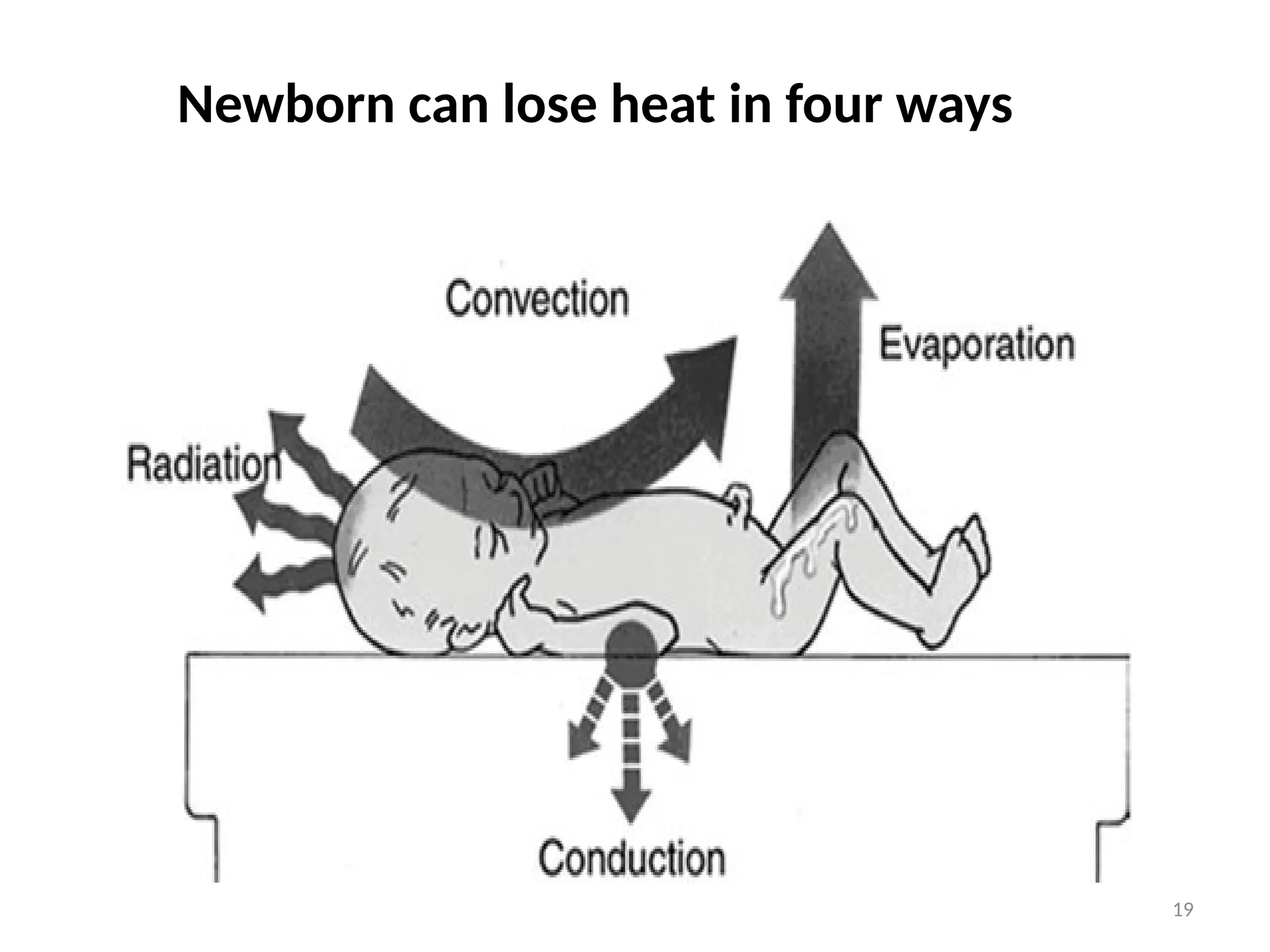
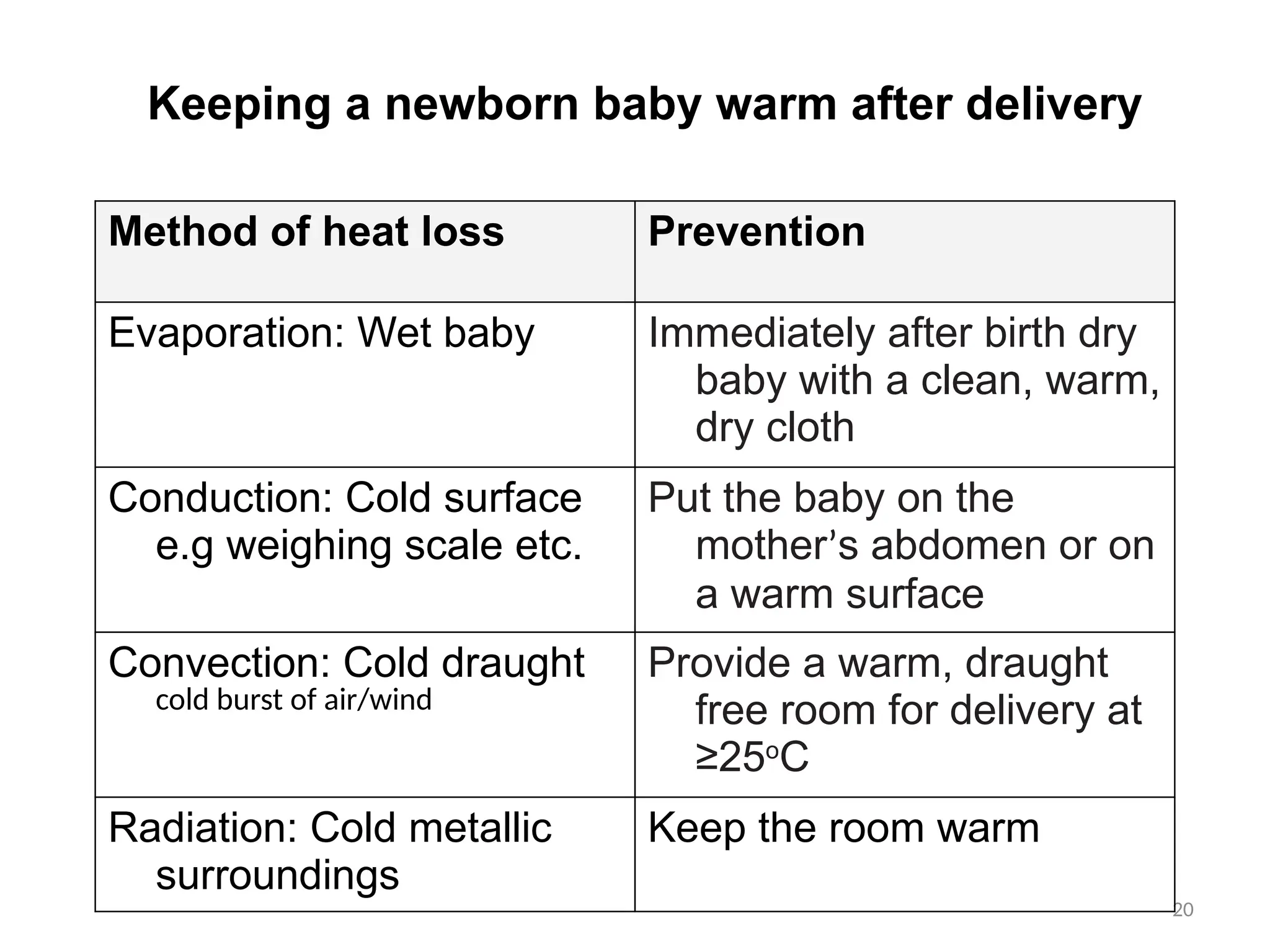
Keeping a newbornbaby warm after delivery
Method of heat loss Prevention
Evaporation: Wet baby Immediately after birth dry
baby with a clean, warm,
dry cloth
Conduction: Cold surface
e.g weighing scale etc.
Put the baby on the
mother’s abdomen or on
a warm surface
Convection: Cold draught
cold burst of air/wind
Provide a warm, draught
free room for delivery at
≥25o
C
Radiation: Cold metallic
surroundings
Keep the room warm
22
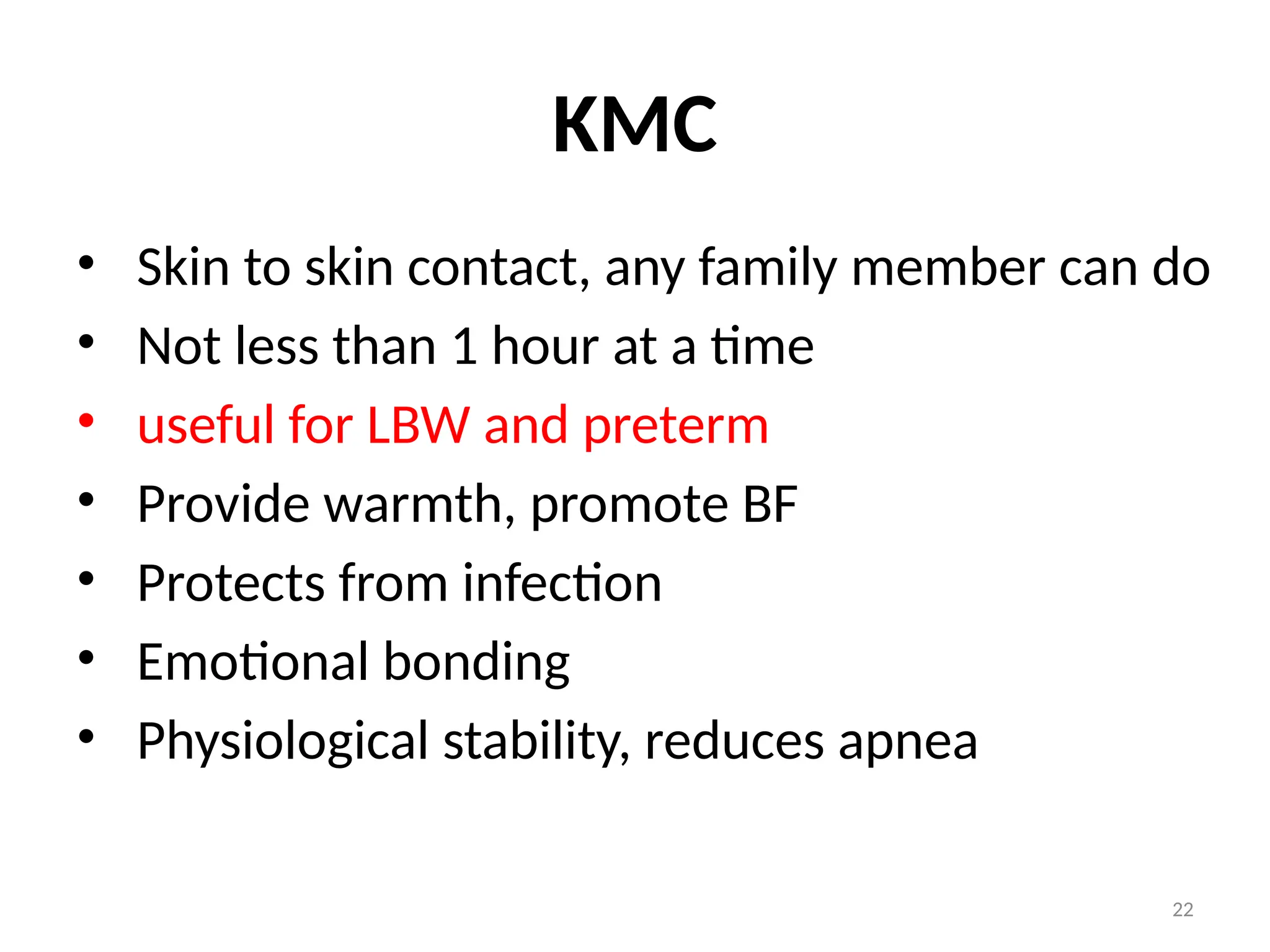
KMC
• Skin toskin contact, any family member can do
• Not less than 1 hour at a time
• useful for LBW and preterm
• Provide warmth, promote BF
• Protects from infection
• Emotional bonding
• Physiological stability, reduces apnea
23.
23
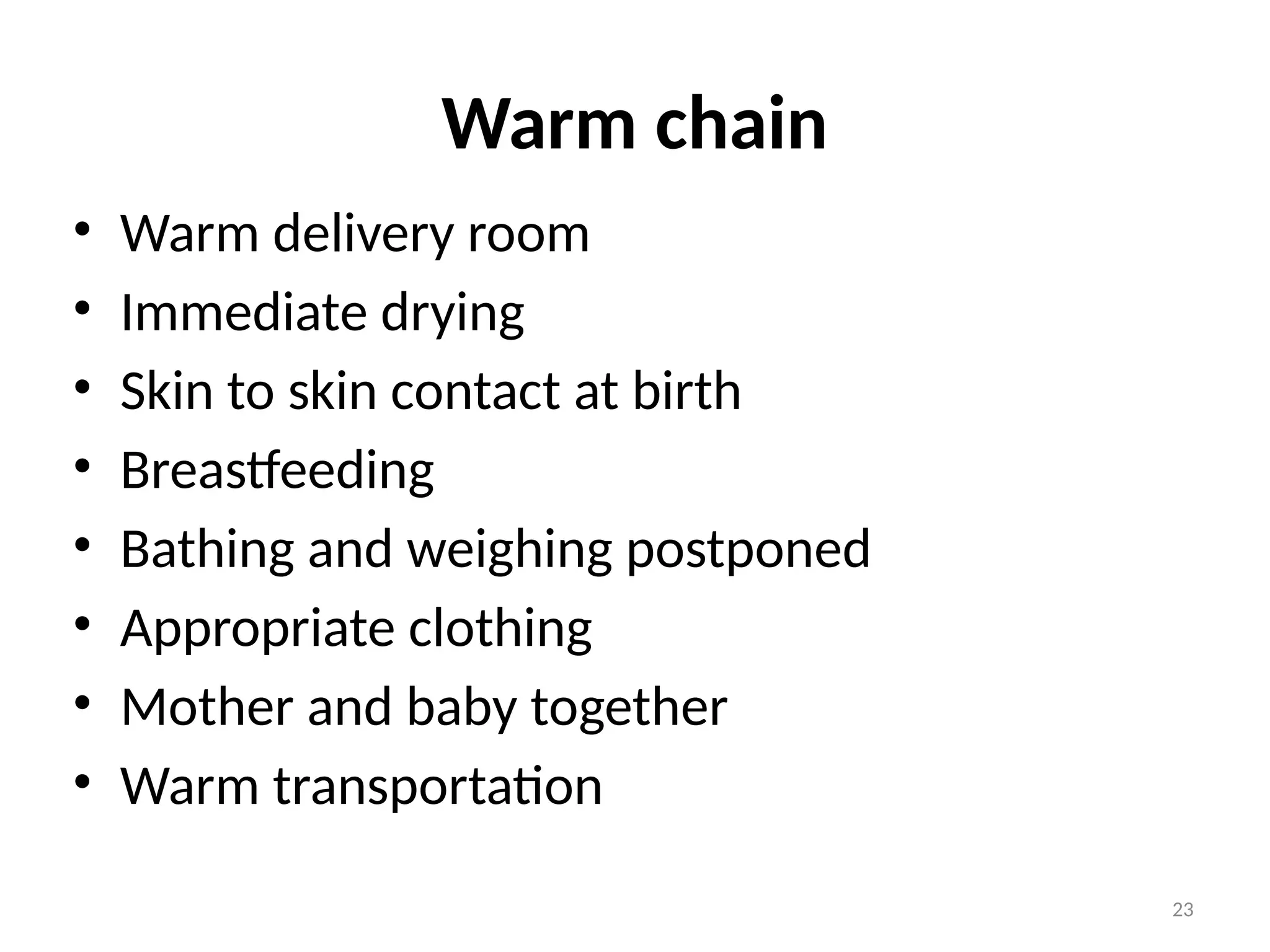
Warm chain
• Warmdelivery room
• Immediate drying
• Skin to skin contact at birth
• Breastfeeding
• Bathing and weighing postponed
• Appropriate clothing
• Mother and baby together
• Warm transportation
24.
24
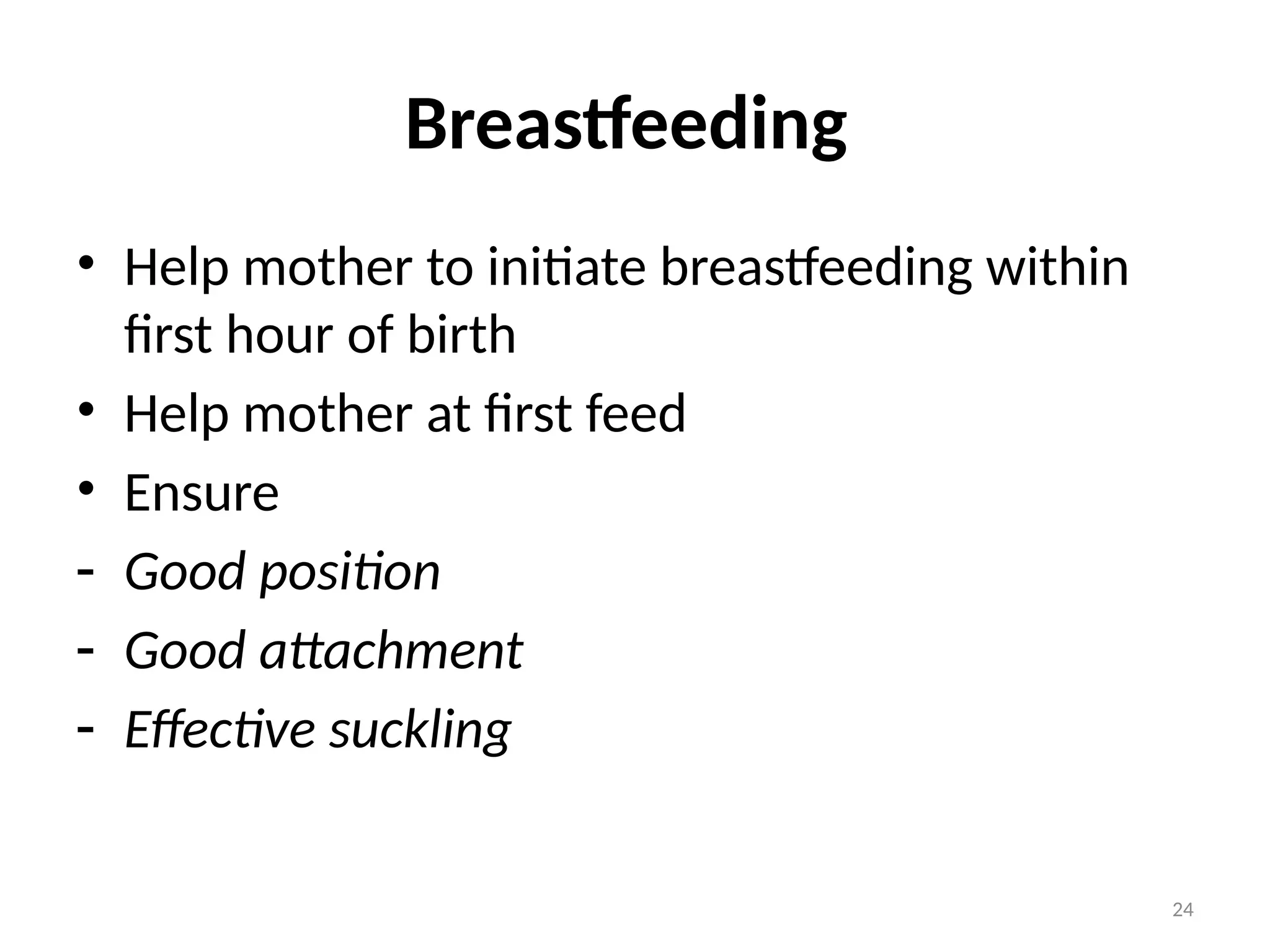
Breastfeeding
• Help motherto initiate breastfeeding within
first hour of birth
• Help mother at first feed
• Ensure
- Good position
- Good attachment
- Effective suckling
25.
25
CARE OF NEWBORNIN POSTNATAL WARD
Postnatal environment
• Kept warm with no draughts from open doors or
windows. Temperature of 25 oC or more required.
• Mother and her baby kept together in same bed
(rooming-in) co sleeping
• Helps to form bonding, can respond quickly when
her baby wants to feed, reduces breastfeeding
difficulties
26.
26
Ask the mother
•Do you or baby have any problems?
• Has infant passed stools, urine?
• Have you started breast feeding infant?
• Is there any difficulty in feeding infant?
• Do you have any pain while breast feeding?
• Have you given any other foods or drinks to
infant? If yes, what and how?
27.
27
Examine the baby
•Count breaths in one minute
• Look for severe chest indrawing
• Look and listen for grunting
• Look at umbilicus. Is it red or draining pus?
28.
28
Examine the baby
•Measure axillary temperature (if not possible,
feel for fever or low body temperature)
• See if young infant is lethargic
• Look for jaundice. Are the face, abdomen or
soles yellow?
• Look for malformations
29.
29
Assess Breastfeeding
If infanthas not fed in previous hour, ask mother to
put her infant to breast. Observe the breastfeed
for 4 minutes.
• Is the infant able to attach?
To check attachment, look for:
- Chin touching breast
- Mouth wide open
- Lower lip turned outward
- More areola above than below the mouth
30.
30
Assess Breastfeeding
• Ifnot well attached, help mother to position so that
baby attaches well.
• Is the infant suckling effectively (that is, slow deep
sucks, sometimes pausing)?
• If not sucking well, then look for:
- ulcers or white patches in mouth (thrush)
• If there is difficulty or pain while feeding, then look for
- Engorged breasts or breast abcess
- Flat or inverted, or sore nipples
31.
31
Look for NormalPhenomena
Transitional stools
• Vaginal white discharge in female babies
• Rashes on skin on 2-3 days of life.
• Weight loss of 6-8% (10-12% in preterms) in
first few days of life
32.
32
Cord Care
• Umbilicalcord is important portal of entry for
pathogenic organism.
• Instruct mother not to apply anything on cord
and keep it dry.
• Umbilical stump must be inspected after 2-4
hours of clamping.
• Bleeding may occur at this time due to
shrinkage of cord and loosening of ligature
33.
33
Skin and EyeCare
• Babies are not bathed routinely in hospital to
prevent complications like hypothermia and
infection.
• May be sponged with lukewarm water.
• TTC eye ointment for prophylaxis against
neonatal conjunctivitis
34.
34
Counsel the mother
•Keep baby warm
• Breastfeed frequently and exclusively
• Advise mother to wash hands with soap and water
after using toilet and after cleaning bottom of baby.
• Advise mother regarding danger signs &care seeking
36
Follow-up
• Schedule postnatalvisit within first week on day 7
of delivery. Also visit on day 14, 21 and 28 if baby is
LBW.
• Assess for growth and development and signs of
illnesses
• Health education of parents done
• Assessed at least once every month for 3 months
and subsequently 3 monthly till 1 year.
37.
37
SUMMARY
• Basic careto support survival & wellbeing is ENC
• Ventilation must be initiated within 1st
min of life
• Help to initiate breast feeding within 1st
hr of birth
• Identify and refer neonates requiring special care
• Take all precautions to prevent infection,
hypothermia and counsel mother the same
• Counsel mother for Danger signs, immunization &
follow-up
Editor's Notes
#15 40 to 60 breaths/minute o2 concentration 21% 0.1mg/ml Adrenaline is a powerful cardiac stimulant and is used to improve cardiac output and increase systemic blood pressure
#19 loss of heat from a newborn's skin to distant cold objects without contact…. heat loss via rapid movement