❖Immediate Basic Care Of
Neonates
❖Hygiene Measures
❖Newborn Nutrition
❖Exclusive Breast Feeding
❖Immunization
❖Neonatal Resuscitation
Definition:-
 Essential new born care is comprehensive
stagey designed to improve the health of
newborns through interventions before
conception ,during pregnancy at and soon
after birth ,and in the postnatal period
.Treatment of key problems such as sepsis and
birth asphyxia.
IMMEDIATE BASIC CARE OF
NEONATES:
1)Deliver the baby on a warm and clean
towel.
2)Establish and maintain a patent airway.
3)Ensure warmth
4)Assessment and documentation of
baby’s condition.
5)care of eyes
6)clamp and cut the cord
7)care of skin
8)Administration of vitamin K
9)Identification of baby.
10)Transfer of baby according to
level of care required.
1)Deliver the baby on a warm and
clean towel.
2)Establish and maintain a patent
airway
3)Ensure warmth
4)Assessment and documentation
of baby’s condition
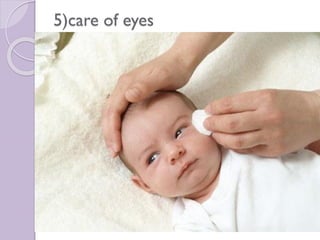
5)care of eyes
6)clamp and cut the cord
 The umbilical cord is clamped when the cord pulsation
stops as this provides the infant extra blood from the
placenta.
 Delay in clamping for 2–3 minutes or till cessation of the
cord pulsation facilitates transfer of 80-100 mL blood
from the compressed placenta to a baby when placed
below the level of uterus.This is beneficial to amature
baby but may be deleterious to a pre-term or a low
birth weight baby due to hypervolemia.
 But early clamping should be done in cases of Rh-
incompatibility (to prevent antibody transfer from the
mother to the baby or babies born asphyxiated or one
of a diabetic mother.
7)care of skin
8)Administration of vitamin K
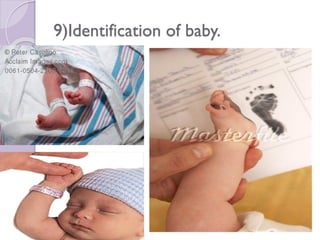
9)Identification of baby.
10)Transfer of baby according to
level of care required.
 Level II Nursery:- Preterm babies with i) Gestational
age between 32-36 weeks ii)Low birth weight (1500-
2000gm) iii)Major congenital malformation or
iv)Suspected of having aspirated meconium ,should be
transferred to special care nursery.
 Level III Nursery :-The following categories of neonates
should be admitted to intensive Care Nursery i)Birth
weight less than 1.5kg ii)Gestational period less than 32
weeks iii)Neonates with respiratory distress iv)Infants
with convulsions,central cyanosis(Congintal heart
disease),severe Neonate jaundice (erythroblastosis
fetails) and those requiring major surgery
HYGIENE
MEASURES
1)Rooming in
2)Initiating breast feeding
3)Observation of early signs of disease
4)Prevention of infection
5)Care of bladder and bowel
6)Maintenance of personal hygiene
7)Parental teaching and follow up
1)Rooming in
❑Promotes early initiation
of breast feeding
❑Provides opportunity for
mother baby interaction and
bonding.
❑Relieves mother ‘s
anxiety related to where
about of the baby.
3)Observation of early signs of
disease
Failure to pass meconium within 24 hours of birth
Failure to pass urine within 48 hours of birth
Failure to take feed.
Excessive crying or undue lethargy.
Jaundice within 24 hours of birth(Pathological
Jaundice)
Hypothermia or Hyperthermia
Seizures
Persistent vomiting or diarrhea
Evidence of superficial infection like oral
thrush,conjunctivitis,umbilical cord pustules on
skin etc.
4)Prevention of infection:
 All personnel coming in contact with the
baby should be free from infection
 Hand washing should be practiced
strictely
 Strict aseptic precautions should be taken
while handling the baby.
 The personal hygiene of mother and baby
should be maintained
 Restrict the number of visitors attending
the baby.
5)Care of bladder and
Bowel:
❖ If the neonate fails to pass
urine and stool within 24 hours
of birth ,it should be notified to
the physician.
❖The urine output is about 200-
300ml by the end of first week
of life so neonate voids about
15-20 times in a day
6)Maintenance of personal
hygiene
7)Parental Teaching and follow up:
The period when mother is in post natal ward can
be utilized for teaching the mother about all
aspects of baby care.
Parents are taught to observe the child’s daily
behaviorrelated to
feeding,sleep,activity,cry,elimination etc.
Parents need to be told about- holding the
baby,baby bath,eye and cord care ,feeding and
nutritional supplements,immunization,prevention
from infection and follow up.
The parents should be educated about the danger
signs in the baby, which if present require
immediate hospitalization.
NEW BORN NUTRITION
NUTRITIONAL REQUIREMENTS IN THE
NEONATE
The infant should get sufficient fluid. Fluid
intake should be 150–175 mL/kg body weight per
day
The infant should get adequate calorie. A
term healthy infant needs 100–110 KCal/kg of body
weight per day. Low birth weight infant needs about
105–130 KCal/kg/ day. Each 30 mL (1 oz) of breast
milk gives 20 calories. Calorie needs are primarily
dependent on oxygen consumption
The food should have a
balanced composition of
protein (2–4 g/kg/day), fat (4–6
g/kg/day),
carbohydrate (10–15 g/kg/day),
minerals and vitamins and it
should be easily digestible.
If the baby does not
responding after
birth then what we
should do????
Newborn Resuscitation
20% death occur due to the
birth asphaxia developmental
delay,vision loss,cerebral palsy.
For most babies, the immediate
care give at the birth is enough
to stimulate the baby to start
breathing.
 Approximately 10% of newborns require some
assistance to begin breathing at birth.Less than 1%
require extensive resuscitation measures.

◦ Term Gestation?
◦ Crying or breathing?
◦ Good muscles tone?
 If answer to all these questions is “YES’’, the
baby does not need resuscitation.The baby
should be dried and placed in skin –to-skin
contact with the mother.Apgar scoring should
be done simultaneously.If answer to above
three questions is “NO’’,the infant requires
resuscitation.
 TABC of Resuscitation
 T-Maintenance ofTemperature
◦ Dry the baby quickly
◦ Remove wet linen
◦ Place the baby under radiant warmer
 A-Establish an open airway
◦ Position the infant
◦ Suction mouth and nose {in few cases also
trachea}
◦ ET intubation ,if needed to ensure open airway.
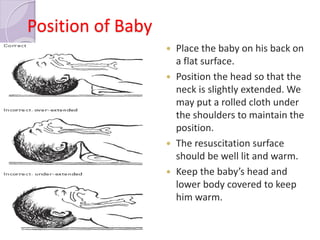
Position of Baby
 Place the baby on his back on
a flat surface.
 Position the head so that the
neck is slightly extended. We
may put a rolled cloth under
the shoulders to maintain the
position.
 The resuscitation surface
should be well lit and warm.
 Keep the baby’s head and
lower body covered to keep
him warm.
 B-Initiate Breathing
◦Tactile stimulation to initiate
respiration
◦PPV when necessary ,using either
Bag and mask or mask or Bag and
ET tube.
 C-circulation
 Chest compression
 Medication [if needed]
 Step 3: Ventilate
 Ventilate about 40 times in 1 minute.
 After 1 minute, stop to see if the baby starts to
breathe independently.
 Continue ventilation until the baby spontaneously
cries or breaths
 If there is no breathing or gasping after 20 minutes,
stop ventilation.
 Step 4: Monitor
 Closely monitor a baby who had resuscitation or
who has poor color, even if he appears to be
breathing well.
 If the baby’s breathing and color are good, give him
to his mother
 REFERRAL AFTER RESUSCITATION
 Not sustaining adequate breathing (less than 30
breaths in 1 minute) or gasping: continue
resuscitation efforts during transport
 More than 60 breaths in 1 minute
 Indrawing of the chest
 Grunting (sound made when breathing out)
 The baby’s tongue and lips are blue or the whole
body is pale or bluish.
Essential new born care converted

Essential new born care converted

  • 2.
    ❖Immediate Basic CareOf Neonates ❖Hygiene Measures ❖Newborn Nutrition ❖Exclusive Breast Feeding ❖Immunization ❖Neonatal Resuscitation
  • 3.
    Definition:-  Essential newborn care is comprehensive stagey designed to improve the health of newborns through interventions before conception ,during pregnancy at and soon after birth ,and in the postnatal period .Treatment of key problems such as sepsis and birth asphyxia.
  • 4.
    IMMEDIATE BASIC CAREOF NEONATES: 1)Deliver the baby on a warm and clean towel. 2)Establish and maintain a patent airway. 3)Ensure warmth 4)Assessment and documentation of baby’s condition. 5)care of eyes 6)clamp and cut the cord
  • 5.
    7)care of skin 8)Administrationof vitamin K 9)Identification of baby. 10)Transfer of baby according to level of care required.
  • 6.
    1)Deliver the babyon a warm and clean towel.
  • 7.
    2)Establish and maintaina patent airway
  • 8.
  • 9.
  • 10.
  • 11.
  • 12.
     The umbilicalcord is clamped when the cord pulsation stops as this provides the infant extra blood from the placenta.  Delay in clamping for 2–3 minutes or till cessation of the cord pulsation facilitates transfer of 80-100 mL blood from the compressed placenta to a baby when placed below the level of uterus.This is beneficial to amature baby but may be deleterious to a pre-term or a low birth weight baby due to hypervolemia.  But early clamping should be done in cases of Rh- incompatibility (to prevent antibody transfer from the mother to the baby or babies born asphyxiated or one of a diabetic mother.
  • 13.
  • 14.
  • 15.
  • 16.
    10)Transfer of babyaccording to level of care required.  Level II Nursery:- Preterm babies with i) Gestational age between 32-36 weeks ii)Low birth weight (1500- 2000gm) iii)Major congenital malformation or iv)Suspected of having aspirated meconium ,should be transferred to special care nursery.  Level III Nursery :-The following categories of neonates should be admitted to intensive Care Nursery i)Birth weight less than 1.5kg ii)Gestational period less than 32 weeks iii)Neonates with respiratory distress iv)Infants with convulsions,central cyanosis(Congintal heart disease),severe Neonate jaundice (erythroblastosis fetails) and those requiring major surgery
  • 17.
    HYGIENE MEASURES 1)Rooming in 2)Initiating breastfeeding 3)Observation of early signs of disease 4)Prevention of infection 5)Care of bladder and bowel 6)Maintenance of personal hygiene 7)Parental teaching and follow up
  • 18.
    1)Rooming in ❑Promotes earlyinitiation of breast feeding ❑Provides opportunity for mother baby interaction and bonding. ❑Relieves mother ‘s anxiety related to where about of the baby.
  • 20.
    3)Observation of earlysigns of disease Failure to pass meconium within 24 hours of birth Failure to pass urine within 48 hours of birth Failure to take feed. Excessive crying or undue lethargy. Jaundice within 24 hours of birth(Pathological Jaundice) Hypothermia or Hyperthermia Seizures Persistent vomiting or diarrhea Evidence of superficial infection like oral thrush,conjunctivitis,umbilical cord pustules on skin etc.
  • 21.
    4)Prevention of infection: All personnel coming in contact with the baby should be free from infection  Hand washing should be practiced strictely  Strict aseptic precautions should be taken while handling the baby.  The personal hygiene of mother and baby should be maintained  Restrict the number of visitors attending the baby.
  • 22.
    5)Care of bladderand Bowel: ❖ If the neonate fails to pass urine and stool within 24 hours of birth ,it should be notified to the physician. ❖The urine output is about 200- 300ml by the end of first week of life so neonate voids about 15-20 times in a day
  • 23.
  • 24.
    7)Parental Teaching andfollow up: The period when mother is in post natal ward can be utilized for teaching the mother about all aspects of baby care. Parents are taught to observe the child’s daily behaviorrelated to feeding,sleep,activity,cry,elimination etc. Parents need to be told about- holding the baby,baby bath,eye and cord care ,feeding and nutritional supplements,immunization,prevention from infection and follow up. The parents should be educated about the danger signs in the baby, which if present require immediate hospitalization.
  • 25.
    NEW BORN NUTRITION NUTRITIONALREQUIREMENTS IN THE NEONATE The infant should get sufficient fluid. Fluid intake should be 150–175 mL/kg body weight per day The infant should get adequate calorie. A term healthy infant needs 100–110 KCal/kg of body weight per day. Low birth weight infant needs about 105–130 KCal/kg/ day. Each 30 mL (1 oz) of breast milk gives 20 calories. Calorie needs are primarily dependent on oxygen consumption
  • 26.
    The food shouldhave a balanced composition of protein (2–4 g/kg/day), fat (4–6 g/kg/day), carbohydrate (10–15 g/kg/day), minerals and vitamins and it should be easily digestible.
  • 27.
    If the babydoes not responding after birth then what we should do????
  • 28.
    Newborn Resuscitation 20% deathoccur due to the birth asphaxia developmental delay,vision loss,cerebral palsy. For most babies, the immediate care give at the birth is enough to stimulate the baby to start breathing.
  • 29.
     Approximately 10%of newborns require some assistance to begin breathing at birth.Less than 1% require extensive resuscitation measures.  ◦ Term Gestation? ◦ Crying or breathing? ◦ Good muscles tone?  If answer to all these questions is “YES’’, the baby does not need resuscitation.The baby should be dried and placed in skin –to-skin contact with the mother.Apgar scoring should be done simultaneously.If answer to above three questions is “NO’’,the infant requires resuscitation.
  • 30.
     TABC ofResuscitation  T-Maintenance ofTemperature ◦ Dry the baby quickly ◦ Remove wet linen ◦ Place the baby under radiant warmer  A-Establish an open airway ◦ Position the infant ◦ Suction mouth and nose {in few cases also trachea} ◦ ET intubation ,if needed to ensure open airway.
  • 31.
    Position of Baby Place the baby on his back on a flat surface.  Position the head so that the neck is slightly extended. We may put a rolled cloth under the shoulders to maintain the position.  The resuscitation surface should be well lit and warm.  Keep the baby’s head and lower body covered to keep him warm.
  • 32.
     B-Initiate Breathing ◦Tactilestimulation to initiate respiration ◦PPV when necessary ,using either Bag and mask or mask or Bag and ET tube.  C-circulation  Chest compression  Medication [if needed]
  • 33.
     Step 3:Ventilate  Ventilate about 40 times in 1 minute.  After 1 minute, stop to see if the baby starts to breathe independently.  Continue ventilation until the baby spontaneously cries or breaths  If there is no breathing or gasping after 20 minutes, stop ventilation.
  • 34.
     Step 4:Monitor  Closely monitor a baby who had resuscitation or who has poor color, even if he appears to be breathing well.  If the baby’s breathing and color are good, give him to his mother  REFERRAL AFTER RESUSCITATION  Not sustaining adequate breathing (less than 30 breaths in 1 minute) or gasping: continue resuscitation efforts during transport  More than 60 breaths in 1 minute  Indrawing of the chest  Grunting (sound made when breathing out)  The baby’s tongue and lips are blue or the whole body is pale or bluish.