TOPICS
 Care of newborn at birth.
 Resuscitation of newborn at birth.
 Care of newborn in the postnatal ward.
 Problems with breast feeding.
 Stabilization of a sick newborn before
referral.
 Transportation of sick newborn.
 Common neonatal problems and their
management
 Demonstrations
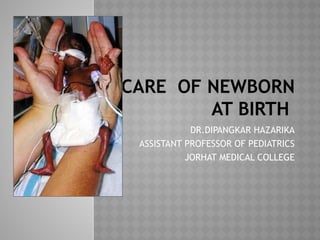
CARE OF NEWBORN
AT BIRTH
DR.DIPANGKAR HAZARIKA
ASSISTANT PROFESSOR OF PEDIATRICS
JORHAT MEDICAL COLLEGE
NEWBORN HEALTH IN INDIA
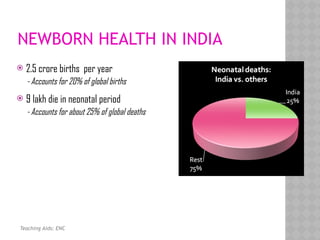
 2.5 crore births per year
- Accounts for 20% of global births
 9 lakh die in neonatal period
- Accounts for about 25% of global deaths
Teaching Aids: ENC
NEONATAL MORTALITY RATE (NMR)
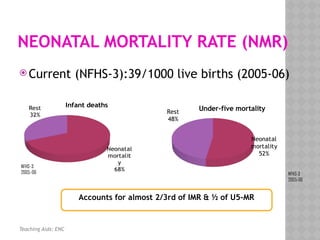
 Current (NFHS-3):39/1000 live births (2005-06)
Teaching Aids: ENC
Neonatal
mortalit
y
68%
Rest
32%
Infant deaths
NFHS-3
2005-06
Neonatal
mortality
52%
Rest
48%
Under-five mortality
NFHS-3
2005-06
Accounts for almost 2/3rd of IMR & ½ of U5-MR
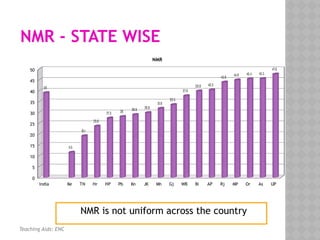
NMR - STATE WISE
NMR is not uniform across the country
India Ke TN Hr HP Pb Kn JK Mh Gj WB Bi AP Rj MP Or As UP
0
5
10
15
20
25
30
35
40
45
50
39
11.5
19.1
23.6
27.3 28
28.9
29.8
31.8
33.5
37.6
39.8 40.3
43.9
44.9 45.4 45.5
47.6
NMR
Teaching Aids: ENC
CAUSES OF NEONATAL DEATHS
Infections, asphyxia and prematurity are the
leading causes of neonatal deaths
Source: ICMR, 2006
Asphyxia
21%
Infection
s
33%
Prematur
ity
15%
Malforma
tions
5%
Others
11%
Not
establishe
d
15%
Teaching Aids: ENC
TIMING OF NEONATAL DEATHS
Nearly 3/4th of neonatal deaths occur within 7
days, mostly during first 24 hours
Teaching Aids: ENC
Week 4
Week 3
Week 2
Day 7
Day 6
Day 5
Day 4
Day 3
Day 2
Day 1
Week 1
0.0% 10.0% 20.0% 30.0% 40.0% 50.0% 60.0% 70.0% 80.0%
4.2%
8.7%
13.8%
3.0%
2.7%
5.6%
5.6%
10.2%
6.7%
39.5%
73.3%
Timing of neonatal deaths
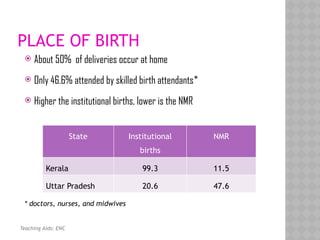
 About 50% of deliveries occur at home
 Only 46.6% attended by skilled birth attendants*
 Higher the institutional births, lower is the NMR
PLACE OF BIRTH
* doctors, nurses, and midwives
Teaching Aids: ENC
State Institutional
births
NMR
Kerala 99.3 11.5
Uttar Pradesh 20.6 47.6
DECLINE OF NMR
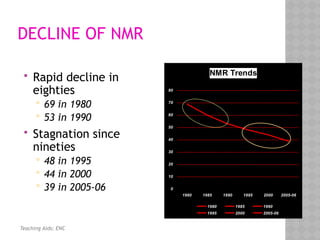
 Rapid decline in
eighties
 69 in 1980
 53 in 1990
 Stagnation since
nineties
 48 in 1995
 44 in 2000
 39 in 2005-06
NMR Trends
0
10
20
30
40
50
60
70
80
1980 1985 1990 1995 2000 2005-06
1980 1985 1990
1995 2000 2005-06
Teaching Aids: ENC
WHY STATIC NMR?
 Govt. programmes focused mainly on post neonatal period
- Diarrheal Disease Control
- ARI
- Immunization
 Focus of essential newborn care component was on a limited number of
government facilities
 Lack of skilled persons for managing newborns
Teaching Aids: ENC
WHY CARE AT BIRTH IS
IMPORTANT?
 Right care at birth reduces the risk of
complications.
 Physiological adaptation at birth includes:
- Temperature adaptation
- Initiation of respiration and oxygenation of
the arterial blood
- Initiation of feeding
Normal Newborn Care 12
WHAT ARE THE ESSENTIAL NEWBORN CARE
 Clean childbirth and cord care to prevent
infection.
 Thermal protection to prevent hypothermia
 Initiation of breathing and resuscitation
 Early and exclusive breastfeeding
KEY PRINCIPLES
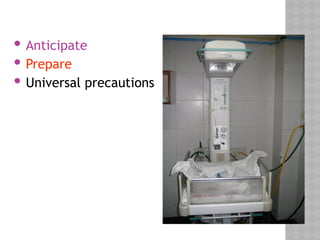
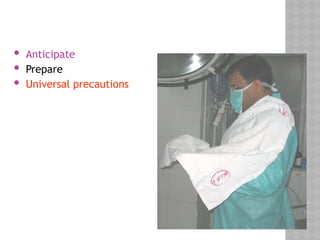
 Anticipate
 Prepare
 Universal precautions
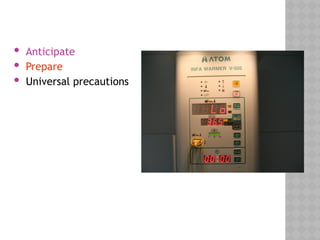
 Anticipate
 Prepare
 Universal precautions
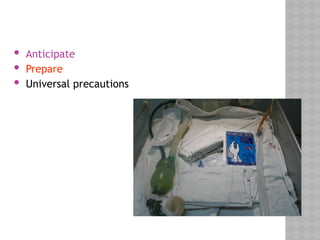
 Anticipate
 Prepare
 Universal precautions
 Anticipate
 Prepare
 Universal precautions
 Anticipate
 Prepare
 Universal precautions
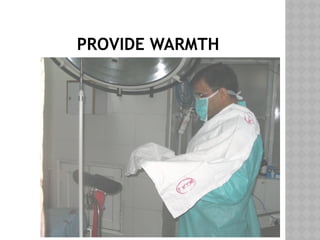
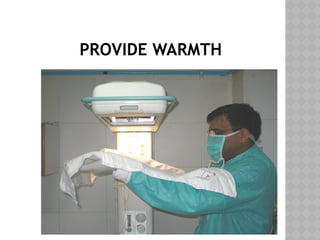
PROVIDE WARMTH
PROVIDE WARMTH
PREPARING FOR BIRTH
 Two or more clean and warm towels or cloths.
 A draught free delivery room.
 Temperature of at least 25-28°C.
 Soap, water, clean gloves, cotton, gauze and a
clean labour table for delivery.
 A clean delivery kit .
 Self inflating bags and masks .
 A suction device ( mucus extractor).
 A radiant warmer, if available.
 A blanket.
 A clock/watch to note the time of delivery.
ASSESSMENT AT BIRTH
Assess by checking whether:
1. Term gestation?
2. Amniotic fluid clear?
3. Breathing or crying?
4. Good muscle tone?
 If YES provide routine care.
 If answer to any question is NO then proceed
for resuscitation.
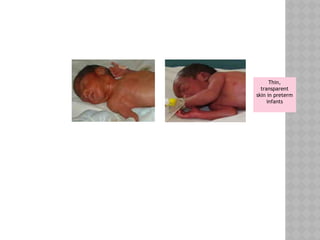
Thin,
transparent
skin in preterm
infants
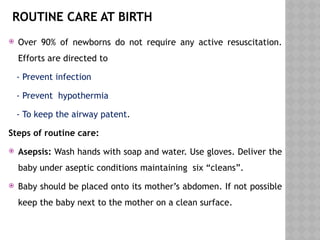
ROUTINE CARE AT BIRTH
 Over 90% of newborns do not require any active resuscitation.
Efforts are directed to
- Prevent infection
- Prevent hypothermia
- To keep the airway patent.
Steps of routine care:
 Asepsis: Wash hands with soap and water. Use gloves. Deliver the
baby under aseptic conditions maintaining six “cleans”.
 Baby should be placed onto its mother’s abdomen. If not possible
keep the baby next to the mother on a clean surface.
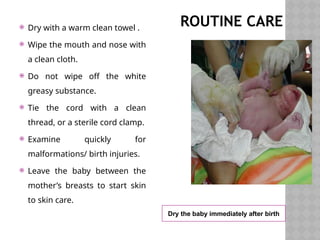
ROUTINE CARE
 Dry with a warm clean towel .
 Wipe the mouth and nose with
a clean cloth.
 Do not wipe off the white
greasy substance.
 Tie the cord with a clean
thread, or a sterile cord clamp.
 Examine quickly for
malformations/ birth injuries.
 Leave the baby between the
mother’s breasts to start skin
to skin care.
Dry the baby immediately after birth
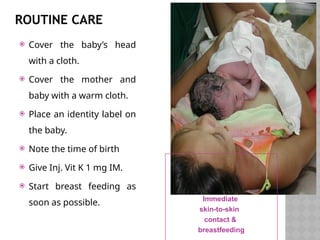
ROUTINE CARE
 Cover the baby’s head
with a cloth.
 Cover the mother and
baby with a warm cloth.
 Place an identity label on
the baby.
 Note the time of birth
 Give Inj. Vit K 1 mg IM.
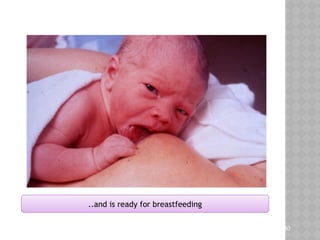
 Start breast feeding as
soon as possible. Immediate
skin-to-skin
contact &
breastfeeding
Teaching Aids: ENC
NC-
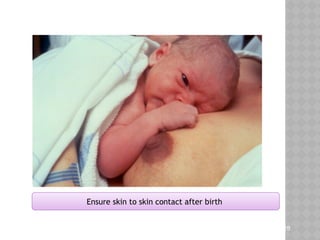
Ensure skin to skin contact after birth
28
Teaching Aids: ENC
NC-
Baby shows feeding cues…
29
Teaching Aids: ENC
NC-
..and is ready for breastfeeding
30
 Check whether baby passed urine and meconium
on table or not.
 Helps to reduce unnecessary referal.
 Normally baby should pass urine by 48 hours and
stool by 24 hours of birth.
WHAT PRACTICES INTERRUPT THE TIME THE MOTHER AND
BABY MAY SPEND TOGETHER IMMEDIATELY AFTER BIRTH?
 In the 1st
two hours after it is not necessary to:
1. Weigh or measure the baby.
2. Bathe the baby.
3. Give the baby any other food apart from breast milk.
4. Give the baby to anyone apart from the mother.
However normal culture practices should be respected.
5. A newborn baby should not be given bath for at least
24 hours after birth.
33
ROUTINE CARE: PREVENTION OF INFECTION
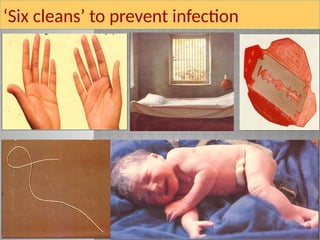
 Principles of cleanliness at childbirth
 Clean hands
 Clean perineum
 Nothing unclean introduced vaginally
 Clean delivery surface
 Cleanliness in cord clamping and cutting
 Cleanliness for cord care
‘Six cleans’ to prevent infection
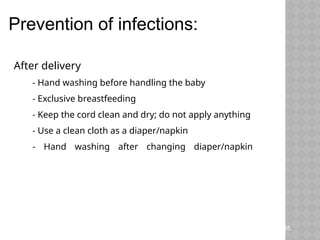
Prevention of infections:
After delivery
1. - Hand washing before handling the baby
2. - Exclusive breastfeeding
3. - Keep the cord clean and dry; do not apply anything
4. - Use a clean cloth as a diaper/napkin
5. - Hand washing after changing diaper/napkin
Teaching Aids: ENC
NC- 35
Normal Newborn Care 36
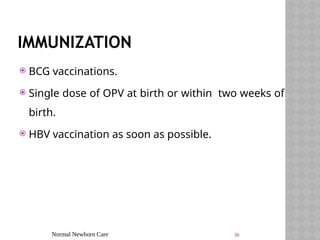
IMMUNIZATION
 BCG vaccinations.
 Single dose of OPV at birth or within two weeks of
birth.
 HBV vaccination as soon as possible.
37
ROUTINE CARE: THERMAL PROTECTION
 Newborn physiology
 Normal temperature: 36.5–37.5°C
 Hypothermia: < 36.5°C
 Stabilization period: 1st 6–12 hours after birth.
 Chances of hypothermia increase when
1. Cold delivery room., post natal ward and home environment.
2. Open window, broken glass, frames.
3. No heater in winter
4. No room thermometer
5. Giving early bath.
6. Running ceiling fan
7. Not drying the baby immediately after delivery.
8. Nor drying the head
9. Baby left on or in a wet cloth
10. Separating mother and baby and then not covering the baby
with sufficient covers.
11. Not breast feeding soon after birth
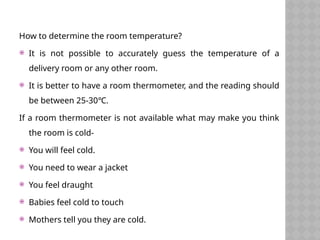
How to determine the room temperature?
 It is not possible to accurately guess the temperature of a
delivery room or any other room.
 It is better to have a room thermometer, and the reading should
be between 25-30℃.
If a room thermometer is not available what may make you think
the room is cold-
 You will feel cold.
 You need to wear a jacket
 You feel draught
 Babies feel cold to touch
 Mothers tell you they are cold.
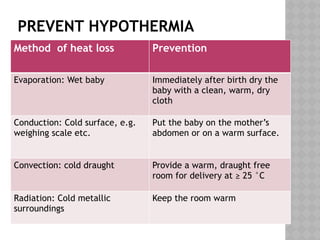
PREVENT HYPOTHERMIA
4 ways a newborn may lose
heat to the environment
 Newborn baby’s temperature
falls within seconds of birth.
 4 ways of losing heat-
Radiation, convection,
evaporation and conduction.
PREVENT HYPOTHERMIA
Method of heat loss Prevention
Evaporation: Wet baby Immediately after birth dry the
baby with a clean, warm, dry
cloth
Conduction: Cold surface, e.g.
weighing scale etc.
Put the baby on the mother’s
abdomen or on a warm surface.
Convection: cold draught Provide a warm, draught free
room for delivery at ≥ 25 °C
Radiation: Cold metallic
surroundings
Keep the room warm
PREVENTIVE MEASURES
 Provide a warm, draught free room for delivery at 25-30°C.
 Receive the baby in a dry, warm, clean towel. Dry well.
 Discard the wet towel immediately and wrap/cover the
baby (except face and upper chest) in a fresh, clean dry
towel.
 Place the baby near a source of warmth.
- A normal baby, who is crying well after birth, can be
placed in skin to skin contact with the mother’s abdomen
and covered with a dry cloth.
- Place the baby under a source of heat such as a lamp
with a 200 Watt bulb or under a radiant warmer.
PREVENTIVE MEASURES
 Delay the first bath to beyond 24 hours period.
 Instead baby can be cleaned by wiping with a soft moist
cloth.
 When bath is given, it should be done quickly in a warm
room, using warm water.
 Do not remove the vernix.
 Give to mother as soon as possible , as skin-to-skin contact
in first few hours after childbirth
 Promotes bonding
 Establish early breastfeeding
Normal Newborn Care 44
BREATHING INITIATION AND
RESUSCITATION
 Spontaneous breathing (> 30 breaths/min.) in most
newborns
 Gentle stimulation, if at all required.
 Newborn resuscitation may be needed
 Depressed newborn.
 Thick meconium stained amniotic fluid and baby
depressed.
 Preterm babies.
Once the baby is born asses baby’s breathing at the time of
drying:
 If the baby is crying vigorously or breathing adequately, air
entry on both sides of the chest is equal and the respiratory
rate between 30-60 per minute, then no intervention is
needed.
 If the baby is not breathing or gasping, then skilled care in
the form of positive pressure ventilation etc. (i.e.
RESUSCITATION) would be required
Teaching Aids: ENC
NC-
Helping the baby breathe
45
Normal Newborn Care 46
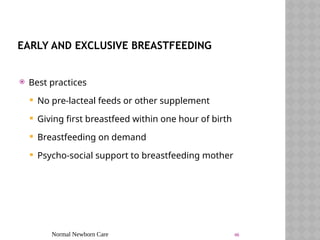
EARLY AND EXCLUSIVE BREASTFEEDING
 Best practices
 No pre-lacteal feeds or other supplement
 Giving first breastfeed within one hour of birth
 Breastfeeding on demand
 Psycho-social support to breastfeeding mother
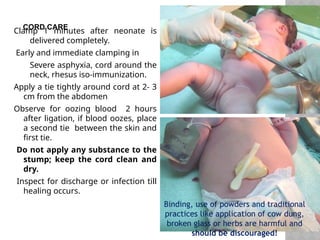
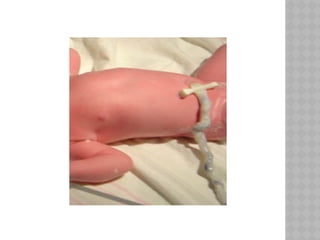
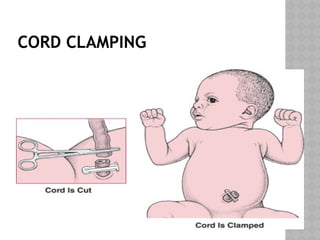
CORD CARE
Clamp 1 minutes after neonate is
delivered completely.
Early and immediate clamping in
- Severe asphyxia, cord around the
neck, rhesus iso-immunization.
Apply a tie tightly around cord at 2- 3
cm from the abdomen
Observe for oozing blood 2 hours
after ligation, if blood oozes, place
a second tie between the skin and
first tie.
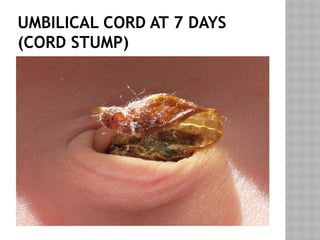
Do not apply any substance to the
stump; keep the cord clean and
dry.
Inspect for discharge or infection till
healing occurs.
Binding, use of powders and traditional
practices like application of cow dung,
broken glass or herbs are harmful and
should be discouraged!
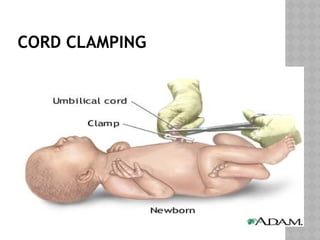
CORD CLAMPING
CORD CLAMPING
UMBILICAL CORD AT 7 DAYS
(CORD STUMP)
Examine Cord for presence
of 3 vessels and document
 2 arteries and 1 vein
EXAMINATION AT BIRTH OR SOON AFTER
 Look for life threatening congenital anomalies ‘-
1. Diaphragmatic hernia (present with respiratory distress
with scaphoid abdomen) .
2. Neural tube defects, B/L choanal atresia
3. Esophageal atresia with TEF (excessive salivation and
mucus discharge from mouth).
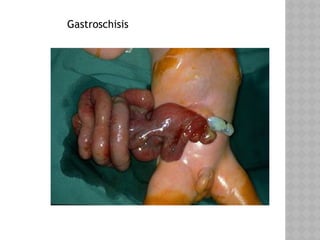
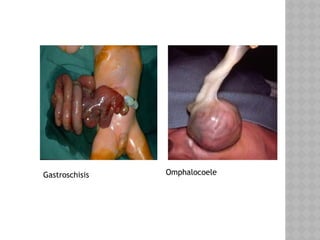
4. Gastrochisis and exomphalos.
5. Urethral obstruction, anal atresia.
6. Bile stained persistent vomitus suggest intestinal
obstruction
 Assess the gestational age.
 Take the weight.
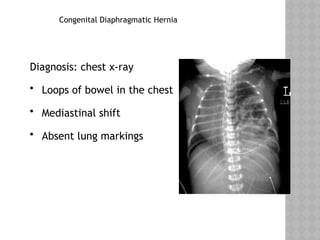
Congenital Diaphragmatic Hernia
Diagnosis: chest x-ray
• Loops of bowel in the chest
• Mediastinal shift
• Absent lung markings
55
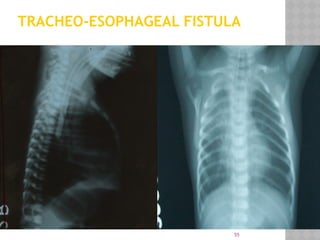
TRACHEO-ESOPHAGEAL FISTULA
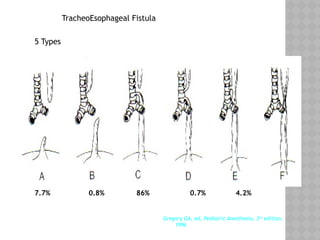
TracheoEsophageal Fistula
5 Types
Gregory GA, ed, Pediatric Anesthesia, 3rd
edition,
1996
7.7% 0.8% 86% 0.7% 4.2%
Gastroschisis
Omphalocoele
Gastroschisis Omphalocoele
EXAMINE FOR MALFORMATIONS
 Identify life threatening congenital anomalies.
 location and patency of all the orifices to rule out TEF and
imperforate anus.
Examine:
 The spine for dimples, tuft of hair (spina bifida occulta) or
cystic swellings (spina bifida cystica)
 Genitalia: In boys, confirm that both testicles have
descended into the scrotum.
 Inspect the perineum and check anus for position and
patency.
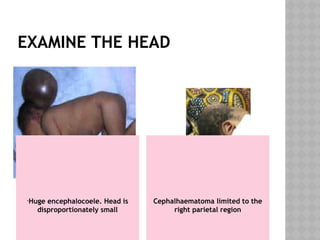
EXAMINE THE HEAD
•Huge encephalocoele. Head is
disproportionately small
Cephalhaematoma limited to the
right parietal region
EXAMINE EYES AND FACE
 Examine eyes for ocular anomalies .
 Examine the face for dysmorphic features and normal
movements
 Examine lips and palate for clefts
Bilateral cleft lip and palate.
Also note purulent left eye
discharge
Facial asymmetry due
to left facial palsy
EXAMINE ABDOMEN
Large omphalocoele.
Surounding erythema indicates
cellulitis.
Spina bifida
TAKE HOME MESSAGE
 Prepare two 1X1 meter size clean cloth in advance.
 Dry the baby immediately after birth.
 Check whether baby passed urine and meconium on table
during delivery.
 Start breast feeding as soon as possible after birth.
 Inj. Vitamin K IM at birth, reduce early HDN.
 Examine all orifices at birth, their position and patency.
 Examine the spine

CARE AT BIRTH (2).pptx v bkbfkjsdksjdfjdbff

  • 1.
    TOPICS  Care ofnewborn at birth.  Resuscitation of newborn at birth.  Care of newborn in the postnatal ward.  Problems with breast feeding.  Stabilization of a sick newborn before referral.  Transportation of sick newborn.  Common neonatal problems and their management  Demonstrations
  • 2.
    CARE OF NEWBORN ATBIRTH DR.DIPANGKAR HAZARIKA ASSISTANT PROFESSOR OF PEDIATRICS JORHAT MEDICAL COLLEGE
  • 3.
    NEWBORN HEALTH ININDIA  2.5 crore births per year - Accounts for 20% of global births  9 lakh die in neonatal period - Accounts for about 25% of global deaths Teaching Aids: ENC
  • 4.
    NEONATAL MORTALITY RATE(NMR)  Current (NFHS-3):39/1000 live births (2005-06) Teaching Aids: ENC Neonatal mortalit y 68% Rest 32% Infant deaths NFHS-3 2005-06 Neonatal mortality 52% Rest 48% Under-five mortality NFHS-3 2005-06 Accounts for almost 2/3rd of IMR & ½ of U5-MR
  • 5.
    NMR - STATEWISE NMR is not uniform across the country India Ke TN Hr HP Pb Kn JK Mh Gj WB Bi AP Rj MP Or As UP 0 5 10 15 20 25 30 35 40 45 50 39 11.5 19.1 23.6 27.3 28 28.9 29.8 31.8 33.5 37.6 39.8 40.3 43.9 44.9 45.4 45.5 47.6 NMR Teaching Aids: ENC
  • 6.
    CAUSES OF NEONATALDEATHS Infections, asphyxia and prematurity are the leading causes of neonatal deaths Source: ICMR, 2006 Asphyxia 21% Infection s 33% Prematur ity 15% Malforma tions 5% Others 11% Not establishe d 15% Teaching Aids: ENC
  • 7.
    TIMING OF NEONATALDEATHS Nearly 3/4th of neonatal deaths occur within 7 days, mostly during first 24 hours Teaching Aids: ENC Week 4 Week 3 Week 2 Day 7 Day 6 Day 5 Day 4 Day 3 Day 2 Day 1 Week 1 0.0% 10.0% 20.0% 30.0% 40.0% 50.0% 60.0% 70.0% 80.0% 4.2% 8.7% 13.8% 3.0% 2.7% 5.6% 5.6% 10.2% 6.7% 39.5% 73.3% Timing of neonatal deaths
  • 8.
     About 50%of deliveries occur at home  Only 46.6% attended by skilled birth attendants*  Higher the institutional births, lower is the NMR PLACE OF BIRTH * doctors, nurses, and midwives Teaching Aids: ENC State Institutional births NMR Kerala 99.3 11.5 Uttar Pradesh 20.6 47.6
  • 9.
    DECLINE OF NMR Rapid decline in eighties  69 in 1980  53 in 1990  Stagnation since nineties  48 in 1995  44 in 2000  39 in 2005-06 NMR Trends 0 10 20 30 40 50 60 70 80 1980 1985 1990 1995 2000 2005-06 1980 1985 1990 1995 2000 2005-06 Teaching Aids: ENC
  • 10.
    WHY STATIC NMR? Govt. programmes focused mainly on post neonatal period - Diarrheal Disease Control - ARI - Immunization  Focus of essential newborn care component was on a limited number of government facilities  Lack of skilled persons for managing newborns Teaching Aids: ENC
  • 11.
    WHY CARE ATBIRTH IS IMPORTANT?  Right care at birth reduces the risk of complications.  Physiological adaptation at birth includes: - Temperature adaptation - Initiation of respiration and oxygenation of the arterial blood - Initiation of feeding
  • 12.
    Normal Newborn Care12 WHAT ARE THE ESSENTIAL NEWBORN CARE  Clean childbirth and cord care to prevent infection.  Thermal protection to prevent hypothermia  Initiation of breathing and resuscitation  Early and exclusive breastfeeding
  • 13.
    KEY PRINCIPLES  Anticipate Prepare  Universal precautions
  • 14.
     Anticipate  Prepare Universal precautions
  • 15.
     Anticipate  Prepare Universal precautions
  • 16.
     Anticipate  Prepare Universal precautions
  • 17.
     Anticipate  Prepare Universal precautions
  • 18.
  • 19.
  • 20.
    PREPARING FOR BIRTH Two or more clean and warm towels or cloths.  A draught free delivery room.  Temperature of at least 25-28°C.  Soap, water, clean gloves, cotton, gauze and a clean labour table for delivery.  A clean delivery kit .  Self inflating bags and masks .  A suction device ( mucus extractor).  A radiant warmer, if available.  A blanket.  A clock/watch to note the time of delivery.
  • 21.
    ASSESSMENT AT BIRTH Assessby checking whether: 1. Term gestation? 2. Amniotic fluid clear? 3. Breathing or crying? 4. Good muscle tone?  If YES provide routine care.  If answer to any question is NO then proceed for resuscitation.
  • 23.
  • 25.
    ROUTINE CARE ATBIRTH  Over 90% of newborns do not require any active resuscitation. Efforts are directed to - Prevent infection - Prevent hypothermia - To keep the airway patent. Steps of routine care:  Asepsis: Wash hands with soap and water. Use gloves. Deliver the baby under aseptic conditions maintaining six “cleans”.  Baby should be placed onto its mother’s abdomen. If not possible keep the baby next to the mother on a clean surface.
  • 26.
    ROUTINE CARE  Drywith a warm clean towel .  Wipe the mouth and nose with a clean cloth.  Do not wipe off the white greasy substance.  Tie the cord with a clean thread, or a sterile cord clamp.  Examine quickly for malformations/ birth injuries.  Leave the baby between the mother’s breasts to start skin to skin care. Dry the baby immediately after birth
  • 27.
    ROUTINE CARE  Coverthe baby’s head with a cloth.  Cover the mother and baby with a warm cloth.  Place an identity label on the baby.  Note the time of birth  Give Inj. Vit K 1 mg IM.  Start breast feeding as soon as possible. Immediate skin-to-skin contact & breastfeeding
  • 28.
    Teaching Aids: ENC NC- Ensureskin to skin contact after birth 28
  • 29.
    Teaching Aids: ENC NC- Babyshows feeding cues… 29
  • 30.
    Teaching Aids: ENC NC- ..andis ready for breastfeeding 30
  • 31.
     Check whetherbaby passed urine and meconium on table or not.  Helps to reduce unnecessary referal.  Normally baby should pass urine by 48 hours and stool by 24 hours of birth.
  • 32.
    WHAT PRACTICES INTERRUPTTHE TIME THE MOTHER AND BABY MAY SPEND TOGETHER IMMEDIATELY AFTER BIRTH?  In the 1st two hours after it is not necessary to: 1. Weigh or measure the baby. 2. Bathe the baby. 3. Give the baby any other food apart from breast milk. 4. Give the baby to anyone apart from the mother. However normal culture practices should be respected. 5. A newborn baby should not be given bath for at least 24 hours after birth.
  • 33.
    33 ROUTINE CARE: PREVENTIONOF INFECTION  Principles of cleanliness at childbirth  Clean hands  Clean perineum  Nothing unclean introduced vaginally  Clean delivery surface  Cleanliness in cord clamping and cutting  Cleanliness for cord care
  • 34.
    ‘Six cleans’ toprevent infection
  • 35.
    Prevention of infections: Afterdelivery 1. - Hand washing before handling the baby 2. - Exclusive breastfeeding 3. - Keep the cord clean and dry; do not apply anything 4. - Use a clean cloth as a diaper/napkin 5. - Hand washing after changing diaper/napkin Teaching Aids: ENC NC- 35
  • 36.
    Normal Newborn Care36 IMMUNIZATION  BCG vaccinations.  Single dose of OPV at birth or within two weeks of birth.  HBV vaccination as soon as possible.
  • 37.
    37 ROUTINE CARE: THERMALPROTECTION  Newborn physiology  Normal temperature: 36.5–37.5°C  Hypothermia: < 36.5°C  Stabilization period: 1st 6–12 hours after birth.
  • 38.
     Chances ofhypothermia increase when 1. Cold delivery room., post natal ward and home environment. 2. Open window, broken glass, frames. 3. No heater in winter 4. No room thermometer 5. Giving early bath. 6. Running ceiling fan 7. Not drying the baby immediately after delivery. 8. Nor drying the head 9. Baby left on or in a wet cloth 10. Separating mother and baby and then not covering the baby with sufficient covers. 11. Not breast feeding soon after birth
  • 39.
    How to determinethe room temperature?  It is not possible to accurately guess the temperature of a delivery room or any other room.  It is better to have a room thermometer, and the reading should be between 25-30℃. If a room thermometer is not available what may make you think the room is cold-  You will feel cold.  You need to wear a jacket  You feel draught  Babies feel cold to touch  Mothers tell you they are cold.
  • 40.
    PREVENT HYPOTHERMIA 4 waysa newborn may lose heat to the environment  Newborn baby’s temperature falls within seconds of birth.  4 ways of losing heat- Radiation, convection, evaporation and conduction.
  • 41.
    PREVENT HYPOTHERMIA Method ofheat loss Prevention Evaporation: Wet baby Immediately after birth dry the baby with a clean, warm, dry cloth Conduction: Cold surface, e.g. weighing scale etc. Put the baby on the mother’s abdomen or on a warm surface. Convection: cold draught Provide a warm, draught free room for delivery at ≥ 25 °C Radiation: Cold metallic surroundings Keep the room warm
  • 42.
    PREVENTIVE MEASURES  Providea warm, draught free room for delivery at 25-30°C.  Receive the baby in a dry, warm, clean towel. Dry well.  Discard the wet towel immediately and wrap/cover the baby (except face and upper chest) in a fresh, clean dry towel.  Place the baby near a source of warmth. - A normal baby, who is crying well after birth, can be placed in skin to skin contact with the mother’s abdomen and covered with a dry cloth. - Place the baby under a source of heat such as a lamp with a 200 Watt bulb or under a radiant warmer.
  • 43.
    PREVENTIVE MEASURES  Delaythe first bath to beyond 24 hours period.  Instead baby can be cleaned by wiping with a soft moist cloth.  When bath is given, it should be done quickly in a warm room, using warm water.  Do not remove the vernix.  Give to mother as soon as possible , as skin-to-skin contact in first few hours after childbirth  Promotes bonding  Establish early breastfeeding
  • 44.
    Normal Newborn Care44 BREATHING INITIATION AND RESUSCITATION  Spontaneous breathing (> 30 breaths/min.) in most newborns  Gentle stimulation, if at all required.  Newborn resuscitation may be needed  Depressed newborn.  Thick meconium stained amniotic fluid and baby depressed.  Preterm babies.
  • 45.
    Once the babyis born asses baby’s breathing at the time of drying:  If the baby is crying vigorously or breathing adequately, air entry on both sides of the chest is equal and the respiratory rate between 30-60 per minute, then no intervention is needed.  If the baby is not breathing or gasping, then skilled care in the form of positive pressure ventilation etc. (i.e. RESUSCITATION) would be required Teaching Aids: ENC NC- Helping the baby breathe 45
  • 46.
    Normal Newborn Care46 EARLY AND EXCLUSIVE BREASTFEEDING  Best practices  No pre-lacteal feeds or other supplement  Giving first breastfeed within one hour of birth  Breastfeeding on demand  Psycho-social support to breastfeeding mother
  • 47.
    CORD CARE Clamp 1minutes after neonate is delivered completely. Early and immediate clamping in - Severe asphyxia, cord around the neck, rhesus iso-immunization. Apply a tie tightly around cord at 2- 3 cm from the abdomen Observe for oozing blood 2 hours after ligation, if blood oozes, place a second tie between the skin and first tie. Do not apply any substance to the stump; keep the cord clean and dry. Inspect for discharge or infection till healing occurs. Binding, use of powders and traditional practices like application of cow dung, broken glass or herbs are harmful and should be discouraged!
  • 49.
  • 50.
  • 51.
    UMBILICAL CORD AT7 DAYS (CORD STUMP)
  • 52.
    Examine Cord forpresence of 3 vessels and document  2 arteries and 1 vein
  • 53.
    EXAMINATION AT BIRTHOR SOON AFTER  Look for life threatening congenital anomalies ‘- 1. Diaphragmatic hernia (present with respiratory distress with scaphoid abdomen) . 2. Neural tube defects, B/L choanal atresia 3. Esophageal atresia with TEF (excessive salivation and mucus discharge from mouth). 4. Gastrochisis and exomphalos. 5. Urethral obstruction, anal atresia. 6. Bile stained persistent vomitus suggest intestinal obstruction  Assess the gestational age.  Take the weight.
  • 54.
    Congenital Diaphragmatic Hernia Diagnosis:chest x-ray • Loops of bowel in the chest • Mediastinal shift • Absent lung markings
  • 55.
  • 56.
    TracheoEsophageal Fistula 5 Types GregoryGA, ed, Pediatric Anesthesia, 3rd edition, 1996 7.7% 0.8% 86% 0.7% 4.2%
  • 57.
  • 58.
  • 59.
  • 60.
    EXAMINE FOR MALFORMATIONS Identify life threatening congenital anomalies.  location and patency of all the orifices to rule out TEF and imperforate anus. Examine:  The spine for dimples, tuft of hair (spina bifida occulta) or cystic swellings (spina bifida cystica)  Genitalia: In boys, confirm that both testicles have descended into the scrotum.  Inspect the perineum and check anus for position and patency.
  • 61.
    EXAMINE THE HEAD •Hugeencephalocoele. Head is disproportionately small Cephalhaematoma limited to the right parietal region
  • 62.
    EXAMINE EYES ANDFACE  Examine eyes for ocular anomalies .  Examine the face for dysmorphic features and normal movements  Examine lips and palate for clefts Bilateral cleft lip and palate. Also note purulent left eye discharge Facial asymmetry due to left facial palsy
  • 63.
    EXAMINE ABDOMEN Large omphalocoele. Suroundingerythema indicates cellulitis. Spina bifida
  • 64.
    TAKE HOME MESSAGE Prepare two 1X1 meter size clean cloth in advance.  Dry the baby immediately after birth.  Check whether baby passed urine and meconium on table during delivery.  Start breast feeding as soon as possible after birth.  Inj. Vitamin K IM at birth, reduce early HDN.  Examine all orifices at birth, their position and patency.  Examine the spine

Editor's Notes

  • #37 Newborns are uniquely susceptible to hypothermia because they have a large body surface area, which helps heat loss; they lack insulation; and lack the body mass to produce and save heat. They are also dependent on caregivers to keep them warm and dry. Care of the newborn at childbirth includes keeping it warm by drying immediately after birth and delaying a bath until the temperature is stabilized.
  • #44 Remember that every newborn should be considered at risk for needing resuscitation (i.e., the attendant should be prepared at every childbirth). Certain conditions may increase the likelihood that resuscitation will be necessary. For example, if there is evidence of fetal distress during the labor or childbirth, thick meconium, breech delivery or a preterm birth.