Community midwifery is one of the functions of community health
care. It aims to promote the well-being of mothers and babies and to support
sound parenting and stable families. It is components of the maternal and
child health (MCH) program in India, which has its preventive obstekics
helps in reduction of maternal, perinatal, infants and childhood mortality and
morbidity and promotion of reproductive health.
ANTENATAL CARE:
The aim of antenatal care is to achieve at the end of a pregnancy- a healthy
mother and a healthy baby. Ideally, this care should begin soonafter
conception and continue throughout pregnancy.
Objectives of Antenatal Care :
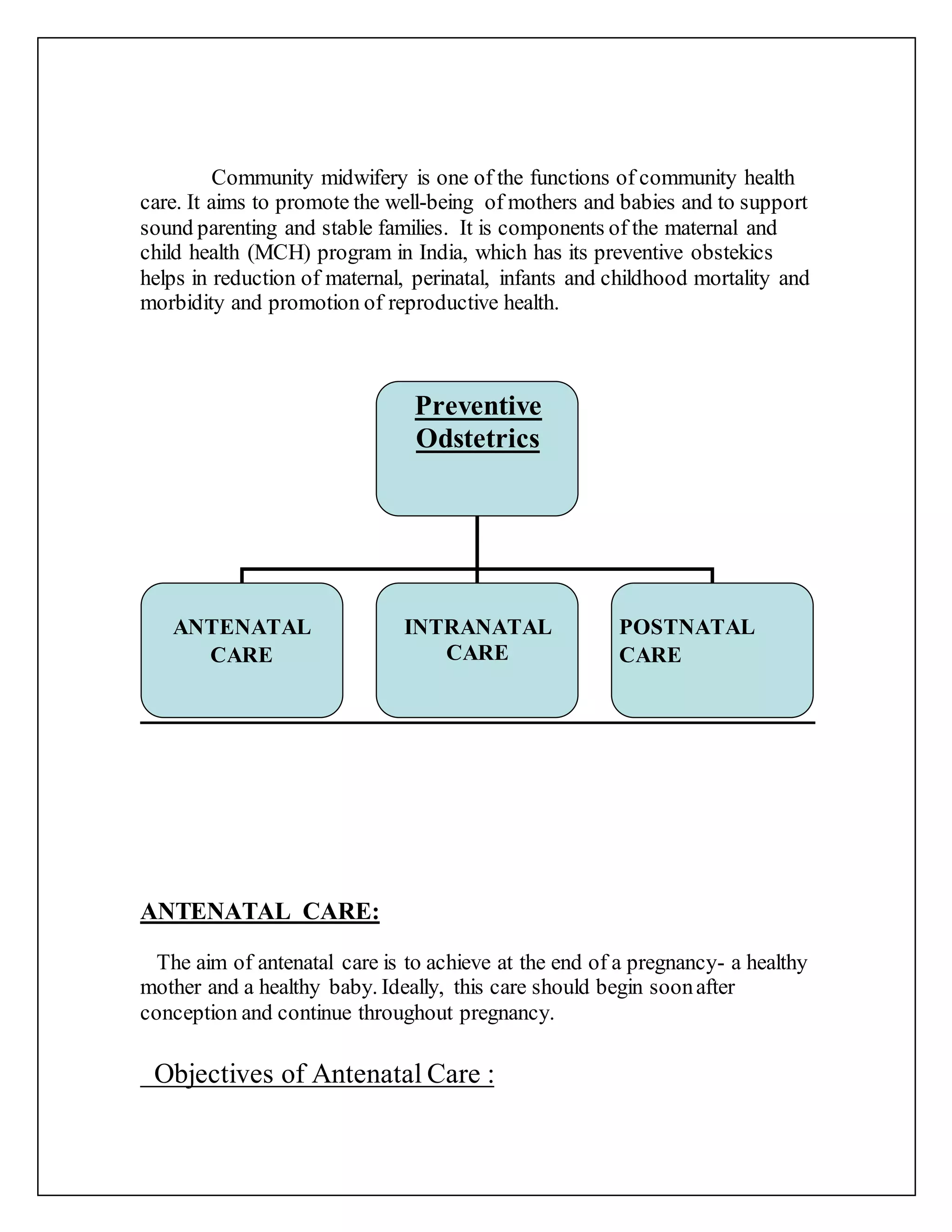
Preventive
Odstetrics
ANTENATAL
CARE
INTRANATAL
CARE
POSTNATAL
CARE
Promote, protectand maintain the health of the mother during
pregnancy.
Detect “high risk” pregnancies and give the mothers special
attention.
Foresee complications and prevent them.
Remove anxiety and fear associated with delivery.
Reduce maternal and infant mortality and morbidity.
Teach mother, elements of childcare, nutrition, personal hygiene
and environmental sanitation.
Sensitize the mother to the need for family planning.
ANTENTATAL VISITS:
Ideally ,the care should begin soonafter
conception and continue throughout pregnancy. A schedule to follow for the
mother is to attend the antenatal clinic once a month during the first seven
months,twice a month during the next two month and therafter once a week
if everything is normal. Hence a minimumof three visits are encouraged as
below:
First visit,as soonas the pregnancy is known or at 20th week.
Second visit, at 32nd week.
Third visit, at 36th week.
Preventive services for mother in the prenatal period:
The first visit irrespective of when it occurs should include:
Health history.
Physical examination.
Laboratory examination.
Complete urine analysis
Stoolexamination
Complete blood count including Hbg estimation
Serological examination.
Blood grouping and Rh determination.
Chest X-ray,if needed.
Gonorrhoea test,if needed
On subsequent visits:
Physical examination including weight and blood pressure.
Laboratory tests including urine examination and hemoglobin
estimation.
Iron and folic acid supplementation and medications as needed.
Immunization against tetanus. -2 injections of tetanus toxoid
between 16 -36 weeks
Group or individual teaching on nutrition,self care, family planning
,delivery and parenthood.
Home visiting by a female health worker or trained dai.
Referral services,when necessary.
Risk Approach :
While continuing to provide appropriate care for all mothers,’high
risk’ cases must be identified as early as possible and arrangements to
be made for skilled care. These cases comprise the following.
Elederly primigravida.
Short statured primigravida.
Malpresentations, e.g. breech, transverse lie etc.
Antepartum hemorrhage, threatened abortion
Preeclampsia and eclampsia
Anemia
Twins, hydramnios
Previous stillbirth, intrauterine death, manual removal of placenta
Eiderly grand multipara
Prolonged pregnancy
Previous cesarean or instrumental delivery
Pragnancy associated with medical conditions, e.g. cardiovascular
disease, kidney disease, diabetes, tuberculosis, liver disease etc.
Home visits:
Home visits are paid by the female health worker or public
health nurse. If the delivery is planned at home , several visits
are required. The home visit will provide opportunities to
study the environment and social conditions at home and to
provide prenatal advice. In the home environment , the
women will have more
Prenatal Advice
A major component of antenatal care is prenatal advice or education.
The mother is more receptive to advice concerning herself and her baby at
this time than any other time.
Diet
A balanced and adequate diet is of utmost importance during pregnancy
and lactation to meet the increased needs of the mother, and to prevent
nutritional stress.
Personal
Advice regarding personal hygiene is equally important. The need to bathe
day and to wear clean clothes should be explained. About eight hours of
sleep and at least two hours rest after midday meals should be advised.
Drugs
The use of drugs that are not absolutely essential should be discouraged as
certain drugs taken by the mother during pregnancy may affects the fetus.
Radiation
Exposure to radiation is a positive danger to the developing fetus. The
most common sourceof radiation is abdominal X-ray during pregnancy.
Studies have shown that mortality rates from leukemia and other neoplasms
were significantly greater among children exposed to intrauterine X-ray.
Warning Signs
The mother should be given instructions that she should report
immediately, any of the following warning signals: swelling of the feet,
convulsions, headache, blurring of the vision, bleeding or discharge per
vagina and any other unusual symptoms.
Specific Health Protection
Specific protection for pregnant women’s health is an essential aspectof
prenatal care.
Other Nutritional Deficiencies
Protection is required against other nutritional deficiencies that may occur
during pregnancy such as protein, vitamin and mineral deficiencies.
HIV Infections
HIV may pass from an infected mother to her fetus through the
placenta or to her infant during delivery or by breast-feeding.Universal
confidential voluntary screening of pregnant woman in high prevalence
areas may allow infected women to choosetherapeutic abortion,make an
informed decision on breast-feeding or receive appropriate care.
Prenatal Genetic Screening
Screening for genetic abnormalities and for direct evidence of
structural anomalies is performed in pregnancy in order to make the option
of therapeutic abortion available when severe defects are detected.
Mental Preparation
Mental preparation is as important as physical or material preparation.
Family Planning
Family planning is releted to every phase pf thematenity
cycle.Educationnal and motivational efforts must be initiated during the
antental period.
INTRANTAL CARE
The need for effective intranatal care is paramount, even if the
delivery is expected to be a normal one. There must be emphasis
on cleaniness, which includes clean hands and fingernails, a clean
surface for delivery, clean cutting and care of the cord, and
keeping birth canal clean by avoiding harmful practices.
The objectives of good intranatal care are to achieve:
Thorough asepsis.
Delivery with minimum injury to the newborn and mother.
Readiness to deal with complications such as prolonged
labor , hemorrhage, convulsions, malpresentations, prolapse
of the cord etc.
Care of the baby at delivery –resuscitation, care of the cord,
care of the eyes etc.
The main emphasis on 5’c-
Clean hands
Clean surface
Clean cord
Clean cutting
Clean birth canal
a)Domicillary care
b)Management of complications
1)Prolonged labour
Preventive measures include early identification of risk factors,use
of partograph,prompt vigilance
2)abnormal uterine contractions
Early detection
Carefull & & constant observation of uterine contractions
3) obstructed labour
Early detection
Carefull & & constant observation of progress of labour
POSTNATAL CARE
Care of the mother and the newborn after delivery is known as
postnatal or post-partal care .
The objectives of post-partal care are to:
Prevent complications of the post-partal period e.g.
puerperal sepsis,thrombophelbitis,post-partum heamorrage
Promote rapid restoration of thr mother’s health to optimum
level.
Check the adequacy of breast-feeding.
Provide family planning instructions and services.
Provide basic health education to mother family.
Following delivery, the mother and baby are visited daily for ten
days.
During each of these visits the midwife checks temperature, pulse
and respirations of the mother, examines her breasts, checks the
progress of normalinvolution of uterus, examines lochia for any
abnormalily , checks urine and bowels and advices on perineal
toileting. The immediate postnatal complications such as puerperal
sepsis, thrombophlebitis and secondary hemorrhage must be kept
in mind.
a) Breast-feeding: Postnatalcare includes helping the mother to
establish successfulbreast-feeding. Formany babies breast milk
provides the main source of nourishment in the first year of life.
b) Family Planning: Every attempt should be made to motivate
mothers when they attend postnatal clinics or during
postnatal contacts to adopt a suitable method for spacing the
next birth or for limiting the family size as appropriate.
c) Health Education : Health education sduring the postnatal period
should cover the following areas:
Hygiene –personaland environmental.
Feeding of infant.
Care of umbilical cord/umbilical stump.
Bathing the baby.
Nutritious diet for the mother.
Pregnancy spacing.
Health check – up for the mother and baby.
Birth registration.

Preventive obstetrics

  • 1.
    Community midwifery isone of the functions of community health care. It aims to promote the well-being of mothers and babies and to support sound parenting and stable families. It is components of the maternal and child health (MCH) program in India, which has its preventive obstekics helps in reduction of maternal, perinatal, infants and childhood mortality and morbidity and promotion of reproductive health. ANTENATAL CARE: The aim of antenatal care is to achieve at the end of a pregnancy- a healthy mother and a healthy baby. Ideally, this care should begin soonafter conception and continue throughout pregnancy. Objectives of Antenatal Care : Preventive Odstetrics ANTENATAL CARE INTRANATAL CARE POSTNATAL CARE
  • 2.
    Promote, protectand maintainthe health of the mother during pregnancy. Detect “high risk” pregnancies and give the mothers special attention. Foresee complications and prevent them. Remove anxiety and fear associated with delivery. Reduce maternal and infant mortality and morbidity. Teach mother, elements of childcare, nutrition, personal hygiene and environmental sanitation. Sensitize the mother to the need for family planning. ANTENTATAL VISITS: Ideally ,the care should begin soonafter conception and continue throughout pregnancy. A schedule to follow for the mother is to attend the antenatal clinic once a month during the first seven months,twice a month during the next two month and therafter once a week if everything is normal. Hence a minimumof three visits are encouraged as below: First visit,as soonas the pregnancy is known or at 20th week. Second visit, at 32nd week. Third visit, at 36th week. Preventive services for mother in the prenatal period: The first visit irrespective of when it occurs should include: Health history. Physical examination. Laboratory examination. Complete urine analysis Stoolexamination Complete blood count including Hbg estimation Serological examination. Blood grouping and Rh determination. Chest X-ray,if needed. Gonorrhoea test,if needed
  • 3.
    On subsequent visits: Physicalexamination including weight and blood pressure. Laboratory tests including urine examination and hemoglobin estimation. Iron and folic acid supplementation and medications as needed. Immunization against tetanus. -2 injections of tetanus toxoid between 16 -36 weeks Group or individual teaching on nutrition,self care, family planning ,delivery and parenthood. Home visiting by a female health worker or trained dai. Referral services,when necessary. Risk Approach : While continuing to provide appropriate care for all mothers,’high risk’ cases must be identified as early as possible and arrangements to be made for skilled care. These cases comprise the following. Elederly primigravida. Short statured primigravida. Malpresentations, e.g. breech, transverse lie etc. Antepartum hemorrhage, threatened abortion Preeclampsia and eclampsia Anemia Twins, hydramnios Previous stillbirth, intrauterine death, manual removal of placenta Eiderly grand multipara Prolonged pregnancy Previous cesarean or instrumental delivery Pragnancy associated with medical conditions, e.g. cardiovascular disease, kidney disease, diabetes, tuberculosis, liver disease etc. Home visits:
  • 4.
    Home visits arepaid by the female health worker or public health nurse. If the delivery is planned at home , several visits are required. The home visit will provide opportunities to study the environment and social conditions at home and to provide prenatal advice. In the home environment , the women will have more Prenatal Advice A major component of antenatal care is prenatal advice or education. The mother is more receptive to advice concerning herself and her baby at this time than any other time. Diet A balanced and adequate diet is of utmost importance during pregnancy and lactation to meet the increased needs of the mother, and to prevent nutritional stress. Personal Advice regarding personal hygiene is equally important. The need to bathe day and to wear clean clothes should be explained. About eight hours of sleep and at least two hours rest after midday meals should be advised. Drugs The use of drugs that are not absolutely essential should be discouraged as certain drugs taken by the mother during pregnancy may affects the fetus. Radiation Exposure to radiation is a positive danger to the developing fetus. The most common sourceof radiation is abdominal X-ray during pregnancy. Studies have shown that mortality rates from leukemia and other neoplasms were significantly greater among children exposed to intrauterine X-ray.
  • 5.
    Warning Signs The mothershould be given instructions that she should report immediately, any of the following warning signals: swelling of the feet, convulsions, headache, blurring of the vision, bleeding or discharge per vagina and any other unusual symptoms. Specific Health Protection Specific protection for pregnant women’s health is an essential aspectof prenatal care. Other Nutritional Deficiencies Protection is required against other nutritional deficiencies that may occur during pregnancy such as protein, vitamin and mineral deficiencies. HIV Infections HIV may pass from an infected mother to her fetus through the placenta or to her infant during delivery or by breast-feeding.Universal confidential voluntary screening of pregnant woman in high prevalence areas may allow infected women to choosetherapeutic abortion,make an informed decision on breast-feeding or receive appropriate care. Prenatal Genetic Screening Screening for genetic abnormalities and for direct evidence of structural anomalies is performed in pregnancy in order to make the option of therapeutic abortion available when severe defects are detected. Mental Preparation Mental preparation is as important as physical or material preparation.
  • 6.
    Family Planning Family planningis releted to every phase pf thematenity cycle.Educationnal and motivational efforts must be initiated during the antental period. INTRANTAL CARE The need for effective intranatal care is paramount, even if the delivery is expected to be a normal one. There must be emphasis on cleaniness, which includes clean hands and fingernails, a clean surface for delivery, clean cutting and care of the cord, and keeping birth canal clean by avoiding harmful practices. The objectives of good intranatal care are to achieve: Thorough asepsis. Delivery with minimum injury to the newborn and mother. Readiness to deal with complications such as prolonged labor , hemorrhage, convulsions, malpresentations, prolapse of the cord etc. Care of the baby at delivery –resuscitation, care of the cord, care of the eyes etc. The main emphasis on 5’c- Clean hands Clean surface Clean cord Clean cutting Clean birth canal a)Domicillary care b)Management of complications 1)Prolonged labour Preventive measures include early identification of risk factors,use of partograph,prompt vigilance
  • 7.
    2)abnormal uterine contractions Earlydetection Carefull & & constant observation of uterine contractions 3) obstructed labour Early detection Carefull & & constant observation of progress of labour POSTNATAL CARE Care of the mother and the newborn after delivery is known as postnatal or post-partal care . The objectives of post-partal care are to: Prevent complications of the post-partal period e.g. puerperal sepsis,thrombophelbitis,post-partum heamorrage Promote rapid restoration of thr mother’s health to optimum level. Check the adequacy of breast-feeding. Provide family planning instructions and services. Provide basic health education to mother family. Following delivery, the mother and baby are visited daily for ten days. During each of these visits the midwife checks temperature, pulse and respirations of the mother, examines her breasts, checks the progress of normalinvolution of uterus, examines lochia for any abnormalily , checks urine and bowels and advices on perineal toileting. The immediate postnatal complications such as puerperal sepsis, thrombophlebitis and secondary hemorrhage must be kept in mind. a) Breast-feeding: Postnatalcare includes helping the mother to establish successfulbreast-feeding. Formany babies breast milk provides the main source of nourishment in the first year of life. b) Family Planning: Every attempt should be made to motivate mothers when they attend postnatal clinics or during
  • 8.
    postnatal contacts toadopt a suitable method for spacing the next birth or for limiting the family size as appropriate. c) Health Education : Health education sduring the postnatal period should cover the following areas: Hygiene –personaland environmental. Feeding of infant. Care of umbilical cord/umbilical stump. Bathing the baby. Nutritious diet for the mother. Pregnancy spacing. Health check – up for the mother and baby. Birth registration.