INTRODUCTION
Standing Orders states that medicines may
be supplied and
administered by midwives to the patients.
Midwives may, under the Medicines Act 1968, supply
all medical products on the General Sale List and Pharmacy
List and administer a small range of Prescription Only
Medicines.
Contd…..
DEFINITION
 Standing orders are the directions and orders of specific nature.
 On the basis of these, in the non availability of doctors,the
nurses, the health workers and the midwives can provide
treatment to patients at home,hospital or health institution.
 Generally, theses instructions/orders are in written form.
OBJECTIVES
 To maintain the continuity of the treatment of the patient
 To protect the life of the patient/to ressucitate him
 To create the feeling of responsibility in the members of health
team.
USES OF STANDING ORDERS
 Providing treatment during emergency
 Enhancing the quality and activity of health services in
the community
 Decentralization of health responsibilities
 Developing the feeling of confidence and
responsibility in the nursing and other
health workers
 Enhancing the faith of general public in medical
institutions
TYPES OF STANDING ORDERS
 The authorized doctor and the registered nurse,jointly
release standing orders. It can be divided into three
categories:-
1. Institutional standing orders
 This category includes standing orders prepared with a
view of available resources , staff position,objectives of
medical institutions.
e.g. standing orders of primary health centres can be
different from that of district hospitals.
 similarly , variations can be found in the standing orders of
the government and private clinics and that of medical
institutions
Contd….
2.Specific standing orders
 These type of standing orders are prepared for the trained
medical personnel,mainly for nurses.
 Technical knowledge and special skills are required to
implement these orders.
e.g.giving injection,oxygen,home nursing etc. come in this
category.
 These orders compensate the need of a doctor and most of
the treatment related decisions are to be taken by the
institutional nurse or midwife .
Contd…..
3.General standing orders
 Due to large population and geographical area, and
shortage of health resources , some standing orders are
used to propagate the health messages to the masses.
 Such standing orders include taking tablets of quinine
in fever etc.
DESIGNATED STAFF
AUTHORISED TO
ADMIN ISTER
VARIOUS DRUG
Authorised Staff
The following staff
is authorised to
administer Midwives
Formulary products
without individual
medical prescription .
1.Registered Midwife
The following requirements are necessary:-
To be professionally accountable
To have received adequate training and be competent
To be familiar with contra-indications to the product
To have access to the current group protocols for the
administration of Medicines in the Midwives Formulary
To be trained to identify anaphylaxis
To have immediate access to appropriate equipment and drugs to
treat anaphylaxis and have access to the current protocol and
guidelines for its management
To maintain their own professional level of competence and
knowledge.
Head of
Midwifery/Midwife
Managers will be
responsible for
Ensuring that
midwives
administering
products have received
adequate training and
follow the patient
group directions for
the administration of
products in the
midwifery formula
STANDING ORDERS FOR THE TREATMENT OF VARIOUS
AILMENTS
 While working in a hospital or institute, many times
the midwife face the situation when it is necessary to
provide treatment to the patients.
e.g. at that time or place where no doctor is available
or likely to come late.
 In such conditions,standing orders come to the rescue
of nurse,they help her in providing treatment to the
patient.
STANDING ORDERS FOR M.C.H. CARE
 Give tablets to check vomiting and nausea (morning
sickness),in the stages of early pregnancy
 In case of toxaemia of pregnancy,advice her restricted
salt diet and complete rest.
 If there is edema,immediately send her to the hospital
 Send the mother to hospital in case of APH or PPH
 If the mother develops fever after delivery, try to find
its cause and give her antipyretic medicine and then
refer her to hospital
Contd……
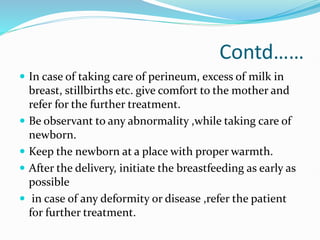
 In case of taking care of perineum, excess of milk in
breast, stillbirths etc. give comfort to the mother and
refer for the further treatment.
 Be observant to any abnormality ,while taking care of
newborn.
 Keep the newborn at a place with proper warmth.
 After the delivery, initiate the breastfeeding as early as
possible
 in case of any deformity or disease ,refer the patient
for further treatment.
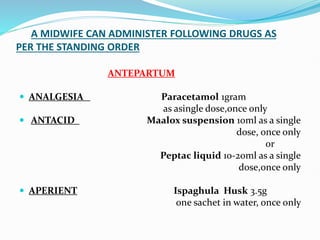
A MIDWIFE CAN ADMINISTER FOLLOWING DRUGS AS
PER THE STANDING ORDER
ANTEPARTUM
 ANALGESIA Paracetamol 1gram
as asingle dose,once only
 ANTACID Maalox suspension 10ml as a single
dose, once only
or
Peptac liquid 10-20ml as a single
dose,once only
 APERIENT Ispaghula Husk 3.5g
one sachet in water, once only
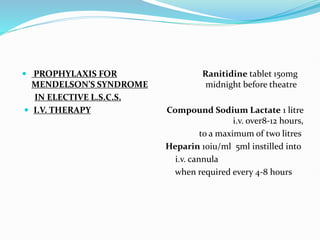
 PROPHYLAXIS FOR Ranitidine tablet 150mg
MENDELSON’S SYNDROME midnight before theatre
IN ELECTIVE L.S.C.S.
 I.V. THERAPY Compound Sodium Lactate 1 litre
i.v. over8-12 hours,
to a maximum of two litres
Heparin 10iu/ml 5ml instilled into
i.v. cannula
when required every 4-8 hours
CONTD….
 LOCAL ANAESTHETIC lignocaine gel 4%
1g under occlusivedressing
45 minutes prior to
venous cannulation once only
 NIGHT SEDATION Temazepam 10mg as a single
dose up to 2.00am
in the morning.
 DINOPROSTONE
VAGINAL Gel As per induction of
labour guidelines
CONTD….
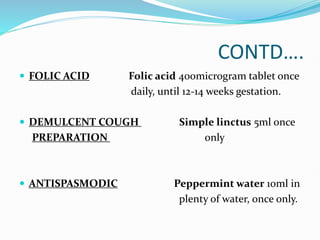
 FOLIC ACID Folic acid 400microgram tablet once
daily, until 12-14 weeks gestation.
 DEMULCENT COUGH Simple linctus 5ml once
PREPARATION only
 ANTISPASMODIC Peppermint water 10ml in
plenty of water, once only.
CONTD…
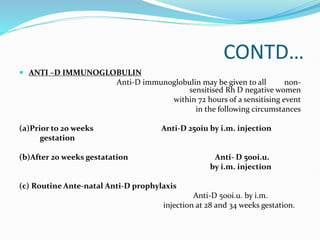
 ANTI –D IMMUNOGLOBULIN
Anti-D immunoglobulin may be given to all non-
sensitised Rh D negative women
within 72 hours of a sensitising event
in the following circumstances
(a)Prior to 20 weeks Anti-D 250iu by i.m. injection
gestation
(b)After 20 weeks gestatation Anti- D 500i.u.
by i.m. injection
(c) Routine Ante-natal Anti-D prophylaxis
Anti-D 500i.u. by i.m.
injection at 28 and 34 weeks gestation.
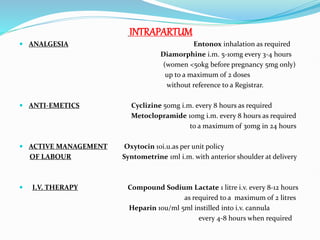
INTRAPARTUM
 ANALGESIA Entonox inhalation as required
Diamorphine i.m. 5-10mg every 3-4 hours
(women <50kg before pregnancy 5mg only)
up to a maximum of 2 doses
without reference to a Registrar.
 ANTI-EMETICS Cyclizine 50mg i.m. every 8 hours as required
Metoclopramide 10mg i.m. every 8 hours as required
to a maximum of 30mg in 24 hours
 ACTIVE MANAGEMENT Oxytocin 10i.u.as per unit policy
OF LABOUR Syntometrine 1ml i.m. with anterior shoulder at delivery
 I.V. THERAPY Compound Sodium Lactate 1 litre i.v. every 8-12 hours
as required to a maximum of 2 litres
Heparin 10u/ml 5ml instilled into i.v. cannula
every 4-8 hours when required
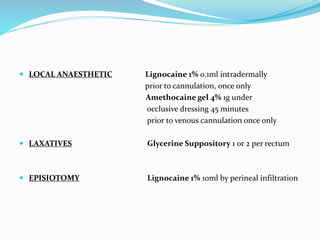
 LOCAL ANAESTHETIC Lignocaine 1% 0.1ml intradermally
prior to cannulation, once only
Amethocaine gel 4% 1g under
occlusive dressing 45 minutes
prior to venous cannulation once only
 LAXATIVES Glycerine Suppository 1 or 2 per rectum
 EPISIOTOMY Lignocaine 1% 10ml by perineal infiltration
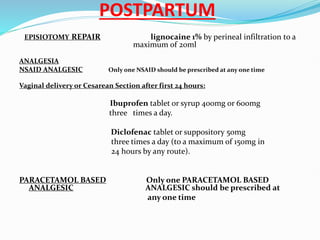
POSTPARTUM
EPISIOTOMY REPAIR lignocaine 1% by perineal infiltration to a
maximum of 20ml
ANALGESIA
NSAID ANALGESIC Only one NSAID should be prescribed at any one time
Vaginal delivery or Cesarean Section after first 24 hours:
Ibuprofen tablet or syrup 400mg or 600mg
three times a day.
Diclofenac tablet or suppository 50mg
three times a day (to a maximum of 150mg in
24 hours by any route).
PARACETAMOL BASED Only one PARACETAMOL BASED
ANALGESIC ANALGESIC should be prescribed at
any one time
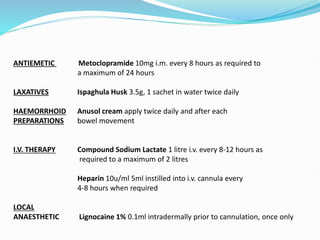
ANTIEMETIC Metoclopramide 10mg i.m. every 8 hours as required to
a maximum of 24 hours
LAXATIVES Ispaghula Husk 3.5g, 1 sachet in water twice daily
HAEMORRHOID Anusol cream apply twice daily and after each
PREPARATIONS bowel movement
I.V. THERAPY Compound Sodium Lactate 1 litre i.v. every 8-12 hours as
required to a maximum of 2 litres
Heparin 10u/ml 5ml instilled into i.v. cannula every
4-8 hours when required
LOCAL
ANAESTHETIC Lignocaine 1% 0.1ml intradermally prior to cannulation, once only
.
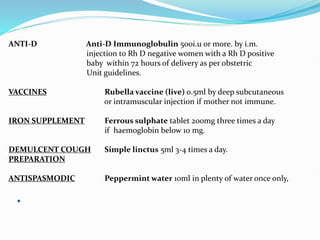
ANTI-D Anti-D Immunoglobulin 500i.u or more. by i.m.
injection to Rh D negative women with a Rh D positive
baby within 72 hours of delivery as per obstetric
Unit guidelines.
VACCINES Rubella vaccine (live) 0.5ml by deep subcutaneous
or intramuscular injection if mother not immune.
IRON SUPPLEMENT Ferrous sulphate tablet 200mg three times a day
if haemoglobin below 10 mg.
DEMULCENT COUGH Simple linctus 5ml 3-4 times a day.
PREPARATION
ANTISPASMODIC Peppermint water 10ml in plenty of water once only,
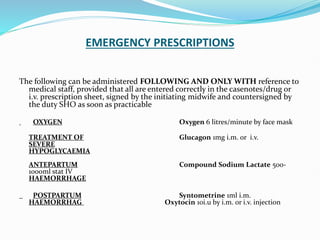
EMERGENCY PRESCRIPTIONS
The following can be administered FOLLOWING AND ONLY WITH reference to
medical staff, provided that all are entered correctly in the casenotes/drug or
i.v. prescription sheet, signed by the initiating midwife and countersigned by
the duty SHO as soon as practicable
OXYGEN Oxygen 6 litres/minute by face mask
TREATMENT OF Glucagon 1mg i.m. or i.v.
SEVERE
HYPOGLYCAEMIA
ANTEPARTUM Compound Sodium Lactate 500-
1000ml stat IV
HAEMORRHAGE
POSTPARTUM Syntometrine 1ml i.m.
HAEMORRHAG Oxytocin 10i.u by i.m. or i.v. injection
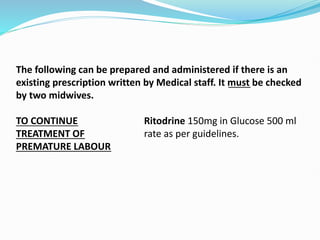
The following can be prepared and administered if there is an
existing prescription written by Medical staff. It must be checked
by two midwives.
TO CONTINUE Ritodrine 150mg in Glucose 500 ml
TREATMENT OF rate as per guidelines.
PREMATURE LABOUR
1.A midwife should collect following information
before providing nursing care :-
history of general health of patient
taking special history of the onset of disease,its intesity
and symptoms.
history of illness in the family pre medical history
2.finding out the actions taken,complications and any
specifications
3.noting vital signs(temperature,pulse,respiration and
blood pressure)and conducting urine test
4. identifying the problems and determining the
personal needs
5.providing nursing nservices under the standing
orders
6.implementing the referral system
7.disclosing the cause of illness,complications,follow up
treatment or preventive measures
8.assessment of work done
9.regular study and monitoring of standing order
manuals/health books.
10.informing the health officer immediately if any
complication arises.
11.keeping the medicine kit ready to follow standing orders
12.representingthe nurses's view point while reviewing the
standing orders.
13.in case of doubt about the standing
orders,collecting complete information at the
earliest
14.being careful about one's limits and
maintaining the faith of doctors and health
administration
15ensure a safe and healthful environment for
patient.well being of patient should be foremost
According to the data published by south australian nursing
and miwifey excellence awards conference held on 8th
may,2009 concerning nursing and midwifery matters
Standing orders for the administration of drugs of dependence in a
health service
The Directive Standing orders for the administration of drugs of
dependence in a health service has been endorsed by Portfolio Executive,
SA Health. Under the Controlled Substances (Poisons) Regulations 1996,
a registered nurse or midwife can administer a drug of dependence (a
schedule 8 drug such as morphine or fentanyl) in accordance with a
standing order prepared or endorsed by a health service and approved by
the Minister. The Directive Standing orders for the administration of
drugs of dependence in a health service provides guidance on:
> situations where standing orders for the
administration of drugs of dependence may
be used
> requirements for a standing order for a drug
of dependence in a health service
> format for standing orders for drugs of
dependence
> the process for seeking Ministerial approval
for a standing order for the administration of drugs.

Standing orders for midwifery practice.pptx

  • 1.
    INTRODUCTION Standing Orders statesthat medicines may be supplied and administered by midwives to the patients. Midwives may, under the Medicines Act 1968, supply all medical products on the General Sale List and Pharmacy List and administer a small range of Prescription Only Medicines.
  • 2.
    Contd….. DEFINITION  Standing ordersare the directions and orders of specific nature.  On the basis of these, in the non availability of doctors,the nurses, the health workers and the midwives can provide treatment to patients at home,hospital or health institution.  Generally, theses instructions/orders are in written form. OBJECTIVES  To maintain the continuity of the treatment of the patient  To protect the life of the patient/to ressucitate him  To create the feeling of responsibility in the members of health team.
  • 3.
    USES OF STANDINGORDERS  Providing treatment during emergency  Enhancing the quality and activity of health services in the community  Decentralization of health responsibilities  Developing the feeling of confidence and responsibility in the nursing and other health workers  Enhancing the faith of general public in medical institutions
  • 4.
    TYPES OF STANDINGORDERS  The authorized doctor and the registered nurse,jointly release standing orders. It can be divided into three categories:- 1. Institutional standing orders  This category includes standing orders prepared with a view of available resources , staff position,objectives of medical institutions. e.g. standing orders of primary health centres can be different from that of district hospitals.  similarly , variations can be found in the standing orders of the government and private clinics and that of medical institutions
  • 5.
    Contd…. 2.Specific standing orders These type of standing orders are prepared for the trained medical personnel,mainly for nurses.  Technical knowledge and special skills are required to implement these orders. e.g.giving injection,oxygen,home nursing etc. come in this category.  These orders compensate the need of a doctor and most of the treatment related decisions are to be taken by the institutional nurse or midwife .
  • 6.
    Contd….. 3.General standing orders Due to large population and geographical area, and shortage of health resources , some standing orders are used to propagate the health messages to the masses.  Such standing orders include taking tablets of quinine in fever etc.
  • 7.
    DESIGNATED STAFF AUTHORISED TO ADMINISTER VARIOUS DRUG Authorised Staff The following staff is authorised to administer Midwives Formulary products without individual medical prescription .
  • 8.
    1.Registered Midwife The followingrequirements are necessary:- To be professionally accountable To have received adequate training and be competent To be familiar with contra-indications to the product To have access to the current group protocols for the administration of Medicines in the Midwives Formulary To be trained to identify anaphylaxis To have immediate access to appropriate equipment and drugs to treat anaphylaxis and have access to the current protocol and guidelines for its management To maintain their own professional level of competence and knowledge.
  • 9.
    Head of Midwifery/Midwife Managers willbe responsible for Ensuring that midwives administering products have received adequate training and follow the patient group directions for the administration of products in the midwifery formula
  • 10.
    STANDING ORDERS FORTHE TREATMENT OF VARIOUS AILMENTS  While working in a hospital or institute, many times the midwife face the situation when it is necessary to provide treatment to the patients. e.g. at that time or place where no doctor is available or likely to come late.  In such conditions,standing orders come to the rescue of nurse,they help her in providing treatment to the patient.
  • 11.
    STANDING ORDERS FORM.C.H. CARE  Give tablets to check vomiting and nausea (morning sickness),in the stages of early pregnancy  In case of toxaemia of pregnancy,advice her restricted salt diet and complete rest.  If there is edema,immediately send her to the hospital  Send the mother to hospital in case of APH or PPH  If the mother develops fever after delivery, try to find its cause and give her antipyretic medicine and then refer her to hospital
  • 12.
    Contd……  In caseof taking care of perineum, excess of milk in breast, stillbirths etc. give comfort to the mother and refer for the further treatment.  Be observant to any abnormality ,while taking care of newborn.  Keep the newborn at a place with proper warmth.  After the delivery, initiate the breastfeeding as early as possible  in case of any deformity or disease ,refer the patient for further treatment.
  • 13.
    A MIDWIFE CANADMINISTER FOLLOWING DRUGS AS PER THE STANDING ORDER ANTEPARTUM  ANALGESIA Paracetamol 1gram as asingle dose,once only  ANTACID Maalox suspension 10ml as a single dose, once only or Peptac liquid 10-20ml as a single dose,once only  APERIENT Ispaghula Husk 3.5g one sachet in water, once only
  • 14.
     PROPHYLAXIS FORRanitidine tablet 150mg MENDELSON’S SYNDROME midnight before theatre IN ELECTIVE L.S.C.S.  I.V. THERAPY Compound Sodium Lactate 1 litre i.v. over8-12 hours, to a maximum of two litres Heparin 10iu/ml 5ml instilled into i.v. cannula when required every 4-8 hours
  • 15.
    CONTD….  LOCAL ANAESTHETIClignocaine gel 4% 1g under occlusivedressing 45 minutes prior to venous cannulation once only  NIGHT SEDATION Temazepam 10mg as a single dose up to 2.00am in the morning.  DINOPROSTONE VAGINAL Gel As per induction of labour guidelines
  • 16.
    CONTD….  FOLIC ACIDFolic acid 400microgram tablet once daily, until 12-14 weeks gestation.  DEMULCENT COUGH Simple linctus 5ml once PREPARATION only  ANTISPASMODIC Peppermint water 10ml in plenty of water, once only.
  • 17.
    CONTD…  ANTI –DIMMUNOGLOBULIN Anti-D immunoglobulin may be given to all non- sensitised Rh D negative women within 72 hours of a sensitising event in the following circumstances (a)Prior to 20 weeks Anti-D 250iu by i.m. injection gestation (b)After 20 weeks gestatation Anti- D 500i.u. by i.m. injection (c) Routine Ante-natal Anti-D prophylaxis Anti-D 500i.u. by i.m. injection at 28 and 34 weeks gestation.
  • 18.
    INTRAPARTUM  ANALGESIA Entonoxinhalation as required Diamorphine i.m. 5-10mg every 3-4 hours (women <50kg before pregnancy 5mg only) up to a maximum of 2 doses without reference to a Registrar.  ANTI-EMETICS Cyclizine 50mg i.m. every 8 hours as required Metoclopramide 10mg i.m. every 8 hours as required to a maximum of 30mg in 24 hours  ACTIVE MANAGEMENT Oxytocin 10i.u.as per unit policy OF LABOUR Syntometrine 1ml i.m. with anterior shoulder at delivery  I.V. THERAPY Compound Sodium Lactate 1 litre i.v. every 8-12 hours as required to a maximum of 2 litres Heparin 10u/ml 5ml instilled into i.v. cannula every 4-8 hours when required
  • 19.
     LOCAL ANAESTHETICLignocaine 1% 0.1ml intradermally prior to cannulation, once only Amethocaine gel 4% 1g under occlusive dressing 45 minutes prior to venous cannulation once only  LAXATIVES Glycerine Suppository 1 or 2 per rectum  EPISIOTOMY Lignocaine 1% 10ml by perineal infiltration
  • 20.
    POSTPARTUM EPISIOTOMY REPAIR lignocaine1% by perineal infiltration to a maximum of 20ml ANALGESIA NSAID ANALGESIC Only one NSAID should be prescribed at any one time Vaginal delivery or Cesarean Section after first 24 hours: Ibuprofen tablet or syrup 400mg or 600mg three times a day. Diclofenac tablet or suppository 50mg three times a day (to a maximum of 150mg in 24 hours by any route). PARACETAMOL BASED Only one PARACETAMOL BASED ANALGESIC ANALGESIC should be prescribed at any one time
  • 21.
    ANTIEMETIC Metoclopramide 10mgi.m. every 8 hours as required to a maximum of 24 hours LAXATIVES Ispaghula Husk 3.5g, 1 sachet in water twice daily HAEMORRHOID Anusol cream apply twice daily and after each PREPARATIONS bowel movement I.V. THERAPY Compound Sodium Lactate 1 litre i.v. every 8-12 hours as required to a maximum of 2 litres Heparin 10u/ml 5ml instilled into i.v. cannula every 4-8 hours when required LOCAL ANAESTHETIC Lignocaine 1% 0.1ml intradermally prior to cannulation, once only
  • 22.
    . ANTI-D Anti-D Immunoglobulin500i.u or more. by i.m. injection to Rh D negative women with a Rh D positive baby within 72 hours of delivery as per obstetric Unit guidelines. VACCINES Rubella vaccine (live) 0.5ml by deep subcutaneous or intramuscular injection if mother not immune. IRON SUPPLEMENT Ferrous sulphate tablet 200mg three times a day if haemoglobin below 10 mg. DEMULCENT COUGH Simple linctus 5ml 3-4 times a day. PREPARATION ANTISPASMODIC Peppermint water 10ml in plenty of water once only,
  • 23.
    EMERGENCY PRESCRIPTIONS The followingcan be administered FOLLOWING AND ONLY WITH reference to medical staff, provided that all are entered correctly in the casenotes/drug or i.v. prescription sheet, signed by the initiating midwife and countersigned by the duty SHO as soon as practicable OXYGEN Oxygen 6 litres/minute by face mask TREATMENT OF Glucagon 1mg i.m. or i.v. SEVERE HYPOGLYCAEMIA ANTEPARTUM Compound Sodium Lactate 500- 1000ml stat IV HAEMORRHAGE POSTPARTUM Syntometrine 1ml i.m. HAEMORRHAG Oxytocin 10i.u by i.m. or i.v. injection
  • 24.
    The following canbe prepared and administered if there is an existing prescription written by Medical staff. It must be checked by two midwives. TO CONTINUE Ritodrine 150mg in Glucose 500 ml TREATMENT OF rate as per guidelines. PREMATURE LABOUR
  • 25.
    1.A midwife shouldcollect following information before providing nursing care :- history of general health of patient taking special history of the onset of disease,its intesity and symptoms. history of illness in the family pre medical history 2.finding out the actions taken,complications and any specifications 3.noting vital signs(temperature,pulse,respiration and blood pressure)and conducting urine test 4. identifying the problems and determining the personal needs 5.providing nursing nservices under the standing orders 6.implementing the referral system
  • 26.
    7.disclosing the causeof illness,complications,follow up treatment or preventive measures 8.assessment of work done 9.regular study and monitoring of standing order manuals/health books. 10.informing the health officer immediately if any complication arises. 11.keeping the medicine kit ready to follow standing orders 12.representingthe nurses's view point while reviewing the standing orders.
  • 27.
    13.in case ofdoubt about the standing orders,collecting complete information at the earliest 14.being careful about one's limits and maintaining the faith of doctors and health administration 15ensure a safe and healthful environment for patient.well being of patient should be foremost
  • 28.
    According to thedata published by south australian nursing and miwifey excellence awards conference held on 8th may,2009 concerning nursing and midwifery matters Standing orders for the administration of drugs of dependence in a health service The Directive Standing orders for the administration of drugs of dependence in a health service has been endorsed by Portfolio Executive, SA Health. Under the Controlled Substances (Poisons) Regulations 1996, a registered nurse or midwife can administer a drug of dependence (a schedule 8 drug such as morphine or fentanyl) in accordance with a standing order prepared or endorsed by a health service and approved by the Minister. The Directive Standing orders for the administration of drugs of dependence in a health service provides guidance on: > situations where standing orders for the administration of drugs of dependence may be used > requirements for a standing order for a drug of dependence in a health service > format for standing orders for drugs of dependence > the process for seeking Ministerial approval for a standing order for the administration of drugs.