1
Flow Logic
and
Every Product Every Cycle
How to start
2
Where to start with current plant &
equipment limitations?
3
The Glenday Sieve
• A tool to help
– Implement Every Product Every Cycle
– Remove waste
4
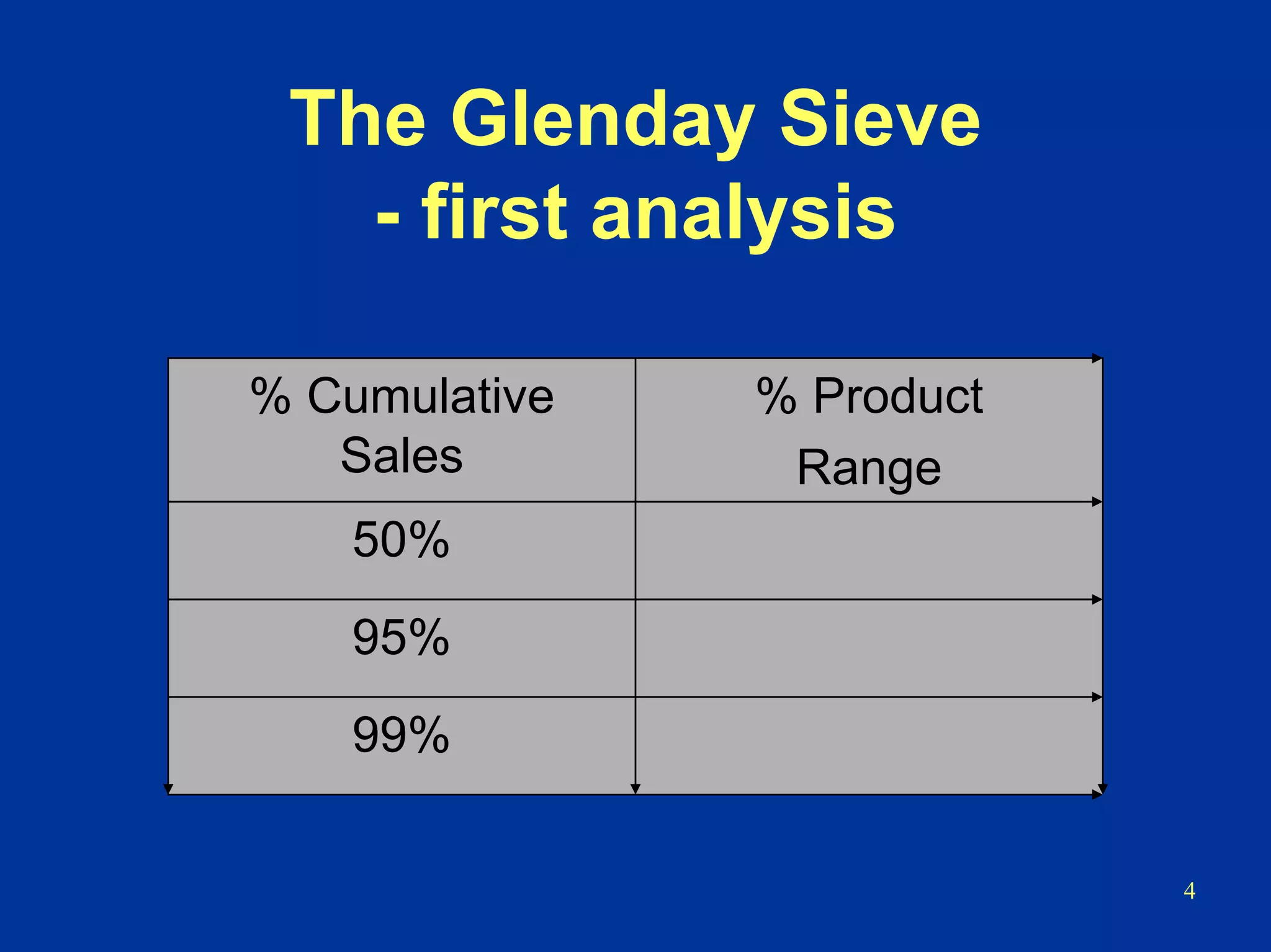
The Glenday Sieve
- first analysis
% Cumulative
Sales
% Product
Range
50%
95%
99%
5
The Glenday Sieve
- first analysis
Exercise
Data source: $B paint/coatings multinational
6
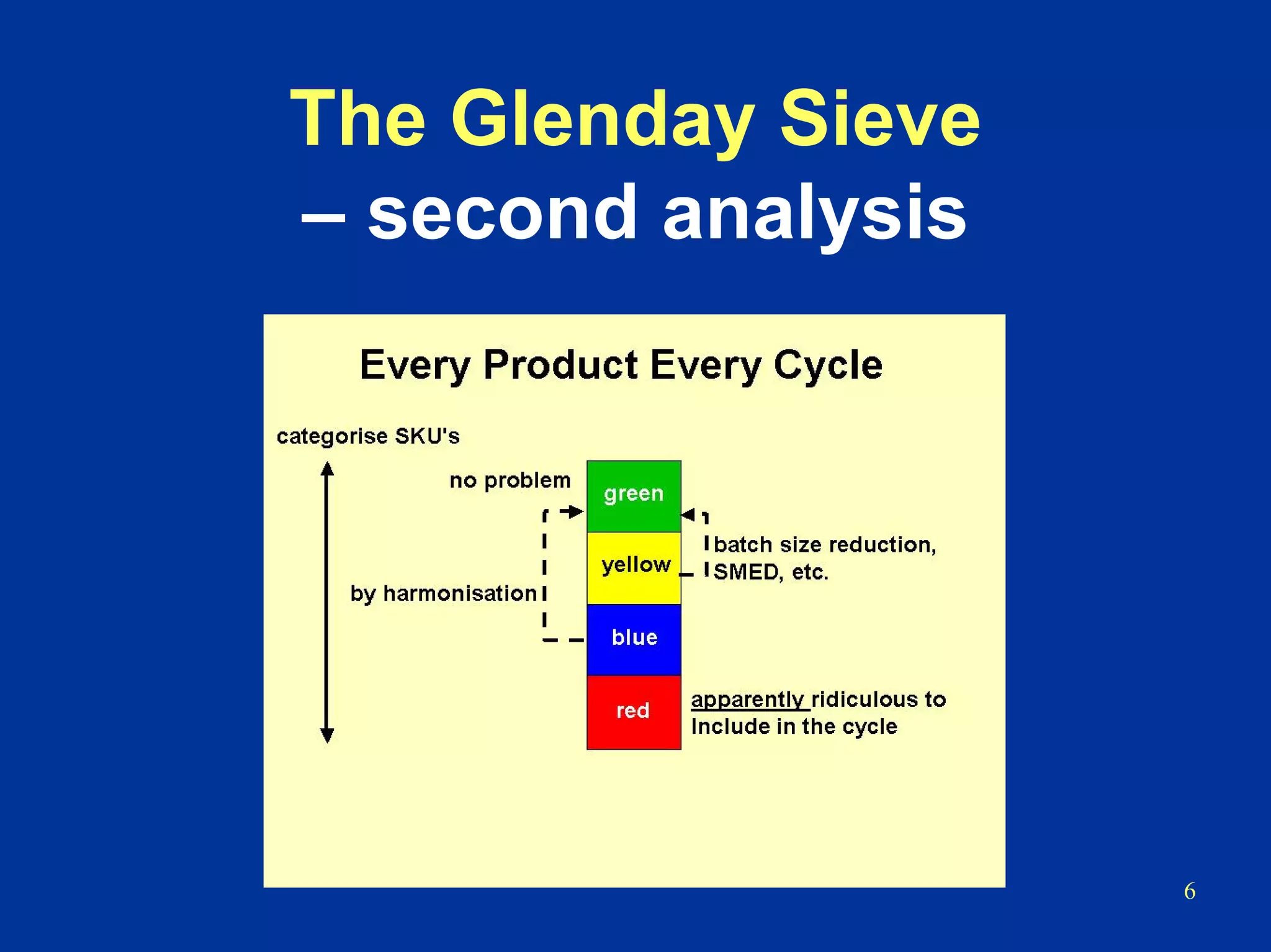
The Glenday Sieve
– second analysis
7
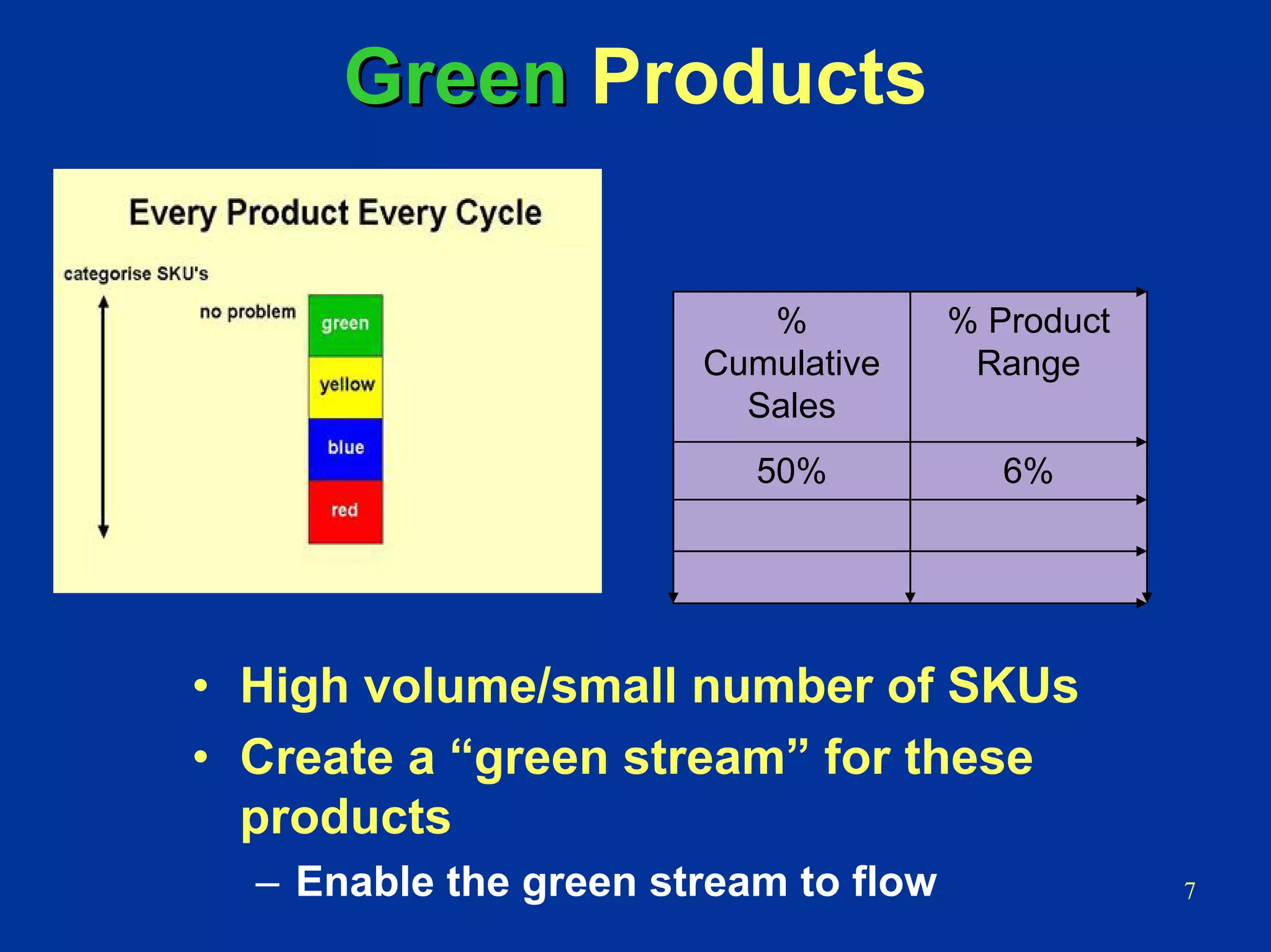
GreenGreen Products
%
Cumulative
Sales
% Product
Range
50% 6%
• High volume/small number of SKUs
• Create a “green stream” for these
products
– Enable the green stream to flow
8
The Glenday Sieve
and
Value Stream Mapping
What do you map first?
The Greens
9
The Glenday Sieve
and
Value Stream Mapping
To make the “greens” flow
10
The Glenday Sieve
and
Value Stream Mapping
which will
as a consequence
reduce non-value added waste
11
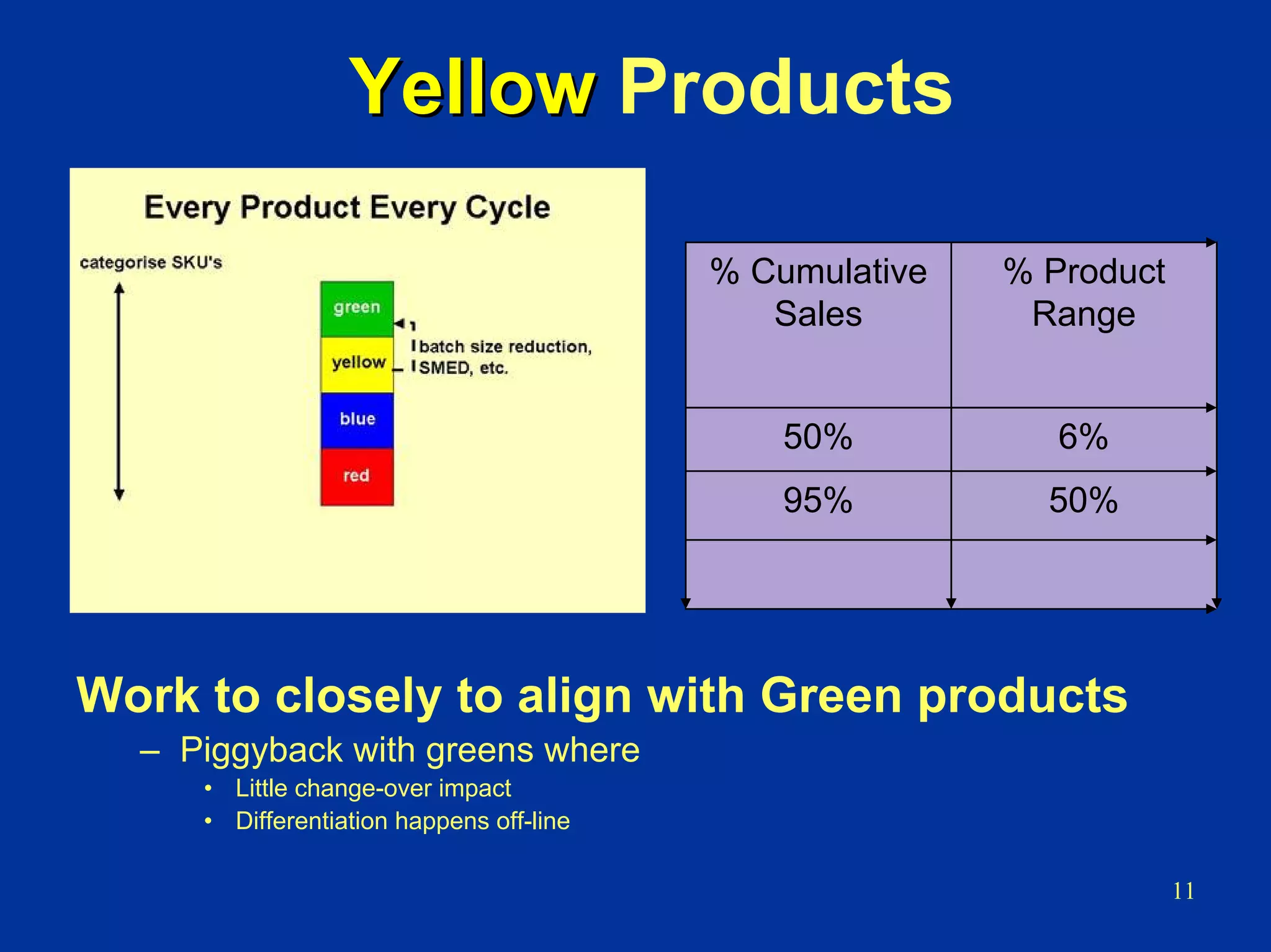
YellowYellow Products
% Cumulative
Sales
% Product
Range
50% 6%
95% 50%
Work to closely to align with Green products
– Piggyback with greens where
• Little change-over impact
• Differentiation happens off-line
12
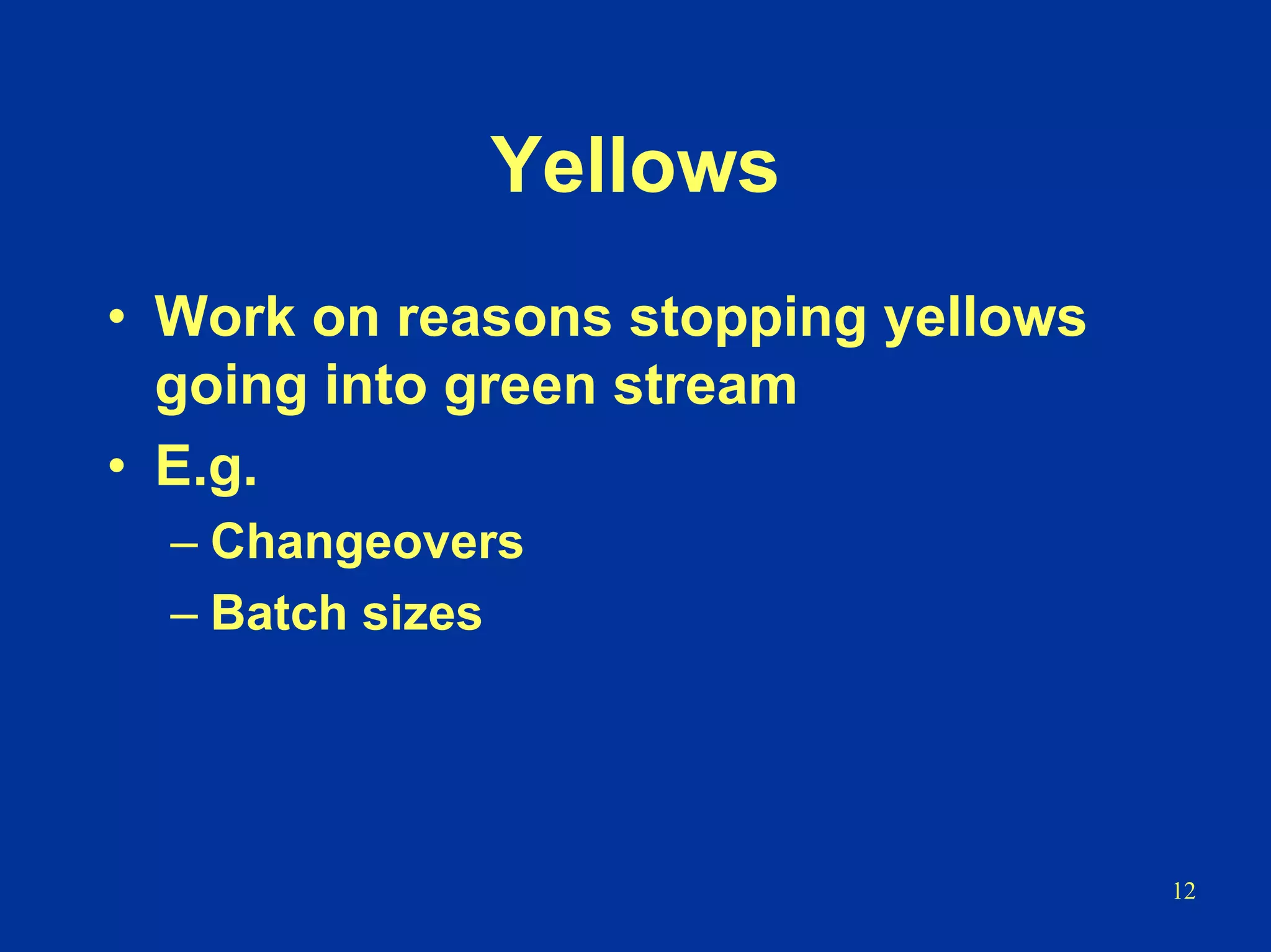
Yellows
• Work on reasons stopping yellows
going into green stream
• E.g.
– Changeovers
– Batch sizes
13
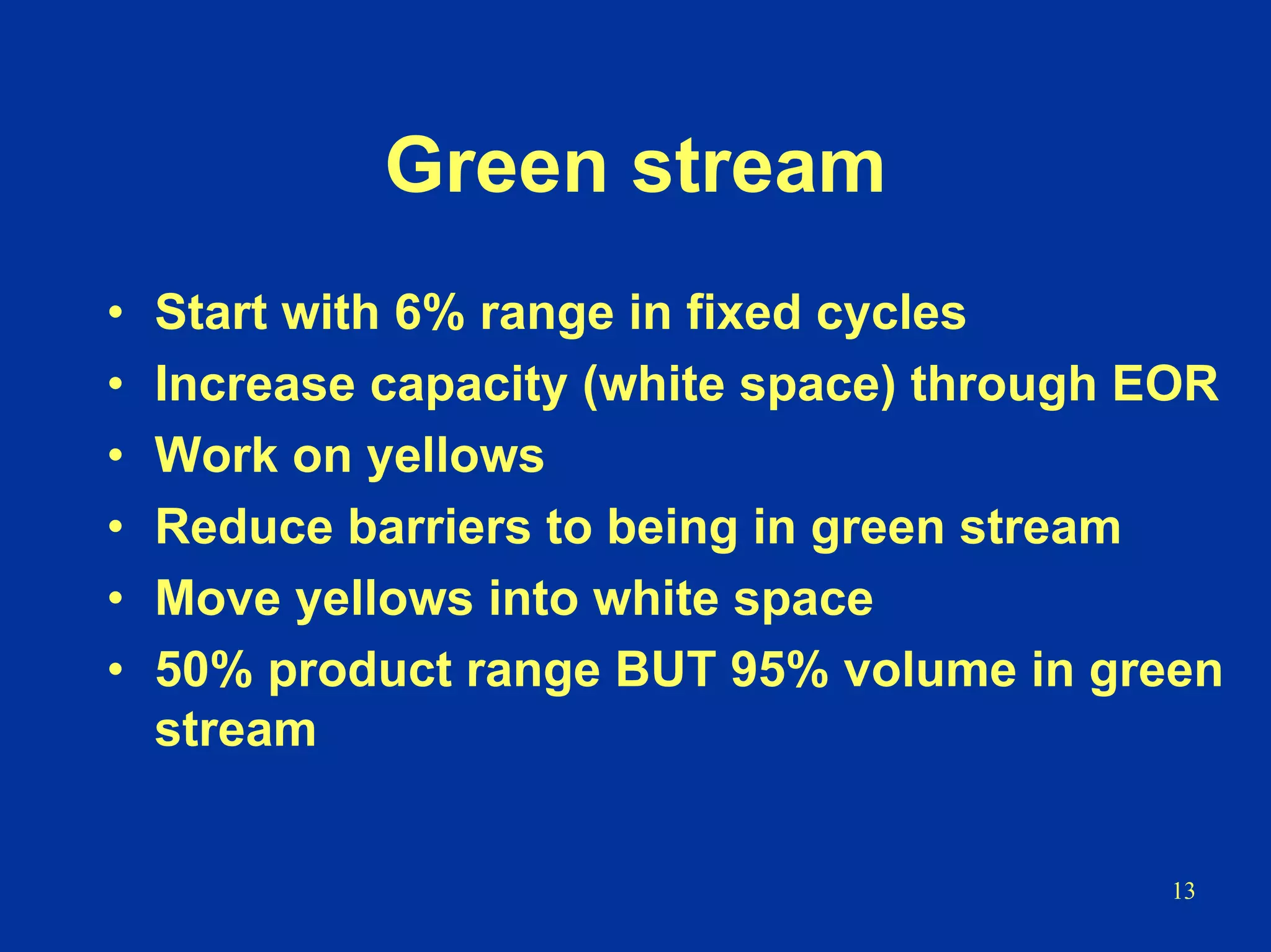
Green stream
• Start with 6% range in fixed cycles
• Increase capacity (white space) through EOR
• Work on yellows
• Reduce barriers to being in green stream
• Move yellows into white space
• 50% product range BUT 95% volume in green
stream
14
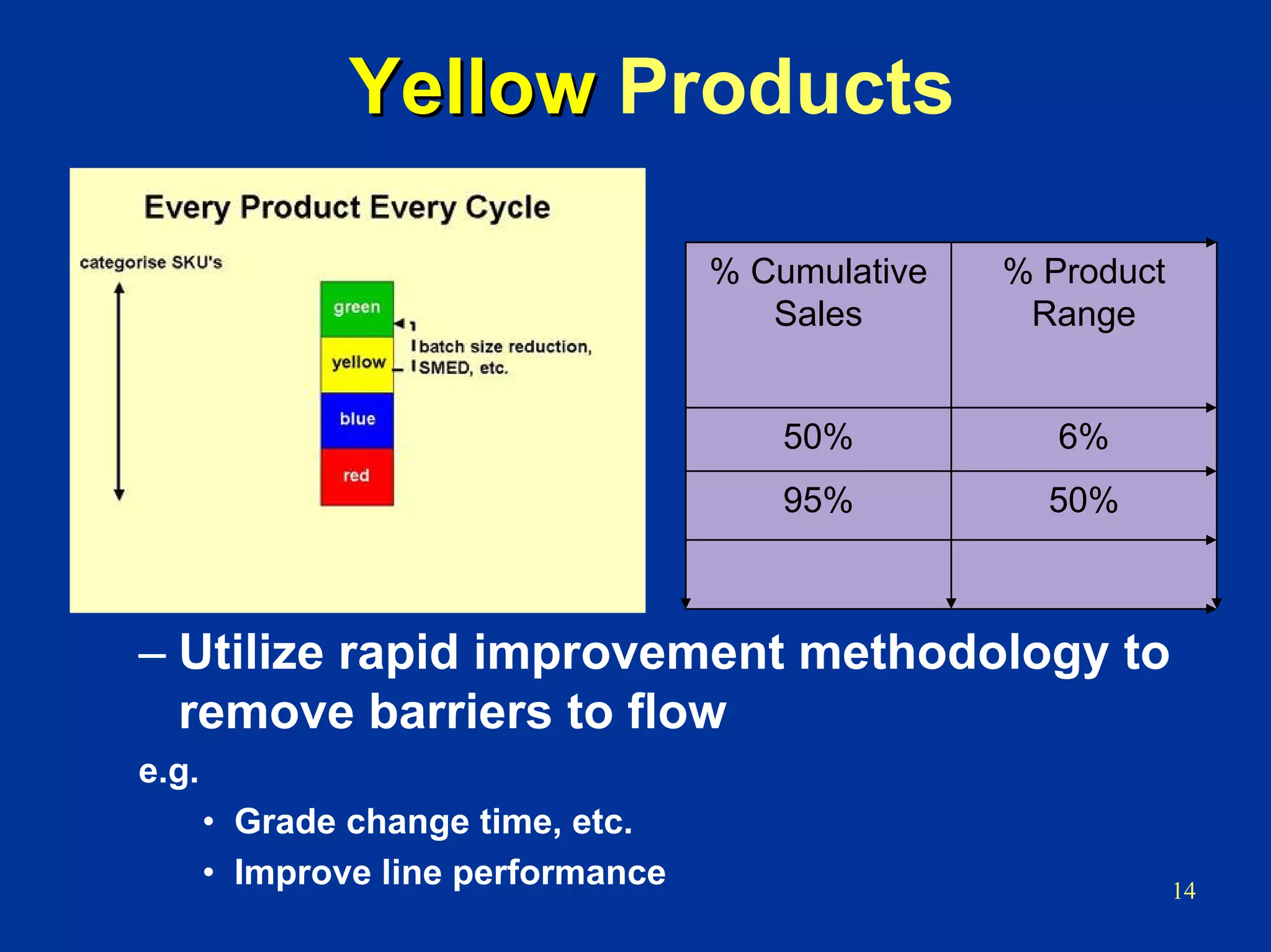
YellowYellow Products
% Cumulative
Sales
% Product
Range
50% 6%
95% 50%
– Utilize rapid improvement methodology to
remove barriers to flow
e.g.
• Grade change time, etc.
• Improve line performance
15
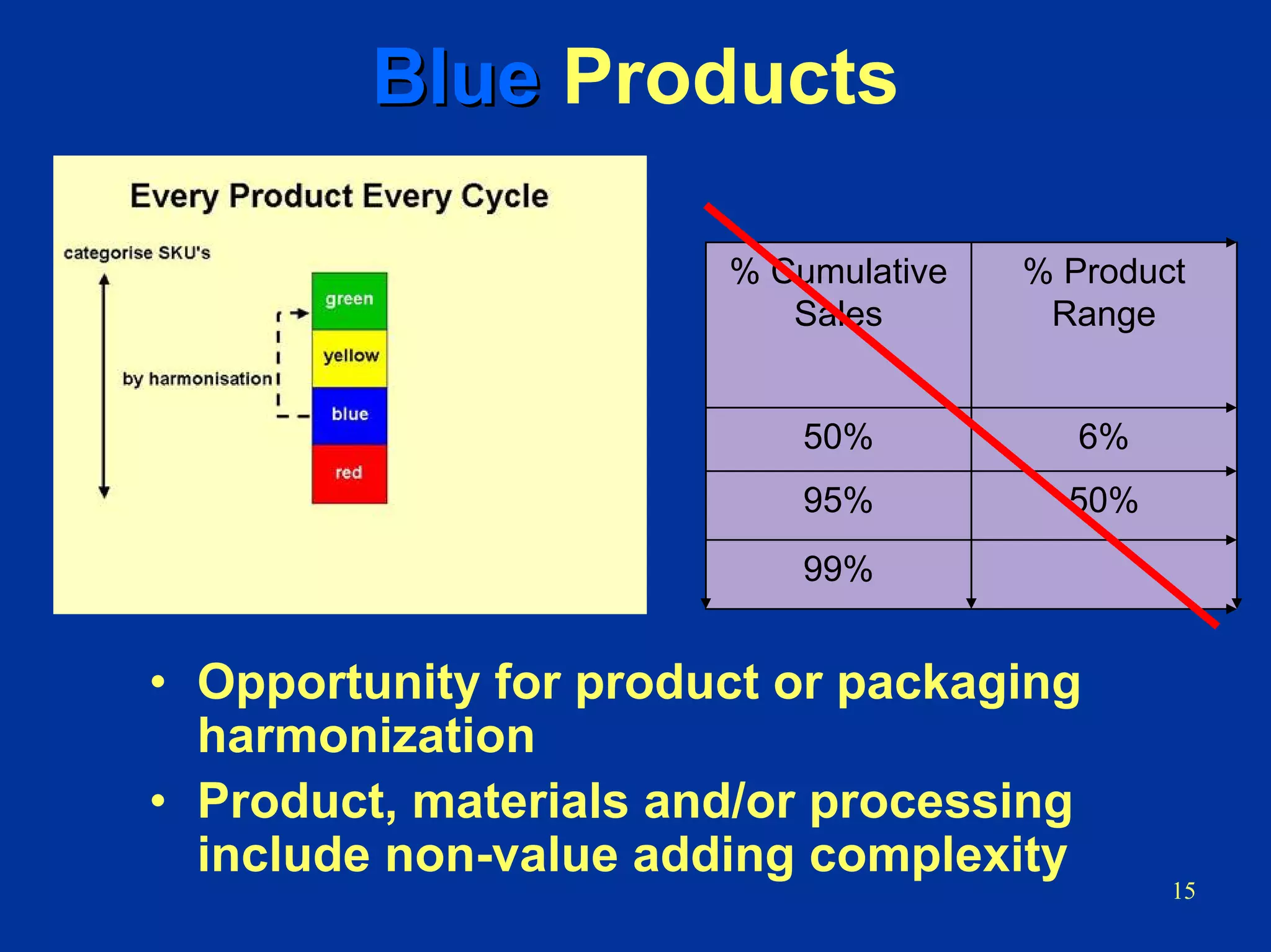
BlueBlue Products
% Cumulative
Sales
% Product
Range
50% 6%
95% 50%
99%
• Opportunity for product or packaging
harmonization
• Product, materials and/or processing
include non-value adding complexity
16
Blue SKU’s
- removing non-value adding complexity
– Back labels
17
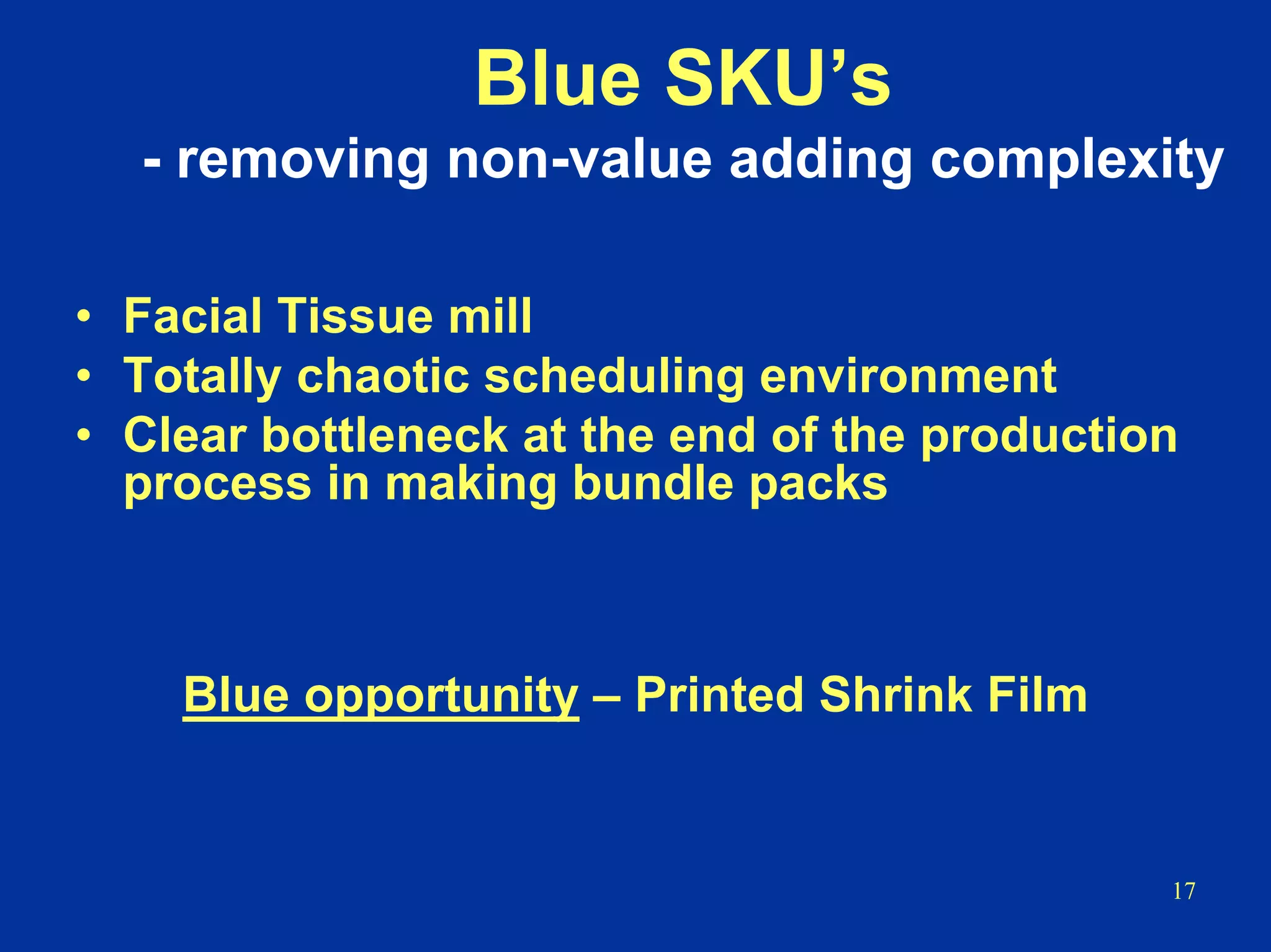
Blue SKU’s
- removing non-value adding complexity
• Facial Tissue mill
• Totally chaotic scheduling environment
• Clear bottleneck at the end of the production
process in making bundle packs
Blue opportunity – Printed Shrink Film
18
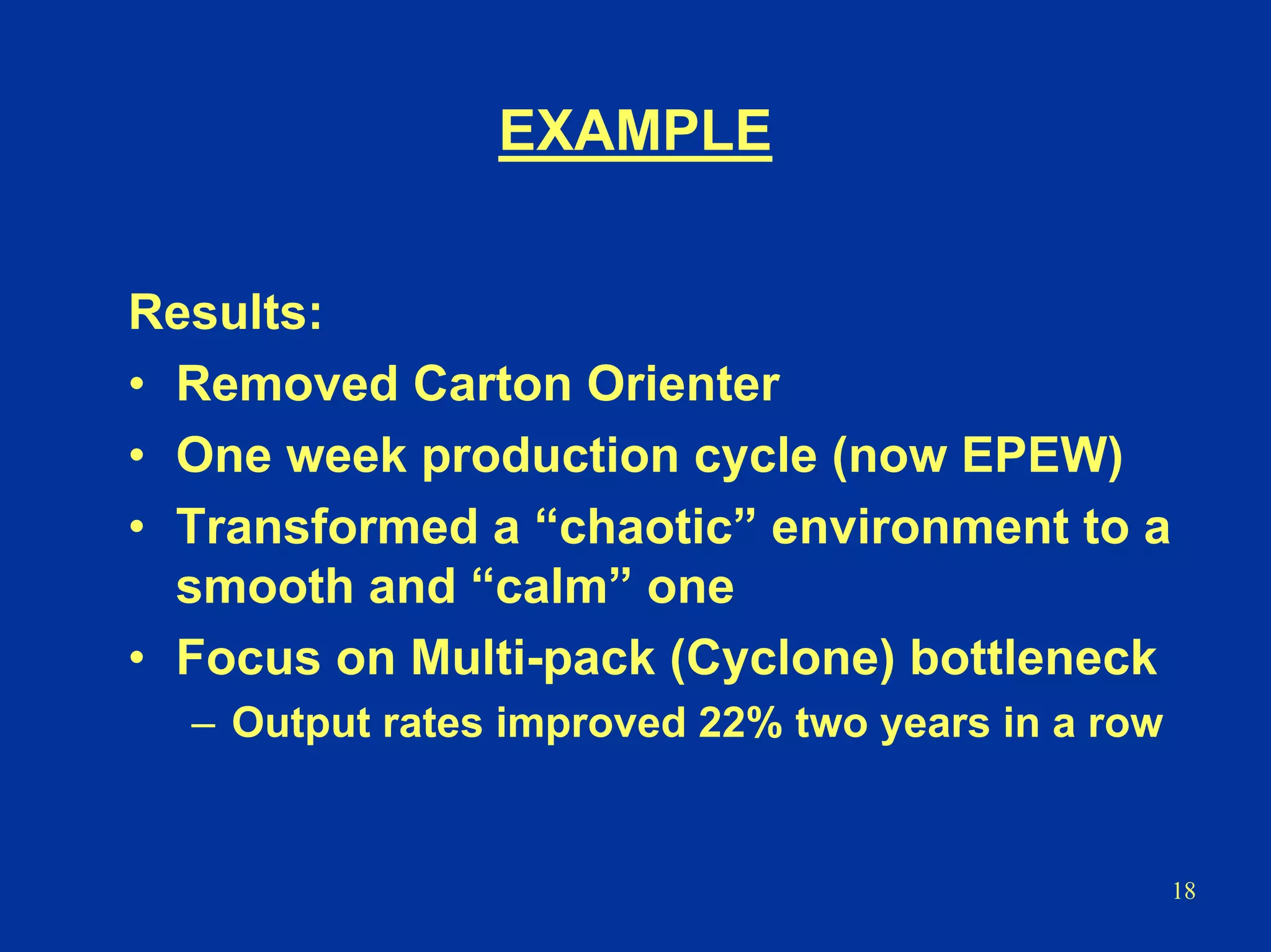
EXAMPLE
Results:
• Removed Carton Orienter
• One week production cycle (now EPEW)
• Transformed a “chaotic” environment to a
smooth and “calm” one
• Focus on Multi-pack (Cyclone) bottleneck
– Output rates improved 22% two years in a row
19
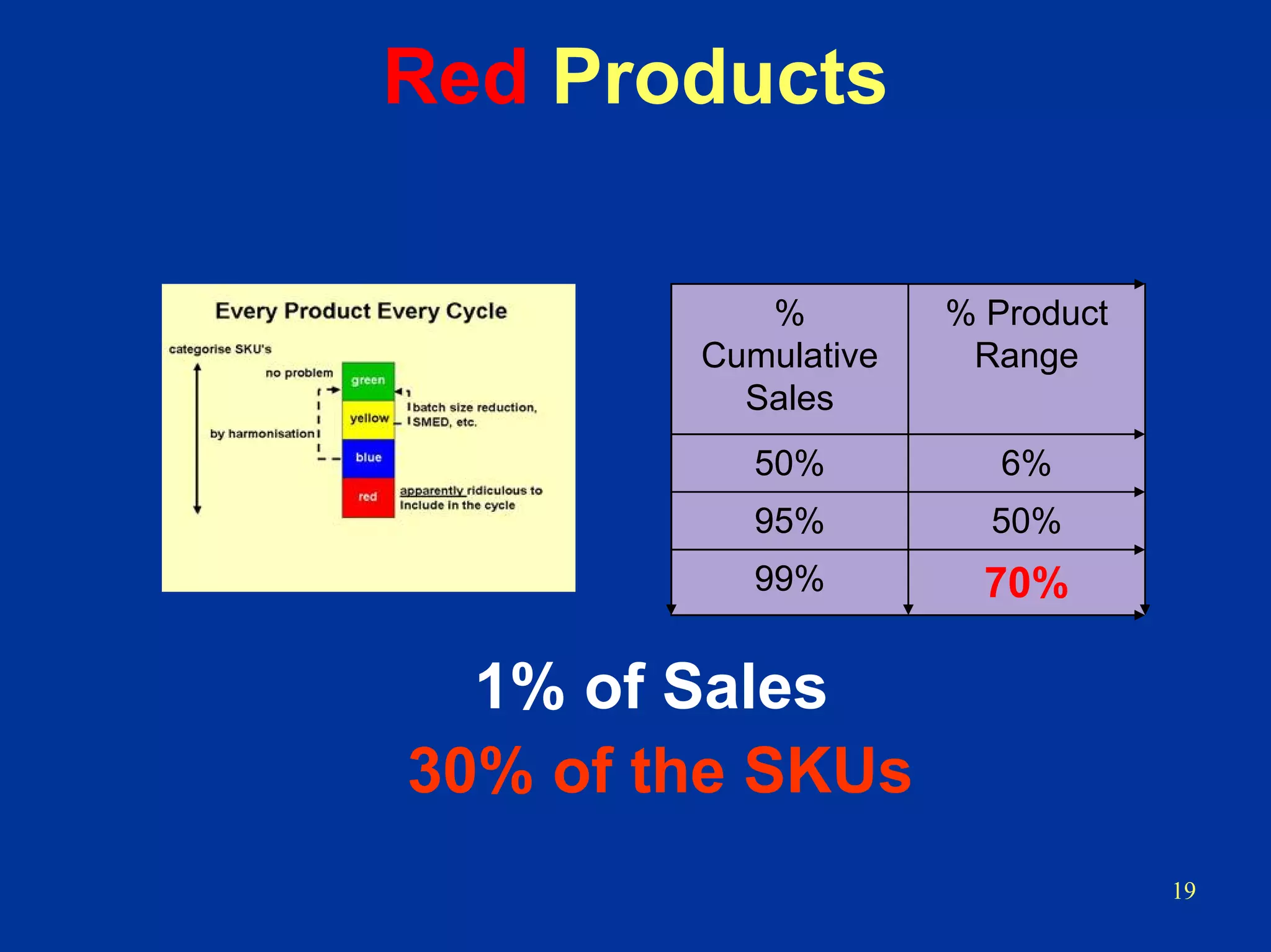
Red Products
%
Cumulative
Sales
% Product
Range
50% 6%
95% 50%
99% 70%
1% of Sales
30% of the SKUs
20
More “institutional” waste
21
Exercise
Impact of central limit theory
On
Sales predictability
22
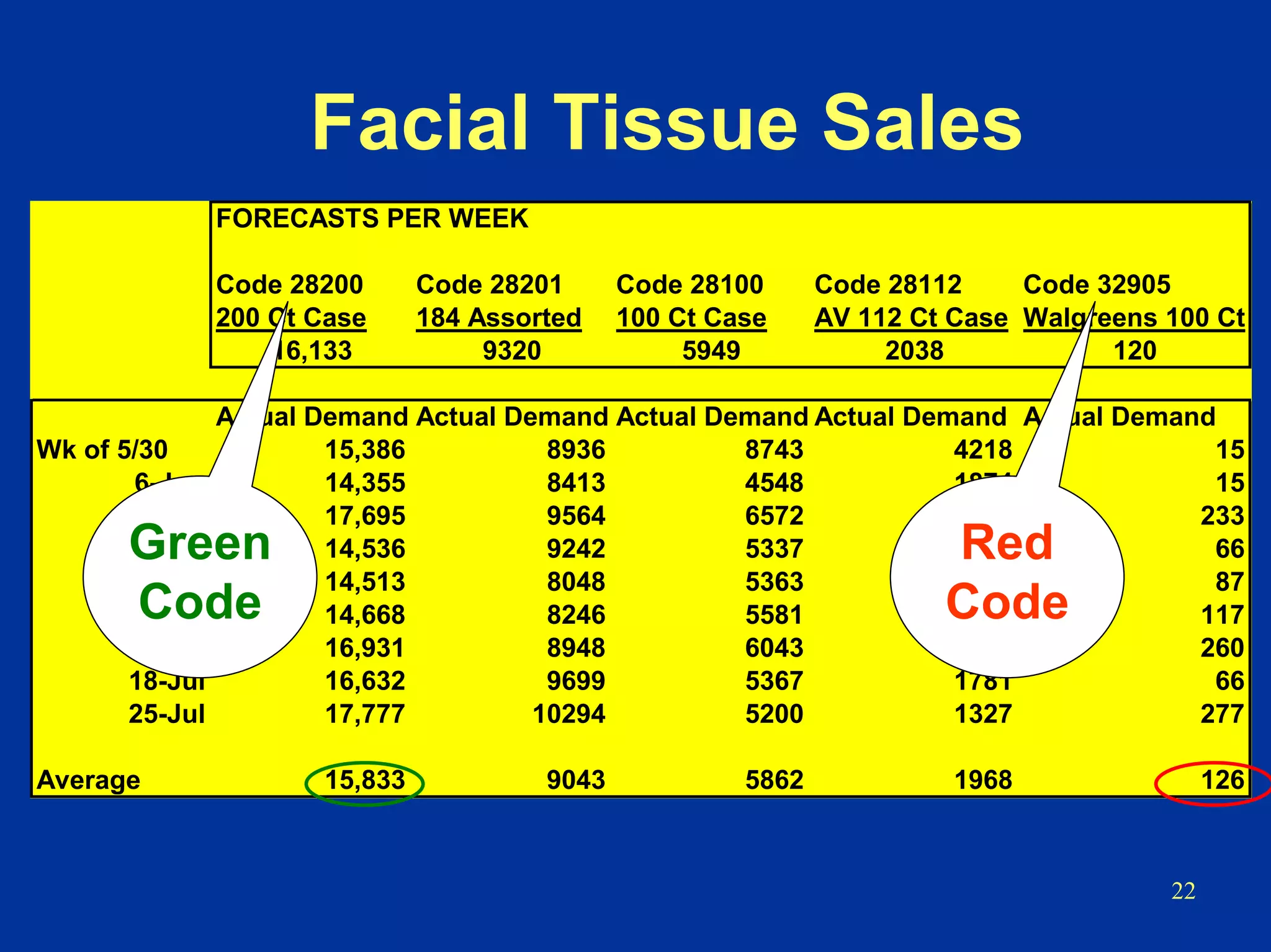
Facial Tissue Sales
FORECASTS PER WEEK
Code 28200 Code 28201 Code 28100 Code 28112 Code 32905
200 Ct Case 184 Assorted 100 Ct Case AV 112 Ct Case Walgreens 100 Ct
16,133 9320 5949 2038 120
Actual Demand Actual Demand Actual Demand Actual Demand Actual Demand
Wk of 5/30 15,386 8936 8743 4218 15
6-Jun 14,355 8413 4548 1874 15
13-Jun 17,695 9564 6572 3153 233
20-Jun 14,536 9242 5337 1011 66
27-Jun 14,513 8048 5363 1065 87
4-Jul 14,668 8246 5581 2002 117
11-Jul 16,931 8948 6043 1280 260
18-Jul 16,632 9699 5367 1781 66
25-Jul 17,777 10294 5200 1327 277
Average 15,833 9043 5862 1968 126
Green
Code
Red
Code
23
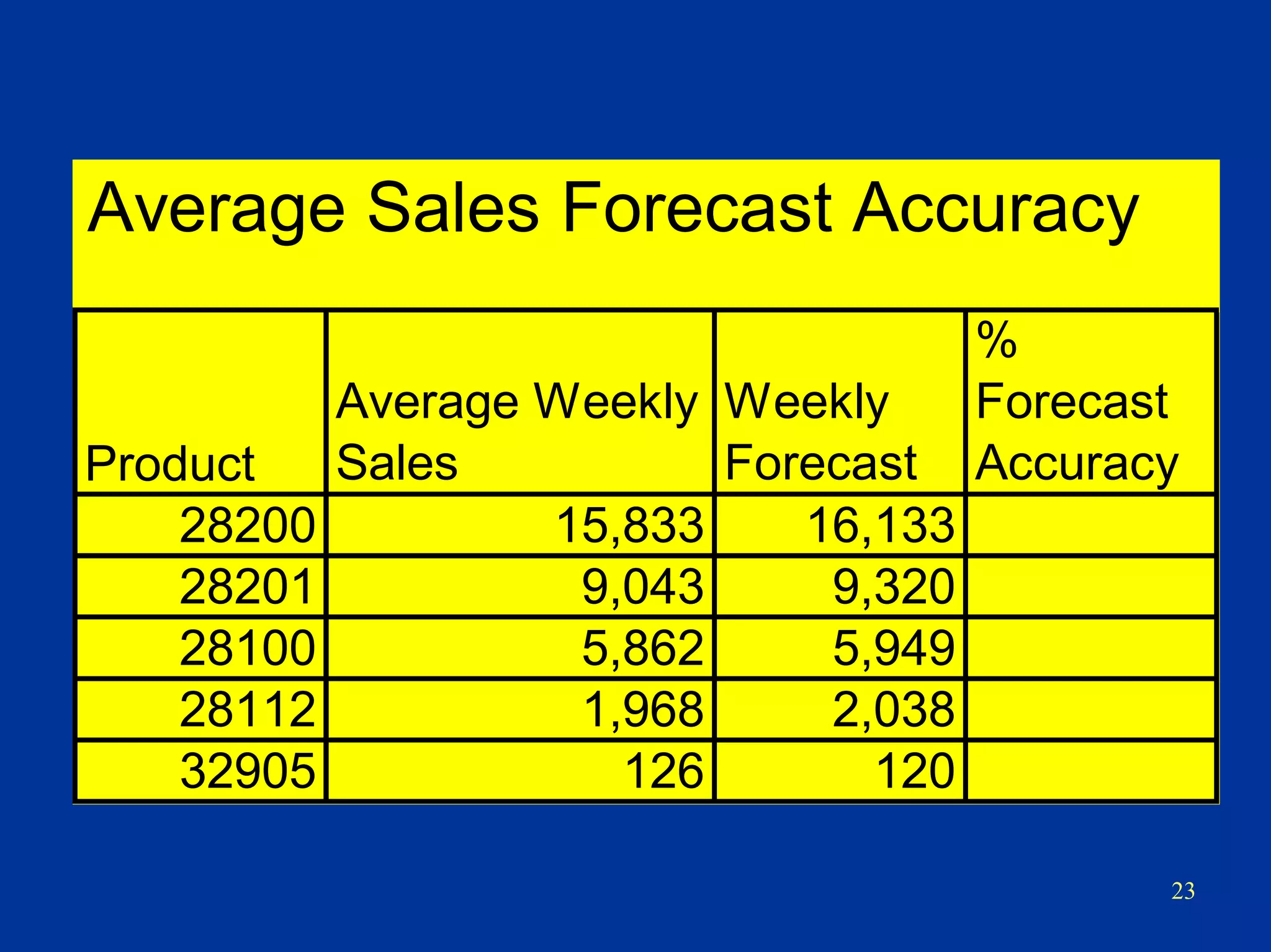
Average Sales Forecast Accuracy
Product
Average Weekly
Sales
Weekly
Forecast
%
Forecast
Accuracy
28200 15,833 16,133
28201 9,043 9,320
28100 5,862 5,949
28112 1,968 2,038
32905 126 120
24
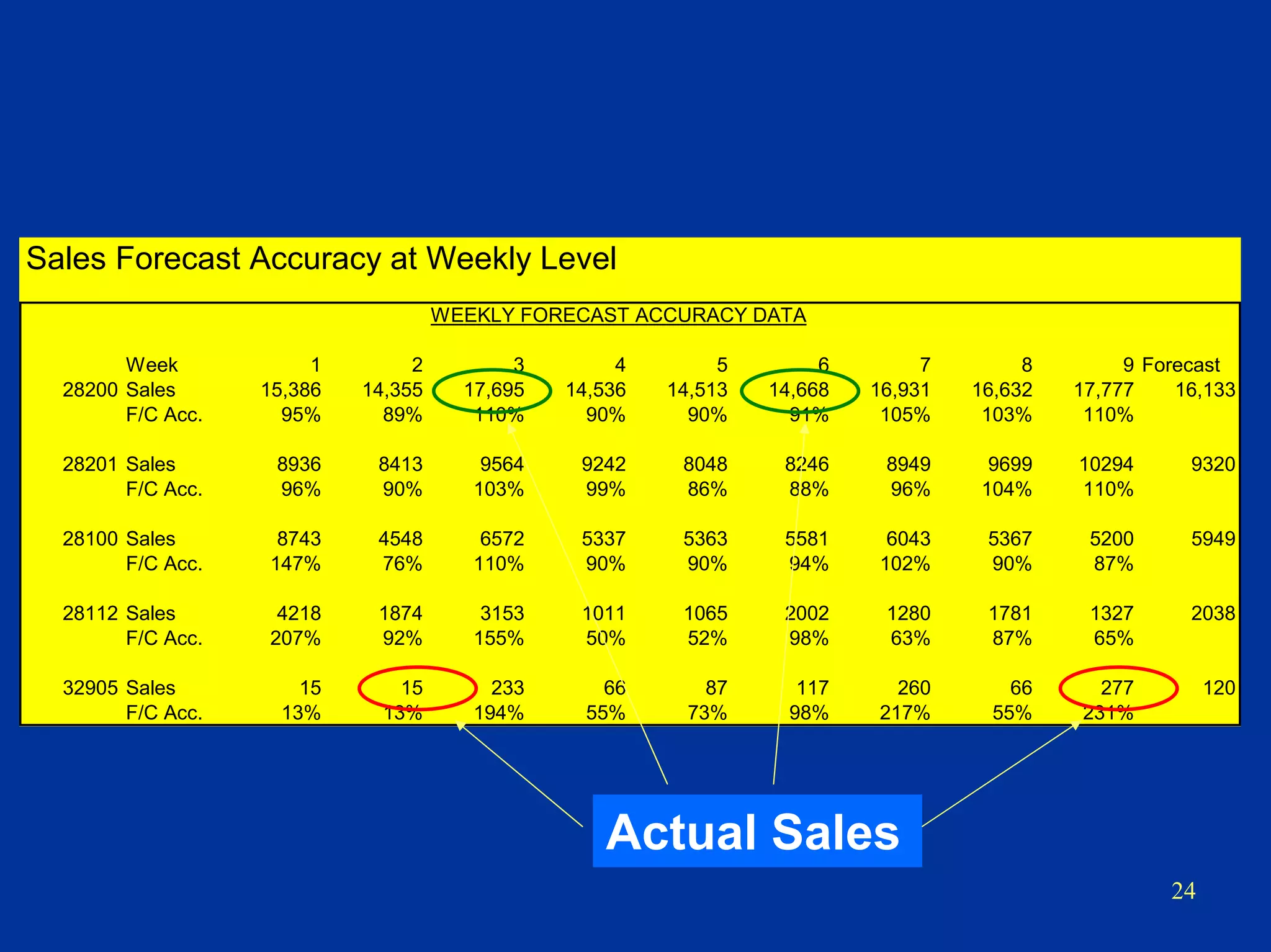
Sales Forecast Accuracy at Weekly Level
WEEKLY FORECAST ACCURACY DATA
Week 1 2 3 4 5 6 7 8 9 Forecast
28200 Sales 15,386 14,355 17,695 14,536 14,513 14,668 16,931 16,632 17,777 16,133
F/C Acc. 95% 89% 110% 90% 90% 91% 105% 103% 110%
28201 Sales 8936 8413 9564 9242 8048 8246 8949 9699 10294 9320
F/C Acc. 96% 90% 103% 99% 86% 88% 96% 104% 110%
28100 Sales 8743 4548 6572 5337 5363 5581 6043 5367 5200 5949
F/C Acc. 147% 76% 110% 90% 90% 94% 102% 90% 87%
28112 Sales 4218 1874 3153 1011 1065 2002 1280 1781 1327 2038
F/C Acc. 207% 92% 155% 50% 52% 98% 63% 87% 65%
32905 Sales 15 15 233 66 87 117 260 66 277 120
F/C Acc. 13% 13% 194% 55% 73% 98% 217% 55% 231%
Actual Sales
25
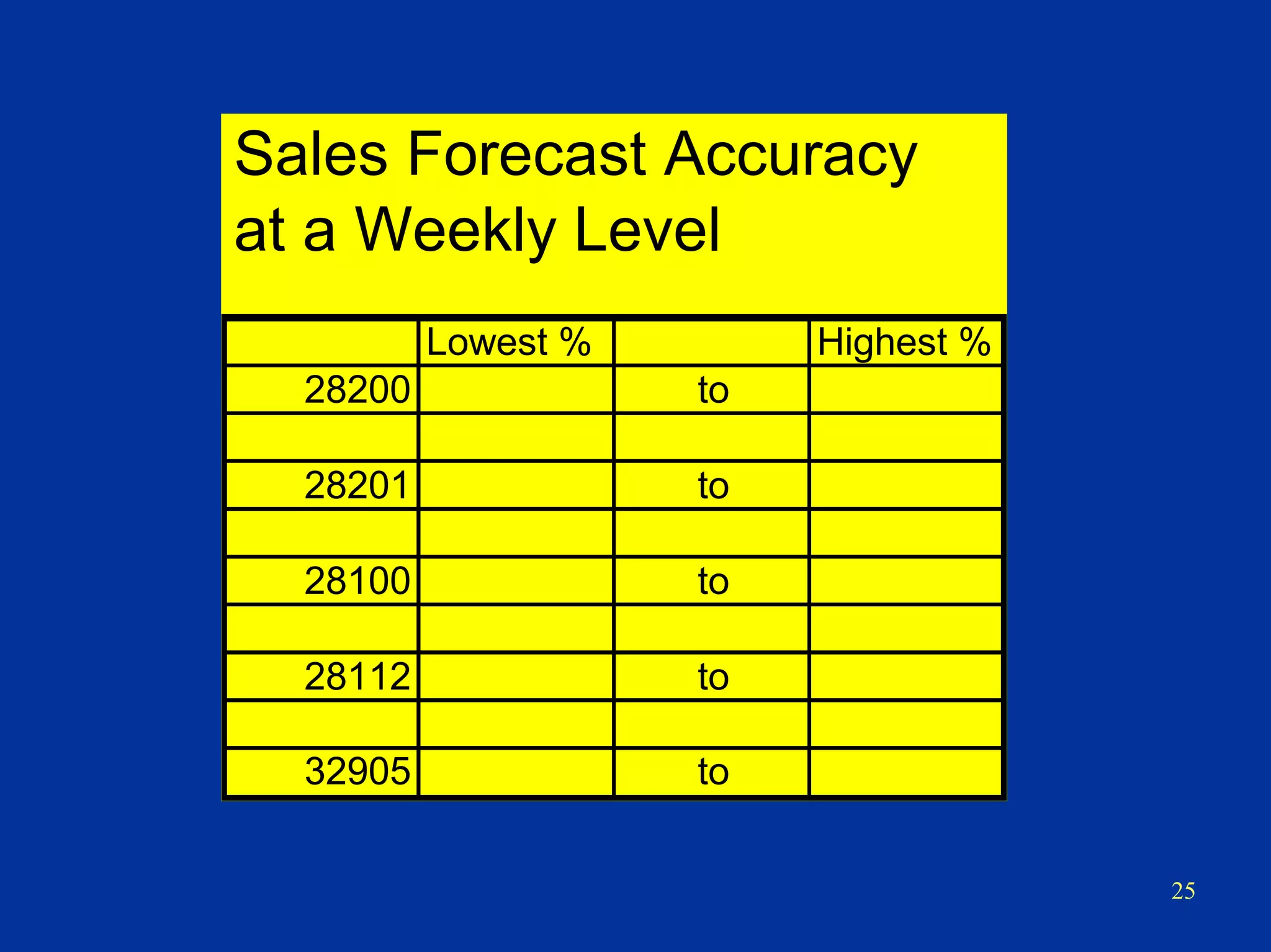
Sales Forecast Accuracy
at a Weekly Level
Lowest % Highest %
28200 to
28201 to
28100 to
28112 to
32905 to
26
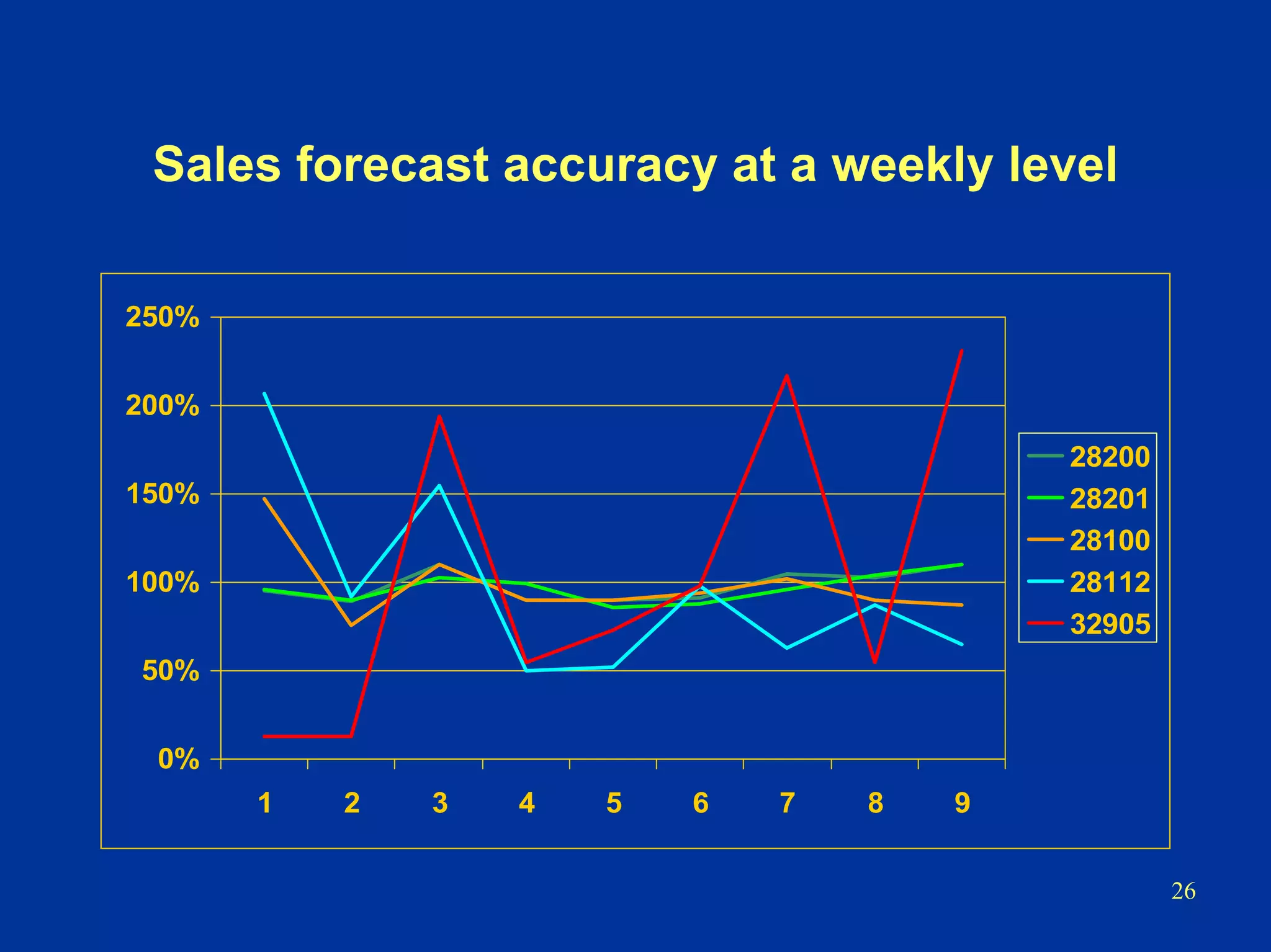
Sales forecast accuracy at a weekly level
0%
50%
100%
150%
200%
250%
1 2 3 4 5 6 7 8 9
28200
28201
28100
28112
32905
27
What about Forecasting and
Sales Variability?
Generally bigger sellers have less
variability
therefore greater predictability
28
Rationalisation is NOT the only option!
It is AN option
however
there are many solutions
Red SKU’s
29
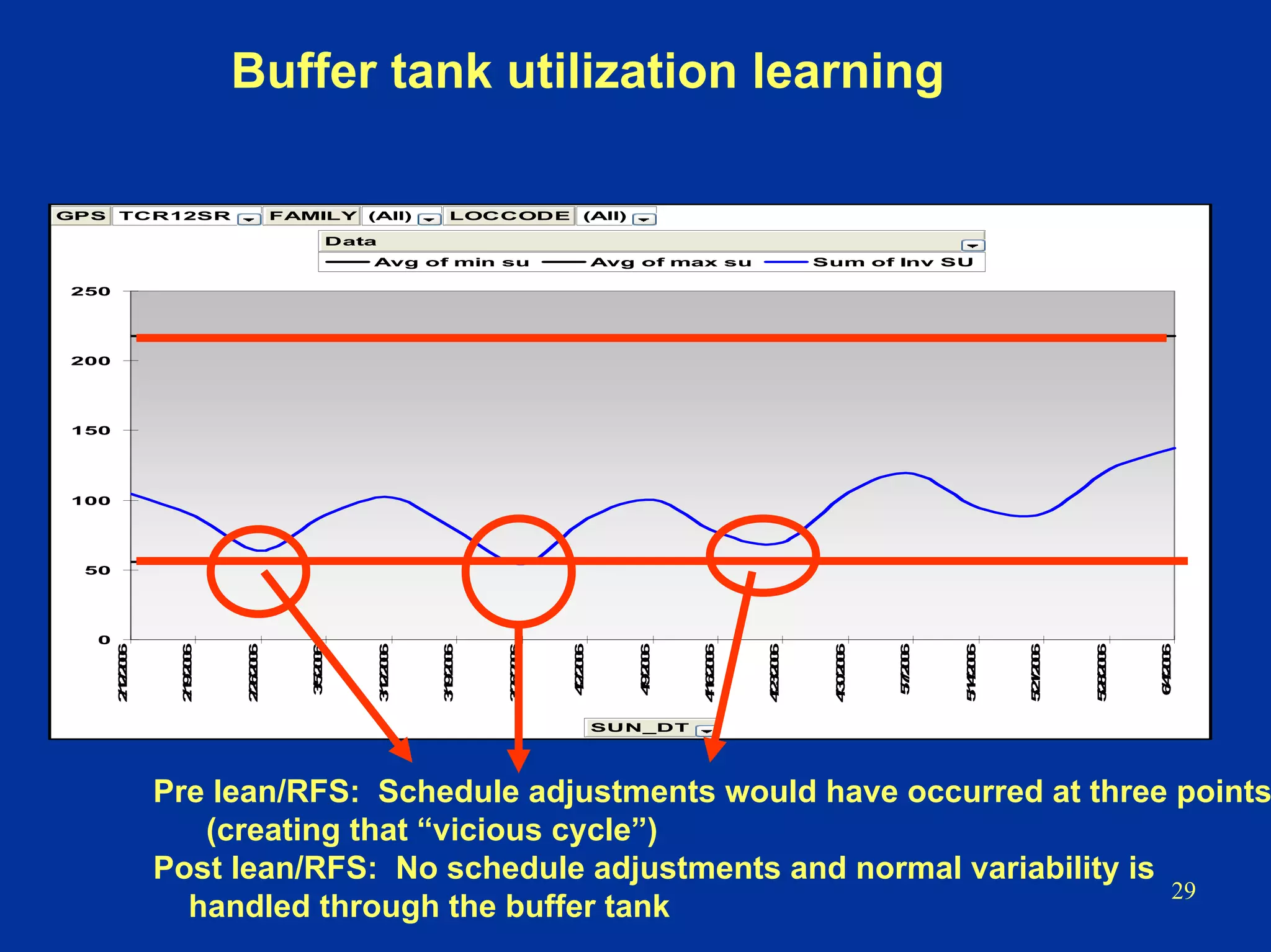
Buffer tank utilization learning
Pre lean/RFS: Schedule adjustments would have occurred at three points
(creating that “vicious cycle”)
Post lean/RFS: No schedule adjustments and normal variability is
handled through the buffer tank
0
50
100
150
200
250
2/12/2006
2/19/2006
2/26/2006
3/5/2006
3/12/2006
3/19/2006
3/26/2006
4/2/2006
4/9/2006
4/16/2006
4/23/2006
4/30/2006
5/7/2006
5/14/2006
5/21/2006
5/28/2006
6/4/2006
Avg of min su Avg of max su Sum of Inv SU
GPS TCR12SR FAMILY (All) LOCCODE (All)
SUN_DT
Data
30
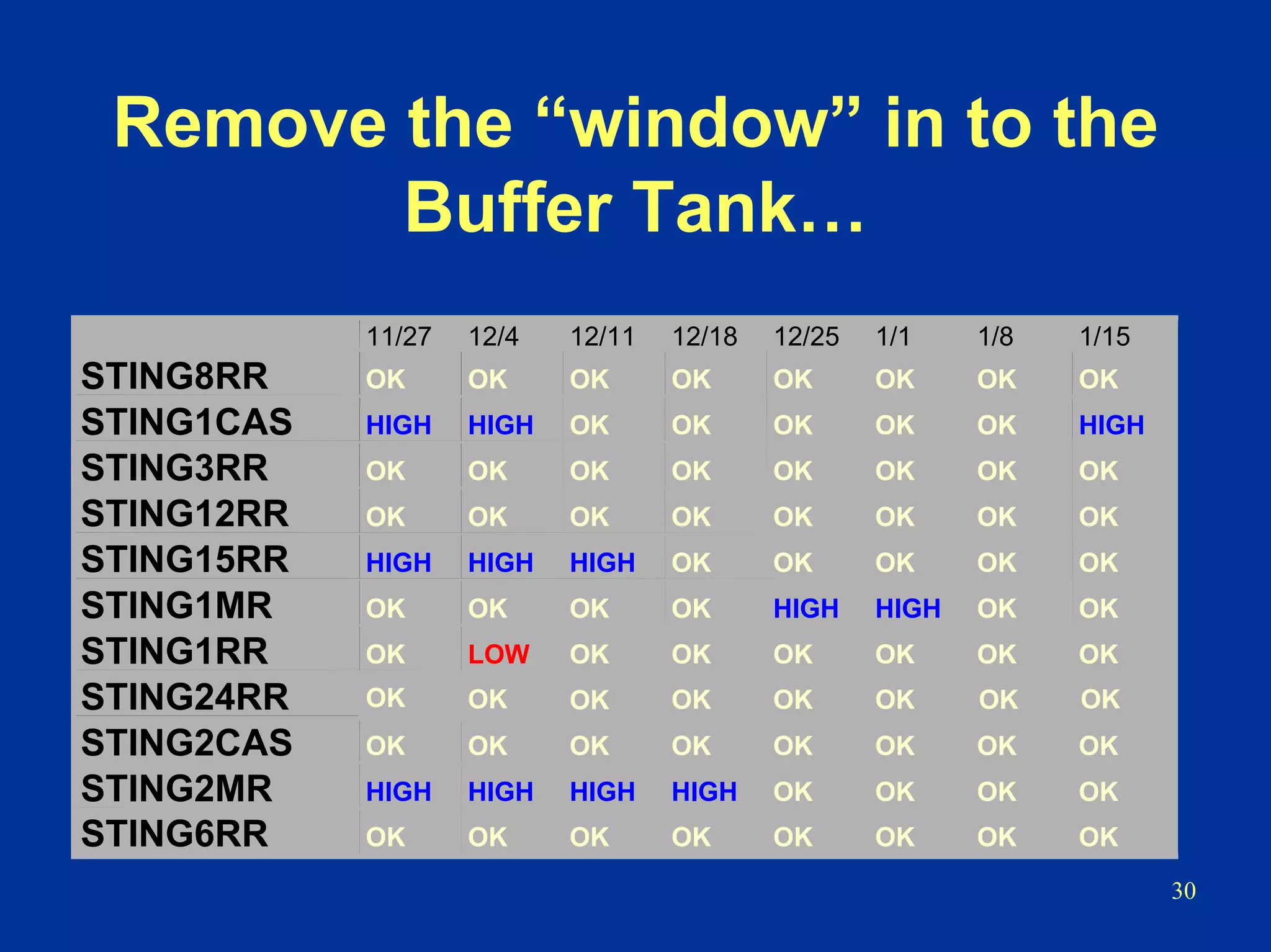
Remove the “window” in to the
Buffer Tank…
11/27 12/4 12/11 12/18 12/25 1/1 1/8 1/15
STING8RR OK OK OK OK OK OK OK OK
STING1CAS HIGH HIGH OK OK OK OK OK HIGH
STING3RR OK OK OK OK OK OK OK OK
STING12RR OK OK OK OK OK OK OK OK
STING15RR HIGH HIGH HIGH OK OK OK OK OK
STING1MR OK OK OK OK HIGH HIGH OK OK
STING1RR OK LOW OK OK OK OK OK OK
STING24RR HIGH HIGH HIGH HIGH HIGH HIGH HIGH HIGH
STING2CAS OK OK OK OK OK OK OK OK
STING2MR HIGH HIGH HIGH HIGH OK OK OK OK
STING6RR OK OK OK OK OK OK OK OK
OK OK OK OK OK OK OK OK
31
Impact on people
G’day Ian
I am sure "easy" was a word that sprang to mind when we first
started fixed cycles...there was a general view that I was insane
but having said that the crew would assassinate anyone who
now tried to take their fixed cycle away...
I'm probably a certifiable "early adopter" and the things you
are proposing seem to make so much sense.
best regards
Marty
32
Impact on people
Hi Ian
Our Green Flow project started with four products that made up around 30%
of our total capacity here in Denmark. To test Green Flow’s proof-of-concept
we ran three cycles of five weeks per cycle. After fifteen weeks, the project’s
final fermentation finished followed by the standard purification, granulation
or liquid formation, QC analysis and shipping procedures.
The project has been a big success. We have reduced our lead time by 50%
for the majority of batches. Even the few batches that required some reworking
have had a 33% reduced lead time. It has been possible to hold the vast majority
of the agreed start/stop times throughout the supply chain. And lastly almost
everyone, from operators to top management, thinks the Green Flow principle
is a far better way of production than what we were doing before. We expect that
Green Flow will no longer be considered a project but an established way of
production.
Best regards,
Herman Herz
Lean Facilitator
33
Impact on people
From: Graham, Jeff
Sent: Monday, February 15, 2007 10:08 AM
To: Sather, Rick
Cc: Gardhouse, Brian
Subject: RE: Huntsville Lean-RFS
Hi Rick
RFS has been a tremendous success for the Huntsville assets. Since the RFS start-up
in 2006 productivity has increase from under 15,000 cph to over 18,000 cph in January 2007.
The steady upward trend in rate of operation is a testament of the power of a frequent,
stable, predictable repeating schedule. I am a believer and would fight any efforts to go back
to the prior scheduling chaos!
We’ve been digging into the productivity improvement “toolbox” using standard techniques
fitted into the RFS structure. SMED, centerlining, TPM and equipment improvements are all
used to improve rates of operation. The approach has been practical with operations and
technical team members’ involvement. In particular, the line mechanics and electrical
Support are fully engaged making improvements regularly. Efforts have concentrated on
eliminating “rocks”, reducing equipment variables and stabilizing the process.
34
A major shift in thinking is the idea of “making the cycle” versus daily rates of operation.
Instead of measuring rates of operation, we measure where we are in the cycle – ahead or
behind by hours. Also when extra hangs are made, it provides all team members a
measurable contribution to the business their efforts made especially when there are
customer service issues.
As for challenges, RFS continues to show us weaknesses in equipment, procedures and
people. Example: the facial tissue grade 280’s continues to be a challenge. Given it is run
every week; we know operating issues are independent of operating team, materials, current
procedures and equipment set-up. Plans have been developed to methodically address
observable barriers to flow to improve rates of operation. Although 280’s rates of operation
are stable and predictable, they are poor compared to other grades.
As I stated at the start, the Multifolder rates of operation continue a steady upward positive
trend in rate of operation. The stable, predictable repeating schedule contributes to
problem solving and solution implementation. I am a RFS believer.
Jeff
35
Rocks or
barriers to flow
• Visible
• Hourly
• Operator led
• Focussed on achieving plan
• Problem identification
36
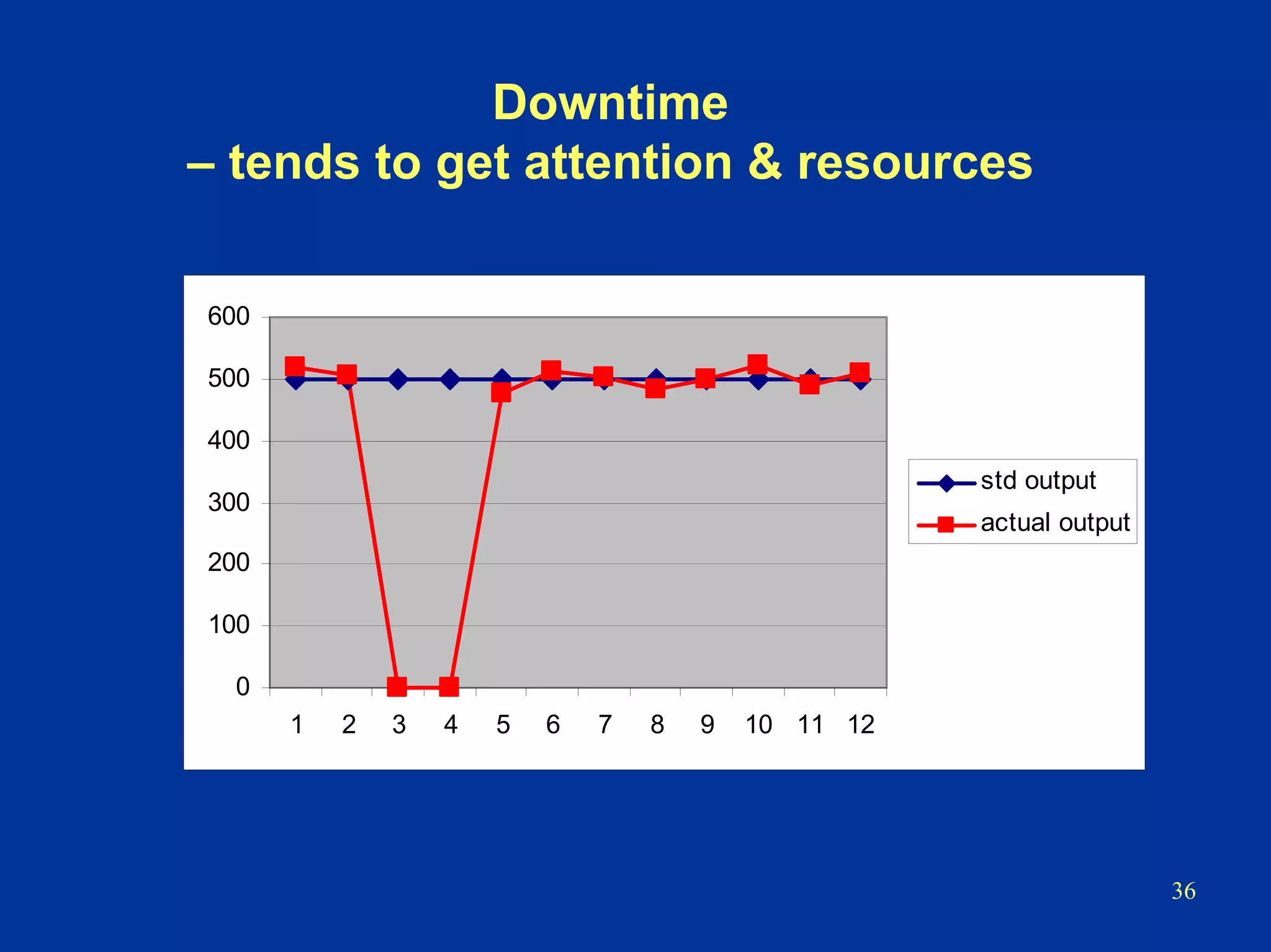
Downtime
– tends to get attention & resources
0
100
200
300
400
500
600
1 2 3 4 5 6 7 8 9 10 11 12
std output
actual output
37
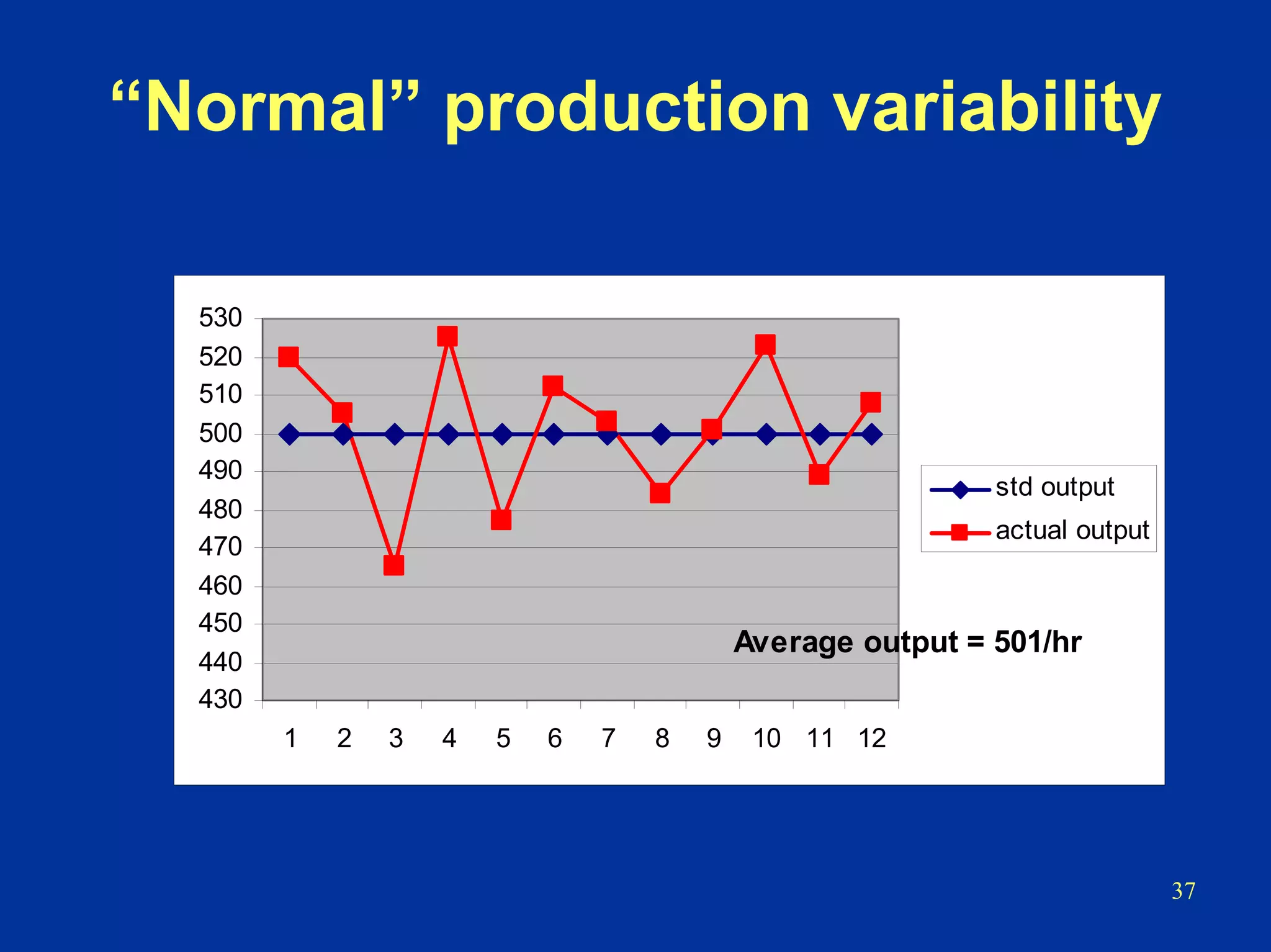
“Normal” production variability
430
440
450
460
470
480
490
500
510
520
530
1 2 3 4 5 6 7 8 9 10 11 12
std output
actual output
Average output = 501/hr
38
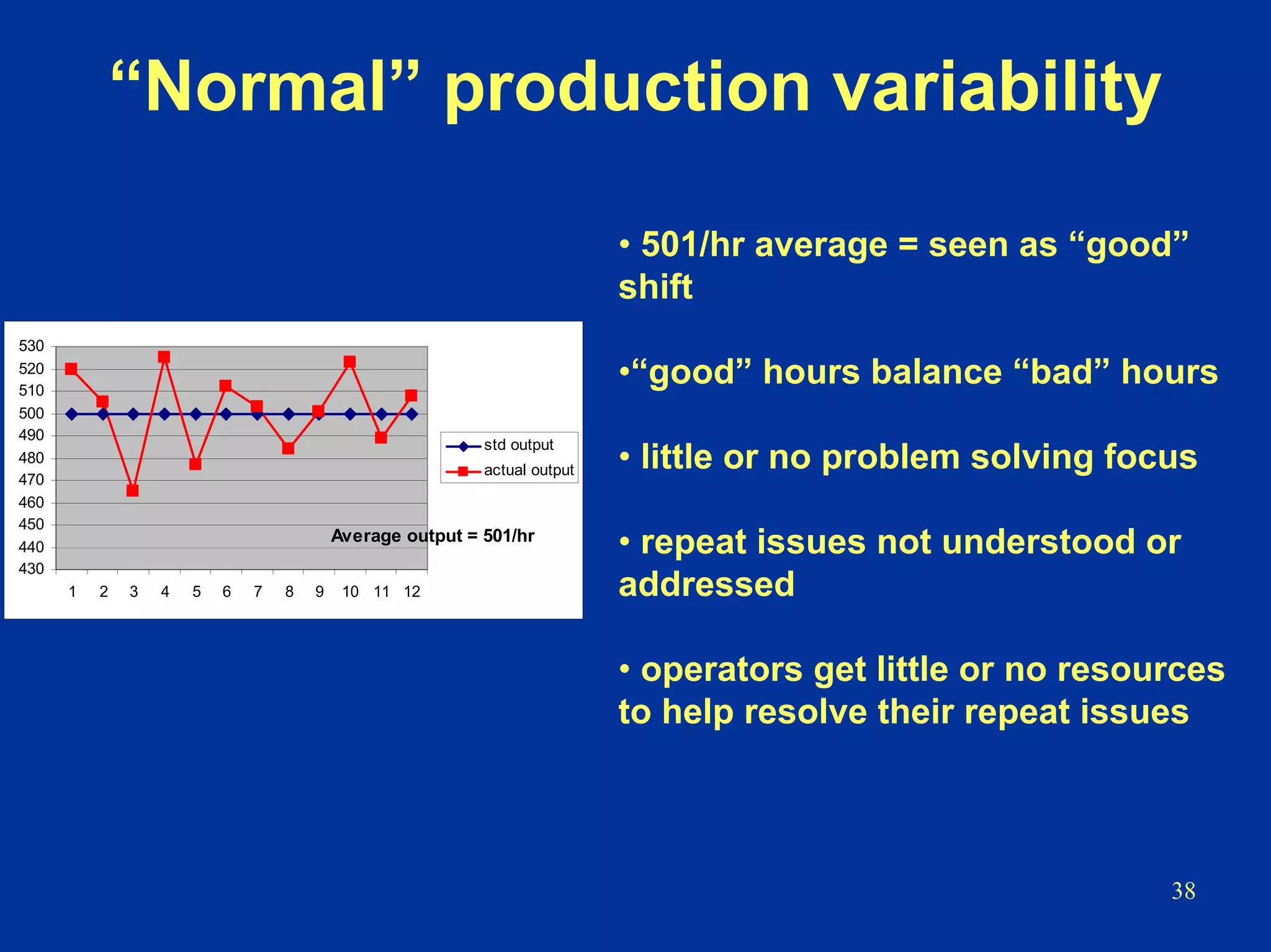
“Normal” production variability
430
440
450
460
470
480
490
500
510
520
530
1 2 3 4 5 6 7 8 9 10 11 12
std output
actual output
Average output = 501/hr
• 501/hr average = seen as “good”
shift
•“good” hours balance “bad” hours
• little or no problem solving focus
• repeat issues not understood or
addressed
• operators get little or no resources
to help resolve their repeat issues
3939
RockbustingRockbusting ProcessProcess
Operator ResponsibilitiesOperator Responsibilities
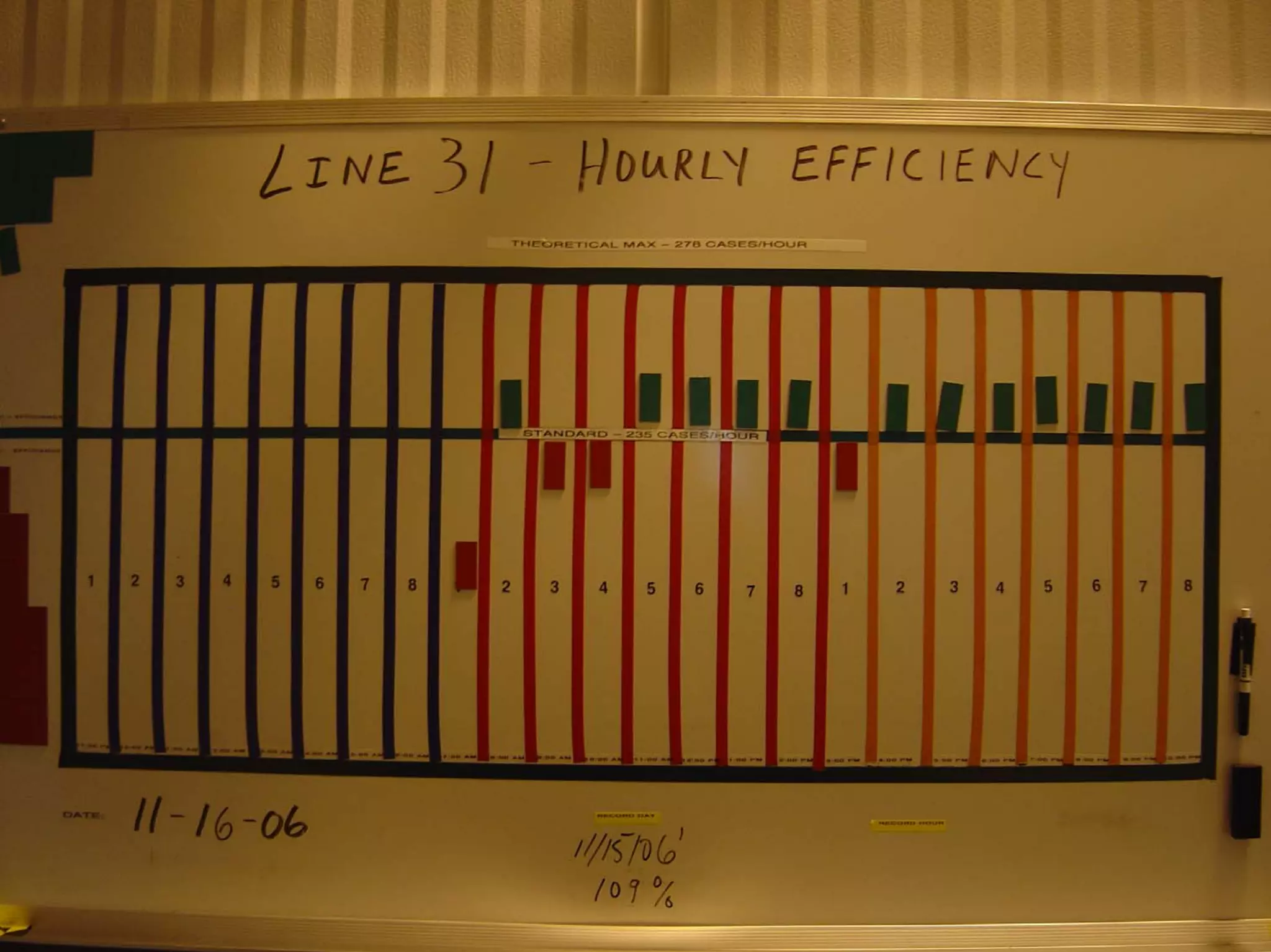
At the end of each hour, enter results on the
“Line 31 hourly Efficiency Board”
– Green Bar if over the standard
– Red Bar if under the standard
4040
4141
Contact ProcessContact Process
Operator
Make necessary contacts if the hourly case
count goes below the Standard Line
Efficiency.
4242
Contact ProcessContact Process
Hour 1: Contacts the Line Supervisor
Hour 2: Contacts Shift/Area Manager
4343
Contact ProcessContact Process
Hour 3: Contacts the Manufacturing Manager.
Hour 4: Contacts the Plant Manager.
44
Rockbusting
• Focus on all “bad” hours
(not consecutive hours or single
reoccurring issue)
• Operator led
• Visible process that triggers help
(NOT a problem solving process)
45
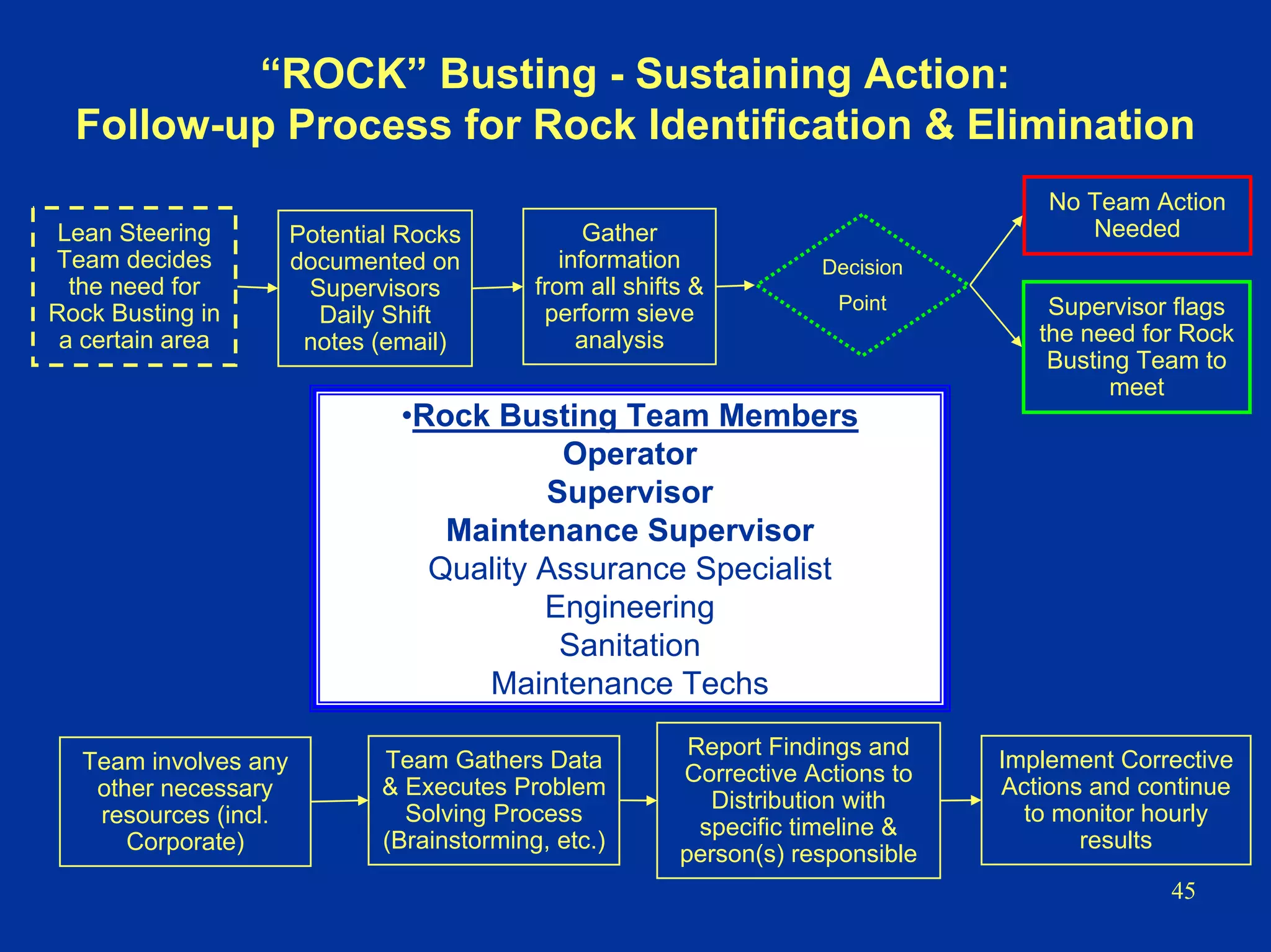
“ROCK” Busting - Sustaining Action:
Follow-up Process for Rock Identification & Elimination
No Team Action
Needed
Decision
Point
Lean Steering
Team decides
the need for
Rock Busting in
a certain area
Gather
information
from all shifts &
perform sieve
analysis
Potential Rocks
documented on
Supervisors
Daily Shift
notes (email)
Supervisor flags
the need for Rock
Busting Team to
meet
•Rock Busting Team Members
Operator
Supervisor
Maintenance Supervisor
Quality Assurance Specialist
Engineering
Sanitation
Maintenance Techs
Report Findings and
Corrective Actions to
Distribution with
specific timeline &
person(s) responsible
Implement Corrective
Actions and continue
to monitor hourly
results
Team Gathers Data
& Executes Problem
Solving Process
(Brainstorming, etc.)
Team involves any
other necessary
resources (incl.
Corporate)
46
Schedule Breaks
A tracking mechanism
47
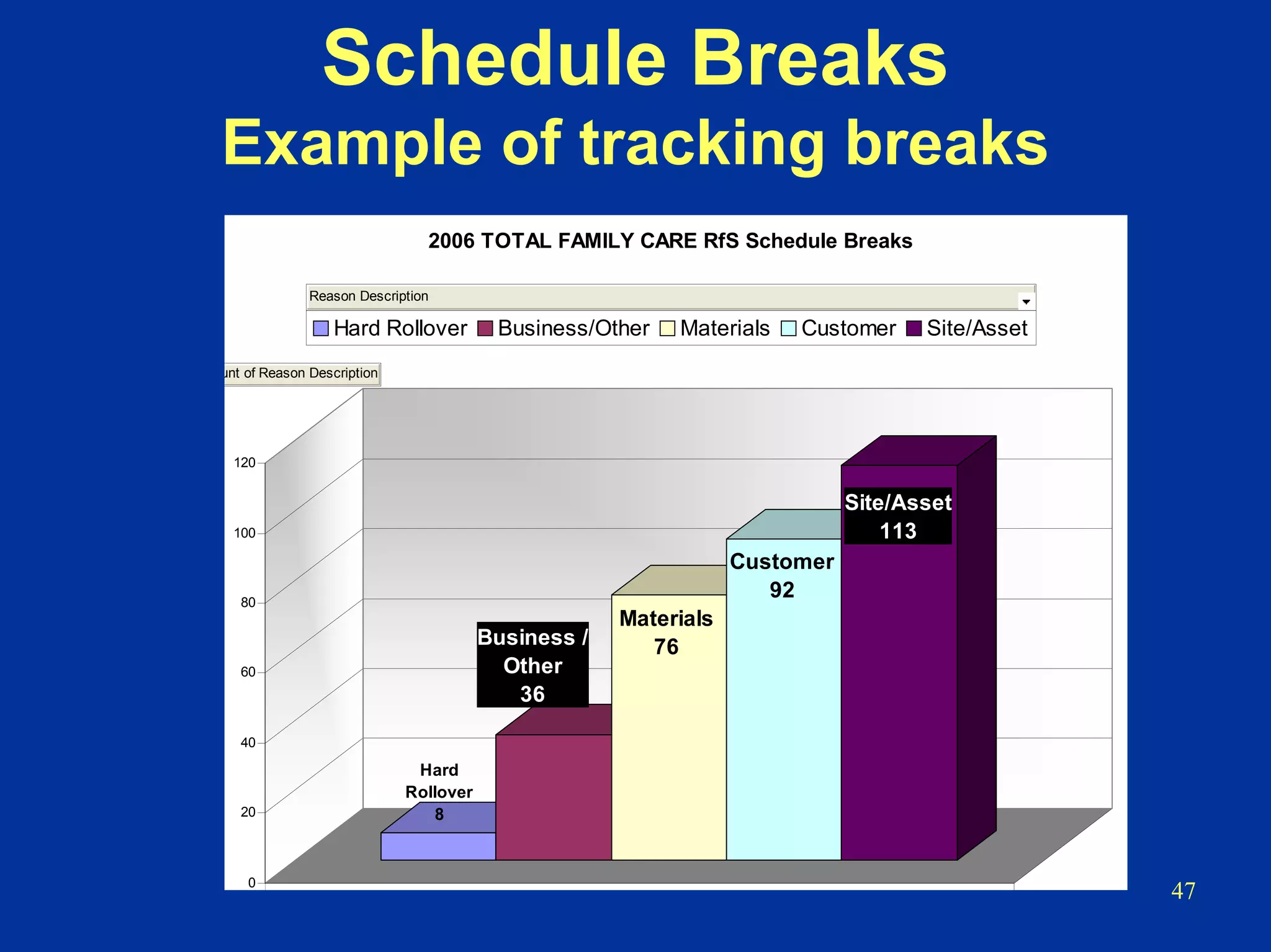
Schedule Breaks
Example of tracking breaks
Hard
Rollover
8
Business /
Other
36
Materials
76
Customer
92
Site/Asset
113
0
20
40
60
80
100
120
2006 TOTAL FAMILY CARE RfS Schedule Breaks
Hard Rollover Business/Other Materials Customer Site/Asset
unt of Reason Description
Reason Description
48
Schedule Breaks
Conclusions
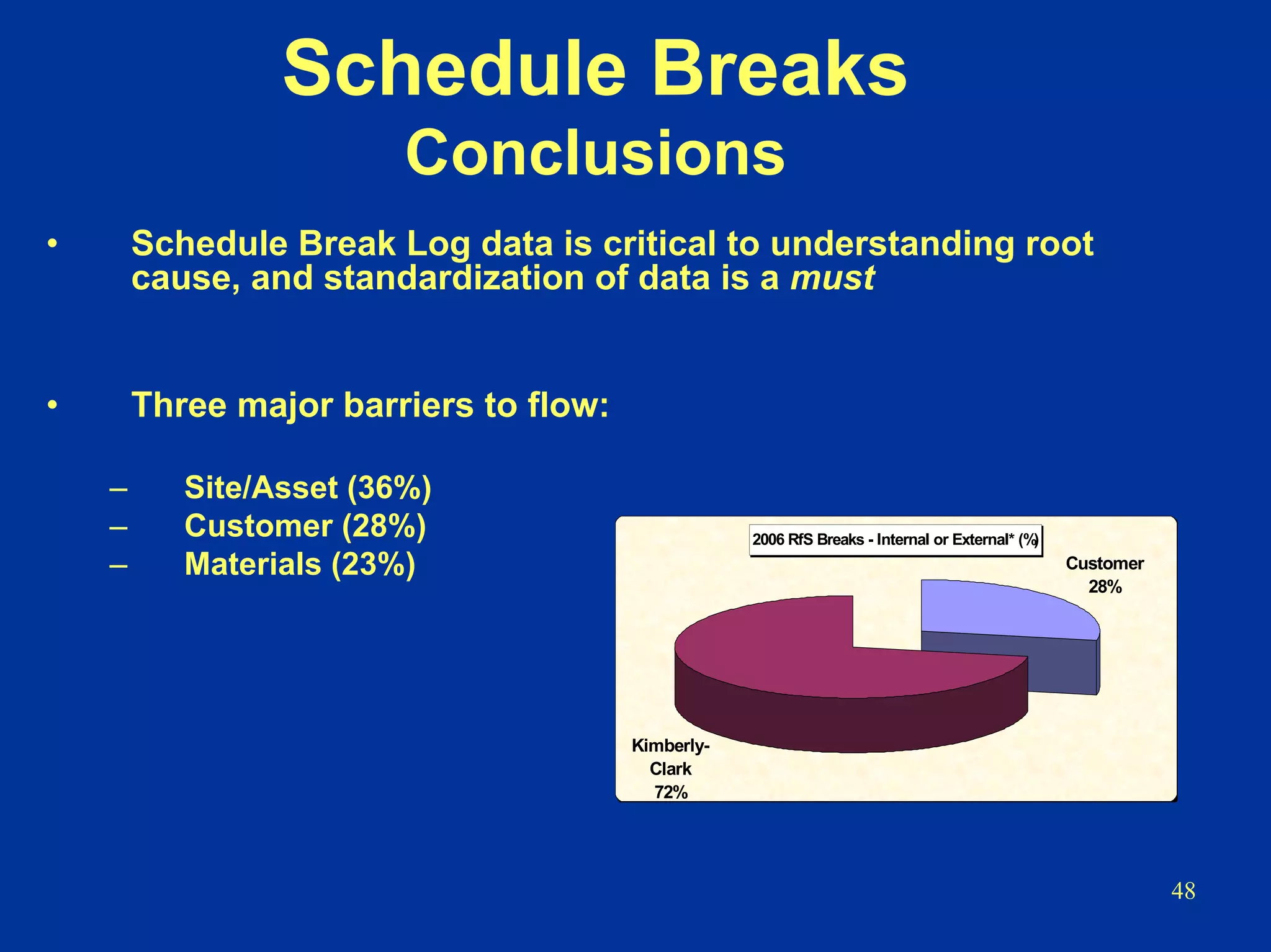
• Schedule Break Log data is critical to understanding root
cause, and standardization of data is a must
• Three major barriers to flow:
– Site/Asset (36%)
– Customer (28%)
– Materials (23%)
2006 RfS Breaks - Internal or External* (%)
Customer
28%
Kimberly-
Clark
72%
49
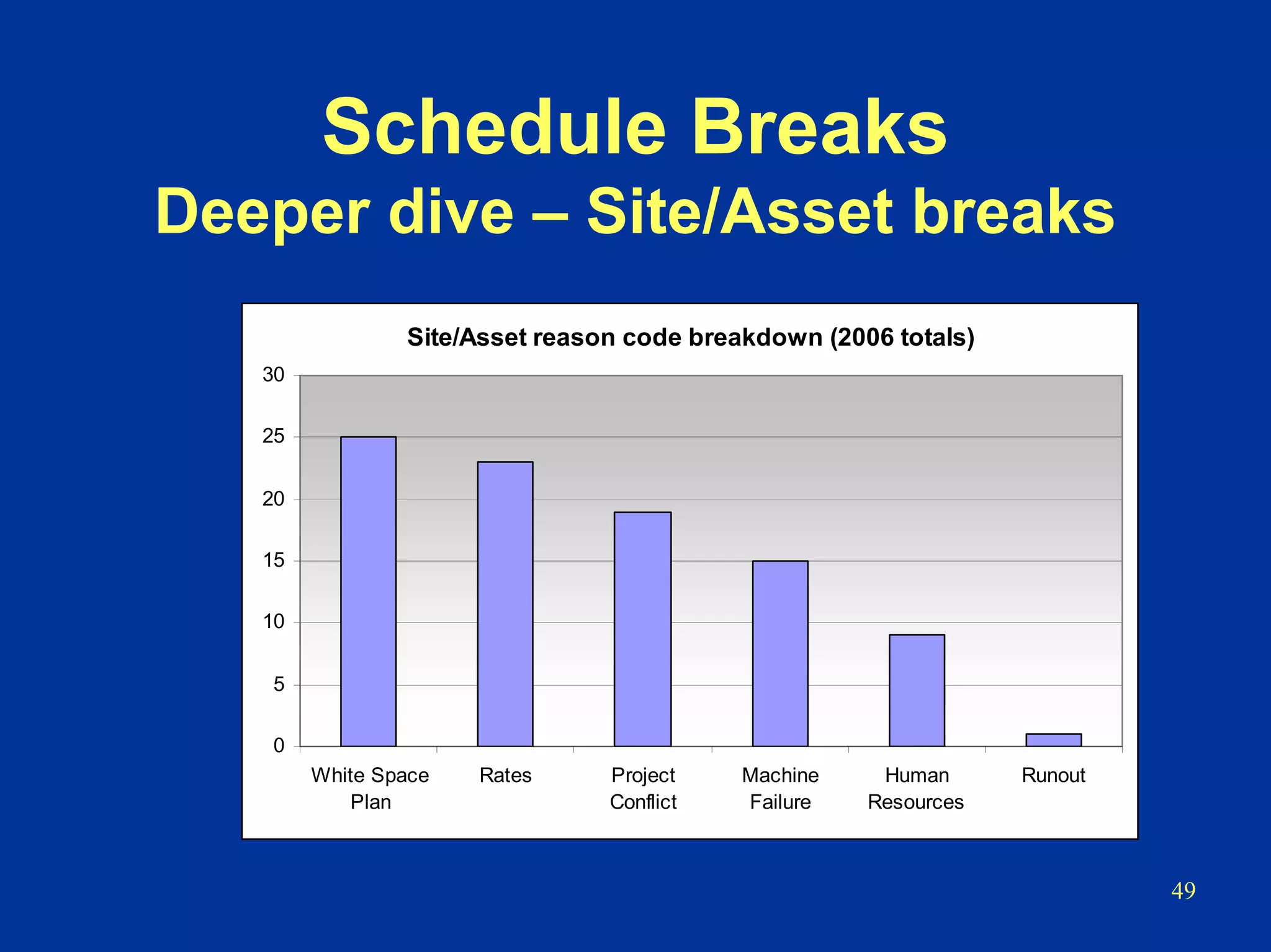
Schedule Breaks
Deeper dive – Site/Asset breaks
Site/Asset reason code breakdown (2006 totals)
0
5
10
15
20
25
30
White Space
Plan
Rates Project
Conflict
Machine
Failure
Human
Resources
Runout
50
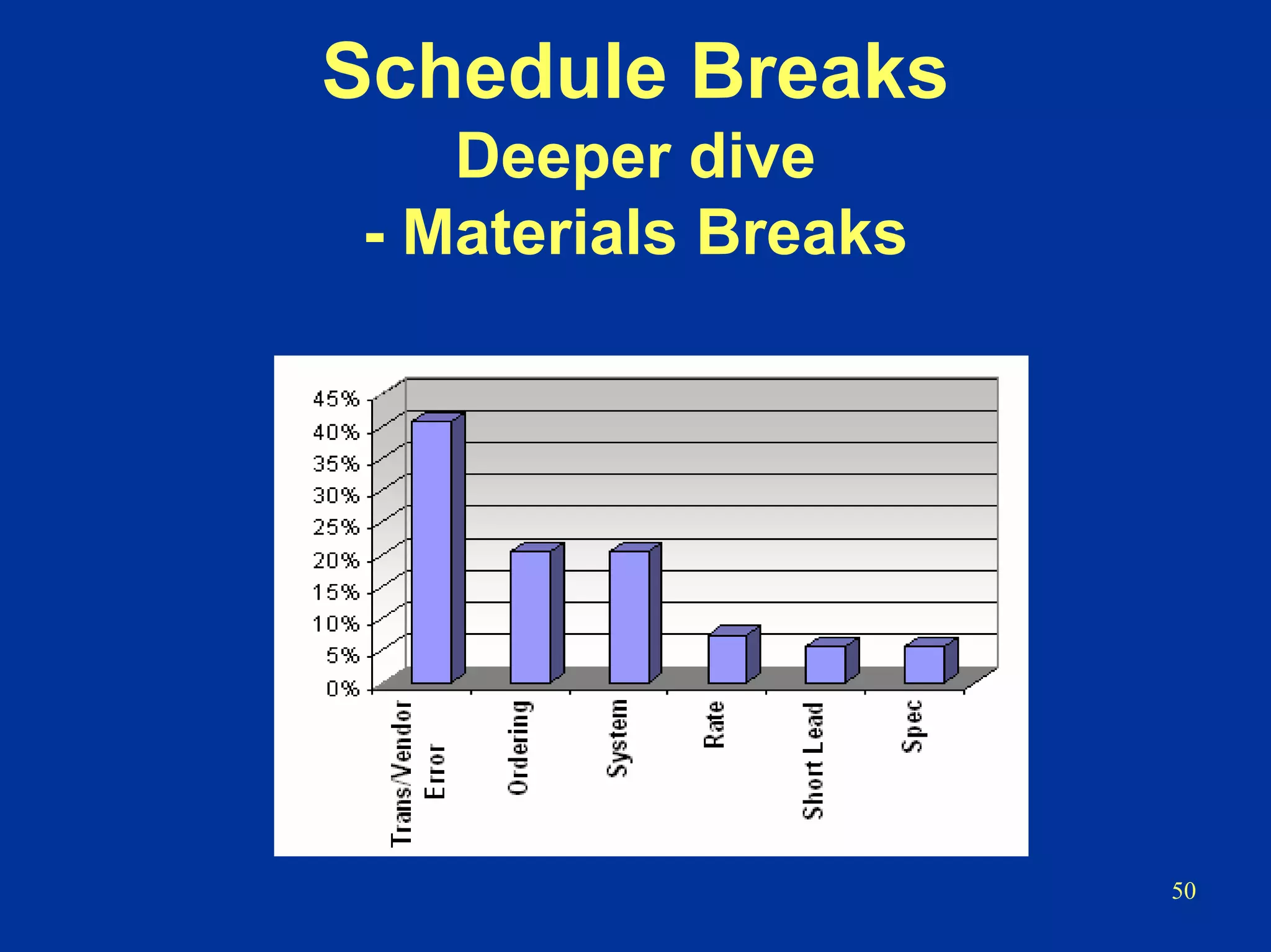
Schedule Breaks
Deeper dive
- Materials Breaks
51
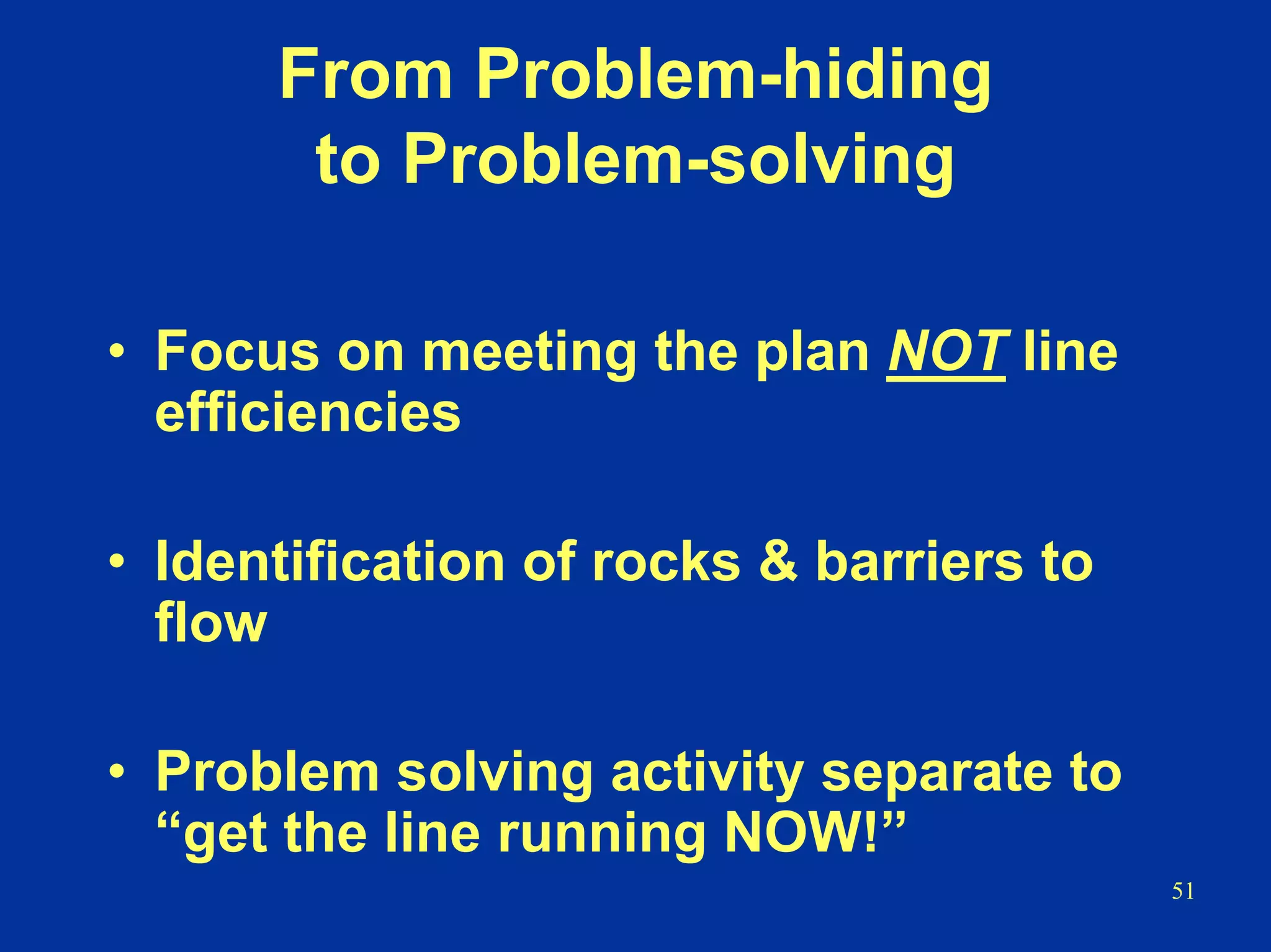
From Problem-hiding
to Problem-solving
• Focus on meeting the plan NOT line
efficiencies
• Identification of rocks & barriers to
flow
• Problem solving activity separate to
“get the line running NOW!”
52
Changing the logic from
Batch to Flow
Overall Summary
53
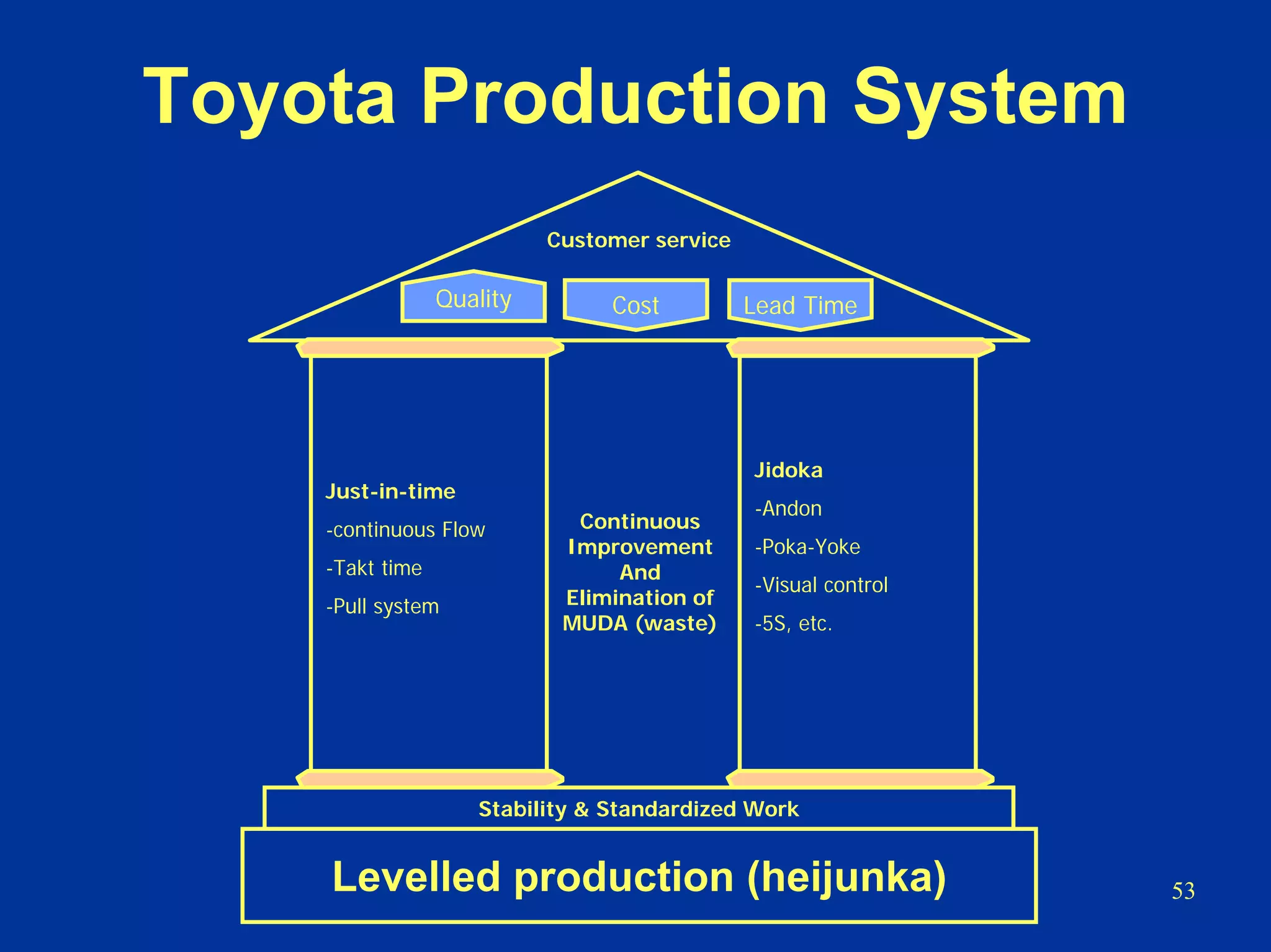
Toyota Production System
Jidoka
-Andon
-Poka-Yoke
-Visual control
-5S, etc.
Just-in-time
-continuous Flow
-Takt time
-Pull system
Customer service
Continuous
Improvement
And
Elimination of
MUDA (waste)
Lead TimeCostQuality
Stability & Standardized Work
Levelled production (heijunka)
54
Production Levelling or
Heijunka
= Foundation of Lean
Therefore essential to being
a truly Lean Enterprise
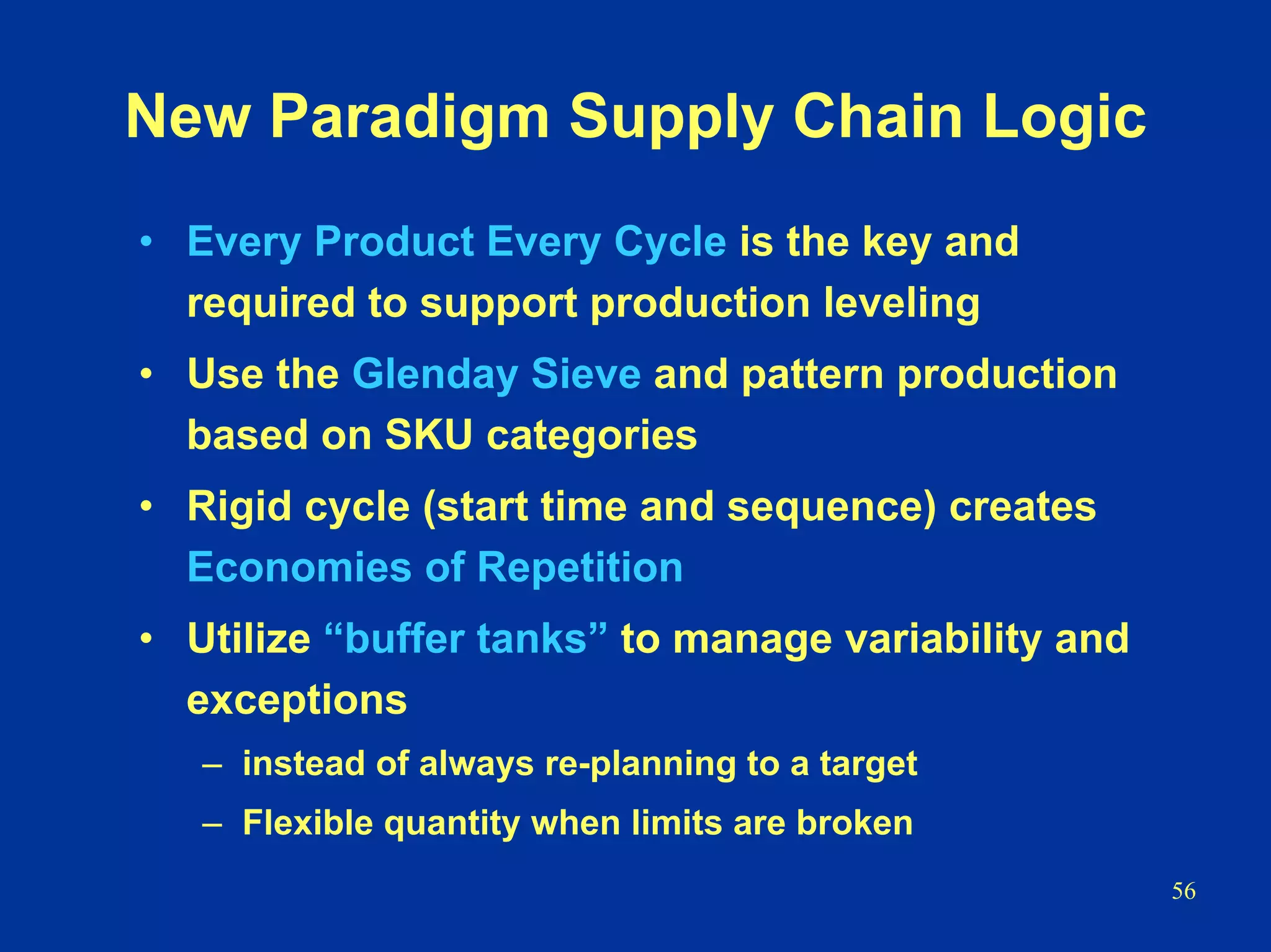
55
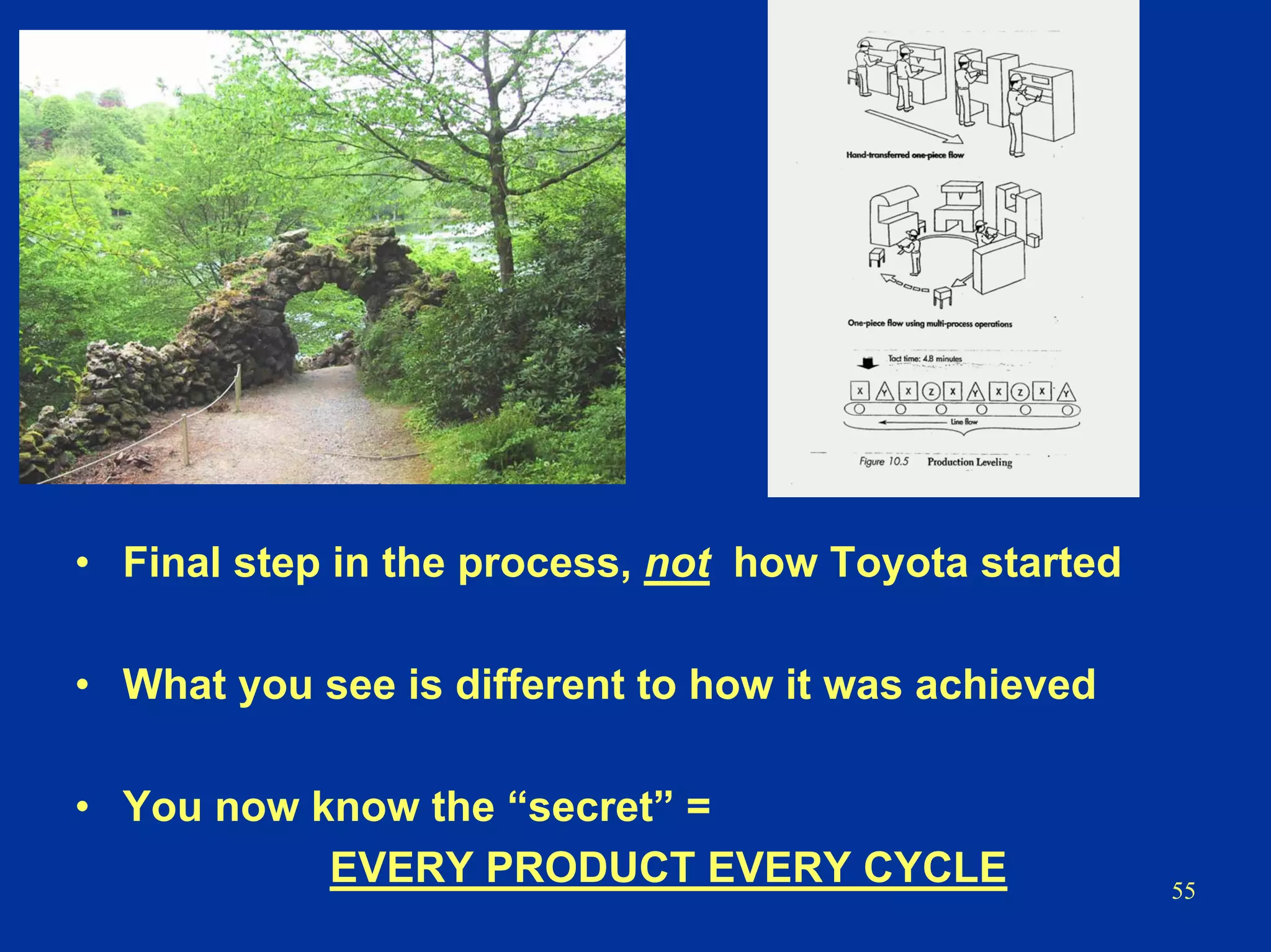
• Final step in the process, not how Toyota started
• What you see is different to how it was achieved
• You now know the “secret” =
EVERY PRODUCT EVERY CYCLE
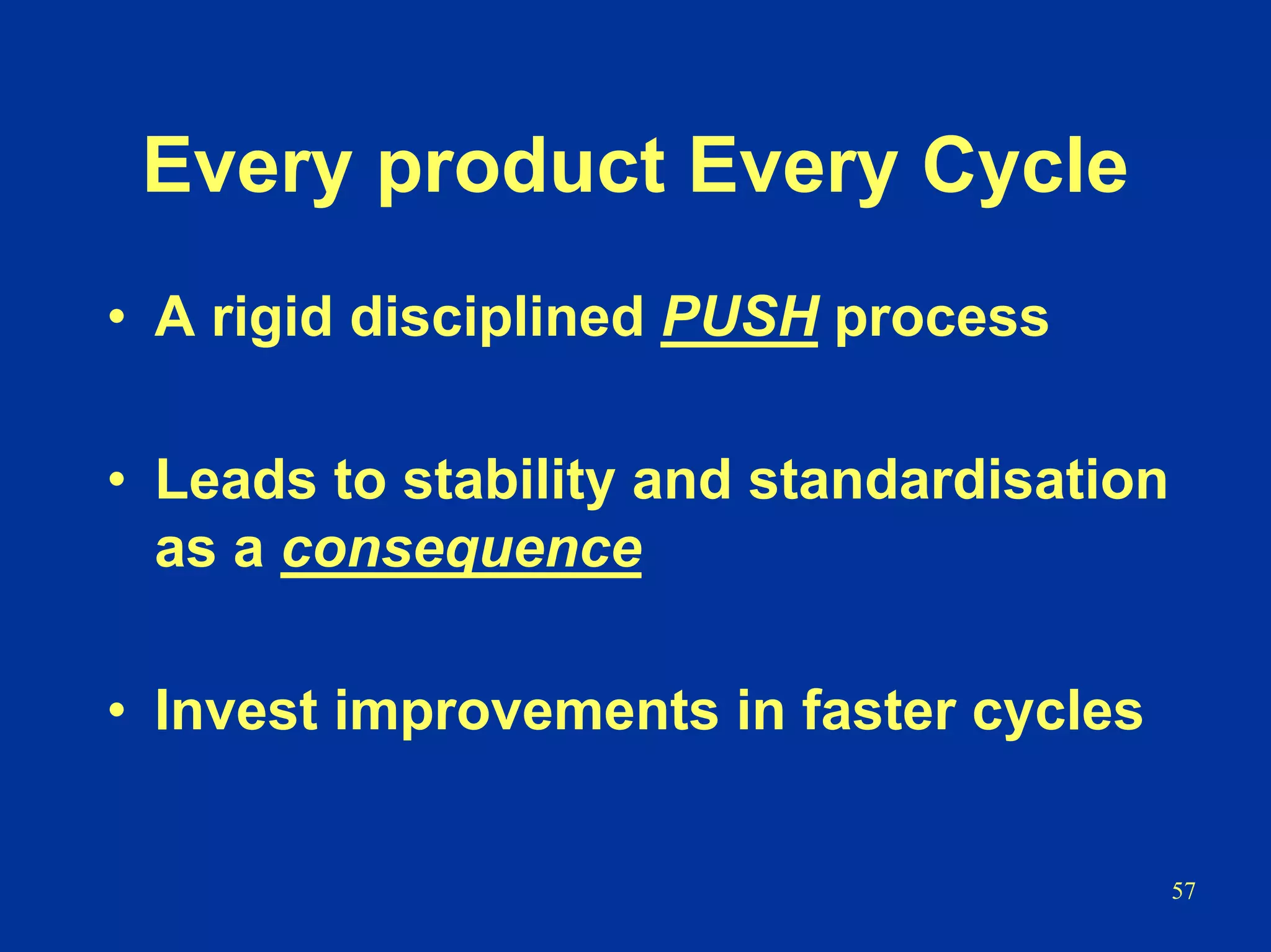
56
New Paradigm Supply Chain Logic
• Every Product Every Cycle is the key and
required to support production leveling
• Use the Glenday Sieve and pattern production
based on SKU categories
• Rigid cycle (start time and sequence) creates
Economies of Repetition
• Utilize “buffer tanks” to manage variability and
exceptions
– instead of always re-planning to a target
– Flexible quantity when limits are broken
57
Every product Every Cycle
• A rigid disciplined PUSH process
• Leads to stability and standardisation
as a consequence
• Invest improvements in faster cycles
58
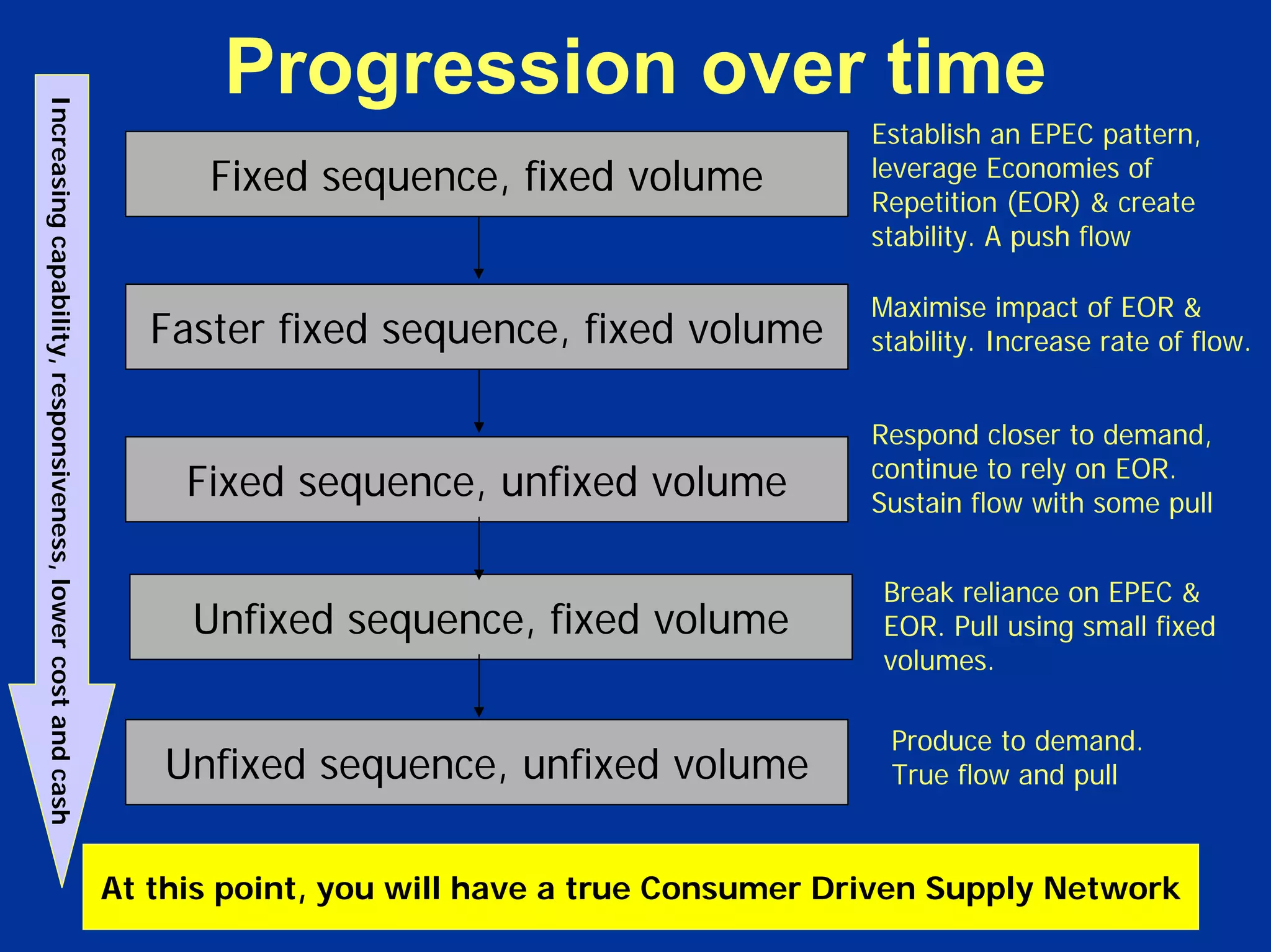
Progression over time
Establish an EPEC pattern,
leverage Economies of
Repetition (EOR) & create
stability. A push flow
Fixed sequence, fixed volume
Fixed sequence, unfixed volume
Unfixed sequence, unfixed volume
Respond closer to demand,
continue to rely on EOR.
Sustain flow with some pull
Produce to demand.
True flow and pull
At this point, you will have a true Consumer Driven Supply Network
Increasingcapability,responsiveness,lowercostandcash
Faster fixed sequence, fixed volume
Maximise impact of EOR &
stability. Increase rate of flow.
Unfixed sequence, fixed volume
Break reliance on EPEC &
EOR. Pull using small fixed
volumes.
59
Getting started
What – specifically – are you
going to do as a result of this forum
next week?
Write it down.
60
Levelled
production
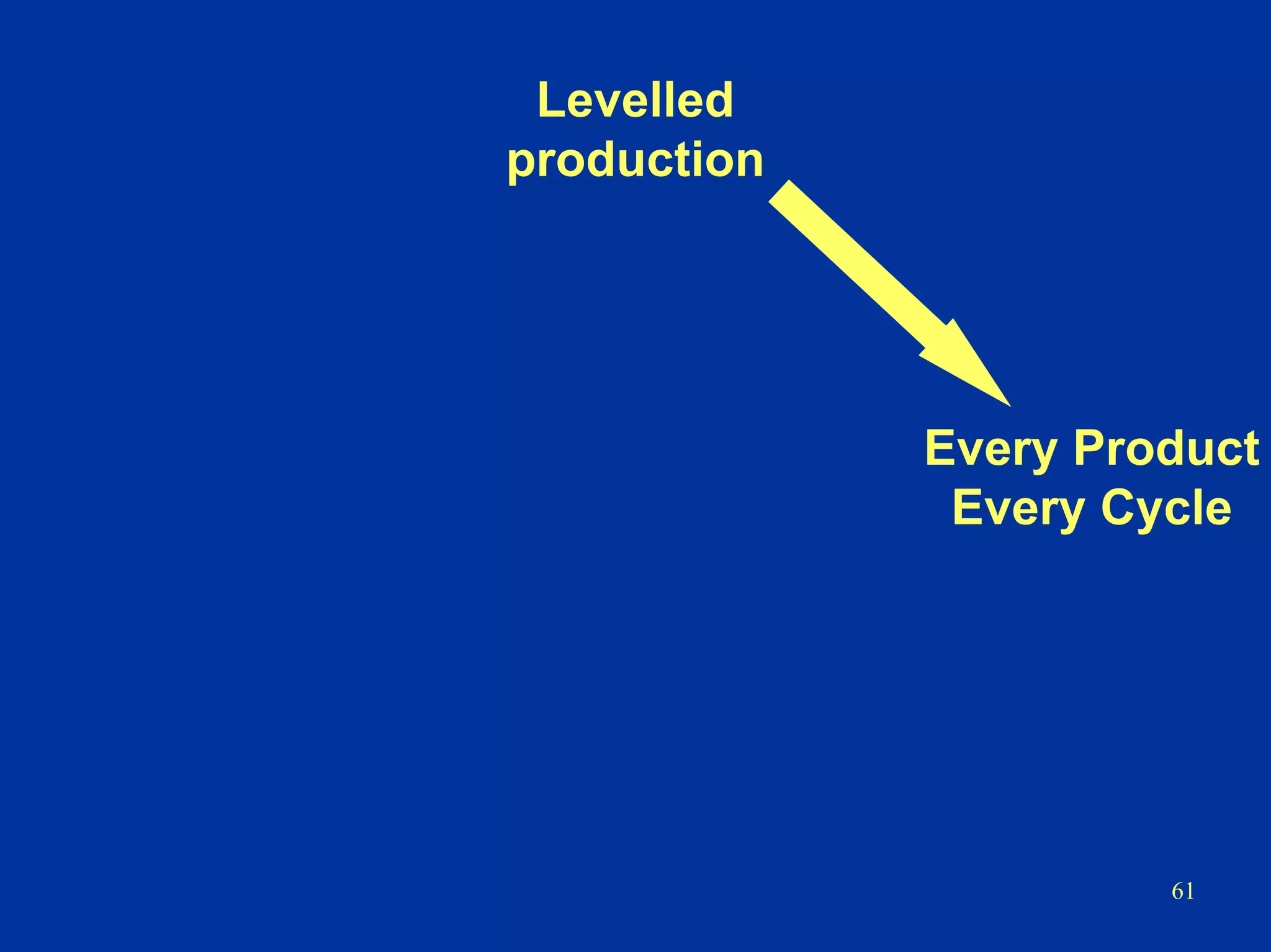
61
Levelled
production
Every Product
Every Cycle
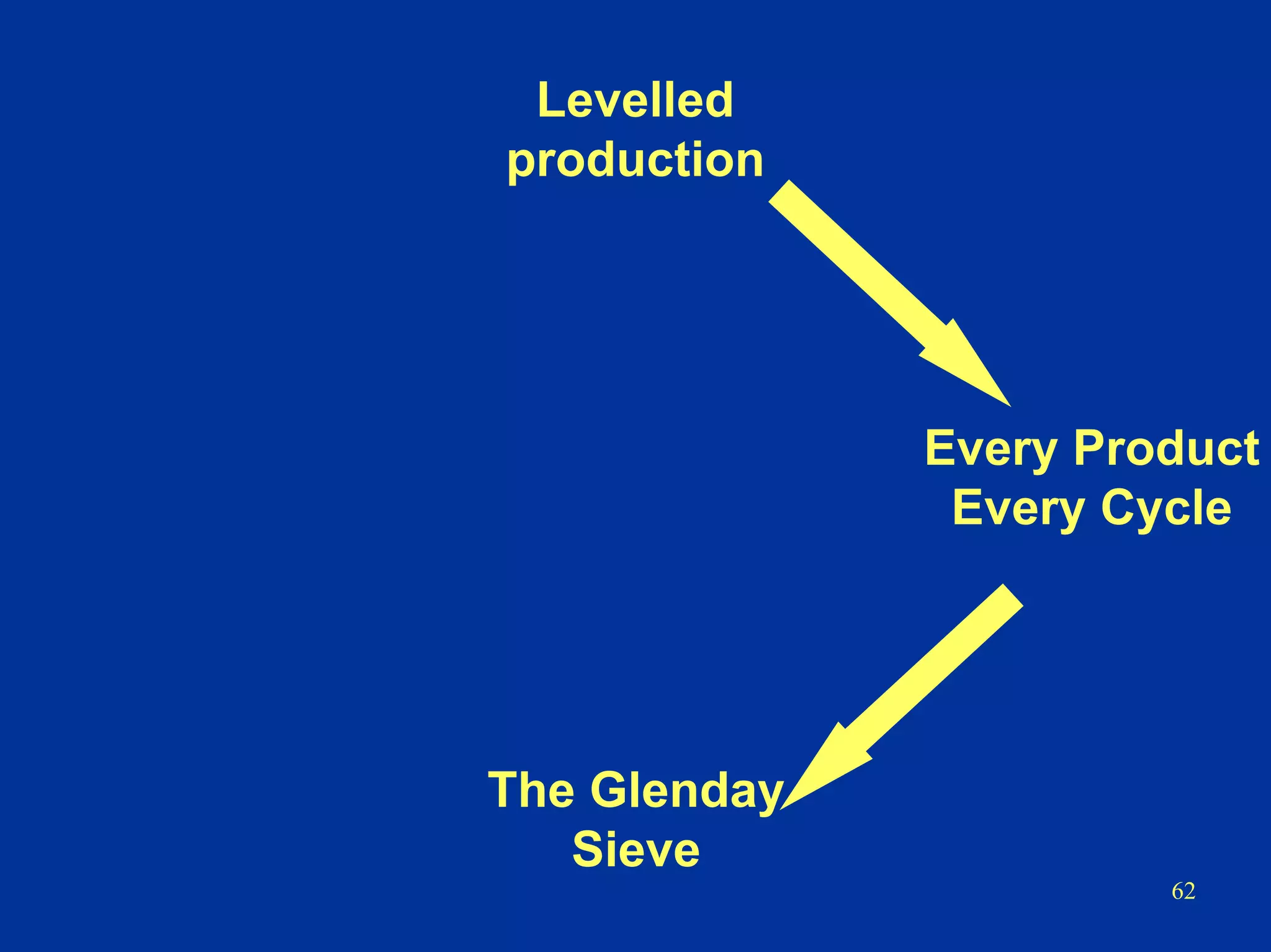
62
Levelled
production
Every Product
Every Cycle
The Glenday
Sieve
63
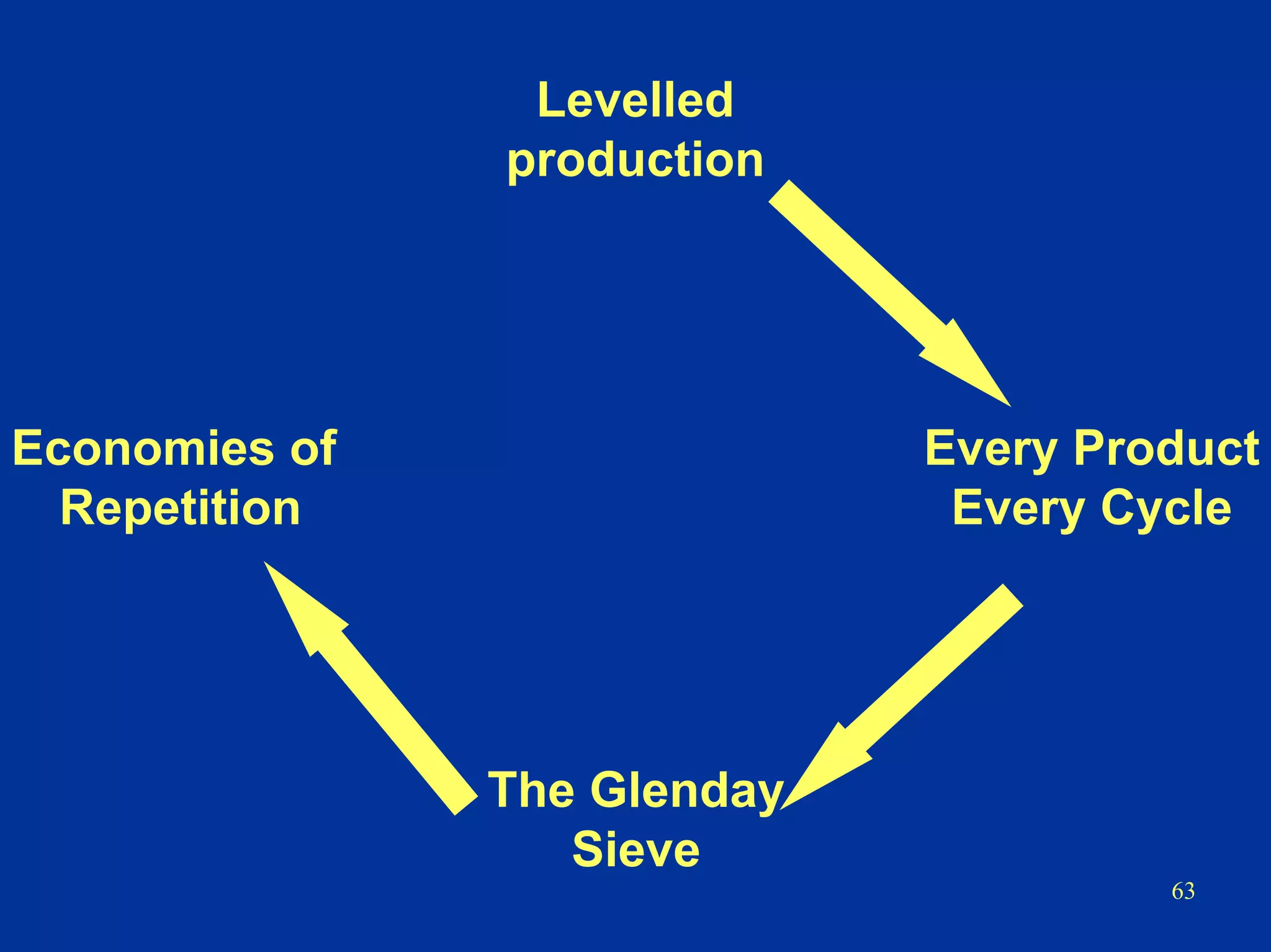
Levelled
production
Economies of
Repetition
Every Product
Every Cycle
The Glenday
Sieve
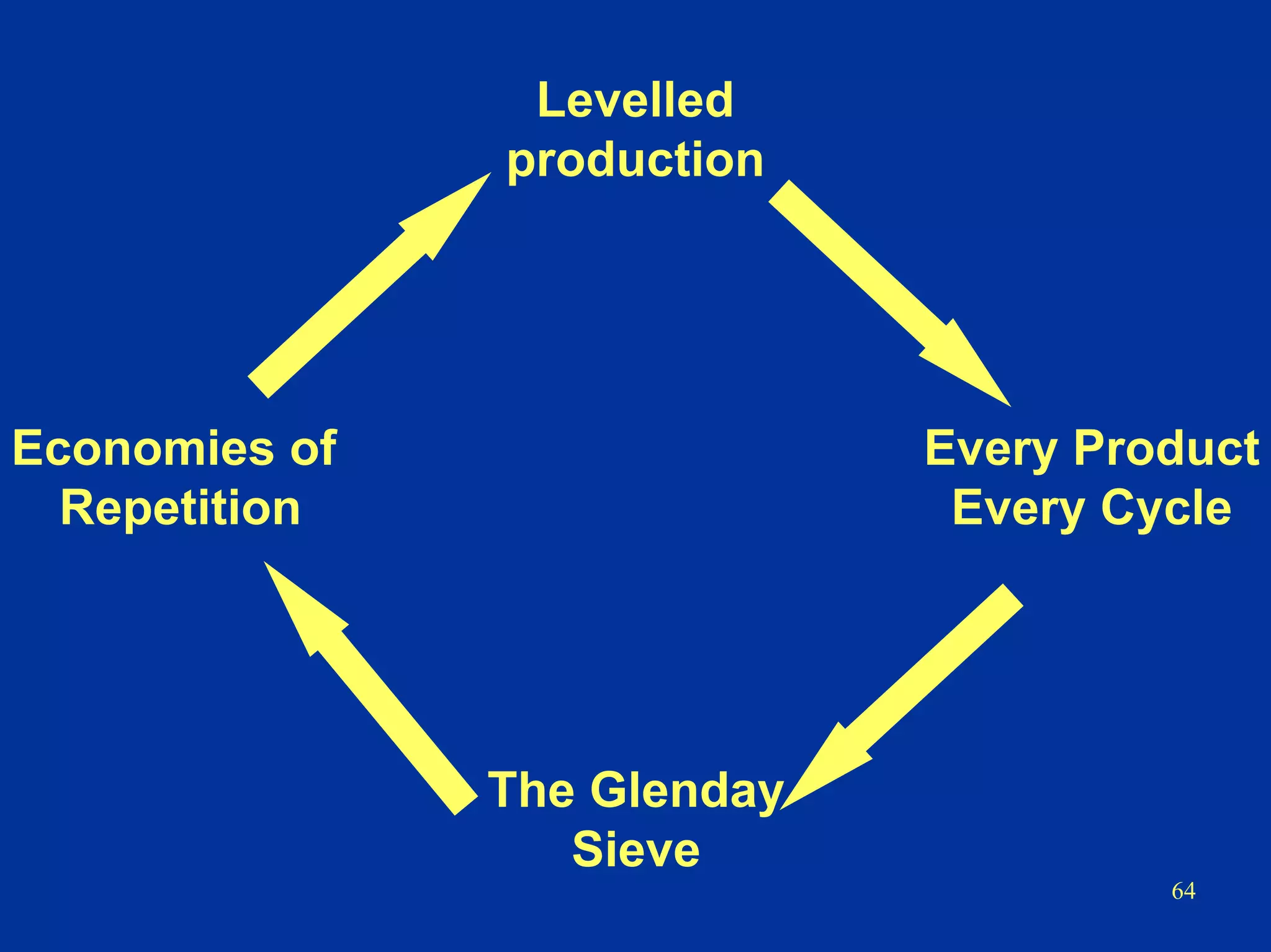
64
Levelled
production
Economies of
Repetition
Every Product
Every Cycle
The Glenday
Sieve
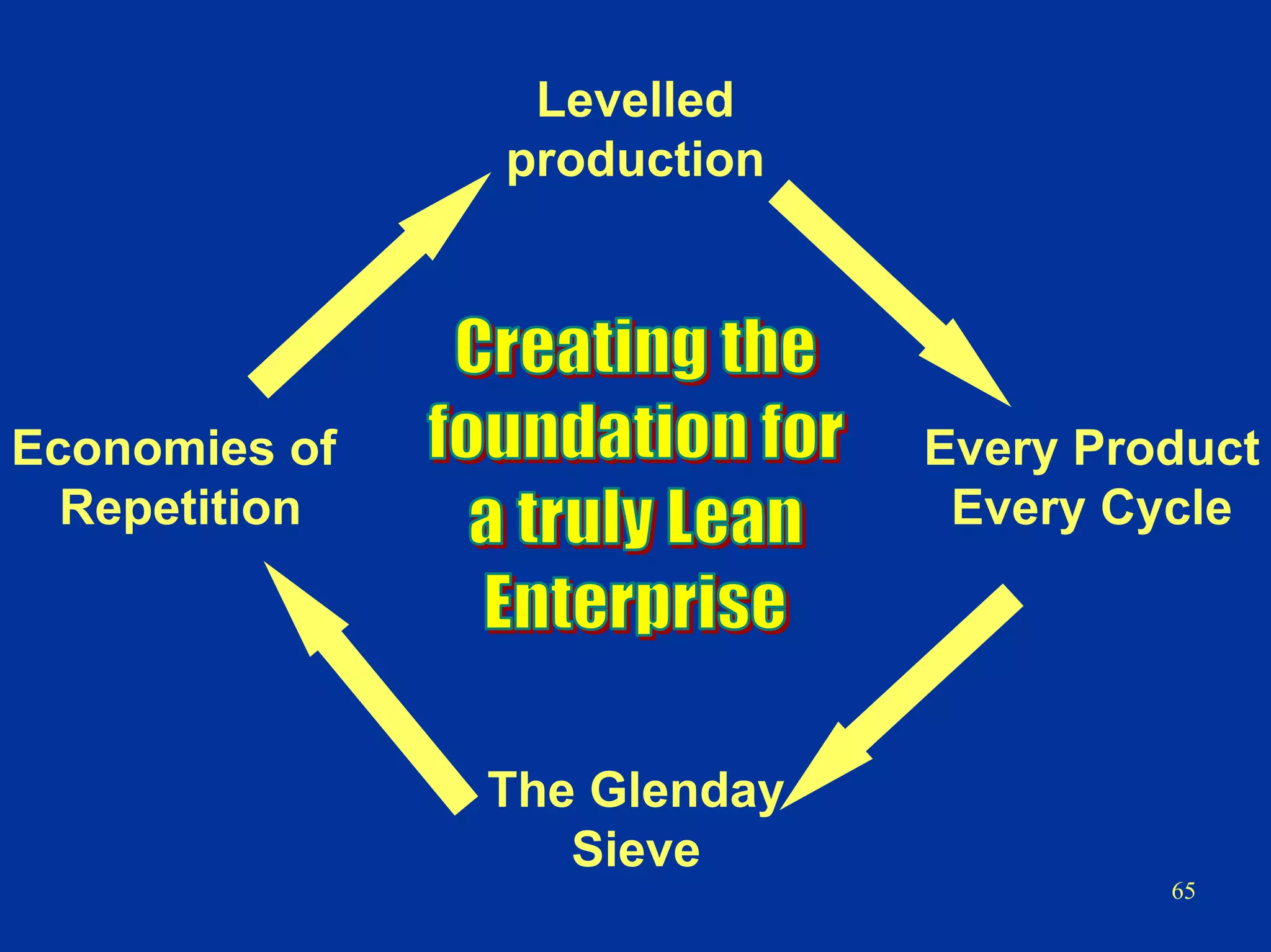
65
Levelled
production
Economies of
Repetition
Every Product
Every Cycle
The Glenday
Sieve

Every Product Every Cycle in Production

  • 1.
    1 Flow Logic and Every ProductEvery Cycle How to start
  • 2.
    2 Where to startwith current plant & equipment limitations?
  • 3.
    3 The Glenday Sieve •A tool to help – Implement Every Product Every Cycle – Remove waste
  • 4.
    4 The Glenday Sieve -first analysis % Cumulative Sales % Product Range 50% 95% 99%
  • 5.
    5 The Glenday Sieve -first analysis Exercise Data source: $B paint/coatings multinational
  • 6.
    6 The Glenday Sieve –second analysis
  • 7.
    7 GreenGreen Products % Cumulative Sales % Product Range 50%6% • High volume/small number of SKUs • Create a “green stream” for these products – Enable the green stream to flow
  • 8.
    8 The Glenday Sieve and ValueStream Mapping What do you map first? The Greens
  • 9.
    9 The Glenday Sieve and ValueStream Mapping To make the “greens” flow
  • 10.
    10 The Glenday Sieve and ValueStream Mapping which will as a consequence reduce non-value added waste
  • 11.
    11 YellowYellow Products % Cumulative Sales %Product Range 50% 6% 95% 50% Work to closely to align with Green products – Piggyback with greens where • Little change-over impact • Differentiation happens off-line
  • 12.
    12 Yellows • Work onreasons stopping yellows going into green stream • E.g. – Changeovers – Batch sizes
  • 13.
    13 Green stream • Startwith 6% range in fixed cycles • Increase capacity (white space) through EOR • Work on yellows • Reduce barriers to being in green stream • Move yellows into white space • 50% product range BUT 95% volume in green stream
  • 14.
    14 YellowYellow Products % Cumulative Sales %Product Range 50% 6% 95% 50% – Utilize rapid improvement methodology to remove barriers to flow e.g. • Grade change time, etc. • Improve line performance
  • 15.
    15 BlueBlue Products % Cumulative Sales %Product Range 50% 6% 95% 50% 99% • Opportunity for product or packaging harmonization • Product, materials and/or processing include non-value adding complexity
  • 16.
    16 Blue SKU’s - removingnon-value adding complexity – Back labels
  • 17.
    17 Blue SKU’s - removingnon-value adding complexity • Facial Tissue mill • Totally chaotic scheduling environment • Clear bottleneck at the end of the production process in making bundle packs Blue opportunity – Printed Shrink Film
  • 18.
    18 EXAMPLE Results: • Removed CartonOrienter • One week production cycle (now EPEW) • Transformed a “chaotic” environment to a smooth and “calm” one • Focus on Multi-pack (Cyclone) bottleneck – Output rates improved 22% two years in a row
  • 19.
    19 Red Products % Cumulative Sales % Product Range 50%6% 95% 50% 99% 70% 1% of Sales 30% of the SKUs
  • 20.
  • 21.
    21 Exercise Impact of centrallimit theory On Sales predictability
  • 22.
    22 Facial Tissue Sales FORECASTSPER WEEK Code 28200 Code 28201 Code 28100 Code 28112 Code 32905 200 Ct Case 184 Assorted 100 Ct Case AV 112 Ct Case Walgreens 100 Ct 16,133 9320 5949 2038 120 Actual Demand Actual Demand Actual Demand Actual Demand Actual Demand Wk of 5/30 15,386 8936 8743 4218 15 6-Jun 14,355 8413 4548 1874 15 13-Jun 17,695 9564 6572 3153 233 20-Jun 14,536 9242 5337 1011 66 27-Jun 14,513 8048 5363 1065 87 4-Jul 14,668 8246 5581 2002 117 11-Jul 16,931 8948 6043 1280 260 18-Jul 16,632 9699 5367 1781 66 25-Jul 17,777 10294 5200 1327 277 Average 15,833 9043 5862 1968 126 Green Code Red Code
  • 23.
    23 Average Sales ForecastAccuracy Product Average Weekly Sales Weekly Forecast % Forecast Accuracy 28200 15,833 16,133 28201 9,043 9,320 28100 5,862 5,949 28112 1,968 2,038 32905 126 120
  • 24.
    24 Sales Forecast Accuracyat Weekly Level WEEKLY FORECAST ACCURACY DATA Week 1 2 3 4 5 6 7 8 9 Forecast 28200 Sales 15,386 14,355 17,695 14,536 14,513 14,668 16,931 16,632 17,777 16,133 F/C Acc. 95% 89% 110% 90% 90% 91% 105% 103% 110% 28201 Sales 8936 8413 9564 9242 8048 8246 8949 9699 10294 9320 F/C Acc. 96% 90% 103% 99% 86% 88% 96% 104% 110% 28100 Sales 8743 4548 6572 5337 5363 5581 6043 5367 5200 5949 F/C Acc. 147% 76% 110% 90% 90% 94% 102% 90% 87% 28112 Sales 4218 1874 3153 1011 1065 2002 1280 1781 1327 2038 F/C Acc. 207% 92% 155% 50% 52% 98% 63% 87% 65% 32905 Sales 15 15 233 66 87 117 260 66 277 120 F/C Acc. 13% 13% 194% 55% 73% 98% 217% 55% 231% Actual Sales
  • 25.
    25 Sales Forecast Accuracy ata Weekly Level Lowest % Highest % 28200 to 28201 to 28100 to 28112 to 32905 to
  • 26.
    26 Sales forecast accuracyat a weekly level 0% 50% 100% 150% 200% 250% 1 2 3 4 5 6 7 8 9 28200 28201 28100 28112 32905
  • 27.
    27 What about Forecastingand Sales Variability? Generally bigger sellers have less variability therefore greater predictability
  • 28.
    28 Rationalisation is NOTthe only option! It is AN option however there are many solutions Red SKU’s
  • 29.
    29 Buffer tank utilizationlearning Pre lean/RFS: Schedule adjustments would have occurred at three points (creating that “vicious cycle”) Post lean/RFS: No schedule adjustments and normal variability is handled through the buffer tank 0 50 100 150 200 250 2/12/2006 2/19/2006 2/26/2006 3/5/2006 3/12/2006 3/19/2006 3/26/2006 4/2/2006 4/9/2006 4/16/2006 4/23/2006 4/30/2006 5/7/2006 5/14/2006 5/21/2006 5/28/2006 6/4/2006 Avg of min su Avg of max su Sum of Inv SU GPS TCR12SR FAMILY (All) LOCCODE (All) SUN_DT Data
  • 30.
    30 Remove the “window”in to the Buffer Tank… 11/27 12/4 12/11 12/18 12/25 1/1 1/8 1/15 STING8RR OK OK OK OK OK OK OK OK STING1CAS HIGH HIGH OK OK OK OK OK HIGH STING3RR OK OK OK OK OK OK OK OK STING12RR OK OK OK OK OK OK OK OK STING15RR HIGH HIGH HIGH OK OK OK OK OK STING1MR OK OK OK OK HIGH HIGH OK OK STING1RR OK LOW OK OK OK OK OK OK STING24RR HIGH HIGH HIGH HIGH HIGH HIGH HIGH HIGH STING2CAS OK OK OK OK OK OK OK OK STING2MR HIGH HIGH HIGH HIGH OK OK OK OK STING6RR OK OK OK OK OK OK OK OK OK OK OK OK OK OK OK OK
  • 31.
    31 Impact on people G’dayIan I am sure "easy" was a word that sprang to mind when we first started fixed cycles...there was a general view that I was insane but having said that the crew would assassinate anyone who now tried to take their fixed cycle away... I'm probably a certifiable "early adopter" and the things you are proposing seem to make so much sense. best regards Marty
  • 32.
    32 Impact on people HiIan Our Green Flow project started with four products that made up around 30% of our total capacity here in Denmark. To test Green Flow’s proof-of-concept we ran three cycles of five weeks per cycle. After fifteen weeks, the project’s final fermentation finished followed by the standard purification, granulation or liquid formation, QC analysis and shipping procedures. The project has been a big success. We have reduced our lead time by 50% for the majority of batches. Even the few batches that required some reworking have had a 33% reduced lead time. It has been possible to hold the vast majority of the agreed start/stop times throughout the supply chain. And lastly almost everyone, from operators to top management, thinks the Green Flow principle is a far better way of production than what we were doing before. We expect that Green Flow will no longer be considered a project but an established way of production. Best regards, Herman Herz Lean Facilitator
  • 33.
    33 Impact on people From:Graham, Jeff Sent: Monday, February 15, 2007 10:08 AM To: Sather, Rick Cc: Gardhouse, Brian Subject: RE: Huntsville Lean-RFS Hi Rick RFS has been a tremendous success for the Huntsville assets. Since the RFS start-up in 2006 productivity has increase from under 15,000 cph to over 18,000 cph in January 2007. The steady upward trend in rate of operation is a testament of the power of a frequent, stable, predictable repeating schedule. I am a believer and would fight any efforts to go back to the prior scheduling chaos! We’ve been digging into the productivity improvement “toolbox” using standard techniques fitted into the RFS structure. SMED, centerlining, TPM and equipment improvements are all used to improve rates of operation. The approach has been practical with operations and technical team members’ involvement. In particular, the line mechanics and electrical Support are fully engaged making improvements regularly. Efforts have concentrated on eliminating “rocks”, reducing equipment variables and stabilizing the process.
  • 34.
    34 A major shiftin thinking is the idea of “making the cycle” versus daily rates of operation. Instead of measuring rates of operation, we measure where we are in the cycle – ahead or behind by hours. Also when extra hangs are made, it provides all team members a measurable contribution to the business their efforts made especially when there are customer service issues. As for challenges, RFS continues to show us weaknesses in equipment, procedures and people. Example: the facial tissue grade 280’s continues to be a challenge. Given it is run every week; we know operating issues are independent of operating team, materials, current procedures and equipment set-up. Plans have been developed to methodically address observable barriers to flow to improve rates of operation. Although 280’s rates of operation are stable and predictable, they are poor compared to other grades. As I stated at the start, the Multifolder rates of operation continue a steady upward positive trend in rate of operation. The stable, predictable repeating schedule contributes to problem solving and solution implementation. I am a RFS believer. Jeff
  • 35.
    35 Rocks or barriers toflow • Visible • Hourly • Operator led • Focussed on achieving plan • Problem identification
  • 36.
    36 Downtime – tends toget attention & resources 0 100 200 300 400 500 600 1 2 3 4 5 6 7 8 9 10 11 12 std output actual output
  • 37.
    37 “Normal” production variability 430 440 450 460 470 480 490 500 510 520 530 12 3 4 5 6 7 8 9 10 11 12 std output actual output Average output = 501/hr
  • 38.
    38 “Normal” production variability 430 440 450 460 470 480 490 500 510 520 530 12 3 4 5 6 7 8 9 10 11 12 std output actual output Average output = 501/hr • 501/hr average = seen as “good” shift •“good” hours balance “bad” hours • little or no problem solving focus • repeat issues not understood or addressed • operators get little or no resources to help resolve their repeat issues
  • 39.
    3939 RockbustingRockbusting ProcessProcess Operator ResponsibilitiesOperatorResponsibilities At the end of each hour, enter results on the “Line 31 hourly Efficiency Board” – Green Bar if over the standard – Red Bar if under the standard
  • 40.
  • 41.
    4141 Contact ProcessContact Process Operator Makenecessary contacts if the hourly case count goes below the Standard Line Efficiency.
  • 42.
    4242 Contact ProcessContact Process Hour1: Contacts the Line Supervisor Hour 2: Contacts Shift/Area Manager
  • 43.
    4343 Contact ProcessContact Process Hour3: Contacts the Manufacturing Manager. Hour 4: Contacts the Plant Manager.
  • 44.
    44 Rockbusting • Focus onall “bad” hours (not consecutive hours or single reoccurring issue) • Operator led • Visible process that triggers help (NOT a problem solving process)
  • 45.
    45 “ROCK” Busting -Sustaining Action: Follow-up Process for Rock Identification & Elimination No Team Action Needed Decision Point Lean Steering Team decides the need for Rock Busting in a certain area Gather information from all shifts & perform sieve analysis Potential Rocks documented on Supervisors Daily Shift notes (email) Supervisor flags the need for Rock Busting Team to meet •Rock Busting Team Members Operator Supervisor Maintenance Supervisor Quality Assurance Specialist Engineering Sanitation Maintenance Techs Report Findings and Corrective Actions to Distribution with specific timeline & person(s) responsible Implement Corrective Actions and continue to monitor hourly results Team Gathers Data & Executes Problem Solving Process (Brainstorming, etc.) Team involves any other necessary resources (incl. Corporate)
  • 46.
  • 47.
    47 Schedule Breaks Example oftracking breaks Hard Rollover 8 Business / Other 36 Materials 76 Customer 92 Site/Asset 113 0 20 40 60 80 100 120 2006 TOTAL FAMILY CARE RfS Schedule Breaks Hard Rollover Business/Other Materials Customer Site/Asset unt of Reason Description Reason Description
  • 48.
    48 Schedule Breaks Conclusions • ScheduleBreak Log data is critical to understanding root cause, and standardization of data is a must • Three major barriers to flow: – Site/Asset (36%) – Customer (28%) – Materials (23%) 2006 RfS Breaks - Internal or External* (%) Customer 28% Kimberly- Clark 72%
  • 49.
    49 Schedule Breaks Deeper dive– Site/Asset breaks Site/Asset reason code breakdown (2006 totals) 0 5 10 15 20 25 30 White Space Plan Rates Project Conflict Machine Failure Human Resources Runout
  • 50.
  • 51.
    51 From Problem-hiding to Problem-solving •Focus on meeting the plan NOT line efficiencies • Identification of rocks & barriers to flow • Problem solving activity separate to “get the line running NOW!”
  • 52.
    52 Changing the logicfrom Batch to Flow Overall Summary
  • 53.
    53 Toyota Production System Jidoka -Andon -Poka-Yoke -Visualcontrol -5S, etc. Just-in-time -continuous Flow -Takt time -Pull system Customer service Continuous Improvement And Elimination of MUDA (waste) Lead TimeCostQuality Stability & Standardized Work Levelled production (heijunka)
  • 54.
    54 Production Levelling or Heijunka =Foundation of Lean Therefore essential to being a truly Lean Enterprise
  • 55.
    55 • Final stepin the process, not how Toyota started • What you see is different to how it was achieved • You now know the “secret” = EVERY PRODUCT EVERY CYCLE
  • 56.
    56 New Paradigm SupplyChain Logic • Every Product Every Cycle is the key and required to support production leveling • Use the Glenday Sieve and pattern production based on SKU categories • Rigid cycle (start time and sequence) creates Economies of Repetition • Utilize “buffer tanks” to manage variability and exceptions – instead of always re-planning to a target – Flexible quantity when limits are broken
  • 57.
    57 Every product EveryCycle • A rigid disciplined PUSH process • Leads to stability and standardisation as a consequence • Invest improvements in faster cycles
  • 58.
    58 Progression over time Establishan EPEC pattern, leverage Economies of Repetition (EOR) & create stability. A push flow Fixed sequence, fixed volume Fixed sequence, unfixed volume Unfixed sequence, unfixed volume Respond closer to demand, continue to rely on EOR. Sustain flow with some pull Produce to demand. True flow and pull At this point, you will have a true Consumer Driven Supply Network Increasingcapability,responsiveness,lowercostandcash Faster fixed sequence, fixed volume Maximise impact of EOR & stability. Increase rate of flow. Unfixed sequence, fixed volume Break reliance on EPEC & EOR. Pull using small fixed volumes.
  • 59.
    59 Getting started What –specifically – are you going to do as a result of this forum next week? Write it down.
  • 60.
  • 61.
  • 62.
  • 63.
  • 64.
  • 65.