Rethinking IT Service Delivery
Dr. Wolfgang Krips
SVP SAP Global IT Infrastructure Services
3 November, 2010
AGENDA
© 2010 SAP Global IT. All rights reserved. / Page 2
1. Starting Point
2. Operating Model
3. Impact
4. Lessons learned
© 2010 SAP Global IT. All rights reserved. / Page 3
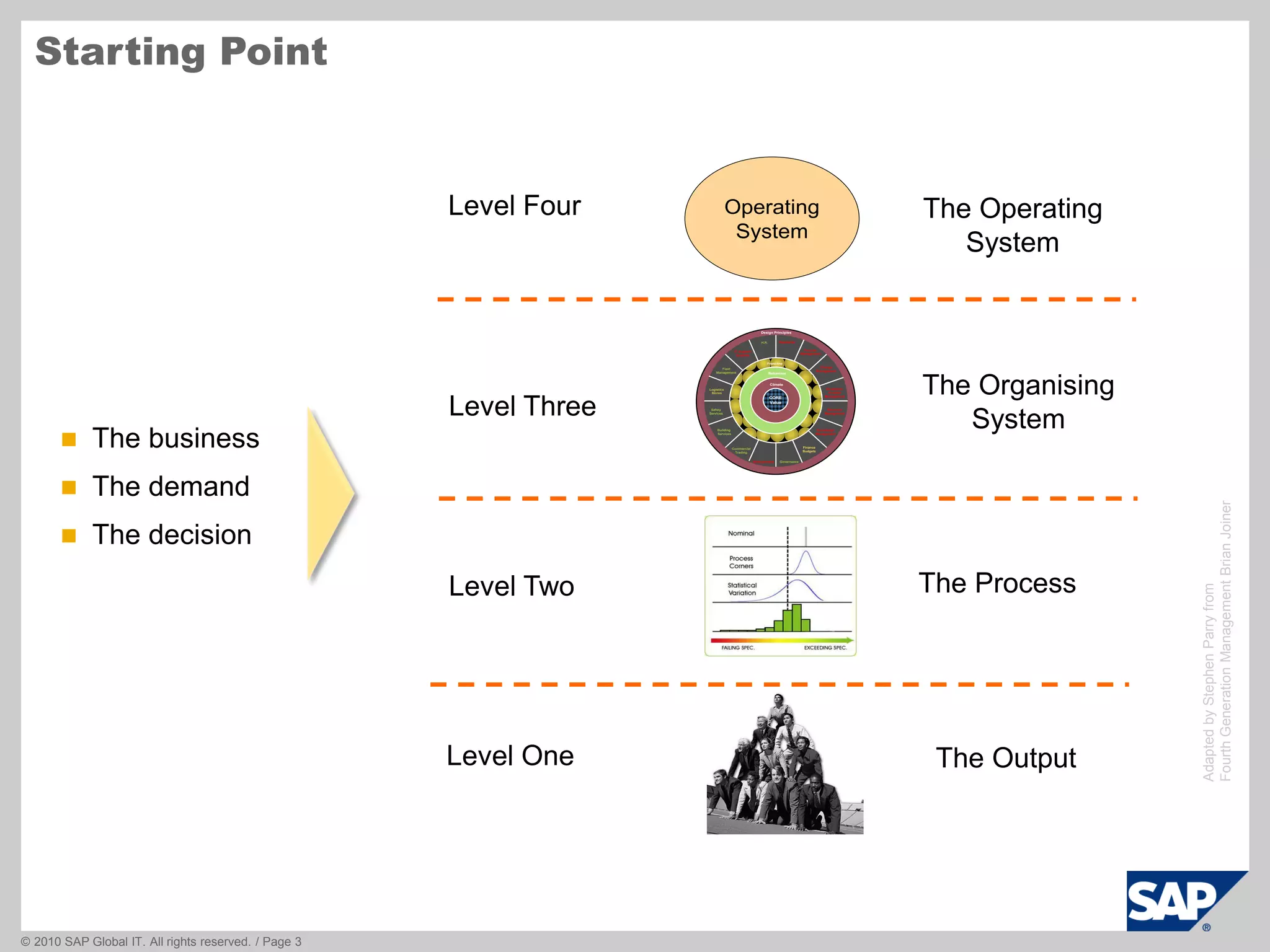
Starting Point
 The business
 The demand
 The decision
Level One
Level Two
Level Three
Change
Management
Standards
Process
Management
Measurement Governance
Finance
Budgets
Knowledge
Management
Resource
Management
Escalation
Problem
Management
Commercial
Trading
Building
Services
Logistics
Stores
Safety
Services
IT Support
Systems
Fleet
Management
H.R.
Change
Management
Standards
Process
Management
Measurement Governance
Finance
Budgets
Knowledge
Management
Resource
Management
Escalation
Problem
Management
Commercial
Trading
Building
Services
Logistics
Stores
Safety
Services
IT Support
Systems
Fleet
Management
H.R.
Front-line
Infrastructure
CORE
Value
Climate
Behaviour
Design Principles
The Organising
System
The Process
The Output
Level Four The Operating
System
Operating
System
AdaptedbyStephenParryfrom
FourthGenerationManagementBrianJoiner
© 2010 SAP Global IT. All rights reserved. / Page 4
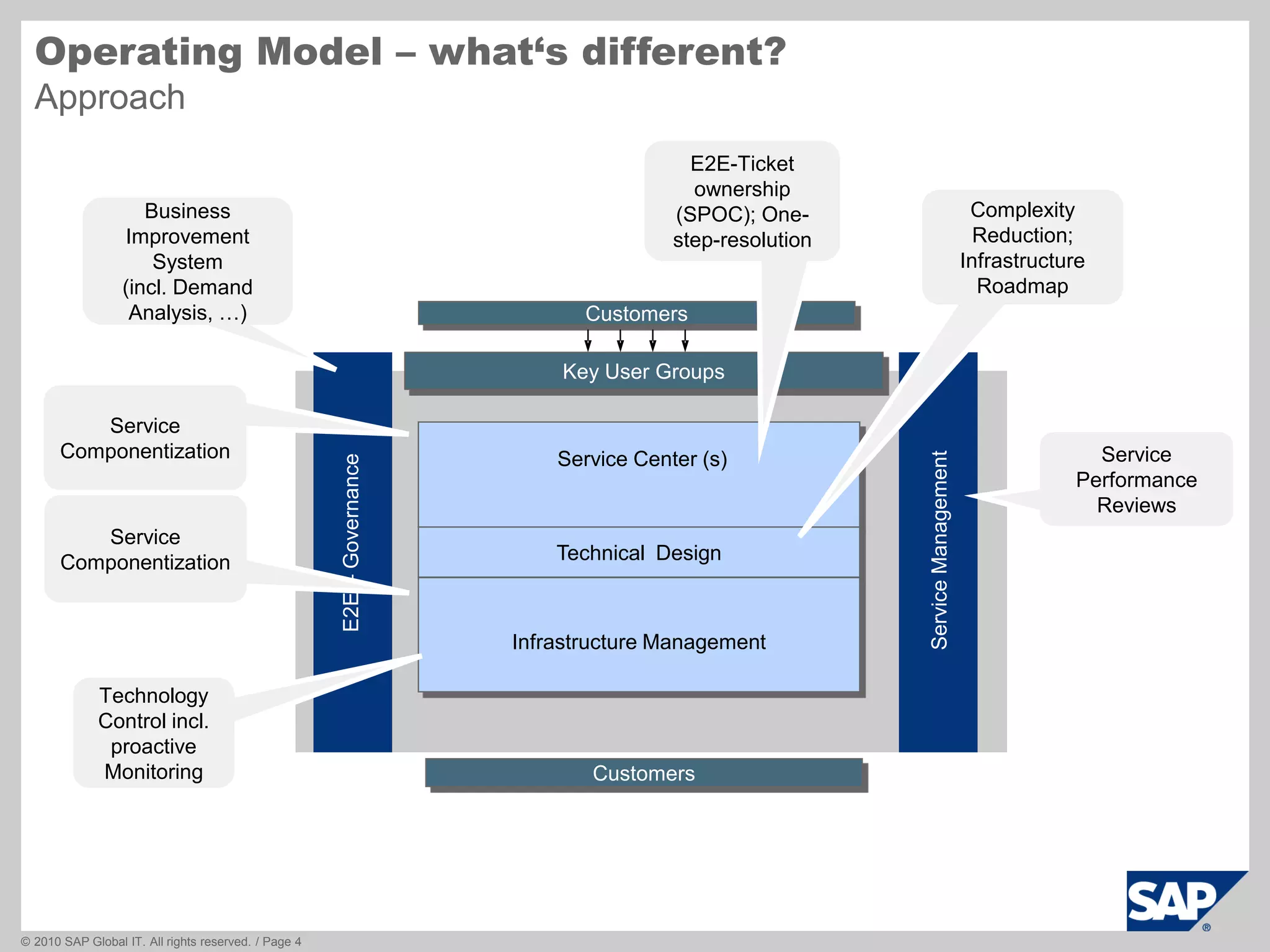
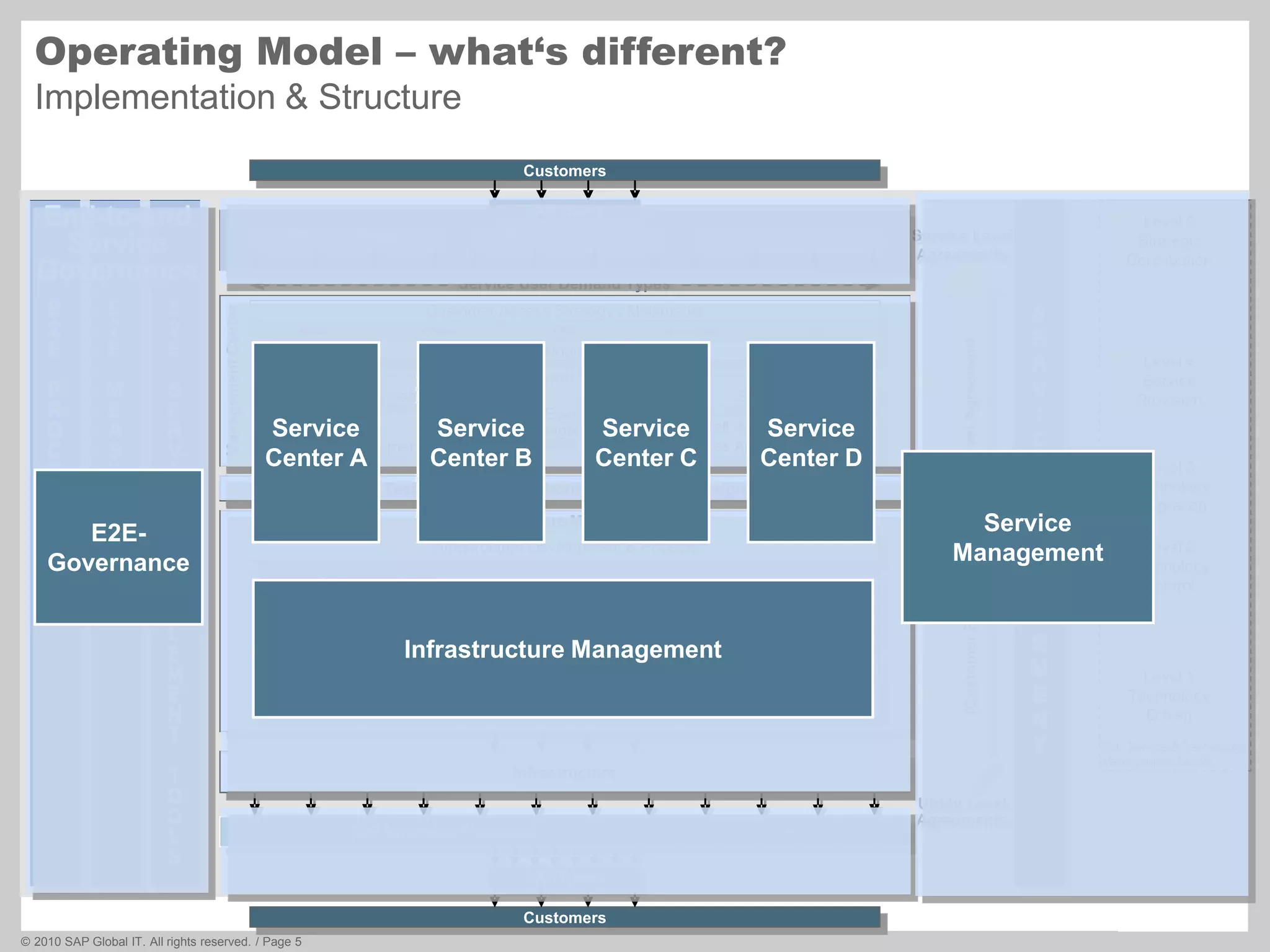
Operating Model – what‘s different?
Approach
Key User Groups
Technical Design
Infrastructure Management
Customers
Customers
ServiceManagement
E2E–Governance
Service Center (s) Service
Performance
Reviews
Service
Componentization
E2E-Ticket
ownership
(SPOC); One-
step-resolution
Complexity
Reduction;
Infrastructure
Roadmap
Business
Improvement
System
(incl. Demand
Analysis, …)
Technology
Control incl.
proactive
Monitoring
Service
Componentization
© 2010 SAP Global IT. All rights reserved. / Page 5
Operating Model – what‘s different?
Implementation & Structure
ITIL Service & Technology
Management Levels
E
2
E
S
E
R
V
I
C
E
E
N
A
B
L
E
M
E
N
T
T
O
O
L
S
ManagementCenter
SAP Users
Key User Group
Customer Access Strategy / Multimedia
Incident Management
Problem Management
Install, Move & Change
Business Application Projects
Technical Design Authority / Solution Design
Infrastructure Management
E
2
E
M
E
A
S
U
R
E
M
E
N
T
S
E
2
E
P
R
O
C
E
S
S
E
S
Service Requests
End-to-end
Service
Governance
eMail Phone FAQ Download etc.
Service Catalogue / Offerings
Key User GroupKey User Group
Customers
Business
Application
Management
Customers
Level 5
Strategic
Contribution
Level 4
Service
Provision
Level 3
Technology
Integration
Level 2
Technology
Control
Level 1
Technology
Driven
(CustomerPurpose)OperationalLevelAgreement
S
E
R
V
I
C
E
M
A
N
A
G
E
M
E
N
T
Service Level
Agreements
E2E Business Processes
Service User Demand Types
SAP Users
Respond Types
Enterprise Management Tools
Asset Management Supplier Management
Operation Tools
Configuration Management
Storage
Management
Database
Management
Utility Level
Agreements
Infrastructure
Network
Management
Server
Management
Other
Infrastructure
Services
Infrastructure Development & Projects
Event
ManagementService
Center A
Infrastructure Management
Service
Center B
Service
Center C
Service
Center D
E2E-
Governance
Service
Management
© 2010 SAP Global IT. All rights reserved. / Page 6
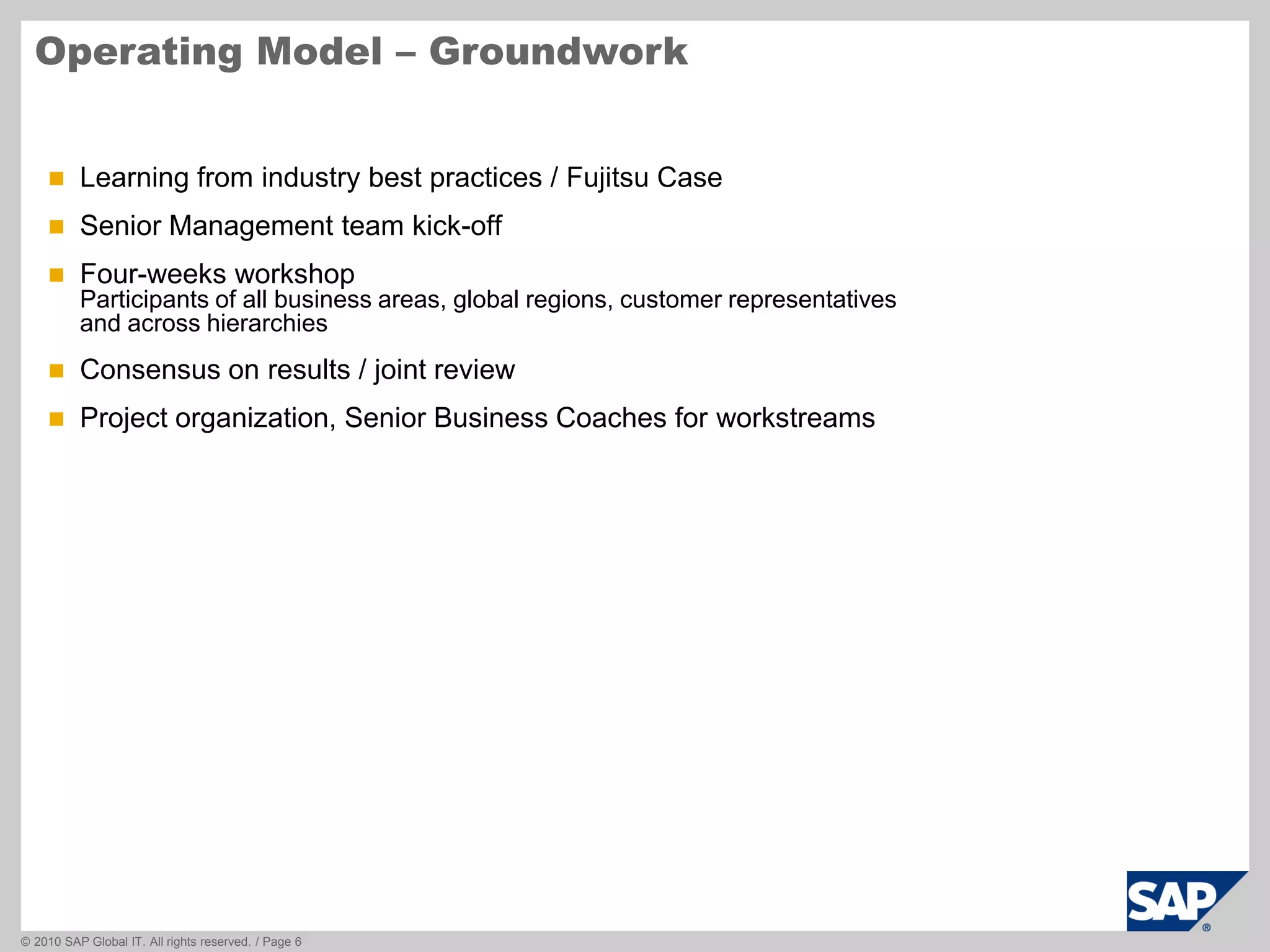
Operating Model – Groundwork
 Learning from industry best practices / Fujitsu Case
 Senior Management team kick-off
 Four-weeks workshop
Participants of all business areas, global regions, customer representatives
and across hierarchies
 Consensus on results / joint review
 Project organization, Senior Business Coaches for workstreams
© 2010 SAP Global IT. All rights reserved. / Page 7
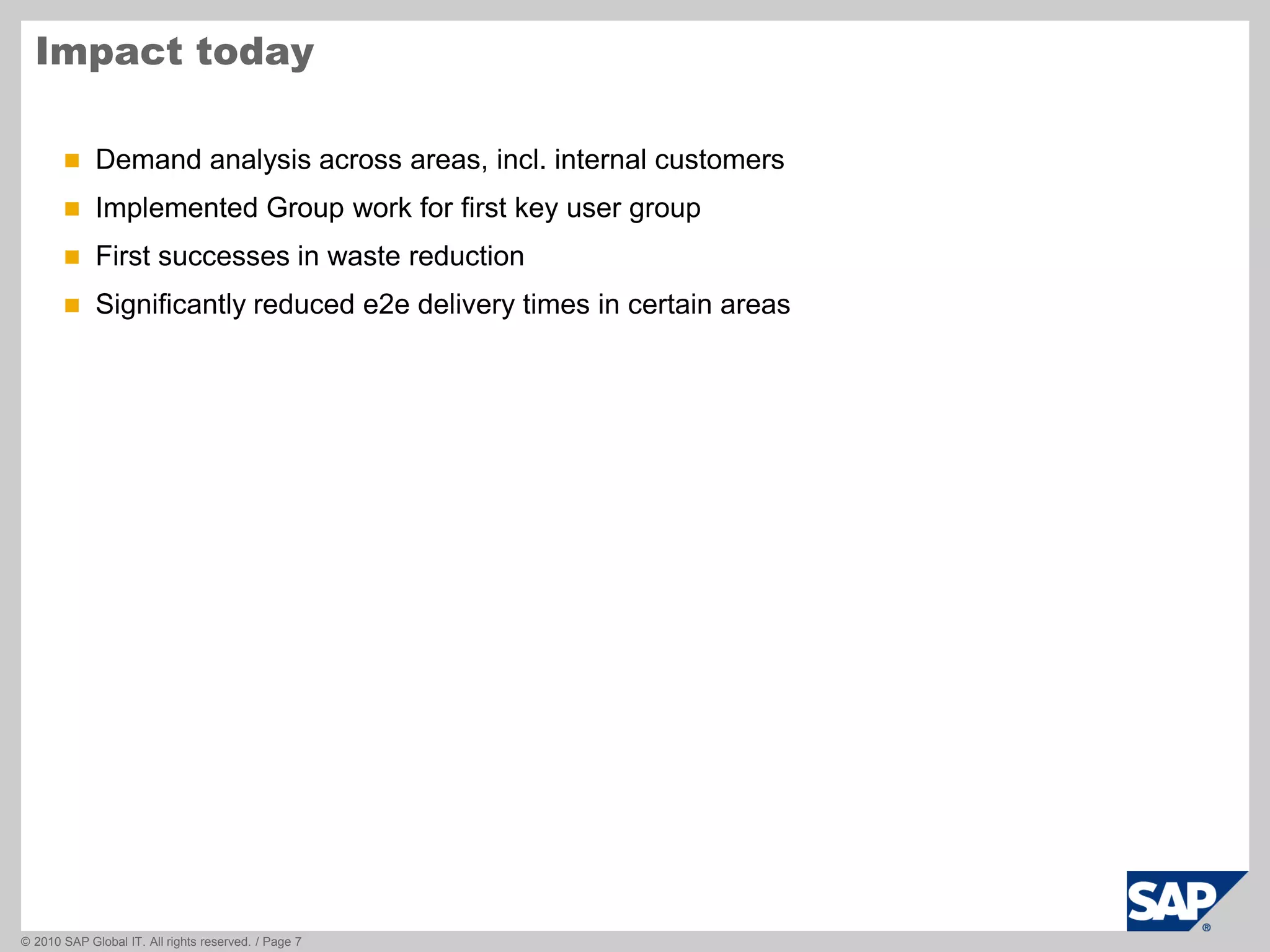
 Demand analysis across areas, incl. internal customers
 Implemented Group work for first key user group
 First successes in waste reduction
 Significantly reduced e2e delivery times in certain areas
Impact today
© 2010 SAP Global IT. All rights reserved. / Page 8
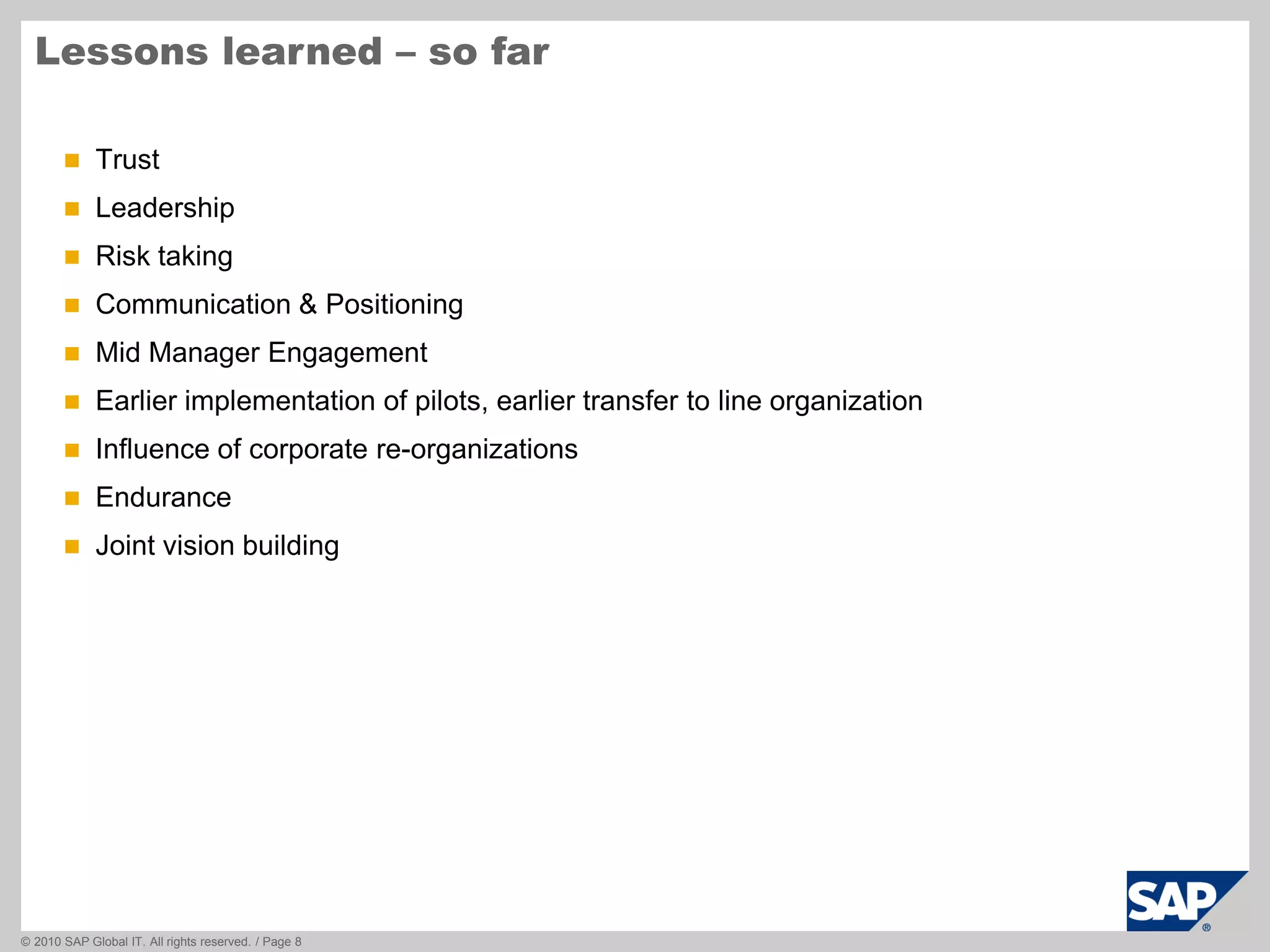
 Trust
 Leadership
 Risk taking
 Communication & Positioning
 Mid Manager Engagement
 Earlier implementation of pilots, earlier transfer to line organization
 Influence of corporate re-organizations
 Endurance
 Joint vision building
Lessons learned – so far
© 2010 SAP Global IT. All rights reserved. / Page 9
No part of this publication may be reproduced or transmitted in any form or for any purpose without the express permission of SAP AG. The information contained herein
may be changed without prior notice.
Some software products marketed by SAP AG and its distributors contain proprietary software components of other software vendors.
Microsoft, Windows, Excel, Outlook, and PowerPoint are registered trademarks of Microsoft Corporation.
IBM, DB2, DB2 Universal Database, System i, System i5, System p, System p5, System x, System z, System z10, System z9, z10, z9, iSeries, pSeries, xSeries, zSeries,
eServer, z/VM, z/OS, i5/OS, S/390, OS/390, OS/400, AS/400, S/390 Parallel Enterprise Server, PowerVM, Power Architecture, POWER6+, POWER6, POWER5+,
POWER5, POWER, OpenPower, PowerPC, BatchPipes, BladeCenter, System Storage, GPFS, HACMP, RETAIN, DB2 Connect, RACF, Redbooks, OS/2, Parallel Sysplex,
MVS/ESA, AIX, Intelligent Miner, WebSphere, Netfinity, Tivoli and Informix are trademarks or registered trademarks of IBM Corporation.
Linux is the registered trademark of Linus Torvalds in the U.S. and other countries.
Adobe, the Adobe logo, Acrobat, PostScript, and Reader are either trademarks or registered trademarks of Adobe Systems Incorporated in the United States and/or other
countries.
Oracle is a registered trademark of Oracle Corporation.
UNIX, X/Open, OSF/1, and Motif are registered trademarks of the Open Group.
Citrix, ICA, Program Neighborhood, MetaFrame, WinFrame, VideoFrame, and MultiWin are trademarks or registered trademarks of Citrix Systems, Inc.
HTML, XML, XHTML and W3C are trademarks or registered trademarks of W3C®, World Wide Web Consortium, Massachusetts Institute of Technology.
Java is a registered trademark of Sun Microsystems, Inc.
JavaScript is a registered trademark of Sun Microsystems, Inc., used under license for technology invented and implemented by Netscape.
SAP, R/3, SAP NetWeaver, Duet, PartnerEdge, ByDesign, Clear Enterprise, SAP BusinessObjects Explorer and other SAP products and services mentioned herein as well
as their respective logos are trademarks or registered trademarks of SAP AG in Germany and other countries.
Business Objects and the Business Objects logo, BusinessObjects, Crystal Reports, Crystal Decisions, Web Intelligence, Xcelsius, and other Business Objects products and
services mentioned herein as well as their respective logos are trademarks or registered trademarks of SAP France in the United States and in other countries.
All other product and service names mentioned are the trademarks of their respective companies. Data contained in this document serves informational purposes only.
National product specifications may vary.
The information in this document is proprietary to SAP. No part of this document may be reproduced, copied, or transmitted in any form or for any purpose without the
express prior written permission of SAP AG.
This document is a preliminary version and not subject to your license agreement or any other agreement with SAP. This document contains only intended strategies,
developments, and functionalities of the SAP® product and is not intended to be binding upon SAP to any particular course of business, product strategy, and/or
development. Please note that this document is subject to change and may be changed by SAP at any time without notice.
SAP assumes no responsibility for errors or omissions in this document. SAP does not warrant the accuracy or completeness of the information, text, graphics, links, or other
items contained within this material. This document is provided without a warranty of any kind, either express or implied, including but not limited to the implied warranties of
merchantability, fitness for a particular purpose, or non-infringement.
SAP shall have no liability for damages of any kind including without limitation direct, special, indirect, or consequential damages that
may result from the use of these materials. This limitation shall not apply in cases of intent or gross negligence.
The statutory liability for personal injury and defective products is not affected. SAP has no control over the information that you may
access through the use of hot links contained in these materials and does not endorse your use of third-party Web pages nor provide
any warranty whatsoever relating to third-party Web pages.
© 2010 SAP AG. All Rights Reserved

Rethinking IT service delivery

  • 1.
    Rethinking IT ServiceDelivery Dr. Wolfgang Krips SVP SAP Global IT Infrastructure Services 3 November, 2010
  • 2.
    AGENDA © 2010 SAPGlobal IT. All rights reserved. / Page 2 1. Starting Point 2. Operating Model 3. Impact 4. Lessons learned
  • 3.
    © 2010 SAPGlobal IT. All rights reserved. / Page 3 Starting Point  The business  The demand  The decision Level One Level Two Level Three Change Management Standards Process Management Measurement Governance Finance Budgets Knowledge Management Resource Management Escalation Problem Management Commercial Trading Building Services Logistics Stores Safety Services IT Support Systems Fleet Management H.R. Change Management Standards Process Management Measurement Governance Finance Budgets Knowledge Management Resource Management Escalation Problem Management Commercial Trading Building Services Logistics Stores Safety Services IT Support Systems Fleet Management H.R. Front-line Infrastructure CORE Value Climate Behaviour Design Principles The Organising System The Process The Output Level Four The Operating System Operating System AdaptedbyStephenParryfrom FourthGenerationManagementBrianJoiner
  • 4.
    © 2010 SAPGlobal IT. All rights reserved. / Page 4 Operating Model – what‘s different? Approach Key User Groups Technical Design Infrastructure Management Customers Customers ServiceManagement E2E–Governance Service Center (s) Service Performance Reviews Service Componentization E2E-Ticket ownership (SPOC); One- step-resolution Complexity Reduction; Infrastructure Roadmap Business Improvement System (incl. Demand Analysis, …) Technology Control incl. proactive Monitoring Service Componentization
  • 5.
    © 2010 SAPGlobal IT. All rights reserved. / Page 5 Operating Model – what‘s different? Implementation & Structure ITIL Service & Technology Management Levels E 2 E S E R V I C E E N A B L E M E N T T O O L S ManagementCenter SAP Users Key User Group Customer Access Strategy / Multimedia Incident Management Problem Management Install, Move & Change Business Application Projects Technical Design Authority / Solution Design Infrastructure Management E 2 E M E A S U R E M E N T S E 2 E P R O C E S S E S Service Requests End-to-end Service Governance eMail Phone FAQ Download etc. Service Catalogue / Offerings Key User GroupKey User Group Customers Business Application Management Customers Level 5 Strategic Contribution Level 4 Service Provision Level 3 Technology Integration Level 2 Technology Control Level 1 Technology Driven (CustomerPurpose)OperationalLevelAgreement S E R V I C E M A N A G E M E N T Service Level Agreements E2E Business Processes Service User Demand Types SAP Users Respond Types Enterprise Management Tools Asset Management Supplier Management Operation Tools Configuration Management Storage Management Database Management Utility Level Agreements Infrastructure Network Management Server Management Other Infrastructure Services Infrastructure Development & Projects Event ManagementService Center A Infrastructure Management Service Center B Service Center C Service Center D E2E- Governance Service Management
  • 6.
    © 2010 SAPGlobal IT. All rights reserved. / Page 6 Operating Model – Groundwork  Learning from industry best practices / Fujitsu Case  Senior Management team kick-off  Four-weeks workshop Participants of all business areas, global regions, customer representatives and across hierarchies  Consensus on results / joint review  Project organization, Senior Business Coaches for workstreams
  • 7.
    © 2010 SAPGlobal IT. All rights reserved. / Page 7  Demand analysis across areas, incl. internal customers  Implemented Group work for first key user group  First successes in waste reduction  Significantly reduced e2e delivery times in certain areas Impact today
  • 8.
    © 2010 SAPGlobal IT. All rights reserved. / Page 8  Trust  Leadership  Risk taking  Communication & Positioning  Mid Manager Engagement  Earlier implementation of pilots, earlier transfer to line organization  Influence of corporate re-organizations  Endurance  Joint vision building Lessons learned – so far
  • 9.
    © 2010 SAPGlobal IT. All rights reserved. / Page 9 No part of this publication may be reproduced or transmitted in any form or for any purpose without the express permission of SAP AG. The information contained herein may be changed without prior notice. Some software products marketed by SAP AG and its distributors contain proprietary software components of other software vendors. Microsoft, Windows, Excel, Outlook, and PowerPoint are registered trademarks of Microsoft Corporation. IBM, DB2, DB2 Universal Database, System i, System i5, System p, System p5, System x, System z, System z10, System z9, z10, z9, iSeries, pSeries, xSeries, zSeries, eServer, z/VM, z/OS, i5/OS, S/390, OS/390, OS/400, AS/400, S/390 Parallel Enterprise Server, PowerVM, Power Architecture, POWER6+, POWER6, POWER5+, POWER5, POWER, OpenPower, PowerPC, BatchPipes, BladeCenter, System Storage, GPFS, HACMP, RETAIN, DB2 Connect, RACF, Redbooks, OS/2, Parallel Sysplex, MVS/ESA, AIX, Intelligent Miner, WebSphere, Netfinity, Tivoli and Informix are trademarks or registered trademarks of IBM Corporation. Linux is the registered trademark of Linus Torvalds in the U.S. and other countries. Adobe, the Adobe logo, Acrobat, PostScript, and Reader are either trademarks or registered trademarks of Adobe Systems Incorporated in the United States and/or other countries. Oracle is a registered trademark of Oracle Corporation. UNIX, X/Open, OSF/1, and Motif are registered trademarks of the Open Group. Citrix, ICA, Program Neighborhood, MetaFrame, WinFrame, VideoFrame, and MultiWin are trademarks or registered trademarks of Citrix Systems, Inc. HTML, XML, XHTML and W3C are trademarks or registered trademarks of W3C®, World Wide Web Consortium, Massachusetts Institute of Technology. Java is a registered trademark of Sun Microsystems, Inc. JavaScript is a registered trademark of Sun Microsystems, Inc., used under license for technology invented and implemented by Netscape. SAP, R/3, SAP NetWeaver, Duet, PartnerEdge, ByDesign, Clear Enterprise, SAP BusinessObjects Explorer and other SAP products and services mentioned herein as well as their respective logos are trademarks or registered trademarks of SAP AG in Germany and other countries. Business Objects and the Business Objects logo, BusinessObjects, Crystal Reports, Crystal Decisions, Web Intelligence, Xcelsius, and other Business Objects products and services mentioned herein as well as their respective logos are trademarks or registered trademarks of SAP France in the United States and in other countries. All other product and service names mentioned are the trademarks of their respective companies. Data contained in this document serves informational purposes only. National product specifications may vary. The information in this document is proprietary to SAP. No part of this document may be reproduced, copied, or transmitted in any form or for any purpose without the express prior written permission of SAP AG. This document is a preliminary version and not subject to your license agreement or any other agreement with SAP. This document contains only intended strategies, developments, and functionalities of the SAP® product and is not intended to be binding upon SAP to any particular course of business, product strategy, and/or development. Please note that this document is subject to change and may be changed by SAP at any time without notice. SAP assumes no responsibility for errors or omissions in this document. SAP does not warrant the accuracy or completeness of the information, text, graphics, links, or other items contained within this material. This document is provided without a warranty of any kind, either express or implied, including but not limited to the implied warranties of merchantability, fitness for a particular purpose, or non-infringement. SAP shall have no liability for damages of any kind including without limitation direct, special, indirect, or consequential damages that may result from the use of these materials. This limitation shall not apply in cases of intent or gross negligence. The statutory liability for personal injury and defective products is not affected. SAP has no control over the information that you may access through the use of hot links contained in these materials and does not endorse your use of third-party Web pages nor provide any warranty whatsoever relating to third-party Web pages. © 2010 SAP AG. All Rights Reserved