1
POLICY (STRATEGY) DEPLOYMENT
A proven process for strategy execution.
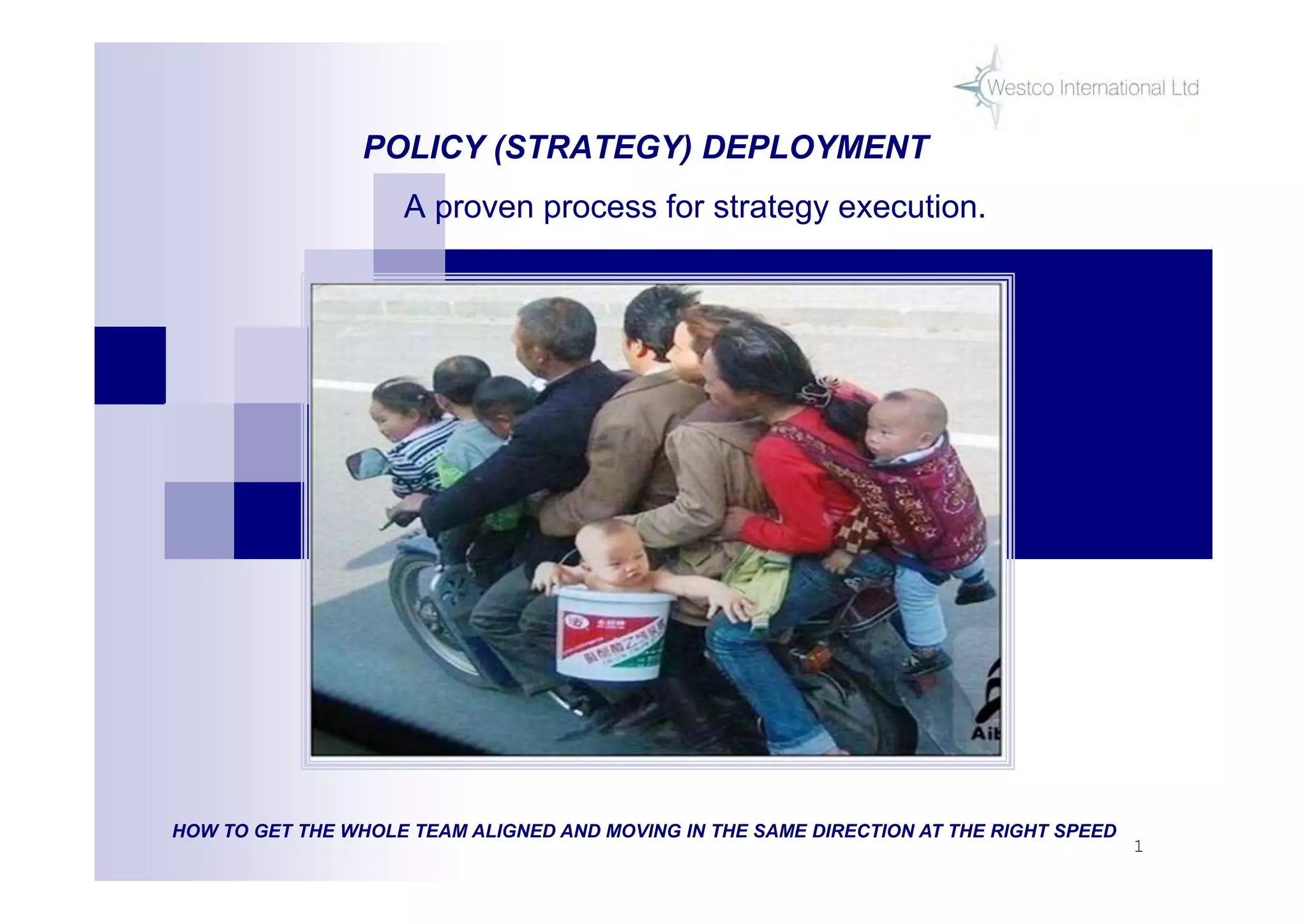
HOW TO GET THE WHOLE TEAM ALIGNED AND MOVING IN THE SAME DIRECTION AT THE RIGHT SPEED
2
PRESENTATION AGENDA
1. A FEW COMMENTS ON STRATEGY DEVELOPMENT.
2. THE POLICY DEPLOYMENT PROCESS EXPLAINED.
3. A CASE STUDY ; BORAL Ltd.
3
WHAT IS STRATEGY ALL ABOUT?
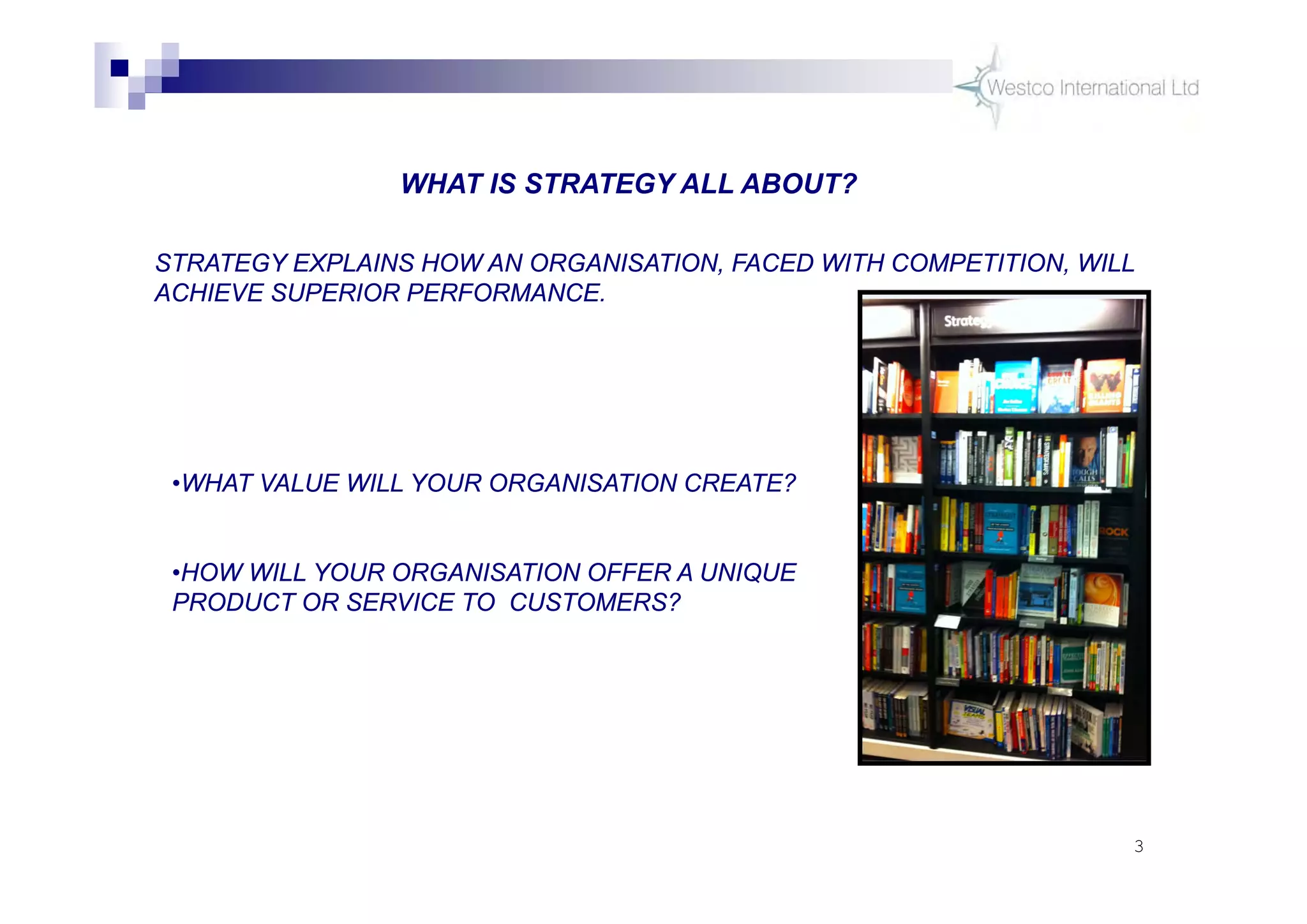
STRATEGY EXPLAINS HOW AN ORGANISATION, FACED WITH COMPETITION, WILL
ACHIEVE SUPERIOR PERFORMANCE.
•WHAT VALUE WILL YOUR ORGANISATION CREATE?
•HOW WILL YOUR ORGANISATION OFFER A UNIQUE
PRODUCT OR SERVICE TO CUSTOMERS?
4
THE ALIGNMENT OF CORPORATE, DIVISIONAL & SITE STRATEGIES
The substance of Corporate strategy is summed up by its Building Blocks;
the 6 or so key concepts and actions that define it.
Corporate level strategy considers the allocation of resources among the
business units. However it must not just be a sum of the parts. Collaboration
should result in identifying opportunities which deliver synergies. What mix will
make the best sustainable return on the company’s capital?
The basic goal then, of the Corporate strategy is to deliver ultimate value to
customers, winning their preference and creating a sustainable competitive
advantage which in turn delivers shareholder value.
5
Research consistently identifies reasons for failure include:
1. People cannot implement what they do not know.
2. People do not implement properly what they do not understand.
3. People do not implement what they are not committed to.
4. People give up on a strategy, the implications of which, have not been
anticipated and thought through.
5. Management overlook the importance of the “HOWS” of executing the strategy.
WHY DO SOME BRILLIANT STRATEGIES FAIL?
“Policy deployment will help Management identify and practically manage the
implementation of a strategy of the Company’s products, markets, customers,
organisation structure, systems, processes, personnel and culture”
6
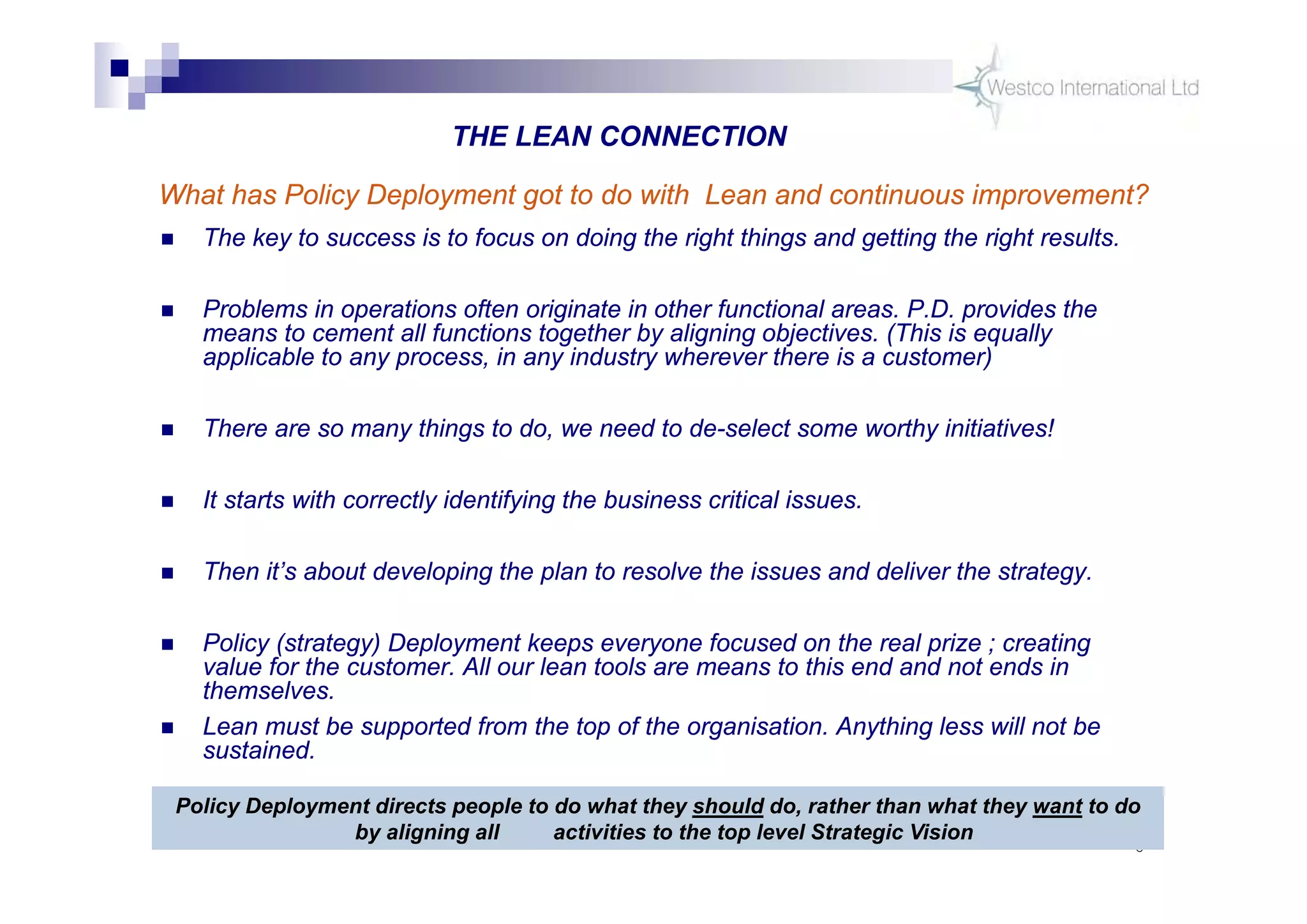
 The key to success is to focus on doing the right things and getting the right results.
 Problems in operations often originate in other functional areas. P.D. provides the
means to cement all functions together by aligning objectives. (This is equally
applicable to any process, in any industry wherever there is a customer)
 There are so many things to do, we need to de-select some worthy initiatives!
 It starts with correctly identifying the business critical issues.
 Then it’s about developing the plan to resolve the issues and deliver the strategy.
 Policy (strategy) Deployment keeps everyone focused on the real prize ; creating
value for the customer. All our lean tools are means to this end and not ends in
themselves.
 Lean must be supported from the top of the organisation. Anything less will not be
sustained.
Policy Deployment directs people to do what they should do, rather than what they want to do
by aligning all activities to the top level Strategic Vision
THE LEAN CONNECTION
What has Policy Deployment got to do with Lean and continuous improvement?
7
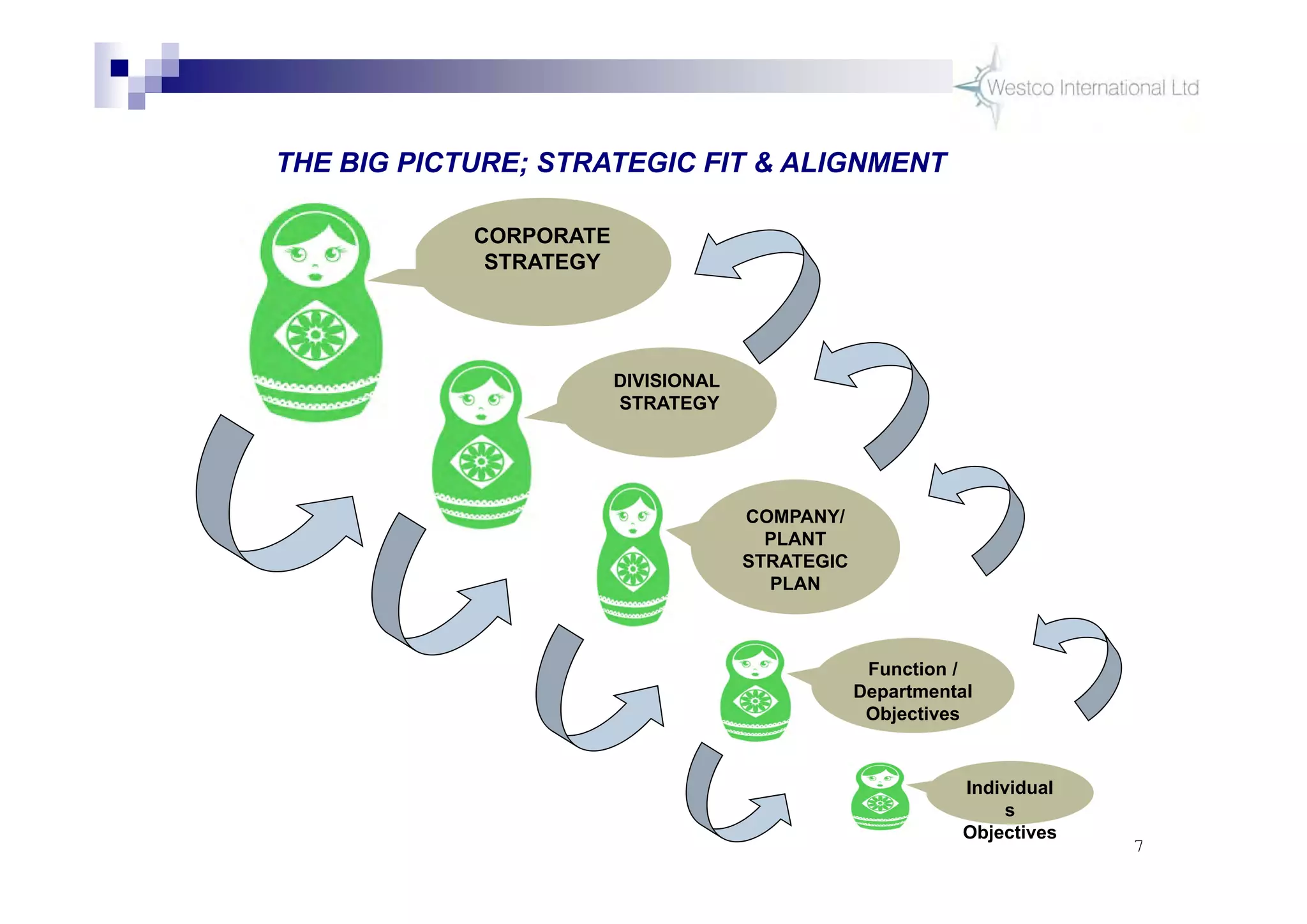
CORPORATE
STRATEGY
DIVISIONAL
STRATEGY
COMPANY/
PLANT
STRATEGIC
PLAN
THE BIG PICTURE; STRATEGIC FIT & ALIGNMENT
Function /
Departmental
Objectives
Individual
s
Objectives
8
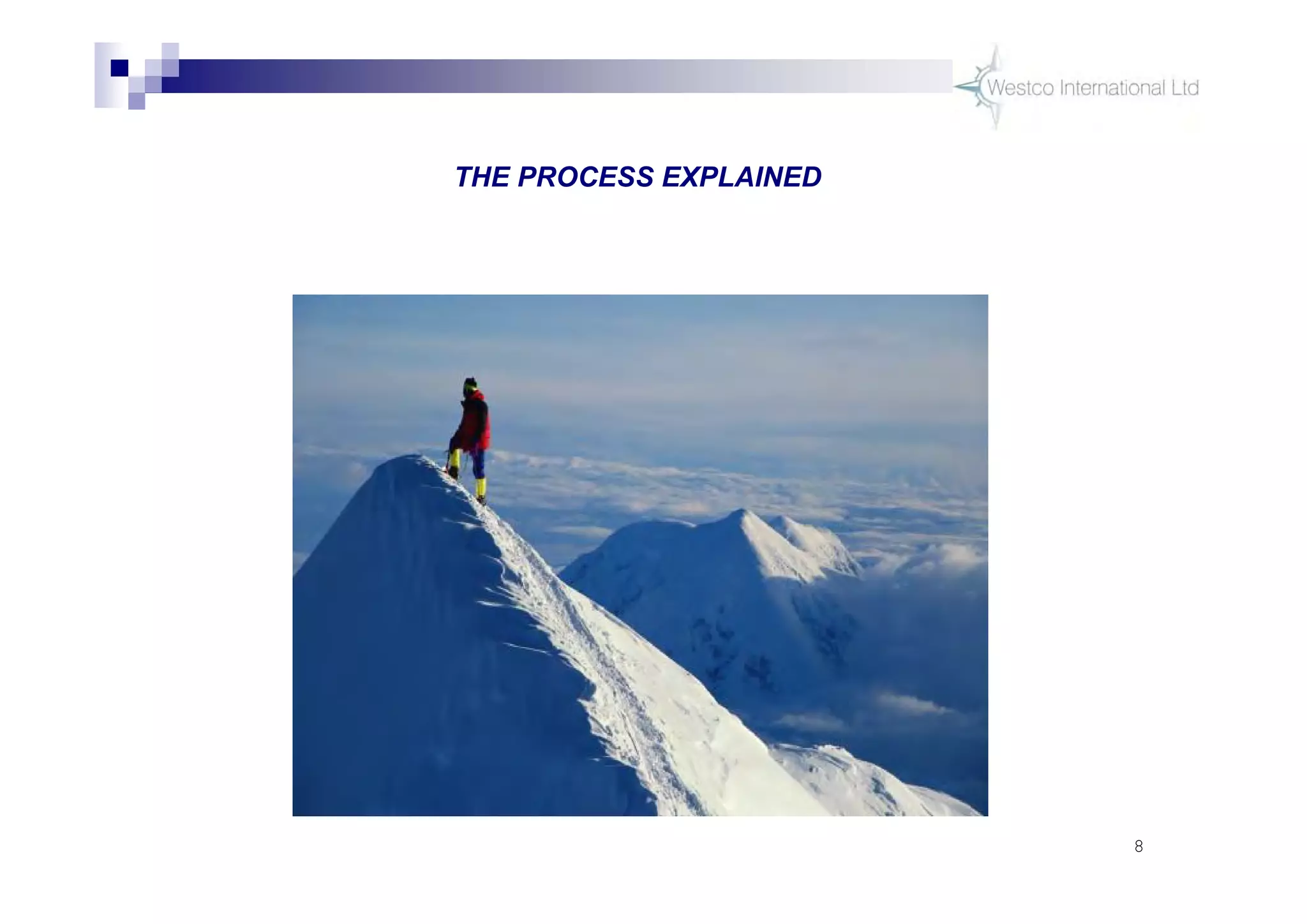
THE PROCESS EXPLAINED
9
Purpose
 To support the achievement of the business strategy through the alignment of all
employees, functions and divisions to the business goals
 To execute the strategic plan, identifying and focusing on the business critical issues
and deselecting non essential activities.
 To achieve ownership, focus, direction and commitment through the involvement of
everyone
The Foundation Stone
 W Edwards Deming’s PLAN, DO, CHECK, ACT (P.D.C.A.) cycle is at the heart of
Policy (Strategy) Deployment.
(The planning normally gets done well but the Do, Check and Act don't!)
WHAT IS IT ALL ABOUT?
10
POLICY DEPLOYMENT ISSUES
Because;
• It is dealing with a multitude of complex issues.
• It addresses the many conflicting goals which can arise between functions.
• It puts people and culture centre stage.
However, once mastered, the benefits are significant and include;
• It aligns people and actions to the true “North Star”
• It generates synergies via teamwork.
• It helps each part of the organisation become aware of the effect of its own actions on
every other part.
• Cross functional learning is fast tracked.
• It builds confidence in the plan knowing every facet has been empirically considered.
• It identifies and prioritises the business critical issues and deselects the unimportant.
POLICY DEPLOYMENT IS THE PIECE THAT
IS THE MOST DIFFICULT TO MASTER;
11
 We assemble the entire top team. This must include all the people that contribute to
the business performance : Engineering, Sales, Marketing, Divisional Heads,
Production, Purchasing, Legal, Finance, HR, IT, Logistics, etc.
 The first analysis is focused entirely on what the customer
really, really wants. (which may be different from what we think he wants!)
 We must insist on reality
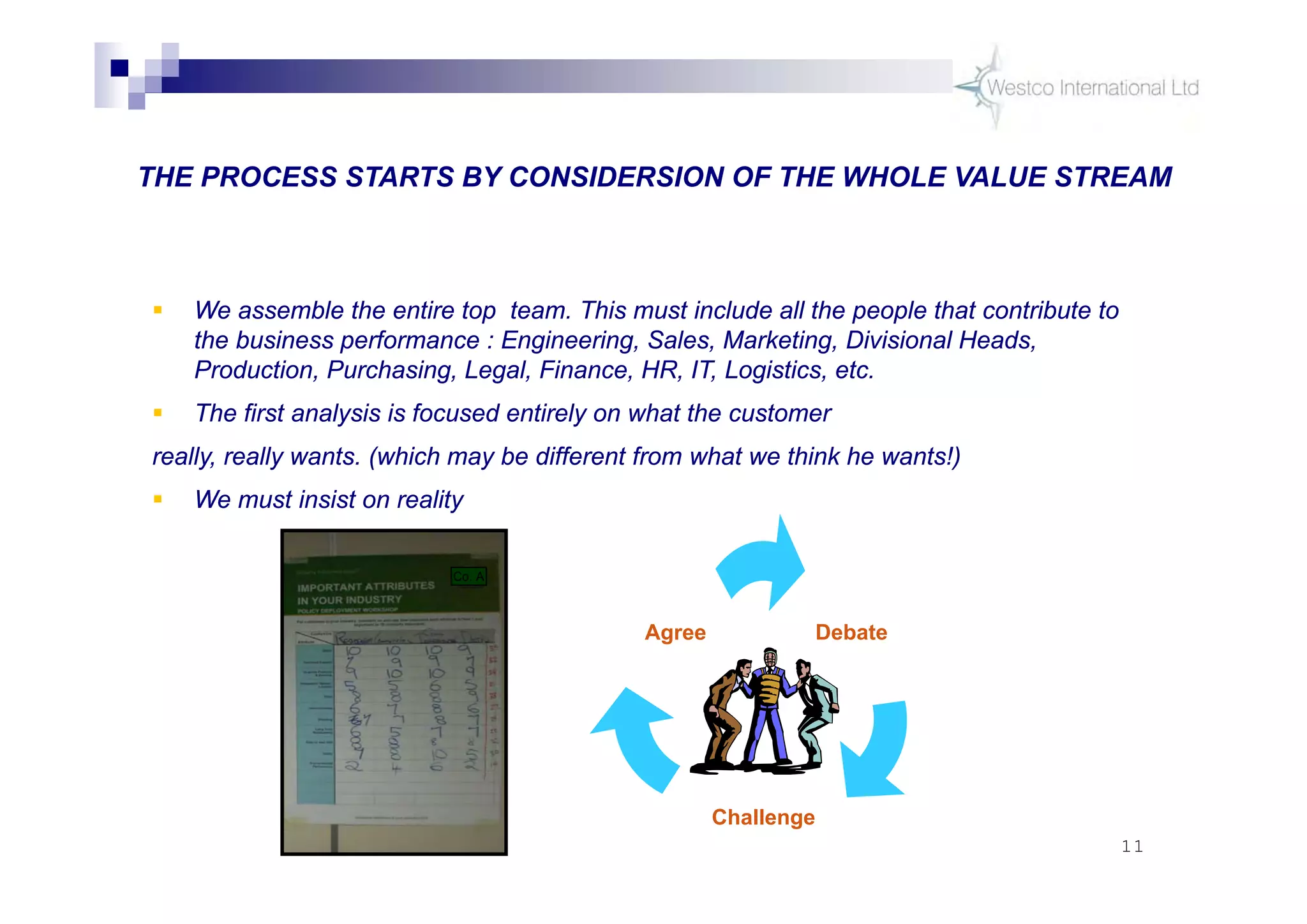
Agree Debate
Challenge
THE PROCESS STARTS BY CONSIDERSION OF THE WHOLE VALUE STREAM
Co. A
12
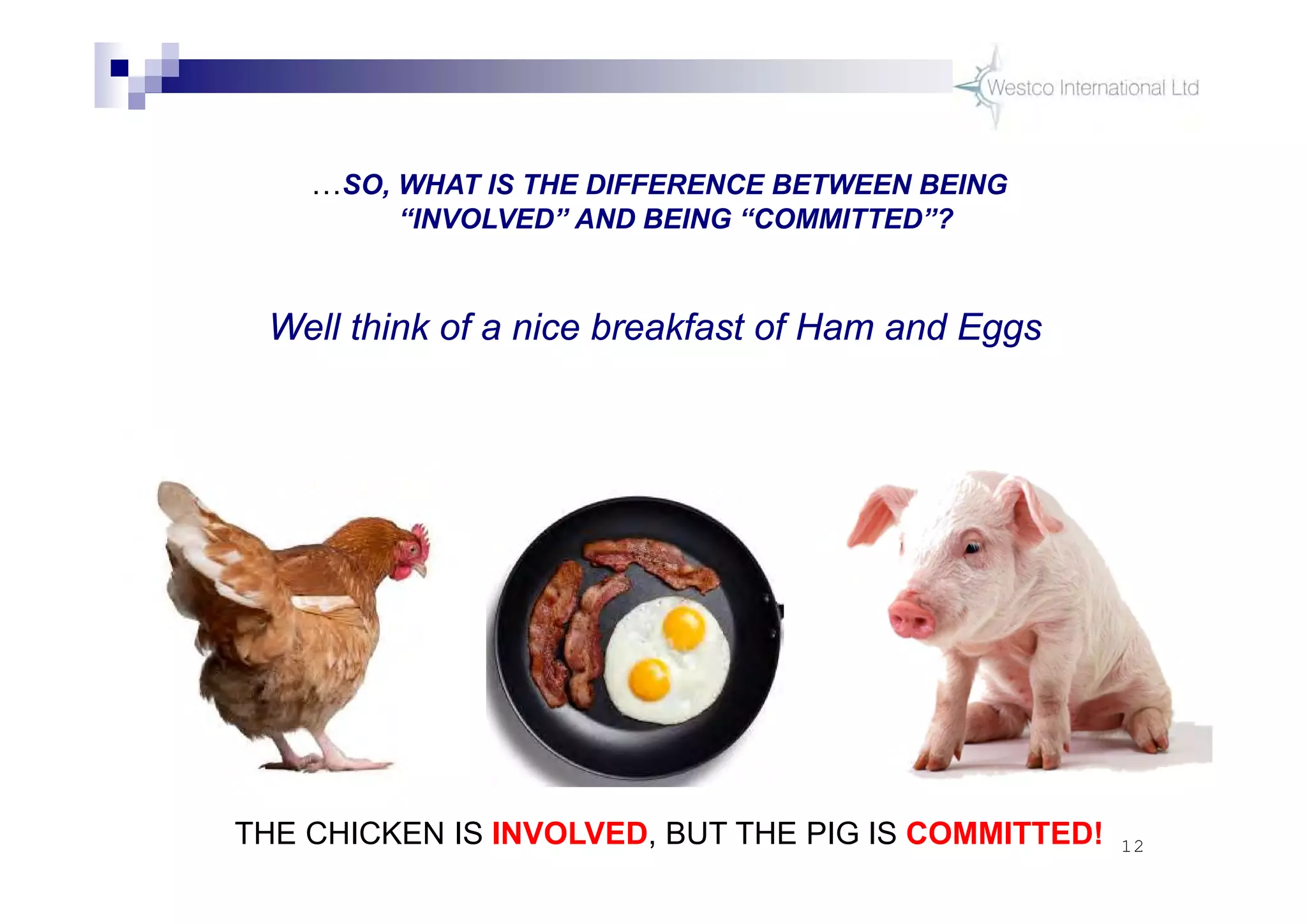
…SO, WHAT IS THE DIFFERENCE BETWEEN BEING
“INVOLVED” AND BEING “COMMITTED”?
Well think of a nice breakfast of Ham and Eggs
THE CHICKEN IS INVOLVED, BUT THE PIG IS COMMITTED!
13
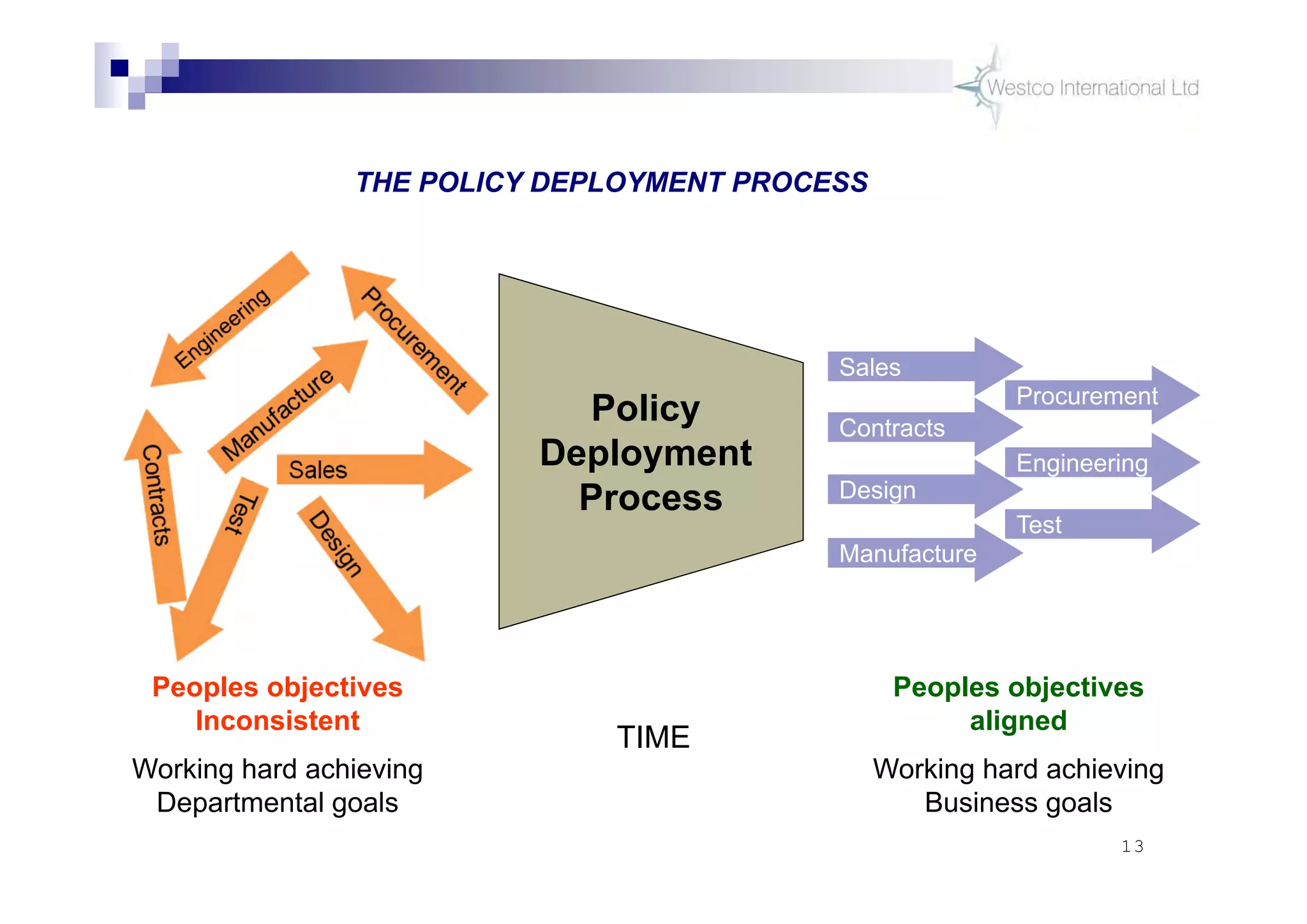
TIME
Procurement
Engineering
Manufacture
Design
Contracts
Sales
Test
Peoples objectives
Inconsistent
Working hard achieving
Departmental goals
Peoples objectives
aligned
Working hard achieving
Business goals
Policy
Deployment
Process
THE POLICY DEPLOYMENT PROCESS
14
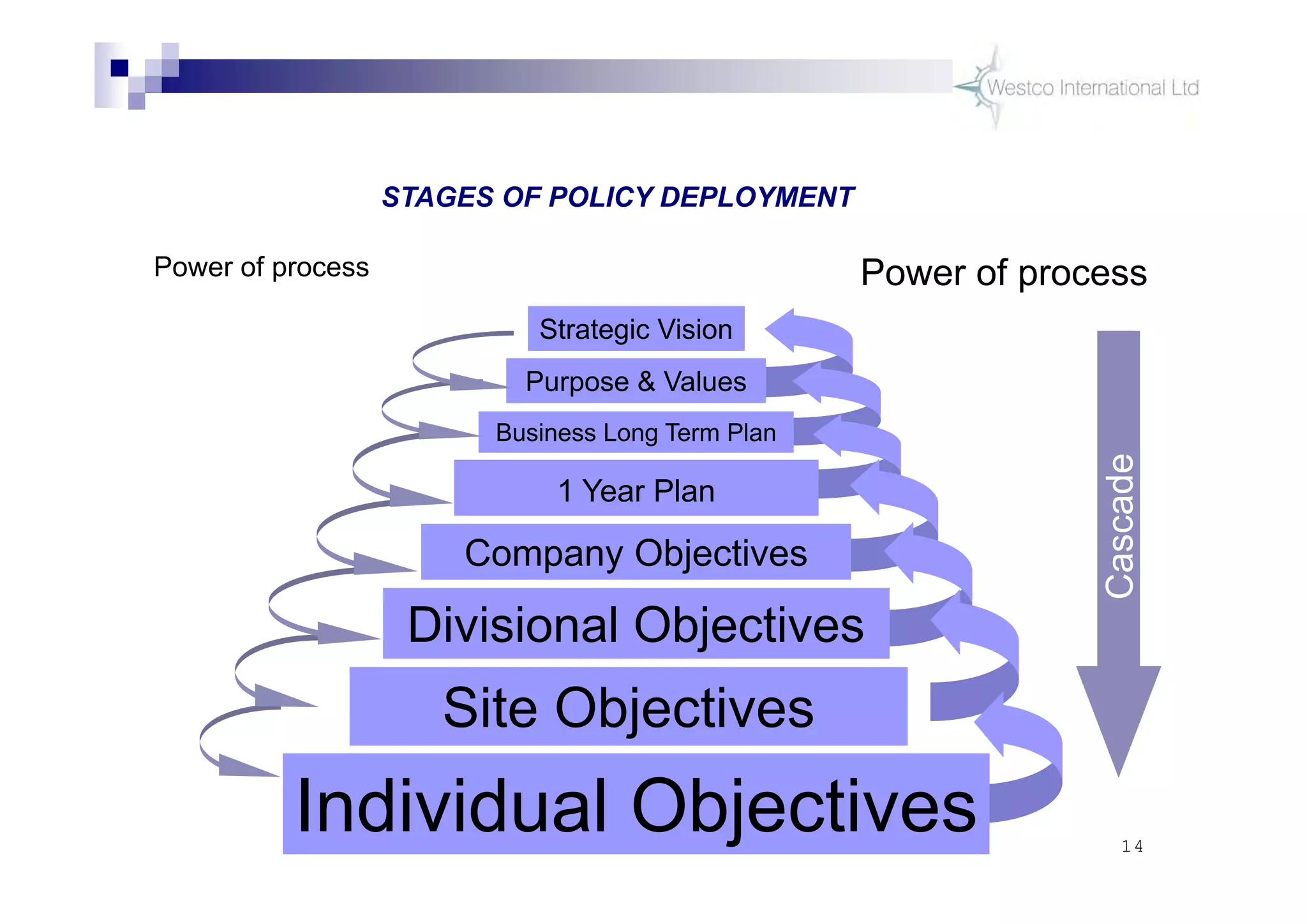
Business Long Term Plan
1 Year Plan
Company Objectives
Divisional Objectives
Site Objectives
Individual Objectives
Purpose & Values
Strategic Vision
Cascade
Power of processPower of process
STAGES OF POLICY DEPLOYMENT
15
THE MOST ADMIRED COMPANIES;
What do they do? How do they do it? What do they measure?
16
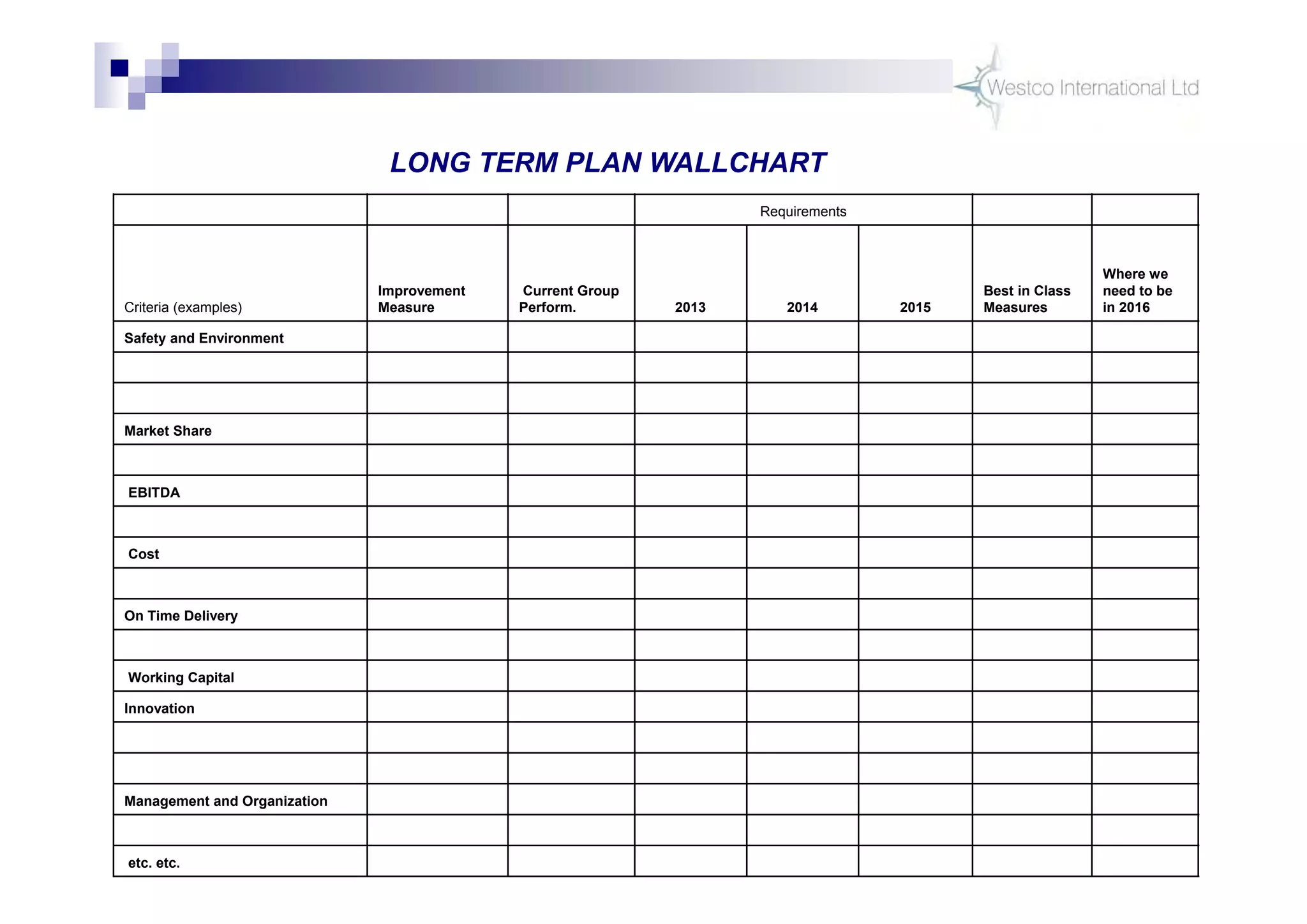
Requirements
Criteria (examples)
Improvement
Measure
Current Group
Perform. 2013 2014 2015
Best in Class
Measures
Where we
need to be
in 2016
Safety and Environment
Market Share
EBITDA
Cost
On Time Delivery
Working Capital
Innovation
Management and Organization
etc. etc.
LONG TERM PLAN WALLCHART
17
Criteria
“Measures that matter”
Improvement Measure
Current Group
performance
Reqt. in
2013 Gap Statement
Safety & Environment LTIFR 2 1.5
The i care programme must be implemented across all sites by end
2012. We must eliminate all accidents on the front line and back offices.
The root causes of muscular stress need to be determined
Internal auditing 5 issues 2 issues
We should strive to obtain ISO 18001 in year 1.
We should record all scrap and disposal bin details
Green house gas
emissions 3.2 2.9 Evaluate alternative fuels
PIN 5 2 Dust controls required
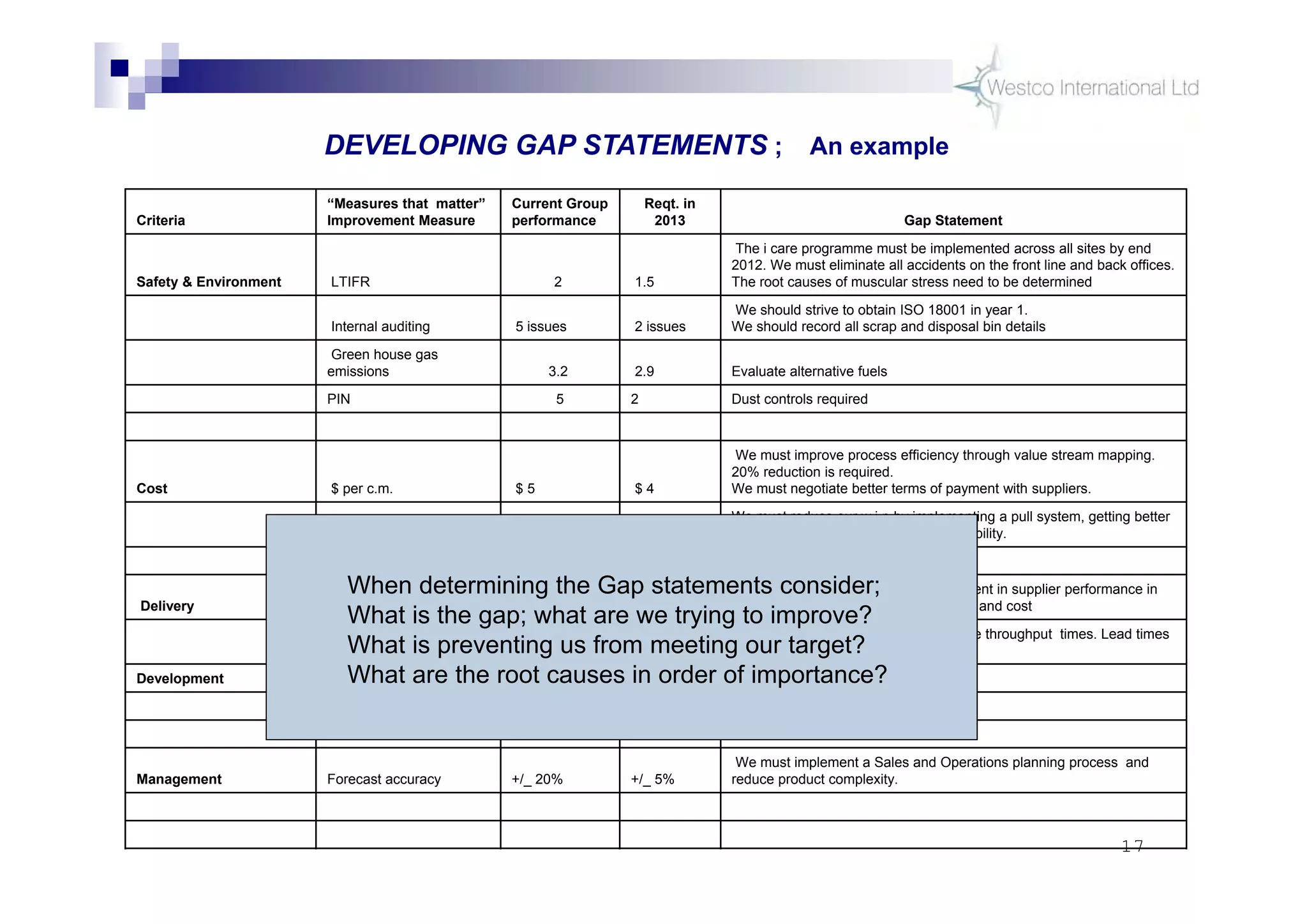
Cost $ per c.m. $ 5 $ 4
We must improve process efficiency through value stream mapping.
20% reduction is required.
We must negotiate better terms of payment with suppliers.
Cash Generation $750k $1.5m
We must reduce our w.i.p by implementing a pull system, getting better
ontrol of suppliers and forecasting capability.
Delivery DIFOT 78% 95%
We must achieve significant improvement in supplier performance in
support of our requirements for delivery and cost
Lead Time 9 hrs 2 hrs
We must improve our systems to reduce throughput times. Lead times
should be halved in 12 months.
Development
Management Forecast accuracy +/_ 20% +/_ 5%
We must implement a Sales and Operations planning process and
reduce product complexity.
DEVELOPING GAP STATEMENTS ; An example
When determining the Gap statements consider;
What is the gap; what are we trying to improve?
What is preventing us from meeting our target?
What are the root causes in order of importance?
18
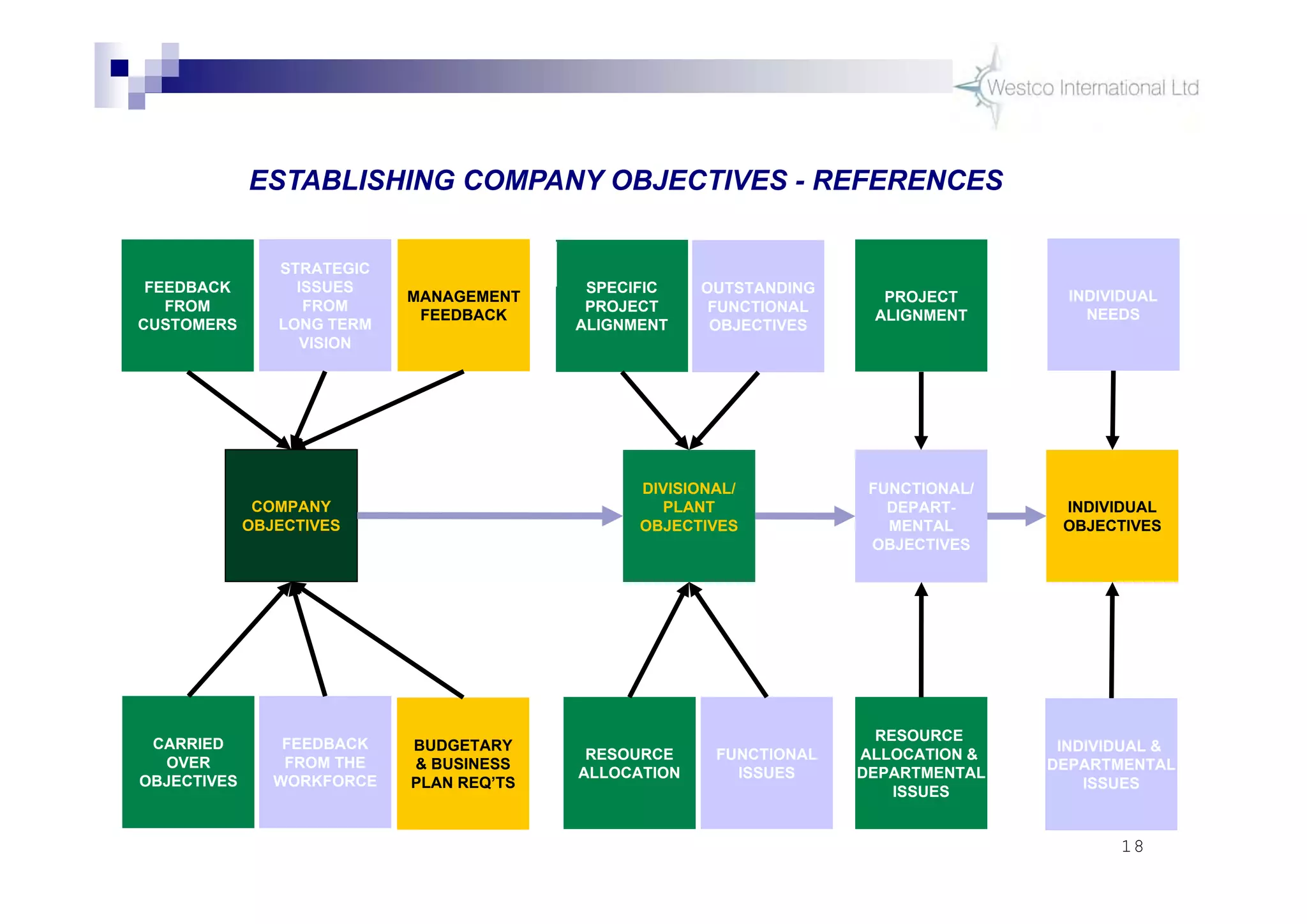
COMPANY
OBJECTIVES
FEEDBACK
FROM
CUSTOMERS
STRATEGIC
ISSUES
FROM
LONG TERM
VISION
MANAGEMENT
FEEDBACK
CARRIED
OVER
OBJECTIVES
FEEDBACK
FROM THE
WORKFORCE
BUDGETARY
& BUSINESS
PLAN REQ’TS
DIVISIONAL/
PLANT
OBJECTIVES
SPECIFIC
PROJECT
ALIGNMENT
OUTSTANDING
FUNCTIONAL
OBJECTIVES
RESOURCE
ALLOCATION
FUNCTIONAL
ISSUES
FUNCTIONAL/
DEPART-
MENTAL
OBJECTIVES
PROJECT
ALIGNMENT
RESOURCE
ALLOCATION &
DEPARTMENTAL
ISSUES
INDIVIDUAL
OBJECTIVES
INDIVIDUAL
NEEDS
INDIVIDUAL &
DEPARTMENTAL
ISSUES
ESTABLISHING COMPANY OBJECTIVES - REFERENCES
19
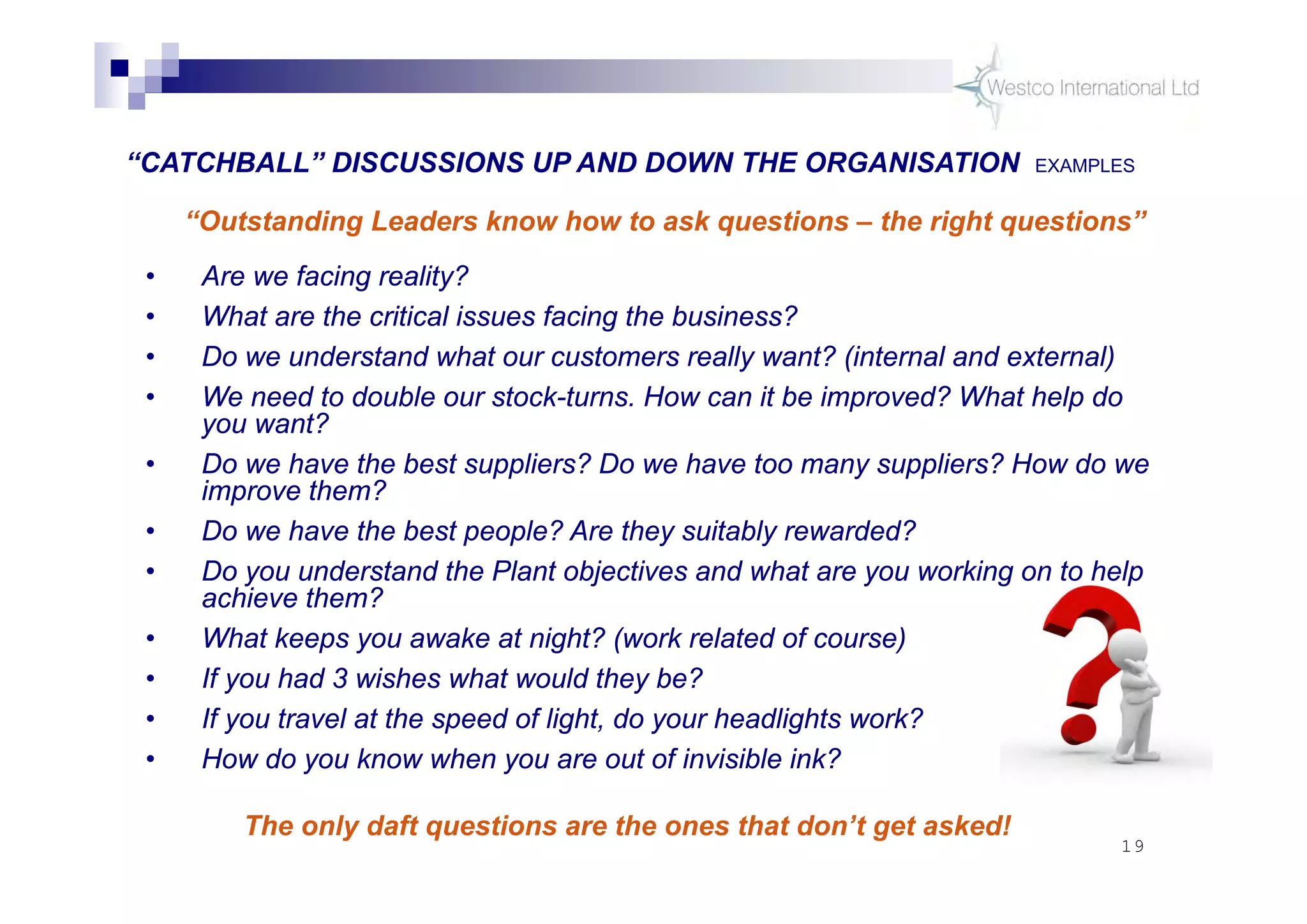
The only daft questions are the ones that don’t get asked!
• Are we facing reality?
• What are the critical issues facing the business?
• Do we understand what our customers really want? (internal and external)
• We need to double our stock-turns. How can it be improved? What help do
you want?
• Do we have the best suppliers? Do we have too many suppliers? How do we
improve them?
• Do we have the best people? Are they suitably rewarded?
• Do you understand the Plant objectives and what are you working on to help
achieve them?
• What keeps you awake at night? (work related of course)
• If you had 3 wishes what would they be?
• If you travel at the speed of light, do your headlights work?
• How do you know when you are out of invisible ink?
“CATCHBALL” DISCUSSIONS UP AND DOWN THE ORGANISATION EXAMPLES
“Outstanding Leaders know how to ask questions – the right questions”
20
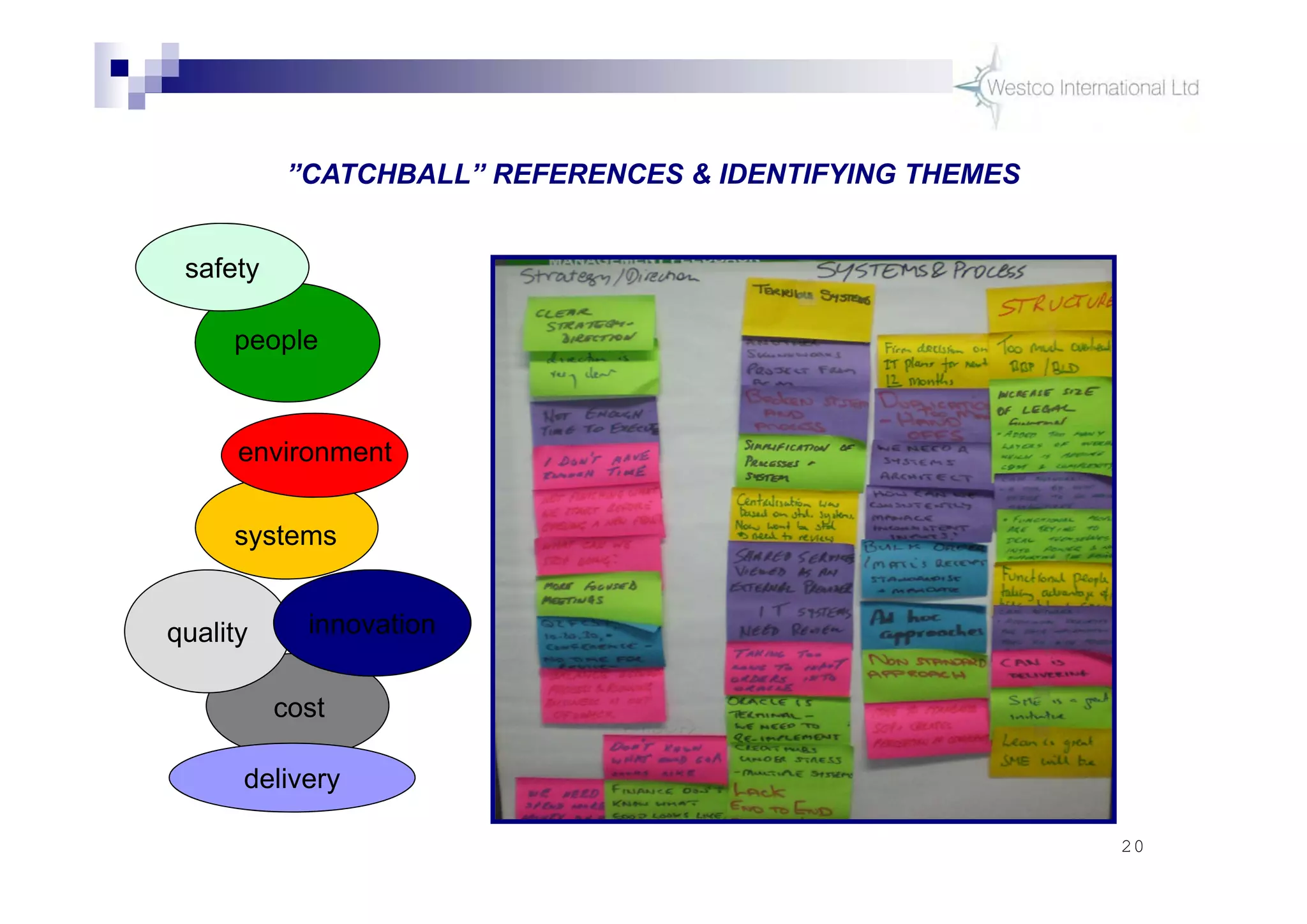
people
systems
cost
quality
safety
environment
delivery
innovation
”CATCHBALL” REFERENCES & IDENTIFYING THEMES
21
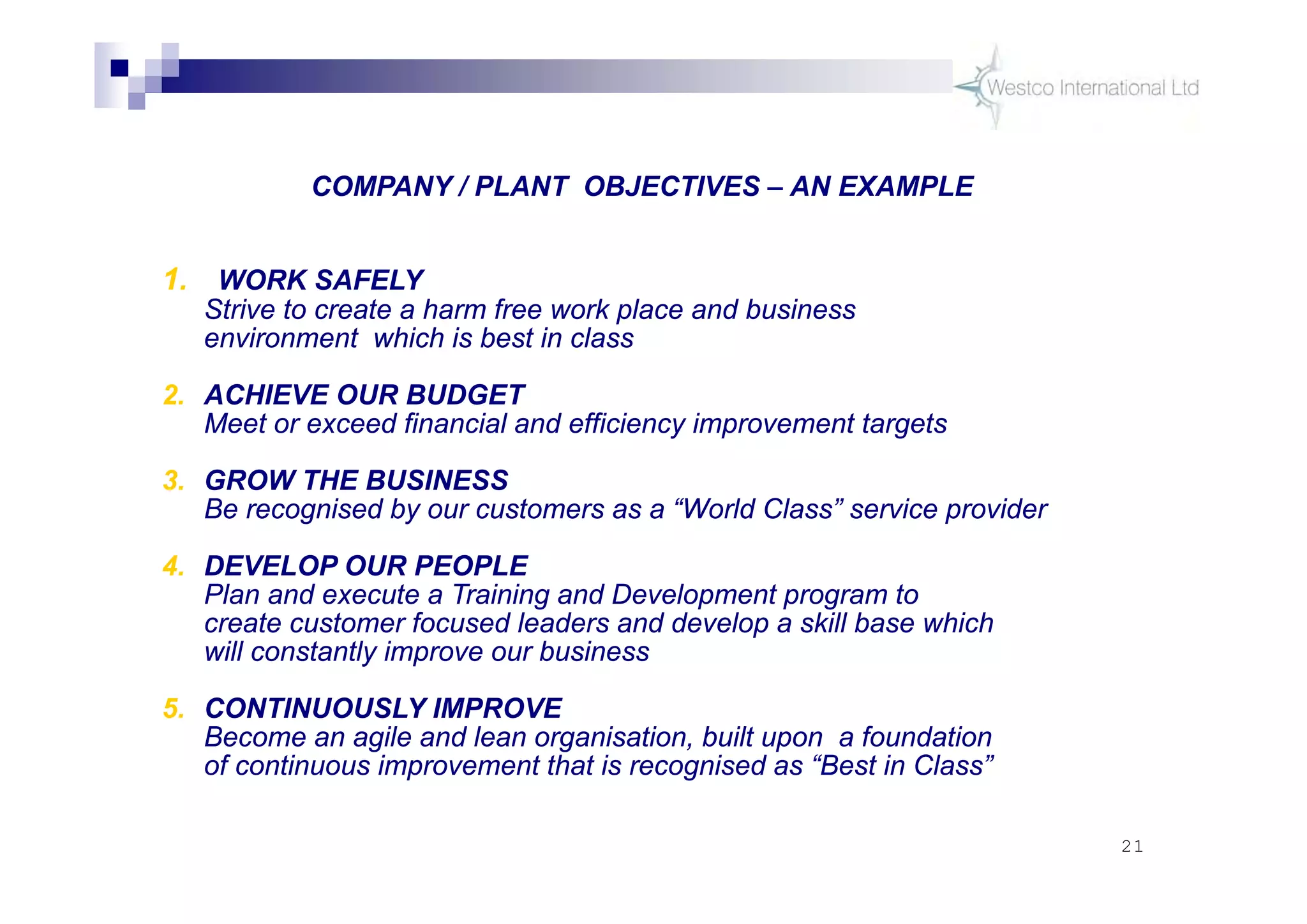
1. WORK SAFELY
Strive to create a harm free work place and business
environment which is best in class
2. ACHIEVE OUR BUDGET
Meet or exceed financial and efficiency improvement targets
3. GROW THE BUSINESS
Be recognised by our customers as a “World Class” service provider
4. DEVELOP OUR PEOPLE
Plan and execute a Training and Development program to
create customer focused leaders and develop a skill base which
will constantly improve our business
5. CONTINUOUSLY IMPROVE
Become an agile and lean organisation, built upon a foundation
of continuous improvement that is recognised as “Best in Class”
COMPANY / PLANT OBJECTIVES – AN EXAMPLE
22
THE OBJECTIVES MUST BE “SMART”
Specific
Measurable
Agreed/Achievable
Realistic
Time related
TESTING THE OBJECTIVES
23
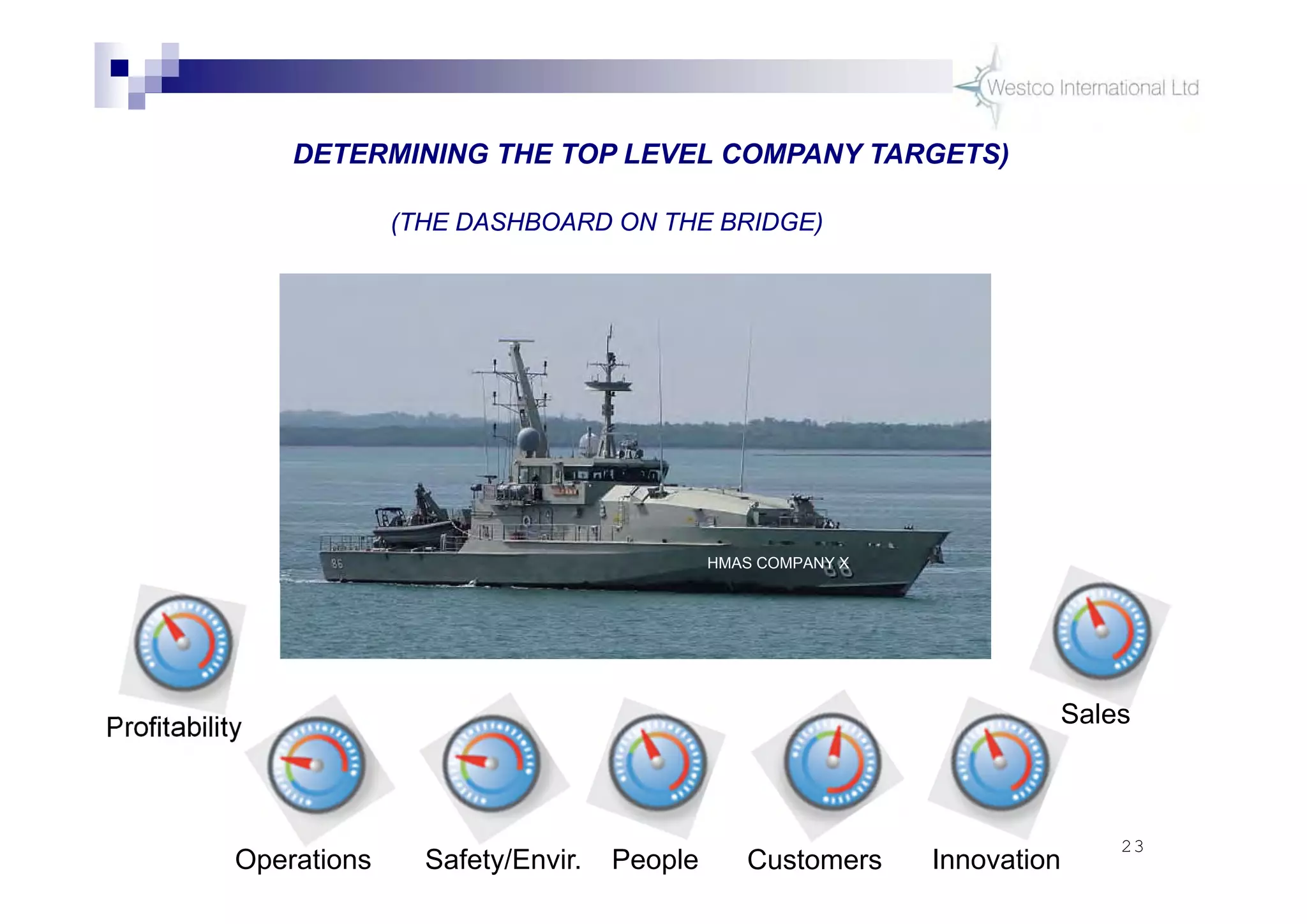
DETERMINING THE TOP LEVEL COMPANY TARGETS)
(THE DASHBOARD ON THE BRIDGE)
Profitability
Safety/Envir. People Customers InnovationOperations
HMAS COMPANY X
Sales
24
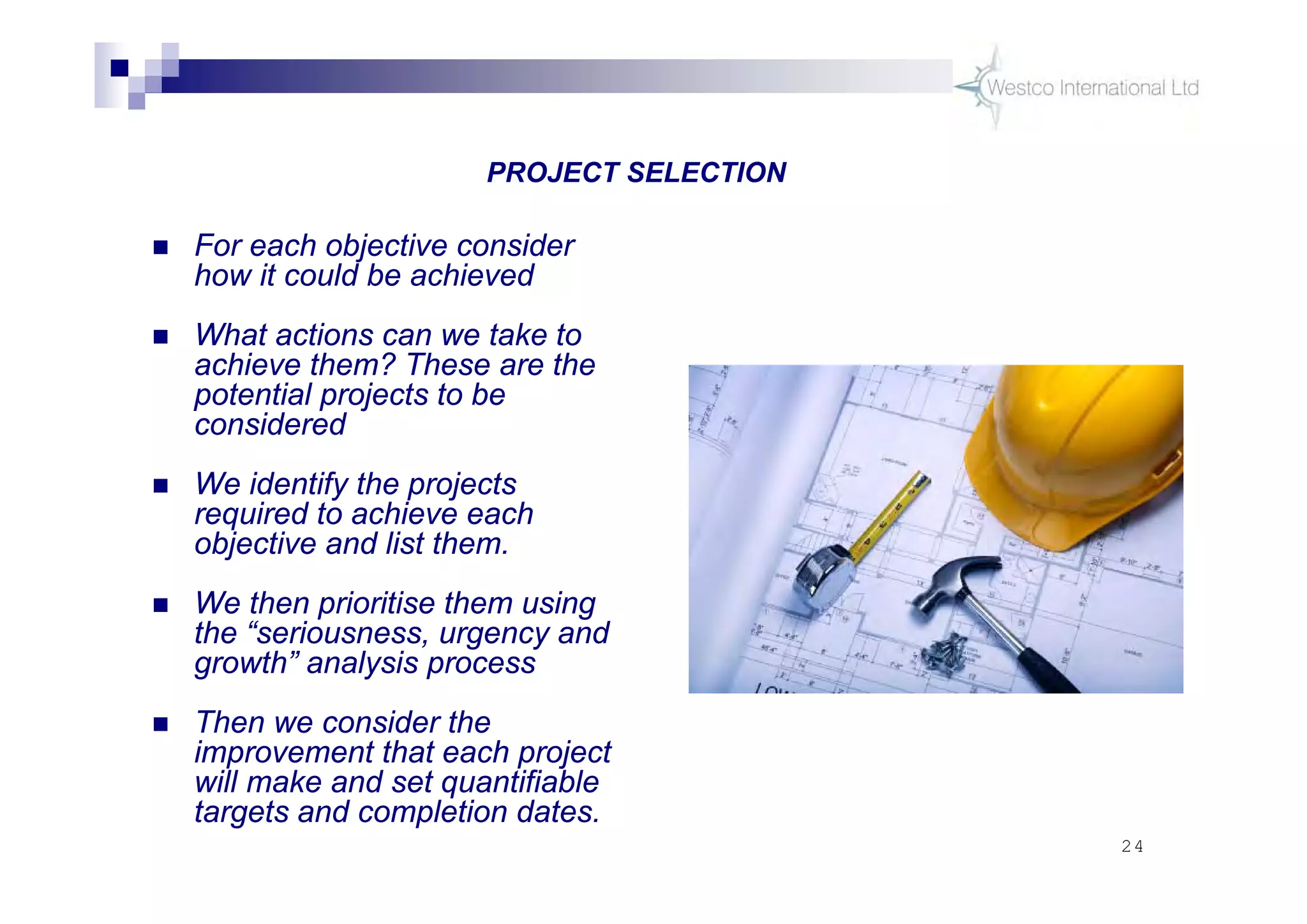
 For each objective consider
how it could be achieved
 What actions can we take to
achieve them? These are the
potential projects to be
considered
 We identify the projects
required to achieve each
objective and list them.
 We then prioritise them using
the “seriousness, urgency and
growth” analysis process
 Then we consider the
improvement that each project
will make and set quantifiable
targets and completion dates.
PROJECT SELECTION
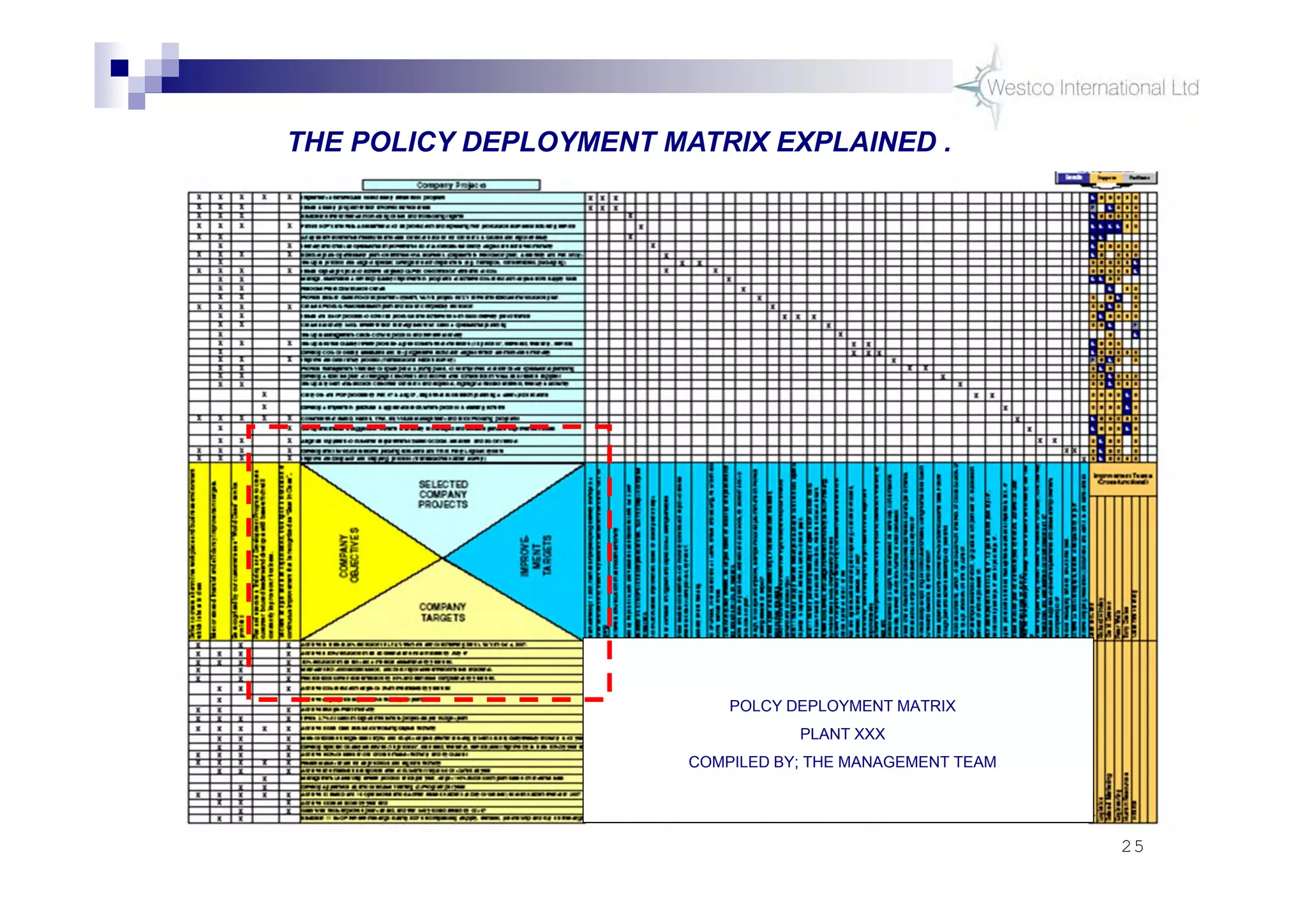
25
POLCY DEPLOYMENT MATRIX
PLANT XXX
COMPILED BY; THE MANAGEMENT TEAM
THE POLICY DEPLOYMENT MATRIX EXPLAINED .
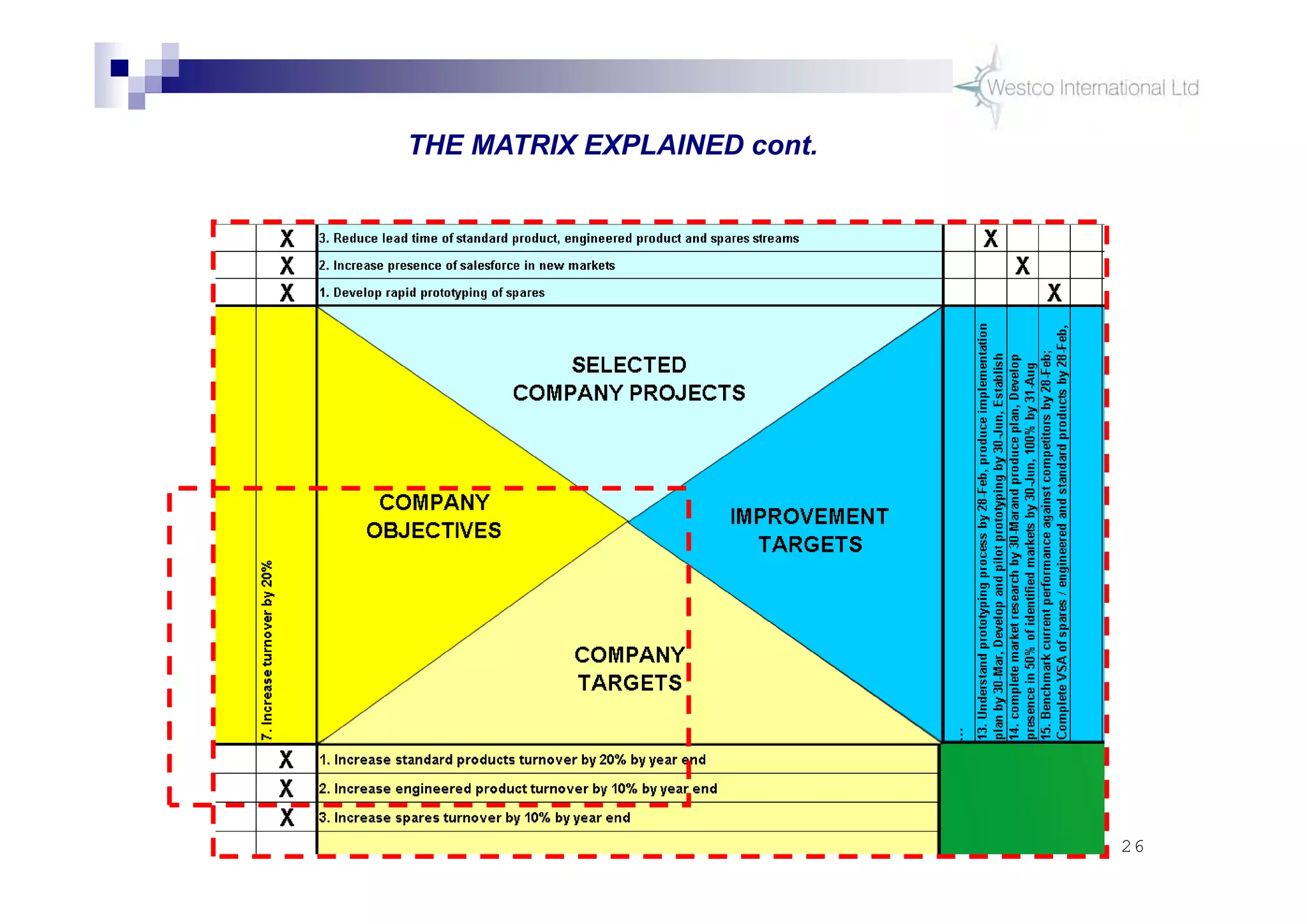
26
THE MATRIX EXPLAINED cont.
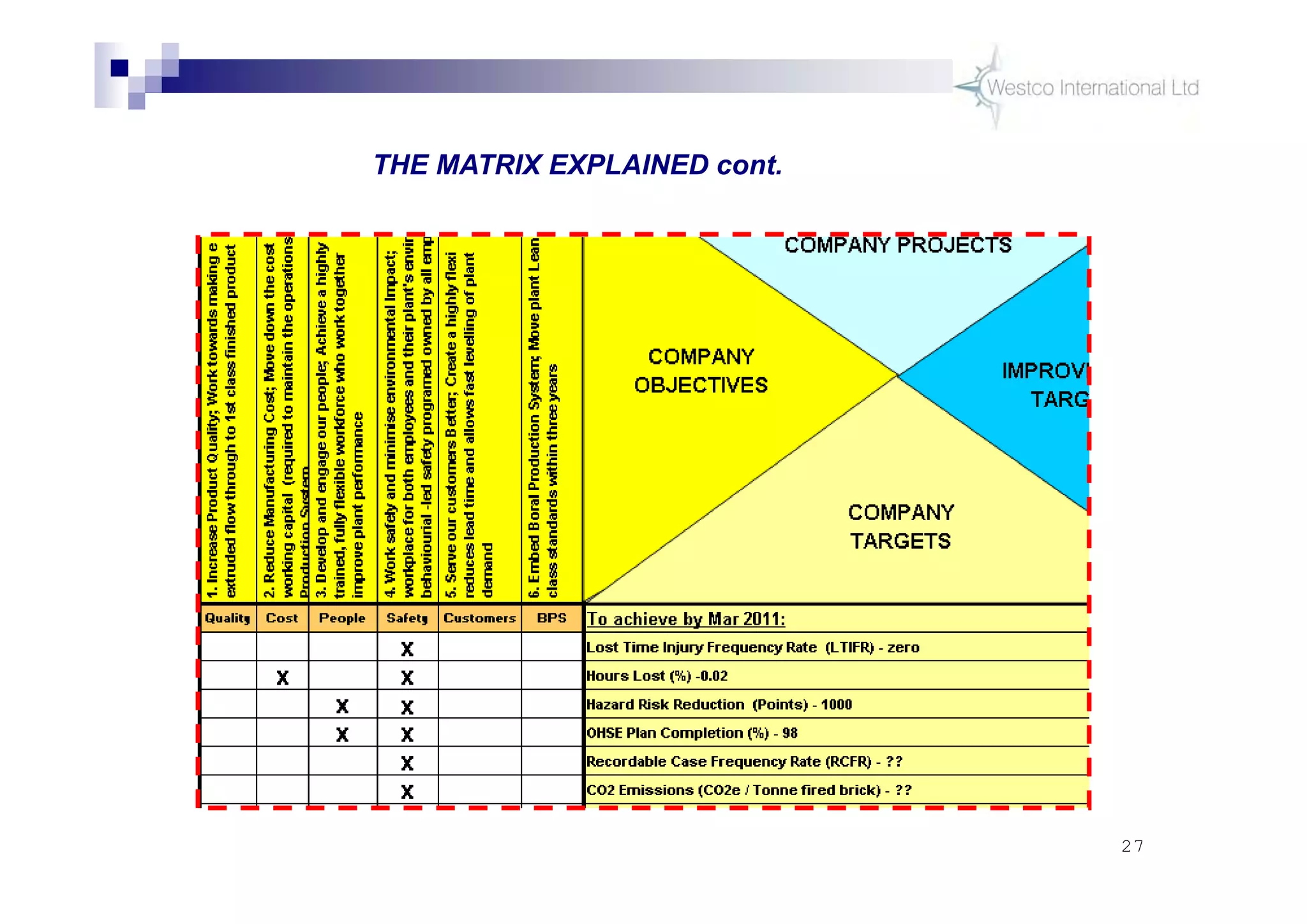
27
THE MATRIX EXPLAINED cont.
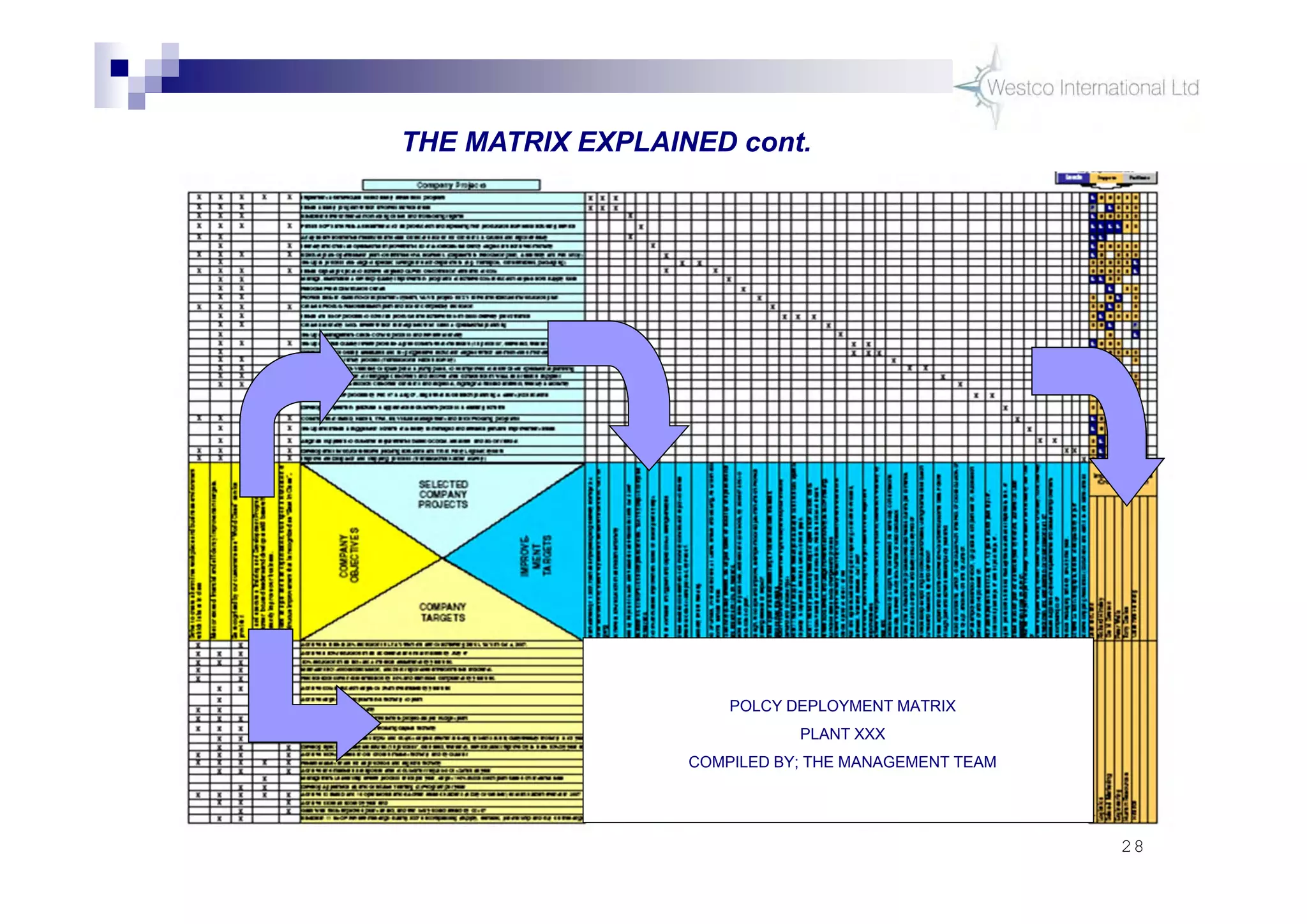
28
POLCY DEPLOYMENT MATRIX
PLANT XXX
COMPILED BY; THE MANAGEMENT TEAM
THE MATRIX EXPLAINED cont.
29
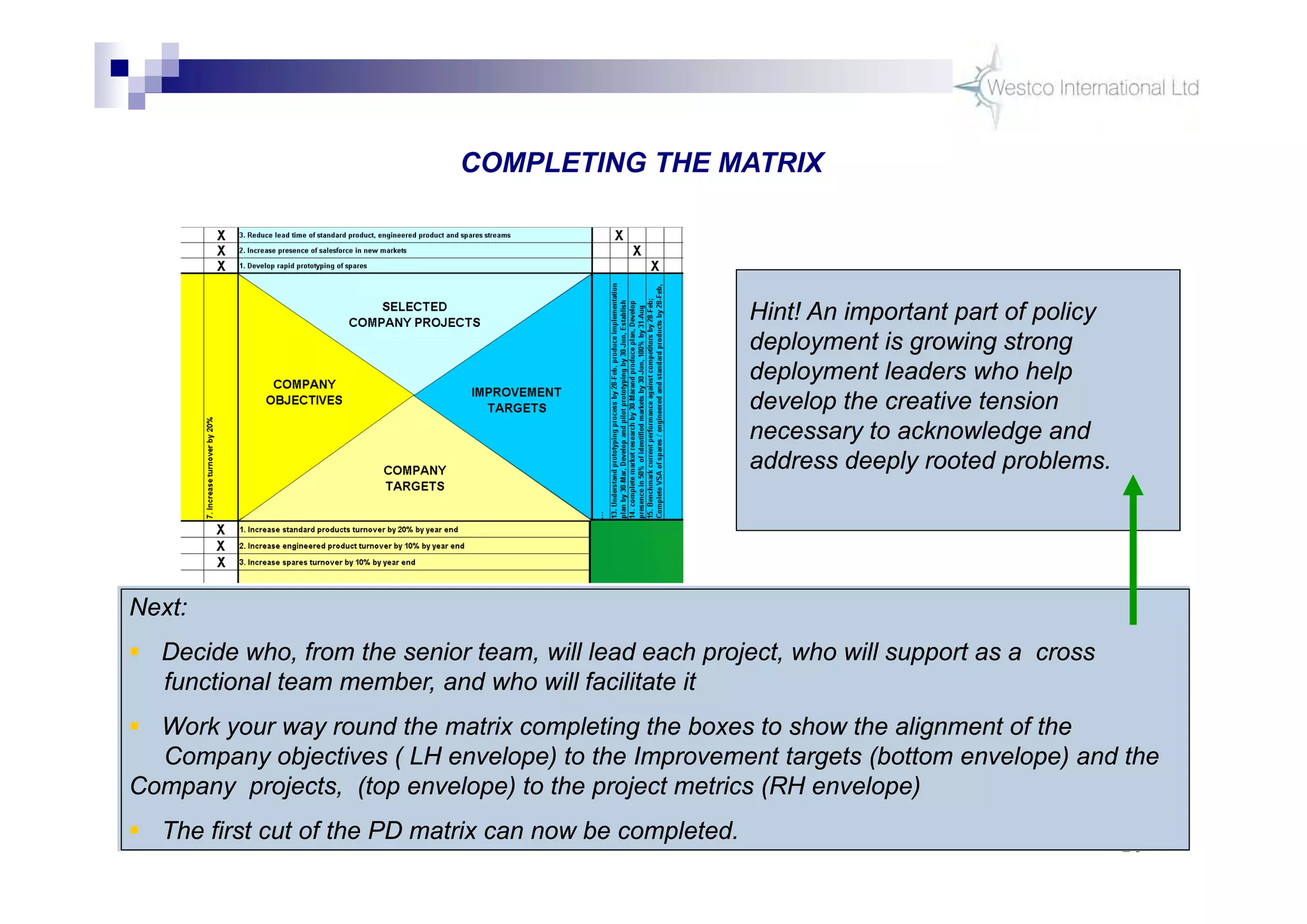
COMPLETING THE MATRIX
Next:
 Decide who, from the senior team, will lead each project, who will support as a cross
functional team member, and who will facilitate it
 Work your way round the matrix completing the boxes to show the alignment of the
Company objectives ( LH envelope) to the Improvement targets (bottom envelope) and the
Company projects, (top envelope) to the project metrics (RH envelope)
 The first cut of the PD matrix can now be completed.
Hint! An important part of policy
deployment is growing strong
deployment leaders who help
develop the creative tension
necessary to acknowledge and
address deeply rooted problems.
30 30
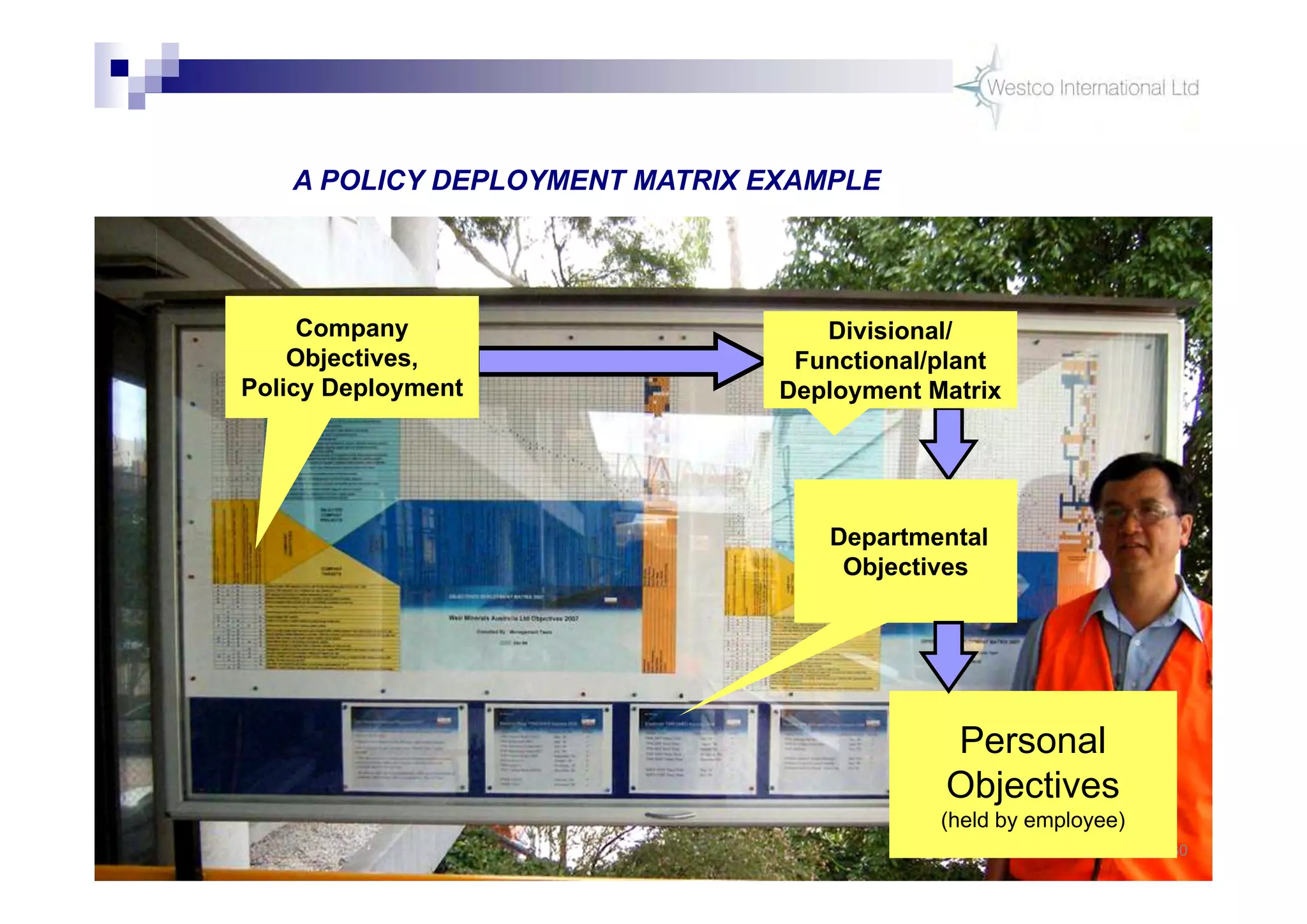
Departmental
Objectives
Personal
Objectives
(held by employee)
Company
Objectives,
Policy Deployment
Divisional/
Functional/plant
Deployment Matrix
A POLICY DEPLOYMENT MATRIX EXAMPLE
31
A CASE STUDY; BORAL LTD
32 32
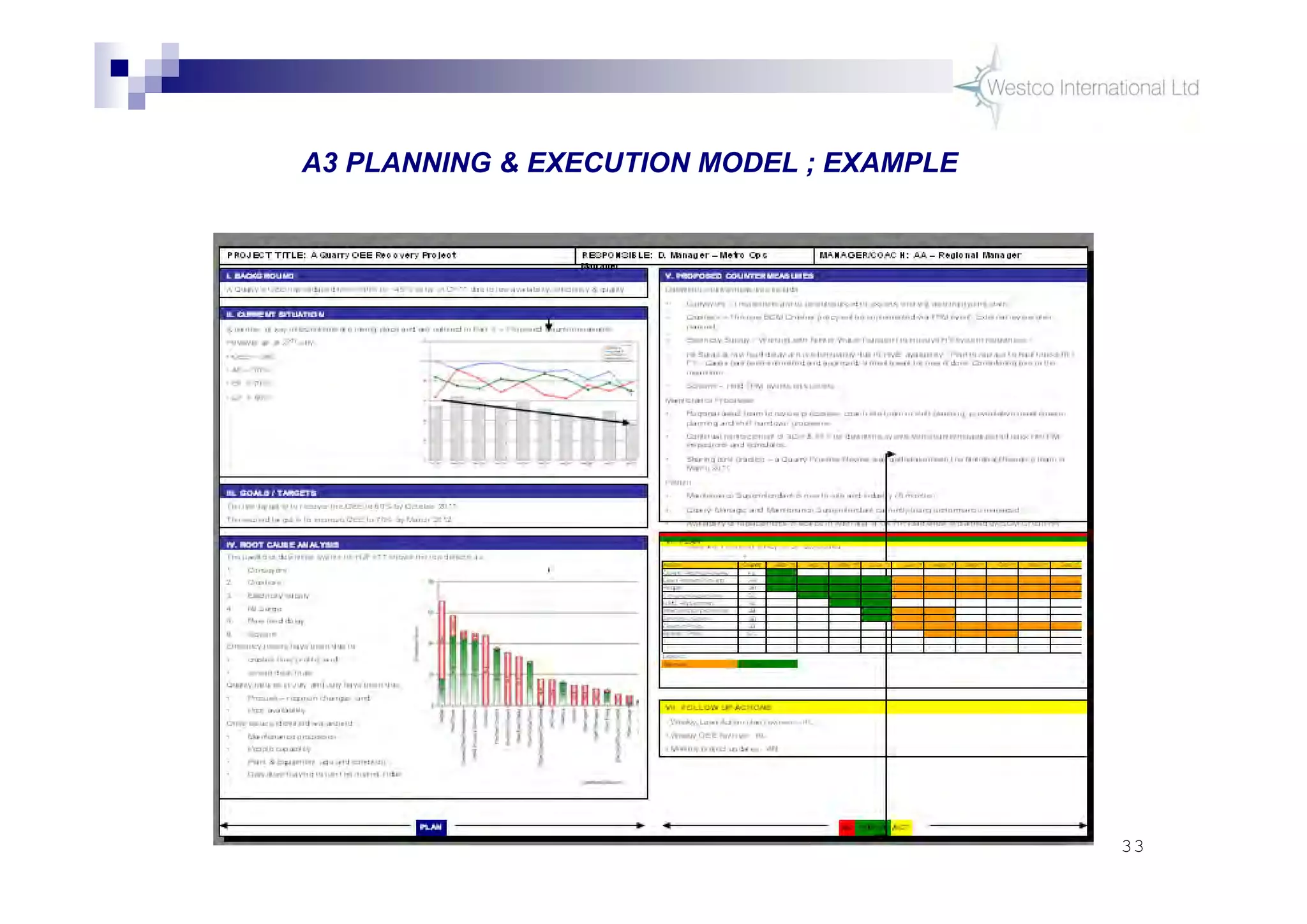
33
A3 PLANNING & EXECUTION MODEL ; EXAMPLE
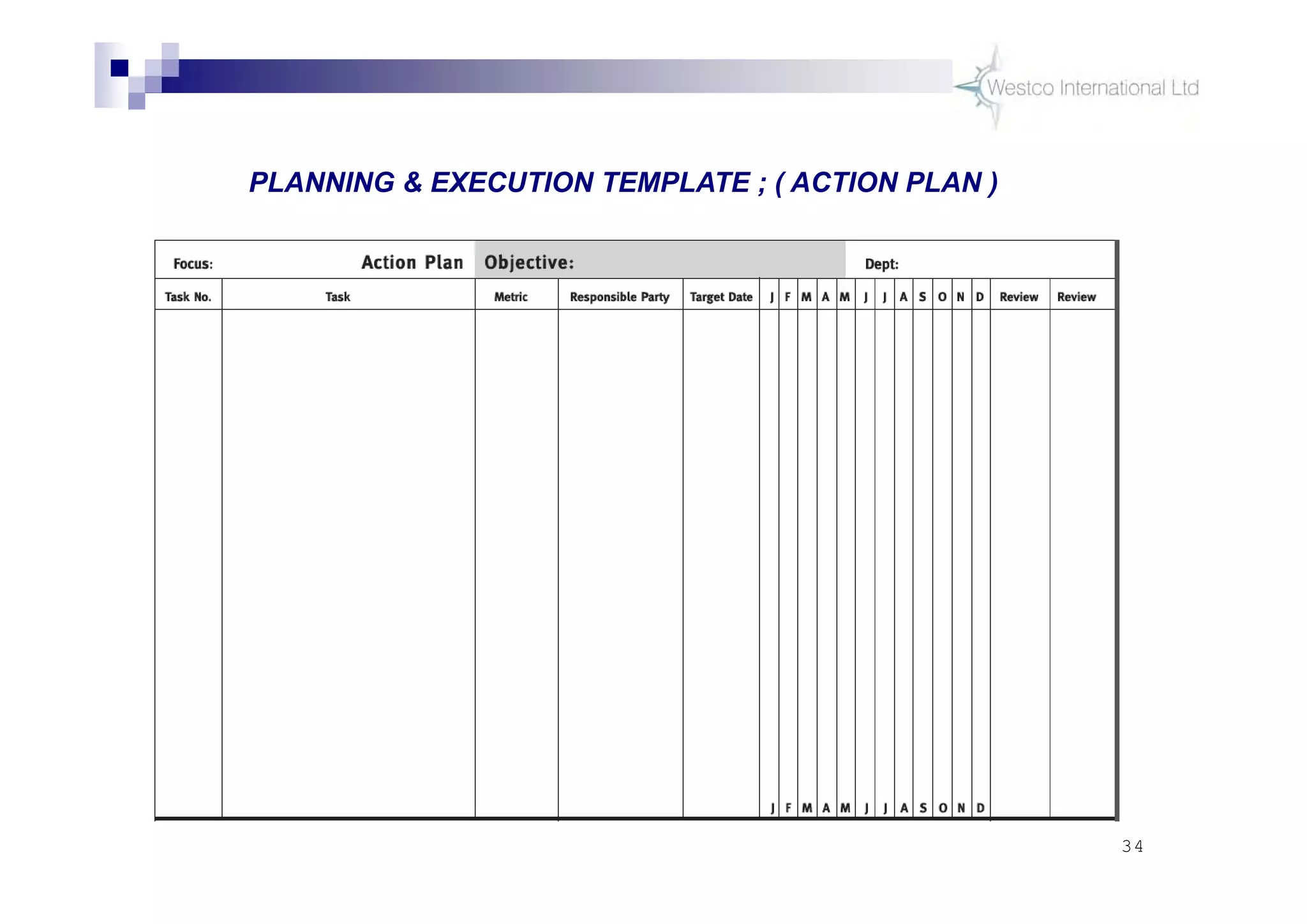
34
PLANNING & EXECUTION TEMPLATE ; ( ACTION PLAN )
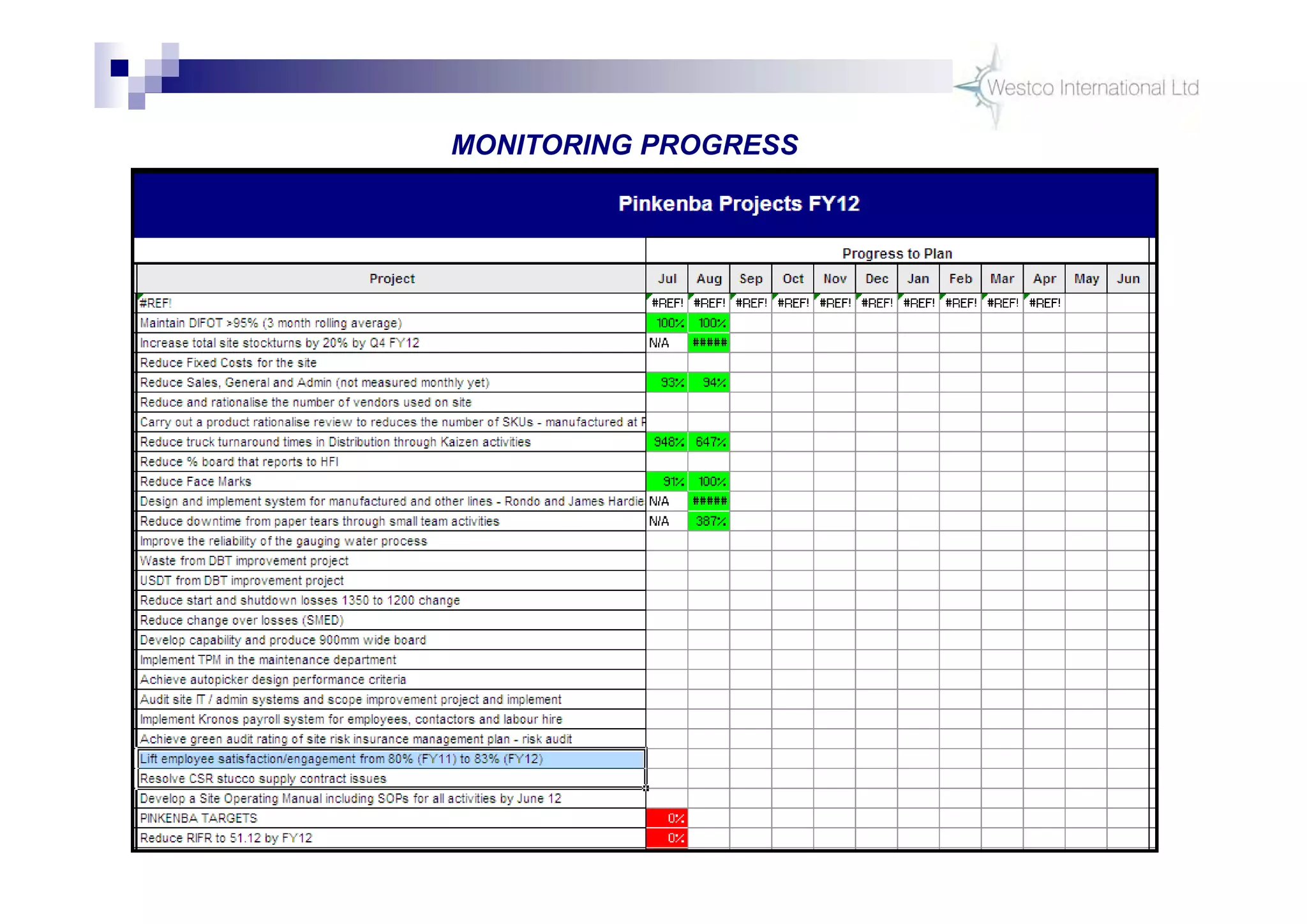
35
MONITORING PROGRESS
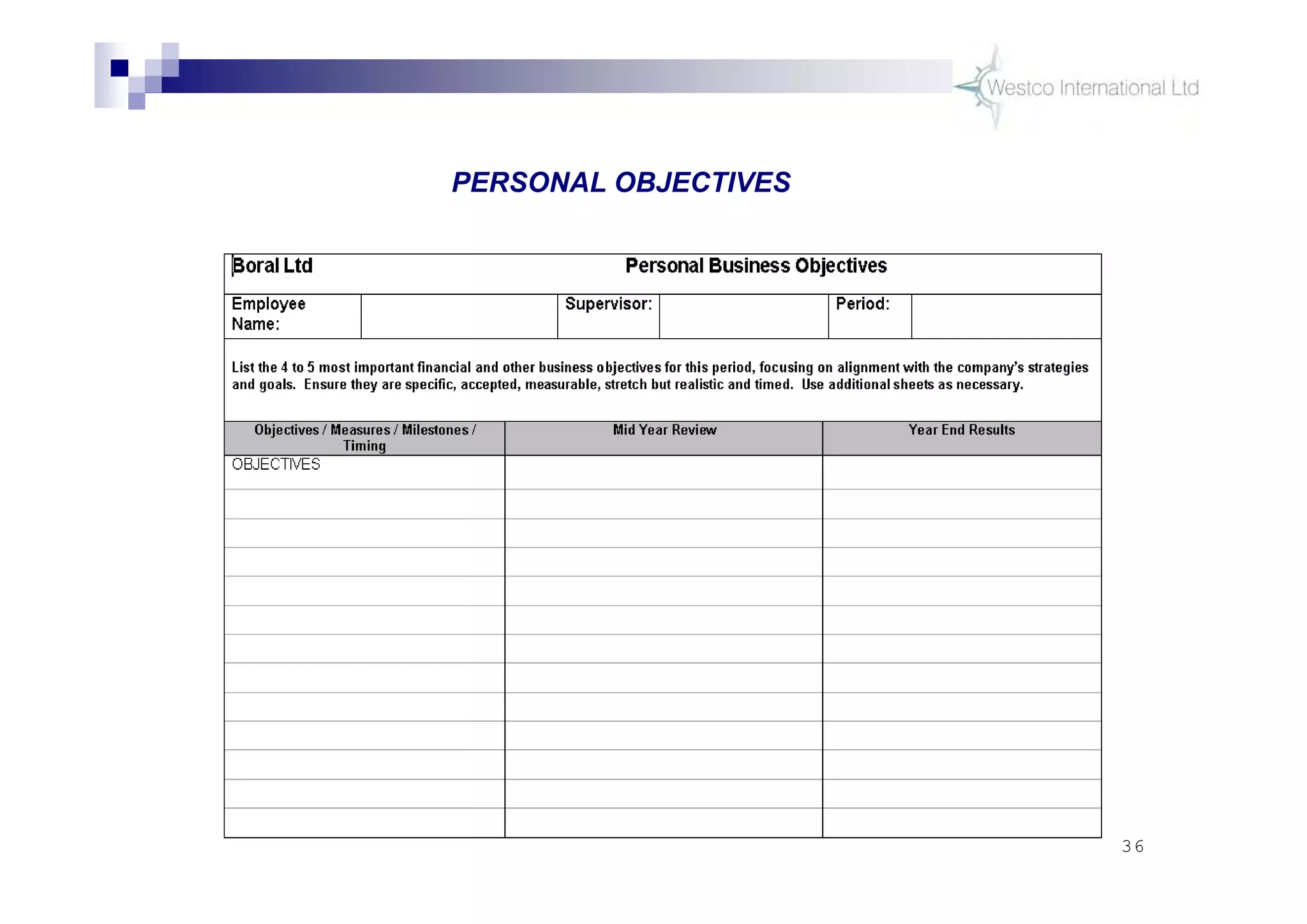
36
PERSONAL OBJECTIVES
37
THE END
THANK YOU FOR LISTENING.
Now the entire team can see the
complete landscape and not just the next
mountain.

Policy Deployment

  • 1.
    1 POLICY (STRATEGY) DEPLOYMENT Aproven process for strategy execution. HOW TO GET THE WHOLE TEAM ALIGNED AND MOVING IN THE SAME DIRECTION AT THE RIGHT SPEED
  • 2.
    2 PRESENTATION AGENDA 1. AFEW COMMENTS ON STRATEGY DEVELOPMENT. 2. THE POLICY DEPLOYMENT PROCESS EXPLAINED. 3. A CASE STUDY ; BORAL Ltd.
  • 3.
    3 WHAT IS STRATEGYALL ABOUT? STRATEGY EXPLAINS HOW AN ORGANISATION, FACED WITH COMPETITION, WILL ACHIEVE SUPERIOR PERFORMANCE. •WHAT VALUE WILL YOUR ORGANISATION CREATE? •HOW WILL YOUR ORGANISATION OFFER A UNIQUE PRODUCT OR SERVICE TO CUSTOMERS?
  • 4.
    4 THE ALIGNMENT OFCORPORATE, DIVISIONAL & SITE STRATEGIES The substance of Corporate strategy is summed up by its Building Blocks; the 6 or so key concepts and actions that define it. Corporate level strategy considers the allocation of resources among the business units. However it must not just be a sum of the parts. Collaboration should result in identifying opportunities which deliver synergies. What mix will make the best sustainable return on the company’s capital? The basic goal then, of the Corporate strategy is to deliver ultimate value to customers, winning their preference and creating a sustainable competitive advantage which in turn delivers shareholder value.
  • 5.
    5 Research consistently identifiesreasons for failure include: 1. People cannot implement what they do not know. 2. People do not implement properly what they do not understand. 3. People do not implement what they are not committed to. 4. People give up on a strategy, the implications of which, have not been anticipated and thought through. 5. Management overlook the importance of the “HOWS” of executing the strategy. WHY DO SOME BRILLIANT STRATEGIES FAIL? “Policy deployment will help Management identify and practically manage the implementation of a strategy of the Company’s products, markets, customers, organisation structure, systems, processes, personnel and culture”
  • 6.
    6  The keyto success is to focus on doing the right things and getting the right results.  Problems in operations often originate in other functional areas. P.D. provides the means to cement all functions together by aligning objectives. (This is equally applicable to any process, in any industry wherever there is a customer)  There are so many things to do, we need to de-select some worthy initiatives!  It starts with correctly identifying the business critical issues.  Then it’s about developing the plan to resolve the issues and deliver the strategy.  Policy (strategy) Deployment keeps everyone focused on the real prize ; creating value for the customer. All our lean tools are means to this end and not ends in themselves.  Lean must be supported from the top of the organisation. Anything less will not be sustained. Policy Deployment directs people to do what they should do, rather than what they want to do by aligning all activities to the top level Strategic Vision THE LEAN CONNECTION What has Policy Deployment got to do with Lean and continuous improvement?
  • 7.
    7 CORPORATE STRATEGY DIVISIONAL STRATEGY COMPANY/ PLANT STRATEGIC PLAN THE BIG PICTURE;STRATEGIC FIT & ALIGNMENT Function / Departmental Objectives Individual s Objectives
  • 8.
  • 9.
    9 Purpose  To supportthe achievement of the business strategy through the alignment of all employees, functions and divisions to the business goals  To execute the strategic plan, identifying and focusing on the business critical issues and deselecting non essential activities.  To achieve ownership, focus, direction and commitment through the involvement of everyone The Foundation Stone  W Edwards Deming’s PLAN, DO, CHECK, ACT (P.D.C.A.) cycle is at the heart of Policy (Strategy) Deployment. (The planning normally gets done well but the Do, Check and Act don't!) WHAT IS IT ALL ABOUT?
  • 10.
    10 POLICY DEPLOYMENT ISSUES Because; •It is dealing with a multitude of complex issues. • It addresses the many conflicting goals which can arise between functions. • It puts people and culture centre stage. However, once mastered, the benefits are significant and include; • It aligns people and actions to the true “North Star” • It generates synergies via teamwork. • It helps each part of the organisation become aware of the effect of its own actions on every other part. • Cross functional learning is fast tracked. • It builds confidence in the plan knowing every facet has been empirically considered. • It identifies and prioritises the business critical issues and deselects the unimportant. POLICY DEPLOYMENT IS THE PIECE THAT IS THE MOST DIFFICULT TO MASTER;
  • 11.
    11  We assemblethe entire top team. This must include all the people that contribute to the business performance : Engineering, Sales, Marketing, Divisional Heads, Production, Purchasing, Legal, Finance, HR, IT, Logistics, etc.  The first analysis is focused entirely on what the customer really, really wants. (which may be different from what we think he wants!)  We must insist on reality Agree Debate Challenge THE PROCESS STARTS BY CONSIDERSION OF THE WHOLE VALUE STREAM Co. A
  • 12.
    12 …SO, WHAT ISTHE DIFFERENCE BETWEEN BEING “INVOLVED” AND BEING “COMMITTED”? Well think of a nice breakfast of Ham and Eggs THE CHICKEN IS INVOLVED, BUT THE PIG IS COMMITTED!
  • 13.
    13 TIME Procurement Engineering Manufacture Design Contracts Sales Test Peoples objectives Inconsistent Working hardachieving Departmental goals Peoples objectives aligned Working hard achieving Business goals Policy Deployment Process THE POLICY DEPLOYMENT PROCESS
  • 14.
    14 Business Long TermPlan 1 Year Plan Company Objectives Divisional Objectives Site Objectives Individual Objectives Purpose & Values Strategic Vision Cascade Power of processPower of process STAGES OF POLICY DEPLOYMENT
  • 15.
    15 THE MOST ADMIREDCOMPANIES; What do they do? How do they do it? What do they measure?
  • 16.
    16 Requirements Criteria (examples) Improvement Measure Current Group Perform.2013 2014 2015 Best in Class Measures Where we need to be in 2016 Safety and Environment Market Share EBITDA Cost On Time Delivery Working Capital Innovation Management and Organization etc. etc. LONG TERM PLAN WALLCHART
  • 17.
    17 Criteria “Measures that matter” ImprovementMeasure Current Group performance Reqt. in 2013 Gap Statement Safety & Environment LTIFR 2 1.5 The i care programme must be implemented across all sites by end 2012. We must eliminate all accidents on the front line and back offices. The root causes of muscular stress need to be determined Internal auditing 5 issues 2 issues We should strive to obtain ISO 18001 in year 1. We should record all scrap and disposal bin details Green house gas emissions 3.2 2.9 Evaluate alternative fuels PIN 5 2 Dust controls required Cost $ per c.m. $ 5 $ 4 We must improve process efficiency through value stream mapping. 20% reduction is required. We must negotiate better terms of payment with suppliers. Cash Generation $750k $1.5m We must reduce our w.i.p by implementing a pull system, getting better ontrol of suppliers and forecasting capability. Delivery DIFOT 78% 95% We must achieve significant improvement in supplier performance in support of our requirements for delivery and cost Lead Time 9 hrs 2 hrs We must improve our systems to reduce throughput times. Lead times should be halved in 12 months. Development Management Forecast accuracy +/_ 20% +/_ 5% We must implement a Sales and Operations planning process and reduce product complexity. DEVELOPING GAP STATEMENTS ; An example When determining the Gap statements consider; What is the gap; what are we trying to improve? What is preventing us from meeting our target? What are the root causes in order of importance?
  • 18.
    18 COMPANY OBJECTIVES FEEDBACK FROM CUSTOMERS STRATEGIC ISSUES FROM LONG TERM VISION MANAGEMENT FEEDBACK CARRIED OVER OBJECTIVES FEEDBACK FROM THE WORKFORCE BUDGETARY &BUSINESS PLAN REQ’TS DIVISIONAL/ PLANT OBJECTIVES SPECIFIC PROJECT ALIGNMENT OUTSTANDING FUNCTIONAL OBJECTIVES RESOURCE ALLOCATION FUNCTIONAL ISSUES FUNCTIONAL/ DEPART- MENTAL OBJECTIVES PROJECT ALIGNMENT RESOURCE ALLOCATION & DEPARTMENTAL ISSUES INDIVIDUAL OBJECTIVES INDIVIDUAL NEEDS INDIVIDUAL & DEPARTMENTAL ISSUES ESTABLISHING COMPANY OBJECTIVES - REFERENCES
  • 19.
    19 The only daftquestions are the ones that don’t get asked! • Are we facing reality? • What are the critical issues facing the business? • Do we understand what our customers really want? (internal and external) • We need to double our stock-turns. How can it be improved? What help do you want? • Do we have the best suppliers? Do we have too many suppliers? How do we improve them? • Do we have the best people? Are they suitably rewarded? • Do you understand the Plant objectives and what are you working on to help achieve them? • What keeps you awake at night? (work related of course) • If you had 3 wishes what would they be? • If you travel at the speed of light, do your headlights work? • How do you know when you are out of invisible ink? “CATCHBALL” DISCUSSIONS UP AND DOWN THE ORGANISATION EXAMPLES “Outstanding Leaders know how to ask questions – the right questions”
  • 20.
  • 21.
    21 1. WORK SAFELY Striveto create a harm free work place and business environment which is best in class 2. ACHIEVE OUR BUDGET Meet or exceed financial and efficiency improvement targets 3. GROW THE BUSINESS Be recognised by our customers as a “World Class” service provider 4. DEVELOP OUR PEOPLE Plan and execute a Training and Development program to create customer focused leaders and develop a skill base which will constantly improve our business 5. CONTINUOUSLY IMPROVE Become an agile and lean organisation, built upon a foundation of continuous improvement that is recognised as “Best in Class” COMPANY / PLANT OBJECTIVES – AN EXAMPLE
  • 22.
    22 THE OBJECTIVES MUSTBE “SMART” Specific Measurable Agreed/Achievable Realistic Time related TESTING THE OBJECTIVES
  • 23.
    23 DETERMINING THE TOPLEVEL COMPANY TARGETS) (THE DASHBOARD ON THE BRIDGE) Profitability Safety/Envir. People Customers InnovationOperations HMAS COMPANY X Sales
  • 24.
    24  For eachobjective consider how it could be achieved  What actions can we take to achieve them? These are the potential projects to be considered  We identify the projects required to achieve each objective and list them.  We then prioritise them using the “seriousness, urgency and growth” analysis process  Then we consider the improvement that each project will make and set quantifiable targets and completion dates. PROJECT SELECTION
  • 25.
    25 POLCY DEPLOYMENT MATRIX PLANTXXX COMPILED BY; THE MANAGEMENT TEAM THE POLICY DEPLOYMENT MATRIX EXPLAINED .
  • 26.
  • 27.
  • 28.
    28 POLCY DEPLOYMENT MATRIX PLANTXXX COMPILED BY; THE MANAGEMENT TEAM THE MATRIX EXPLAINED cont.
  • 29.
    29 COMPLETING THE MATRIX Next: Decide who, from the senior team, will lead each project, who will support as a cross functional team member, and who will facilitate it  Work your way round the matrix completing the boxes to show the alignment of the Company objectives ( LH envelope) to the Improvement targets (bottom envelope) and the Company projects, (top envelope) to the project metrics (RH envelope)  The first cut of the PD matrix can now be completed. Hint! An important part of policy deployment is growing strong deployment leaders who help develop the creative tension necessary to acknowledge and address deeply rooted problems.
  • 30.
    30 30 Departmental Objectives Personal Objectives (held byemployee) Company Objectives, Policy Deployment Divisional/ Functional/plant Deployment Matrix A POLICY DEPLOYMENT MATRIX EXAMPLE
  • 31.
  • 32.
  • 33.
    33 A3 PLANNING &EXECUTION MODEL ; EXAMPLE
  • 34.
    34 PLANNING & EXECUTIONTEMPLATE ; ( ACTION PLAN )
  • 35.
  • 36.
  • 37.
    37 THE END THANK YOUFOR LISTENING. Now the entire team can see the complete landscape and not just the next mountain.