Lean Enterprise Academy www.leanuk.org1
Creating Lean Solutions:
The Next Steps for Lean
Daniel T Jones
Chairman
Lean Enterprise Academy
Manufacturer Live – Telford – 28 September 2005
Lean Enterprise Academy www.leanuk.org2
Who am I?
• A Missionary – for applying lean process thinking
to every human activity
• An Author – of The Machine that Changed the
World, Lean Thinking and now Lean Solutions
• The Founder – of the Lean Enterprise Academy in
the UK, part of the Lean Global Network
• My Activities – include Mentoring, Training the
Trainers, Workshops, Workbooks, Lean Summits,
Networks and eletters – details at www.leanuk.org
Lean Enterprise Academy www.leanuk.org3
Toyota’s Lean Strategy
“Brilliant process management is our
strategy.
We get brilliant results from average
people managing brilliant processes.
We observe that our competitors often
get average (or worse) results from
brilliant people managing broken
processes.”
Lean Thinking is Process Thinking
Lean Enterprise Academy www.leanuk.org4
Lean Principles
• Specify value from the standpoint of the consumer
- (not from your assets and organisation)
• Identify the value stream through the steps
required to create and deliver each product and
remove the wasted steps
• Make the process of value creation flow smoothly
and quickly to the customer
• But only in line with the pull of the consumer
• While pursuing perfection by constantly improving
the product and the value stream
As a result products are getting better and cheaper
Lean Enterprise Academy www.leanuk.org5
The Changing Context
• Wage costs are probably now at an all time low –
although they are now rising in China
• This is forcing manufacturers to squeeze waste out
of their processes and think how and where to
make products in the future
• Western manufacturers’ potential is:
• Being close to their customers – that is us!
• Developing the right technology, products and
services to solve their problems
• Developing the right processes to rapidly
respond to their needs
But we need to do a lot better at all of these
Lean Enterprise Academy www.leanuk.org6
The Lean Frontier
• What is happening to your customers?
• How are they buying your products?
• How are you responding to their needs?
• How would a lean thinker think about these
questions?
• What implications does this have for
manufacturers?
These questions are key to your survival
Lean Enterprise Academy www.leanuk.org7
Lean Consumption and Provision
• We now understand that Production (including
design and supplier management) is a process. A
series of actions manufacturers must perform in
the proper sequence to create value for customers
• Consumption is also a process. A series of
actions consumers must perform in the proper
sequence to obtain the value they seek
• Provision is a third process. The actions that
someone must perform between the factory and
the customer to achieve the objectives of both
parties
There is a yawning gap between the last two
Lean Enterprise Academy www.leanuk.org8
What’s Happening to Consumers?
• Mass customisation has added to their choices
• The end of regulation has extended the number of
things they have to make choices about
• The self-service economy enables them to buy
more personal capital goods to replace services
• Two-income and single-parent households have
less time to manage consumption
• Ageing households have more time - but less
energy
• The internet is blurring production and
consumption and has opened access to a global
supply base
They have more choices to make and products to
manage but less time and energy to do so
Lean Enterprise Academy www.leanuk.org9
What is Happening to Consumption?
• If products are getting better why is consumption
still so frustrating?
• Why does the new computer fail to work with the rest of
our kit?
• Why do “help lines” not help?
• Why do we waste so much time in hub airports and
general hospitals?
• Why do we fail to find exactly what we are looking for on
a trip to the supermarket?
• Is it because of bad people or broken processes?
Why do we think and act differently as consumers
to how we do in our lives as providers?
Lean Enterprise Academy www.leanuk.org10
Provision Processes are also Broken
• Growing spending on “new” products, features
and options that fail to attract new customers
• Growing spending to increase customer loyalty as
customers become less loyal
• High out of stocks, lost sales and remaindering
• Larger investments in bigger assets which have a
shrinking ability to create competitive advantage
• Outsourcing customer support so direct contact
with the consumer is lost
• Employee dissatisfaction and high staff turnover
How can we improve provision and consumption?
Lean Enterprise Academy www.leanuk.org11
The Consumption Process
• The answer begins by seeing consumption not as
an isolated transaction between strangers
• But by seeing consumption as a process of steps
to enable the consumer to solve their problem
• It involves searching, selecting, obtaining,
integrating, maintaining, upgrading, disposing
and replacing many items over time
• Interacting with several providers of goods and
services in a parallel provision process
• Add this up and you realise that managing
(household) consumption processes is
complicated and takes a lot of “unpaid” time and
mind share
So what do consumers really want?
Lean Enterprise Academy www.leanuk.org12
Principles of Lean Consumption
1. Solve the consumer’s problem completely
2. Don’t waste the consumer’s (or the
provider’s) time
3. Provide exactly what the consumer wants
4. Deliver it where it’s wanted
5. Supply it when it’s wanted
6. Continually reduce the consumer’s time
and hassle in solving their problems
All this can be done with lower costs
Lean Enterprise Academy www.leanuk.org13
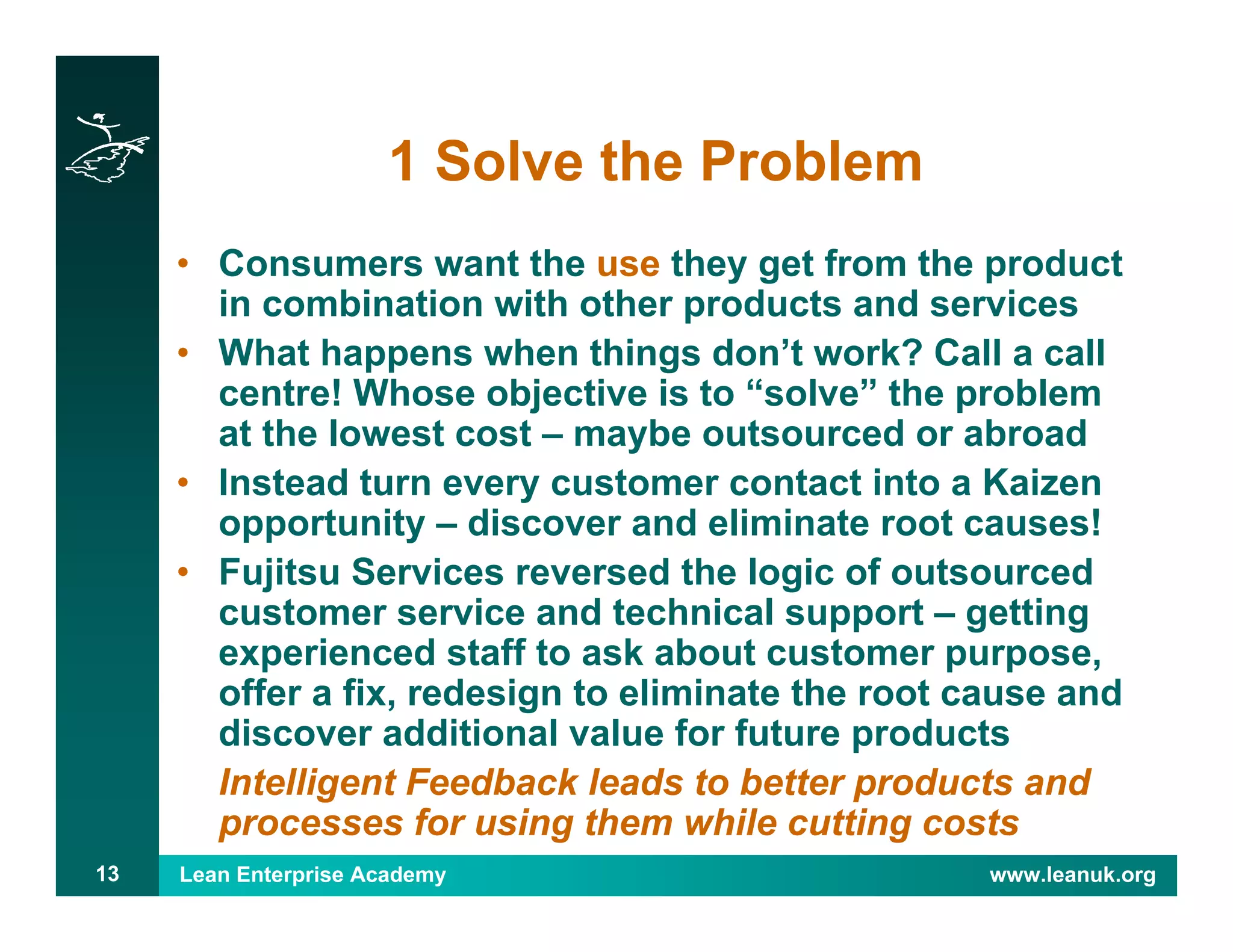
1 Solve the Problem
• Consumers want the use they get from the product
in combination with other products and services
• What happens when things don’t work? Call a call
centre! Whose objective is to “solve” the problem
at the lowest cost – maybe outsourced or abroad
• Instead turn every customer contact into a Kaizen
opportunity – discover and eliminate root causes!
• Fujitsu Services reversed the logic of outsourced
customer service and technical support – getting
experienced staff to ask about customer purpose,
offer a fix, redesign to eliminate the root cause and
discover additional value for future products
Intelligent Feedback leads to better products and
processes for using them while cutting costs
Lean Enterprise Academy www.leanuk.org14
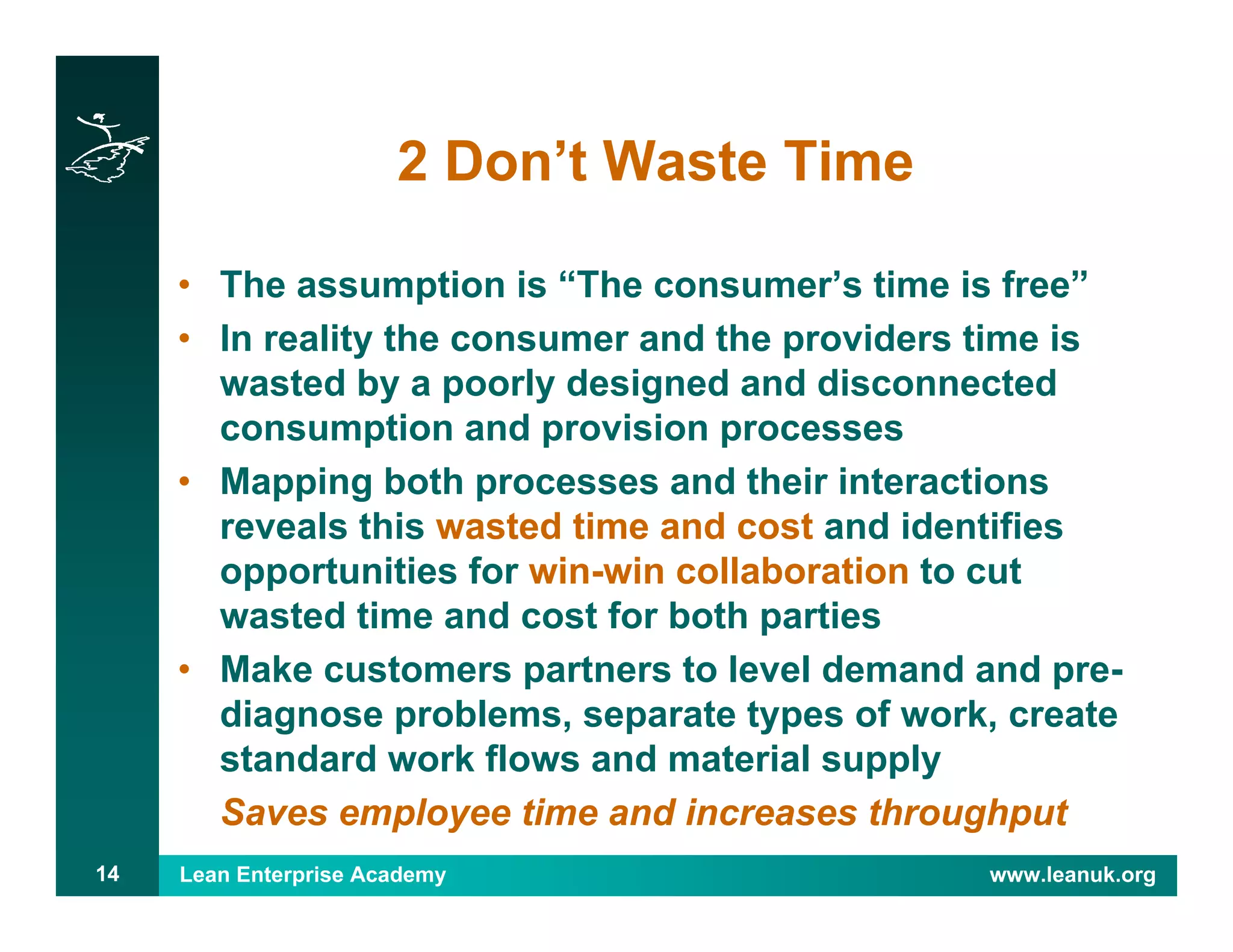
2 Don’t Waste Time
• The assumption is “The consumer’s time is free”
• In reality the consumer and the providers time is
wasted by a poorly designed and disconnected
consumption and provision processes
• Mapping both processes and their interactions
reveals this wasted time and cost and identifies
opportunities for win-win collaboration to cut
wasted time and cost for both parties
• Make customers partners to level demand and pre-
diagnose problems, separate types of work, create
standard work flows and material supply
Saves employee time and increases throughput
Lean Enterprise Academy www.leanuk.org15
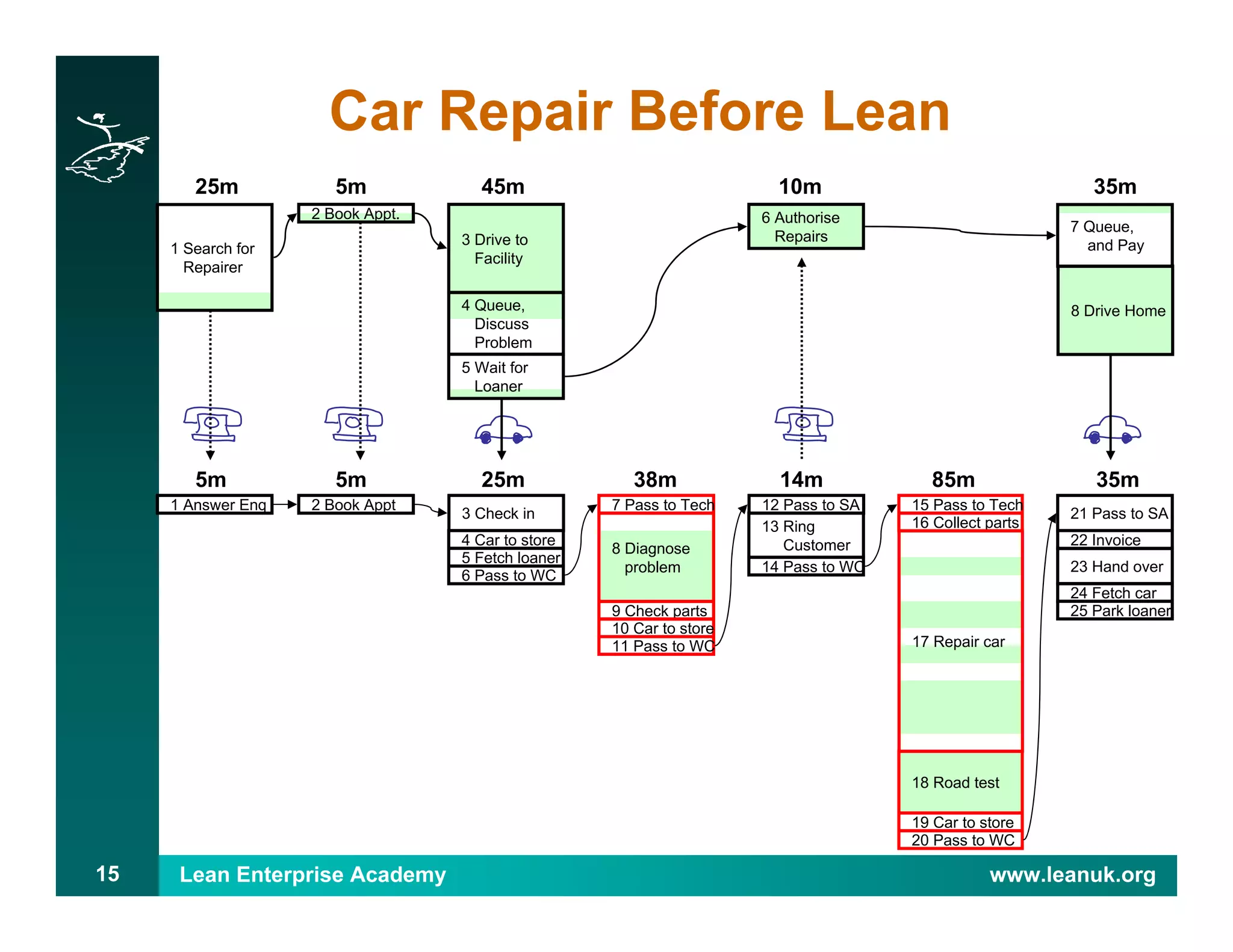
Car Repair Before Lean
8 Drive Home
7 Queue,
and Pay1 Search for
Repairer
2 Book Appt.
5 Wait for
Loaner
3 Drive to
Facility
4 Queue,
Discuss
Problem
6 Authorise
Repairs
25m 5m 45m 10m 35m
2 Book Appt1 Answer Enq
3 Check in
12 Pass to SA
4 Car to store
5 Fetch loaner
6 Pass to WC
7 Pass to Tech
8 Diagnose
problem
9 Check parts
10 Car to store
11 Pass to WC
14 Pass to WC
13 Ring
Customer
21 Pass to SA
15 Pass to Tech
16 Collect parts
17 Repair car
18 Road test
19 Car to store
20 Pass to WC
25 Park loaner
22 Invoice
23 Hand over
24 Fetch car
5m 5m 25m 38m 14m 85m 35m
Lean Enterprise Academy www.leanuk.org16
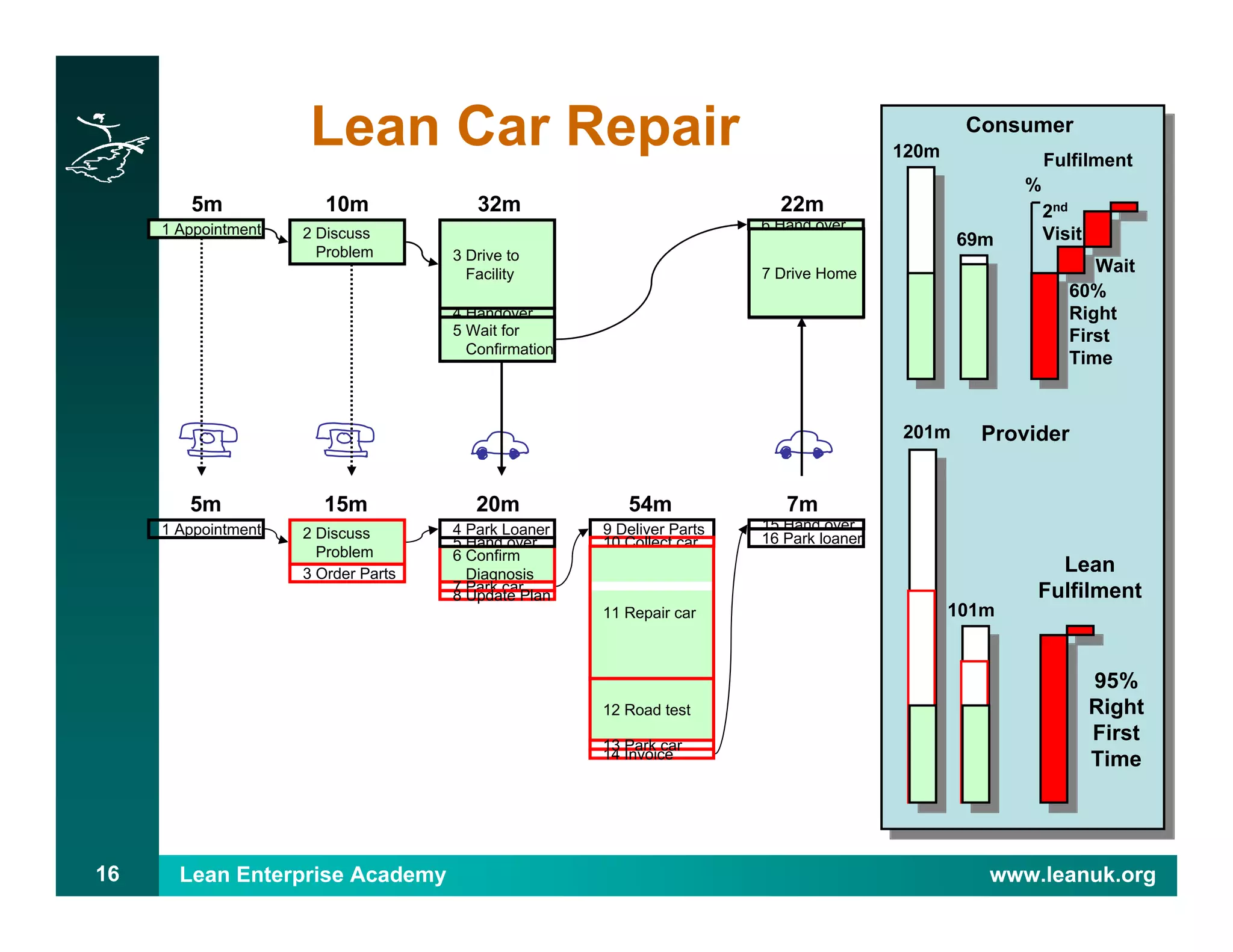
Lean Car Repair
12 Road test
1 Appointment 15 Hand over
16 Park loaner2 Discuss
Problem
3 Order Parts
6 Confirm
Diagnosis
4 Park Loaner
5 Hand over
7 Park car
8 Update Plan
9 Deliver Parts
10 Collect car
11 Repair car
14 Invoice
13 Park car
5m 15m 20m 54m 7m
7 Drive Home
6 Hand over1 Appointment 2 Discuss
Problem
5 Wait for
Confirmation
3 Drive to
Facility
4 Handover
5m 10m 32m 22m
120m
69m
60%
Right
First
Time
Wait
2nd
Visit
%
Fulfilment
Provider
Consumer
101m
201m
Lean
Fulfilment
95%
Right
First
Time
Lean Enterprise Academy www.leanuk.org17
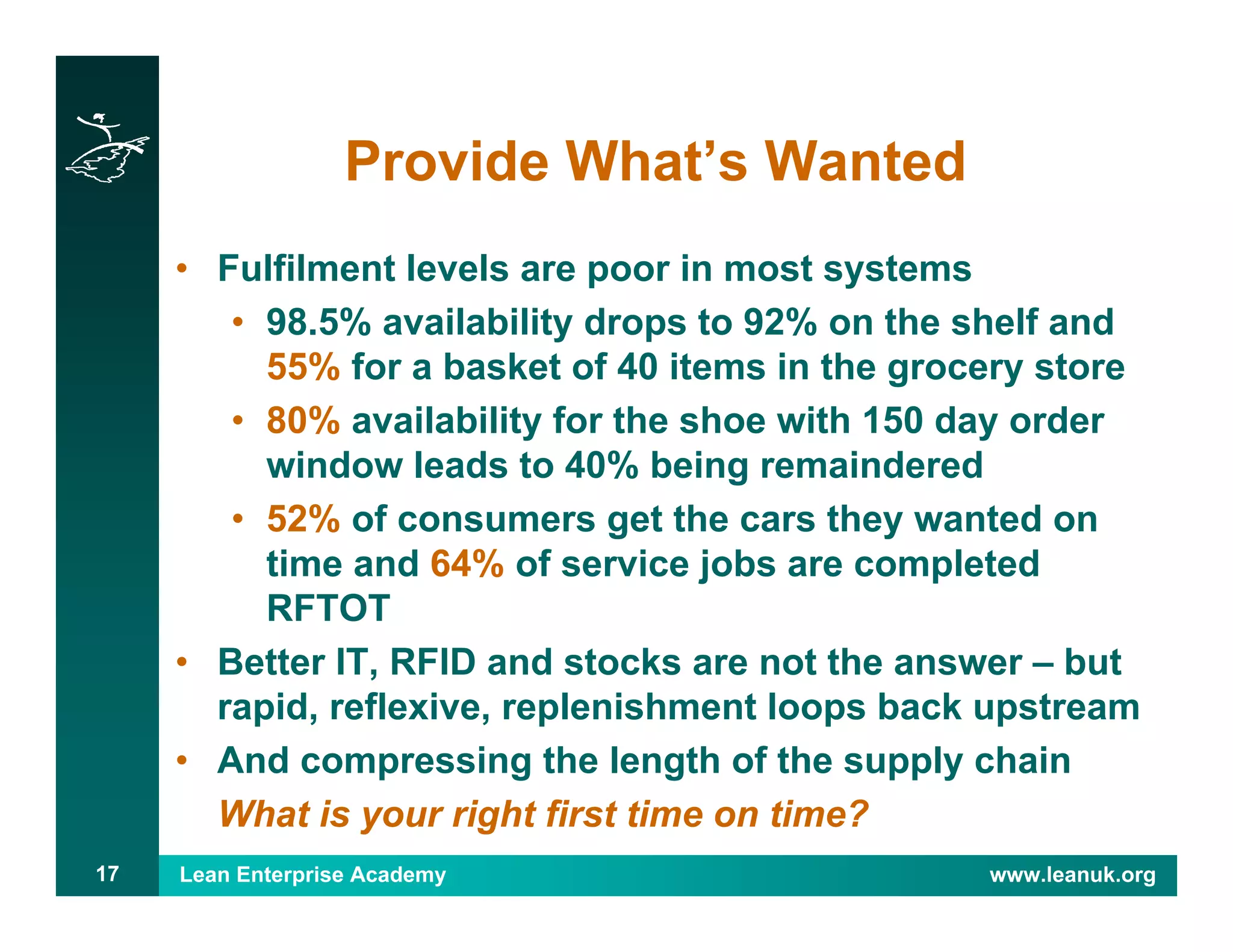
Provide What’s Wanted
• Fulfilment levels are poor in most systems
• 98.5% availability drops to 92% on the shelf and
55% for a basket of 40 items in the grocery store
• 80% availability for the shoe with 150 day order
window leads to 40% being remaindered
• 52% of consumers get the cars they wanted on
time and 64% of service jobs are completed
RFTOT
• Better IT, RFID and stocks are not the answer – but
rapid, reflexive, replenishment loops back upstream
• And compressing the length of the supply chain
What is your right first time on time?
Lean Enterprise Academy www.leanuk.org18
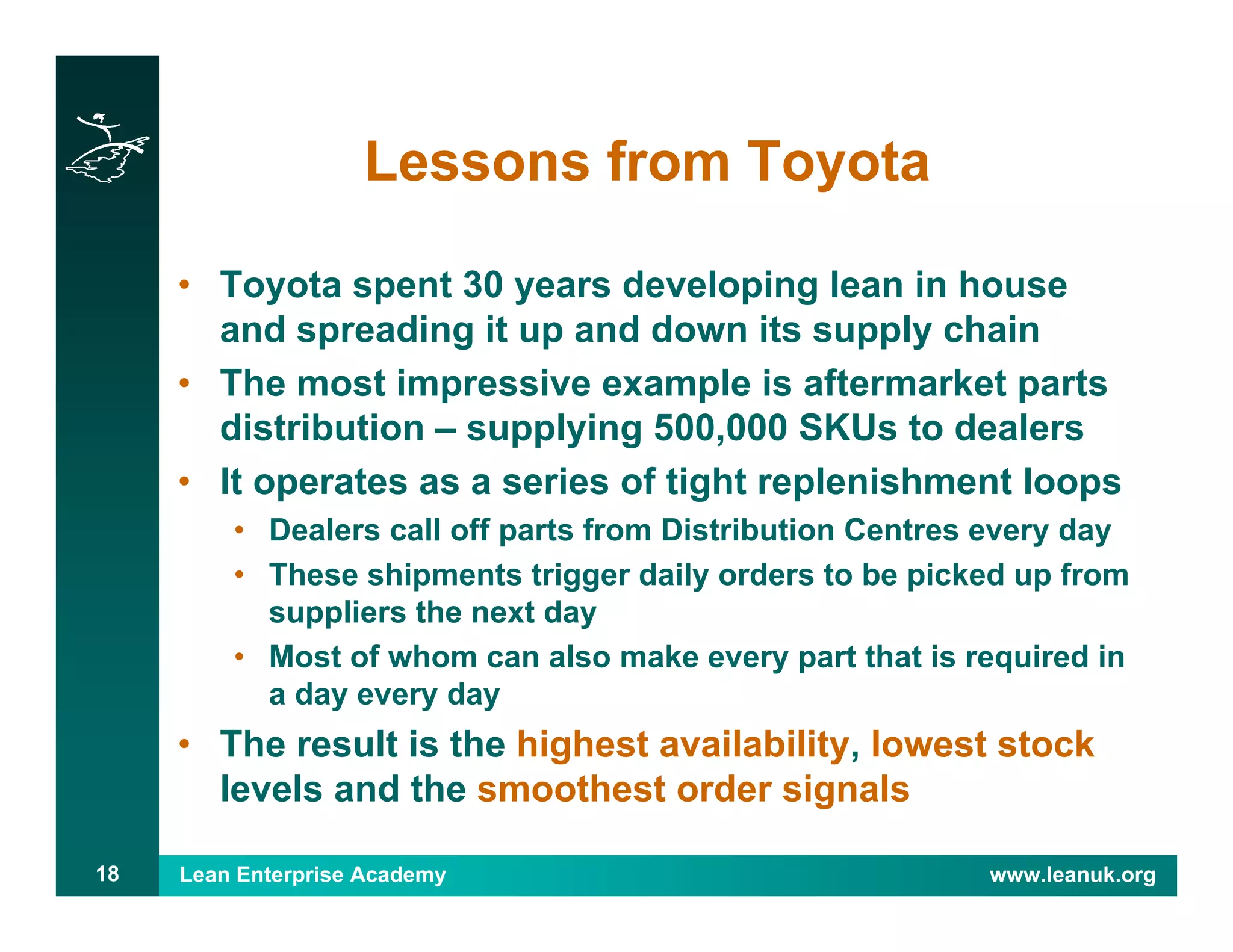
Lessons from Toyota
• Toyota spent 30 years developing lean in house
and spreading it up and down its supply chain
• The most impressive example is aftermarket parts
distribution – supplying 500,000 SKUs to dealers
• It operates as a series of tight replenishment loops
• Dealers call off parts from Distribution Centres every day
• These shipments trigger daily orders to be picked up from
suppliers the next day
• Most of whom can also make every part that is required in
a day every day
• The result is the highest availability, lowest stock
levels and the smoothest order signals
Lean Enterprise Academy www.leanuk.org19
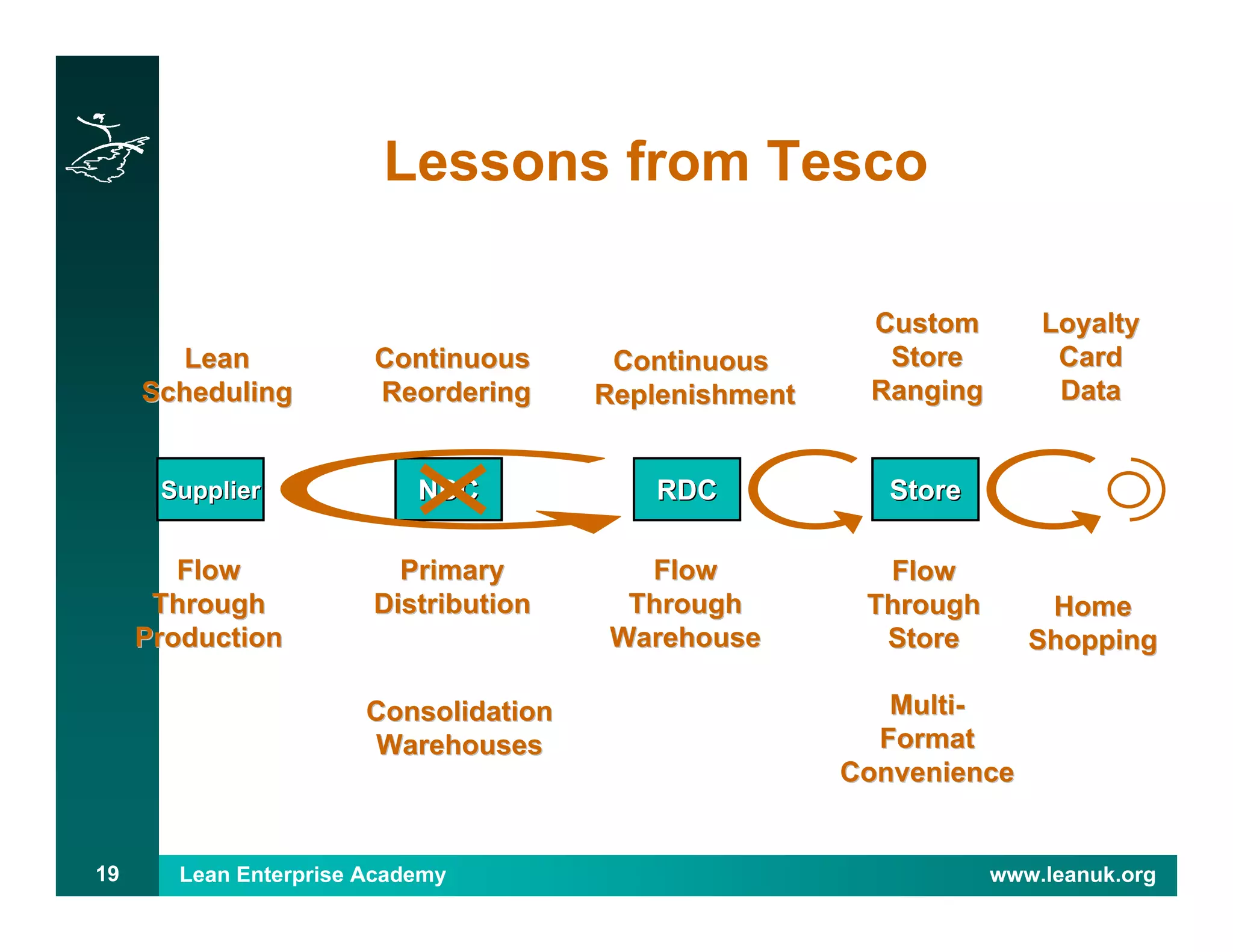
Lessons from Tesco
SupplierSupplier RDCRDC StoreStoreNDCNDC
ContinuousContinuous
ReplenishmentReplenishment
FlowFlow
ThroughThrough
StoreStore
FlowFlow
ThroughThrough
ProductionProduction
LeanLean
SchedulingScheduling
CustomCustom
StoreStore
RangingRanging
LoyaltyLoyalty
CardCard
DataData
HomeHome
ShoppingShopping
MultiMulti--
FormatFormat
ConvenienceConvenience
FlowFlow
ThroughThrough
WarehouseWarehouse
PrimaryPrimary
DistributionDistribution
ContinuousContinuous
ReorderingReordering
ConsolidationConsolidation
WarehousesWarehouses
Lean Enterprise Academy www.leanuk.org20
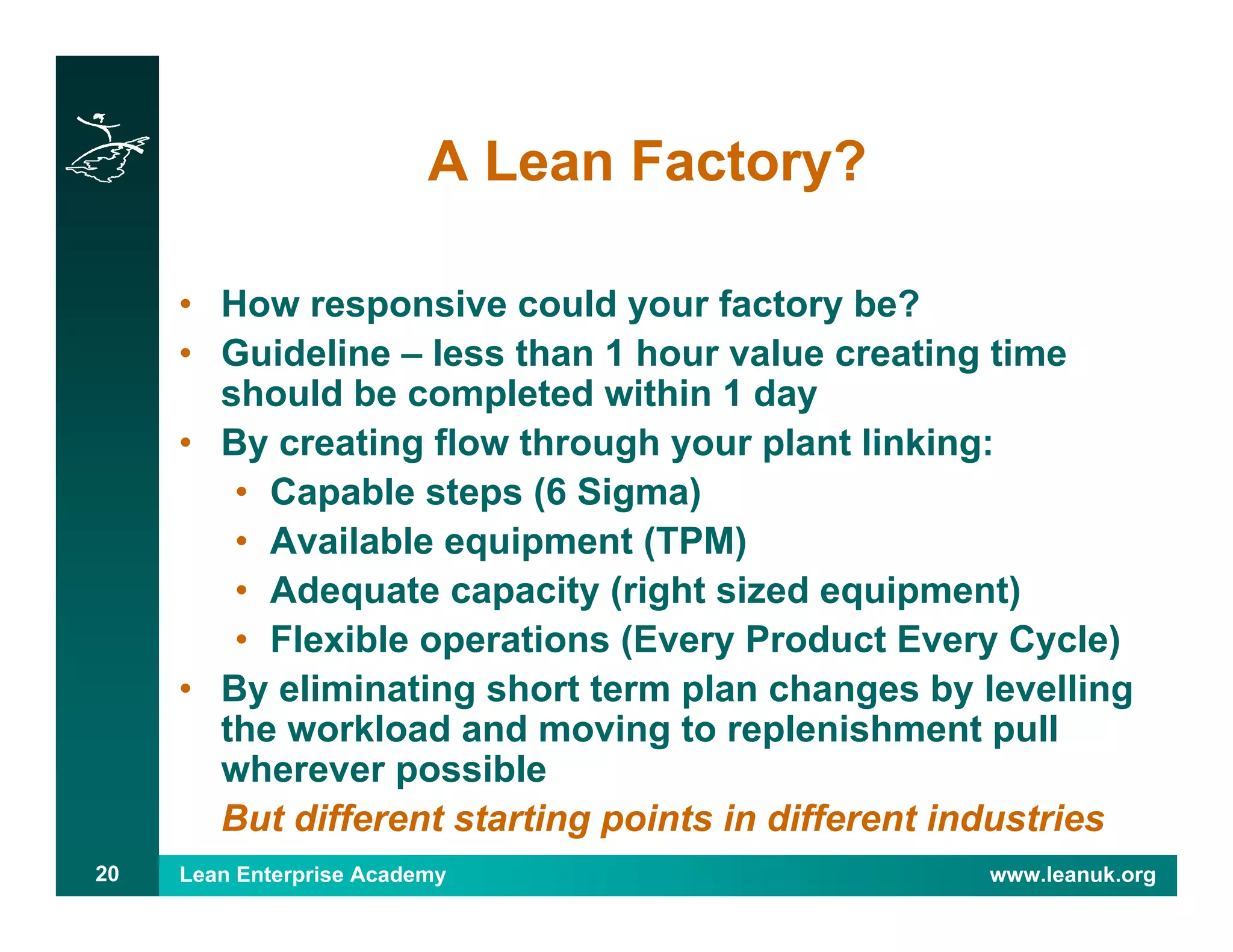
A Lean Factory?
• How responsive could your factory be?
• Guideline – less than 1 hour value creating time
should be completed within 1 day
• By creating flow through your plant linking:
• Capable steps (6 Sigma)
• Available equipment (TPM)
• Adequate capacity (right sized equipment)
• Flexible operations (Every Product Every Cycle)
• By eliminating short term plan changes by levelling
the workload and moving to replenishment pull
wherever possible
But different starting points in different industries
Lean Enterprise Academy www.leanuk.org21
Getting to Lean
• In machining and assembly:
• By using Chaku-chaku lines and cells instead
of monster machines and automated lines
• In process industries:
• By flowing high volume products separately
from low volume products
• In build to order industries:
• By creating flow in the quotation process, in
the installation process and a rhythm in
production
But a lean island is not enough!
Lean Enterprise Academy www.leanuk.org22
A Lean Supply Chain
• Having created level flow and pull for your volume
products you need to pull just what you need from
your suppliers every day
• And your customers need to pull products from
you every day
• By each taking responsibility for picking up
products rather than waiting for deliveries
• So you can consolidate and synchronise mixed
product loads in daily milk runs and reduce the
noise in the order signal
Little and often works better than pushing batches
Lean Enterprise Academy www.leanuk.org23
Rapid, Reflexive Replenishment
• Toyota distinguish between cognitive and reflexive
decision making systems
• They separate capacity and materials planning from
production and shipping instructions
• Lean, rapid, reflexive replenishment is based on
four key principles:-
• Only one scheduling point or pacemaker
• Greatly increased frequency of replenishment
• Replenish only exactly what was sold
• Where possible compress the vale stream
The objective is to optimise the flow not each asset
Lean Enterprise Academy www.leanuk.org24
Where to Produce What
• Calculate “factory gate” costs at different locations
• Germany, Romania and China?
• Calculate freight costs to supply the factory and to
reach all your customers
• Including all the expedited shipments!
• Add in all the overhead costs of:
• Management and engineering time and travel
• Quality (warranty costs etc.)
• Extra inventories, lost sales, out-of-stocks, write-offs, etc.
• Currency and country risks
Then decide what to make where – which might
also change over the product life cycle
Lean Enterprise Academy www.leanuk.org25
4 Deliver Where it’s Wanted
• All consumers use different types formats
depending on their circumstances – time pressure
places a growing premium on convenience
• The convenience store revolution is changing
retailing - signalling the end of the “big box”
dominant mass retailing format
• The key to serving multiple channels is a common
fulfilment system and a “water spider”
replenishment system for all formats – including
local stores and home shopping
• Convenience does not need to cost more
Multiple channels will replace “one best way” for
most products and services
Lean Enterprise Academy www.leanuk.org26
5 Supply When it’s Wanted
• Is everything purchased on impulse? Is there any
incentive to plan ahead?
• The consequence is that production must be
infinitely flexible, every event must be planned and
we have to dispose of unwanted stock
• Reversing this logic – How can we plan ahead with
most consumers while offering price incentives to
smooth the demand for production slots?
• This stability creates the possibility of responding
to the “got-to-have-it-now” consumers at much
lower cost?
This realistically takes us beyond “build to order”
Lean Enterprise Academy www.leanuk.org27
6 Continuing Solutions
• Why are consumers increasing the number of
suppliers – often one off strangers – to acquire the
elements of the solution to their problems?
• While lean producers are decreasing the number of
suppliers, each with a deeper knowledge to solve
bigger problems on a continuing basis?
• When will someone provide continuing solutions to
integrate the elements to solve my bigger problems?
• Communications
• Mobility
• Shelter
• Healthcare
• Financial management
• Personal Logistics (routine shopping)
Lean Enterprise Academy www.leanuk.org28
Conclusions
• Intelligent Feedback leads to better products and
processes for using them while cutting costs –
out-sourcing and off-shoring are not the answer
• Collaboration with customers to eliminate waiting
and queues frees employee’s time, cuts cost and
increases throughput – banish queues
• Rapid replenishment improves availability while
lowering costs – little and often is cheaper but
“low cost” sourcing may not be the answer either
• Several convenient channels will replace one
route to market – for every kind of product
• Planning ahead with key customers provides the
stability that enhances responsiveness – build-to-
order is not the answer and flexibility is a curse
• Think about providing complete solutions
Lean Enterprise Academy www.leanuk.org29
Creating Lean Solutions:
The Next Steps for Lean
Daniel T Jones
Chairman
Lean Enterprise Academy
Manufacturer Live – Telford – 28 September 2005

Creating Lean Solutions

  • 1.
    Lean Enterprise Academywww.leanuk.org1 Creating Lean Solutions: The Next Steps for Lean Daniel T Jones Chairman Lean Enterprise Academy Manufacturer Live – Telford – 28 September 2005
  • 2.
    Lean Enterprise Academywww.leanuk.org2 Who am I? • A Missionary – for applying lean process thinking to every human activity • An Author – of The Machine that Changed the World, Lean Thinking and now Lean Solutions • The Founder – of the Lean Enterprise Academy in the UK, part of the Lean Global Network • My Activities – include Mentoring, Training the Trainers, Workshops, Workbooks, Lean Summits, Networks and eletters – details at www.leanuk.org
  • 3.
    Lean Enterprise Academywww.leanuk.org3 Toyota’s Lean Strategy “Brilliant process management is our strategy. We get brilliant results from average people managing brilliant processes. We observe that our competitors often get average (or worse) results from brilliant people managing broken processes.” Lean Thinking is Process Thinking
  • 4.
    Lean Enterprise Academywww.leanuk.org4 Lean Principles • Specify value from the standpoint of the consumer - (not from your assets and organisation) • Identify the value stream through the steps required to create and deliver each product and remove the wasted steps • Make the process of value creation flow smoothly and quickly to the customer • But only in line with the pull of the consumer • While pursuing perfection by constantly improving the product and the value stream As a result products are getting better and cheaper
  • 5.
    Lean Enterprise Academywww.leanuk.org5 The Changing Context • Wage costs are probably now at an all time low – although they are now rising in China • This is forcing manufacturers to squeeze waste out of their processes and think how and where to make products in the future • Western manufacturers’ potential is: • Being close to their customers – that is us! • Developing the right technology, products and services to solve their problems • Developing the right processes to rapidly respond to their needs But we need to do a lot better at all of these
  • 6.
    Lean Enterprise Academywww.leanuk.org6 The Lean Frontier • What is happening to your customers? • How are they buying your products? • How are you responding to their needs? • How would a lean thinker think about these questions? • What implications does this have for manufacturers? These questions are key to your survival
  • 7.
    Lean Enterprise Academywww.leanuk.org7 Lean Consumption and Provision • We now understand that Production (including design and supplier management) is a process. A series of actions manufacturers must perform in the proper sequence to create value for customers • Consumption is also a process. A series of actions consumers must perform in the proper sequence to obtain the value they seek • Provision is a third process. The actions that someone must perform between the factory and the customer to achieve the objectives of both parties There is a yawning gap between the last two
  • 8.
    Lean Enterprise Academywww.leanuk.org8 What’s Happening to Consumers? • Mass customisation has added to their choices • The end of regulation has extended the number of things they have to make choices about • The self-service economy enables them to buy more personal capital goods to replace services • Two-income and single-parent households have less time to manage consumption • Ageing households have more time - but less energy • The internet is blurring production and consumption and has opened access to a global supply base They have more choices to make and products to manage but less time and energy to do so
  • 9.
    Lean Enterprise Academywww.leanuk.org9 What is Happening to Consumption? • If products are getting better why is consumption still so frustrating? • Why does the new computer fail to work with the rest of our kit? • Why do “help lines” not help? • Why do we waste so much time in hub airports and general hospitals? • Why do we fail to find exactly what we are looking for on a trip to the supermarket? • Is it because of bad people or broken processes? Why do we think and act differently as consumers to how we do in our lives as providers?
  • 10.
    Lean Enterprise Academywww.leanuk.org10 Provision Processes are also Broken • Growing spending on “new” products, features and options that fail to attract new customers • Growing spending to increase customer loyalty as customers become less loyal • High out of stocks, lost sales and remaindering • Larger investments in bigger assets which have a shrinking ability to create competitive advantage • Outsourcing customer support so direct contact with the consumer is lost • Employee dissatisfaction and high staff turnover How can we improve provision and consumption?
  • 11.
    Lean Enterprise Academywww.leanuk.org11 The Consumption Process • The answer begins by seeing consumption not as an isolated transaction between strangers • But by seeing consumption as a process of steps to enable the consumer to solve their problem • It involves searching, selecting, obtaining, integrating, maintaining, upgrading, disposing and replacing many items over time • Interacting with several providers of goods and services in a parallel provision process • Add this up and you realise that managing (household) consumption processes is complicated and takes a lot of “unpaid” time and mind share So what do consumers really want?
  • 12.
    Lean Enterprise Academywww.leanuk.org12 Principles of Lean Consumption 1. Solve the consumer’s problem completely 2. Don’t waste the consumer’s (or the provider’s) time 3. Provide exactly what the consumer wants 4. Deliver it where it’s wanted 5. Supply it when it’s wanted 6. Continually reduce the consumer’s time and hassle in solving their problems All this can be done with lower costs
  • 13.
    Lean Enterprise Academywww.leanuk.org13 1 Solve the Problem • Consumers want the use they get from the product in combination with other products and services • What happens when things don’t work? Call a call centre! Whose objective is to “solve” the problem at the lowest cost – maybe outsourced or abroad • Instead turn every customer contact into a Kaizen opportunity – discover and eliminate root causes! • Fujitsu Services reversed the logic of outsourced customer service and technical support – getting experienced staff to ask about customer purpose, offer a fix, redesign to eliminate the root cause and discover additional value for future products Intelligent Feedback leads to better products and processes for using them while cutting costs
  • 14.
    Lean Enterprise Academywww.leanuk.org14 2 Don’t Waste Time • The assumption is “The consumer’s time is free” • In reality the consumer and the providers time is wasted by a poorly designed and disconnected consumption and provision processes • Mapping both processes and their interactions reveals this wasted time and cost and identifies opportunities for win-win collaboration to cut wasted time and cost for both parties • Make customers partners to level demand and pre- diagnose problems, separate types of work, create standard work flows and material supply Saves employee time and increases throughput
  • 15.
    Lean Enterprise Academywww.leanuk.org15 Car Repair Before Lean 8 Drive Home 7 Queue, and Pay1 Search for Repairer 2 Book Appt. 5 Wait for Loaner 3 Drive to Facility 4 Queue, Discuss Problem 6 Authorise Repairs 25m 5m 45m 10m 35m 2 Book Appt1 Answer Enq 3 Check in 12 Pass to SA 4 Car to store 5 Fetch loaner 6 Pass to WC 7 Pass to Tech 8 Diagnose problem 9 Check parts 10 Car to store 11 Pass to WC 14 Pass to WC 13 Ring Customer 21 Pass to SA 15 Pass to Tech 16 Collect parts 17 Repair car 18 Road test 19 Car to store 20 Pass to WC 25 Park loaner 22 Invoice 23 Hand over 24 Fetch car 5m 5m 25m 38m 14m 85m 35m
  • 16.
    Lean Enterprise Academywww.leanuk.org16 Lean Car Repair 12 Road test 1 Appointment 15 Hand over 16 Park loaner2 Discuss Problem 3 Order Parts 6 Confirm Diagnosis 4 Park Loaner 5 Hand over 7 Park car 8 Update Plan 9 Deliver Parts 10 Collect car 11 Repair car 14 Invoice 13 Park car 5m 15m 20m 54m 7m 7 Drive Home 6 Hand over1 Appointment 2 Discuss Problem 5 Wait for Confirmation 3 Drive to Facility 4 Handover 5m 10m 32m 22m 120m 69m 60% Right First Time Wait 2nd Visit % Fulfilment Provider Consumer 101m 201m Lean Fulfilment 95% Right First Time
  • 17.
    Lean Enterprise Academywww.leanuk.org17 Provide What’s Wanted • Fulfilment levels are poor in most systems • 98.5% availability drops to 92% on the shelf and 55% for a basket of 40 items in the grocery store • 80% availability for the shoe with 150 day order window leads to 40% being remaindered • 52% of consumers get the cars they wanted on time and 64% of service jobs are completed RFTOT • Better IT, RFID and stocks are not the answer – but rapid, reflexive, replenishment loops back upstream • And compressing the length of the supply chain What is your right first time on time?
  • 18.
    Lean Enterprise Academywww.leanuk.org18 Lessons from Toyota • Toyota spent 30 years developing lean in house and spreading it up and down its supply chain • The most impressive example is aftermarket parts distribution – supplying 500,000 SKUs to dealers • It operates as a series of tight replenishment loops • Dealers call off parts from Distribution Centres every day • These shipments trigger daily orders to be picked up from suppliers the next day • Most of whom can also make every part that is required in a day every day • The result is the highest availability, lowest stock levels and the smoothest order signals
  • 19.
    Lean Enterprise Academywww.leanuk.org19 Lessons from Tesco SupplierSupplier RDCRDC StoreStoreNDCNDC ContinuousContinuous ReplenishmentReplenishment FlowFlow ThroughThrough StoreStore FlowFlow ThroughThrough ProductionProduction LeanLean SchedulingScheduling CustomCustom StoreStore RangingRanging LoyaltyLoyalty CardCard DataData HomeHome ShoppingShopping MultiMulti-- FormatFormat ConvenienceConvenience FlowFlow ThroughThrough WarehouseWarehouse PrimaryPrimary DistributionDistribution ContinuousContinuous ReorderingReordering ConsolidationConsolidation WarehousesWarehouses
  • 20.
    Lean Enterprise Academywww.leanuk.org20 A Lean Factory? • How responsive could your factory be? • Guideline – less than 1 hour value creating time should be completed within 1 day • By creating flow through your plant linking: • Capable steps (6 Sigma) • Available equipment (TPM) • Adequate capacity (right sized equipment) • Flexible operations (Every Product Every Cycle) • By eliminating short term plan changes by levelling the workload and moving to replenishment pull wherever possible But different starting points in different industries
  • 21.
    Lean Enterprise Academywww.leanuk.org21 Getting to Lean • In machining and assembly: • By using Chaku-chaku lines and cells instead of monster machines and automated lines • In process industries: • By flowing high volume products separately from low volume products • In build to order industries: • By creating flow in the quotation process, in the installation process and a rhythm in production But a lean island is not enough!
  • 22.
    Lean Enterprise Academywww.leanuk.org22 A Lean Supply Chain • Having created level flow and pull for your volume products you need to pull just what you need from your suppliers every day • And your customers need to pull products from you every day • By each taking responsibility for picking up products rather than waiting for deliveries • So you can consolidate and synchronise mixed product loads in daily milk runs and reduce the noise in the order signal Little and often works better than pushing batches
  • 23.
    Lean Enterprise Academywww.leanuk.org23 Rapid, Reflexive Replenishment • Toyota distinguish between cognitive and reflexive decision making systems • They separate capacity and materials planning from production and shipping instructions • Lean, rapid, reflexive replenishment is based on four key principles:- • Only one scheduling point or pacemaker • Greatly increased frequency of replenishment • Replenish only exactly what was sold • Where possible compress the vale stream The objective is to optimise the flow not each asset
  • 24.
    Lean Enterprise Academywww.leanuk.org24 Where to Produce What • Calculate “factory gate” costs at different locations • Germany, Romania and China? • Calculate freight costs to supply the factory and to reach all your customers • Including all the expedited shipments! • Add in all the overhead costs of: • Management and engineering time and travel • Quality (warranty costs etc.) • Extra inventories, lost sales, out-of-stocks, write-offs, etc. • Currency and country risks Then decide what to make where – which might also change over the product life cycle
  • 25.
    Lean Enterprise Academywww.leanuk.org25 4 Deliver Where it’s Wanted • All consumers use different types formats depending on their circumstances – time pressure places a growing premium on convenience • The convenience store revolution is changing retailing - signalling the end of the “big box” dominant mass retailing format • The key to serving multiple channels is a common fulfilment system and a “water spider” replenishment system for all formats – including local stores and home shopping • Convenience does not need to cost more Multiple channels will replace “one best way” for most products and services
  • 26.
    Lean Enterprise Academywww.leanuk.org26 5 Supply When it’s Wanted • Is everything purchased on impulse? Is there any incentive to plan ahead? • The consequence is that production must be infinitely flexible, every event must be planned and we have to dispose of unwanted stock • Reversing this logic – How can we plan ahead with most consumers while offering price incentives to smooth the demand for production slots? • This stability creates the possibility of responding to the “got-to-have-it-now” consumers at much lower cost? This realistically takes us beyond “build to order”
  • 27.
    Lean Enterprise Academywww.leanuk.org27 6 Continuing Solutions • Why are consumers increasing the number of suppliers – often one off strangers – to acquire the elements of the solution to their problems? • While lean producers are decreasing the number of suppliers, each with a deeper knowledge to solve bigger problems on a continuing basis? • When will someone provide continuing solutions to integrate the elements to solve my bigger problems? • Communications • Mobility • Shelter • Healthcare • Financial management • Personal Logistics (routine shopping)
  • 28.
    Lean Enterprise Academywww.leanuk.org28 Conclusions • Intelligent Feedback leads to better products and processes for using them while cutting costs – out-sourcing and off-shoring are not the answer • Collaboration with customers to eliminate waiting and queues frees employee’s time, cuts cost and increases throughput – banish queues • Rapid replenishment improves availability while lowering costs – little and often is cheaper but “low cost” sourcing may not be the answer either • Several convenient channels will replace one route to market – for every kind of product • Planning ahead with key customers provides the stability that enhances responsiveness – build-to- order is not the answer and flexibility is a curse • Think about providing complete solutions
  • 29.
    Lean Enterprise Academywww.leanuk.org29 Creating Lean Solutions: The Next Steps for Lean Daniel T Jones Chairman Lean Enterprise Academy Manufacturer Live – Telford – 28 September 2005