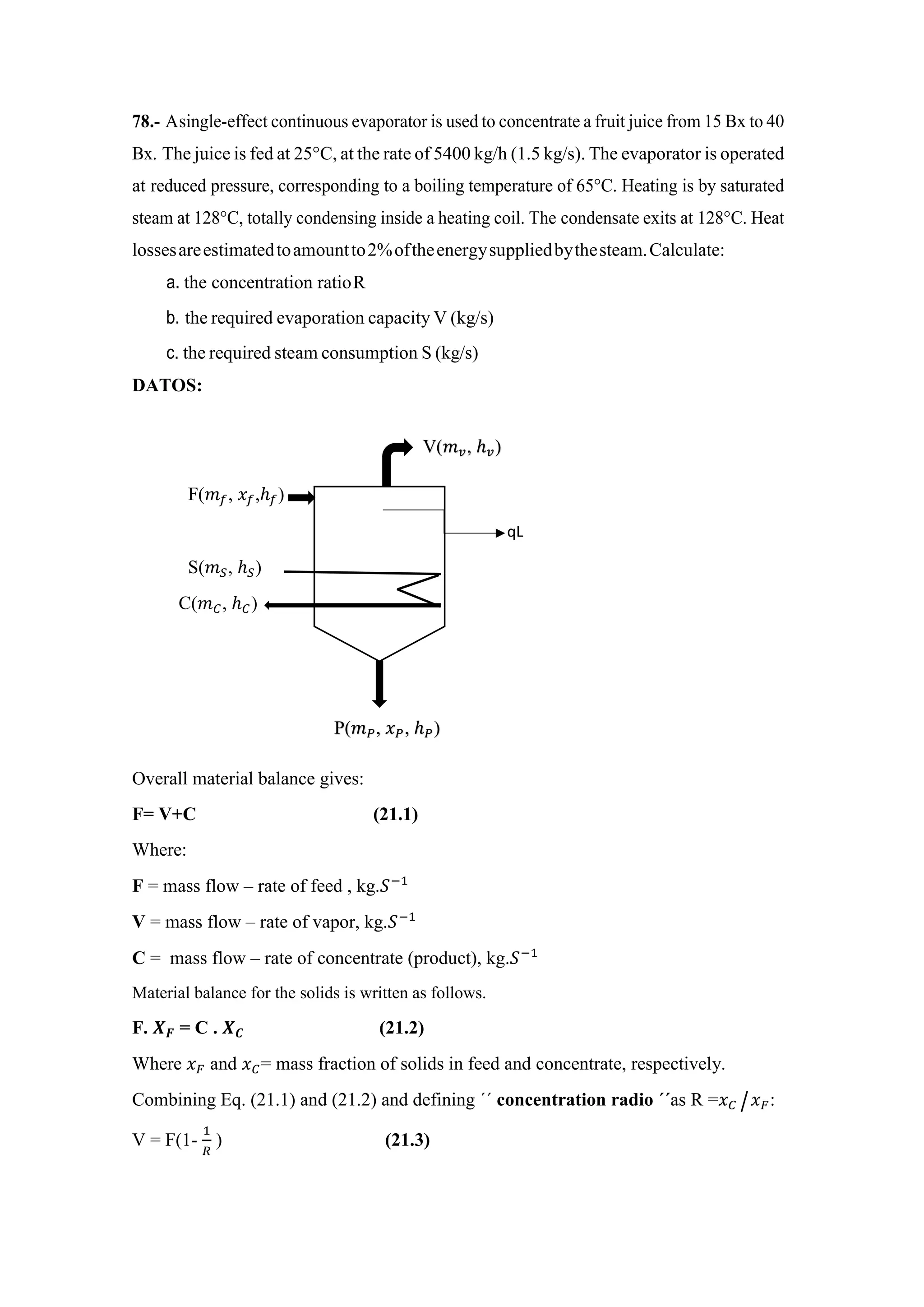
78.- Asingle-effect continuous evaporator is used to concentrate a fruit juice from 15 Bx to 40
Bx. The juice is fed at 25°C, at the rate of 5400 kg/h (1.5 kg/s). The evaporator is operated
at reduced pressure, corresponding to a boiling temperature of 65°C. Heating is by saturated
steam at 128°C, totally condensing inside a heating coil. The condensate exits at 128°C. Heat
lossesareestimatedtoamountto2%oftheenergysuppliedbythesteam.Calculate:
a. the concentration ratioR
b. the required evaporation capacity V (kg/s)
c. the required steam consumption S (kg/s)
DATOS:
F(𝑚 𝑓, 𝑥𝑓,ℎ𝑓)
qL
S(𝑚 𝑆, ℎ 𝑆)
C(𝑚 𝐶, ℎ 𝐶)
Overall material balance gives:
F= V+C (21.1)
Where:
F = mass flow – rate of feed , kg.𝑆−1
V = mass flow – rate of vapor, kg.𝑆−1
C = mass flow – rate of concentrate (product), kg.𝑆−1
Material balance for the solids is written as follows.
F. 𝑿 𝑭 = C . 𝑿 𝑪 (21.2)
Where 𝑥 𝐹 and 𝑥 𝐶= mass fraction of solids in feed and concentrate, respectively.
Combining Eq. (21.1) and (21.2) and defining ´´ concentration radio ´´as R =𝑥 𝐶 𝑥 𝐹:
V = F(1-
1
𝑅
) (21.3)
P(𝑚 𝑃, 𝑥 𝑃, ℎ 𝑃)
V(𝑚 𝑣, ℎ 𝑣)
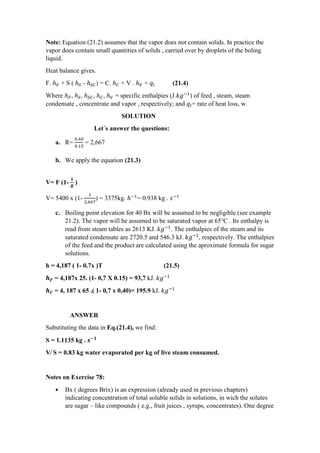
Note: Equation (21.2) assumes that the vapor does not contain solids. In practice the
vapor does contain small quantities of solids , carried over by droplets of the boling
liquid.
Heat balance gives.
F. ℎ 𝐹 + S ( ℎ 𝑆 - ℎ 𝑆𝐶) = C. ℎ 𝐶 + V . ℎ 𝑉 + 𝑞𝑙 (21.4)
Where ℎ 𝐹, ℎ 𝑆, ℎ 𝑆𝐶, ℎ 𝐶, ℎ 𝑉 = specific enthalpies (J.𝑘𝑔−1
) of feed , steam, steam
condensate , concentrate and vapor , respectively; and 𝑞𝑙= rate of heat loss, w.
SOLUTION
Let´s answer the questions:
a. R=
0.40
0.15
= 2,667
b. We apply the equation (21.3)
V= F (1-
𝟏
𝑹
)
V= 5400 x (1-
1
2,667
) = 3375kg. ℎ−1
= 0.938 kg . 𝑠−1
c. Boiling point elevation for 40 Bx will be assumed to be negligible (see example
21.2). The vapor will be assumed to be saturated vapor at 65℃ . Its enthalpy is
read from steam tables as 2613 KJ. 𝑘𝑔−1
. The enthalpies of the steam and its
saturated condensate are 2720.5 and 546.3 kJ. 𝑘𝑔−1
, respectively. The enthalpies
of the feed and the product are calculated using the aproximate formula for sugar
solutions.
h = 4,187 ( 1- 0.7x )T (21.5)
𝒉 𝑭 = 4,187x 25. (1- 0,7 X 0.15) = 93,7 kJ. 𝑘𝑔−1
𝒉 𝑪 = 4, 187 x 65 .( 1- 0,7 x 0,40)= 195.9 kJ. 𝑘𝑔−1
ANSWER
Substituting the data in Eq.(21.4), we find:
S = 1.1135 kg . 𝒔−𝟏
V∕ S = 0.83 kg water evaporated per kg of live steam consumed.
Notes on Exercise 78:
• Bx ( degrees Brix) is an expression (already used in previous chapters)
indicating concentration of total soluble solids in solutions, in wich the solutes
are sugar – like compounds ( e.g., fruit juices , syrups, concentrates). One degree
Brix is equivalent to 1 kg sugar- like soluble solids per looking of solution . It is
most commonly measured by refractometry.
• The quantity of water evaporated per unit time (evaporation capacity), V, is the
nominal size indicator of a commercial evaporator.
• The ratio of evaporation capacity to steam consumption is a measure of the
thermal efficiency of the operation. In single effect evaporators receiving a cold
feed , the thermal efficiency is, abviously, below 100% (83% in this exercise).
• The temperature of the feed may have a substantial influence on the energy
balance. Let us assign, for convenience, the temperature of evaporation (i.e., 𝑇𝐶
or 𝑇𝑉) as the reference temperature for entalphies . The heat balance, Eq.(21.4)
now becomes.
S (ℎ 𝑆 - ℎ 𝑆𝐶) = 𝐹𝐶 𝑃𝐹 (𝑇𝐶 - 𝑇𝐹) + V𝜆 𝑉 + 𝑞𝑙 = (I) + (II) + (III) (21.6)
Where 𝐶 𝑃𝐹 is the specific heat of the feed and 𝜆 𝑉 is the latent heat of evaporation.
Equation (21.6) shows that the heat supplied by the steam is used to compensate
three thermal loads, indicated in the equation as (I), (II) ,(III) :
(I) Is the heat used to raise the temperature of the feed, up to the temperature of
evaporation.
(II) Is the heat used to produce the vapor.
(III) Is the heat used to compensate heat losses .
In the exercise, these three loads represent 10%, 88% and 2% of the total energy
consumed , respectively.
79.- Calculatethesteam consumptionin asingleeffect evaporator with25 m2 heattransfer
area, whichisbeingusedtoconcentrateafruitjuice.Thejuiceenterstheevaporatorat70°C,
the saturation pressure in the evaporator is 31.19 kPa, saturated steam at 100 °C is used as the
heatingmedium,thecondensateexitsat95°C,andtheoverallheattransfercoefficientis
1500 W/m2 °C.
DATOS
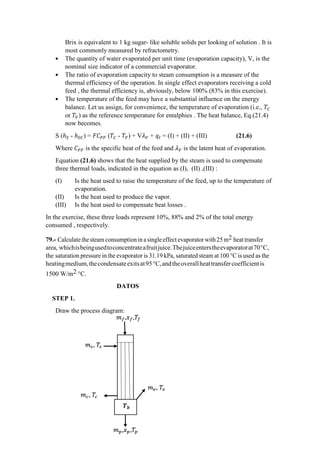
STEP 1.
Draw the process diagram:
𝑻 𝒃
𝑚 𝑓,𝑥 𝑓,𝑇𝑓
𝑚 𝑣, 𝑇𝑣
𝑚 𝑐, 𝑇𝑐
𝑚 𝑝,𝑥 𝑝,𝑇𝑝
𝑚 𝑠, 𝑇𝑠
STEP 2.
State your assumptions:
• The boiling point elevation is negligible.
• The heat losses to the environmet are negligible.
• The system operates at steady state
STEP 3.
89.- La corrosión por oxigeno de las tuberías de las calderas pueden reducirse si se
emplea sulfito de sodio, el cual elimina oxigeno del agua de alimentación de la coladera
por medio de la siguiente Reacción:
2Na2SO3 +O2 2Na2SO4
¿Cuántas libras de sulfito de sodio se requieren en teoría ( reacción completa) para
eliminar el oxigeno de 8,330,000 lb de agua (106 gal) que contiene 10.0 partes por
millón (ppm) de oxigeno disuelto y al mismo tiempo mantener un 35% de exceso de
sulfito de sodio?
DATOS:
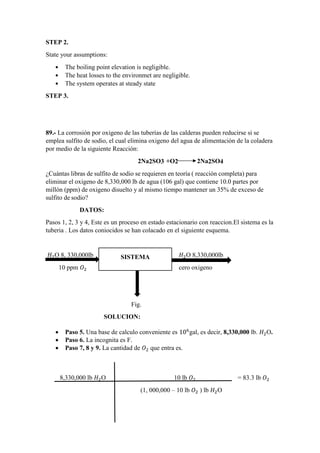
Pasos 1, 2, 3 y 4, Este es un proceso en estado estacionario con reaccion.El sistema es la
tuberia . Los datos coniocidos se han colacado en el siguiente esquema.
𝐻2O 8, 330,000lb 𝐻2O 8,330,000lb
10 ppm 𝑂2 cero oxigeno
Fig.
SOLUCION:
• Paso 5. Una base de calculo conveniente es 106
gal, es decir, 8,330,000 lb. 𝐻2O.
• Paso 6. La incognita es F.
• Paso 7, 8 y 9. La cantidad de 𝑂2 que entra es.
8,330,000 lb 𝐻2O 10 lb 𝑂2 = 83.3 lb 𝑂2
(1, 000,000 – 10 lb 𝑂2 ) lb 𝐻2O
SISTEMA
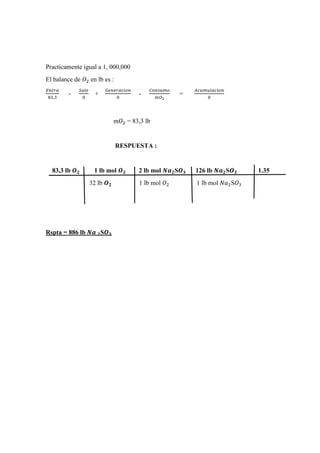
Practicamente igual a 1, 000,000
El balance de 𝑂2 en lb es :
𝐸𝑛𝑡𝑟𝑎
83,3
-
𝑆𝑎𝑙𝑒
0
+
𝐺𝑒𝑛𝑒𝑟𝑎𝑐𝑖𝑜𝑛
0
-
𝐶𝑜𝑛𝑠𝑢𝑚𝑜
𝑚𝑂2
=
𝐴𝑐𝑢𝑚𝑢𝑙𝑎𝑐𝑖𝑜𝑛
0
m𝑂2 = 83,3 lb
RESPUESTA :
83,3 lb 𝑶 𝟐 1 lb mol 𝑶 𝟐 2 lb mol 𝑵𝒂 𝟐S𝑶 𝟑 126 lb 𝑵𝒂 𝟐S𝑶 𝟑 1.35
32 lb 𝑶 𝟐 1 lb mol 𝑂2 1 lb mol 𝑁𝑎2S𝑂3
Rspta = 886 lb 𝑵𝒂 𝟐S𝑶 𝟑

Avance de balance tres convertido

  • 1.
    78.- Asingle-effect continuousevaporator is used to concentrate a fruit juice from 15 Bx to 40 Bx. The juice is fed at 25°C, at the rate of 5400 kg/h (1.5 kg/s). The evaporator is operated at reduced pressure, corresponding to a boiling temperature of 65°C. Heating is by saturated steam at 128°C, totally condensing inside a heating coil. The condensate exits at 128°C. Heat lossesareestimatedtoamountto2%oftheenergysuppliedbythesteam.Calculate: a. the concentration ratioR b. the required evaporation capacity V (kg/s) c. the required steam consumption S (kg/s) DATOS: F(𝑚 𝑓, 𝑥𝑓,ℎ𝑓) qL S(𝑚 𝑆, ℎ 𝑆) C(𝑚 𝐶, ℎ 𝐶) Overall material balance gives: F= V+C (21.1) Where: F = mass flow – rate of feed , kg.𝑆−1 V = mass flow – rate of vapor, kg.𝑆−1 C = mass flow – rate of concentrate (product), kg.𝑆−1 Material balance for the solids is written as follows. F. 𝑿 𝑭 = C . 𝑿 𝑪 (21.2) Where 𝑥 𝐹 and 𝑥 𝐶= mass fraction of solids in feed and concentrate, respectively. Combining Eq. (21.1) and (21.2) and defining ´´ concentration radio ´´as R =𝑥 𝐶 𝑥 𝐹: V = F(1- 1 𝑅 ) (21.3) P(𝑚 𝑃, 𝑥 𝑃, ℎ 𝑃) V(𝑚 𝑣, ℎ 𝑣)
  • 2.
    Note: Equation (21.2)assumes that the vapor does not contain solids. In practice the vapor does contain small quantities of solids , carried over by droplets of the boling liquid. Heat balance gives. F. ℎ 𝐹 + S ( ℎ 𝑆 - ℎ 𝑆𝐶) = C. ℎ 𝐶 + V . ℎ 𝑉 + 𝑞𝑙 (21.4) Where ℎ 𝐹, ℎ 𝑆, ℎ 𝑆𝐶, ℎ 𝐶, ℎ 𝑉 = specific enthalpies (J.𝑘𝑔−1 ) of feed , steam, steam condensate , concentrate and vapor , respectively; and 𝑞𝑙= rate of heat loss, w. SOLUTION Let´s answer the questions: a. R= 0.40 0.15 = 2,667 b. We apply the equation (21.3) V= F (1- 𝟏 𝑹 ) V= 5400 x (1- 1 2,667 ) = 3375kg. ℎ−1 = 0.938 kg . 𝑠−1 c. Boiling point elevation for 40 Bx will be assumed to be negligible (see example 21.2). The vapor will be assumed to be saturated vapor at 65℃ . Its enthalpy is read from steam tables as 2613 KJ. 𝑘𝑔−1 . The enthalpies of the steam and its saturated condensate are 2720.5 and 546.3 kJ. 𝑘𝑔−1 , respectively. The enthalpies of the feed and the product are calculated using the aproximate formula for sugar solutions. h = 4,187 ( 1- 0.7x )T (21.5) 𝒉 𝑭 = 4,187x 25. (1- 0,7 X 0.15) = 93,7 kJ. 𝑘𝑔−1 𝒉 𝑪 = 4, 187 x 65 .( 1- 0,7 x 0,40)= 195.9 kJ. 𝑘𝑔−1 ANSWER Substituting the data in Eq.(21.4), we find: S = 1.1135 kg . 𝒔−𝟏 V∕ S = 0.83 kg water evaporated per kg of live steam consumed. Notes on Exercise 78: • Bx ( degrees Brix) is an expression (already used in previous chapters) indicating concentration of total soluble solids in solutions, in wich the solutes are sugar – like compounds ( e.g., fruit juices , syrups, concentrates). One degree
  • 3.
    Brix is equivalentto 1 kg sugar- like soluble solids per looking of solution . It is most commonly measured by refractometry. • The quantity of water evaporated per unit time (evaporation capacity), V, is the nominal size indicator of a commercial evaporator. • The ratio of evaporation capacity to steam consumption is a measure of the thermal efficiency of the operation. In single effect evaporators receiving a cold feed , the thermal efficiency is, abviously, below 100% (83% in this exercise). • The temperature of the feed may have a substantial influence on the energy balance. Let us assign, for convenience, the temperature of evaporation (i.e., 𝑇𝐶 or 𝑇𝑉) as the reference temperature for entalphies . The heat balance, Eq.(21.4) now becomes. S (ℎ 𝑆 - ℎ 𝑆𝐶) = 𝐹𝐶 𝑃𝐹 (𝑇𝐶 - 𝑇𝐹) + V𝜆 𝑉 + 𝑞𝑙 = (I) + (II) + (III) (21.6) Where 𝐶 𝑃𝐹 is the specific heat of the feed and 𝜆 𝑉 is the latent heat of evaporation. Equation (21.6) shows that the heat supplied by the steam is used to compensate three thermal loads, indicated in the equation as (I), (II) ,(III) : (I) Is the heat used to raise the temperature of the feed, up to the temperature of evaporation. (II) Is the heat used to produce the vapor. (III) Is the heat used to compensate heat losses . In the exercise, these three loads represent 10%, 88% and 2% of the total energy consumed , respectively. 79.- Calculatethesteam consumptionin asingleeffect evaporator with25 m2 heattransfer area, whichisbeingusedtoconcentrateafruitjuice.Thejuiceenterstheevaporatorat70°C, the saturation pressure in the evaporator is 31.19 kPa, saturated steam at 100 °C is used as the heatingmedium,thecondensateexitsat95°C,andtheoverallheattransfercoefficientis 1500 W/m2 °C. DATOS STEP 1. Draw the process diagram: 𝑻 𝒃 𝑚 𝑓,𝑥 𝑓,𝑇𝑓 𝑚 𝑣, 𝑇𝑣 𝑚 𝑐, 𝑇𝑐 𝑚 𝑝,𝑥 𝑝,𝑇𝑝 𝑚 𝑠, 𝑇𝑠
  • 4.
    STEP 2. State yourassumptions: • The boiling point elevation is negligible. • The heat losses to the environmet are negligible. • The system operates at steady state STEP 3. 89.- La corrosión por oxigeno de las tuberías de las calderas pueden reducirse si se emplea sulfito de sodio, el cual elimina oxigeno del agua de alimentación de la coladera por medio de la siguiente Reacción: 2Na2SO3 +O2 2Na2SO4 ¿Cuántas libras de sulfito de sodio se requieren en teoría ( reacción completa) para eliminar el oxigeno de 8,330,000 lb de agua (106 gal) que contiene 10.0 partes por millón (ppm) de oxigeno disuelto y al mismo tiempo mantener un 35% de exceso de sulfito de sodio? DATOS: Pasos 1, 2, 3 y 4, Este es un proceso en estado estacionario con reaccion.El sistema es la tuberia . Los datos coniocidos se han colacado en el siguiente esquema. 𝐻2O 8, 330,000lb 𝐻2O 8,330,000lb 10 ppm 𝑂2 cero oxigeno Fig. SOLUCION: • Paso 5. Una base de calculo conveniente es 106 gal, es decir, 8,330,000 lb. 𝐻2O. • Paso 6. La incognita es F. • Paso 7, 8 y 9. La cantidad de 𝑂2 que entra es. 8,330,000 lb 𝐻2O 10 lb 𝑂2 = 83.3 lb 𝑂2 (1, 000,000 – 10 lb 𝑂2 ) lb 𝐻2O SISTEMA
  • 5.
    Practicamente igual a1, 000,000 El balance de 𝑂2 en lb es : 𝐸𝑛𝑡𝑟𝑎 83,3 - 𝑆𝑎𝑙𝑒 0 + 𝐺𝑒𝑛𝑒𝑟𝑎𝑐𝑖𝑜𝑛 0 - 𝐶𝑜𝑛𝑠𝑢𝑚𝑜 𝑚𝑂2 = 𝐴𝑐𝑢𝑚𝑢𝑙𝑎𝑐𝑖𝑜𝑛 0 m𝑂2 = 83,3 lb RESPUESTA : 83,3 lb 𝑶 𝟐 1 lb mol 𝑶 𝟐 2 lb mol 𝑵𝒂 𝟐S𝑶 𝟑 126 lb 𝑵𝒂 𝟐S𝑶 𝟑 1.35 32 lb 𝑶 𝟐 1 lb mol 𝑂2 1 lb mol 𝑁𝑎2S𝑂3 Rspta = 886 lb 𝑵𝒂 𝟐S𝑶 𝟑