Caroline Cerveny, SSJ-TOSF, D. Min.
Learner Leader
   Digital Immigrant
   Founder of Interactive Connections
   Master of Arts in Educational
    Technology and Religious Studies
   D.Min. in Parish Revitalization
   Educator in secondary education for 4 Years
   Pastoral Associate for 2 Years
   Diocesan Service for 16 Years
   Congregational Leadership for 4 Years
   Publishing Industry Electronic Media for 4 Years
   University Academic Technology and Campus Ministry for 7 Years
   New Media Formation since 1983 (30 Years)
What is Evangelization?
   Pope Paul VI in Evangelii Nuntiandi
     “evangelization is in fact the face and vocation
      proper to the Church, her deepest identity. She
      exists to evangelize


   USCCB : Go and Make Disciples
     http://old.usccb.org/evangelization/goandmake/eng.shtml
What is Evangelization?

   Bringing the Good News of Jesus into every
    human situation and seeking to convert
    individuals and society by divine power of the
    Gospel itself.
Goals for Evangelization
USCCB
 To bring about in all Catholics such an enthusiasm
  for their faith that, in living their faith in Jesus they
  freely share it with others
 To invite all people in the US whatever the social or
  cultural background to hear the message of
  salvation in Jesus Christ so that they may come to
  join us in the fullness of the Catholic faith
 To foster gospel values in our society promoting the
  dignity and the common good of our society, so that
  our nation may continue to be transformed by the
  saving power of Jesus
Goals for Evangelization
 Steeped in Prayer
 Focus on everyday life
 Evangelize Church goers with a deeper faith
What is Good News?
 Loving God that is intimately involved with
  us
 Intermediary is Jesus
 Salvation through Jesus’ sacrifice
 God is with us still
Good News of Evangelization
   Evangelization is the deepest part of our
    Catholic identity
     ENFLAME those who are already connected to
      Christ
     INVITE others to join us – in doing so
     TRANSFORM the world
Evangelii Nuntiandi (1975)
   Goal for communications media - while social
    communications can reach millions of people, there
    remains a challenge of “piercing the conscience of each
    individual, of implanting [the gospel] in his heart as
    though he were the only person being addressed, with all
    his most individual and personal qualities, and evoke an
    entirely personal adherence and commitment” (45).
   The “person-to-person” form of encounter “remains valid
    and important” and points to Jesus Christ’s own
    encounters with individuals in the gospels (46). He
    poignantly asks, “In the long run, is there any other way
    of handing on the Gospel than by transmitting to another
    person one’s personal experience of faith?”


    http://www.capuchins.org/articles/Evan_Nunt_PPVI.pdf
ROME, MAY 5, 2011 (Zenit.org)
 Evangelization in a world of
 communications technology is the biggest
 challenge the Vatican is facing today,
 according to the president of the Pontifical
 Council for Social Communications -
 Archbishop Claudio Celli
New Culture Example
   400,000 primary school children in Uruguay studying on
    laptops
   "From first grade," the Archbishop said, "they learn to
    relate to and to know one another through the computer.
    To find out something they go to Wikipedia, and they
    connect from home with their friends. A child who lives
    in connection with others, for example, understands
    better what it means to be in communication." And he
    will also be able "to understand better what the Mystical
    Body of Christ is" because he will understand better what
    it means to be in communication with the Church.
   Nevertheless, the Vatican official cautioned, a paradox
    exists, because "while one is connected, at the same time
    one is very alone."
Basic Problem:
According to Archbishop Celli


   How well is the Church able to
    communicate and proclaim the Gospel in
    this digital culture?
Digital Culture Creative Classroom


https://www.youtube.com/watch?v=x_bWNSEwe0U
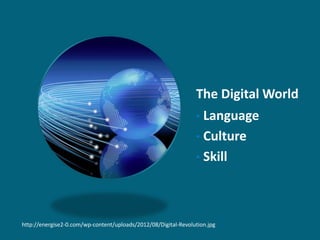
The Digital World
                                                                • Language
                                                                • Culture
                                                                • Skill


http://energise2-0.com/wp-content/uploads/2012/08/Digital-Revolution.jpg
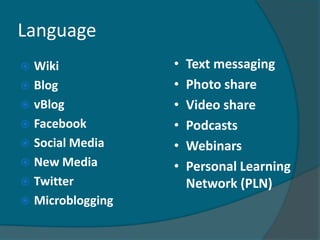
Language
 Wiki            •   Text messaging
 Blog            •   Photo share
 vBlog           •   Video share
 Facebook        •   Podcasts
 Social Media    •   Webinars
 New Media       •   Personal Learning
 Twitter             Network (PLN)
 Microblogging
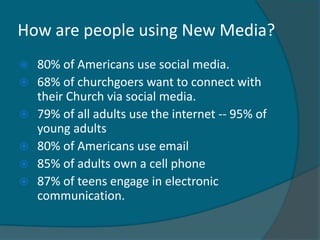
How are people using New Media?
   80% of Americans use social media.
   68% of churchgoers want to connect with
    their Church via social media.
   79% of all adults use the internet -- 95% of
    young adults
   80% of Americans use email
   85% of adults own a cell phone
   87% of teens engage in electronic
    communication.
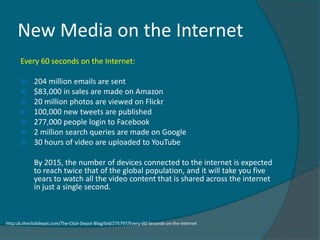
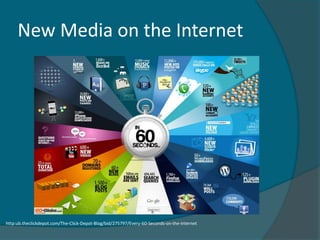
New Media on the Internet
      Every 60 seconds on the Internet:

            204 million emails are sent
            $83,000 in sales are made on Amazon
            20 million photos are viewed on Flickr
            100,000 new tweets are published
            277,000 people login to Facebook
            2 million search queries are made on Google
            30 hours of video are uploaded to YouTube

             By 2015, the number of devices connected to the internet is expected
             to reach twice that of the global population, and it will take you five
             years to watch all the video content that is shared across the internet
             in just a single second.


http:ub.theclickdepot.com/The-Click-Depot-Blog/bid/275797/Every-60-Seconds-on-the-Internet
New Media on the Internet


http:ub.theclickdepot.com/The-Click-Depot-Blog/bid/275797/Every-60-Seconds-on-the-Internet
What is “New Media”
 On-demand access to content any time,
  anywhere, on any digital device
 Interactive user feedback
 Creative participation and community formation
     Creation
     Publication
     Distribution
     Consumption
What is “New Media”
 Digital
 Content manipulated
     Networkable
     Dense
     Compressible
     Interactive
New Media
 Websites
 Computer multimedia (video/audio)
 Video Games
 CD-Roms
 DVD
 NOT
     TV, feature films, magazines, books, paper-based
      publications unless digital interactivity
                                   Source: Wikipedia.com
Social Media
   Web-based and mobile technologies
     Turns communication into interactive
      dialogue
     Easily accessible
Social Media
 Internet Magazines
 Internet forums
 Weblogs
 Social Blogs
 Microblogging
 Wikis
 Podcasts
Social Media
 Photo sharing sites
 Video sharing sites
 Social bookmarking sites
Social Media
   Six Different Types
     Collaborative projects (Wikipedia)
     Blogs and micro blogs (Twitter)
     Content Communities (YouTube)
     Social Networking (Facebook – LinkedIn)
     Virtual Game Worlds (World of Warcraft)
     Virtual Social Worlds (Second Life)
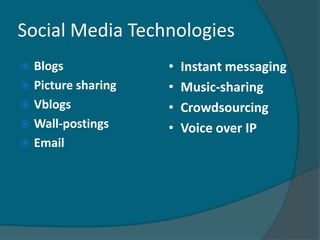
Social Media Technologies
 Blogs             •   Instant messaging
 Picture sharing   •   Music-sharing
 Vblogs            •   Crowdsourcing
 Wall-postings     •   Voice over IP
 Email
SKILL
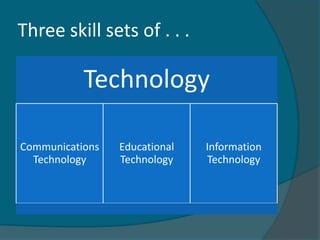
Three skill sets of . . .

           Technology

Communications   Educational   Information
  Technology     Technology    Technology
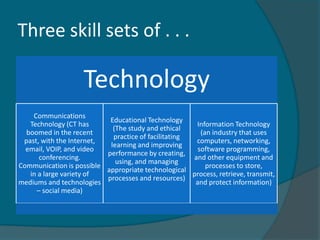
Three skill sets of . . .

                    Technology
    Communications
                           Educational Technology
   Technology (CT has                                 Information Technology
                            (The study and ethical
  boomed in the recent                                  (an industry that uses
                            practice of facilitating
 past, with the Internet,                             computers, networking,
                           learning and improving
  email, VOIP, and video                               software programming,
                          performance by creating,
      conferencing.                                  and other equipment and
                             using, and managing
Communication is possible                                 processes to store,
                          appropriate technological
   in a large variety of                             process, retrieve, transmit,
                          processes and resources)
mediums and technologies                              and protect information)
     – social media)
Three skill sets of . . .

                   Technology
    Communications
   Technology (CT has
  boomed in the recent
 past, with the Internet,
  email, VOIP, and video
      conferencing.
Communication is possible
   in a large variety of
mediums and technologies
     – social media)
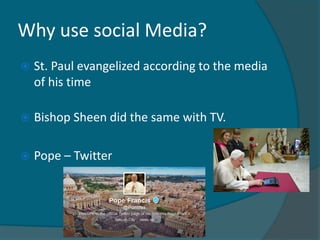
Why use social Media?
   St. Paul evangelized according to the media
    of his time

   Bishop Sheen did the same with TV.

   Pope – Twitter
Our Media
   Go where the people are

   Reaches new audiences

   Provides information in the manner that we are
    used to finding it

   Available and accessible
New Media – Authentic Voice?
   How can I remain confident that we are truly
    communication THE Catholic faith and my OWN
    versions of the Catholic faith? My solution is to
    saturate my writings with Scripture and the
    Church Fathers – but especially the Church
    Fathers. If I am to write an article or post about
    the Sacraments of Baptism, I have to begin by
    admitting the following: What did the great
    Fathers, theologians, and saints say about it?
    Therefore I try to constantly glean authoritative
    passages from Church history.
           Taylor Marshall– Church in the new media – Brandon Vogt
The New Media -- TODAY
   We are expanding the message of Christ
    and the apostles become our own

   NOT changing the message … but making it
    relevant to our time
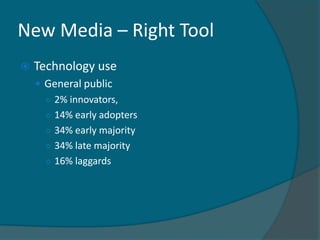
New Media – Right Tool
   Technology use
     General public
      ○ 2% innovators,
      ○ 14% early adopters
      ○ 34% early majority
      ○ 34% late majority
      ○ 16% laggards
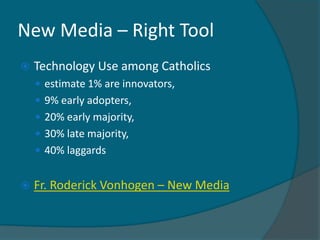
New Media – Right Tool
   Technology Use among Catholics
     estimate 1% are innovators,
     9% early adopters,
     20% early majority,
     30% late majority,
     40% laggards


   Fr. Roderick Vonhogen – New Media
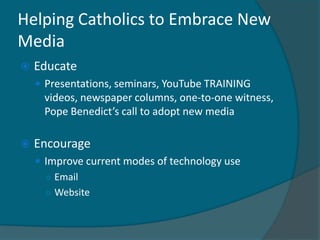
Helping Catholics to Embrace New
Media
   Educate
     Presentations, seminars, YouTube TRAINING
     videos, newspaper columns, one-to-one witness,
     Pope Benedict’s call to adopt new media

   Encourage
     Improve current modes of technology use
      ○ Email
      ○ Website
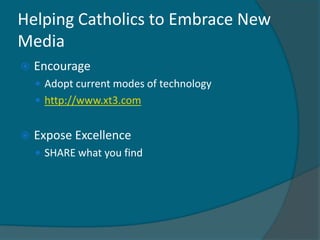
Helping Catholics to Embrace New
Media
   Encourage
     Adopt current modes of technology
     http://www.xt3.com


   Expose Excellence
     SHARE what you find
Helping Catholics to Embrace New
Media
   Evaluate
     Where are we now?
     Where we need to go?
     PLAN with experts


   Execute
     Build the idea of what “users” want
     Does not have to be expensive
     Use Guidelines by USCCB
     Social Networking Policy by your diocese
Helping Catholics to Embrace New
Media
   Extend
     Catholic TV
     Homilies through podcasts
     Parish blog, Facebook fanpage, twitter accounts


   Evangelize
     Go and make disciples – words of Christ
     Media is NOT the message
Experience of Church
 According to Matt Waner
 We need to evangelize the way our audience
  wants to listen
     80% use some form of social media
     68% want to connect with church using social media
     Most regularly use email and text messaging to
      communicate – most of these people do not read
      parish bulletin – most are not registered with parish –
      most don’t think about parish in between Sundays.
Experience of the Church
        Pope Benedict XVI, message for the 44th World
               Communication Day – May 2010
   Priests stand at the threshold of a new era: as new
    technologies create deeper forms of relationship across
    greater distances, they are called to respond pastorally
    by putting the media ever more effectively at the service
    of the Word. ….

   Priests are thus challenged to proclaim the Gospel by
    employing the latest generation of audiovisual resources
    (images, videos, animated features, blogs, websites)
    which, alongside traditional means, can open up broad
    new vistas for dialogue, evangelization and catechesis.
Parish Website
   YOUR WEBSITE MATTERS!
   Official Presence
   Primary presence of WHO you are. Similar to
    the sign out front.
   UP TO DATE
   Collaborative TEAM
   Engage target audience
   Create a “brand”
                          Opensourcecatholic.com
Parish Website
   Two fold purpose
     Visitors EASILY find information
     Connect with parishioners
      ○ Mailing lists
      ○ Email, phone number, registration information
      ○ ENGAGE them on facebook or twitter
      ○ ALL OF THE ABOVE
Parish Website
   Seek the guidance of professionals
     Really knows about building websites
     Spend more money on website than doughnuts
     Less than a car
     Within 4 seconds – find into
     EVERY director of ministries should update their
      own page
Parish Website
   WHY SHOULD SOMEONE VISIT YOUR
    WEBSITE?
     Build the site around that
      ○ Confession times
      ○ Mass times
      ○ On-line parish registration
      ○ Parish ministry information
      ○ Tell story of your parish
      ○ LINK TO THE DIOCESE SITE
Parish Website
   Reach people where they are
     Early missionaries WENT OUT to the people


   Email
     Unsubscribe
     Every subscription to ministry lists
     PRUDENT in use
Parish Website – Reach people
   Text messaging
     Bulk texting
     NEVER late at night
     Opt our of messaging for individual users


   DON’T give up
Parish Website – Engage People
   Engage their hearts FIRST
     "If your mission is to be truly effective—if the
      words you proclaim are to touch hearts, engage
      people's freedom and change their lives—you
      must draw them into an encounter with persons
      and communities who witness to the grace of
      Christ by their faith and their lives," he said.

                                           Pope Benedict XVI
          http://www.americancatholic.org/news/report.aspx?id=2682
Parish Website – Engage People
   Communication PLAN
     Serious budget
     Hire someone
     Take notice of free services
     Leadership within the parish


     Catholic websites
      ○ http://the-american-catholic.com/2009/04/20/googles-top-
        25-catholic-websites/
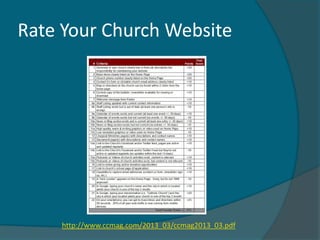
Rate Your Church Website


    http://www.ccmag.com/2013_03/ccmag2013_03.pdf
Blog
   What is it?
     A personal journal published on a the Web
      consisting of discrete entries or “posts”
     Displayed in reverse chronological order – recent
      appears first
     Themed on a single subject


   Because of the interaction, part of social
    networking
Blog
   Not only produce content but also build
    social relations with their readers

   Different than newspapers – viewers can
    comment on what is being written
Blog
 Post regularly
 Record talks presentations (podcasts – only
  audio)
 Record homilies (video and/or audio)
 Viewers can access from home
     Church comes home
     More than Sunday
Blogs and Community
   Fuel true conversation
   Builds community
     Virtual choir
      (http://www.ted.com/talks/eric_whitacre_a_virtual_choir_2_0
      00_voices_strong.html )

   while previous generations of moms gathered for Rosary
    groups or play dates at catholic school playground,
    today’s mothers tend to supplement their “real world”
    friendships with the vibrant communities that have
    cropped up around the Internet in places like
    catholicmom.com – builds mutual trust, true dialogue,
    and lasting friendship
                                                   Lisa Hendey
Blogs and Community
Entering cyberspace can be a sign of an authentic
search for personal encounters with others,
provided that attention is paid to avoiding dangers
such as enclosing oneself in a sort of parallel
existence, or excessive exposure to the virtual
world. In the search for sharing, for “friends”, there
is the challenge to be authentic and faithful, and
not give in to the illusion of constructing an artificial
public profile for oneself
                                             MESSAGE OF HIS HOLINESS
                                                   POPE BENEDICT XVI
                             FOR THE 45th WORLD COMMUNICATIONS DAY
Community Beliefs
   Contributions of each person are valuable
   Share openly and honestly.
   Be supportive
   Believing that we all have something to
    contribute - perspectives, talent,
   Be grateful for contributions and for
    participation. for the - just being there
   There are those you can help and those you
    can learn from.
   AND Encourage more sharing
Facebook
 Huge part of lives
 500 million users (2010) – 70 languages
 73% of 12 – 17 years olds have at least one
  profile
 7.5 million kids under 13
 Used by businesses, organizations, and
  governments
Facebook
 Chat
 Share photos (100 million every day)
 Post videos
 Share personal news
 30 billion pieces of content monthly
Why use facebook?
 Socializing or “hanging out”
 Day-to-day news about their friends,
  acquaintances, relatives, and peer groups
 Collaborating
 Validation or emotional support
 Self-expression and the identity exploration and
  formation
Why use facebook?
   “Informal learning,” or learning outside of
    formal settings such as school, including
    learning social norms and social literacy

   Learning the technical skills of the digital
    age,
Why use facebook?
   Discovering and exploring interests, both
    academic and future professional interests

   Learning about the world

   Civic engagement – participating in causes
    that are meaningful to them.
Twitter
   Twitter is an online social networking
    service and microblogging service that
    enables its users to send and read text-
    based posts of up to 140 characters, known
    as "tweets".
                                        Wikipedia
Visit to Twitter
 Username
 Tweets
 Hastags
 Following people
 Direct messages
 Shortened URLS
Podcasts
   Digital media consisting of an episodic
    series of audio files
     From "broadcast" and "pod" from the success of
      the iPod, as podcasts are often listened to on
      portable media players.


   http://catholicboard.com/utspodcast/introduction
Podcasts
 www.SQPN.com – Star Quest Production
  Network
 www.CatholicAudio.blogspot.com Sonitus
  Sanctus
 www.CatholiciCast.com Catholic Cast
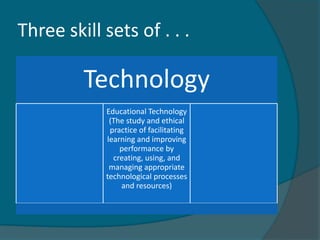
Three skill sets of . . .

         Technology
            Educational Technology
             (The study and ethical
             practice of facilitating
            learning and improving
                performance by
              creating, using, and
             managing appropriate
            technological processes
                and resources)
Digital Discipleship
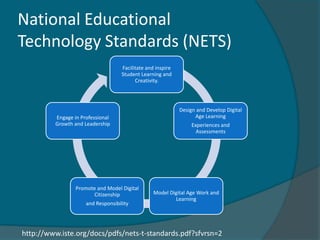
National Educational
Technology Standards (NETS)
                                    Facilitate and inspire
                                    Student Learning and
                                          Creativity.


                                                             Design and Develop Digital
         Engage in Professional                                    Age Learning
         Growth and Leadership                                    Experiences and
                                                                    Assessments


                 Promote and Model Digital
                       Citizenship               Model Digital Age Work and
                                                         Learning
                     and Responsibility


http://www.iste.org/docs/pdfs/nets-t-standards.pdf?sfvrsn=2
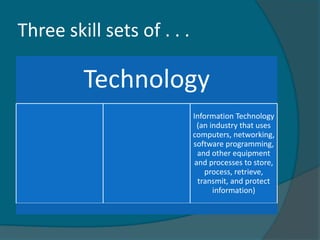
Three skill sets of . . .

         Technology
                            Information Technology
                              (an industry that uses
                            computers, networking,
                            software programming,
                              and other equipment
                             and processes to store,
                                process, retrieve,
                              transmit, and protect
                                   information)
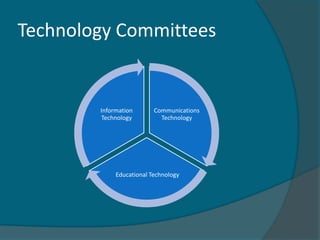
Technology Committees


        Information       Communications
        Technology          Technology


             Educational Technology
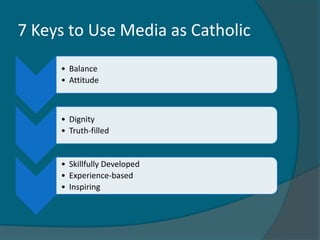
7 Keys to Use Media as Catholic
     • Balance
     • Attitude


     • Dignity
     • Truth-filled


     • Skillfully Developed
     • Experience-based
     • Inspiring
7 keys to use Media as a Catholic
   Balance: How the Church says it
     must take into consideration the entire situation or
      circumstances, namely, the persons, place, time and
      other conditions under which communication takes
      place and which can affect or totally change its
      propriety” (Inter Mirifica, No. 4).

     Media consumers “should exercise self-control. They
      must not allow themselves to be so beguiled by the
      charms of the media’s products or by the curiosity
      that these arouse that they neglect urgent duties or
      simply waste time” (Communio et Progressio, No. 52).
7 keys to use Media as a Catholic
   Attitude
     Critical awareness of the message
     Why it matters?
      ○ Message affects us for good and for ill
     How to?
      ○ Research and observation
         Who makes it
         Look for behaviors that are encouraged, discouraged,
          rewarded, or mocked. Ask, “Does the use prompt
          Christian behavior?”
7 keys to use Media as a Catholic
   Attitude: What the Church Says
     “The means of communication ... enrich men’s
     minds if their character and function is
     understood. On the other hand, men who do not
     sufficiently appreciate their importance, may
     find their liberty diminished” (Communio et
     Progressio, No. 64).
7 keys to use Media as a Catholic
   Dignity of the Human Person
     Creating and using media that upholds, reflects,
      and promotes and defends the dignity of the
      human person
     Why it matters?
      ○ Media exists to serve human person:
         To enlighten us about:
          - Who we are
          - To spread information
          - Build human community
          - Love more fully
7 keys to use Media as a Catholic
   Dignity of the Human Person
     How to?
      ○ Pornography
      ○ Online communities treat real people like objects
      ○ When face-to-face ONLY answer cell phone or
        respond to text messages when necessary
      ○ Don’t post intimate details about family
      ○ Use technology to spread gossip
7 keys to use Media as a Catholic
   What the Church Says:
     The human person and the human community
     are the end and measure of the use of the media
     of social communication; communication should
     be by persons to persons for the integral
     development of persons” (Ethics in
     Communication, No. 21).
7 keys to use Media as a Catholic
   Truth-filled
     What it means?
      ○ Conform to reality and lead others to reality
     Why it matters?
      ○ Connects with people on level of emotion
         Truth more compelling
         Lies more believable
         Pope Paul IV – teachers of faith are the witnesses to faith
          – how are we using media?
7 keys to use Media as a Catholic
   Truth-filled
     How to?
      ○ Use facebook to post links interesting to faith
      ○ Don’t avoid difficult discussions on-line
      ○ Never pass another work as your own
      ○ Exercise same charity with folks on-line as with
        face to face
7 keys to use Media as a Catholic
   What Church says
     “Every communication must comply with certain
     essential requirements and these are sincerity,
     honesty and truthfulness. Good intentions and a
     clear conscience do not thereby make a
     communication sound and reliable. A
     communication must state the truth”
     (Communio et Progressio, No. 17).
7 keys to use Media as a Catholic
   Inspires
     What it means?
      ○ Can help us in our journey to heaven
      ○ Pointing us in the right way
      ○ Inspire us for the good
     How to?
      ○ Avoid media that inspired in the wrong direction
      ○ Feature on blog or facebook songs that inspire
      ○ Don’t use media to “kill time”
7 keys to use Media as a Catholic
   What Church says
     “Today it takes no great stretch of the
      imagination to envisage the earth as an
      interconnected globe humming with electronic
      transmissions — a chattering planet nestled in
      the provident silence of space. The ethical
      question is whether this is contributing to
      authentic human development and helping
      individuals and peoples to be true to their
      transcendent destiny” (Ethics in Internet, No. 1).
7 keys to use Media as a Catholic
   Skillfully Developed
     What it means?
      ○ The media that Catholics develop should be GOOD
        – as compared to the secular media
     Why it matters?
      ○ Packing matters
         Increases credibility and believability as well as hold
          attention
     How?
      ○ Do your research – visit websites
7 keys to use Media as a Catholic
   What the Church Says:
     :“[Catholic communicators] have a duty in
      conscience to make themselves competent in
      the art of social communication in order to be
      effective in their work. ... People today have
      grown so used to the entertaining style and
      skillful presentation of communications by the
      media that they are intolerant of what is
      obviously inferior in any public presentation”
      (Communio et Progressio, Nos. 15, 130).
7 keys to use Media as a Catholic
   Experienced – based
     Related to human experience
      ○ Rooted in realities of the world
      ○ Appeals to our senses
     How to
      ○ Embed videos on blog or social networking page
      ○ Incorporate stories about self and life on blog
      ○ You have a sense of you
7 keys to use Media as a Catholic
   What the Church says:
     “While he was on earth Christ revealed himself as
      the Perfect Communicator. Through his ‘incarnation,’
      he utterly identified himself with those who were to
      receive his communication, and he gave his message
      not only in words but in the whole manner of his life.
      He spoke from within, that is to say, from out of the
      press of his people. He preached the divine message
      without fear or compromise. He adjusted to his
      people’s way of talking and to their patterns of
      thought. And he spoke out of the predicament of
      their time” (Communio et Progressio, No. 11).
Basic Problem:
According to Archbishop Celli


   How well is the Church able to
    communicate and proclaim the Gospel in
    this digital culture?
Caroline Cerveny, SSJ-
TOSF, D. Min.
c.cerveny@verizon.net
https://www.facebook.com/c.cerveny
https://twitter.com/ccerveny
@ccerveny
http://acyberpilgrim.org
http://catechesis20.org
http://digitalcatechesis.ning.com


 Resource: Evangelization in the Digital Age,
 Sr. Geralyn Schmidt, SCC

Evangelizing In Our Digital Culture

  • 1.
  • 2.
    Learner Leader  Digital Immigrant  Founder of Interactive Connections  Master of Arts in Educational Technology and Religious Studies  D.Min. in Parish Revitalization  Educator in secondary education for 4 Years  Pastoral Associate for 2 Years  Diocesan Service for 16 Years  Congregational Leadership for 4 Years  Publishing Industry Electronic Media for 4 Years  University Academic Technology and Campus Ministry for 7 Years  New Media Formation since 1983 (30 Years)
  • 3.
    What is Evangelization?  Pope Paul VI in Evangelii Nuntiandi  “evangelization is in fact the face and vocation proper to the Church, her deepest identity. She exists to evangelize  USCCB : Go and Make Disciples  http://old.usccb.org/evangelization/goandmake/eng.shtml
  • 4.
    What is Evangelization?  Bringing the Good News of Jesus into every human situation and seeking to convert individuals and society by divine power of the Gospel itself.
  • 5.
    Goals for Evangelization USCCB To bring about in all Catholics such an enthusiasm for their faith that, in living their faith in Jesus they freely share it with others  To invite all people in the US whatever the social or cultural background to hear the message of salvation in Jesus Christ so that they may come to join us in the fullness of the Catholic faith  To foster gospel values in our society promoting the dignity and the common good of our society, so that our nation may continue to be transformed by the saving power of Jesus
  • 6.
    Goals for Evangelization Steeped in Prayer  Focus on everyday life  Evangelize Church goers with a deeper faith
  • 7.
    What is GoodNews?  Loving God that is intimately involved with us  Intermediary is Jesus  Salvation through Jesus’ sacrifice  God is with us still
  • 8.
    Good News ofEvangelization  Evangelization is the deepest part of our Catholic identity  ENFLAME those who are already connected to Christ  INVITE others to join us – in doing so  TRANSFORM the world
  • 9.
    Evangelii Nuntiandi (1975)  Goal for communications media - while social communications can reach millions of people, there remains a challenge of “piercing the conscience of each individual, of implanting [the gospel] in his heart as though he were the only person being addressed, with all his most individual and personal qualities, and evoke an entirely personal adherence and commitment” (45).  The “person-to-person” form of encounter “remains valid and important” and points to Jesus Christ’s own encounters with individuals in the gospels (46). He poignantly asks, “In the long run, is there any other way of handing on the Gospel than by transmitting to another person one’s personal experience of faith?” http://www.capuchins.org/articles/Evan_Nunt_PPVI.pdf
  • 10.
    ROME, MAY 5,2011 (Zenit.org) Evangelization in a world of communications technology is the biggest challenge the Vatican is facing today, according to the president of the Pontifical Council for Social Communications - Archbishop Claudio Celli
  • 11.
    New Culture Example  400,000 primary school children in Uruguay studying on laptops  "From first grade," the Archbishop said, "they learn to relate to and to know one another through the computer. To find out something they go to Wikipedia, and they connect from home with their friends. A child who lives in connection with others, for example, understands better what it means to be in communication." And he will also be able "to understand better what the Mystical Body of Christ is" because he will understand better what it means to be in communication with the Church.  Nevertheless, the Vatican official cautioned, a paradox exists, because "while one is connected, at the same time one is very alone."
  • 12.
    Basic Problem: According toArchbishop Celli  How well is the Church able to communicate and proclaim the Gospel in this digital culture?
  • 14.
    Digital Culture CreativeClassroom https://www.youtube.com/watch?v=x_bWNSEwe0U
  • 16.
    The Digital World • Language • Culture • Skill http://energise2-0.com/wp-content/uploads/2012/08/Digital-Revolution.jpg
  • 17.
    Language  Wiki • Text messaging  Blog • Photo share  vBlog • Video share  Facebook • Podcasts  Social Media • Webinars  New Media • Personal Learning  Twitter Network (PLN)  Microblogging
  • 19.
    How are peopleusing New Media?  80% of Americans use social media.  68% of churchgoers want to connect with their Church via social media.  79% of all adults use the internet -- 95% of young adults  80% of Americans use email  85% of adults own a cell phone  87% of teens engage in electronic communication.
  • 20.
    New Media onthe Internet Every 60 seconds on the Internet:  204 million emails are sent  $83,000 in sales are made on Amazon  20 million photos are viewed on Flickr  100,000 new tweets are published  277,000 people login to Facebook  2 million search queries are made on Google  30 hours of video are uploaded to YouTube By 2015, the number of devices connected to the internet is expected to reach twice that of the global population, and it will take you five years to watch all the video content that is shared across the internet in just a single second. http:ub.theclickdepot.com/The-Click-Depot-Blog/bid/275797/Every-60-Seconds-on-the-Internet
  • 21.
    New Media onthe Internet http:ub.theclickdepot.com/The-Click-Depot-Blog/bid/275797/Every-60-Seconds-on-the-Internet
  • 22.
    What is “NewMedia”  On-demand access to content any time, anywhere, on any digital device  Interactive user feedback  Creative participation and community formation  Creation  Publication  Distribution  Consumption
  • 23.
    What is “NewMedia”  Digital  Content manipulated  Networkable  Dense  Compressible  Interactive
  • 24.
    New Media  Websites Computer multimedia (video/audio)  Video Games  CD-Roms  DVD  NOT  TV, feature films, magazines, books, paper-based publications unless digital interactivity Source: Wikipedia.com
  • 25.
    Social Media  Web-based and mobile technologies  Turns communication into interactive dialogue  Easily accessible
  • 26.
    Social Media  InternetMagazines  Internet forums  Weblogs  Social Blogs  Microblogging  Wikis  Podcasts
  • 27.
    Social Media  Photosharing sites  Video sharing sites  Social bookmarking sites
  • 28.
    Social Media  Six Different Types  Collaborative projects (Wikipedia)  Blogs and micro blogs (Twitter)  Content Communities (YouTube)  Social Networking (Facebook – LinkedIn)  Virtual Game Worlds (World of Warcraft)  Virtual Social Worlds (Second Life)
  • 29.
    Social Media Technologies Blogs • Instant messaging  Picture sharing • Music-sharing  Vblogs • Crowdsourcing  Wall-postings • Voice over IP  Email
  • 30.
  • 31.
    Three skill setsof . . . Technology Communications Educational Information Technology Technology Technology
  • 32.
    Three skill setsof . . . Technology Communications Educational Technology Technology (CT has Information Technology (The study and ethical boomed in the recent (an industry that uses practice of facilitating past, with the Internet, computers, networking, learning and improving email, VOIP, and video software programming, performance by creating, conferencing. and other equipment and using, and managing Communication is possible processes to store, appropriate technological in a large variety of process, retrieve, transmit, processes and resources) mediums and technologies and protect information) – social media)
  • 33.
    Three skill setsof . . . Technology Communications Technology (CT has boomed in the recent past, with the Internet, email, VOIP, and video conferencing. Communication is possible in a large variety of mediums and technologies – social media)
  • 34.
    Why use socialMedia?  St. Paul evangelized according to the media of his time  Bishop Sheen did the same with TV.  Pope – Twitter
  • 35.
    Our Media  Go where the people are  Reaches new audiences  Provides information in the manner that we are used to finding it  Available and accessible
  • 36.
    New Media –Authentic Voice?  How can I remain confident that we are truly communication THE Catholic faith and my OWN versions of the Catholic faith? My solution is to saturate my writings with Scripture and the Church Fathers – but especially the Church Fathers. If I am to write an article or post about the Sacraments of Baptism, I have to begin by admitting the following: What did the great Fathers, theologians, and saints say about it? Therefore I try to constantly glean authoritative passages from Church history. Taylor Marshall– Church in the new media – Brandon Vogt
  • 37.
    The New Media-- TODAY  We are expanding the message of Christ and the apostles become our own  NOT changing the message … but making it relevant to our time
  • 38.
    New Media –Right Tool  Technology use  General public ○ 2% innovators, ○ 14% early adopters ○ 34% early majority ○ 34% late majority ○ 16% laggards
  • 39.
    New Media –Right Tool  Technology Use among Catholics  estimate 1% are innovators,  9% early adopters,  20% early majority,  30% late majority,  40% laggards  Fr. Roderick Vonhogen – New Media
  • 40.
    Helping Catholics toEmbrace New Media  Educate  Presentations, seminars, YouTube TRAINING videos, newspaper columns, one-to-one witness, Pope Benedict’s call to adopt new media  Encourage  Improve current modes of technology use ○ Email ○ Website
  • 41.
    Helping Catholics toEmbrace New Media  Encourage  Adopt current modes of technology  http://www.xt3.com  Expose Excellence  SHARE what you find
  • 42.
    Helping Catholics toEmbrace New Media  Evaluate  Where are we now?  Where we need to go?  PLAN with experts  Execute  Build the idea of what “users” want  Does not have to be expensive  Use Guidelines by USCCB  Social Networking Policy by your diocese
  • 43.
    Helping Catholics toEmbrace New Media  Extend  Catholic TV  Homilies through podcasts  Parish blog, Facebook fanpage, twitter accounts  Evangelize  Go and make disciples – words of Christ  Media is NOT the message
  • 44.
    Experience of Church According to Matt Waner  We need to evangelize the way our audience wants to listen  80% use some form of social media  68% want to connect with church using social media  Most regularly use email and text messaging to communicate – most of these people do not read parish bulletin – most are not registered with parish – most don’t think about parish in between Sundays.
  • 45.
    Experience of theChurch Pope Benedict XVI, message for the 44th World Communication Day – May 2010  Priests stand at the threshold of a new era: as new technologies create deeper forms of relationship across greater distances, they are called to respond pastorally by putting the media ever more effectively at the service of the Word. ….  Priests are thus challenged to proclaim the Gospel by employing the latest generation of audiovisual resources (images, videos, animated features, blogs, websites) which, alongside traditional means, can open up broad new vistas for dialogue, evangelization and catechesis.
  • 46.
    Parish Website  YOUR WEBSITE MATTERS!  Official Presence  Primary presence of WHO you are. Similar to the sign out front.  UP TO DATE  Collaborative TEAM  Engage target audience  Create a “brand” Opensourcecatholic.com
  • 47.
    Parish Website  Two fold purpose  Visitors EASILY find information  Connect with parishioners ○ Mailing lists ○ Email, phone number, registration information ○ ENGAGE them on facebook or twitter ○ ALL OF THE ABOVE
  • 48.
    Parish Website  Seek the guidance of professionals  Really knows about building websites  Spend more money on website than doughnuts  Less than a car  Within 4 seconds – find into  EVERY director of ministries should update their own page
  • 49.
    Parish Website  WHY SHOULD SOMEONE VISIT YOUR WEBSITE?  Build the site around that ○ Confession times ○ Mass times ○ On-line parish registration ○ Parish ministry information ○ Tell story of your parish ○ LINK TO THE DIOCESE SITE
  • 50.
    Parish Website  Reach people where they are  Early missionaries WENT OUT to the people  Email  Unsubscribe  Every subscription to ministry lists  PRUDENT in use
  • 51.
    Parish Website –Reach people  Text messaging  Bulk texting  NEVER late at night  Opt our of messaging for individual users  DON’T give up
  • 52.
    Parish Website –Engage People  Engage their hearts FIRST  "If your mission is to be truly effective—if the words you proclaim are to touch hearts, engage people's freedom and change their lives—you must draw them into an encounter with persons and communities who witness to the grace of Christ by their faith and their lives," he said. Pope Benedict XVI http://www.americancatholic.org/news/report.aspx?id=2682
  • 53.
    Parish Website –Engage People  Communication PLAN  Serious budget  Hire someone  Take notice of free services  Leadership within the parish  Catholic websites ○ http://the-american-catholic.com/2009/04/20/googles-top- 25-catholic-websites/
  • 54.
    Rate Your ChurchWebsite http://www.ccmag.com/2013_03/ccmag2013_03.pdf
  • 55.
    Blog  What is it?  A personal journal published on a the Web consisting of discrete entries or “posts”  Displayed in reverse chronological order – recent appears first  Themed on a single subject  Because of the interaction, part of social networking
  • 56.
    Blog  Not only produce content but also build social relations with their readers  Different than newspapers – viewers can comment on what is being written
  • 57.
    Blog  Post regularly Record talks presentations (podcasts – only audio)  Record homilies (video and/or audio)  Viewers can access from home  Church comes home  More than Sunday
  • 58.
    Blogs and Community  Fuel true conversation  Builds community  Virtual choir (http://www.ted.com/talks/eric_whitacre_a_virtual_choir_2_0 00_voices_strong.html )  while previous generations of moms gathered for Rosary groups or play dates at catholic school playground, today’s mothers tend to supplement their “real world” friendships with the vibrant communities that have cropped up around the Internet in places like catholicmom.com – builds mutual trust, true dialogue, and lasting friendship Lisa Hendey
  • 59.
    Blogs and Community Enteringcyberspace can be a sign of an authentic search for personal encounters with others, provided that attention is paid to avoiding dangers such as enclosing oneself in a sort of parallel existence, or excessive exposure to the virtual world. In the search for sharing, for “friends”, there is the challenge to be authentic and faithful, and not give in to the illusion of constructing an artificial public profile for oneself MESSAGE OF HIS HOLINESS POPE BENEDICT XVI FOR THE 45th WORLD COMMUNICATIONS DAY
  • 60.
    Community Beliefs  Contributions of each person are valuable  Share openly and honestly.  Be supportive  Believing that we all have something to contribute - perspectives, talent,  Be grateful for contributions and for participation. for the - just being there  There are those you can help and those you can learn from.  AND Encourage more sharing
  • 61.
    Facebook  Huge partof lives  500 million users (2010) – 70 languages  73% of 12 – 17 years olds have at least one profile  7.5 million kids under 13  Used by businesses, organizations, and governments
  • 62.
    Facebook  Chat  Sharephotos (100 million every day)  Post videos  Share personal news  30 billion pieces of content monthly
  • 63.
    Why use facebook? Socializing or “hanging out”  Day-to-day news about their friends, acquaintances, relatives, and peer groups  Collaborating  Validation or emotional support  Self-expression and the identity exploration and formation
  • 64.
    Why use facebook?  “Informal learning,” or learning outside of formal settings such as school, including learning social norms and social literacy  Learning the technical skills of the digital age,
  • 65.
    Why use facebook?  Discovering and exploring interests, both academic and future professional interests  Learning about the world  Civic engagement – participating in causes that are meaningful to them.
  • 66.
    Twitter  Twitter is an online social networking service and microblogging service that enables its users to send and read text- based posts of up to 140 characters, known as "tweets". Wikipedia
  • 67.
    Visit to Twitter Username  Tweets  Hastags  Following people  Direct messages  Shortened URLS
  • 68.
    Podcasts  Digital media consisting of an episodic series of audio files  From "broadcast" and "pod" from the success of the iPod, as podcasts are often listened to on portable media players.  http://catholicboard.com/utspodcast/introduction
  • 69.
    Podcasts  www.SQPN.com –Star Quest Production Network  www.CatholicAudio.blogspot.com Sonitus Sanctus  www.CatholiciCast.com Catholic Cast
  • 70.
    Three skill setsof . . . Technology Educational Technology (The study and ethical practice of facilitating learning and improving performance by creating, using, and managing appropriate technological processes and resources)
  • 71.
  • 72.
    National Educational Technology Standards(NETS) Facilitate and inspire Student Learning and Creativity. Design and Develop Digital Engage in Professional Age Learning Growth and Leadership Experiences and Assessments Promote and Model Digital Citizenship Model Digital Age Work and Learning and Responsibility http://www.iste.org/docs/pdfs/nets-t-standards.pdf?sfvrsn=2
  • 73.
    Three skill setsof . . . Technology Information Technology (an industry that uses computers, networking, software programming, and other equipment and processes to store, process, retrieve, transmit, and protect information)
  • 74.
    Technology Committees Information Communications Technology Technology Educational Technology
  • 75.
    7 Keys toUse Media as Catholic • Balance • Attitude • Dignity • Truth-filled • Skillfully Developed • Experience-based • Inspiring
  • 76.
    7 keys touse Media as a Catholic  Balance: How the Church says it  must take into consideration the entire situation or circumstances, namely, the persons, place, time and other conditions under which communication takes place and which can affect or totally change its propriety” (Inter Mirifica, No. 4).  Media consumers “should exercise self-control. They must not allow themselves to be so beguiled by the charms of the media’s products or by the curiosity that these arouse that they neglect urgent duties or simply waste time” (Communio et Progressio, No. 52).
  • 77.
    7 keys touse Media as a Catholic  Attitude  Critical awareness of the message  Why it matters? ○ Message affects us for good and for ill  How to? ○ Research and observation  Who makes it  Look for behaviors that are encouraged, discouraged, rewarded, or mocked. Ask, “Does the use prompt Christian behavior?”
  • 78.
    7 keys touse Media as a Catholic  Attitude: What the Church Says  “The means of communication ... enrich men’s minds if their character and function is understood. On the other hand, men who do not sufficiently appreciate their importance, may find their liberty diminished” (Communio et Progressio, No. 64).
  • 79.
    7 keys touse Media as a Catholic  Dignity of the Human Person  Creating and using media that upholds, reflects, and promotes and defends the dignity of the human person  Why it matters? ○ Media exists to serve human person:  To enlighten us about: - Who we are - To spread information - Build human community - Love more fully
  • 80.
    7 keys touse Media as a Catholic  Dignity of the Human Person  How to? ○ Pornography ○ Online communities treat real people like objects ○ When face-to-face ONLY answer cell phone or respond to text messages when necessary ○ Don’t post intimate details about family ○ Use technology to spread gossip
  • 81.
    7 keys touse Media as a Catholic  What the Church Says:  The human person and the human community are the end and measure of the use of the media of social communication; communication should be by persons to persons for the integral development of persons” (Ethics in Communication, No. 21).
  • 82.
    7 keys touse Media as a Catholic  Truth-filled  What it means? ○ Conform to reality and lead others to reality  Why it matters? ○ Connects with people on level of emotion  Truth more compelling  Lies more believable  Pope Paul IV – teachers of faith are the witnesses to faith – how are we using media?
  • 83.
    7 keys touse Media as a Catholic  Truth-filled  How to? ○ Use facebook to post links interesting to faith ○ Don’t avoid difficult discussions on-line ○ Never pass another work as your own ○ Exercise same charity with folks on-line as with face to face
  • 84.
    7 keys touse Media as a Catholic  What Church says  “Every communication must comply with certain essential requirements and these are sincerity, honesty and truthfulness. Good intentions and a clear conscience do not thereby make a communication sound and reliable. A communication must state the truth” (Communio et Progressio, No. 17).
  • 85.
    7 keys touse Media as a Catholic  Inspires  What it means? ○ Can help us in our journey to heaven ○ Pointing us in the right way ○ Inspire us for the good  How to? ○ Avoid media that inspired in the wrong direction ○ Feature on blog or facebook songs that inspire ○ Don’t use media to “kill time”
  • 86.
    7 keys touse Media as a Catholic  What Church says  “Today it takes no great stretch of the imagination to envisage the earth as an interconnected globe humming with electronic transmissions — a chattering planet nestled in the provident silence of space. The ethical question is whether this is contributing to authentic human development and helping individuals and peoples to be true to their transcendent destiny” (Ethics in Internet, No. 1).
  • 87.
    7 keys touse Media as a Catholic  Skillfully Developed  What it means? ○ The media that Catholics develop should be GOOD – as compared to the secular media  Why it matters? ○ Packing matters  Increases credibility and believability as well as hold attention  How? ○ Do your research – visit websites
  • 88.
    7 keys touse Media as a Catholic  What the Church Says:  :“[Catholic communicators] have a duty in conscience to make themselves competent in the art of social communication in order to be effective in their work. ... People today have grown so used to the entertaining style and skillful presentation of communications by the media that they are intolerant of what is obviously inferior in any public presentation” (Communio et Progressio, Nos. 15, 130).
  • 89.
    7 keys touse Media as a Catholic  Experienced – based  Related to human experience ○ Rooted in realities of the world ○ Appeals to our senses  How to ○ Embed videos on blog or social networking page ○ Incorporate stories about self and life on blog ○ You have a sense of you
  • 90.
    7 keys touse Media as a Catholic  What the Church says:  “While he was on earth Christ revealed himself as the Perfect Communicator. Through his ‘incarnation,’ he utterly identified himself with those who were to receive his communication, and he gave his message not only in words but in the whole manner of his life. He spoke from within, that is to say, from out of the press of his people. He preached the divine message without fear or compromise. He adjusted to his people’s way of talking and to their patterns of thought. And he spoke out of the predicament of their time” (Communio et Progressio, No. 11).
  • 91.
    Basic Problem: According toArchbishop Celli  How well is the Church able to communicate and proclaim the Gospel in this digital culture?
  • 92.
    Caroline Cerveny, SSJ- TOSF,D. Min. c.cerveny@verizon.net https://www.facebook.com/c.cerveny https://twitter.com/ccerveny @ccerveny http://acyberpilgrim.org http://catechesis20.org http://digitalcatechesis.ning.com Resource: Evangelization in the Digital Age, Sr. Geralyn Schmidt, SCC