
Andrew Sears
President, City Vision University
Director, Master’s in Technology and Ministry
How Can Theology of Technology
Better Prepare Christians for Ministry?
Key Questions in Developing a
Theology of Technology
1. What are the needs we are trying to address
with a Theology of Technology?
2. Who are the audiences for a Theology of
Technology?
3. What are our goals with different audiences?
4. What are the disciplines and traditions that a
Theology of Technology can learn from?
5. Given these answers, what is the best
approach in developing a Theology of
Technology?
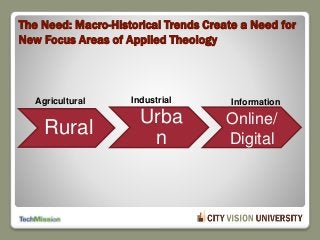
Rural
Urba
n
Online/
Digital
Agricultural Industrial Information
The Need: Macro-Historical Trends Create a Need for
New Focus Areas of Applied Theology
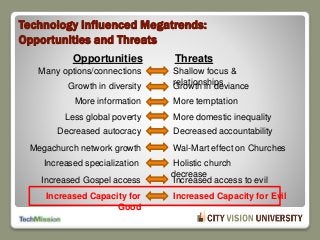
Technology Influenced Megatrends:
Opportunities and Threats
Opportunities Threats
Growth in diversity Growth in deviance
Many options/connections Shallow focus &
relationships
More information More temptation
Less global poverty More domestic inequality
Decreased autocracy Decreased accountability
Increased specialization Holistic church
decrease
Megachurch network growth Wal-Mart effect on Churches
Increased Gospel access Increased access to evil
Increased Capacity for
Good
Increased Capacity for Evil
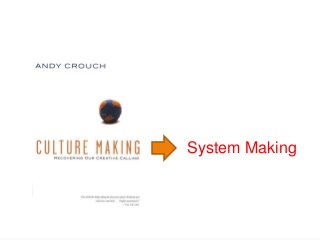
System Making
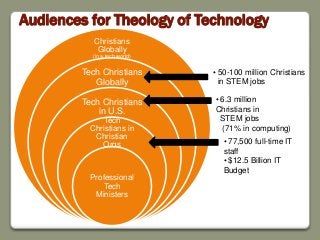
Christians
Globally
(in a tech world)
Tech Christians
Globally
Tech Christians
in U.S.
Tech
Christians in
Christian
Orgs
Professional
Tech
Ministers
• 77,500 full-time IT
staff
• $12.5 Billion IT
Budget
• 6.3 million
Christians in
STEM jobs
(71% in computing)
• 50-100 million Christians
in STEM jobs
Audiences for Theology of Technology
Christianity
(Following Jesus)
Theology, Culture,
Paradigms, Deep Wounds,
(Spiritual Strongholds)
Nurture (Family)
Thoughts/Emotions, Habits,
Nature: Biochemical
Social
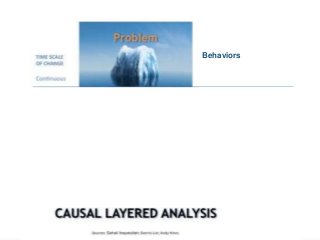
Behaviors
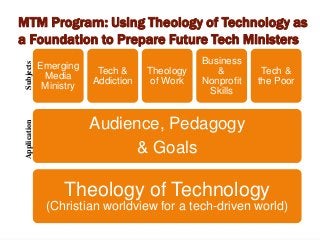
MTM Program: Using Theology of Technology as
a Foundation to Prepare Future Tech Ministers
Theology of Technology
(Christian worldview for a tech-driven world)
Audience, Pedagogy
& Goals
Emerging
Media
Ministry
Tech &
Addiction
Theology
of Work
Business
&
Nonprofit
Skills
Tech &
the Poor
SubjectsApplication
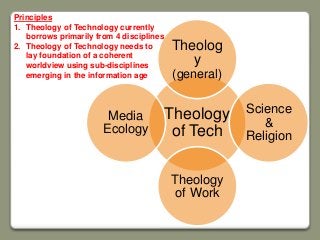
Theology
of Tech
Theolog
y
(general)
Science
&
Religion
Theology
of Work
Media
Ecology
Principles
1. Theology of Technology currently
borrows primarily from 4 disciplines
2. Theology of Technology needs to
lay foundation of a coherent
worldview using sub-disciplines
emerging in the information age
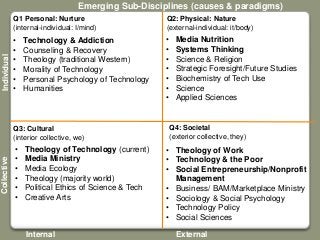
Q1 Personal: Nurture
(internal-individual: I/mind)
Q2: Physical: Nature
(external-individual: it/body)
Q3: Cultural
(interior collective, we)
Q4: Societal
(exterior collective, they)
• Theology of Technology (current)
• Media Ministry
• Media Ecology
• Theology (majority world)
• Political Ethics of Science & Tech
• Creative Arts
• Theology of Work
• Technology & the Poor
• Social Entrepreneurship/Nonprofit
Management
• Business/ BAM/Marketplace Ministry
• Sociology & Social Psychology
• Technology Policy
• Social Sciences
• Technology & Addiction
• Counseling & Recovery
• Theology (traditional Western)
• Morality of Technology
• Personal Psychology of Technology
• Humanities
• Media Nutrition
• Systems Thinking
• Science & Religion
• Strategic Foresight/Future Studies
• Biochemistry of Tech Use
• Science
• Applied Sciences
Emerging Sub-Disciplines (causes & paradigms)IndividualCollective
Internal External
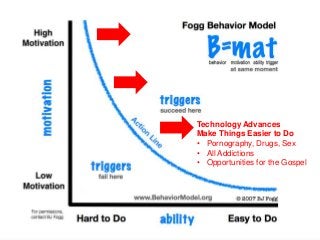
Technology Advances
Make Things Easier to Do
• Pornography, Drugs, Sex
• All Addictions
• Opportunities for the Gospel
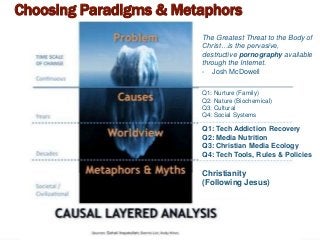
Christianity
(Following Jesus)
Q1: Tech Addiction Recovery
Q2: Media Nutrition
Q3: Christian Media Ecology
Q4: Tech Tools, Rules & Policies
Q1: Nurture (Family)
Q2: Nature (Biochemical)
Q3: Cultural
Q4: Social Systems
The Greatest Threat to the Body of
Christ…is the pervasive,
destructive pornography available
through the Internet.
- Josh McDowell
Choosing Paradigms & Metaphors
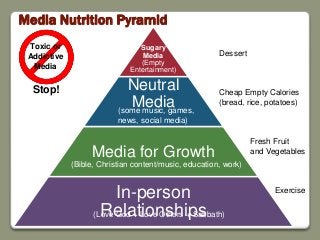
Sugary
Media
(Empty
Entertainment)
Neutral
Media
Media for Growth
In-person
Relationships
(Bible, Christian content/music, education, work)
(some music, games,
news, social media)
(Love God + Love Others + Sabbath)
Fresh Fruit
and Vegetables
Cheap Empty Calories
(bread, rice, potatoes)
Dessert
Exercise
Toxic or
Addictive
Media
Stop!
Media Nutrition Pyramid
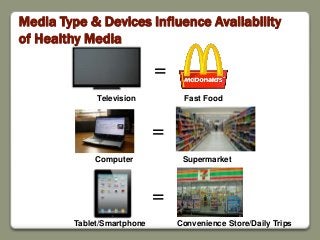
Television Fast Food
=
Computer Supermarket
Tablet/Smartphone Convenience Store/Daily Trips
=
=
Media Type & Devices Influence Availability
of Healthy Media
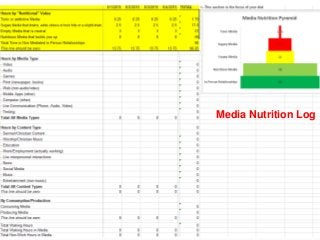
Media Nutrition Log
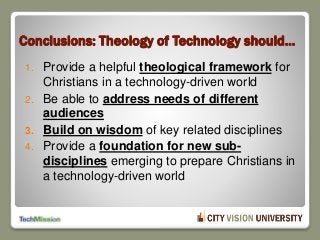
Conclusions: Theology of Technology should…
1. Provide a helpful theological framework for
Christians in a technology-driven world
2. Be able to address needs of different
audiences
3. Build on wisdom of key related disciplines
4. Provide a foundation for new sub-
disciplines emerging to prepare Christians in
a technology-driven world
For More Information
 This presentation on Slideshare: http://goo.gl/W6DcYO
 Master’s in Technology and Ministry Videos
◦ http://www.cityvision.edu/mtm
◦ Theology of Technology
◦ Technology Cross-Cultural Ministry & the Poor
◦ Theology of Work in the STEM Professions
◦ Emerging Media Ministry
◦ Technology & Social Entrepreneurship
◦ Technology and Addiction
 Dissertation: “Disruptive Innovation in Christian Higher Education”
◦ Full Dissertation: goo.gl/nzkhRP
◦ Slideshare: http://goo.gl/UOjpLK
◦ YouTube Playlist: http://goo.gl/6Wptak (will soon include this talk)
◦ Bibliography: https://www.zotero.org/andrewsears/items
 Contact
◦ LinkedIn: www.linkedin.com/in/andrewsears
◦ andrew@cityvision.edu 617-282-9798 x101
Q & A
 Are these the right questions? What other
questions should we be asking?
 Are these helpful answers and conclusions?
 What else would people add?
Appendix
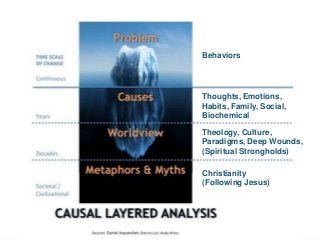
Christianity
(Following Jesus)
Theology, Culture,
Paradigms, Deep Wounds,
(Spiritual Strongholds)
Thoughts, Emotions,
Habits, Family, Social,
Biochemical
Behaviors
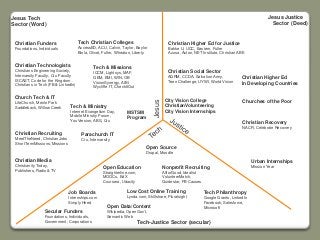
Jesus
Christian Social Sector
AGRM, CCDA, Salvation Army,
Teen Challenge, UYWI, World Vision
Job Boards
Internships.com
Simply Hired
Christian Higher Ed for Justice
Bakke U, UCC, Eastern, Fuller
Azusa, Acton, NET Institute, Christian ABE
Open Education
Straighterline.com,
MOOCs, EdX
Coursera, Udacity
Nonprofit Recruiting
AllforGood, Idealist
VolunteerMatch,
Guidestar, FB Causes
Tech & Missions
ICCM, Lightsys, MAF,
GEM, EMI, WIN, OB
VisionSynergy, AIBI
Wycliffe IT, CheckItOut
Tech & Ministry
Internet Evangelism Day,
Mobile Ministry Forum,
YouVersion, ABS, Cru
MSTSM
Program
Tech-Justice Sector (secular)
Jesus Tech
Sector (Word)
Jesus Justice
Sector (Deed)
City Vision College
ChristianVolunteering
City Vision Internships
Tech Christian Colleges
AccessED, ACU, Calvin, Taylor, Baylor
Biola, Olivet, Fuller, Wheaton, Liberty
Christian Technologists
Christians Engineering Society,
Intervarsity Faculty, Cru Faculty
ISCAST, Code for the Kingdom
Christians in Tech (FB & LinkedIn)
Christian Recruiting
MeetTheNeed, ChristianJobs
ShortTermMissions, Missions
Christian Media
Christianity Today,
Publishers, Radio & TV
Tech Philanthropy
Google Grants, LinkedIn
Facebook, Salesforce,
Microsoft
Open Source
Drupal, Moodle
Church Tech & IT
LifeChurch, Menlo Park
Saddleback, Willow Creek
Christian Recovery
NACR, Celebrate Recovery
Urban Internships
Mission Year
Churches of the Poor
Christian Higher Ed
In Developing Countries
Low Cost Online Training
Lynda.com, Skillshare, Pluralsight
Parachurch IT
Cru, Intervarsity
Open Data/Content
Wikipedia, Open Gov’t,
Semantic Web
Christian Funders
Foundations, Individuals
Secular Funders
Foundations, Individuals,
Government, Corporations
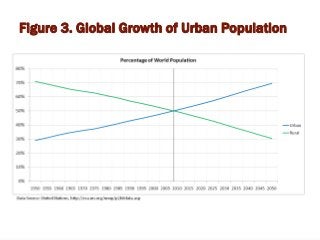
Figure 3. Global Growth of Urban Population
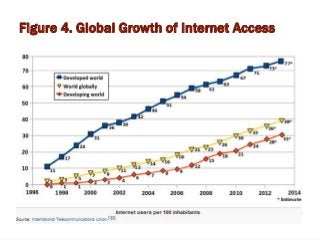
Figure 4. Global Growth of Internet Access
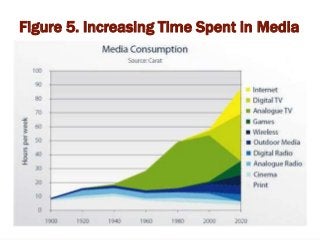
Figure 5. Increasing Time Spent in Media
Past Debates: Writing
 Key Debate: Will writing hurt learning?
“For this invention [writing] will produce forgetfulness in the minds of
those who learn to use it, because they will not practice their memory.
Their trust in writing, produced by external characters which are no
part of themselves, will discourage the use of their own memory within
them.”
– Socrates in Phaedrus 274c-275b)
 Writing enabled knowledge discovery to be modularized
from rest of learning process
Past Debates: Books
 Big Debate: Should a professor only teach from
books they wrote?
◦ “…If we use Sasso’s book, theywill say what our
students have learned, they have learned from Sasso,
not from us” –John Paul Nicolas, 1588, expressing
concerns about not using grammer books that they
had written themselves
 Books became modularized from rest of
learning process

Developing a Theology of Technology

  • 1.
    Andrew Sears President, CityVision University Director, Master’s in Technology and Ministry How Can Theology of Technology Better Prepare Christians for Ministry?
  • 2.
    Key Questions inDeveloping a Theology of Technology 1. What are the needs we are trying to address with a Theology of Technology? 2. Who are the audiences for a Theology of Technology? 3. What are our goals with different audiences? 4. What are the disciplines and traditions that a Theology of Technology can learn from? 5. Given these answers, what is the best approach in developing a Theology of Technology?
  • 3.
    Rural Urba n Online/ Digital Agricultural Industrial Information TheNeed: Macro-Historical Trends Create a Need for New Focus Areas of Applied Theology
  • 4.
    Technology Influenced Megatrends: Opportunitiesand Threats Opportunities Threats Growth in diversity Growth in deviance Many options/connections Shallow focus & relationships More information More temptation Less global poverty More domestic inequality Decreased autocracy Decreased accountability Increased specialization Holistic church decrease Megachurch network growth Wal-Mart effect on Churches Increased Gospel access Increased access to evil Increased Capacity for Good Increased Capacity for Evil
  • 5.
  • 6.
    Christians Globally (in a techworld) Tech Christians Globally Tech Christians in U.S. Tech Christians in Christian Orgs Professional Tech Ministers • 77,500 full-time IT staff • $12.5 Billion IT Budget • 6.3 million Christians in STEM jobs (71% in computing) • 50-100 million Christians in STEM jobs Audiences for Theology of Technology
  • 7.
    Christianity (Following Jesus) Theology, Culture, Paradigms,Deep Wounds, (Spiritual Strongholds) Nurture (Family) Thoughts/Emotions, Habits, Nature: Biochemical Social Behaviors
  • 8.
    MTM Program: UsingTheology of Technology as a Foundation to Prepare Future Tech Ministers Theology of Technology (Christian worldview for a tech-driven world) Audience, Pedagogy & Goals Emerging Media Ministry Tech & Addiction Theology of Work Business & Nonprofit Skills Tech & the Poor SubjectsApplication
  • 9.
    Theology of Tech Theolog y (general) Science & Religion Theology of Work Media Ecology Principles 1.Theology of Technology currently borrows primarily from 4 disciplines 2. Theology of Technology needs to lay foundation of a coherent worldview using sub-disciplines emerging in the information age
  • 10.
    Q1 Personal: Nurture (internal-individual:I/mind) Q2: Physical: Nature (external-individual: it/body) Q3: Cultural (interior collective, we) Q4: Societal (exterior collective, they) • Theology of Technology (current) • Media Ministry • Media Ecology • Theology (majority world) • Political Ethics of Science & Tech • Creative Arts • Theology of Work • Technology & the Poor • Social Entrepreneurship/Nonprofit Management • Business/ BAM/Marketplace Ministry • Sociology & Social Psychology • Technology Policy • Social Sciences • Technology & Addiction • Counseling & Recovery • Theology (traditional Western) • Morality of Technology • Personal Psychology of Technology • Humanities • Media Nutrition • Systems Thinking • Science & Religion • Strategic Foresight/Future Studies • Biochemistry of Tech Use • Science • Applied Sciences Emerging Sub-Disciplines (causes & paradigms)IndividualCollective Internal External
  • 11.
    Technology Advances Make ThingsEasier to Do • Pornography, Drugs, Sex • All Addictions • Opportunities for the Gospel
  • 12.
    Christianity (Following Jesus) Q1: TechAddiction Recovery Q2: Media Nutrition Q3: Christian Media Ecology Q4: Tech Tools, Rules & Policies Q1: Nurture (Family) Q2: Nature (Biochemical) Q3: Cultural Q4: Social Systems The Greatest Threat to the Body of Christ…is the pervasive, destructive pornography available through the Internet. - Josh McDowell Choosing Paradigms & Metaphors
  • 13.
    Sugary Media (Empty Entertainment) Neutral Media Media for Growth In-person Relationships (Bible,Christian content/music, education, work) (some music, games, news, social media) (Love God + Love Others + Sabbath) Fresh Fruit and Vegetables Cheap Empty Calories (bread, rice, potatoes) Dessert Exercise Toxic or Addictive Media Stop! Media Nutrition Pyramid
  • 14.
    Television Fast Food = ComputerSupermarket Tablet/Smartphone Convenience Store/Daily Trips = = Media Type & Devices Influence Availability of Healthy Media
  • 15.
  • 16.
    Conclusions: Theology ofTechnology should… 1. Provide a helpful theological framework for Christians in a technology-driven world 2. Be able to address needs of different audiences 3. Build on wisdom of key related disciplines 4. Provide a foundation for new sub- disciplines emerging to prepare Christians in a technology-driven world
  • 17.
    For More Information This presentation on Slideshare: http://goo.gl/W6DcYO  Master’s in Technology and Ministry Videos ◦ http://www.cityvision.edu/mtm ◦ Theology of Technology ◦ Technology Cross-Cultural Ministry & the Poor ◦ Theology of Work in the STEM Professions ◦ Emerging Media Ministry ◦ Technology & Social Entrepreneurship ◦ Technology and Addiction  Dissertation: “Disruptive Innovation in Christian Higher Education” ◦ Full Dissertation: goo.gl/nzkhRP ◦ Slideshare: http://goo.gl/UOjpLK ◦ YouTube Playlist: http://goo.gl/6Wptak (will soon include this talk) ◦ Bibliography: https://www.zotero.org/andrewsears/items  Contact ◦ LinkedIn: www.linkedin.com/in/andrewsears ◦ andrew@cityvision.edu 617-282-9798 x101
  • 18.
    Q & A Are these the right questions? What other questions should we be asking?  Are these helpful answers and conclusions?  What else would people add?
  • 19.
  • 20.
    Christianity (Following Jesus) Theology, Culture, Paradigms,Deep Wounds, (Spiritual Strongholds) Thoughts, Emotions, Habits, Family, Social, Biochemical Behaviors
  • 21.
    Jesus Christian Social Sector AGRM,CCDA, Salvation Army, Teen Challenge, UYWI, World Vision Job Boards Internships.com Simply Hired Christian Higher Ed for Justice Bakke U, UCC, Eastern, Fuller Azusa, Acton, NET Institute, Christian ABE Open Education Straighterline.com, MOOCs, EdX Coursera, Udacity Nonprofit Recruiting AllforGood, Idealist VolunteerMatch, Guidestar, FB Causes Tech & Missions ICCM, Lightsys, MAF, GEM, EMI, WIN, OB VisionSynergy, AIBI Wycliffe IT, CheckItOut Tech & Ministry Internet Evangelism Day, Mobile Ministry Forum, YouVersion, ABS, Cru MSTSM Program Tech-Justice Sector (secular) Jesus Tech Sector (Word) Jesus Justice Sector (Deed) City Vision College ChristianVolunteering City Vision Internships Tech Christian Colleges AccessED, ACU, Calvin, Taylor, Baylor Biola, Olivet, Fuller, Wheaton, Liberty Christian Technologists Christians Engineering Society, Intervarsity Faculty, Cru Faculty ISCAST, Code for the Kingdom Christians in Tech (FB & LinkedIn) Christian Recruiting MeetTheNeed, ChristianJobs ShortTermMissions, Missions Christian Media Christianity Today, Publishers, Radio & TV Tech Philanthropy Google Grants, LinkedIn Facebook, Salesforce, Microsoft Open Source Drupal, Moodle Church Tech & IT LifeChurch, Menlo Park Saddleback, Willow Creek Christian Recovery NACR, Celebrate Recovery Urban Internships Mission Year Churches of the Poor Christian Higher Ed In Developing Countries Low Cost Online Training Lynda.com, Skillshare, Pluralsight Parachurch IT Cru, Intervarsity Open Data/Content Wikipedia, Open Gov’t, Semantic Web Christian Funders Foundations, Individuals Secular Funders Foundations, Individuals, Government, Corporations
  • 22.
    Figure 3. GlobalGrowth of Urban Population
  • 23.
    Figure 4. GlobalGrowth of Internet Access
  • 24.
    Figure 5. IncreasingTime Spent in Media
  • 25.
    Past Debates: Writing Key Debate: Will writing hurt learning? “For this invention [writing] will produce forgetfulness in the minds of those who learn to use it, because they will not practice their memory. Their trust in writing, produced by external characters which are no part of themselves, will discourage the use of their own memory within them.” – Socrates in Phaedrus 274c-275b)  Writing enabled knowledge discovery to be modularized from rest of learning process
  • 26.
    Past Debates: Books Big Debate: Should a professor only teach from books they wrote? ◦ “…If we use Sasso’s book, theywill say what our students have learned, they have learned from Sasso, not from us” –John Paul Nicolas, 1588, expressing concerns about not using grammer books that they had written themselves  Books became modularized from rest of learning process

Editor's Notes

  • #2 The title of my talk is Jesus Geek: Technology Ministers & Digital Natives.
  • #4 Alvin Toffler and many others have talked about the transition from agricultural, industrial and information ages Past decade was the first time more people live in urban settings globally than rural In the next decade, we will see more people online than are not In Future Shock talks Toffler about how massive macro changes, requires new systems to handle the changes Macro-historical trends have resulted in shifts in applied theology
  • #5 What are the megatrends that are being caused by this virtualization? I’ve spent much of my past 20 years researching this starting at MIT where I co-founded the Internet Telecoms consortium. My study continued as I worked with venture capitalist and Internet startups, then switched to the nonprofit side, at TechMission where we live out the values of Jesus, Justice & Technology. Since eating of the tree of Knowledge of Good and Evil, Mankind has been increasing in its knowledge of Good and Evil The real question is how do we maximize the strengths of this new model while offsetting the weaknesses That will be the struggle of the next few generations
  • #23 If you look at the Bible, it starts in a garden, but it ends in a City. We are in the middle of the largest mass migration in history. Just recently globally more people now live in urban rather than rural environments. The blue line represents the percentage of people in urban environments and the green represents the percentage in rural.
  • #24 Now there is a much more rapid migration happening in the virtualization of the world into online and digital formats. Now I recognize that the analogy of urbanization to virtualization doesn’t exactly fit, because people actually don’t move from cities to a “virtual world,” but it does fit from a cultural perspective and from a time perspective.