TTeecchhnnoollooggyy aanndd 
CCoommmmuunniiccaattiioonn iinn tthhee 
CChhuurrcchh 
Pastor Taurai Emmanuel Maforo 
ZWAC MUMC Retreat @Mabelreign South Circuit 
Saturday 9th November 2013
Introduction 
• Information and Communications 
Technology(ICT) has become a vital tool in 
facilitating the use of new and emerging 
information and communications technologies 
by the church as it looks at sending the Gospel 
to the entire world since ICT opens the world-reach 
wider. 
• This presentation will put into perspective 
how technology and communication impact 
the life of the church
Training Objectives 
• To explore how technology and 
communications impact the church’s ministry. 
• To engage ZWAC MUMC in discussions 
towards having communications committee in 
their structures. 
• To engage the MUMC in using available media 
resources for effective communication.
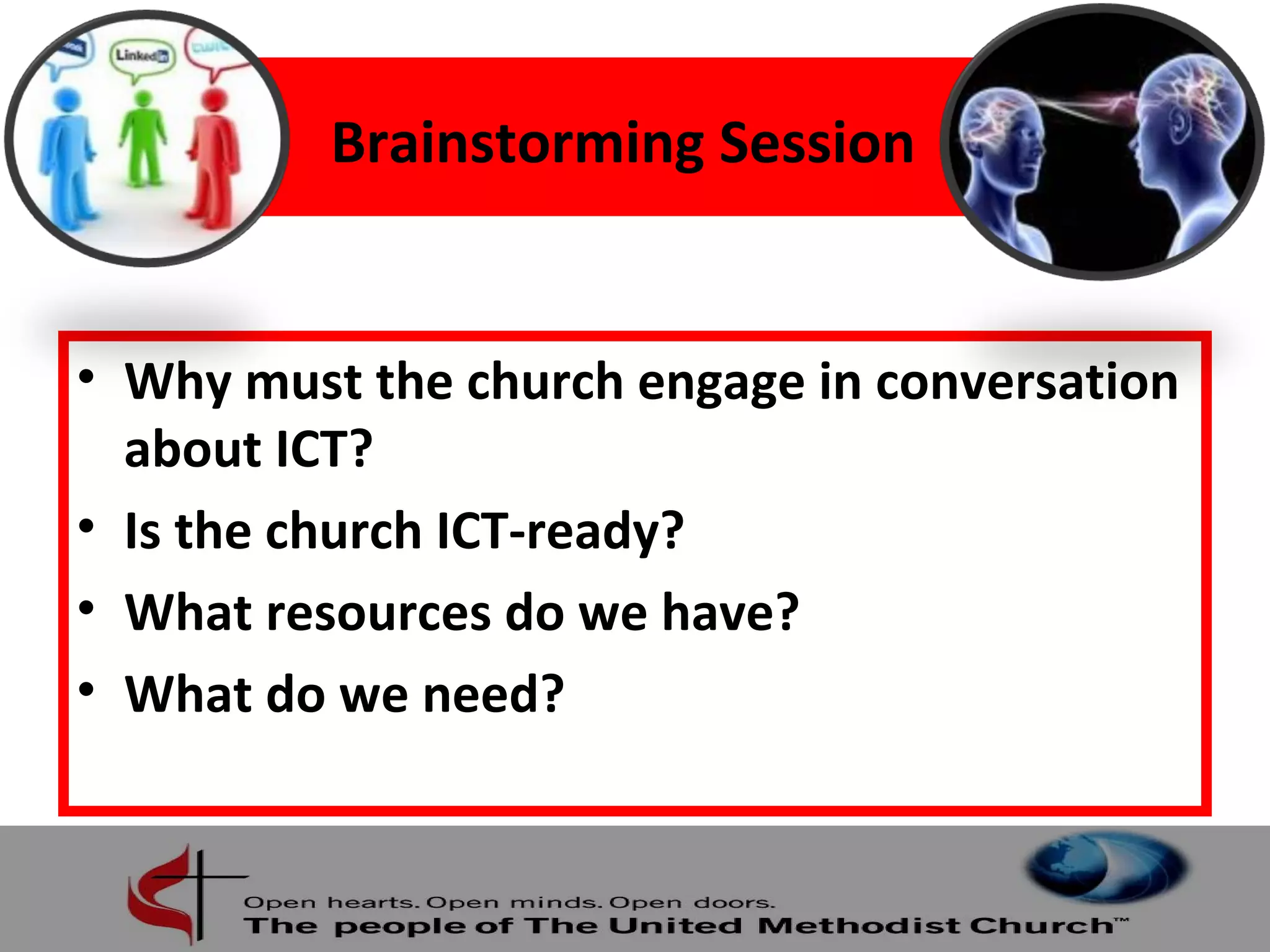
Brainstorming Session 
• Why must the church engage in conversation 
about ICT? 
• Is the church ICT-ready? 
• What resources do we have? 
• What do we need?
DDiissccllaaiimmeerr 
• In my quest to raise the importance of 
technology, I have no intention to minimize the 
power of human beings created in the image of 
the sovereign God as no machine can function 
without humanity’s touch. 
• Some quotations by some of the world’s 
renowned man will help to maintain the status 
of humanity above technology.
• “I am enough of an artist to draw freely upon my 
imagination. Imagination is more important than knowledge. 
Knowledge is limited. Imagination circles the world.” – Albert 
Einstein 
• “The perfect computer has been developed. You just feed your 
problems and they never come out again.” – Al Goodman 
• The real problem is not whether machines think but whether 
men do. – B.F. Skinner 
• “One machine can do the work of fifty ordinary men. No 
machine can do the work of one extraordinary man.” Elbert 
Hubbard 
• “Man is still the extraordinary computer of all.” – J.F. Kennedy 
• “The empires of the future are the empires of the mind.” – 
Winston Churchill
Definitions 
• Technology 
• ICT 
• Communication
Technology 
• The purposeful application of 
information in the design, 
production, and utilization of 
goods and services, and in the 
organization of human activities. 
businessdictionary.com
ICT 
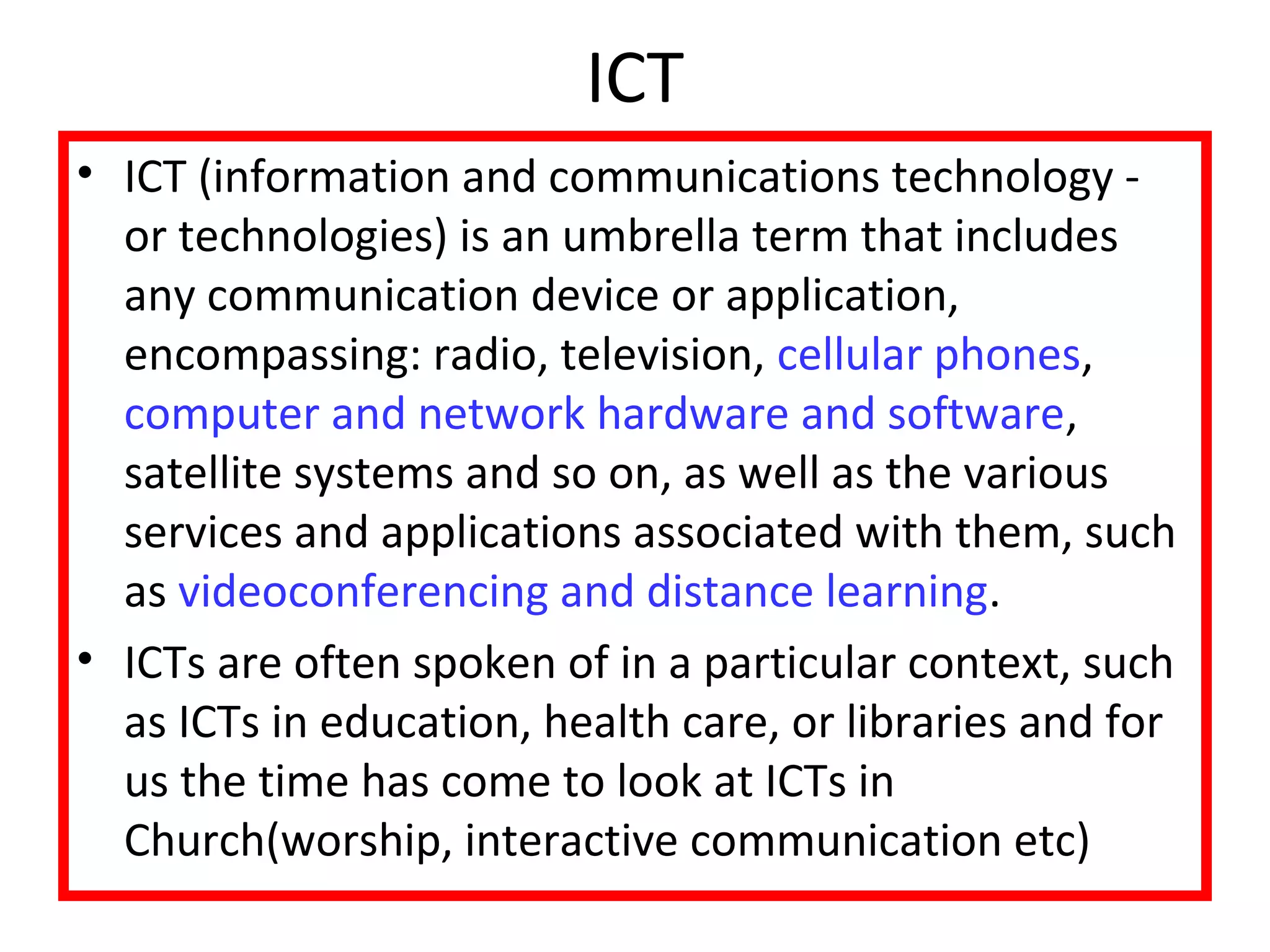
• ICT (information and communications technology - 
or technologies) is an umbrella term that includes 
any communication device or application, 
encompassing: radio, television, cellular phones, 
computer and network hardware and software, 
satellite systems and so on, as well as the various 
services and applications associated with them, such 
as videoconferencing and distance learning. 
• ICTs are often spoken of in a particular context, such 
as ICTs in education, health care, or libraries and for 
us the time has come to look at ICTs in 
Church(worship, interactive communication etc)
From Technology to People 
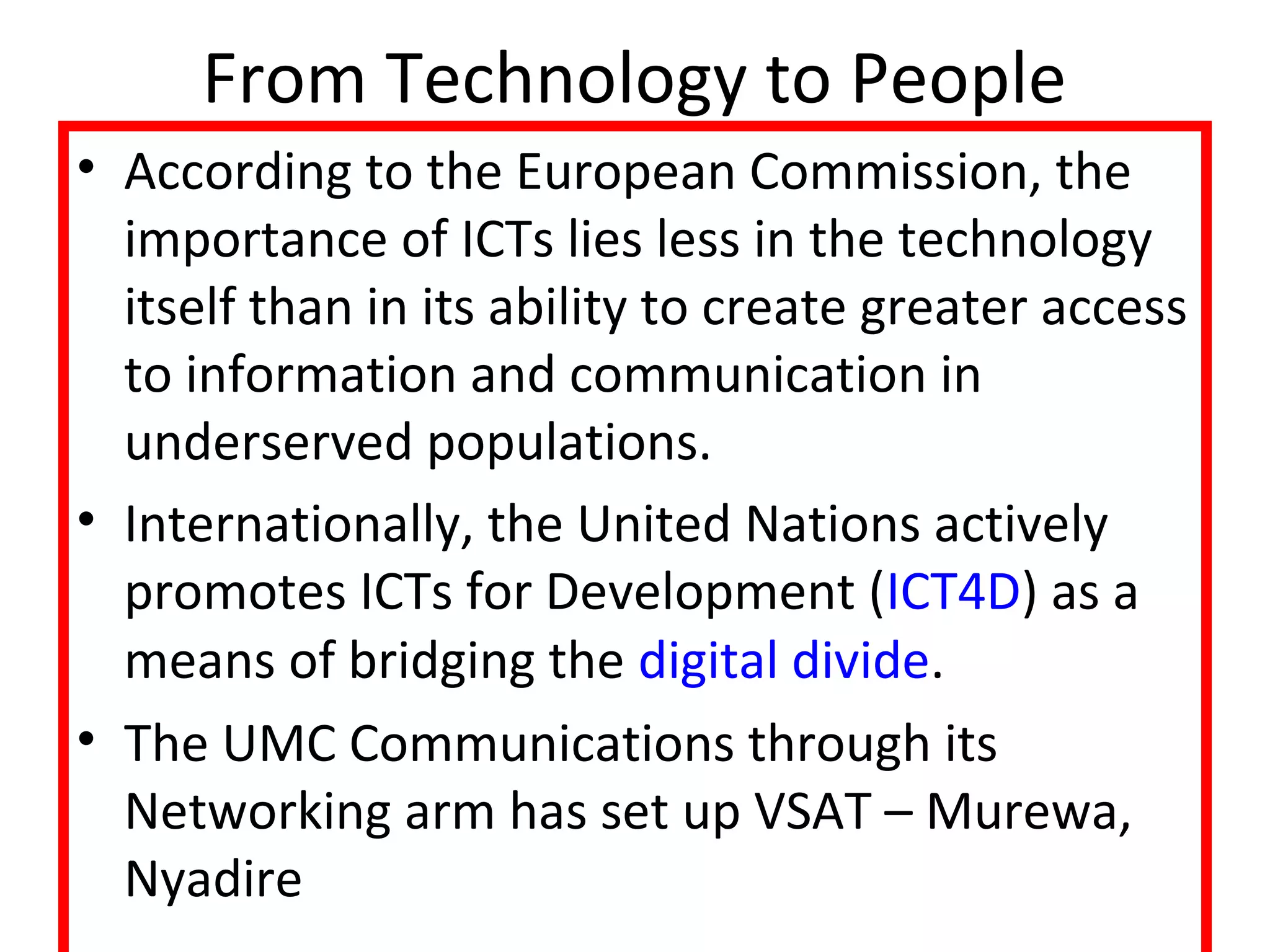
• According to the European Commission, the 
importance of ICTs lies less in the technology 
itself than in its ability to create greater access 
to information and communication in 
underserved populations. 
• Internationally, the United Nations actively 
promotes ICTs for Development (ICT4D) as a 
means of bridging the digital divide. 
• The UMC Communications through its 
Networking arm has set up VSAT – Murewa, 
Nyadire
Communication 
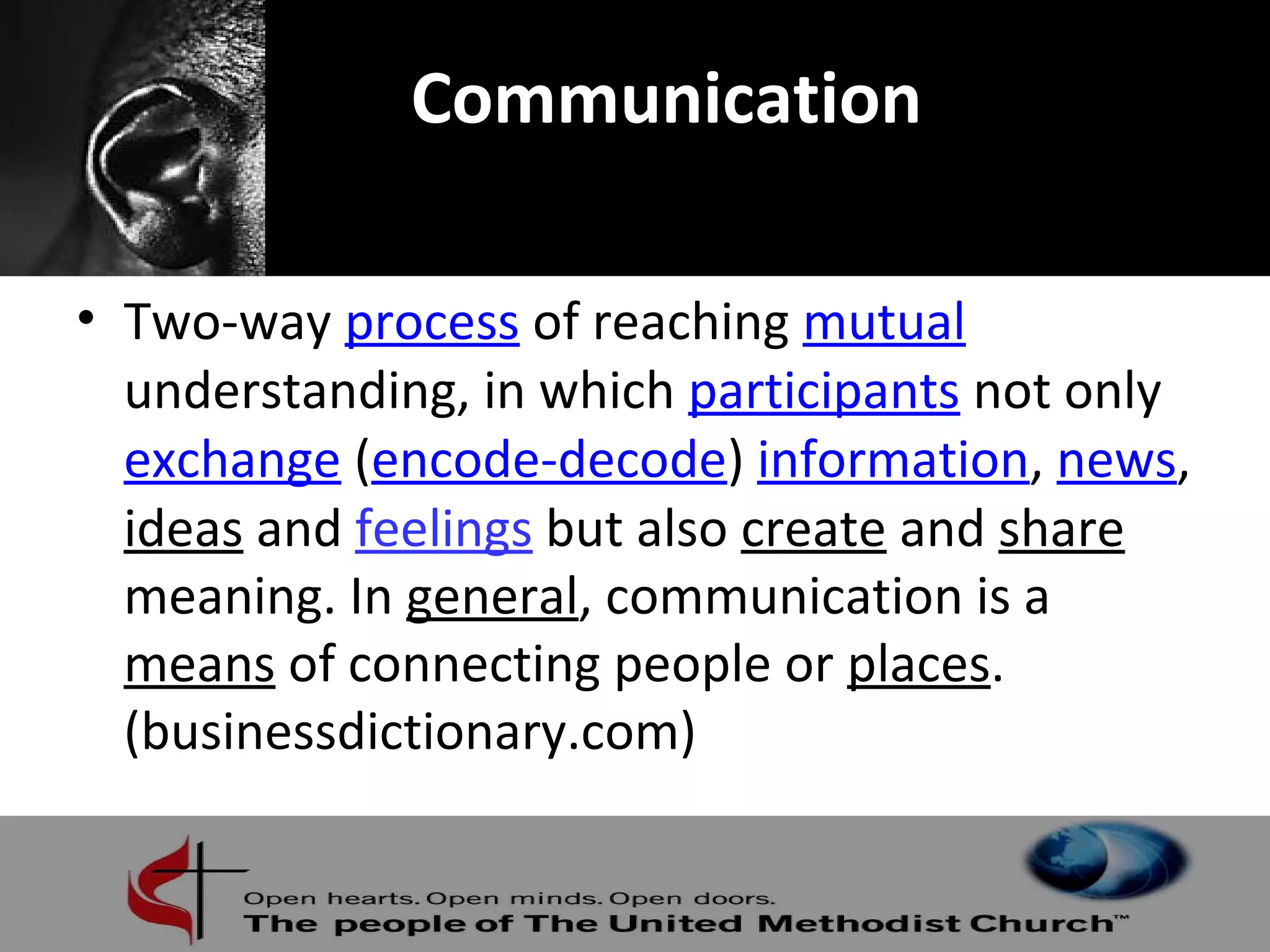
• Two-way process of reaching mutual 
understanding, in which participants not only 
exchange (encode-decode) information, news, 
ideas and feelings but also create and share 
meaning. In general, communication is a 
means of connecting people or places. 
(businessdictionary.com)
Why Communications?
“Communication is a strategic 
function necessary for the success 
of the mission of The United 
Methodist Church.” 
(Bk. Of Discipline 2012,1806)
Communications is a ministry 
driver 
• It is an instrument that controls the direction 
and speed of the denomination with a view 
toward the “long short” – the mission of the 
church (Matt. 28:18-20) and ensuring a 
communicative relationship of its programs. 
That direction is achieved through 
considering external and internal influences 
that significantly impact the organization 
(UMC).
The church’s communications system 
must be understood or cast within 
the scope or context of the nature of 
our connectionalism.
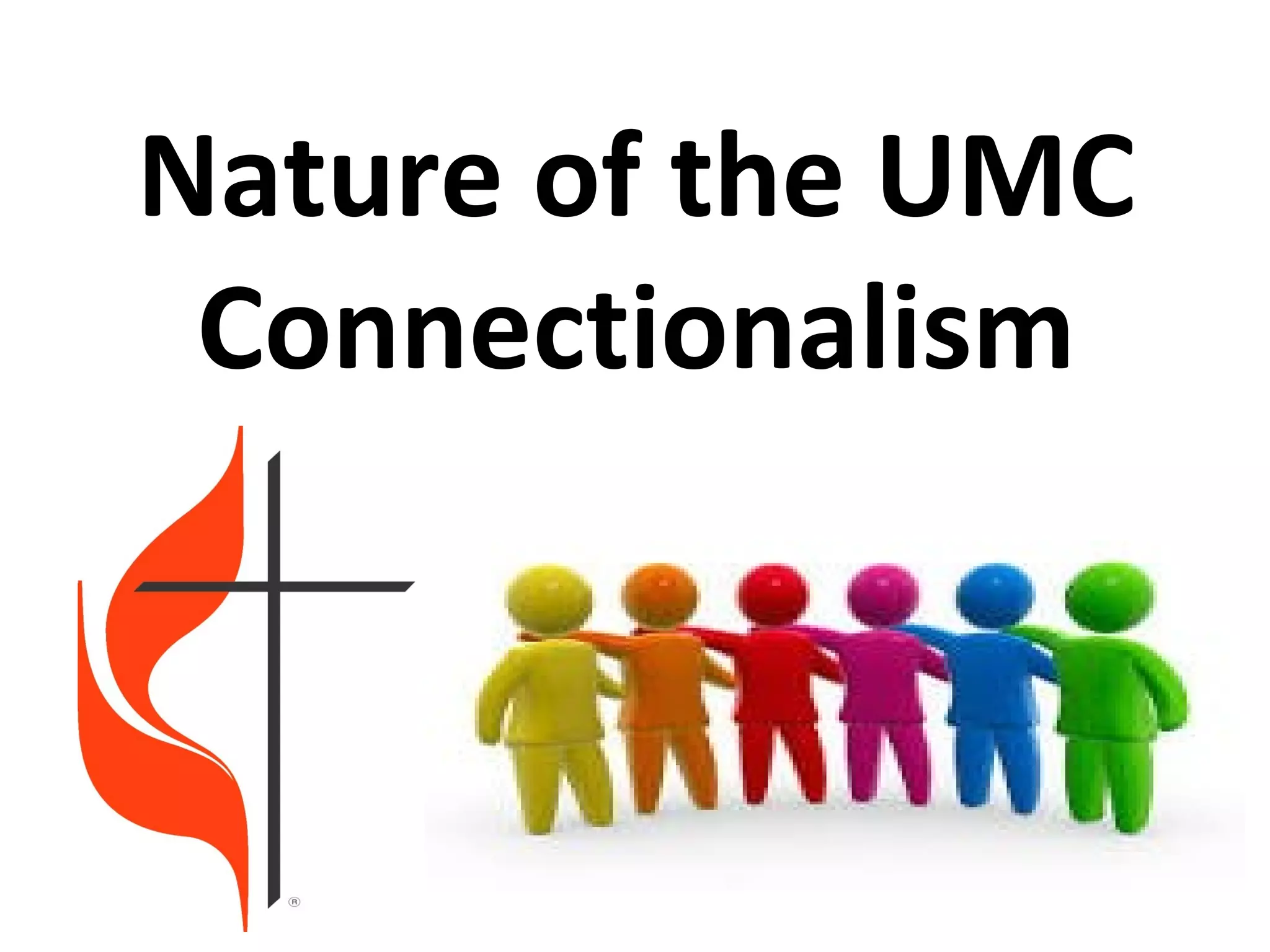
Nature of the UMC 
Connectionalism
Multi-leveled
Global in scope
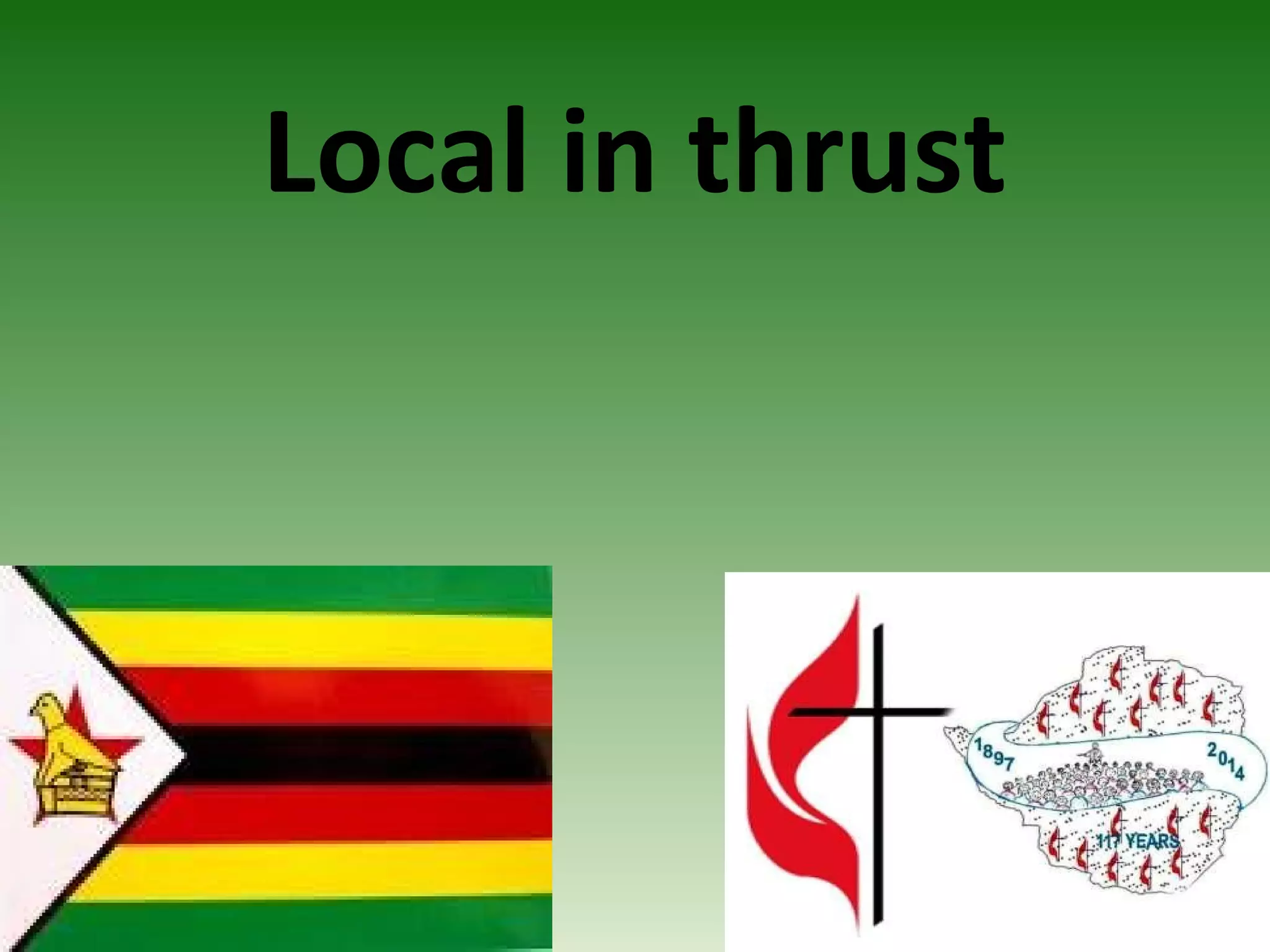
Local in thrust
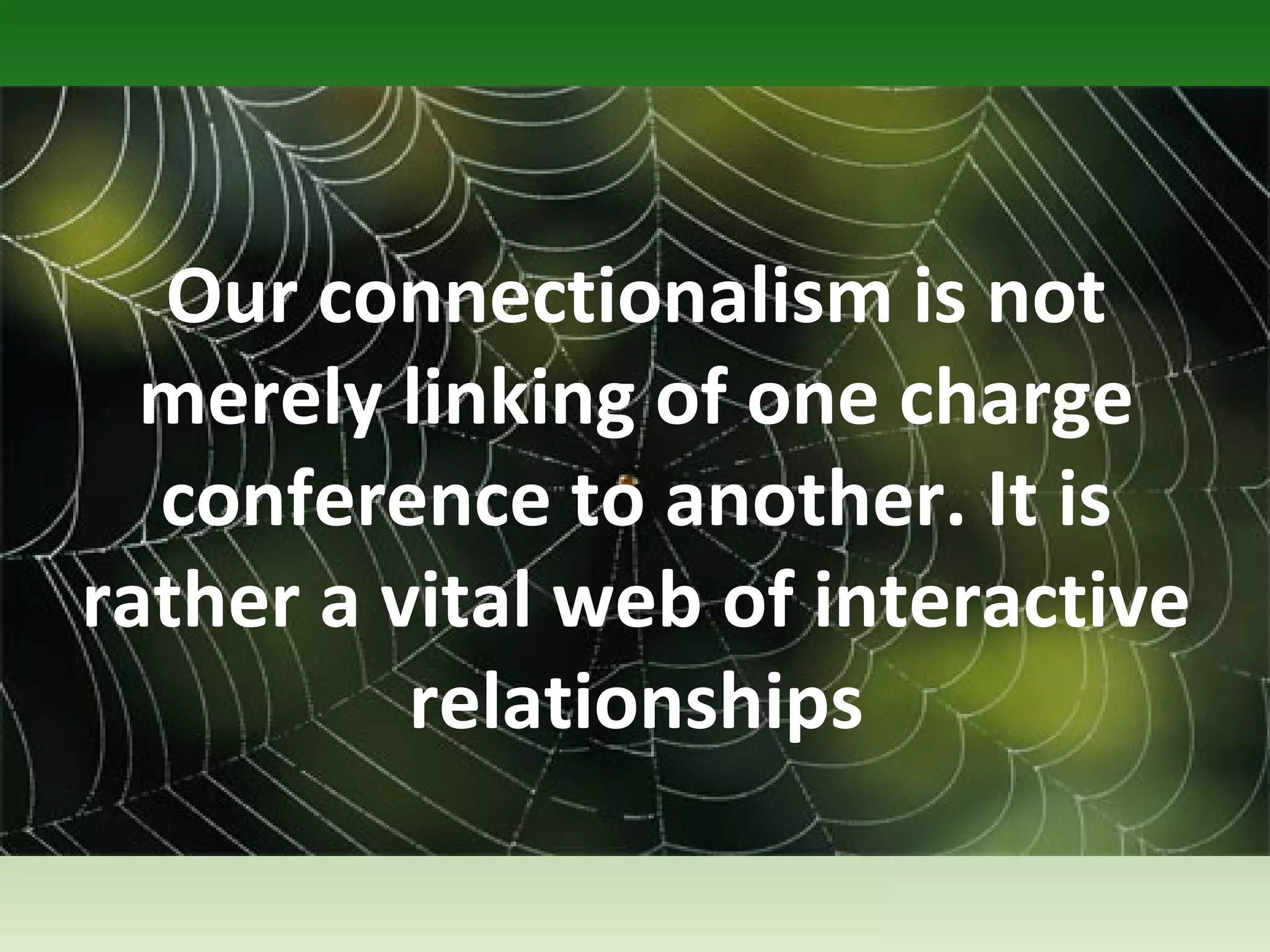
Our connectionalism is not 
merely linking of one charge 
conference to another. It is 
rather a vital web of interactive 
relationships
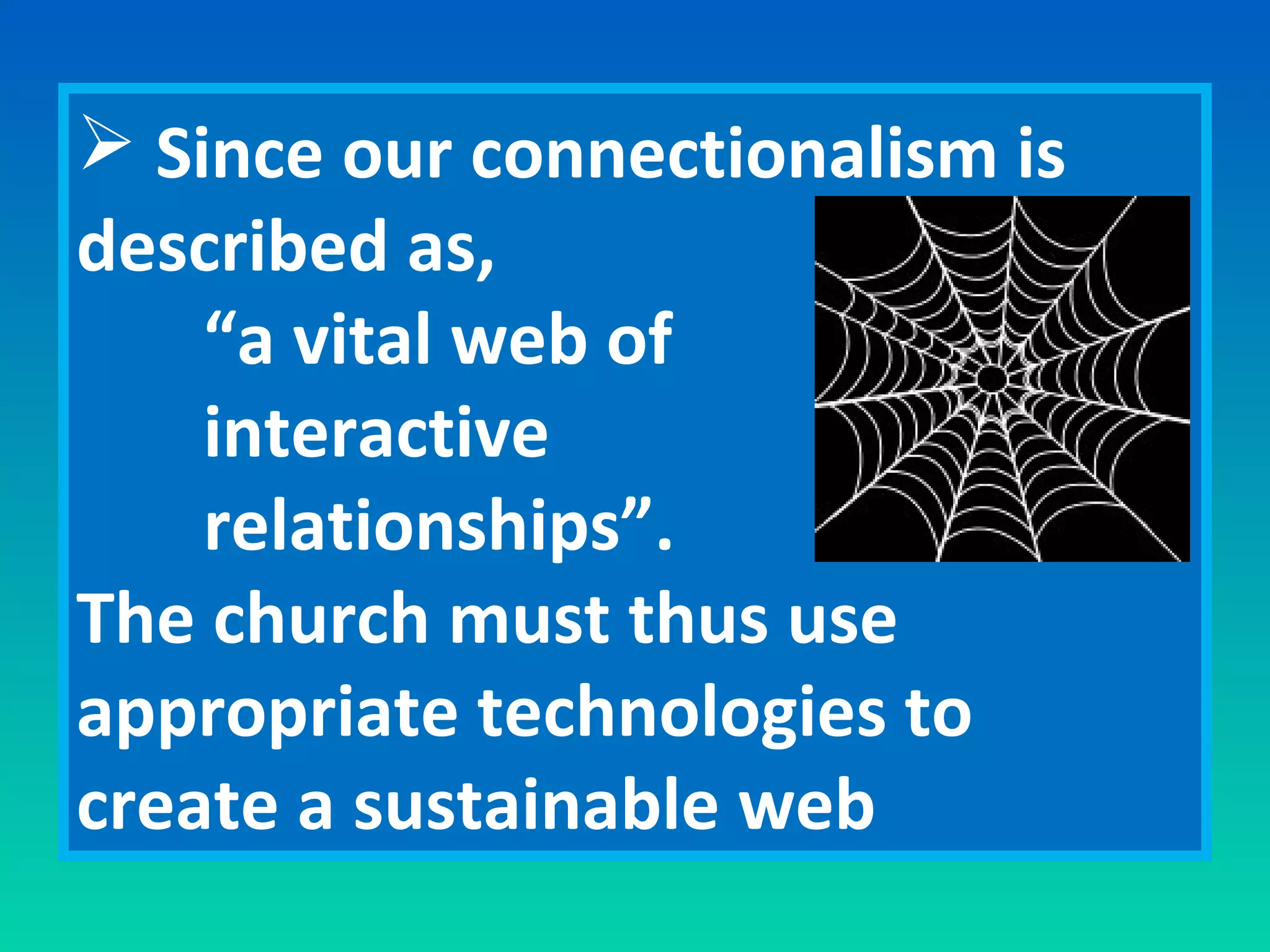
 Since our connectionalism is 
described as, 
“a vital web of 
interactive 
relationships”. 
The church must thus use 
appropriate technologies to 
create a sustainable web
The Communications mandate 
• “As United Methodists, our theological 
understanding obligates us, as members 
of the body of Christ, to communicate 
our faith by speaking and listening to 
persons both within and outside the 
Church throughout the world, and to 
utilize all appropriate means of 
communication.” (Bk. Of 
Disc.2012,1801,p698)
“The responsibility to communicate is 
laid upon; 
• Every church member 
• Every pastor 
• Every congregation 
• Every annual conference 
• Every institution 
• And every agency of the Church 
NB: MUMC as an organization in the church 
must thus find ways of communicating 
effectively
ICT Based Communication Platforms 
• Web technology – www.umczea.org 
• Social Media – Facebook, Twitter, YouTube 
• SMS platforms – eg. Frontline SMS, Whatsapp 
• Electronic 
mail (email) 
Email appears to many as a common mode or 
communication platform but is the most less 
understood in terms of its features and 
parameters. It is the most taken for granted 
and many errors in communication emanate 
from this “common” medium. Ranging from 
forwarding wrong messages or replies 
intended for a single recipient but end up 
sent to multiple recipients 
Email appears to many as a common mode or 
communication platform but is the most less 
understood in terms of its features and 
parameters. It is the most taken for granted 
and many errors in communication emanate 
from this “common” medium. Ranging from 
forwarding wrong messages or replies 
intended for a single recipient but end up 
sent to multiple recipients
Electronic mail 
Internet email messages consist of two major 
sections: 
1. Header – Structured into fields such as From, 
To, CC, Subject, Date, and other 
information about the email. 
• Body – The basic content, as unstructured 
text; sometimes containing a 

signature block at the end. This is 
exactly the same as the body of a 
regular letter.
Electronic mail 
• To: The email address(es), and optionally name(s) of the 
message's recipient(s). Indicates primary recipients 
(multiple allowed), for secondary recipients see Cc: 
and Bcc: below. 
• Subject: A brief summary of the topic of the message. 
Certain abbreviations are commonly used in the 
subject, including "RE:" and "FW:". 
• Bcc: Blind Carbon Copy; addresses added to the SMTP 
delivery list but not (usually) listed in the message 
data, remaining invisible to other recipients. 
• Cc: Carbon Copy; Many email clients will mark email in your 
inbox differently depending on whether you are in the 
To: or Cc: list.
Electronic mail 
• Precedence: "vacation" or "out of office" 
responses should not be returned for this 
mail, e.g. to prevent vacation notices from 
being sent to all other subscribers of a mailing 
list. Sendmail uses this header to affect 
prioritization of queued email, with 
"Precedence: special-delivery" messages 
delivered sooner.
Electronic mail 
• Reply-To: Address that should be used to reply 
to the message. 
• Sender: Address of the actual sender acting on 
behalf of the author listed in the From: field 
(secretary, list manager, etc.). 
• Archived-At: A direct link to the archived form 
of an individual email message.
Technology in Religious services 
has been increasing for the past 
several decades. Churches may use 
only minimal sound systems, or full 
audio visual presentations. 
•
Advantages: 
• It can be very interactive 
• Often provides a hip and current way to worship 
appealing to the up coming generations 
• Allows for a smoother service with large groups of 
people 
• Provides an easy access, well organized 
administration 
• Creates a new medium by which members are able 
to connect and participate
Disadvantages: 
• It is a distraction from the point of worship. 
• Often technology comes at the expense of spending 
scarce resources on other, more justifiable things (ie. 
food banks, welfare programs...etc) 
• Technology emphasizes focus on experience, instead of 
truth 
• It distances members of the congregation from an 
accountable, personal relationship 
• The emphasis on being present in the church is lowered
Way Forward
Technology is like.....
Fish....Eat it
BUT!!
Remove the bones
EENNDD
Question Time

Technology and communication in the church

  • 1.
    TTeecchhnnoollooggyy aanndd CCoommmmuunniiccaattiioonniinn tthhee CChhuurrcchh Pastor Taurai Emmanuel Maforo ZWAC MUMC Retreat @Mabelreign South Circuit Saturday 9th November 2013
  • 2.
    Introduction • Informationand Communications Technology(ICT) has become a vital tool in facilitating the use of new and emerging information and communications technologies by the church as it looks at sending the Gospel to the entire world since ICT opens the world-reach wider. • This presentation will put into perspective how technology and communication impact the life of the church
  • 3.
    Training Objectives •To explore how technology and communications impact the church’s ministry. • To engage ZWAC MUMC in discussions towards having communications committee in their structures. • To engage the MUMC in using available media resources for effective communication.
  • 4.
    Brainstorming Session •Why must the church engage in conversation about ICT? • Is the church ICT-ready? • What resources do we have? • What do we need?
  • 5.
    DDiissccllaaiimmeerr • Inmy quest to raise the importance of technology, I have no intention to minimize the power of human beings created in the image of the sovereign God as no machine can function without humanity’s touch. • Some quotations by some of the world’s renowned man will help to maintain the status of humanity above technology.
  • 6.
    • “I amenough of an artist to draw freely upon my imagination. Imagination is more important than knowledge. Knowledge is limited. Imagination circles the world.” – Albert Einstein • “The perfect computer has been developed. You just feed your problems and they never come out again.” – Al Goodman • The real problem is not whether machines think but whether men do. – B.F. Skinner • “One machine can do the work of fifty ordinary men. No machine can do the work of one extraordinary man.” Elbert Hubbard • “Man is still the extraordinary computer of all.” – J.F. Kennedy • “The empires of the future are the empires of the mind.” – Winston Churchill
  • 7.
    Definitions • Technology • ICT • Communication
  • 8.
    Technology • Thepurposeful application of information in the design, production, and utilization of goods and services, and in the organization of human activities. businessdictionary.com
  • 9.
    ICT • ICT(information and communications technology - or technologies) is an umbrella term that includes any communication device or application, encompassing: radio, television, cellular phones, computer and network hardware and software, satellite systems and so on, as well as the various services and applications associated with them, such as videoconferencing and distance learning. • ICTs are often spoken of in a particular context, such as ICTs in education, health care, or libraries and for us the time has come to look at ICTs in Church(worship, interactive communication etc)
  • 10.
    From Technology toPeople • According to the European Commission, the importance of ICTs lies less in the technology itself than in its ability to create greater access to information and communication in underserved populations. • Internationally, the United Nations actively promotes ICTs for Development (ICT4D) as a means of bridging the digital divide. • The UMC Communications through its Networking arm has set up VSAT – Murewa, Nyadire
  • 11.
    Communication • Two-wayprocess of reaching mutual understanding, in which participants not only exchange (encode-decode) information, news, ideas and feelings but also create and share meaning. In general, communication is a means of connecting people or places. (businessdictionary.com)
  • 12.
  • 13.
    “Communication is astrategic function necessary for the success of the mission of The United Methodist Church.” (Bk. Of Discipline 2012,1806)
  • 14.
    Communications is aministry driver • It is an instrument that controls the direction and speed of the denomination with a view toward the “long short” – the mission of the church (Matt. 28:18-20) and ensuring a communicative relationship of its programs. That direction is achieved through considering external and internal influences that significantly impact the organization (UMC).
  • 15.
    The church’s communicationssystem must be understood or cast within the scope or context of the nature of our connectionalism.
  • 16.
    Nature of theUMC Connectionalism
  • 17.
  • 18.
  • 19.
  • 20.
    Our connectionalism isnot merely linking of one charge conference to another. It is rather a vital web of interactive relationships
  • 21.
     Since ourconnectionalism is described as, “a vital web of interactive relationships”. The church must thus use appropriate technologies to create a sustainable web
  • 22.
    The Communications mandate • “As United Methodists, our theological understanding obligates us, as members of the body of Christ, to communicate our faith by speaking and listening to persons both within and outside the Church throughout the world, and to utilize all appropriate means of communication.” (Bk. Of Disc.2012,1801,p698)
  • 23.
    “The responsibility tocommunicate is laid upon; • Every church member • Every pastor • Every congregation • Every annual conference • Every institution • And every agency of the Church NB: MUMC as an organization in the church must thus find ways of communicating effectively
  • 24.
    ICT Based CommunicationPlatforms • Web technology – www.umczea.org • Social Media – Facebook, Twitter, YouTube • SMS platforms – eg. Frontline SMS, Whatsapp • Electronic mail (email) Email appears to many as a common mode or communication platform but is the most less understood in terms of its features and parameters. It is the most taken for granted and many errors in communication emanate from this “common” medium. Ranging from forwarding wrong messages or replies intended for a single recipient but end up sent to multiple recipients Email appears to many as a common mode or communication platform but is the most less understood in terms of its features and parameters. It is the most taken for granted and many errors in communication emanate from this “common” medium. Ranging from forwarding wrong messages or replies intended for a single recipient but end up sent to multiple recipients
  • 25.
    Electronic mail Internetemail messages consist of two major sections: 1. Header – Structured into fields such as From, To, CC, Subject, Date, and other information about the email. • Body – The basic content, as unstructured text; sometimes containing a signature block at the end. This is exactly the same as the body of a regular letter.

  • 26.
    Electronic mail •To: The email address(es), and optionally name(s) of the message's recipient(s). Indicates primary recipients (multiple allowed), for secondary recipients see Cc: and Bcc: below. • Subject: A brief summary of the topic of the message. Certain abbreviations are commonly used in the subject, including "RE:" and "FW:". • Bcc: Blind Carbon Copy; addresses added to the SMTP delivery list but not (usually) listed in the message data, remaining invisible to other recipients. • Cc: Carbon Copy; Many email clients will mark email in your inbox differently depending on whether you are in the To: or Cc: list.
  • 27.
    Electronic mail •Precedence: "vacation" or "out of office" responses should not be returned for this mail, e.g. to prevent vacation notices from being sent to all other subscribers of a mailing list. Sendmail uses this header to affect prioritization of queued email, with "Precedence: special-delivery" messages delivered sooner.
  • 28.
    Electronic mail •Reply-To: Address that should be used to reply to the message. • Sender: Address of the actual sender acting on behalf of the author listed in the From: field (secretary, list manager, etc.). • Archived-At: A direct link to the archived form of an individual email message.
  • 29.
    Technology in Religiousservices has been increasing for the past several decades. Churches may use only minimal sound systems, or full audio visual presentations. •
  • 30.
    Advantages: • Itcan be very interactive • Often provides a hip and current way to worship appealing to the up coming generations • Allows for a smoother service with large groups of people • Provides an easy access, well organized administration • Creates a new medium by which members are able to connect and participate
  • 31.
    Disadvantages: • Itis a distraction from the point of worship. • Often technology comes at the expense of spending scarce resources on other, more justifiable things (ie. food banks, welfare programs...etc) • Technology emphasizes focus on experience, instead of truth • It distances members of the congregation from an accountable, personal relationship • The emphasis on being present in the church is lowered


  • 32.
  • 33.
  • 34.
  • 35.
  • 36.
  • 37.
  • 38.