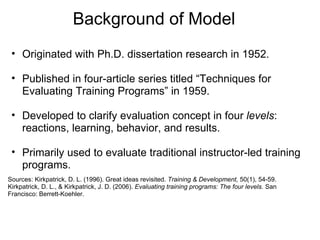
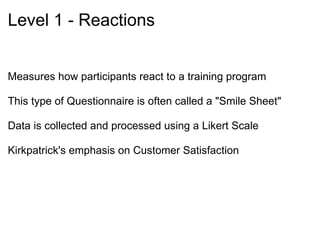
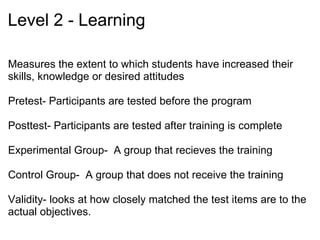
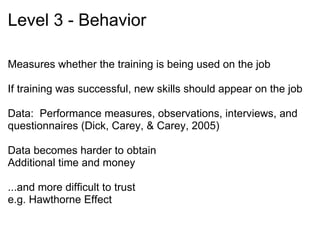
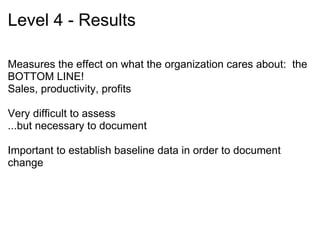
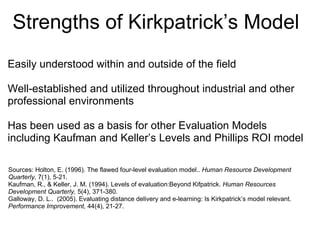
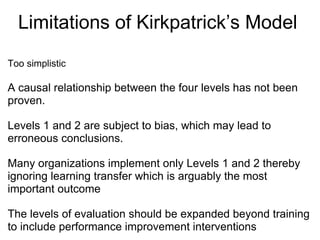
Kirkpatrick's Four Levels of Evaluation Model is a framework for evaluating training programs and other professional development activities. It originated from Kirkpatrick's 1952 dissertation and was published in 1959. The four levels are: 1) Reactions, 2) Learning, 3) Behavior, and 4) Results. Level 1 assesses satisfaction with the training. Level 2 evaluates the increase in knowledge from pre-to post-training. Level 3 looks at applying skills on the job. Level 4 examines the impact on business results such as productivity or profits. The model provides an easily understood approach for evaluation but has limitations such as oversimplifying the relationship between levels.