ASSESSMENT
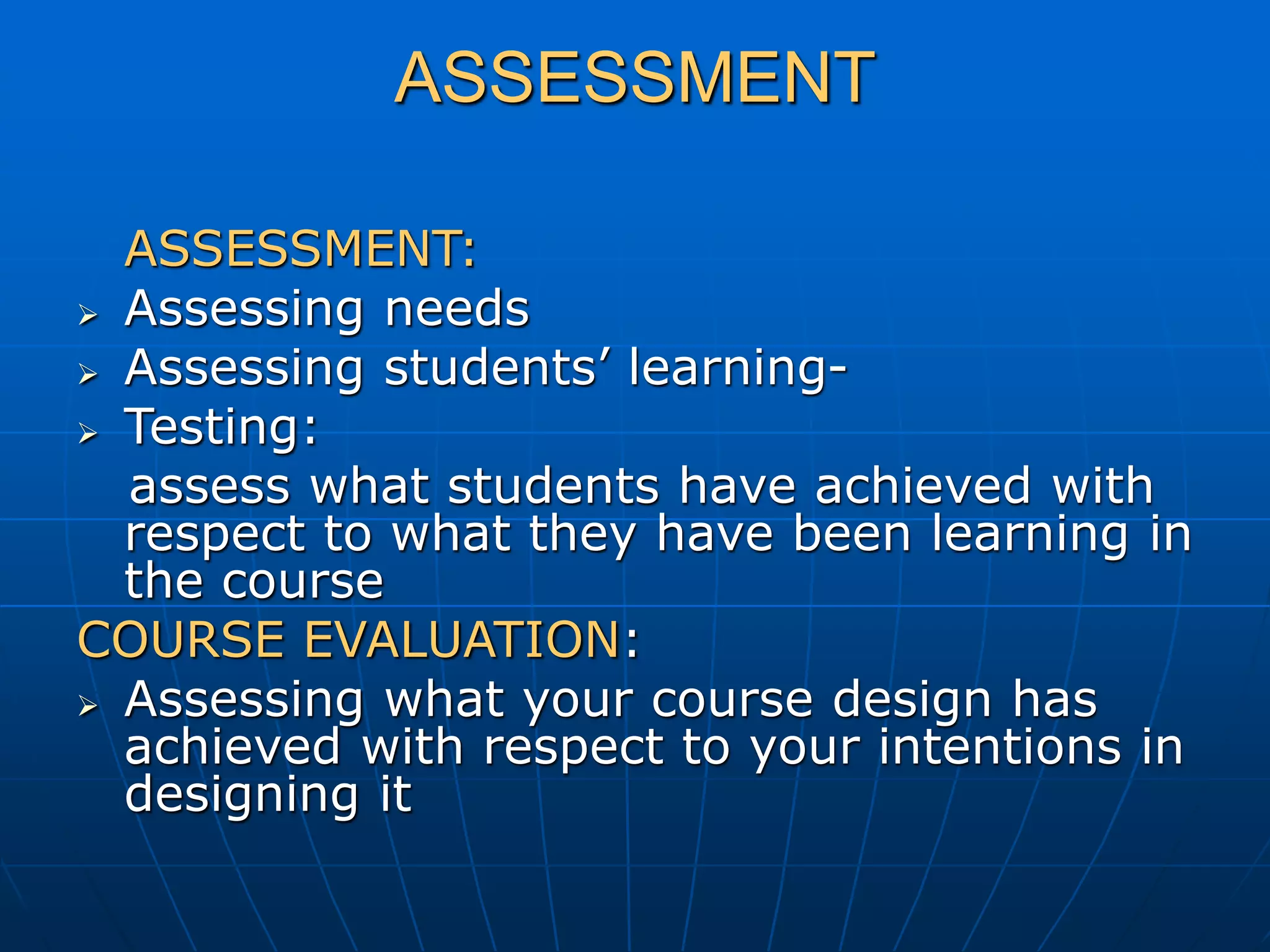
ASSESSMENT:
 Assessing needs
 Assessing students’ learning-
 Testing:
assess what students have achieved with
respect to what they have been learning in
the course
COURSE EVALUATION:
 Assessing what your course design has
achieved with respect to your intentions in
designing it
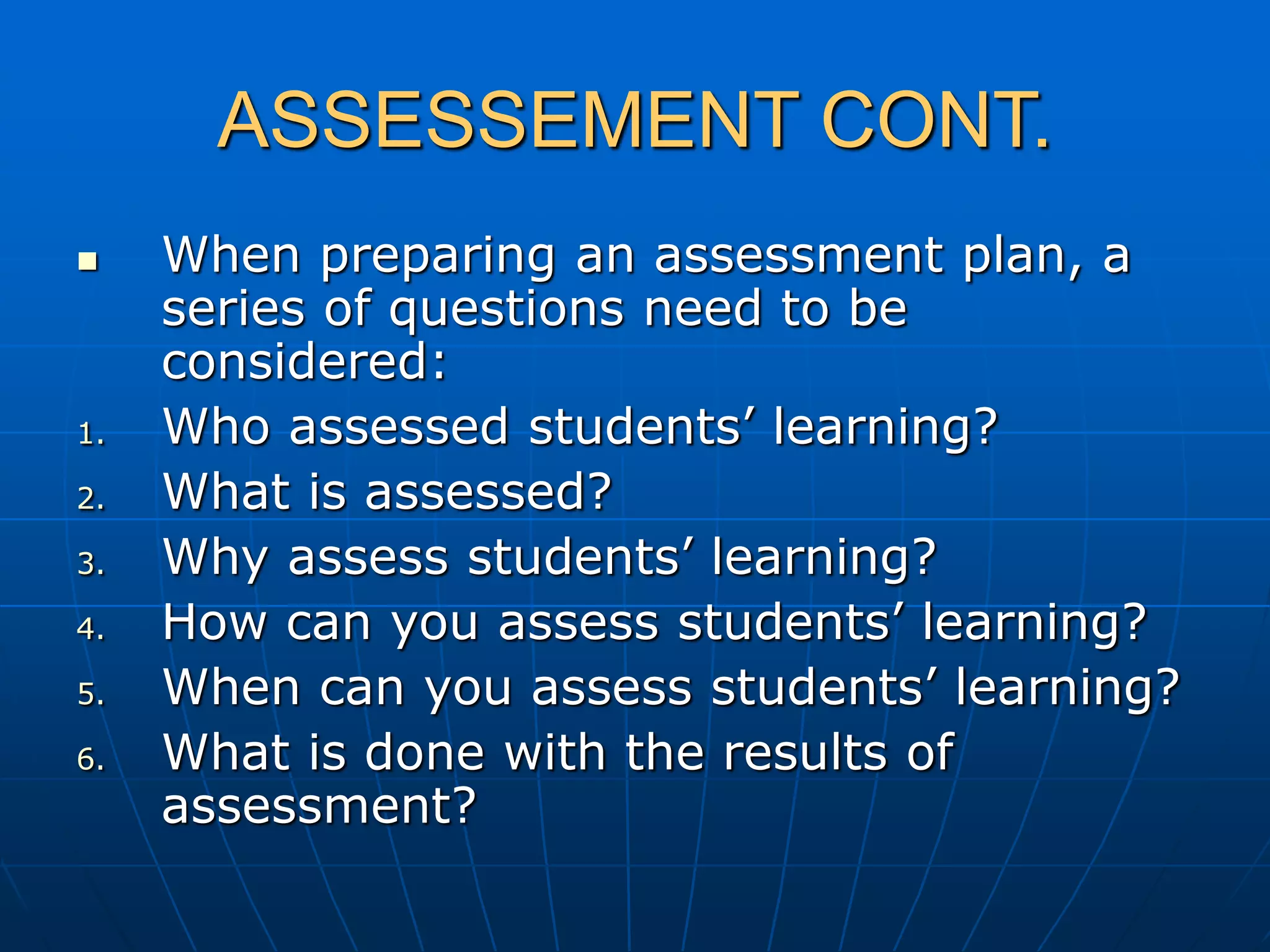
ASSESSEMENT CONT.
 When preparing an assessment plan, a
series of questions need to be
considered:
1. Who assessed students’ learning?
2. What is assessed?
3. Why assess students’ learning?
4. How can you assess students’ learning?
5. When can you assess students’ learning?
6. What is done with the results of
assessment?
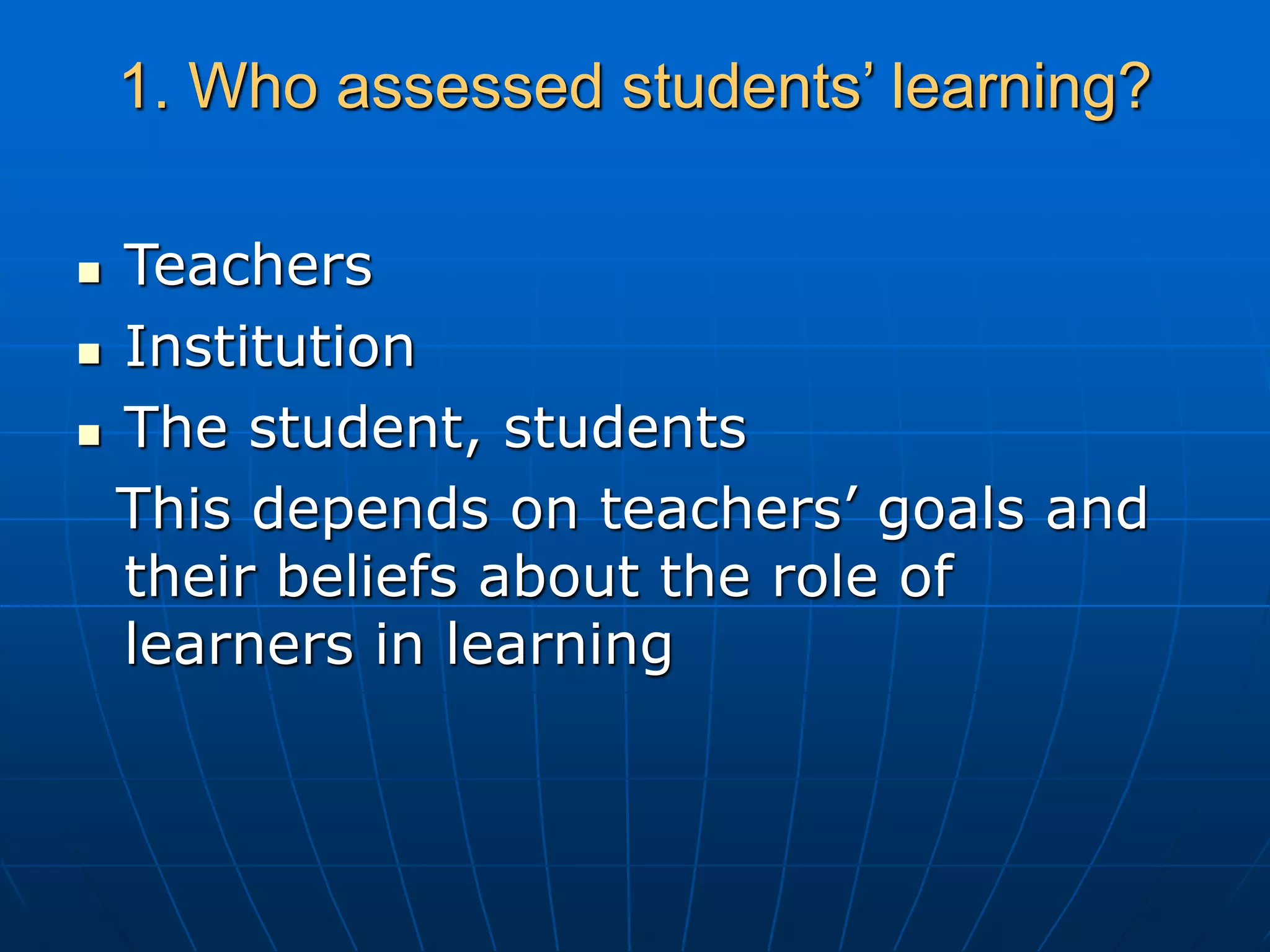
1. Who assessed students’ learning?
 Teachers
 Institution
 The student, students
This depends on teachers’ goals and
their beliefs about the role of
learners in learning
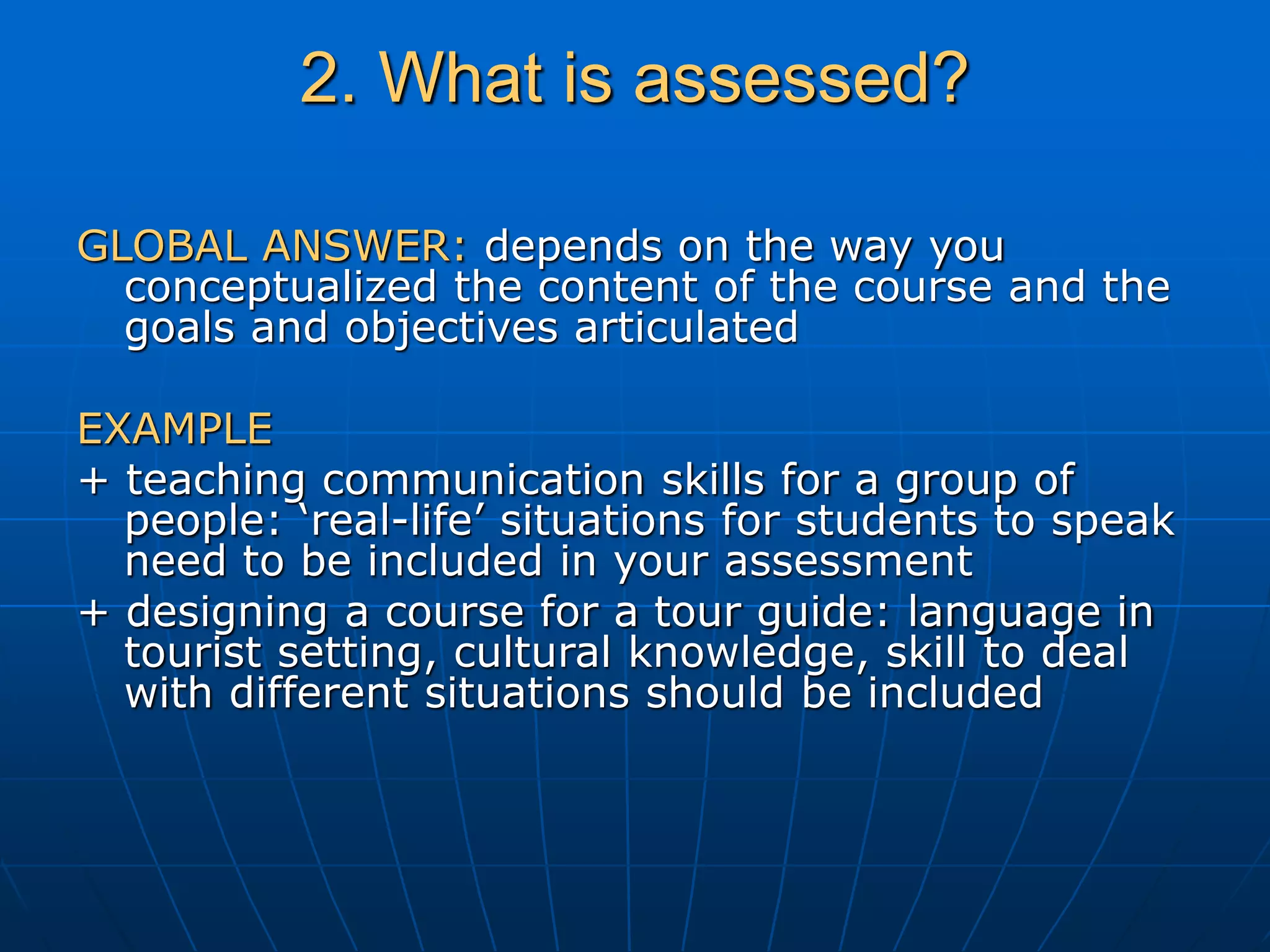
2. What is assessed?
GLOBAL ANSWER: depends on the way you
conceptualized the content of the course and the
goals and objectives articulated
EXAMPLE
+ teaching communication skills for a group of
people: ‘real-life’ situations for students to speak
need to be included in your assessment
+ designing a course for a tour guide: language in
tourist setting, cultural knowledge, skill to deal
with different situations should be included
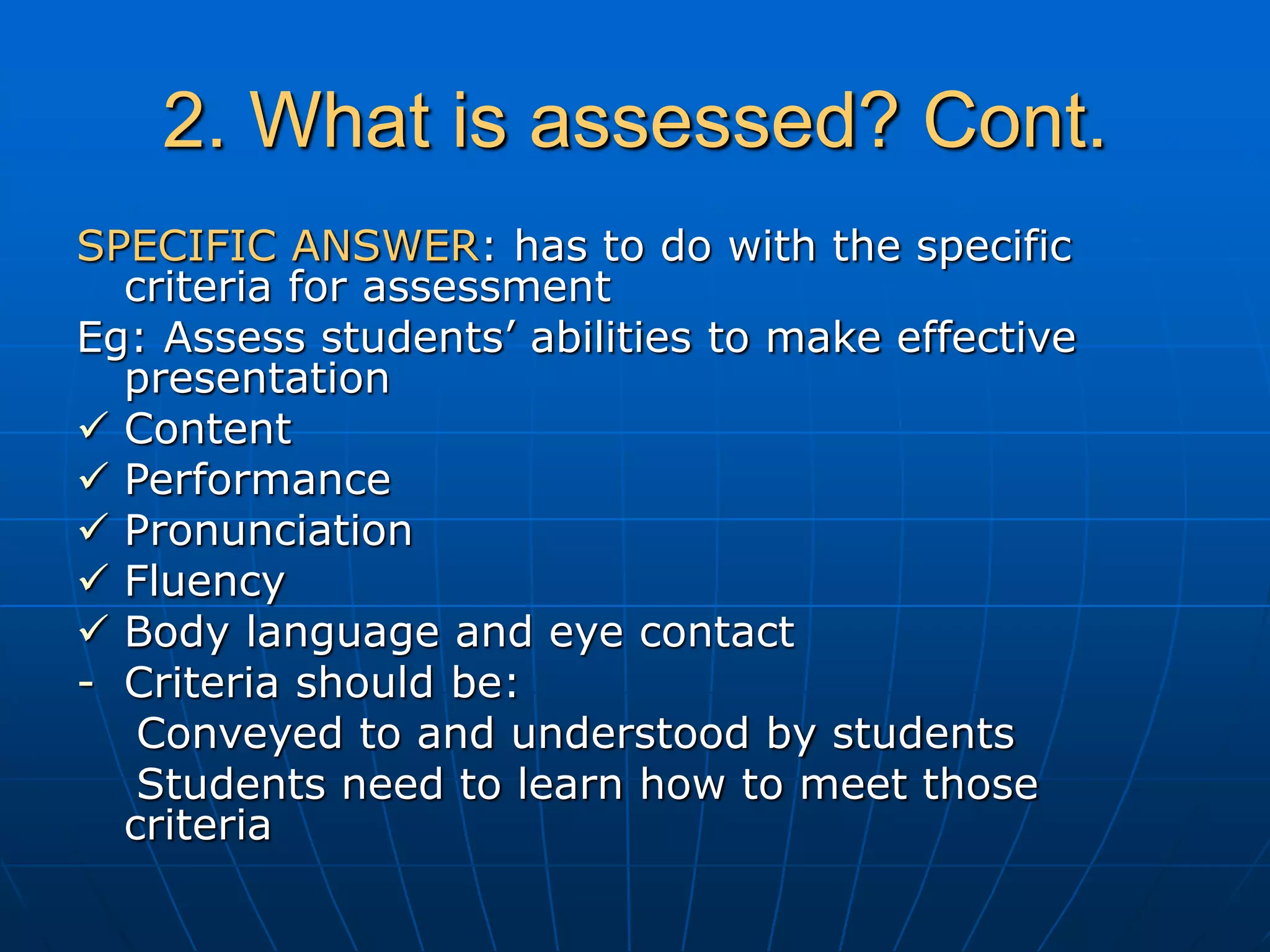
2. What is assessed? Cont.
SPECIFIC ANSWER: has to do with the specific
criteria for assessment
Eg: Assess students’ abilities to make effective
presentation
 Content
 Performance
 Pronunciation
 Fluency
 Body language and eye contact
- Criteria should be:
Conveyed to and understood by students
Students need to learn how to meet those
criteria
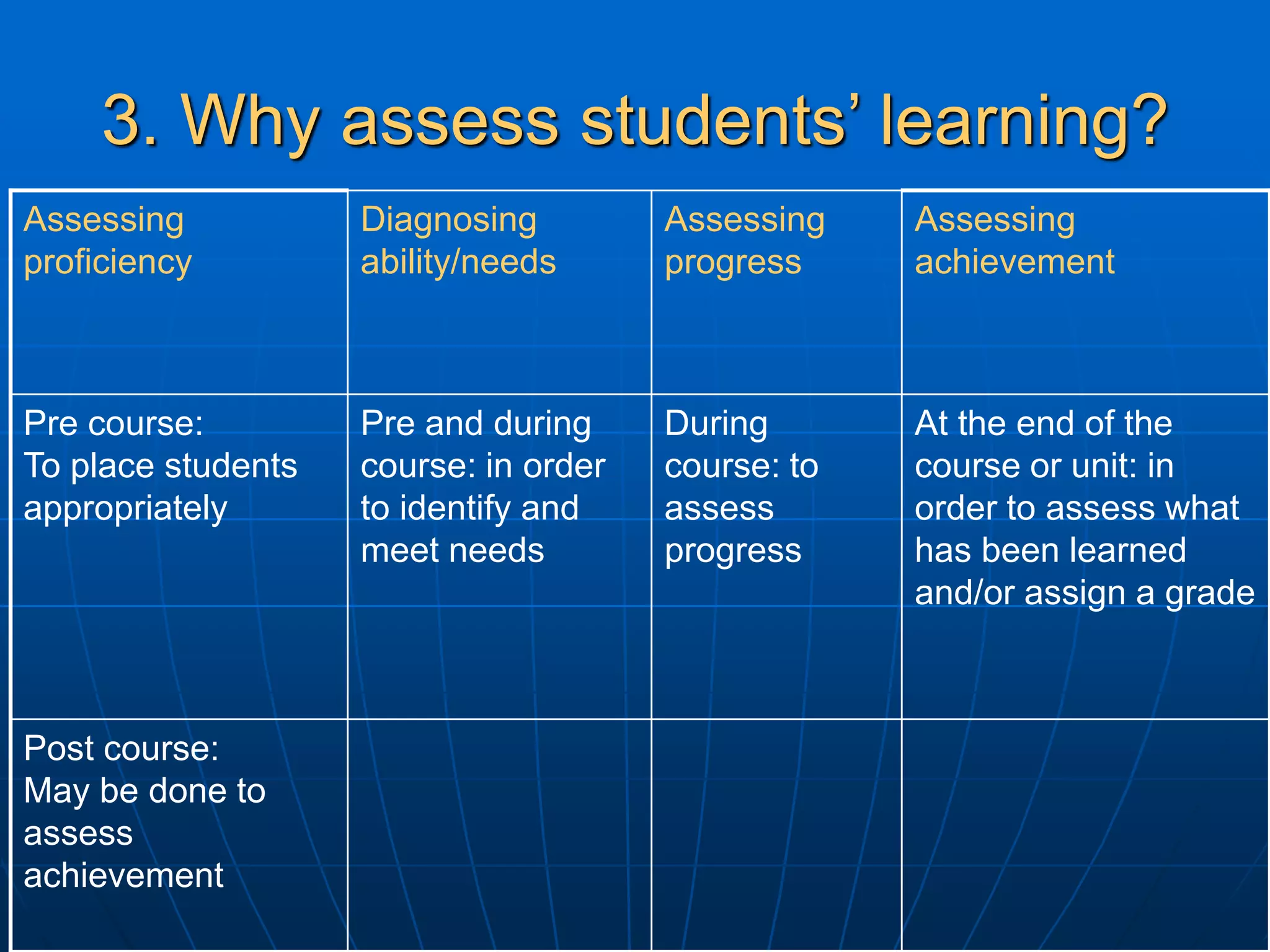
3. Why assess students’ learning?
Assessing
proficiency
Diagnosing
ability/needs
Assessing
progress
Assessing
achievement
Pre course:
To place students
appropriately
Pre and during
course: in order
to identify and
meet needs
During
course: to
assess
progress
At the end of the
course or unit: in
order to assess what
has been learned
and/or assign a grade
Post course:
May be done to
assess
achievement
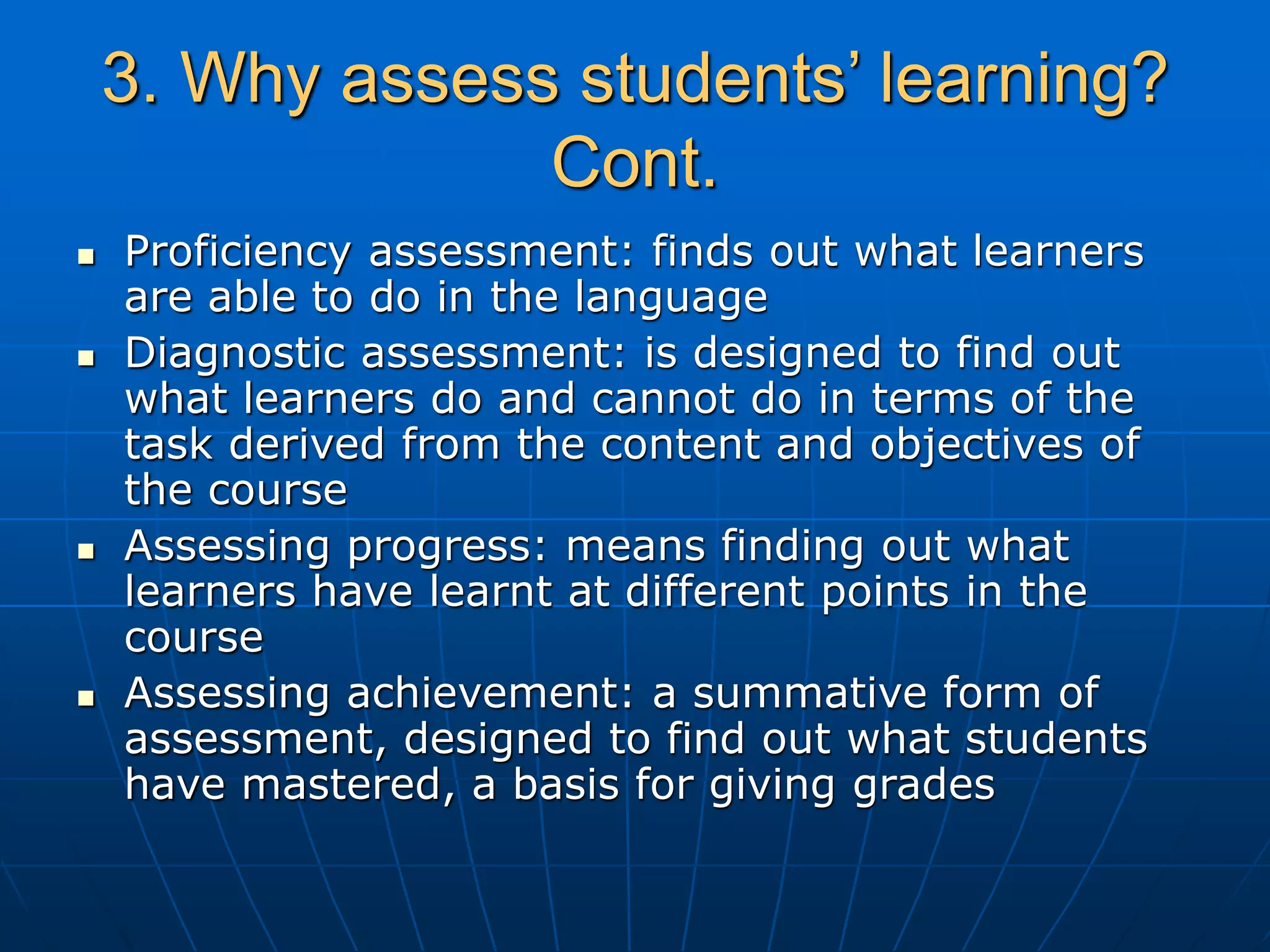
3. Why assess students’ learning?
Cont.
 Proficiency assessment: finds out what learners
are able to do in the language
 Diagnostic assessment: is designed to find out
what learners do and cannot do in terms of the
task derived from the content and objectives of
the course
 Assessing progress: means finding out what
learners have learnt at different points in the
course
 Assessing achievement: a summative form of
assessment, designed to find out what students
have mastered, a basis for giving grades
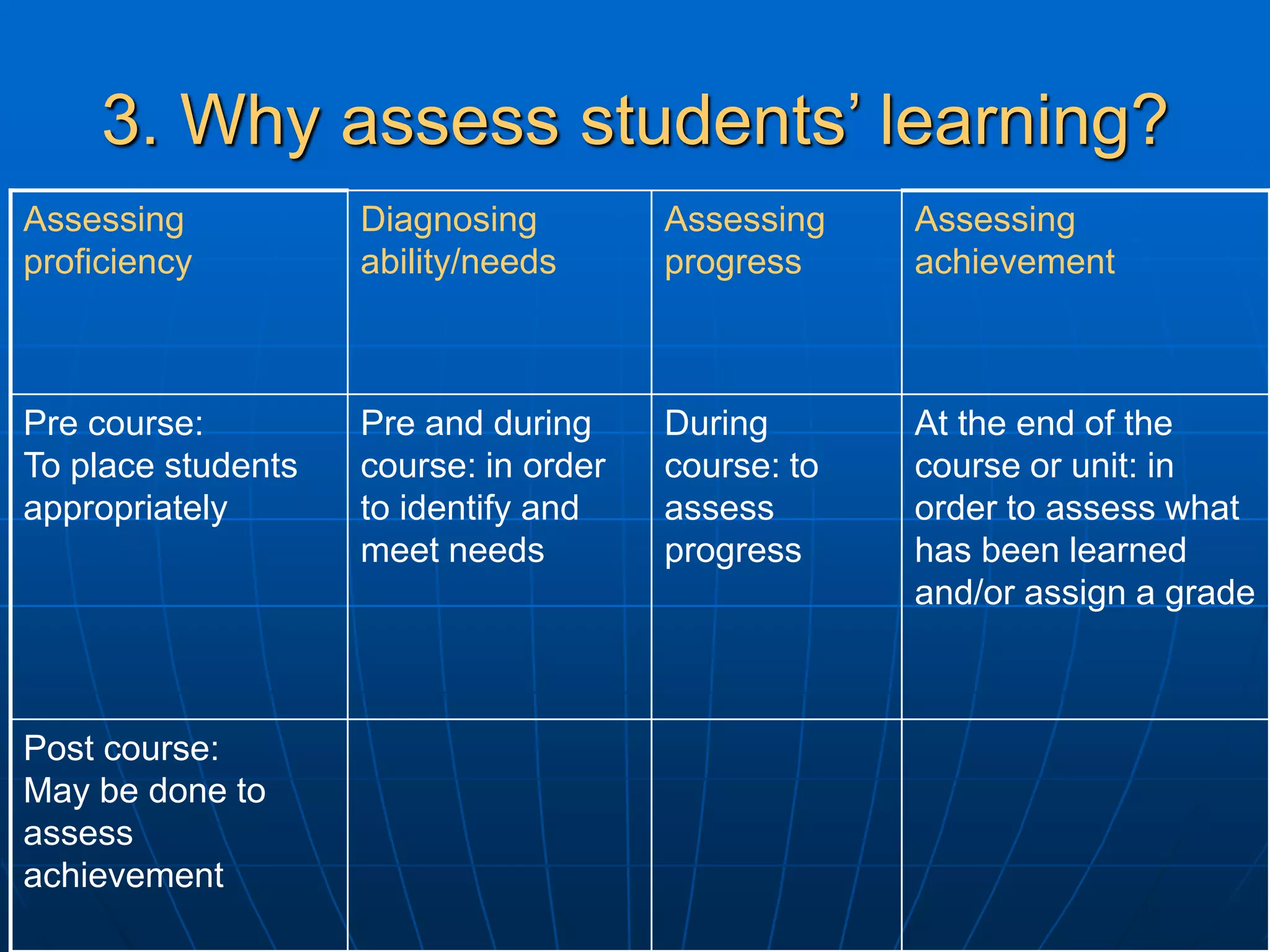
3. Why assess students’ learning?
Assessing
proficiency
Diagnosing
ability/needs
Assessing
progress
Assessing
achievement
Pre course:
To place students
appropriately
Pre and during
course: in order
to identify and
meet needs
During
course: to
assess
progress
At the end of the
course or unit: in
order to assess what
has been learned
and/or assign a grade
Post course:
May be done to
assess
achievement
4. How do you assess students’
learning?
 There are a number of tools and
activities for assessing learning:
- Tests
- Role plays
- Written assignments
Students must learn how to use any
assessment instrument
5. When can you assess students’
learning?
 Depend on the context: the length of
the course, when to assign the
grades, how the course units are
constructed
 Need to have plan for both formative
and summative assessment
6. What is done with the results of
assessment?
 Proficiency test:
- helps you to choose or modify the material in
the course
- asseses whether students will be able to
perform the language tasks required of them.
 Diagnostic test: helps you to know your students’
needs, evaluate the appropriateness of the goals
and objectives
 Progress and achievement tests: help you and
students to get sense of what they have learnt
and how the course is successfully guiding them
ROLE OF ASSESSMENT
- Roles: 3 interrelated roles
+ Assessing needs: « What (and how) do students
need to learn with respect to _____? »
+ Assessing students’ learning: « What have Ss
learned with respect to _____? »
+ Evaluating course: « How effective is/was the
course in helping them learn ____? »
- Purpose: to indicate the extent to which a course
achieves its objectives and outcomes so that the
course can be improved.
ASSESSMENT (cont.)
 Classification:
- Formative and summative
- Objective and subjective
- Formal and informal
FORMATIVE
 takes place as the course is in progress
 provides information about how well the
students are doing – what they have achieved,
what they need to work on, and how well the
course is meeting their needs
SUMMATIVE
 takes place at the end of the course
 provides info about the Ss’ overall achievement
as well as the overall effectiveness of the
course.
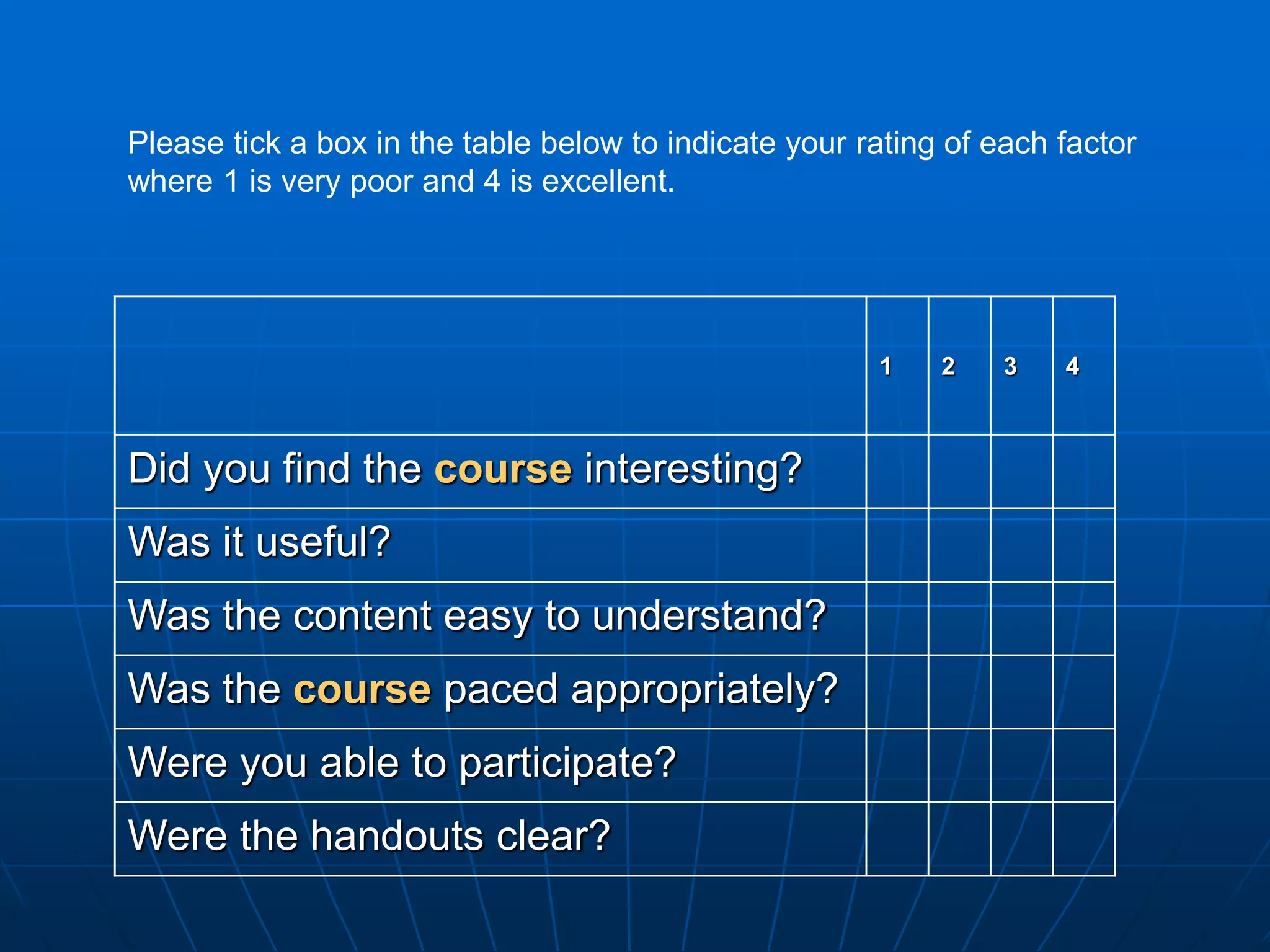
OBJECTIVE
 is a form of questioning which has a single
correct answer
 questions types include T/F answers, multiple
choice, matching questions
 e.g:
1 2 3 4
Did you find the course interesting?
Was it useful?
Was the content easy to understand?
Was the course paced appropriately?
Were you able to participate?
Were the handouts clear?
Please tick a box in the table below to indicate your rating of each factor
where 1 is very poor and 4 is excellent.
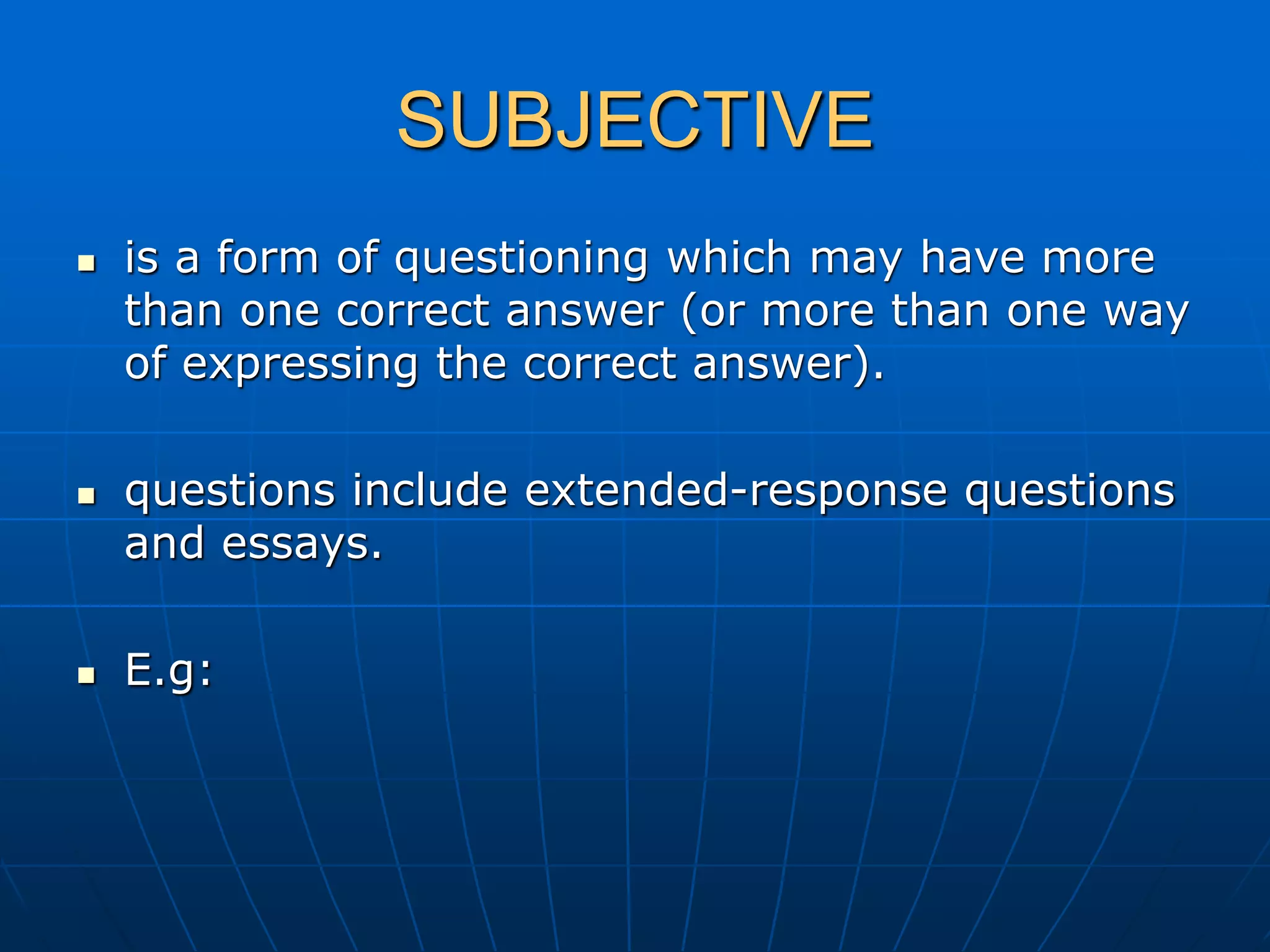
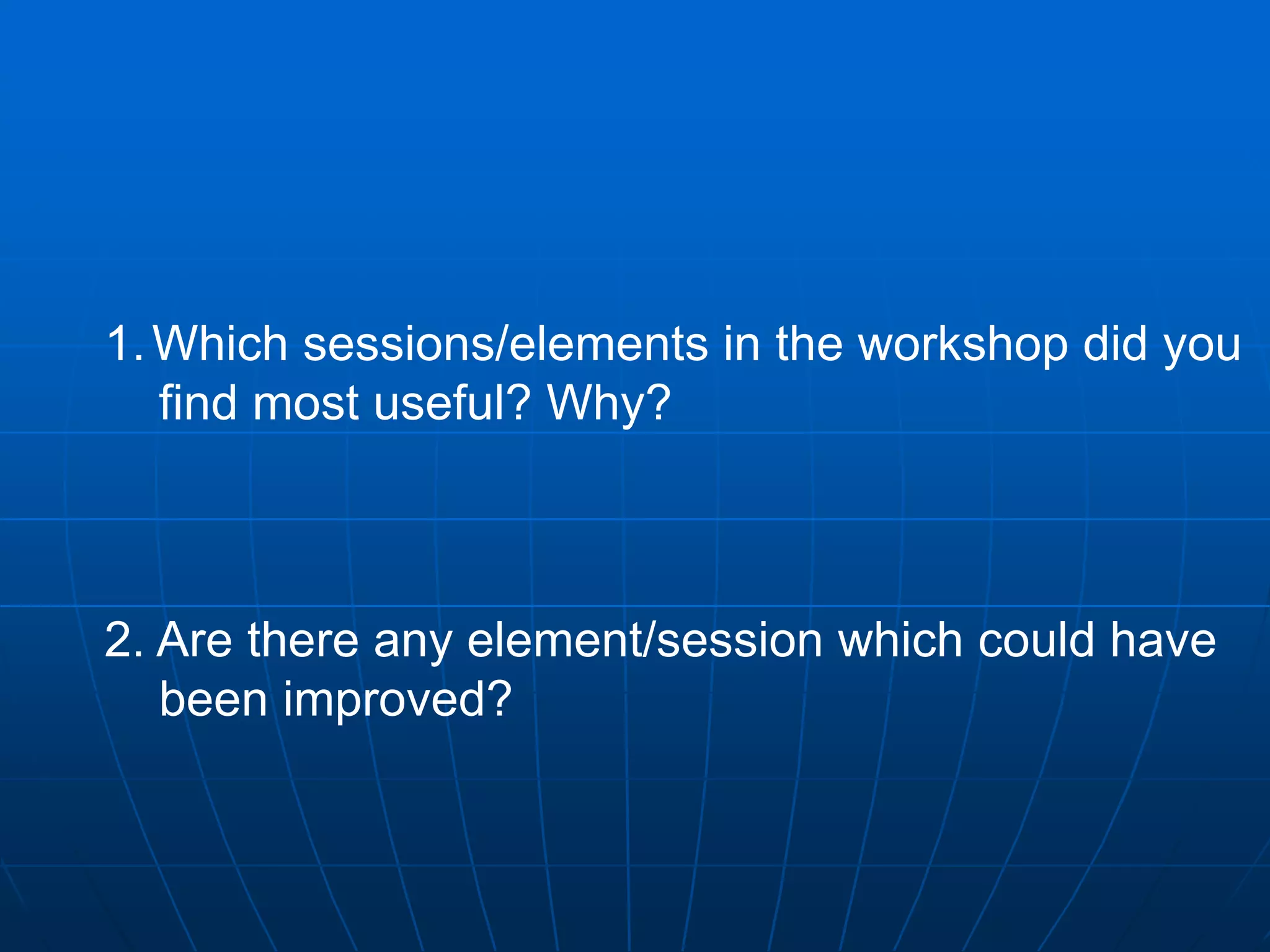
SUBJECTIVE
 is a form of questioning which may have more
than one correct answer (or more than one way
of expressing the correct answer).
 questions include extended-response questions
and essays.
 E.g:
1.Which sessions/elements in the workshop did you
find most useful? Why?
2. Are there any element/session which could have
been improved?
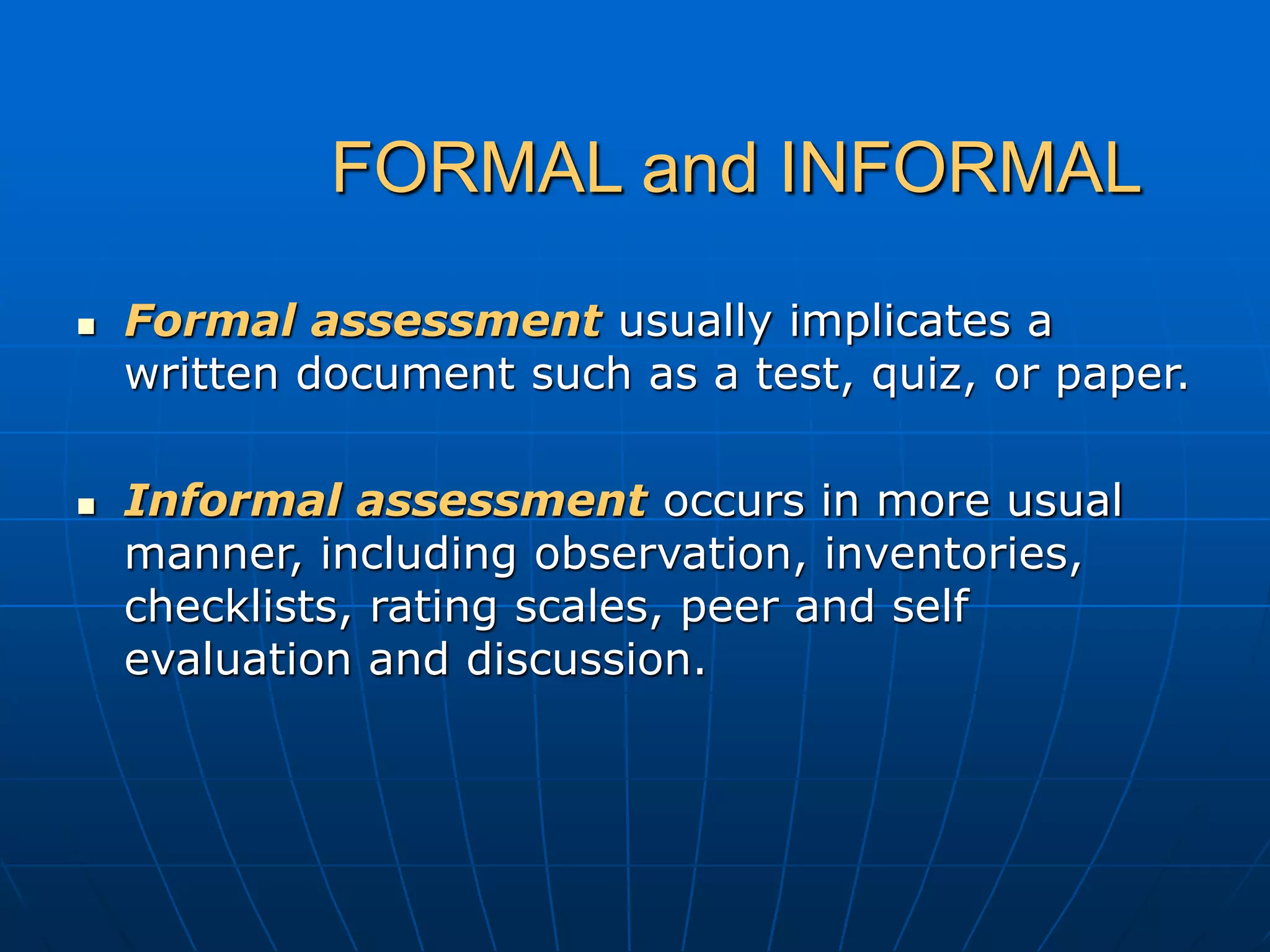
FORMAL and INFORMAL
 Formal assessment usually implicates a
written document such as a test, quiz, or paper.
 Informal assessment occurs in more usual
manner, including observation, inventories,
checklists, rating scales, peer and self
evaluation and discussion.
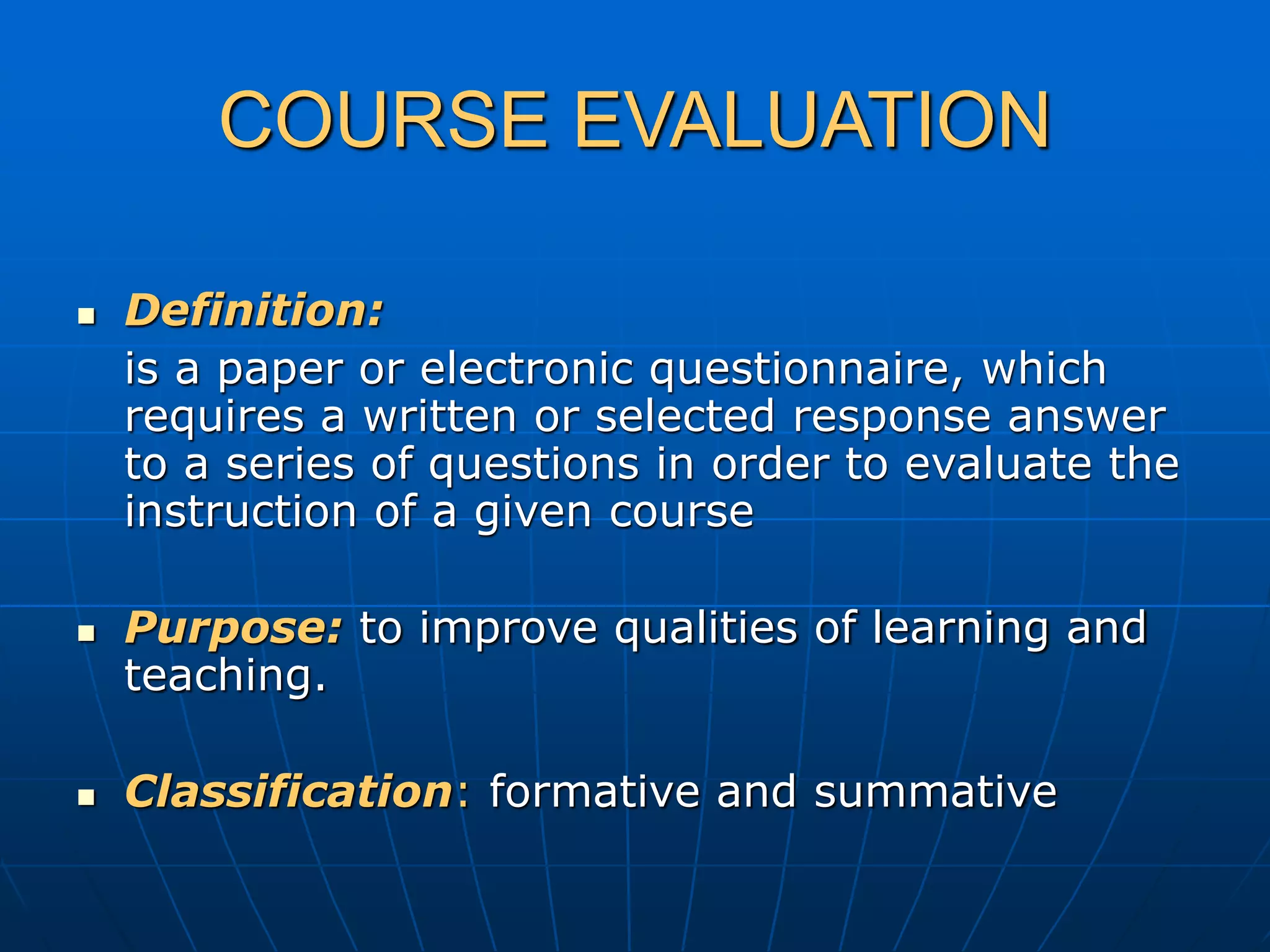
COURSE EVALUATION
 Definition:
is a paper or electronic questionnaire, which
requires a written or selected response answer
to a series of questions in order to evaluate the
instruction of a given course
 Purpose: to improve qualities of learning and
teaching.
 Classification: formative and summative
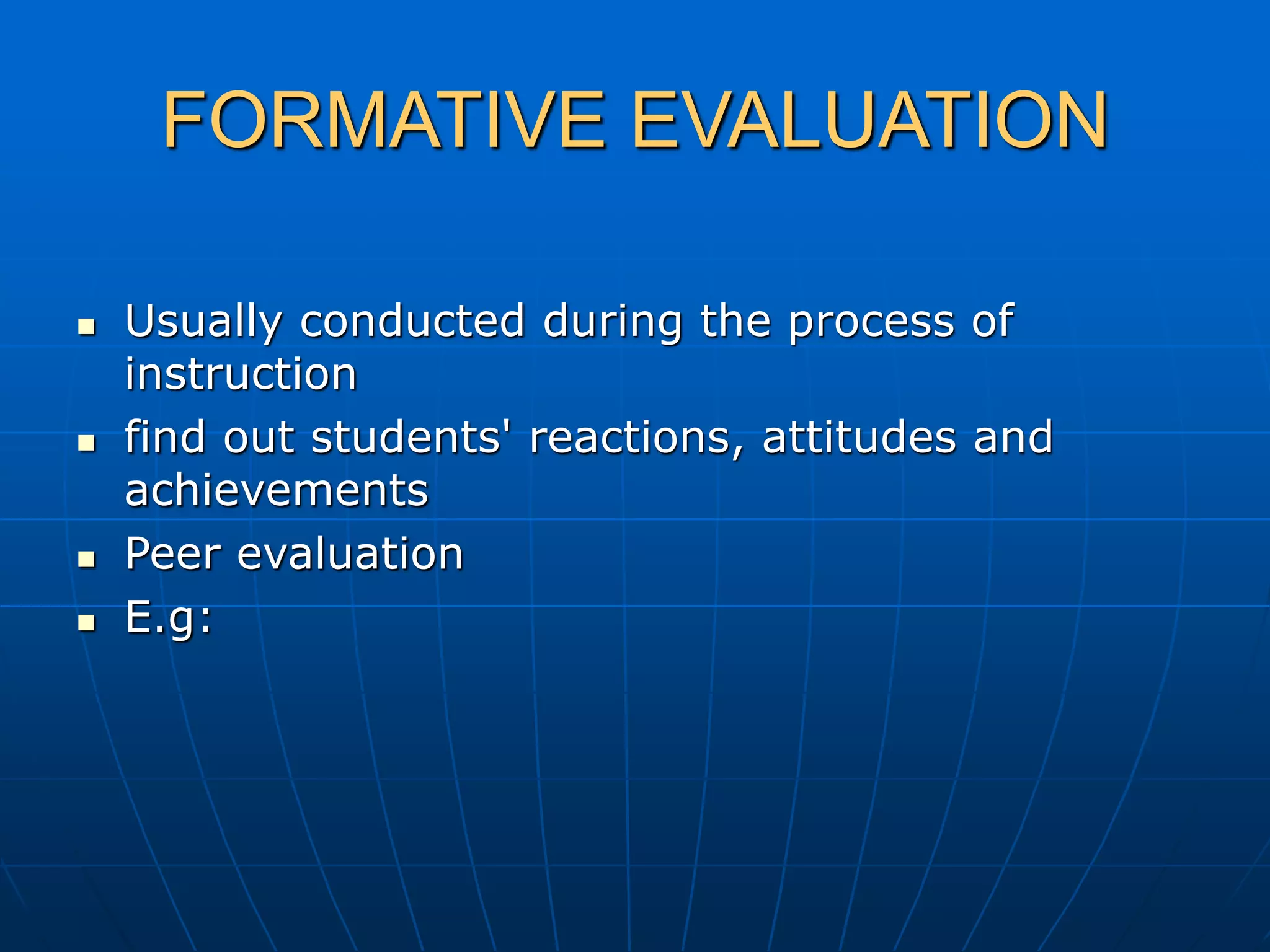
FORMATIVE EVALUATION
 Usually conducted during the process of
instruction
 find out students' reactions, attitudes and
achievements
 Peer evaluation
 E.g:
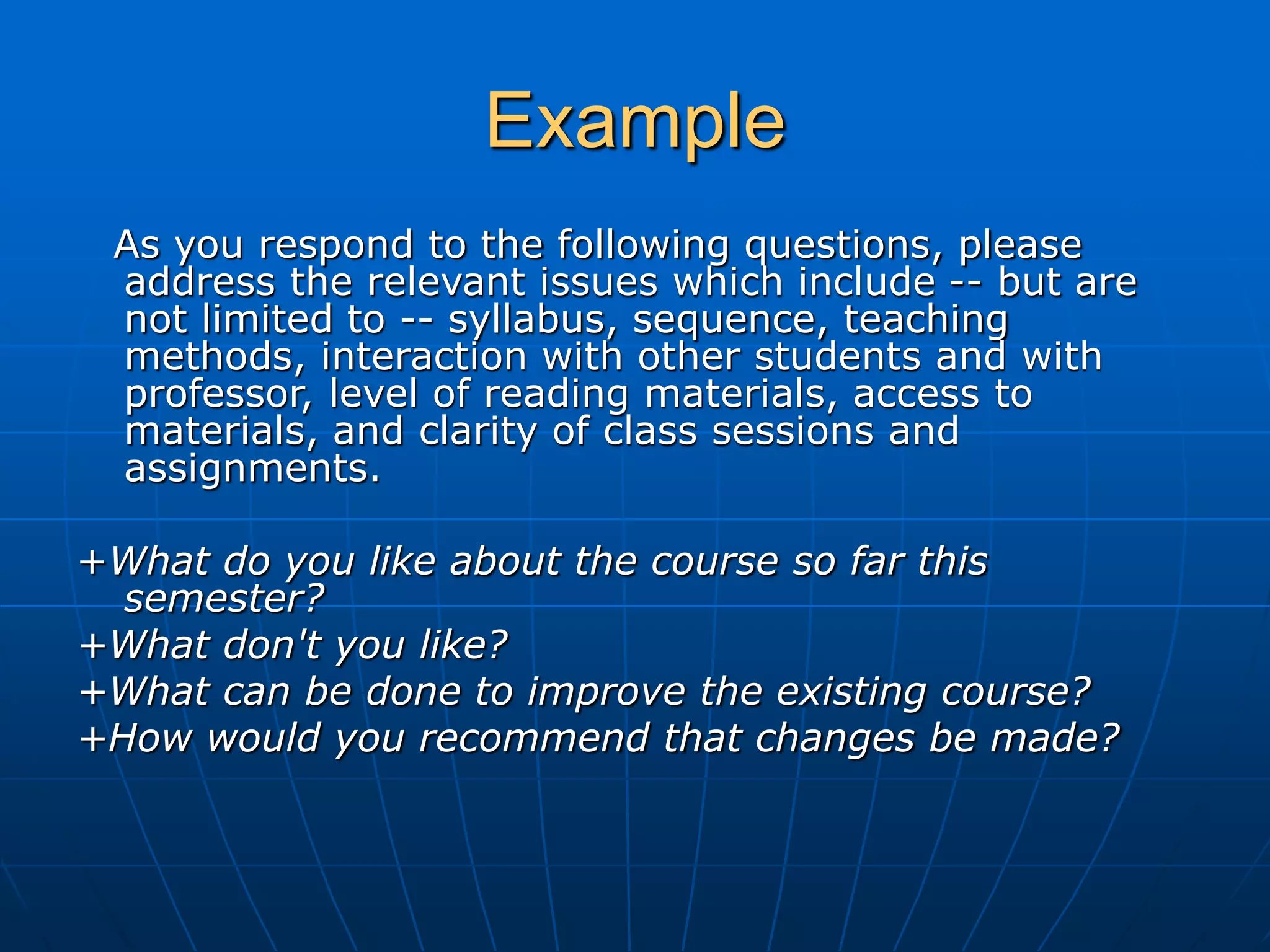
Example
As you respond to the following questions, please
address the relevant issues which include -- but are
not limited to -- syllabus, sequence, teaching
methods, interaction with other students and with
professor, level of reading materials, access to
materials, and clarity of class sessions and
assignments.
+What do you like about the course so far this
semester?
+What don't you like?
+What can be done to improve the existing course?
+How would you recommend that changes be made?
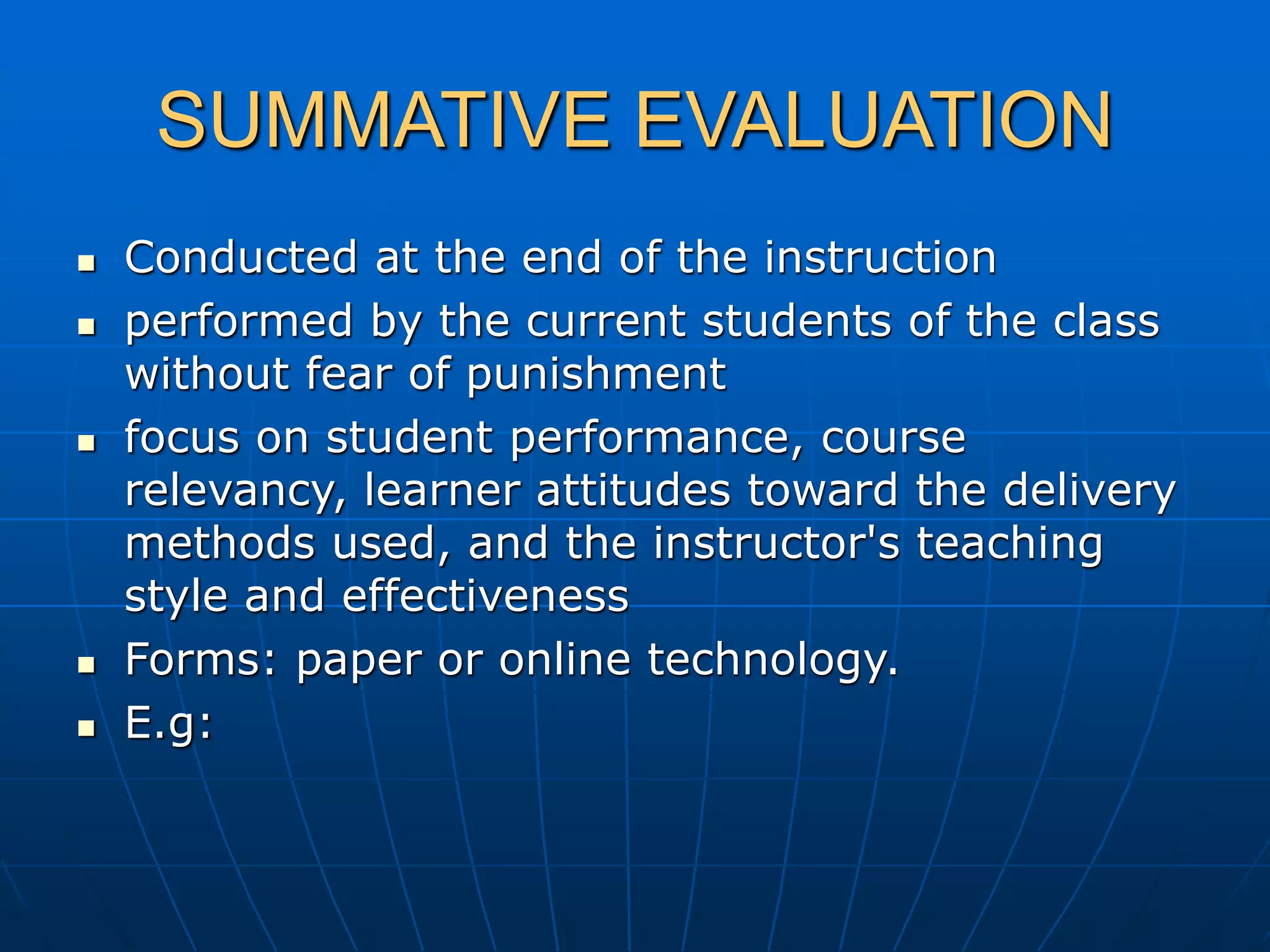
SUMMATIVE EVALUATION
 Conducted at the end of the instruction
 performed by the current students of the class
without fear of punishment
 focus on student performance, course
relevancy, learner attitudes toward the delivery
methods used, and the instructor's teaching
style and effectiveness
 Forms: paper or online technology.
 E.g:
Example
As you respond to the following questions, please
address the relevant issues which include, but are
not limited, to syllabus, sequence, teaching
methods, interaction with other students and
with professor, level of reading materials, access
to materials, and clarity of class sessions and
assignments.
 What did you like about the course this
semester?
 What didn't you like?
 What can be done to improve future courses?
How would you recommend that changes be
made?
Evaluating the course
 To evaluate the course = To answer
the 6 questions
Evaluating the course
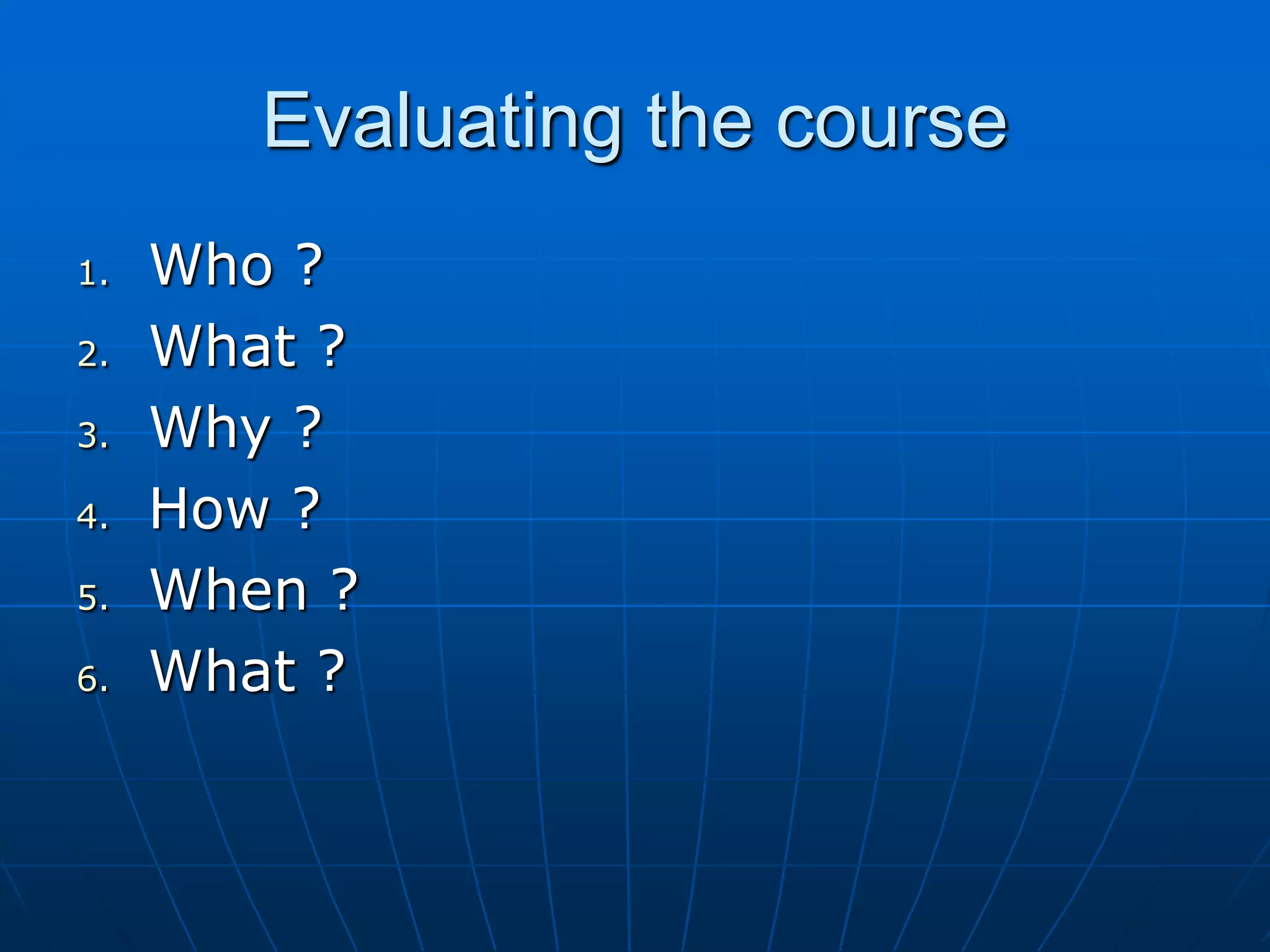
1. Who ?
2. What ?
3. Why ?
4. How ?
5. When ?
6. What ?
Evaluating the course. (Cont.)
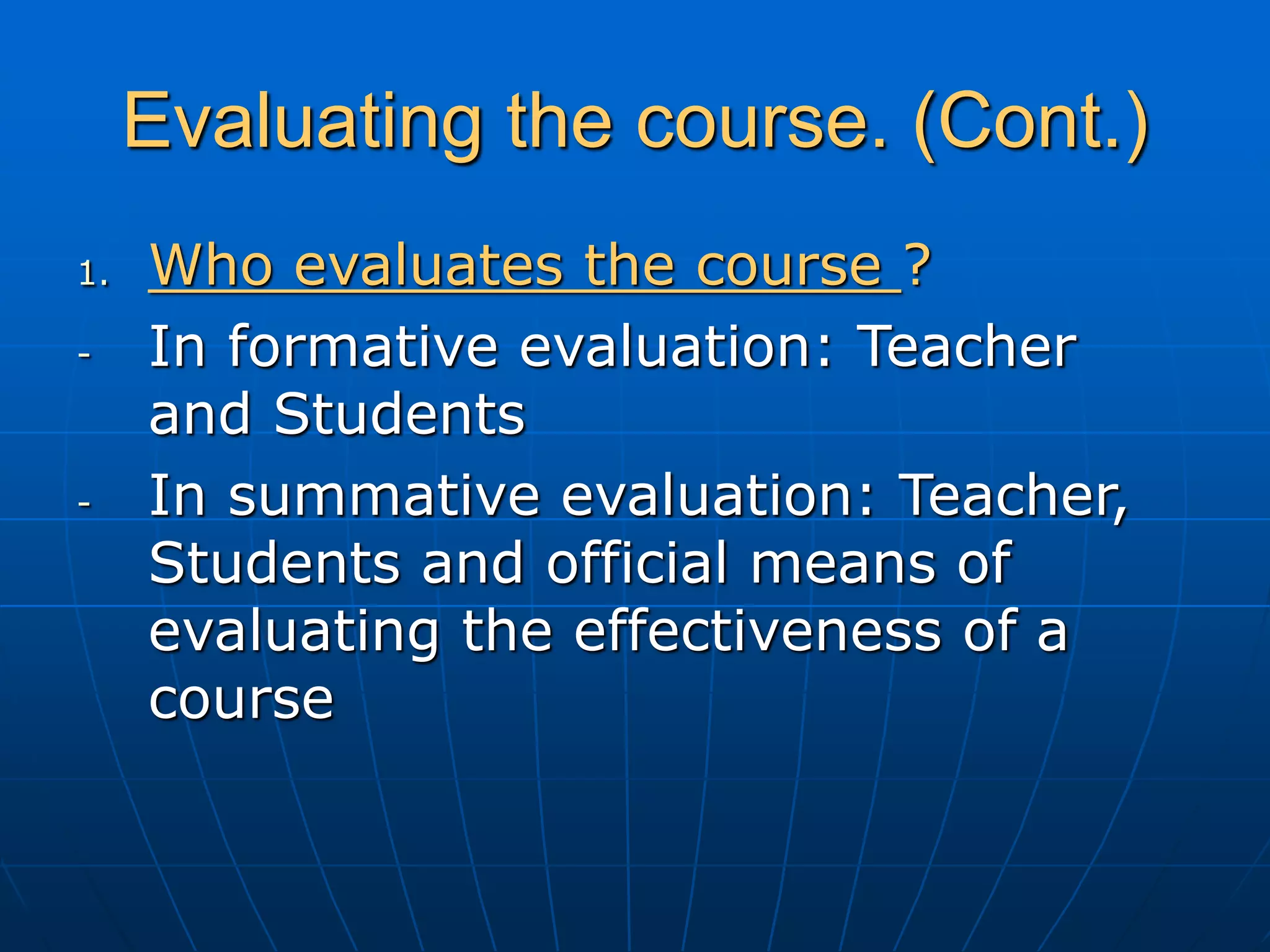
1. Who evaluates the course ?
- In formative evaluation: Teacher
and Students
- In summative evaluation: Teacher,
Students and official means of
evaluating the effectiveness of a
course
Evaluating the course. (Cont.)
2. What is evaluated ?
All aspects of course design can be
assessed and evaluated:
- the goals and objectives: are/were
they realistic ? Appropriate?
Achievable ? How should they be
changed ?
- the course content: is/was it what
the students needed ? At right level ?
Comprehensive enough ? Focused
enough ?
Evaluating the course. (Cont.)
- the needs assessment: did it provide
the needed information? The right
amount of information? In a timely
way? Did the students understand it ?
Was it appropriately and effectively
responded to?
- the way the course is organized: does it
flow from unit and within unit? Do
students perceive a sensible
progression? Is the course content
woven together in a balanced way? Is
material recycled throughout the
Evaluating the course. (Cont.)
- the materials and methods: are they
at the right level ? Is the material
engaging ? Do the students have
enough opportunities to learn what
they need to ? Is the material
relevant ? Are the students
comfortable with their roles ? The
teacher’s role ?
Evaluating the course.(Cont.)
- the learning assessment plan: do
students understand how they will be
assessed and why ? Do assessment
activities assess what has been
learned? Do they help students
diagnose needs ? Measure progress or
achievement ? Are they timely?
- the course evaluation plan: do students
understand how the course is being
evaluated and their role? Do they
understand the purpose? Is the
formative evaluation timely? Does it
provide useful information?
Evaluating the course. (Cont.)
3. Why evaluate the course ?
- Formative evaluation: evaluate what is
effective and what isn’t -> change so
that the course effectively meets
students’ needs; give students a voice
in learning; provide information for the
redesign of the course.
- Summative evaluation: decide whether
the course should continue or not;
assess the achievement of the course;
provide information for the redesign of
the course.
Evaluating the course. (Cont.)
4. How can you evaluate the course ?
-> through:
+ dialogue journals
+ feedback (oral or written, individual
or group)
+ questionaires
Evaluating the course. (Cont.)
5. When can you evaluate the course ?
-> periodically, at natural intervals
(end of week, unit); at the midterm,
or at the end of the course; when
problems arise.
Evaluating the course. (Cont.)
6. What is done with the results of
evaluation ?
- Formative evaluation: help to retain
effective aspects of the course and
change ineffective aspects while
teaching.
- Summative evaluation: is used to
improve for next time.
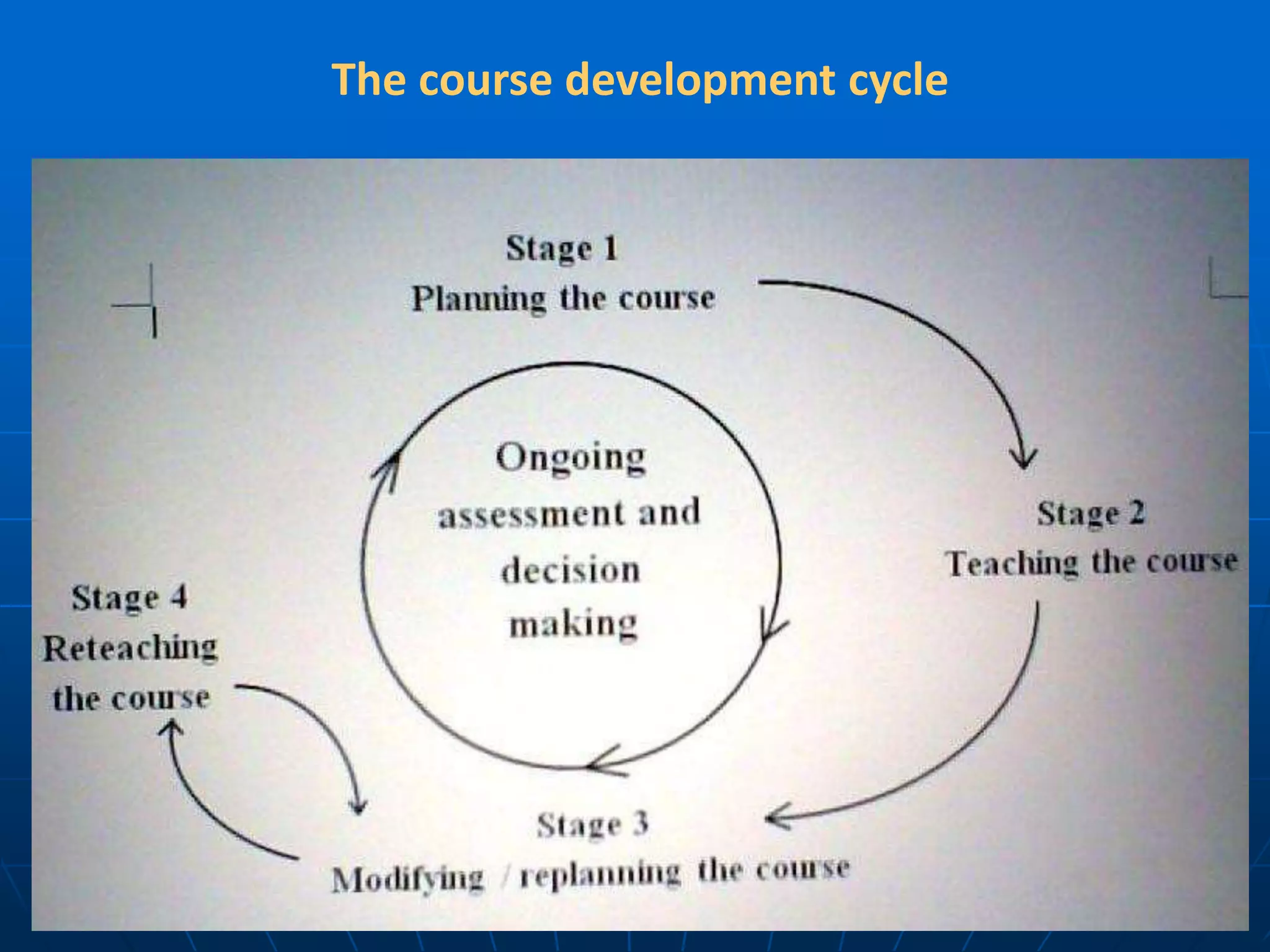
The course development cycle
Thank you for your
attention

EVALUATION AND ASSESSEMENT IN ESP

  • 1.
    ASSESSMENT ASSESSMENT:  Assessing needs Assessing students’ learning-  Testing: assess what students have achieved with respect to what they have been learning in the course COURSE EVALUATION:  Assessing what your course design has achieved with respect to your intentions in designing it
  • 2.
    ASSESSEMENT CONT.  Whenpreparing an assessment plan, a series of questions need to be considered: 1. Who assessed students’ learning? 2. What is assessed? 3. Why assess students’ learning? 4. How can you assess students’ learning? 5. When can you assess students’ learning? 6. What is done with the results of assessment?
  • 3.
    1. Who assessedstudents’ learning?  Teachers  Institution  The student, students This depends on teachers’ goals and their beliefs about the role of learners in learning
  • 4.
    2. What isassessed? GLOBAL ANSWER: depends on the way you conceptualized the content of the course and the goals and objectives articulated EXAMPLE + teaching communication skills for a group of people: ‘real-life’ situations for students to speak need to be included in your assessment + designing a course for a tour guide: language in tourist setting, cultural knowledge, skill to deal with different situations should be included
  • 5.
    2. What isassessed? Cont. SPECIFIC ANSWER: has to do with the specific criteria for assessment Eg: Assess students’ abilities to make effective presentation  Content  Performance  Pronunciation  Fluency  Body language and eye contact - Criteria should be: Conveyed to and understood by students Students need to learn how to meet those criteria
  • 6.
    3. Why assessstudents’ learning? Assessing proficiency Diagnosing ability/needs Assessing progress Assessing achievement Pre course: To place students appropriately Pre and during course: in order to identify and meet needs During course: to assess progress At the end of the course or unit: in order to assess what has been learned and/or assign a grade Post course: May be done to assess achievement
  • 7.
    3. Why assessstudents’ learning? Cont.  Proficiency assessment: finds out what learners are able to do in the language  Diagnostic assessment: is designed to find out what learners do and cannot do in terms of the task derived from the content and objectives of the course  Assessing progress: means finding out what learners have learnt at different points in the course  Assessing achievement: a summative form of assessment, designed to find out what students have mastered, a basis for giving grades
  • 8.
    3. Why assessstudents’ learning? Assessing proficiency Diagnosing ability/needs Assessing progress Assessing achievement Pre course: To place students appropriately Pre and during course: in order to identify and meet needs During course: to assess progress At the end of the course or unit: in order to assess what has been learned and/or assign a grade Post course: May be done to assess achievement
  • 9.
    4. How doyou assess students’ learning?  There are a number of tools and activities for assessing learning: - Tests - Role plays - Written assignments Students must learn how to use any assessment instrument
  • 10.
    5. When canyou assess students’ learning?  Depend on the context: the length of the course, when to assign the grades, how the course units are constructed  Need to have plan for both formative and summative assessment
  • 11.
    6. What isdone with the results of assessment?  Proficiency test: - helps you to choose or modify the material in the course - asseses whether students will be able to perform the language tasks required of them.  Diagnostic test: helps you to know your students’ needs, evaluate the appropriateness of the goals and objectives  Progress and achievement tests: help you and students to get sense of what they have learnt and how the course is successfully guiding them
  • 12.
    ROLE OF ASSESSMENT -Roles: 3 interrelated roles + Assessing needs: « What (and how) do students need to learn with respect to _____? » + Assessing students’ learning: « What have Ss learned with respect to _____? » + Evaluating course: « How effective is/was the course in helping them learn ____? » - Purpose: to indicate the extent to which a course achieves its objectives and outcomes so that the course can be improved.
  • 13.
    ASSESSMENT (cont.)  Classification: -Formative and summative - Objective and subjective - Formal and informal
  • 14.
    FORMATIVE  takes placeas the course is in progress  provides information about how well the students are doing – what they have achieved, what they need to work on, and how well the course is meeting their needs
  • 15.
    SUMMATIVE  takes placeat the end of the course  provides info about the Ss’ overall achievement as well as the overall effectiveness of the course.
  • 16.
    OBJECTIVE  is aform of questioning which has a single correct answer  questions types include T/F answers, multiple choice, matching questions  e.g:
  • 17.
    1 2 34 Did you find the course interesting? Was it useful? Was the content easy to understand? Was the course paced appropriately? Were you able to participate? Were the handouts clear? Please tick a box in the table below to indicate your rating of each factor where 1 is very poor and 4 is excellent.
  • 18.
    SUBJECTIVE  is aform of questioning which may have more than one correct answer (or more than one way of expressing the correct answer).  questions include extended-response questions and essays.  E.g:
  • 19.
    1.Which sessions/elements inthe workshop did you find most useful? Why? 2. Are there any element/session which could have been improved?
  • 20.
    FORMAL and INFORMAL Formal assessment usually implicates a written document such as a test, quiz, or paper.  Informal assessment occurs in more usual manner, including observation, inventories, checklists, rating scales, peer and self evaluation and discussion.
  • 21.
    COURSE EVALUATION  Definition: isa paper or electronic questionnaire, which requires a written or selected response answer to a series of questions in order to evaluate the instruction of a given course  Purpose: to improve qualities of learning and teaching.  Classification: formative and summative
  • 22.
    FORMATIVE EVALUATION  Usuallyconducted during the process of instruction  find out students' reactions, attitudes and achievements  Peer evaluation  E.g:
  • 23.
    Example As you respondto the following questions, please address the relevant issues which include -- but are not limited to -- syllabus, sequence, teaching methods, interaction with other students and with professor, level of reading materials, access to materials, and clarity of class sessions and assignments. +What do you like about the course so far this semester? +What don't you like? +What can be done to improve the existing course? +How would you recommend that changes be made?
  • 24.
    SUMMATIVE EVALUATION  Conductedat the end of the instruction  performed by the current students of the class without fear of punishment  focus on student performance, course relevancy, learner attitudes toward the delivery methods used, and the instructor's teaching style and effectiveness  Forms: paper or online technology.  E.g:
  • 25.
    Example As you respondto the following questions, please address the relevant issues which include, but are not limited, to syllabus, sequence, teaching methods, interaction with other students and with professor, level of reading materials, access to materials, and clarity of class sessions and assignments.  What did you like about the course this semester?  What didn't you like?  What can be done to improve future courses? How would you recommend that changes be made?
  • 26.
    Evaluating the course To evaluate the course = To answer the 6 questions
  • 27.
    Evaluating the course 1.Who ? 2. What ? 3. Why ? 4. How ? 5. When ? 6. What ?
  • 28.
    Evaluating the course.(Cont.) 1. Who evaluates the course ? - In formative evaluation: Teacher and Students - In summative evaluation: Teacher, Students and official means of evaluating the effectiveness of a course
  • 29.
    Evaluating the course.(Cont.) 2. What is evaluated ? All aspects of course design can be assessed and evaluated: - the goals and objectives: are/were they realistic ? Appropriate? Achievable ? How should they be changed ? - the course content: is/was it what the students needed ? At right level ? Comprehensive enough ? Focused enough ?
  • 30.
    Evaluating the course.(Cont.) - the needs assessment: did it provide the needed information? The right amount of information? In a timely way? Did the students understand it ? Was it appropriately and effectively responded to? - the way the course is organized: does it flow from unit and within unit? Do students perceive a sensible progression? Is the course content woven together in a balanced way? Is material recycled throughout the
  • 31.
    Evaluating the course.(Cont.) - the materials and methods: are they at the right level ? Is the material engaging ? Do the students have enough opportunities to learn what they need to ? Is the material relevant ? Are the students comfortable with their roles ? The teacher’s role ?
  • 32.
    Evaluating the course.(Cont.) -the learning assessment plan: do students understand how they will be assessed and why ? Do assessment activities assess what has been learned? Do they help students diagnose needs ? Measure progress or achievement ? Are they timely? - the course evaluation plan: do students understand how the course is being evaluated and their role? Do they understand the purpose? Is the formative evaluation timely? Does it provide useful information?
  • 33.
    Evaluating the course.(Cont.) 3. Why evaluate the course ? - Formative evaluation: evaluate what is effective and what isn’t -> change so that the course effectively meets students’ needs; give students a voice in learning; provide information for the redesign of the course. - Summative evaluation: decide whether the course should continue or not; assess the achievement of the course; provide information for the redesign of the course.
  • 34.
    Evaluating the course.(Cont.) 4. How can you evaluate the course ? -> through: + dialogue journals + feedback (oral or written, individual or group) + questionaires
  • 35.
    Evaluating the course.(Cont.) 5. When can you evaluate the course ? -> periodically, at natural intervals (end of week, unit); at the midterm, or at the end of the course; when problems arise.
  • 36.
    Evaluating the course.(Cont.) 6. What is done with the results of evaluation ? - Formative evaluation: help to retain effective aspects of the course and change ineffective aspects while teaching. - Summative evaluation: is used to improve for next time.
  • 37.
  • 38.
    Thank you foryour attention