By:
Ruel Montefolka
Ariel John Quiachon
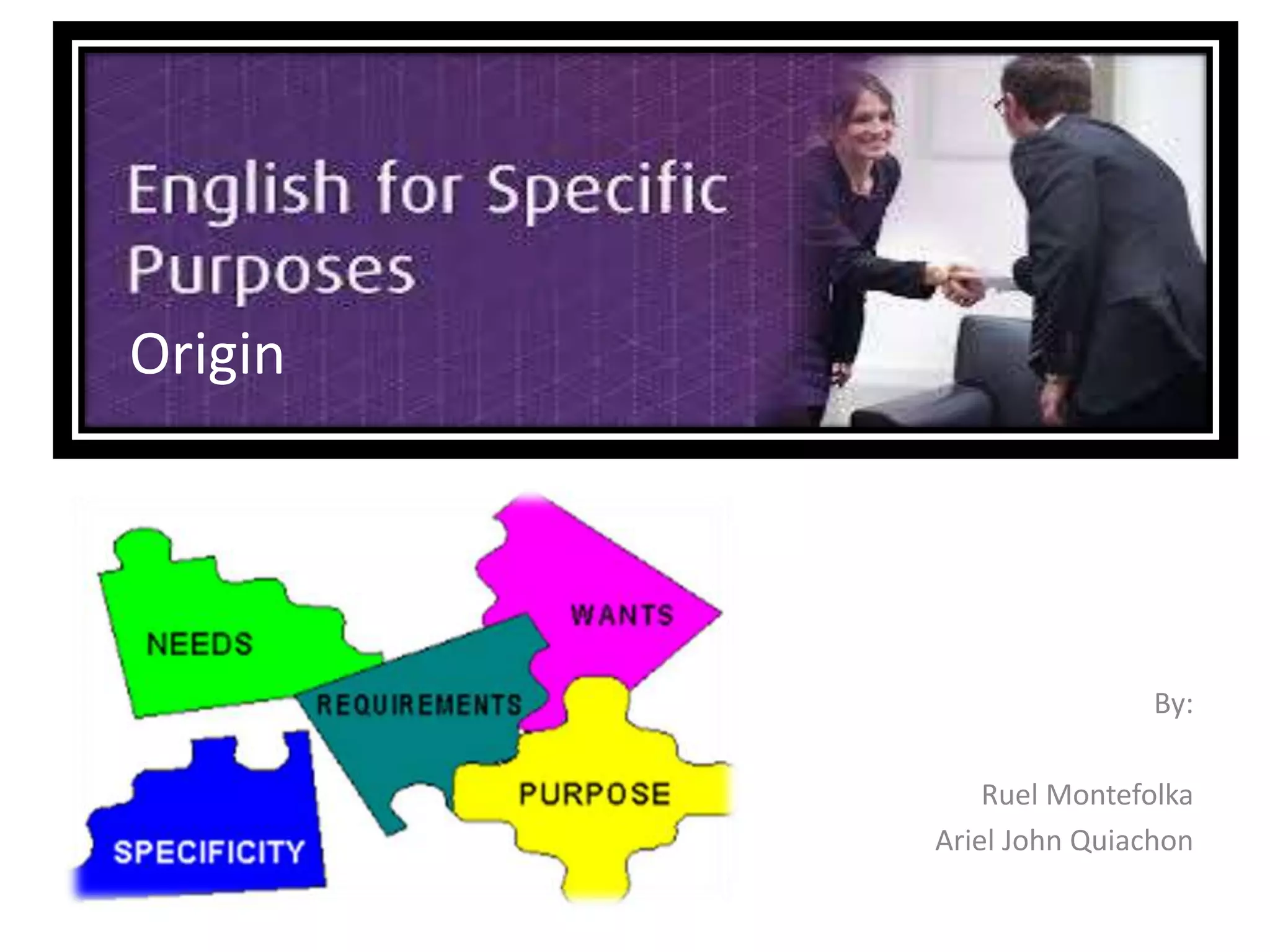
Origin
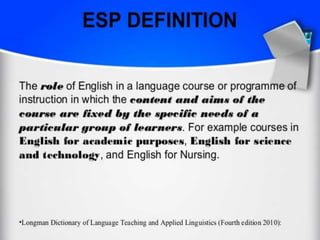
What is ESP?
Is an approach to
language teaching in
which all decisions as to
content and methods
are based on the
learners reason for
learning.
As with most developments
in human activity ESP was not
planned and coherent movement
but rather a phenomenon that
grew out of a number of converging
trends.
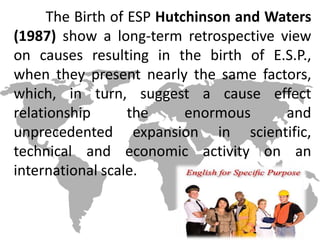
The Birth of ESP Hutchinson and Waters
(1987) show a long-term retrospective view
on causes resulting in the birth of E.S.P.,
when they present nearly the same factors,
which, in turn, suggest a cause effect
relationship the enormous and
unprecedented expansion in scientific,
technical and economic activity on an
international scale.
a. Two forces were dominating the new post-war
world – technology and commerce, whose
relentless progress soon generated a demand for
an international language and, due to the
economic power of the U.S. it was English which
was granted this role.
b. The emerging of a new mass of people wanting
to learn English – the key to international
currencies of technology and commerce. This
mass of people joined together particularly new
generations of learners who knew specifically
what they were to learn and why.
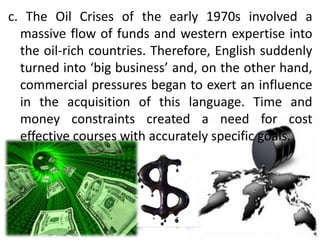
c. The Oil Crises of the early 1970s involved a
massive flow of funds and western expertise into
the oil-rich countries. Therefore, English suddenly
turned into ‘big business’ and, on the other hand,
commercial pressures began to exert an influence
in the acquisition of this language. Time and
money constraints created a need for cost
effective courses with accurately specific goals.
d. The need for several countries to update their knowledge.
Therefore, E.S.P. came into being and gradually developed
into a multilayered language approach primarily based on
learners’ specific needs required by their professions or
occupations. The domain labeled E.S.P. was proven to
have a universal dimension through the concept of
language for specific purposes and a language-specific
perspective through the insights explored into various
European languages.
References
1. Mohammad Kaosar Ahmed Associate Professor
Department of English Language and Literature
International Islamic University Chittagong
2. http://www.esp-
world.info/Articles_42/Documents/Ahmed.pdf
3. www.google.com/images
Time and Date Retrieved
6/20/16
02:50pm

ESP (English for Specific Purposes) Origin

  • 1.
  • 2.
    What is ESP? Isan approach to language teaching in which all decisions as to content and methods are based on the learners reason for learning.
  • 4.
    As with mostdevelopments in human activity ESP was not planned and coherent movement but rather a phenomenon that grew out of a number of converging trends.
  • 5.
    The Birth ofESP Hutchinson and Waters (1987) show a long-term retrospective view on causes resulting in the birth of E.S.P., when they present nearly the same factors, which, in turn, suggest a cause effect relationship the enormous and unprecedented expansion in scientific, technical and economic activity on an international scale.
  • 7.
    a. Two forceswere dominating the new post-war world – technology and commerce, whose relentless progress soon generated a demand for an international language and, due to the economic power of the U.S. it was English which was granted this role.
  • 8.
    b. The emergingof a new mass of people wanting to learn English – the key to international currencies of technology and commerce. This mass of people joined together particularly new generations of learners who knew specifically what they were to learn and why.
  • 9.
    c. The OilCrises of the early 1970s involved a massive flow of funds and western expertise into the oil-rich countries. Therefore, English suddenly turned into ‘big business’ and, on the other hand, commercial pressures began to exert an influence in the acquisition of this language. Time and money constraints created a need for cost effective courses with accurately specific goals.
  • 10.
    d. The needfor several countries to update their knowledge. Therefore, E.S.P. came into being and gradually developed into a multilayered language approach primarily based on learners’ specific needs required by their professions or occupations. The domain labeled E.S.P. was proven to have a universal dimension through the concept of language for specific purposes and a language-specific perspective through the insights explored into various European languages.
  • 11.
    References 1. Mohammad KaosarAhmed Associate Professor Department of English Language and Literature International Islamic University Chittagong 2. http://www.esp- world.info/Articles_42/Documents/Ahmed.pdf 3. www.google.com/images Time and Date Retrieved 6/20/16 02:50pm