Customer-Driven Marketing Strategy:
Creating Value for Target Customers
Session Outline
Differentiation and Positioning
Market Segmentation
Market Targeting
Customer-Driven Marketing Strategy
Customer-Driven Marketing Strategy
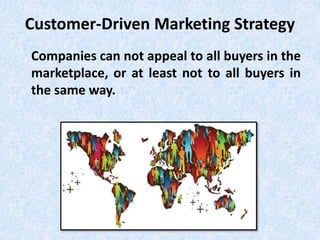
Companies can not appeal to all buyers in the
marketplace, or at least not to all buyers in
the same way.
Designing a Customer-Driven Marketing
Strategy
Create value for
targeted
customers
Select customers
to serve
Decide on a value
proposition
Segmentation
Targeting
Differentiation
Positioning
Market Segmentation
Dividing a market into smaller groups with
distinct needs, characteristics, or behaviours
that might require separate marketing
strategies or mixes.
Segmentation (Cont.)
Through market segmentation, companies divide
large heterogeneous markets into smaller
segments that can be reached more efficiently
and effectively with products and services that
match their unique needs
Segmenting Consumer Markets
There is no single way to segment a
market. A marketer has to try different
segmentation variables, alone and in
combination, to find the best way to
view the market structure.
Major Segmentation Bases
Geographic
Demographic
Psychographic
Behavioural
Major Segmentation Variables
Geographic Demographic Psychographic Behavioural
World region or
country
Age Social class Occasions
Country region Gender Lifestyle Benefits
Province Family size Personality User status
District Family life cycle User rates
City Income Loyalty status
Density Occupation Readiness stage
Climate Education Attitude toward
product
Religion
Nationality
Requirements for Effective Segmentation
Accessible
Measurable
Substantial
Differentiable
Actionable
The size, purchasing power, and profiles of the
segments can be measured.
The market segments can be effectively reached
and served.
The market segments are large or profitable
enough to serve.
The segments are conceptually distinguishable
and respond differently to different marketing
mix elements and programmes.
Effective programmes can be designed for
attracting and serving the segments.
Market Targeting
Target Market
A set of buyers sharing common needs or
characteristics that the company decides to
serve.
Market Targeting
The process of evaluating each market
segment’s attractiveness and selecting one or
more segments to enter.
Targeting (Cont.)
The firm now has to evaluate the various
segments and decide how many and
which segments it can serve best.
Evaluating Market Segments
1. Segment Size and Growth
Sales, growth rates, expected profitability
2. Segment Structural Attractiveness
Competitors, substitute products, power of
buyers, power of suppliers
3. Company Objectives and Resources
Long-run objectives, skills, resources
Selecting Target Market Segments
Undifferentia
ted (mass)
marketing
Differentiated
(segmented)
marketing
Concentrated
(niche)
marketing
Micromarketin
g (local or
individual
marketing)
Targeting
broadly
Targeting
narrowly
Market Targeting Strategies
Undifferentiated (Mass) Marketing
Mass marketing strategy focuses on what is
common in the needs of consumers rather
than on what is different.
A market coverage strategy in which a firm
might decide to ignore market segment
differences and go after the whole market with
one offer.
Differentiated (Segmented) Marketing
Results
• Higher sales, a stronger position within each
market segment.
• Increasing the cost of doing businesses.
A market-coverage startegy in which a firm
decides to target several market segments and
designs separate offers for each.
Concentrated (Niche) Marketing
A market-coverage strategy in which a firm
goes after a large share of one or a few smaller
segments or niches.
Niche Marketing,
Fine-tuning the marketing mix to the needs of carefully
defined segments.
Targeting products or services, channels and
communications programmes toward only consumers that it
can serve best and most profitably.
Achieves a strong market position because of its greater
knowledge of consumer needs in the niches it serves and
the special reputation it acquires.
Micromarketing (Local or Individual)
The practice of tailoring products and
marketing programmes to the needs and
wants of specific individuals and local
customer groups.
Local Marketing Individual Marketing
Micromarketing
Local Marketing
Tailoring brands and promotions to the needs and
wants of local customer groups – cities,
neighbourhoods, and even specific stores.
Individual Marketing
Tailoring products and marketing programmes to the
needs and preferences of individual customers – also
labeled “one-to-one marketing”, “customized
marketing”, and “markets-of-one marketing”
Differentiation and Positioning
Beyond deciding which segments of the
market it will target, the company must decide
on a value proposition – on how it will create
differentiated value for targeted segments and
what positions it wants to occupy in those
segments.
Product Position
The way the product is defined by consumers
on important attributes – the place the
product occupies in consumers’ mind relative
to competing products.
“Products are created in the
factory, but brands are created in
the mind.”
Positioning Maps
Perceptual Positioning Map
Shows consumer perceptions of their brands versus
competing products on important buying dimensions.
Choosing a Differentiation and Positioning
Strategy
A brand’s positioning must serve the needs and
preferences of well-defined target markets.
1. Identifying Possible Value Differences and
Competitive Advantages
Competitive Advantage
An advantage over competitors gained by offering
greater customer value, either through lower prices
or by providing more benefits that justify higher
prices.
In what specific ways can a company
differentiate itself or its market offer?
Product Differentiation
Services Differentiation
Channels Differentiation
People Differentiation
Image Differentiation
2. Choosing the Right Competitive Advantages
How Many Differences to Promote
- Unique Selling Proposition or
- More than one differentiator
Which Differences to Promote
Each difference has the potential to create
company costs as well as customer benefits.
A difference is worth establishing to the extent
that it satisfies the following criteria:
Important
Distinctive
Superior
Communicable
Preemptive
Affordable
Profitable
3. Selecting an Overall Positioning Strategy
Why should I buy your brand?
Value Proposition
The full positioning of a brand - the full mix of
benefits upon which the brand is differentiated and
positioned.
Possible Value Propositions
More for
more
More for
the same
More for
less
The same
for less
Less for
much less
Winning
value
propositions
Losers
Price
More The same Less
More
The same
Less
Benefits
4. Developing a Positioning Statement
A statement that summarizes company or brand
positioning – it takes this form: To (target segment
and need) our (brand) is (concept) that (point-of-
difference).
Example
To busy, mobile professionals who need to always
be in the loop, BlackBerry is a wireless connectivity
solution that gives you an easier, more reliable way
to stay connected to data, people and resources
while on the go.
Communicating and Delivering the
Chosen Position
Once it has chosen a position, the company
must take strong steps to deliver and
communicate the desired position to target
consumers. All the company’s marketing mix
efforts must support the positioning strategy.
Summary and Conclusions

Customer_driven_marketing_strategy.pptx

  • 1.
  • 2.
    Session Outline Differentiation andPositioning Market Segmentation Market Targeting Customer-Driven Marketing Strategy
  • 3.
    Customer-Driven Marketing Strategy Companiescan not appeal to all buyers in the marketplace, or at least not to all buyers in the same way.
  • 4.
    Designing a Customer-DrivenMarketing Strategy Create value for targeted customers Select customers to serve Decide on a value proposition Segmentation Targeting Differentiation Positioning
  • 5.
    Market Segmentation Dividing amarket into smaller groups with distinct needs, characteristics, or behaviours that might require separate marketing strategies or mixes.
  • 6.
    Segmentation (Cont.) Through marketsegmentation, companies divide large heterogeneous markets into smaller segments that can be reached more efficiently and effectively with products and services that match their unique needs
  • 7.
    Segmenting Consumer Markets Thereis no single way to segment a market. A marketer has to try different segmentation variables, alone and in combination, to find the best way to view the market structure.
  • 8.
  • 9.
    Major Segmentation Variables GeographicDemographic Psychographic Behavioural World region or country Age Social class Occasions Country region Gender Lifestyle Benefits Province Family size Personality User status District Family life cycle User rates City Income Loyalty status Density Occupation Readiness stage Climate Education Attitude toward product Religion Nationality
  • 10.
    Requirements for EffectiveSegmentation Accessible Measurable Substantial Differentiable Actionable The size, purchasing power, and profiles of the segments can be measured. The market segments can be effectively reached and served. The market segments are large or profitable enough to serve. The segments are conceptually distinguishable and respond differently to different marketing mix elements and programmes. Effective programmes can be designed for attracting and serving the segments.
  • 11.
    Market Targeting Target Market Aset of buyers sharing common needs or characteristics that the company decides to serve. Market Targeting The process of evaluating each market segment’s attractiveness and selecting one or more segments to enter.
  • 12.
    Targeting (Cont.) The firmnow has to evaluate the various segments and decide how many and which segments it can serve best.
  • 13.
    Evaluating Market Segments 1.Segment Size and Growth Sales, growth rates, expected profitability 2. Segment Structural Attractiveness Competitors, substitute products, power of buyers, power of suppliers 3. Company Objectives and Resources Long-run objectives, skills, resources
  • 14.
    Selecting Target MarketSegments Undifferentia ted (mass) marketing Differentiated (segmented) marketing Concentrated (niche) marketing Micromarketin g (local or individual marketing) Targeting broadly Targeting narrowly Market Targeting Strategies
  • 15.
    Undifferentiated (Mass) Marketing Massmarketing strategy focuses on what is common in the needs of consumers rather than on what is different. A market coverage strategy in which a firm might decide to ignore market segment differences and go after the whole market with one offer.
  • 16.
    Differentiated (Segmented) Marketing Results •Higher sales, a stronger position within each market segment. • Increasing the cost of doing businesses. A market-coverage startegy in which a firm decides to target several market segments and designs separate offers for each.
  • 17.
    Concentrated (Niche) Marketing Amarket-coverage strategy in which a firm goes after a large share of one or a few smaller segments or niches.
  • 18.
    Niche Marketing, Fine-tuning themarketing mix to the needs of carefully defined segments. Targeting products or services, channels and communications programmes toward only consumers that it can serve best and most profitably. Achieves a strong market position because of its greater knowledge of consumer needs in the niches it serves and the special reputation it acquires.
  • 19.
    Micromarketing (Local orIndividual) The practice of tailoring products and marketing programmes to the needs and wants of specific individuals and local customer groups. Local Marketing Individual Marketing Micromarketing
  • 20.
    Local Marketing Tailoring brandsand promotions to the needs and wants of local customer groups – cities, neighbourhoods, and even specific stores. Individual Marketing Tailoring products and marketing programmes to the needs and preferences of individual customers – also labeled “one-to-one marketing”, “customized marketing”, and “markets-of-one marketing”
  • 21.
    Differentiation and Positioning Beyonddeciding which segments of the market it will target, the company must decide on a value proposition – on how it will create differentiated value for targeted segments and what positions it wants to occupy in those segments.
  • 22.
    Product Position The waythe product is defined by consumers on important attributes – the place the product occupies in consumers’ mind relative to competing products.
  • 23.
    “Products are createdin the factory, but brands are created in the mind.”
  • 24.
    Positioning Maps Perceptual PositioningMap Shows consumer perceptions of their brands versus competing products on important buying dimensions.
  • 25.
    Choosing a Differentiationand Positioning Strategy A brand’s positioning must serve the needs and preferences of well-defined target markets. 1. Identifying Possible Value Differences and Competitive Advantages Competitive Advantage An advantage over competitors gained by offering greater customer value, either through lower prices or by providing more benefits that justify higher prices.
  • 26.
    In what specificways can a company differentiate itself or its market offer? Product Differentiation Services Differentiation Channels Differentiation People Differentiation Image Differentiation
  • 27.
    2. Choosing theRight Competitive Advantages How Many Differences to Promote - Unique Selling Proposition or - More than one differentiator Which Differences to Promote Each difference has the potential to create company costs as well as customer benefits.
  • 28.
    A difference isworth establishing to the extent that it satisfies the following criteria: Important Distinctive Superior Communicable Preemptive Affordable Profitable
  • 29.
    3. Selecting anOverall Positioning Strategy Why should I buy your brand? Value Proposition The full positioning of a brand - the full mix of benefits upon which the brand is differentiated and positioned.
  • 30.
    Possible Value Propositions Morefor more More for the same More for less The same for less Less for much less Winning value propositions Losers Price More The same Less More The same Less Benefits
  • 31.
    4. Developing aPositioning Statement A statement that summarizes company or brand positioning – it takes this form: To (target segment and need) our (brand) is (concept) that (point-of- difference). Example To busy, mobile professionals who need to always be in the loop, BlackBerry is a wireless connectivity solution that gives you an easier, more reliable way to stay connected to data, people and resources while on the go.
  • 32.
    Communicating and Deliveringthe Chosen Position Once it has chosen a position, the company must take strong steps to deliver and communicate the desired position to target consumers. All the company’s marketing mix efforts must support the positioning strategy.
  • 33.