INTRODUCTION
The mainfunction of the genetic
material is to store information required
to produce an organism
The DNA molecule does that through
its base sequence
DNA sequences are necessary for
1. Synthesis of RNA and cellular
proteins
2. Proper segregation of
chromosomes
3. Replication of chromosomes
4. Compaction of chromosomes
So they can fit within living cells
Chromosomes are the structures
that contain the genetic material
They are complexes of DNA
and proteins
A genome is all the genetic information of
an organism. It consists of nucleotide
sequences of DNA (or RNA in RNA viruses).
The nuclear genome includes protein-
coding genes and non-coding genes, other
functional regions of the genome such as
regulatory sequences (see non-coding DNA
), and often a substantial fraction of
junk DNA with no evident function. Almost
all eukaryotes have mitochondria and a
small mitochondrial genome. Algae and
plants also contain chloroplasts with a
chloroplast genome.
The genome comprises all the genetic
material that an organism possesses
In bacteria, it is typically a single circular
chromosome
In eukaryotes, it refers to one complete set
of nuclear chromosomes
Note
Eukaryotes possess a mitochondrial genome
Plants also have a chloroplast genome
3.
BACTERIAL CHROMOSOMES
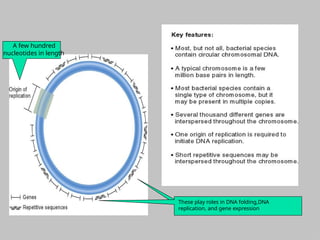
Bacterialchromosomal DNA is usually a
circular molecule that is a few million
nucleotides in length
Escherichia coli ~ 4.6 million base
pairs
Haemophilus influenzae ~ 1.8 million
base pairs
A typical bacterial chromosome
contains a few thousand different
genes
Structural gene sequences (encoding
proteins) account for the majority of
bacterial DNA
The non transcribed DNA between
The bacterial
chromosome is found in
a region called the
nucleoid
The nucleoid is not
membrane-bounded
So the DNA is in
direct contact with
the cytoplasm
Bacteria may have one to
four identical copies of the
same chromosome
The number
depends on the
species and
growth conditions
4.
A few hundred
nucleotidesin length
These play roles in DNA folding,DNA
replication, and gene expression
5.
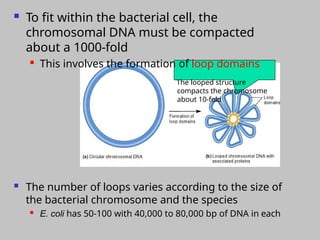
The numberof loops varies according to the size of
the bacterial chromosome and the species
E. coli has 50-100 with 40,000 to 80,000 bp of DNA in each
To fit within the bacterial cell, the
chromosomal DNA must be compacted
about a 1000-fold
This involves the formation of loop domains
The looped structure
compacts the chromosome
about 10-fold
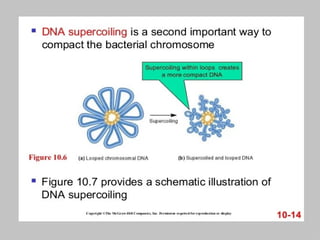
The control ofsupercoiling
in bacteria is accomplished
by two main enzymes
1. DNA gyrase
(also termed DNA
topoisomerase II)
Introduces
negative
supercoils using
energy from ATP
It can also relax
positive
supercoils when
they occur
2. DNA
topoisomerase I
Relaxes negative
EUKARYOTIC CHROMOSOMES
Eukaryotic species contain one or
more sets of chromosomes
Each set is composed of
several different linear
chromosomes
The total amount of DNA in
eukaryotic species is typically greater
than that in bacterial cells
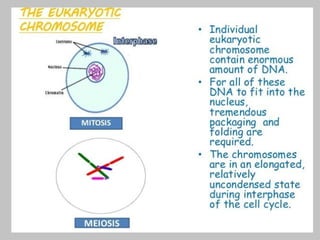
Chromosomes in eukaryotes are
located in the nucleus
To fit in there, they must be
highly compacted
This is accomplished by
the binding of many
proteins
The DNA-protein complex
is termed chromatin
8.
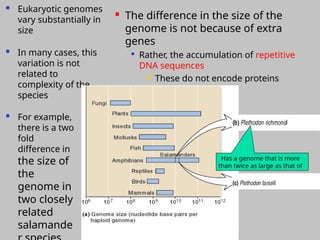
Eukaryotic genomes
varysubstantially in
size
In many cases, this
variation is not
related to
complexity of the
species
For example,
there is a two
fold
difference in
the size of
the
genome in
two closely
related
salamande
The difference in the size of the
genome is not because of extra
genes
Rather, the accumulation of repetitive
DNA sequences
These do not encode proteins
Has a genome that is more
than twice as large as that of
15.
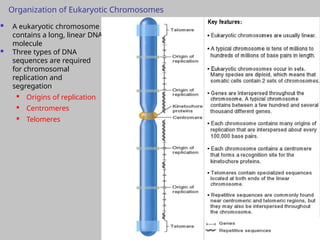
A eukaryoticchromosome
contains a long, linear DNA
molecule
Three types of DNA
sequences are required
for chromosomal
replication and
segregation
Origins of replication
Centromeres
Telomeres
Organization of Eukaryotic Chromosomes
16.
Genes arelocated between the
centromeric and telomeric regions along
the entire chromosome
A single chromosome usually has
a few hundred to several
thousand genes
In lower eukaryotes (such as yeast)
Genes are relatively small
They contain
primarily the
sequences encoding
the polypeptides
ie: Very few introns
are present
In higher eukaryotes (such as
mammals)
Genes are long
They tend to have
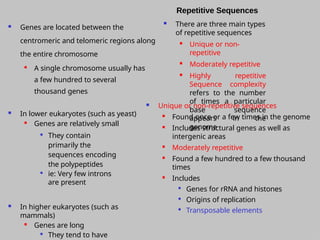
Repetitive Sequences
There are three main types
of repetitive sequences
Unique or non-
repetitive
Moderately repetitive
Highly repetitive
Sequence complexity
refers to the number
of times a particular
base sequence
appears in the
genome
Unique or non-repetitive sequences
Found once or a few times in the genome
Includes structural genes as well as
intergenic areas
Moderately repetitive
Found a few hundred to a few thousand
times
Includes
Genes for rRNA and histones
Origins of replication
Transposable elements
17.
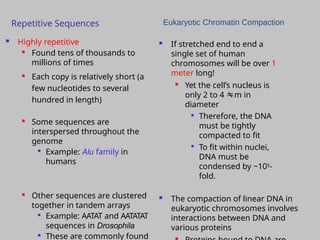
Highly repetitive
Foundtens of thousands to
millions of times
Each copy is relatively short (a
few nucleotides to several
hundred in length)
Some sequences are
interspersed throughout the
genome
Example: Alu family in
humans
Other sequences are clustered
together in tandem arrays
Example: AATAT and AATATAT
sequences in Drosophila
These are commonly found
Repetitive Sequences Eukaryotic Chromatin Compaction
If stretched end to end a
single set of human
chromosomes will be over 1
meter long!
Yet the cell’s nucleus is
only 2 to 4 m in
diameter
Therefore, the DNA
must be tightly
compacted to fit
To fit within nuclei,
DNA must be
condensed by ~105-
fold.
The compaction of linear DNA in
eukaryotic chromosomes involves
interactions between DNA and
various proteins
18.
Extended and CondensedChromatin
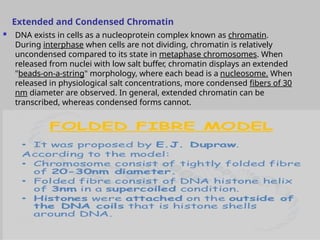
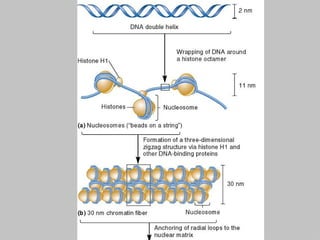
DNA exists in cells as a nucleoprotein complex known as chromatin.
During interphase when cells are not dividing, chromatin is relatively
uncondensed compared to its state in metaphase chromosomes. When
released from nuclei with low salt buffer, chromatin displays an extended
"beads-on-a-string" morphology, where each bead is a nucleosome. When
released in physiological salt concentrations, more condensed fibers of 30
nm diameter are observed. In general, extended chromatin can be
transcribed, whereas condensed forms cannot.
21.
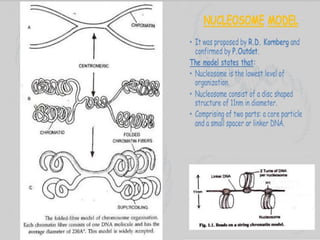
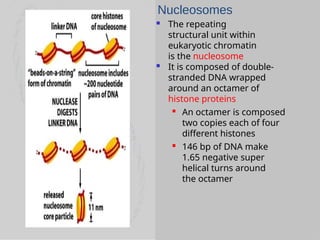
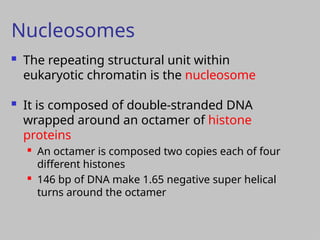
The repeating
structuralunit within
eukaryotic chromatin
is the nucleosome
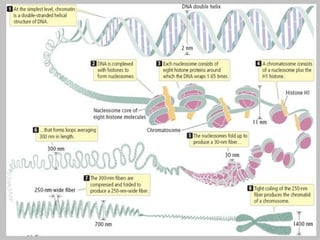
It is composed of double-
stranded DNA wrapped
around an octamer of
histone proteins
An octamer is composed
two copies each of four
different histones
146 bp of DNA make
1.65 negative super
helical turns around
the octamer
Nucleosomes
22.
The repeatingstructural unit within
eukaryotic chromatin is the nucleosome
It is composed of double-stranded DNA
wrapped around an octamer of histone
proteins
An octamer is composed two copies each of four
different histones
146 bp of DNA make 1.65 negative super helical
turns around the octamer
Nucleosomes
23.
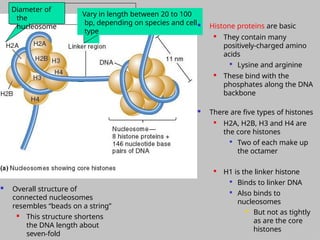
Overall structureof
connected nucleosomes
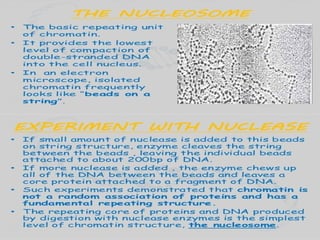
resembles “beads on a string”
This structure shortens
the DNA length about
seven-fold
Vary in length between 20 to 100
bp, depending on species and cell
type
Diameter of
the
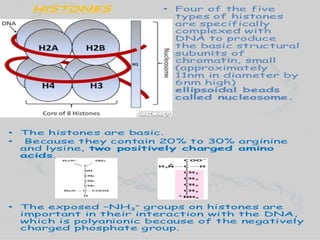
nucleosome Histone proteins are basic
They contain many
positively-charged amino
acids
Lysine and arginine
These bind with the
phosphates along the DNA
backbone
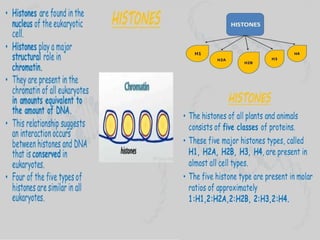
There are five types of histones
H2A, H2B, H3 and H4 are
the core histones
Two of each make up
the octamer
H1 is the linker histone
Binds to linker DNA
Also binds to
nucleosomes
But not as tightly
as are the core
histones
24.
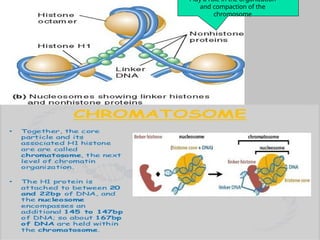
Play a rolein the organization
and compaction of the
chromosome
25.
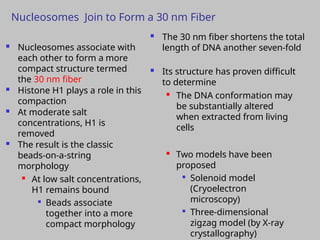
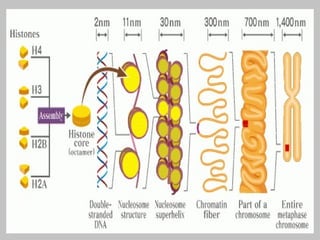
Nucleosomes associatewith
each other to form a more
compact structure termed
the 30 nm fiber
Histone H1 plays a role in this
compaction
At moderate salt
concentrations, H1 is
removed
The result is the classic
beads-on-a-string
morphology
At low salt concentrations,
H1 remains bound
Beads associate
together into a more
compact morphology
Nucleosomes Join to Form a 30 nm Fiber
The 30 nm fiber shortens the total
length of DNA another seven-fold
Its structure has proven difficult
to determine
The DNA conformation may
be substantially altered
when extracted from living
cells
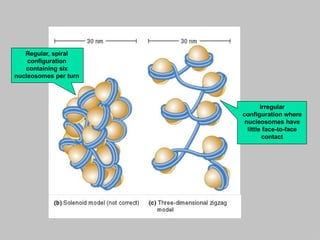
Two models have been
proposed
Solenoid model
(Cryoelectron
microscopy)
Three-dimensional
zigzag model (by X-ray
crystallography)
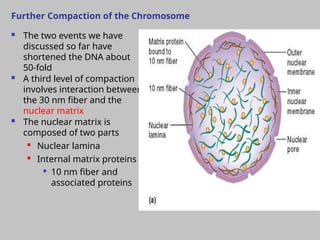
The twoevents we have
discussed so far have
shortened the DNA about
50-fold
A third level of compaction
involves interaction between
the 30 nm fiber and the
nuclear matrix
The nuclear matrix is
composed of two parts
Nuclear lamina
Internal matrix proteins
10 nm fiber and
associated proteins
Further Compaction of the Chromosome
28.
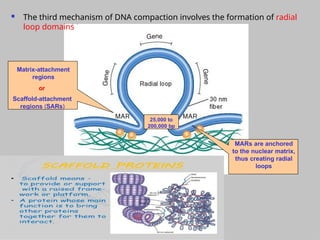
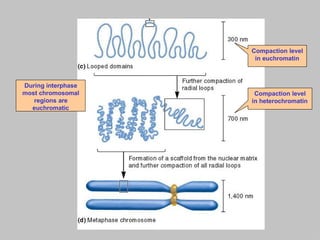
The thirdmechanism of DNA compaction involves the formation of radial
loop domains
Matrix-attachment
regions
or
Scaffold-attachment
regions (SARs)
MARs are anchored
to the nuclear matrix,
thus creating radial
loops
25,000 to
200,000 bp
31.
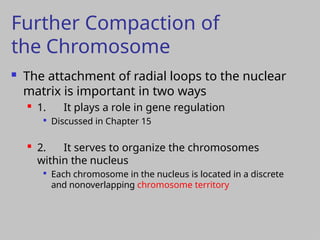
The attachmentof radial loops to the nuclear
matrix is important in two ways
1. It plays a role in gene regulation
Discussed in Chapter 15
2. It serves to organize the chromosomes
within the nucleus
Each chromosome in the nucleus is located in a discrete
and nonoverlapping chromosome territory
Further Compaction of
the Chromosome
32.
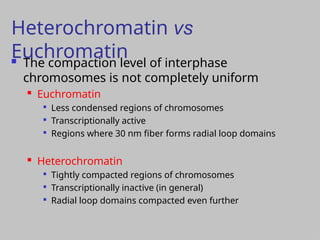
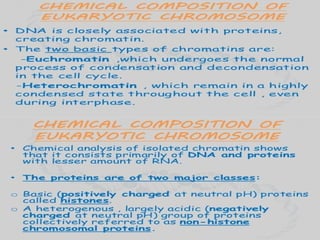
The compactionlevel of interphase
chromosomes is not completely uniform
Euchromatin
Less condensed regions of chromosomes
Transcriptionally active
Regions where 30 nm fiber forms radial loop domains
Heterochromatin
Tightly compacted regions of chromosomes
Transcriptionally inactive (in general)
Radial loop domains compacted even further
Heterochromatin vs
Euchromatin
33.
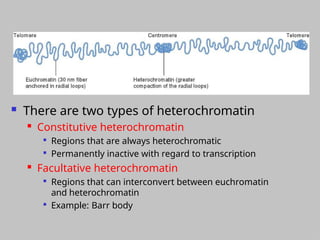
There aretwo types of heterochromatin
Constitutive heterochromatin
Regions that are always heterochromatic
Permanently inactive with regard to transcription
Facultative heterochromatin
Regions that can interconvert between euchromatin
and heterochromatin
Example: Barr body
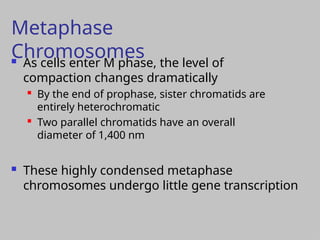
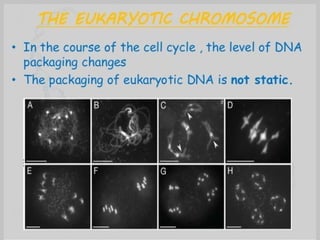
As cellsenter M phase, the level of
compaction changes dramatically
By the end of prophase, sister chromatids are
entirely heterochromatic
Two parallel chromatids have an overall
diameter of 1,400 nm
These highly condensed metaphase
chromosomes undergo little gene transcription
Metaphase
Chromosomes
37.
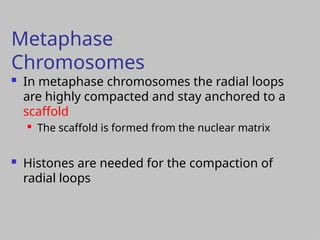
In metaphasechromosomes the radial loops
are highly compacted and stay anchored to a
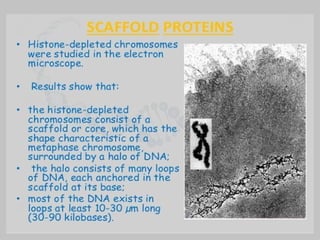
scaffold
The scaffold is formed from the nuclear matrix
Histones are needed for the compaction of
radial loops
Metaphase
Chromosomes
38.
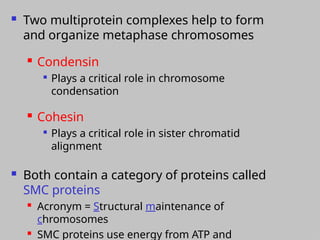
Two multiproteincomplexes help to form
and organize metaphase chromosomes
Condensin
Plays a critical role in chromosome
condensation
Cohesin
Plays a critical role in sister chromatid
alignment
Both contain a category of proteins called
SMC proteins
Acronym = Structural maintenance of
chromosomes
SMC proteins use energy from ATP and
39.
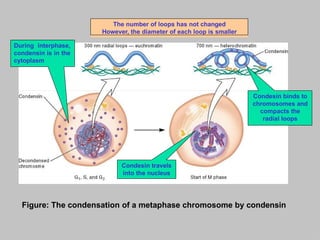
Figure: The condensationof a metaphase chromosome by condensin
The number of loops has not changed
However, the diameter of each loop is smaller
Condesin travels
into the nucleus
Condesin binds to
chromosomes and
compacts the
radial loops
During interphase,
condensin is in the
cytoplasm
40.
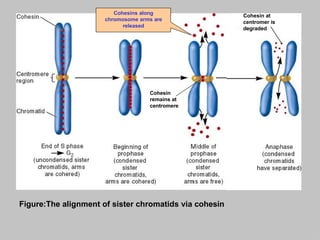
Figure:The alignment ofsister chromatids via cohesin
Cohesins along
chromosome arms are
released
Cohesin
remains at
centromere
Cohesin at
centromer is
degraded
 Most read