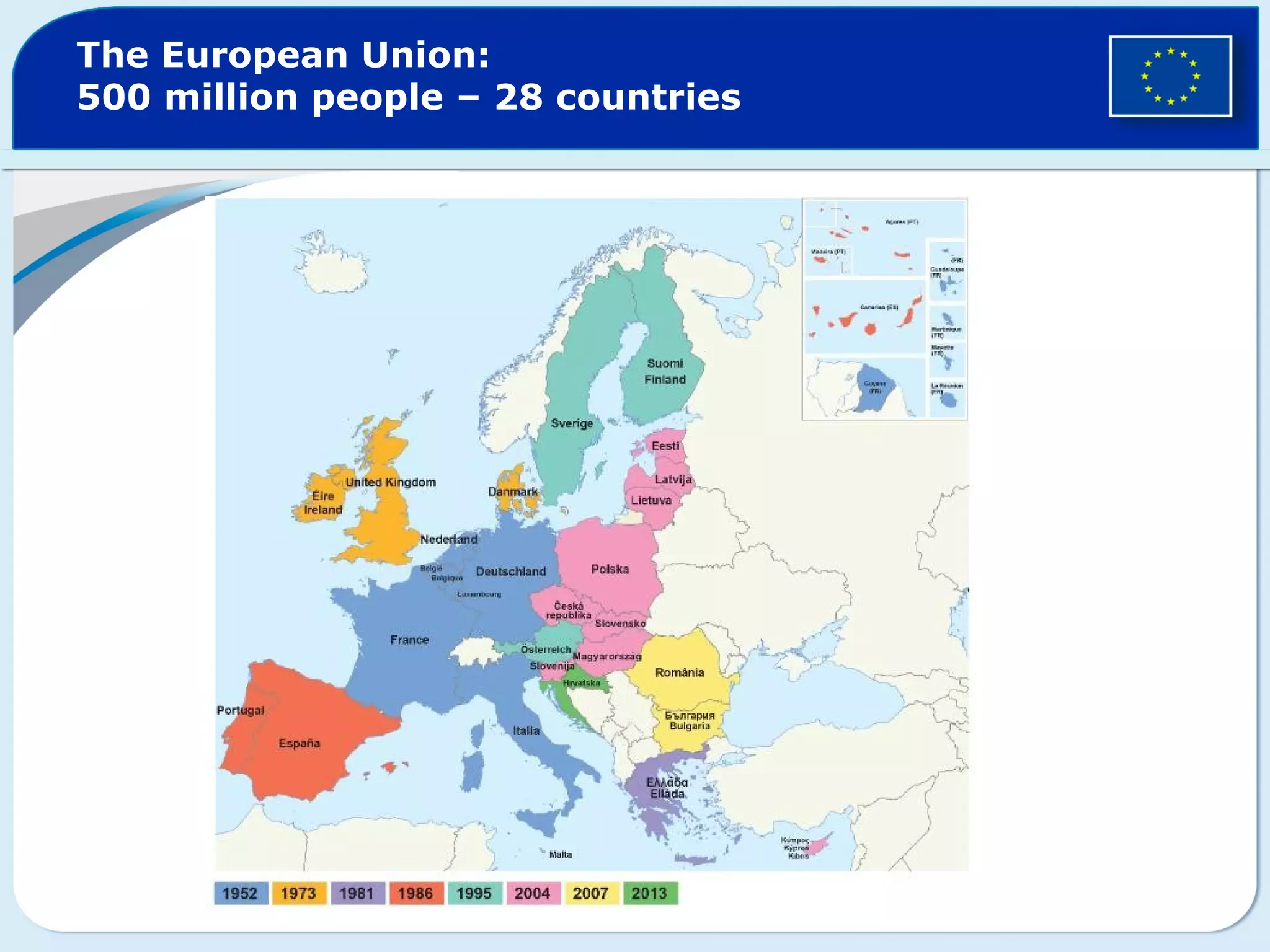
The European Union:
500 million people – 28 countries
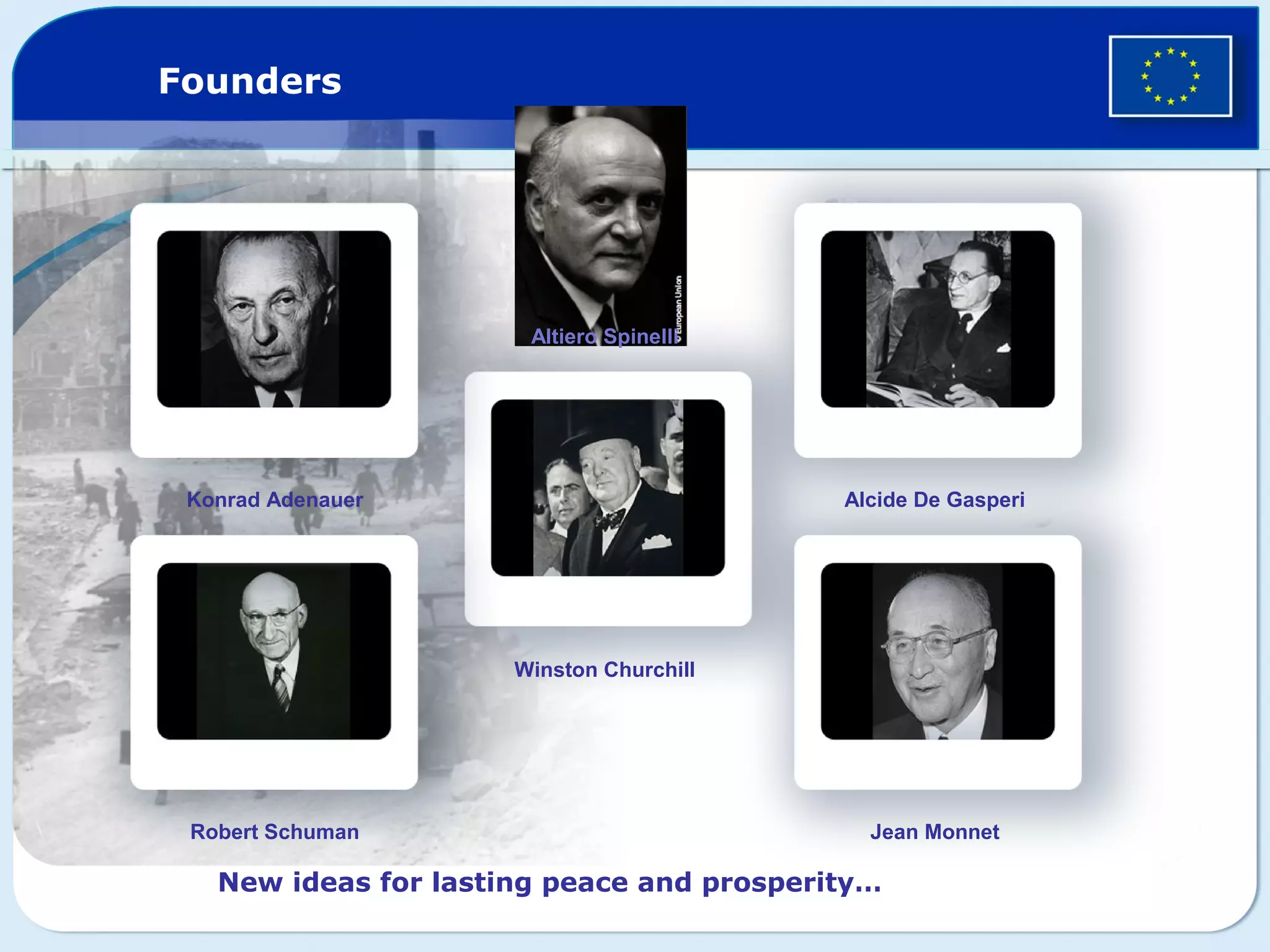
Founders
New ideas for lasting peace and prosperity…
Konrad Adenauer
Robert Schuman
Winston Churchill
Alcide De Gasperi
Jean Monnet
Altiero Spinelli
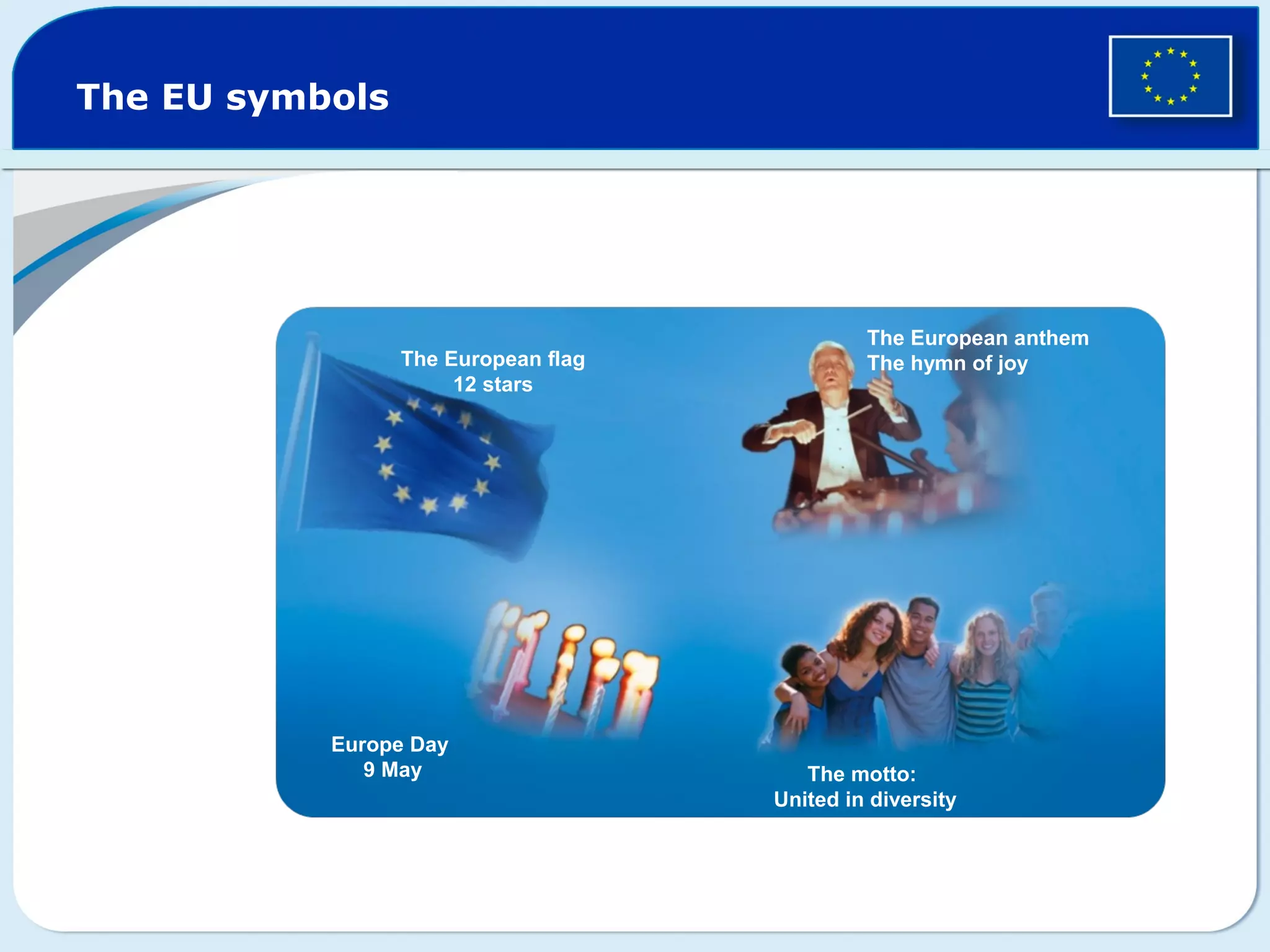
The EU symbols
The European flag
12 stars
The European anthem
The hymn of joy
Europe Day
9 May The motto:
United in diversity
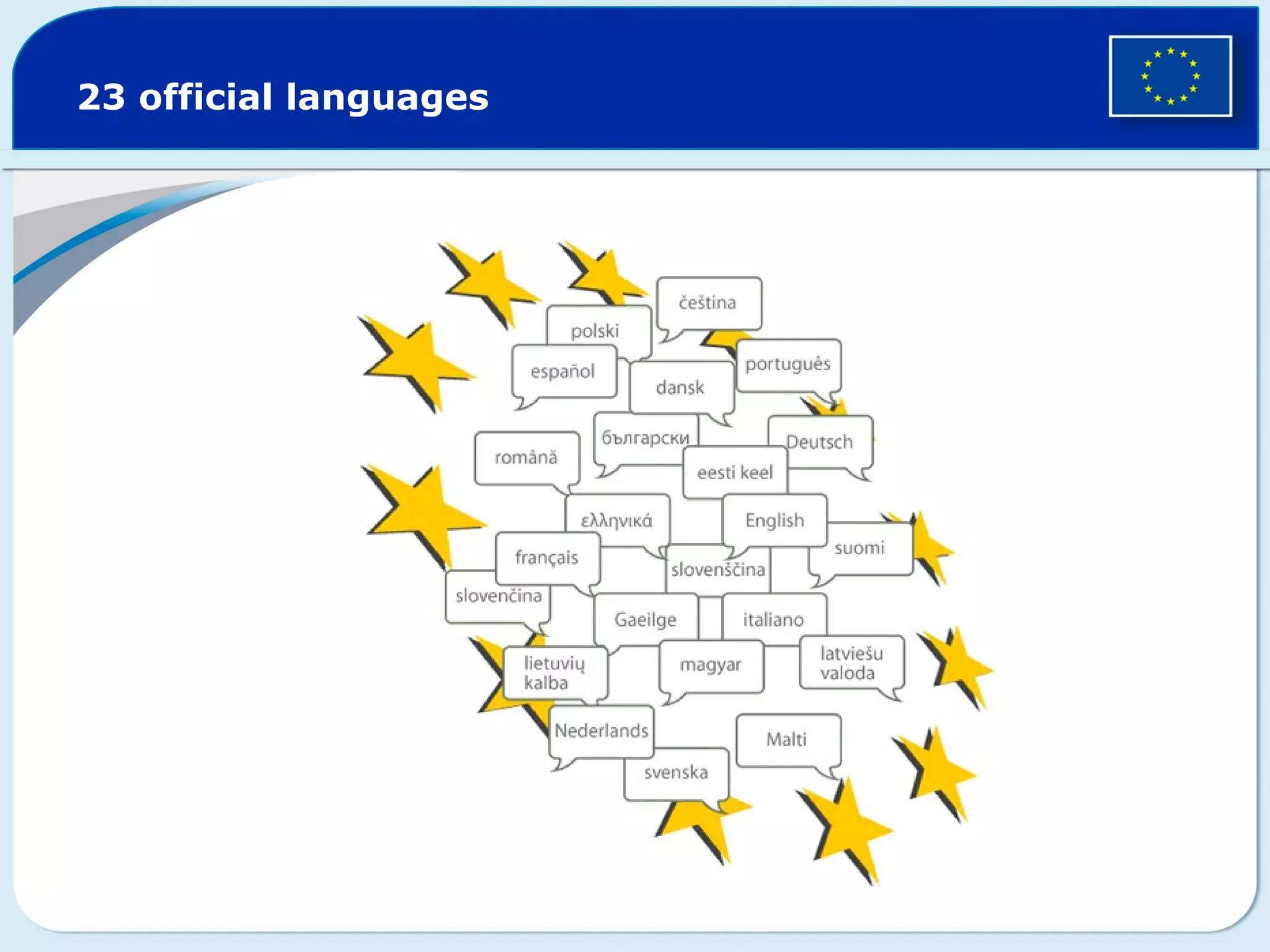
23 official languages
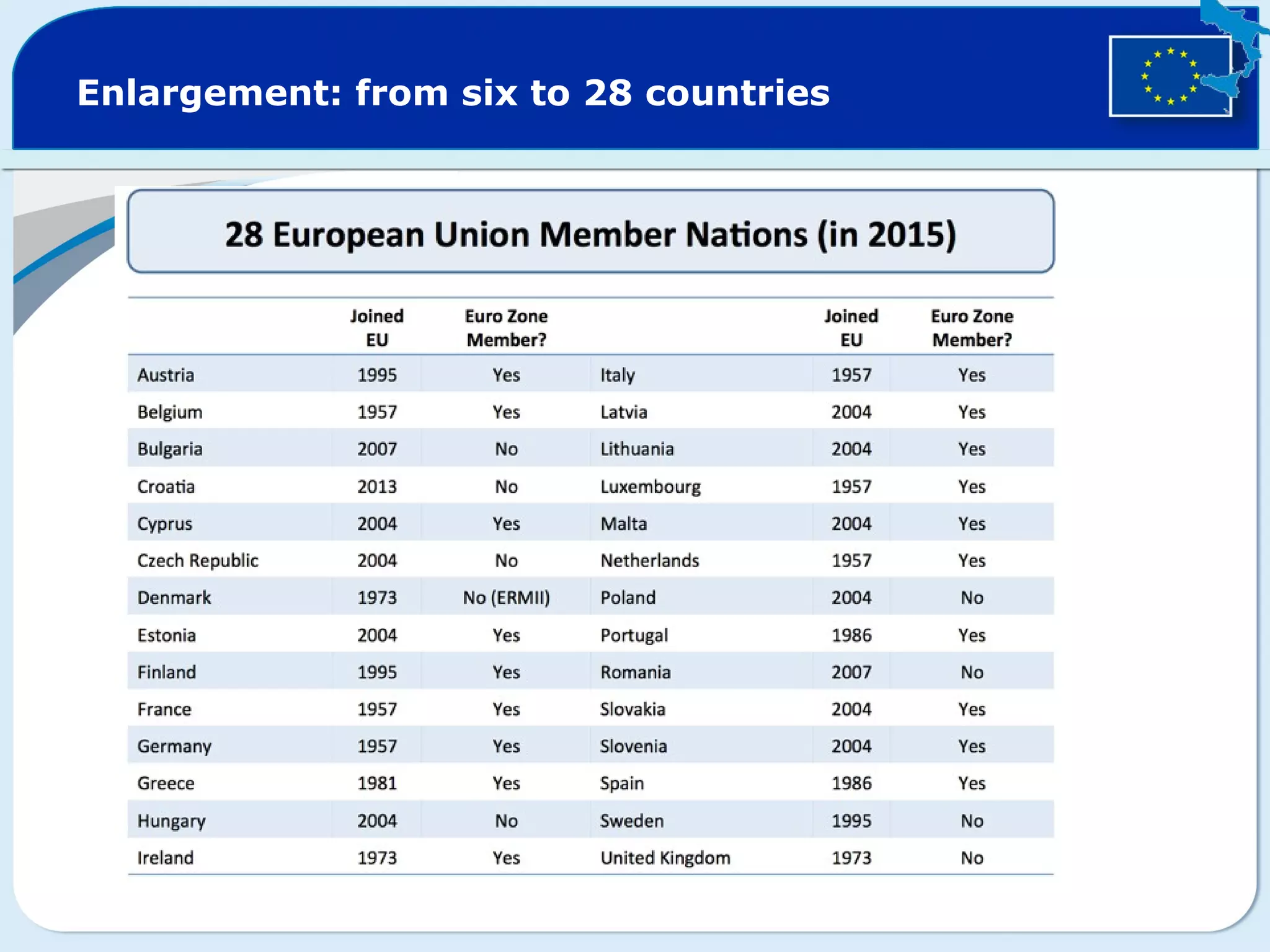
Enlargement: from six to 28 countries
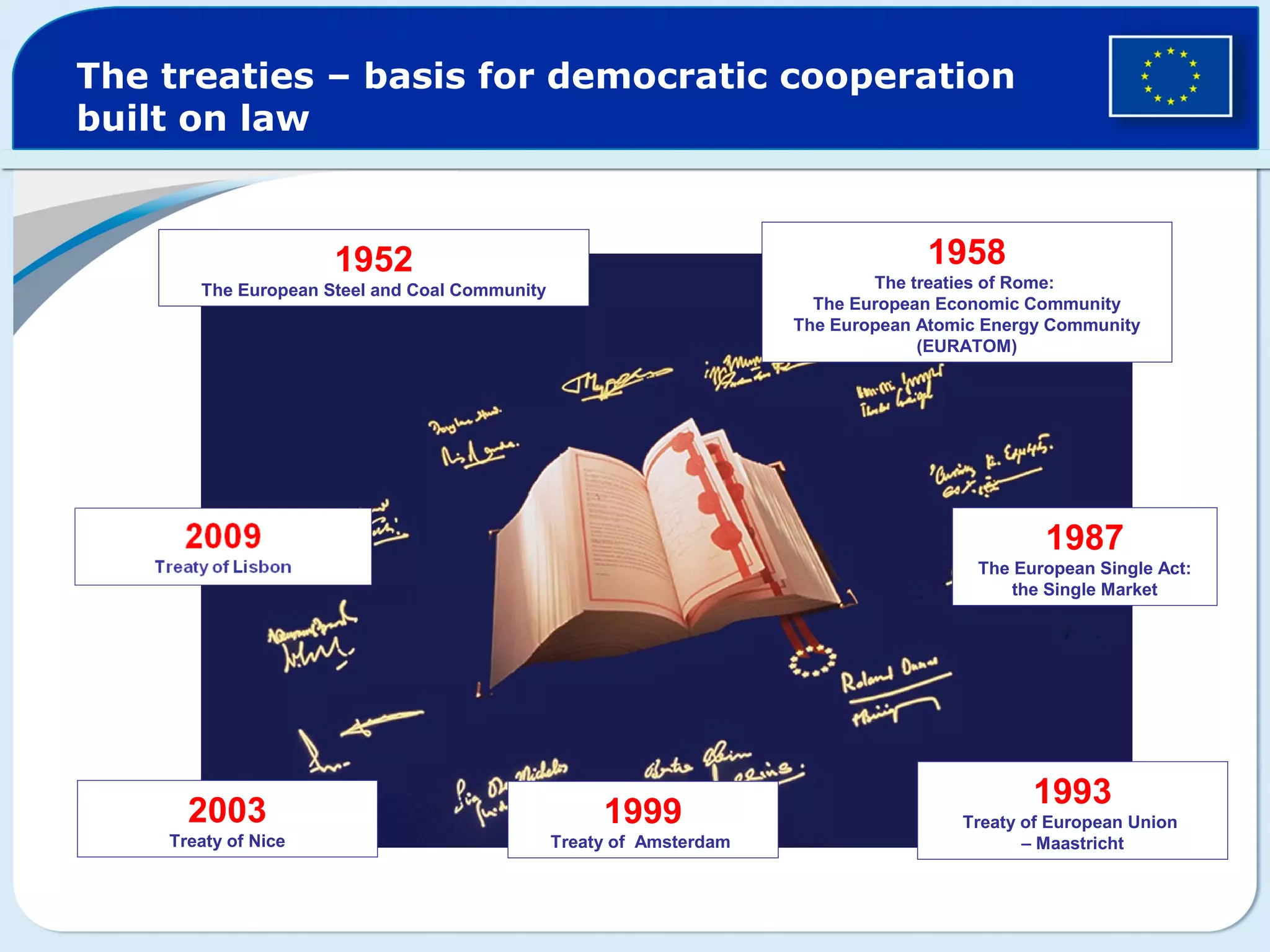
The treaties – basis for democratic cooperation
built on law
1952
The European Steel and Coal Community
1958
The treaties of Rome:
The European Economic Community
The European Atomic Energy Community
(EURATOM)
1987
The European Single Act:
the Single Market
1993
Treaty of European Union
– Maastricht
1999
Treaty of Amsterdam
2003
Treaty of Nice
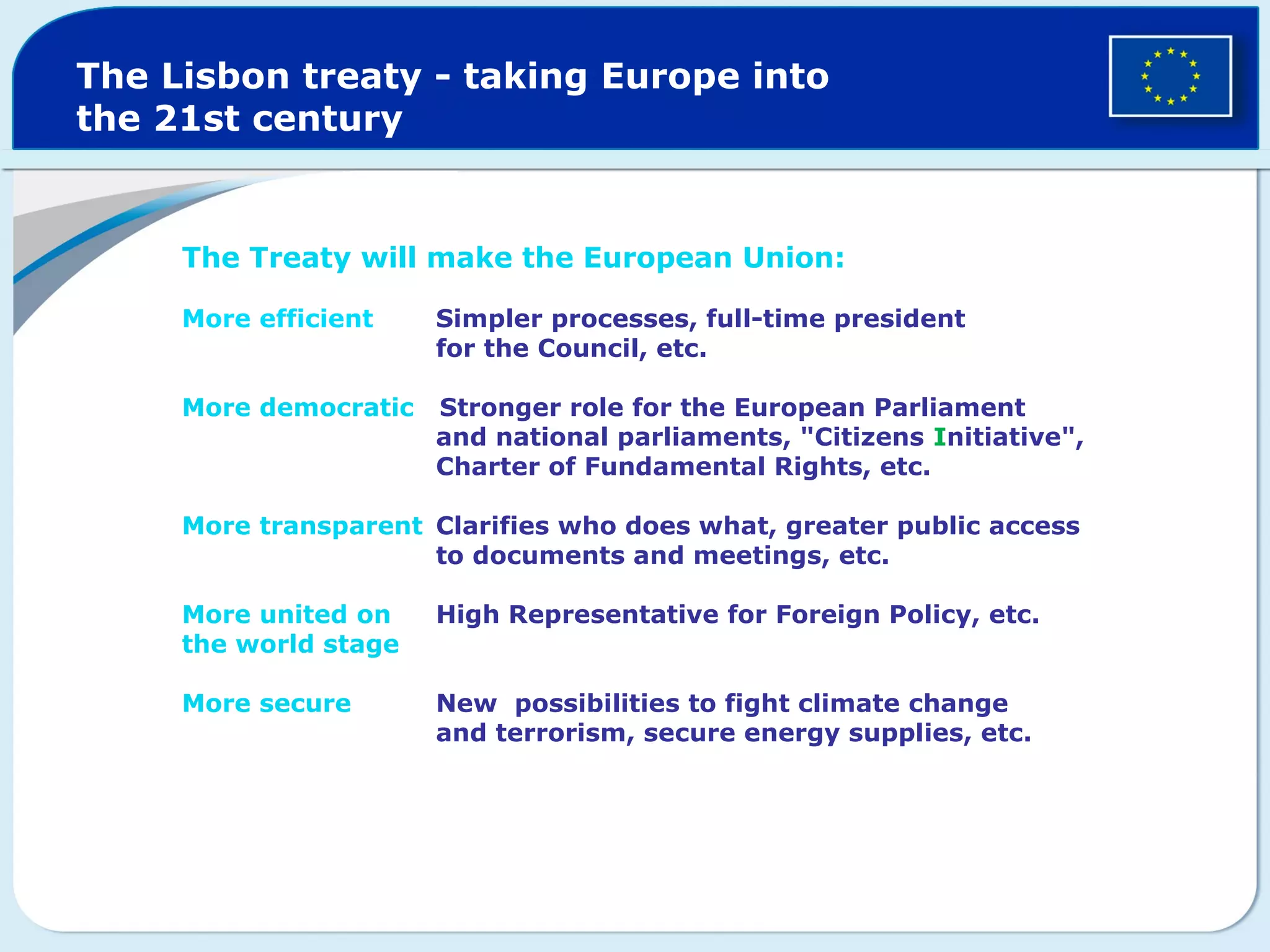
The Lisbon treaty - taking Europe into
the 21st century
The Treaty will make the European Union:
More efficient Simpler processes, full-time president
for the Council, etc.
More democratic Stronger role for the European Parliament
and national parliaments, "Citizens Initiative",
Charter of Fundamental Rights, etc.
More transparent Clarifies who does what, greater public access
to documents and meetings, etc.
More united on High Representative for Foreign Policy, etc.
the world stage
More secure New possibilities to fight climate change
and terrorism, secure energy supplies, etc.
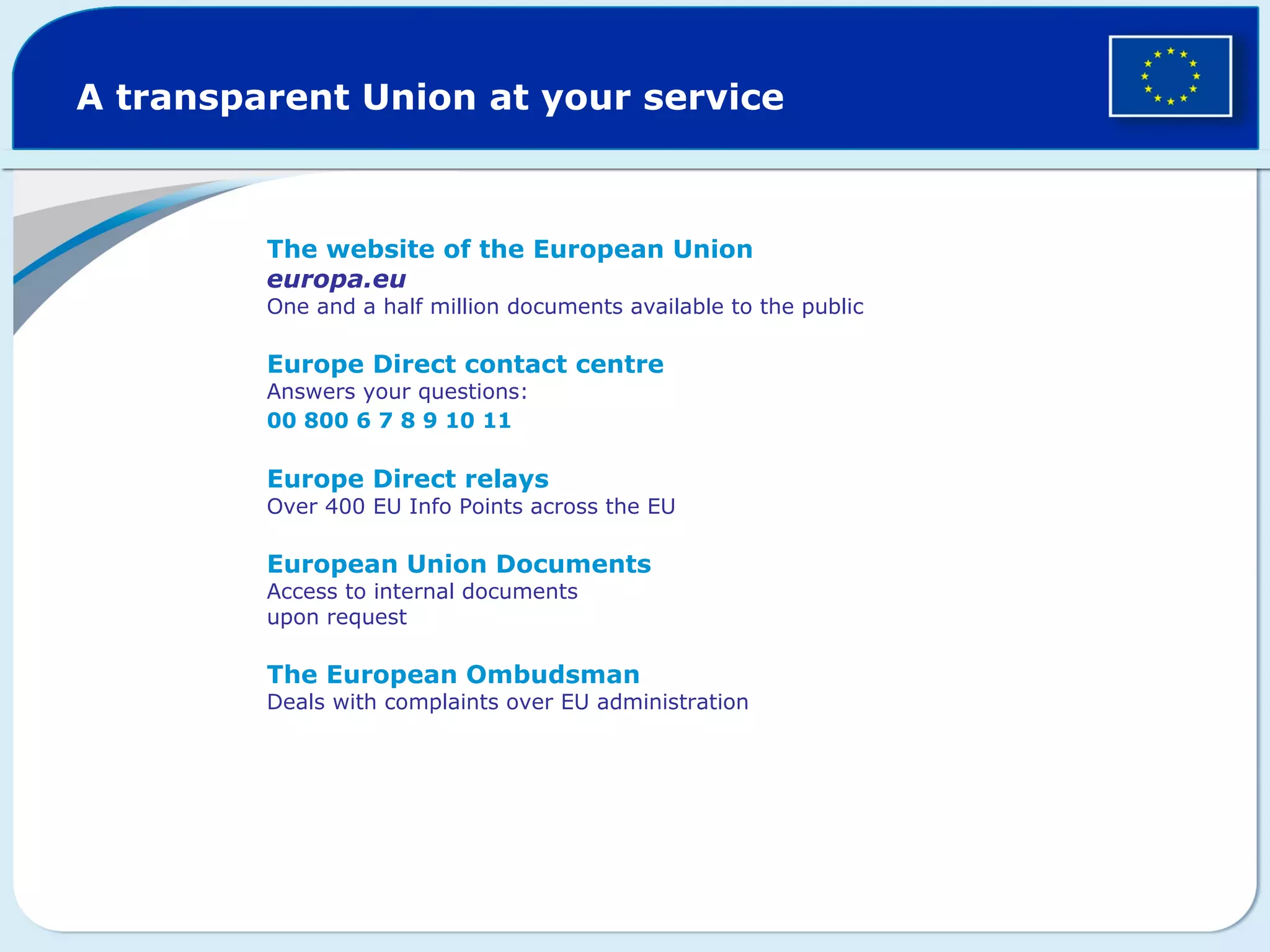
A transparent Union at your service
The website of the European Union
europa.eu
One and a half million documents available to the public
Europe Direct contact centre
Answers your questions:
00 800 6 7 8 9 10 11
Europe Direct relays
Over 400 EU Info Points across the EU
European Union Documents
Access to internal documents
upon request
The European Ombudsman
Deals with complaints over EU administration
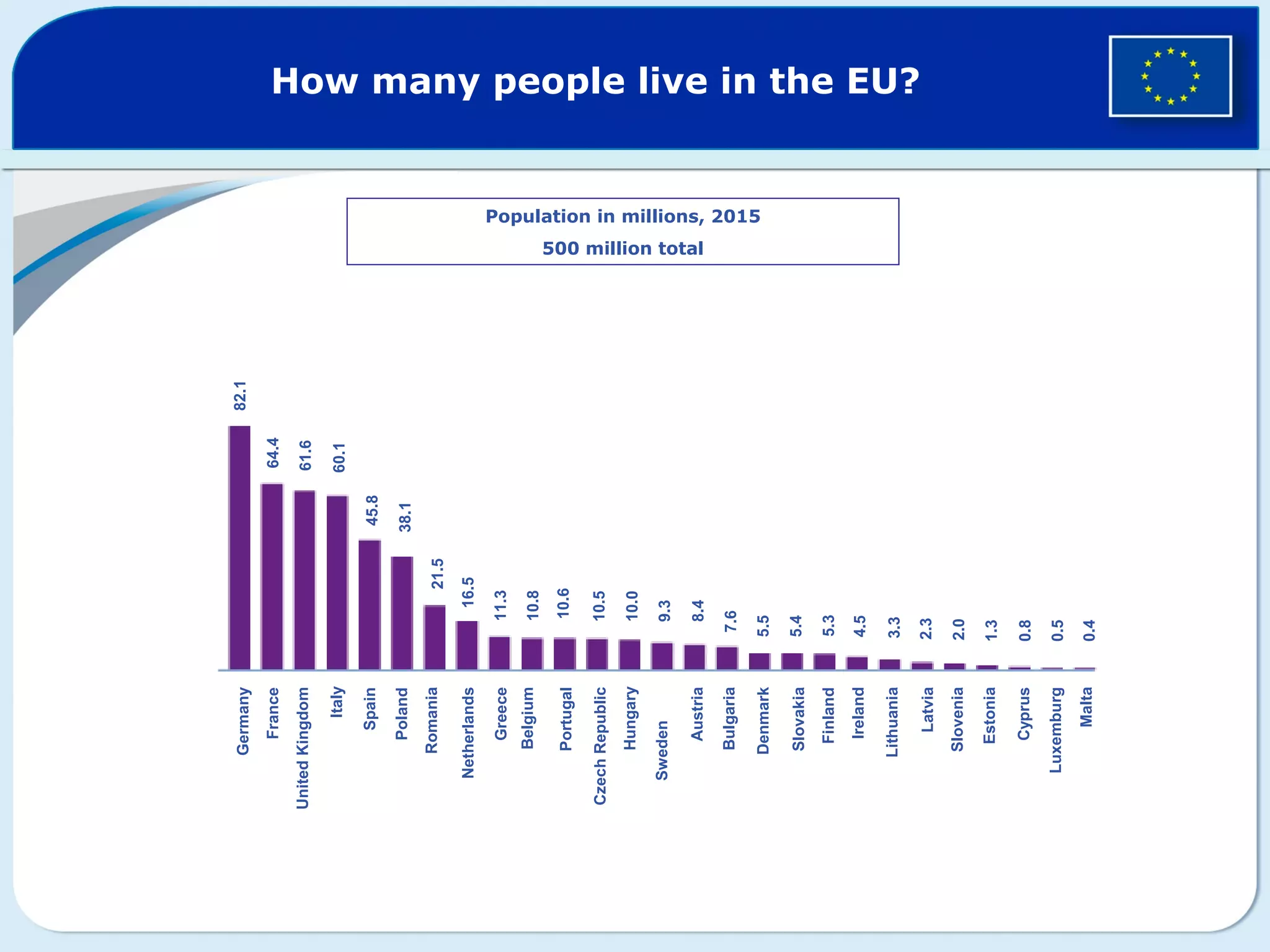
How many people live in the EU?
Population in millions, 2015
500 million total
82.1
64.4
61.6
60.1
45.8
38.1
21.5
16.5
11.3
10.6
10.8
10.5
10.0
9.3
8.4
7.6
5.5
5.4
5.3
4.5
3.3
2.3
2.0
1.3
0.8
0.5
0.4
France
Spain
Sweden
Poland
Finland
Italy
UnitedKingdom
Romania
Greece
Bulgaria
Hungary
Portugal
Austria
CzechRepublic
Ireland
Lithuania
Latvia
Slovakia
Estonia
Denmark
Netherlands
Belgium
Slovenia
Cyprus
Luxemburg
Malta
Germany
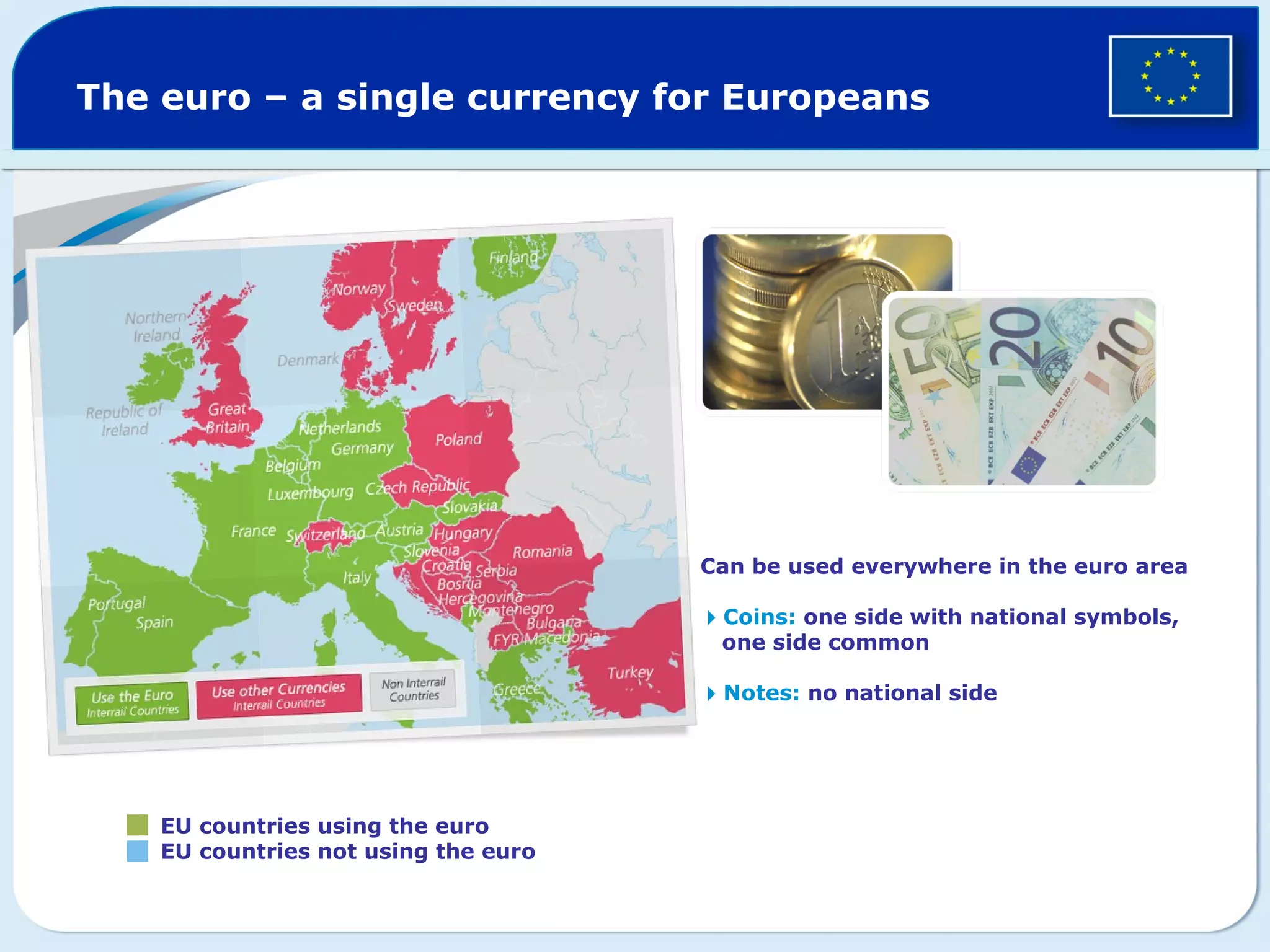
The euro – a single currency for Europeans
EU countries using the euro
EU countries not using the euro
Can be used everywhere in the euro area
Coins: one side with national symbols,
one side common
Notes: no national side
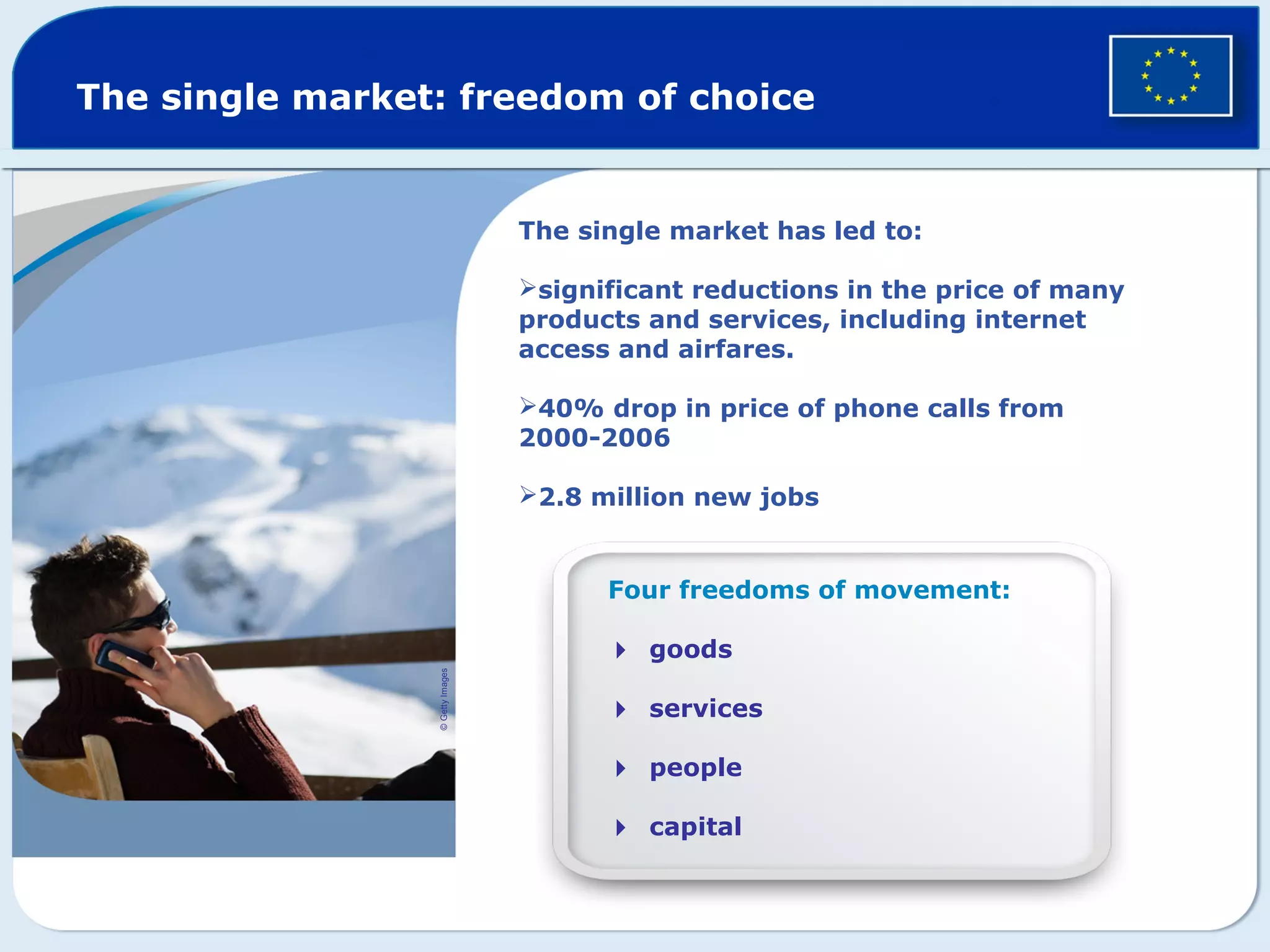
The single market: freedom of choice
Four freedoms of movement:
goods
services
people
capital
©GettyImages
The single market has led to:
significant reductions in the price of many
products and services, including internet
access and airfares.
40% drop in price of phone calls from
2000-2006
2.8 million new jobs
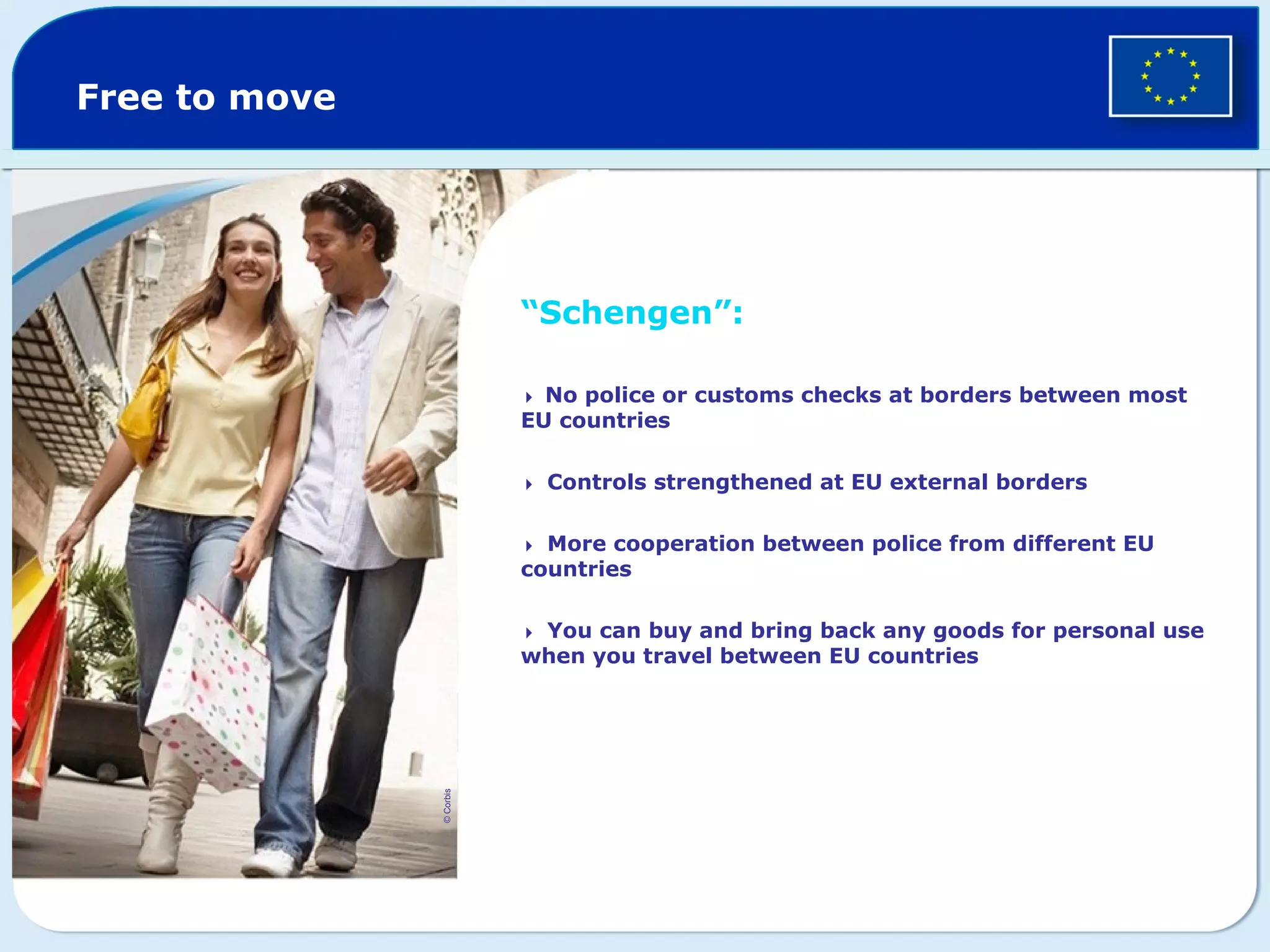
Free to move
“Schengen”:
 No police or customs checks at borders between most
EU countries
Controls strengthened at EU external borders
More cooperation between police from different EU
countries
You can buy and bring back any goods for personal use
when you travel between EU countries
©Corbis
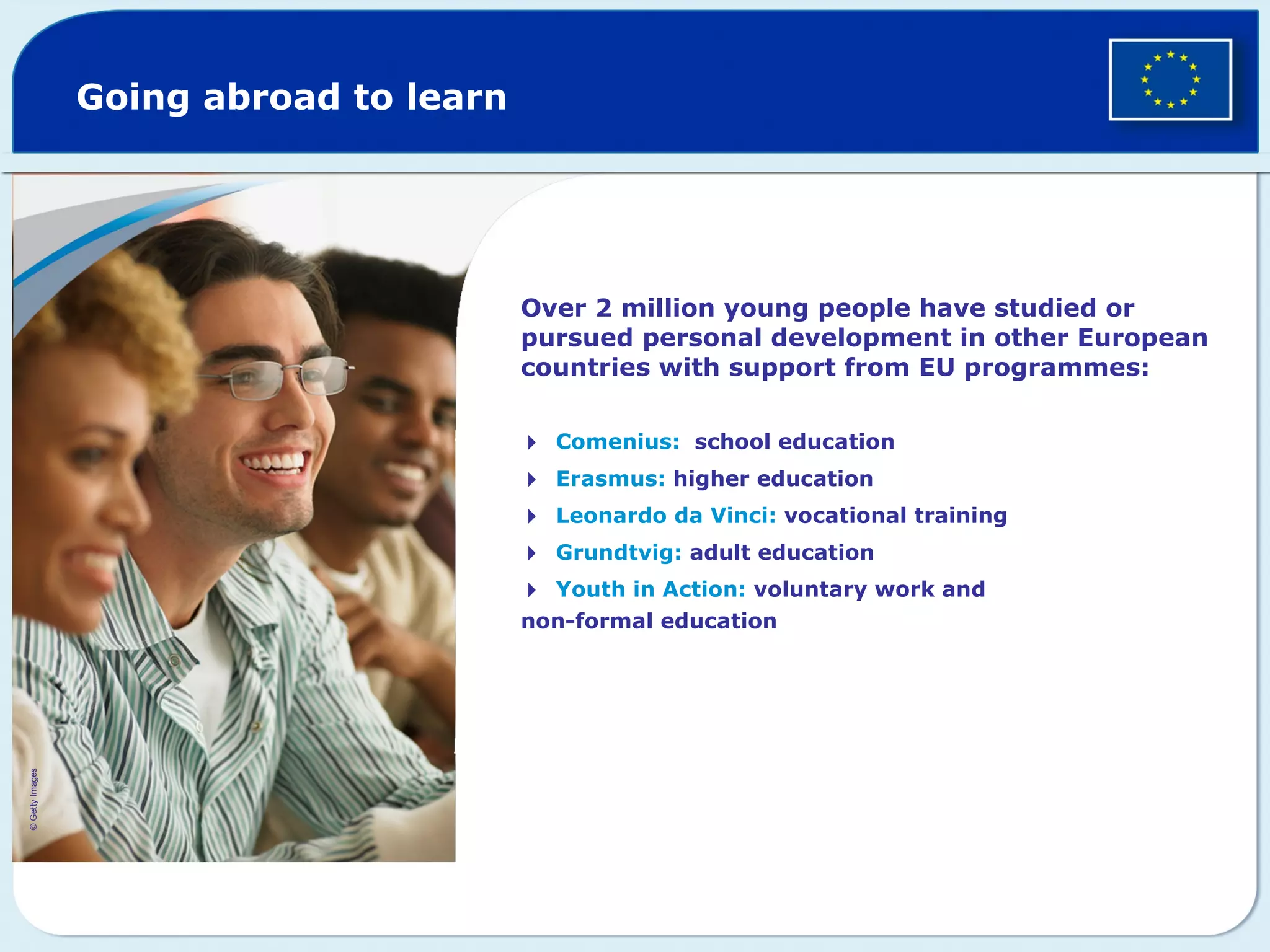
Going abroad to learn
Over 2 million young people have studied or
pursued personal development in other European
countries with support from EU programmes:
Comenius: school education
Erasmus: higher education
Leonardo da Vinci: vocational training
Grundtvig: adult education
Youth in Action: voluntary work and
non-formal education
©GettyImages
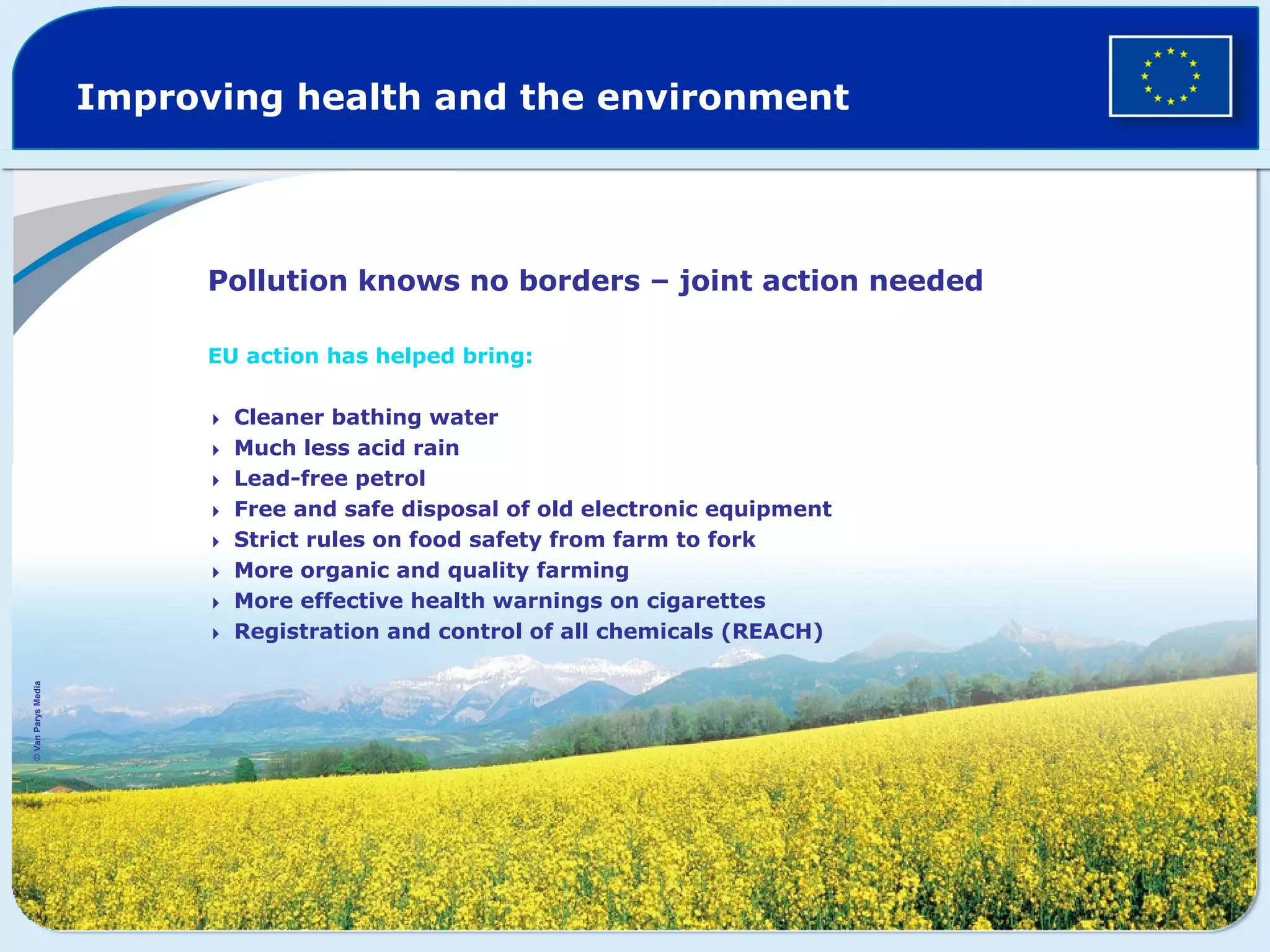
Improving health and the environment
Pollution knows no borders – joint action needed
EU action has helped bring:
Cleaner bathing water
Much less acid rain
Lead-free petrol
Free and safe disposal of old electronic equipment
Strict rules on food safety from farm to fork
More organic and quality farming
More effective health warnings on cigarettes
Registration and control of all chemicals (REACH)
©VanParysMedia
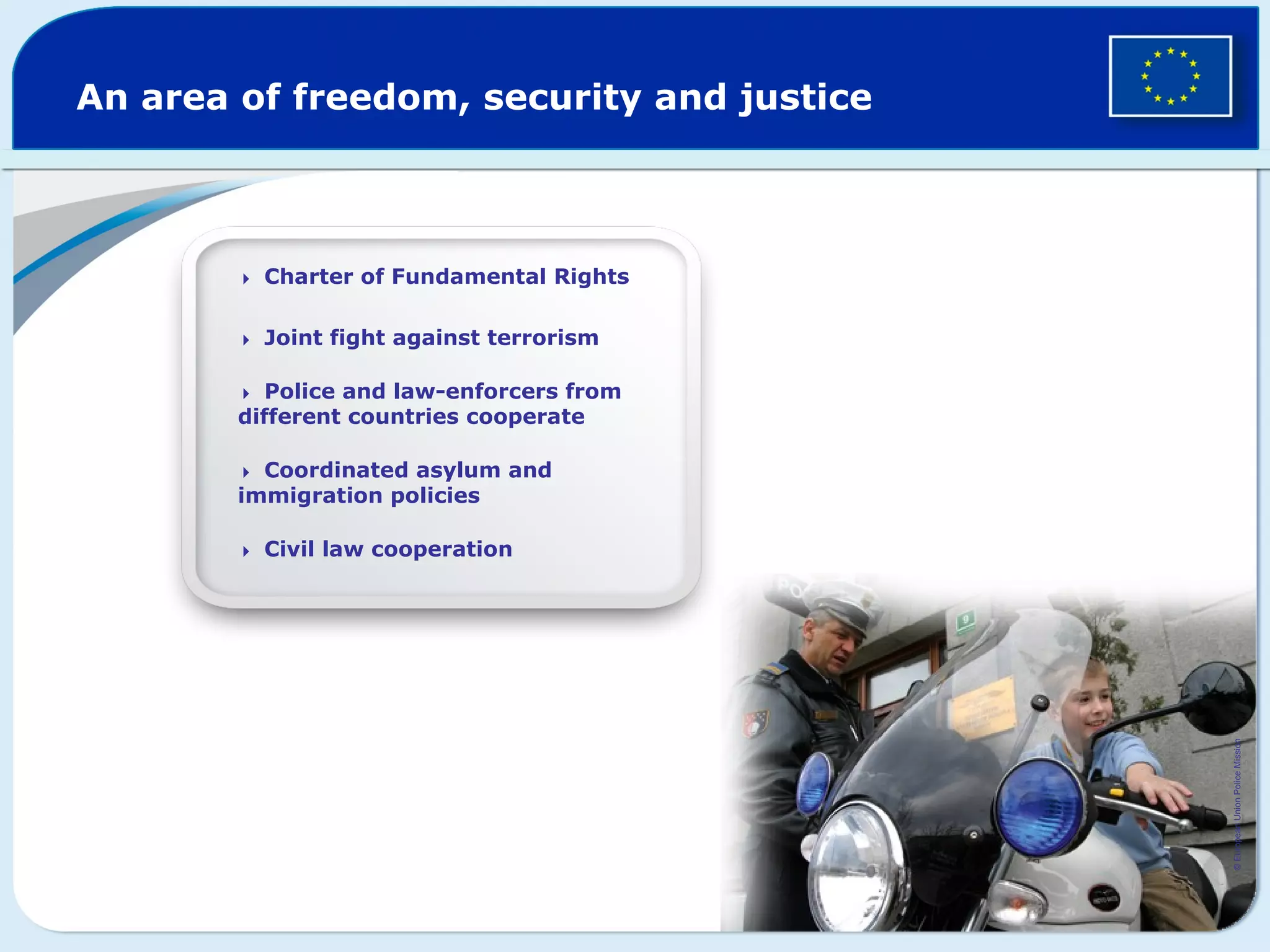
An area of freedom, security and justice
Charter of Fundamental Rights
Joint fight against terrorism
Police and law-enforcers from
different countries cooperate
Coordinated asylum and
immigration policies
Civil law cooperation
©EuropeanUnionPoliceMission
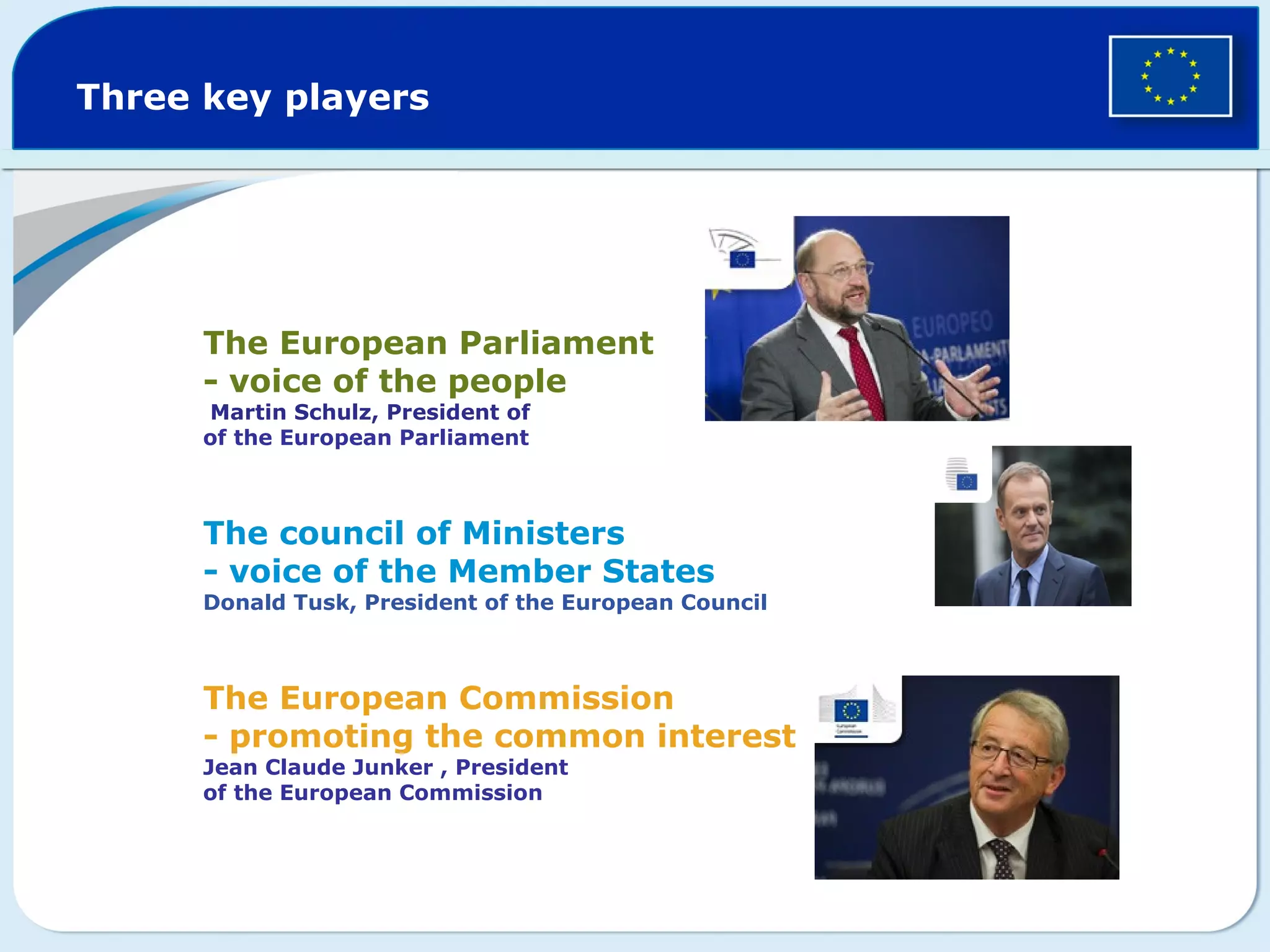
Three key players
The European Parliament
- voice of the people
Martin Schulz, President of
of the European Parliament
The council of Ministers
- voice of the Member States
Donald Tusk, President of the European Council
The European Commission
- promoting the common interest
Jean Claude Junker , President
of the European Commission
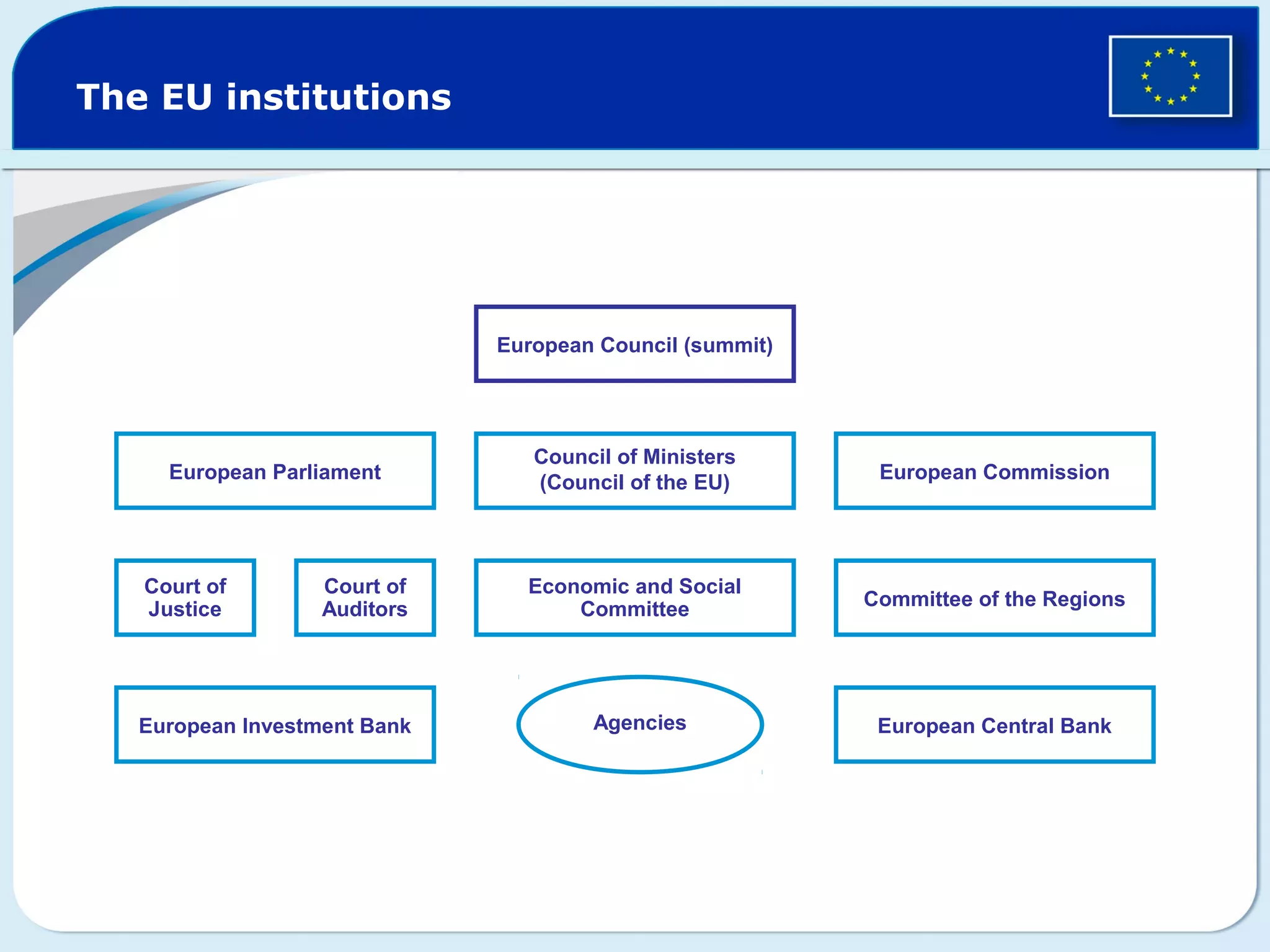
European Parliament
The EU institutions
Court of
Justice
Court of
Auditors
Economic and Social
Committee Committee of the Regions
Council of Ministers
(Council of the EU) European Commission
European Investment Bank European Central BankAgencies
European Council (summit)
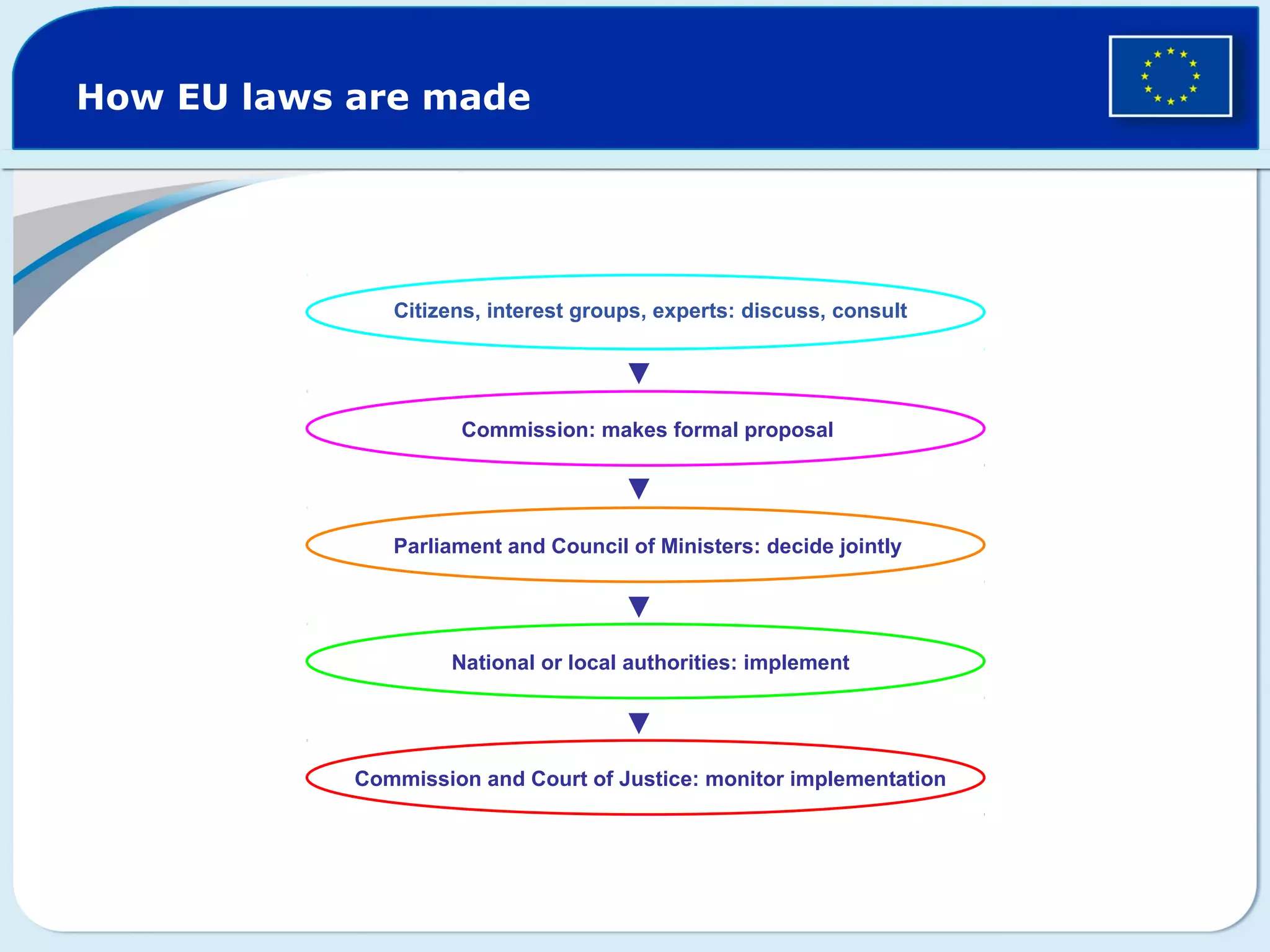
How EU laws are made
Citizens, interest groups, experts: discuss, consult
Commission: makes formal proposal
Parliament and Council of Ministers: decide jointly
Commission and Court of Justice: monitor implementation
National or local authorities: implement
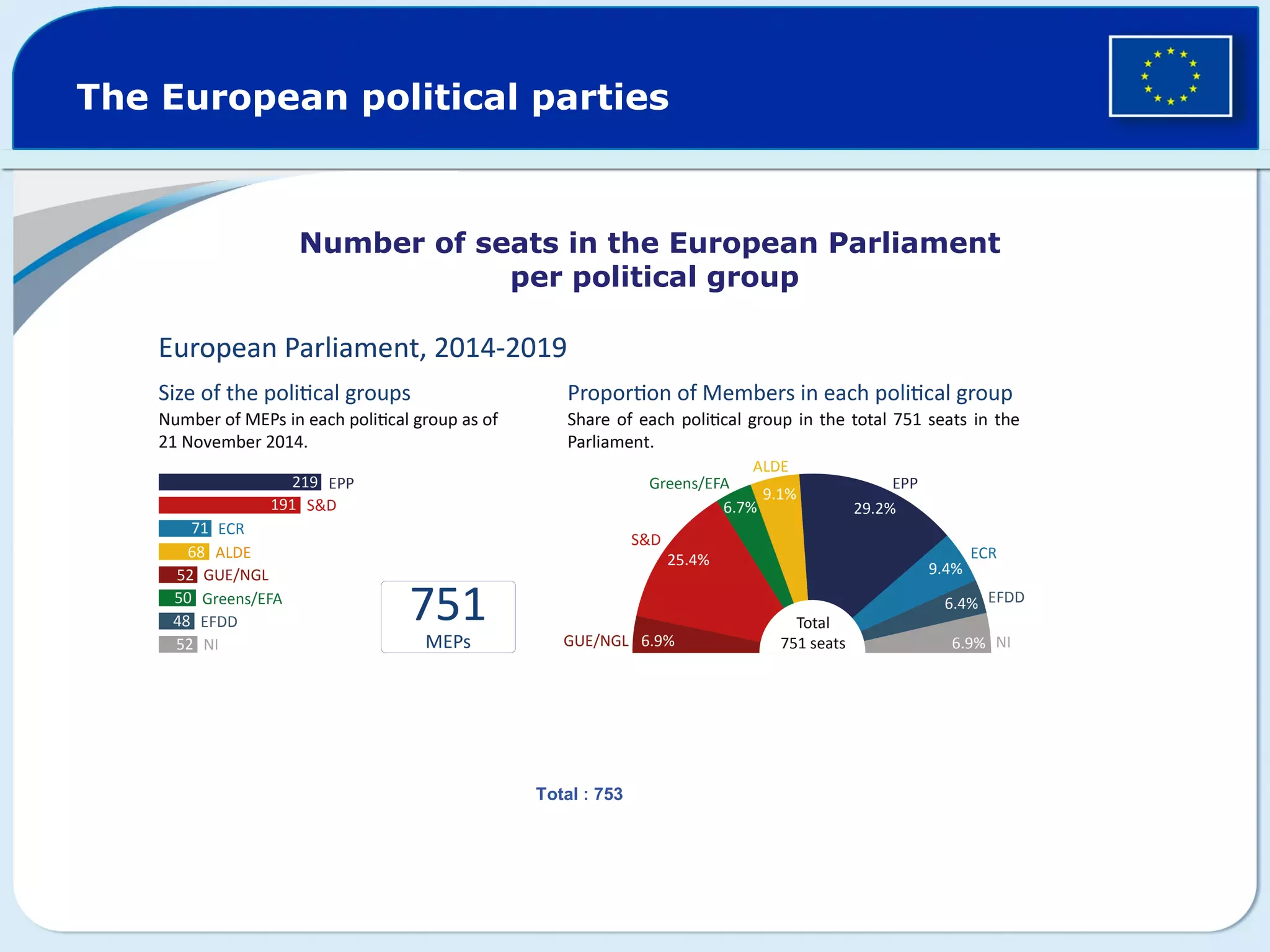
The European political parties
Total : 753
Number of seats in the European Parliament
per political group
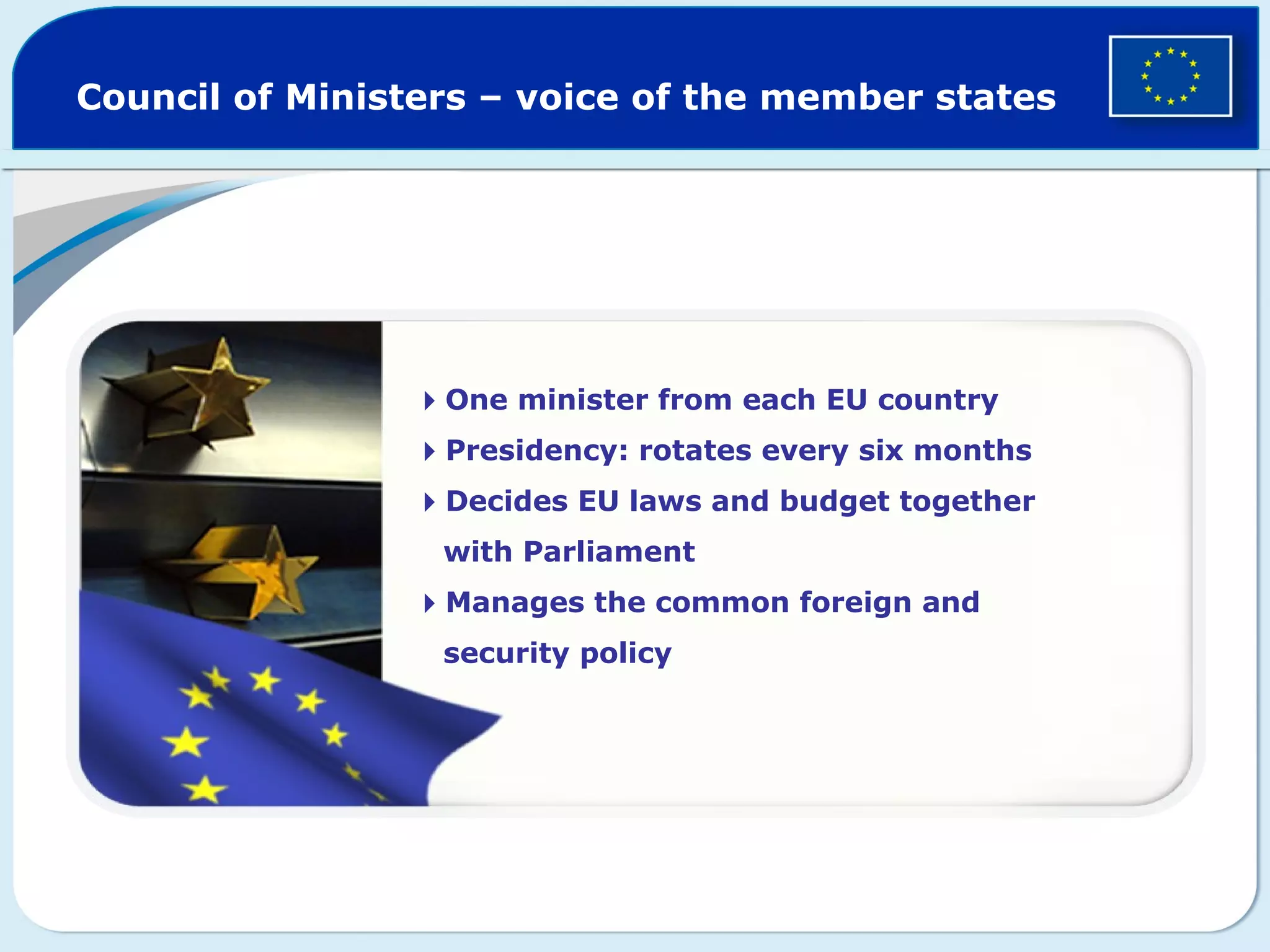
Council of Ministers – voice of the member states
One minister from each EU country
Presidency: rotates every six months
Decides EU laws and budget together
with Parliament
Manages the common foreign and
security policy
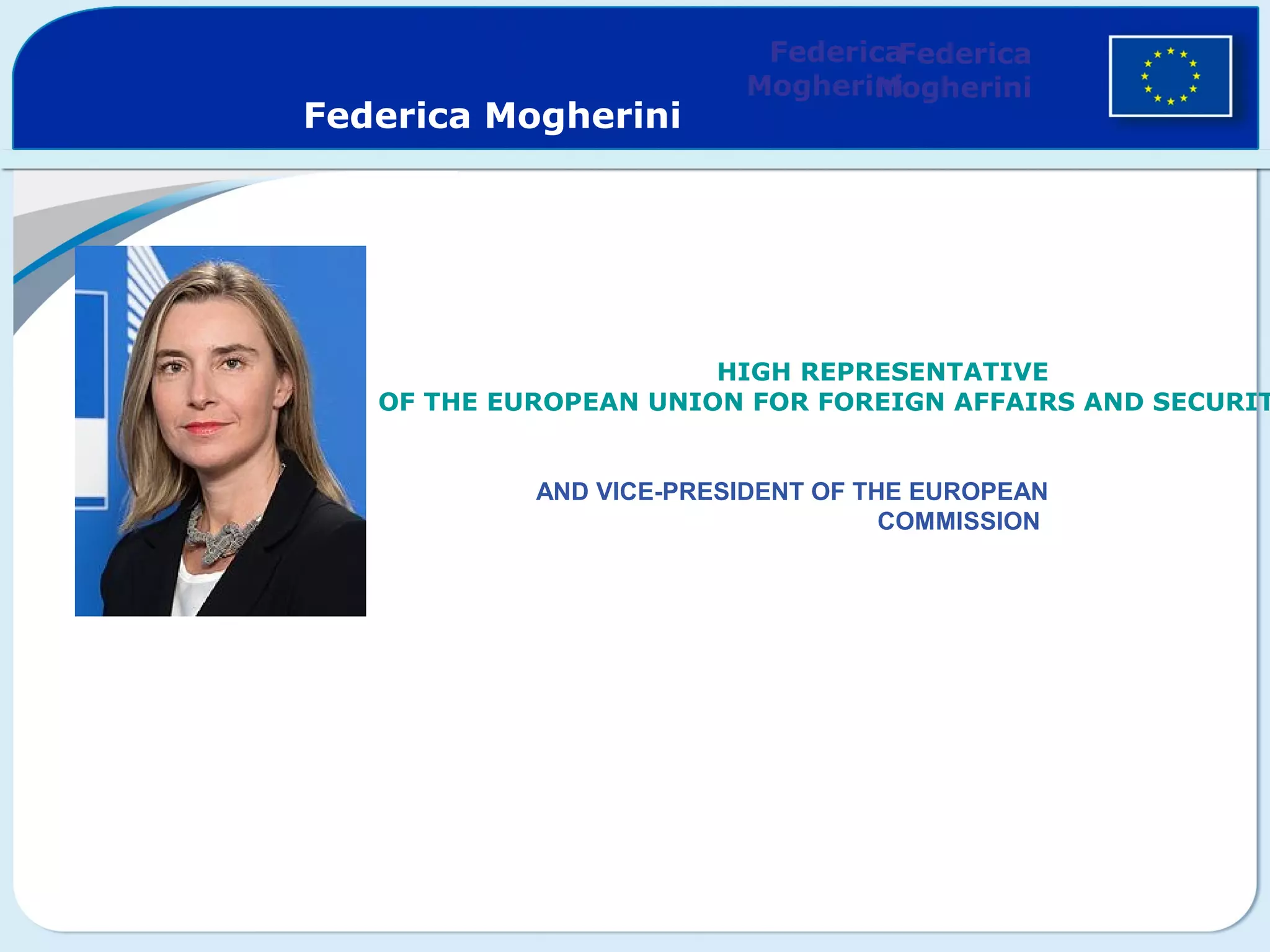
THE ITALIAN  CURRENT
HIGH REPRESENTATIVE
OF THE EUROPEAN UNION FOR FOREIGN AFFAIRS AND SECURIT
AND VICE-PRESIDENT OF THE EUROPEAN
COMMISSION
Federica
Mogherini
Federica
Mogherini
Federica Mogherini
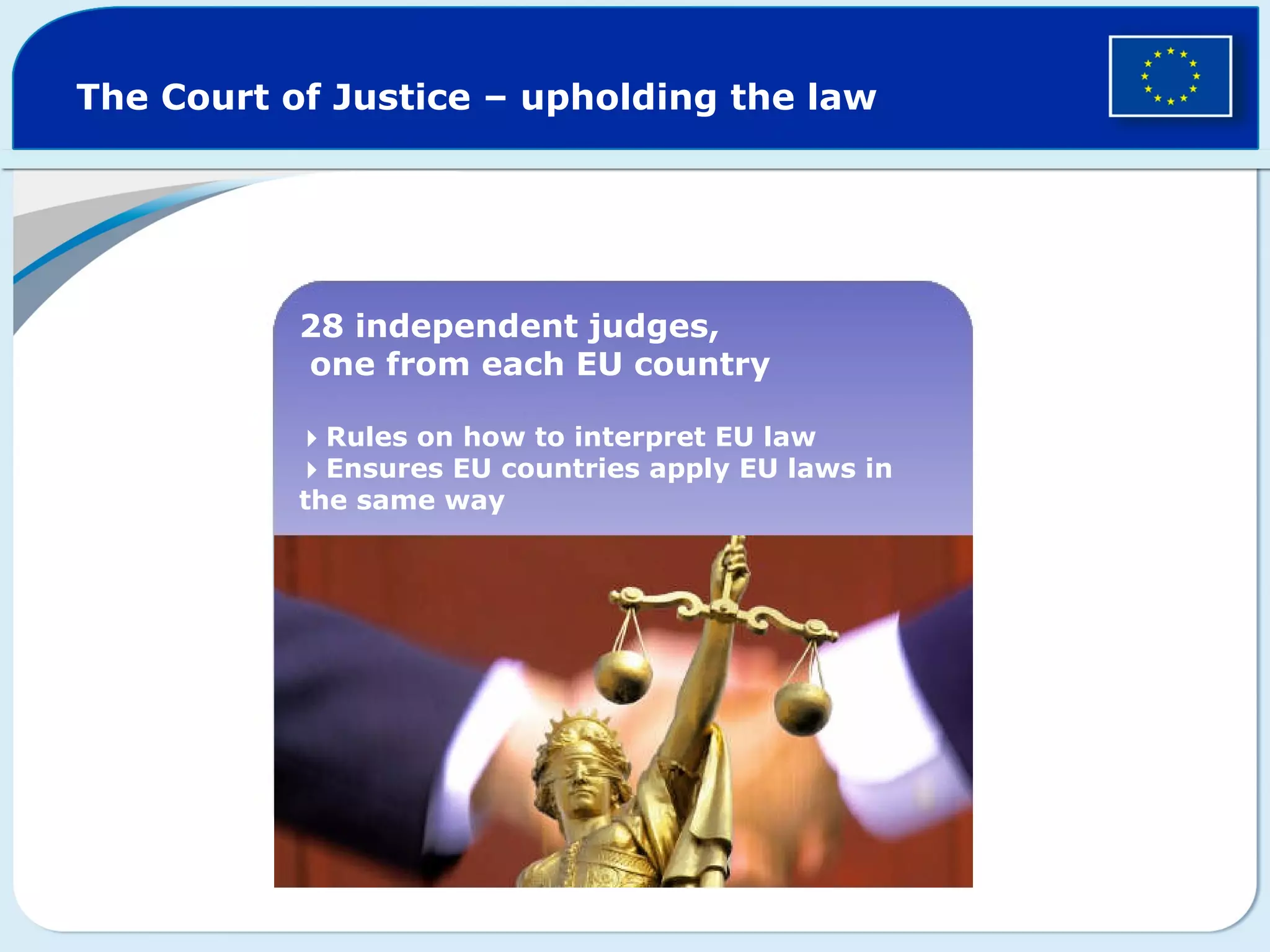
The Court of Justice – upholding the law
28 independent judges,
one from each EU country
Rules on how to interpret EU law
Ensures EU countries apply EU laws in
the same way
ITCG ENRICO FERMI TIVOLI 2016 CLIL
BASED ON DIFFERENT SOURCES
• UE WEBSITE
• WIKIPEDIA
• THE CLIL BOOK “ GLOBAL CITIZEN”
V E AMMINISTRAZIONE FINANZA E MARKETING
DOCENTE: ROSA DE LUCA

The European Union in a few slides

  • 1.
    The European Union: 500million people – 28 countries
  • 2.
    Founders New ideas forlasting peace and prosperity… Konrad Adenauer Robert Schuman Winston Churchill Alcide De Gasperi Jean Monnet Altiero Spinelli
  • 3.
    The EU symbols TheEuropean flag 12 stars The European anthem The hymn of joy Europe Day 9 May The motto: United in diversity
  • 4.
  • 5.
    Enlargement: from sixto 28 countries
  • 6.
    The treaties –basis for democratic cooperation built on law 1952 The European Steel and Coal Community 1958 The treaties of Rome: The European Economic Community The European Atomic Energy Community (EURATOM) 1987 The European Single Act: the Single Market 1993 Treaty of European Union – Maastricht 1999 Treaty of Amsterdam 2003 Treaty of Nice
  • 7.
    The Lisbon treaty- taking Europe into the 21st century The Treaty will make the European Union: More efficient Simpler processes, full-time president for the Council, etc. More democratic Stronger role for the European Parliament and national parliaments, "Citizens Initiative", Charter of Fundamental Rights, etc. More transparent Clarifies who does what, greater public access to documents and meetings, etc. More united on High Representative for Foreign Policy, etc. the world stage More secure New possibilities to fight climate change and terrorism, secure energy supplies, etc.
  • 8.
    A transparent Unionat your service The website of the European Union europa.eu One and a half million documents available to the public Europe Direct contact centre Answers your questions: 00 800 6 7 8 9 10 11 Europe Direct relays Over 400 EU Info Points across the EU European Union Documents Access to internal documents upon request The European Ombudsman Deals with complaints over EU administration
  • 9.
    How many peoplelive in the EU? Population in millions, 2015 500 million total 82.1 64.4 61.6 60.1 45.8 38.1 21.5 16.5 11.3 10.6 10.8 10.5 10.0 9.3 8.4 7.6 5.5 5.4 5.3 4.5 3.3 2.3 2.0 1.3 0.8 0.5 0.4 France Spain Sweden Poland Finland Italy UnitedKingdom Romania Greece Bulgaria Hungary Portugal Austria CzechRepublic Ireland Lithuania Latvia Slovakia Estonia Denmark Netherlands Belgium Slovenia Cyprus Luxemburg Malta Germany
  • 10.
    The euro –a single currency for Europeans EU countries using the euro EU countries not using the euro Can be used everywhere in the euro area Coins: one side with national symbols, one side common Notes: no national side
  • 11.
    The single market:freedom of choice Four freedoms of movement: goods services people capital ©GettyImages The single market has led to: significant reductions in the price of many products and services, including internet access and airfares. 40% drop in price of phone calls from 2000-2006 2.8 million new jobs
  • 12.
    Free to move “Schengen”: No police or customs checks at borders between most EU countries Controls strengthened at EU external borders More cooperation between police from different EU countries You can buy and bring back any goods for personal use when you travel between EU countries ©Corbis
  • 13.
    Going abroad tolearn Over 2 million young people have studied or pursued personal development in other European countries with support from EU programmes: Comenius: school education Erasmus: higher education Leonardo da Vinci: vocational training Grundtvig: adult education Youth in Action: voluntary work and non-formal education ©GettyImages
  • 14.
    Improving health andthe environment Pollution knows no borders – joint action needed EU action has helped bring: Cleaner bathing water Much less acid rain Lead-free petrol Free and safe disposal of old electronic equipment Strict rules on food safety from farm to fork More organic and quality farming More effective health warnings on cigarettes Registration and control of all chemicals (REACH) ©VanParysMedia
  • 15.
    An area offreedom, security and justice Charter of Fundamental Rights Joint fight against terrorism Police and law-enforcers from different countries cooperate Coordinated asylum and immigration policies Civil law cooperation ©EuropeanUnionPoliceMission
  • 16.
    Three key players TheEuropean Parliament - voice of the people Martin Schulz, President of of the European Parliament The council of Ministers - voice of the Member States Donald Tusk, President of the European Council The European Commission - promoting the common interest Jean Claude Junker , President of the European Commission
  • 17.
    European Parliament The EUinstitutions Court of Justice Court of Auditors Economic and Social Committee Committee of the Regions Council of Ministers (Council of the EU) European Commission European Investment Bank European Central BankAgencies European Council (summit)
  • 18.
    How EU lawsare made Citizens, interest groups, experts: discuss, consult Commission: makes formal proposal Parliament and Council of Ministers: decide jointly Commission and Court of Justice: monitor implementation National or local authorities: implement
  • 19.
    The European politicalparties Total : 753 Number of seats in the European Parliament per political group
  • 20.
    Council of Ministers– voice of the member states One minister from each EU country Presidency: rotates every six months Decides EU laws and budget together with Parliament Manages the common foreign and security policy
  • 21.
    THE ITALIAN  CURRENT HIGHREPRESENTATIVE OF THE EUROPEAN UNION FOR FOREIGN AFFAIRS AND SECURIT AND VICE-PRESIDENT OF THE EUROPEAN COMMISSION Federica Mogherini Federica Mogherini Federica Mogherini
  • 22.
    The Court ofJustice – upholding the law 28 independent judges, one from each EU country Rules on how to interpret EU law Ensures EU countries apply EU laws in the same way
  • 23.
    ITCG ENRICO FERMITIVOLI 2016 CLIL BASED ON DIFFERENT SOURCES • UE WEBSITE • WIKIPEDIA • THE CLIL BOOK “ GLOBAL CITIZEN” V E AMMINISTRAZIONE FINANZA E MARKETING DOCENTE: ROSA DE LUCA