Ethyl Benzene
Hashim Khan
(DDP-SP13-
BEC-53)
Abu Bakar
(DDP-SP13-
BEC-43)
Zohaib Uzair
(DDP-SP13-
BEC-101)
Shahzaib
Younis
(DDP-SP13-
BEC-85)
Ethyl Benzene
Introduction
Manufacture
Routes
Chemistry
Uses &
Applications
Effects On
Human Health
Introduction
Manufacture
Routes
Chemistry
Uses &
Applications
Effects On
Human Health
Ethylbenzene
was first
produced on
a commercial
scale in the
1930s in
Germany and
the United
States.
The ethylbenzene–styrene
industry remained relatively
insignificant until the Second
World War, when the demand
for synthetic styrene–butadiene
rubber prompted accelerated
technology improvements and
tremendous capacity expansion.
History
Nomenclature
Reg. No.: 100-41-4 Ethylbenzene
EB; ethyl benzol;
α-methyl toluene;
phenyl ethane
• Ethylbenzene (EB) is a
• Colorless
• Aromatic liquid
• Has a boiling point of 136.2°C which is very close
to that of p-xylene
• This complicates separating it from the C 8
aromatic equilibrium mixture obtained from
catalytic reforming processes. Ethyl benzene
obtained from this source, however, is small
compared to the synthetic route.
Description Colorless liquid with an aromatic odor (Coty et al., 1987)
Boiling-point 136.2 °C (Lide & Milne, 1996)
Melting-point –94.9 °C (Lide & Milne, 1996)
Density 0.8670 g/cm 3 at 20 °C (Lide & Milne, 1996)
Spectroscopy
data
Infrared, ultraviolet [97], nuclear magnetic resonance and mass spectral
data have been reported (Lide & Milne, 1996)
Solubility Slightly soluble in water (152 mg/L at 20 °C) (ECETOC, 1986) and
chloroform; miscible with diethyl ether and ethanol (Lide & Milne,
1996)
Volatility Vapor pressure, 1.28 kilo Pascal at 25 °C (Lide & Milne, 1996); relative
vapor density (air = 1), 3.7 (Verschueren, 1996); flash-point (closed-
cup), 15 °C (Coty et al., 1987)
Octanol/water
partition
coefficient (P)
log P, 3.15 (Verschueren, 1996)
Conversion
factor
mg/m 3 = 4.34 × ppm
Introduction
Manufacture
Routes
Chemistry
Uses &
Applications
Effects On
Human Health
• Alkylation Of Benzene
• Ethylene is also an active alkylating agent.
• Alkylation of benzene with ethylene produces
ethyl benzene.
• Ethyl benzene can be dehydrogenated to styrene.
• Styrene is a monomer used in the manufacture of
many commercial polymers and copolymers.
Benzene Ethylene Ethyl Benzene
The main process for producing EB is the catalyzed
alkylation of benzene with ethylene.
Chapter 17 13
Friedel-Crafts Alkylation
• Synthesis of alkyl benzenes from alkyl
halides and a Lewis acid, usually AlCl3.
Organic Chem4 614
Ethyl Benzene
Introduction
Manufacture
Routes
Chemistry
Uses &
Applications
Effects On
Human Health
• Badger process which has been commercialized
since 1980, can accept dilute ethylene streams such
as those produced from FCC off gas.
• A zeolite type heterogeneous catalyst is used in a
fixed bed process. The reaction conditions are
420°C and 200–300 psi.
• Over 98% yield is obtained at 90% conversion.
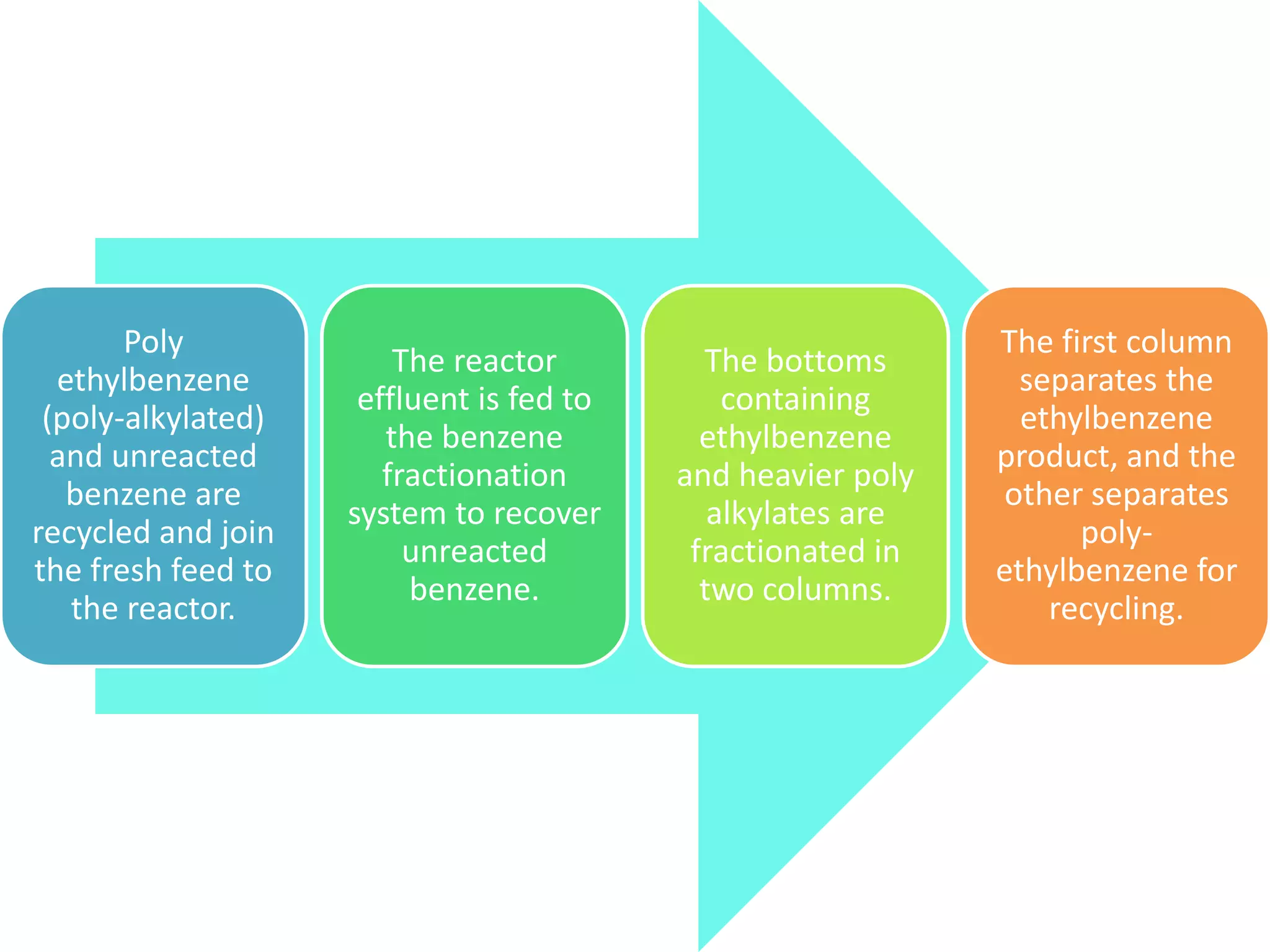
Poly
ethylbenzene
(poly-alkylated)
and unreacted
benzene are
recycled and join
the fresh feed to
the reactor.
The reactor
effluent is fed to
the benzene
fractionation
system to recover
unreacted
benzene.
The bottoms
containing
ethylbenzene
and heavier poly
alkylates are
fractionated in
two columns.
The first column
separates the
ethylbenzene
product, and the
other separates
poly-
ethylbenzene for
recycling.
Introduction
Manufacture
Routes
Chemistry
Uses &
Applications
Effects On
Human Health
Ethylbenzene is almost exclusively (> 99%)
used as an intermediate for the manufacture
of styrene monomer.
Less than 1% of the ethylbenzene produced
is used as a paint solvent or as an
intermediate for the production of diethyl
benzene and acetophenone.
Ethylbenzene has been added to motor and
aviation fuels because of its anti-knock
properties. Estimates of ethylbenzene in
gasoline have ranged from < 1–2.7%.
Ethylbenzene is also used as a negative
photoresist solvent in the semiconductor
industry.
• Ethylbenzene is also present in commercial
mixed xylenes at levels up to 25%, the
ethylbenzene present in recovered mixed xylenes
is largely converted to xylenes or benzene.
• Other than that it is also present in many
– paints
– lacquers
– printing inks
– insecticides
– solvents
– rubber and chemical industries
Introduction
Manufacture
Routes
Chemistry
Uses &
Applications
Effects On
Human
Health
There is inadequate evidence in humans
for the carcinogenicity of ethylbenzene.
There is sufficient evidence in
experimental animals for the
carcinogenicity of ethylbenzene.
But based on results of test performed on
test species ethylbenzene is possibly
carcinogenic to humans (Group 2B).
Production Of Methanol With
Bio Gas
What is Biogas? Methanol Synthesis In Pakistan
Organic Waste +
Microorganisms
Biogas
Digestate
What Is Biogas?
Manufacture
AD is a microbiological process of decomposition of organic matter,
in the absence of oxygen, common to many natural environments
and largely applied today to produce biogas in airproof reactor
tanks, commonly named digesters.
Process
A wide range of micro-organisms are involved in the anaerobic
process which has two main end products: biogas and digestate.
Comp.
Biogas is a combustible gas consisting of methane, carbon dioxide
and small amounts of other gases and trace elements. Digestate is
the decomposed substrate, rich in macro- and micro nutrients and
therefore suitable to be used as plant fertilizer.
• Common Biomass Categories
• Animal manure and slurry
• Agricultural residues and by-products
• Digestible organic wastes from food and agro
industries (vegetable and animal origin)
• Organic fraction of municipal waste and from
catering (vegetable and animal origin)
• Sewage sludge
• Dedicated energy crops (e.g. maize, miscanthus,
sorghum, clover)
The initial material is continuously broken down into smaller units.
Specific groups of micro-organisms are involved in each individual
step. These organisms successively decompose the products of the
previous steps. The simplified diagram of the AD process, shown in
Figure 3.5, highlights the four main process steps: hydrolysis,
acidogenesis, acetogenesis, and methanogenesis.
Municipal solid waste supplied to a German biogas plant
Maize silage
Biogas installations, processing agricultural substrates, are
some of the most important applications of AD today.
In Asia alone, millions of family owned, small scale digesters
are in operation in countries like China, India, Nepal and
Vietnam, producing biogas for cooking and lighting.
Thousands of agricultural biogas plants are in operation in
Europe and North America, many of them using the newest
technologies within this area, and their number is
continuously increasing. In Germany alone, more than 3700
agricultural biogas plants were in operation in 2007.
The World’s economies are dependent today of crude oil. There is
some disagreement among scientists on how long this fossil resource
will last but according to researchers, the “peak oil production”* has
already occurred or it is expected to occur within the next period of
time.
Methane yield from various biomass stocks
CO2
Biogas
CO2
Organics
What is Biogas? Methanol Synthesis In Pakistan
From
Biogas
Purification
What is Biogas? Methanol Synthesis In Pakistan
Reference Filesmethanol-fact-sheet.pdf
Biogas plants will be installed for the operation of 100,000
tube wells across the Punjab.
At present. 835000 tube wells run on high speed diesel; 70% of
these tube wells are owned by small farmers who constitute
85% of the farmers population.
The main objective of this initiative is to reduce energy costs.
Furthermore, the project will also offer huge benefits by
reducing huge costs on imported petroleum.
It is estimated that each biogas operated tube well (16 HP) will
result In saving more than 2000 liters of high speed diesel
annually.
Biogas ConceptMy Movie.mp4
Thanks
• Last slide
Ethyl Benzene
History & Process
Ethylbenzene was first produced on a commercial scale in the 1930s in Germany and the United
States. The ethylbenzene–styrene industry remained relatively insignificant until the Second World
War, when the demand for synthetic styrene–butadiene rubber prompted accelerated
technology improvements and tremendous capacity expansion.
There are many processes to convert ethylene and benzene into ethyl benzene. One of them is
Badger process. The process flow diagram is given above.
Applications
There are many applications of ethyl benzene… Some of them are…
1. paints
2. lacquers
3. printing inks
4. insecticides
5. solvents
Figure 1-Badger Process For Ethyl Benzene Synthesis

Ethyl Benzene

  • 1.
  • 2.
    Hashim Khan (DDP-SP13- BEC-53) Abu Bakar (DDP-SP13- BEC-43) ZohaibUzair (DDP-SP13- BEC-101) Shahzaib Younis (DDP-SP13- BEC-85)
  • 3.
  • 4.
  • 5.
    Ethylbenzene was first produced on acommercial scale in the 1930s in Germany and the United States. The ethylbenzene–styrene industry remained relatively insignificant until the Second World War, when the demand for synthetic styrene–butadiene rubber prompted accelerated technology improvements and tremendous capacity expansion. History
  • 6.
    Nomenclature Reg. No.: 100-41-4Ethylbenzene EB; ethyl benzol; α-methyl toluene; phenyl ethane
  • 7.
    • Ethylbenzene (EB)is a • Colorless • Aromatic liquid • Has a boiling point of 136.2°C which is very close to that of p-xylene • This complicates separating it from the C 8 aromatic equilibrium mixture obtained from catalytic reforming processes. Ethyl benzene obtained from this source, however, is small compared to the synthetic route.
  • 8.
    Description Colorless liquidwith an aromatic odor (Coty et al., 1987) Boiling-point 136.2 °C (Lide & Milne, 1996) Melting-point –94.9 °C (Lide & Milne, 1996) Density 0.8670 g/cm 3 at 20 °C (Lide & Milne, 1996) Spectroscopy data Infrared, ultraviolet [97], nuclear magnetic resonance and mass spectral data have been reported (Lide & Milne, 1996) Solubility Slightly soluble in water (152 mg/L at 20 °C) (ECETOC, 1986) and chloroform; miscible with diethyl ether and ethanol (Lide & Milne, 1996) Volatility Vapor pressure, 1.28 kilo Pascal at 25 °C (Lide & Milne, 1996); relative vapor density (air = 1), 3.7 (Verschueren, 1996); flash-point (closed- cup), 15 °C (Coty et al., 1987) Octanol/water partition coefficient (P) log P, 3.15 (Verschueren, 1996) Conversion factor mg/m 3 = 4.34 × ppm
  • 9.
  • 10.
    • Alkylation OfBenzene • Ethylene is also an active alkylating agent. • Alkylation of benzene with ethylene produces ethyl benzene. • Ethyl benzene can be dehydrogenated to styrene. • Styrene is a monomer used in the manufacture of many commercial polymers and copolymers.
  • 11.
    Benzene Ethylene EthylBenzene The main process for producing EB is the catalyzed alkylation of benzene with ethylene.
  • 13.
    Chapter 17 13 Friedel-CraftsAlkylation • Synthesis of alkyl benzenes from alkyl halides and a Lewis acid, usually AlCl3.
  • 14.
  • 16.
  • 21.
    • Badger processwhich has been commercialized since 1980, can accept dilute ethylene streams such as those produced from FCC off gas. • A zeolite type heterogeneous catalyst is used in a fixed bed process. The reaction conditions are 420°C and 200–300 psi. • Over 98% yield is obtained at 90% conversion.
  • 22.
    Poly ethylbenzene (poly-alkylated) and unreacted benzene are recycledand join the fresh feed to the reactor. The reactor effluent is fed to the benzene fractionation system to recover unreacted benzene. The bottoms containing ethylbenzene and heavier poly alkylates are fractionated in two columns. The first column separates the ethylbenzene product, and the other separates poly- ethylbenzene for recycling.
  • 25.
  • 27.
    Ethylbenzene is almostexclusively (> 99%) used as an intermediate for the manufacture of styrene monomer.
  • 28.
    Less than 1%of the ethylbenzene produced is used as a paint solvent or as an intermediate for the production of diethyl benzene and acetophenone.
  • 29.
    Ethylbenzene has beenadded to motor and aviation fuels because of its anti-knock properties. Estimates of ethylbenzene in gasoline have ranged from < 1–2.7%.
  • 30.
    Ethylbenzene is alsoused as a negative photoresist solvent in the semiconductor industry.
  • 31.
    • Ethylbenzene isalso present in commercial mixed xylenes at levels up to 25%, the ethylbenzene present in recovered mixed xylenes is largely converted to xylenes or benzene. • Other than that it is also present in many – paints – lacquers – printing inks – insecticides – solvents – rubber and chemical industries
  • 32.
  • 33.
    There is inadequateevidence in humans for the carcinogenicity of ethylbenzene. There is sufficient evidence in experimental animals for the carcinogenicity of ethylbenzene. But based on results of test performed on test species ethylbenzene is possibly carcinogenic to humans (Group 2B).
  • 35.
    Production Of MethanolWith Bio Gas What is Biogas? Methanol Synthesis In Pakistan
  • 36.
  • 37.
    What Is Biogas? Manufacture ADis a microbiological process of decomposition of organic matter, in the absence of oxygen, common to many natural environments and largely applied today to produce biogas in airproof reactor tanks, commonly named digesters. Process A wide range of micro-organisms are involved in the anaerobic process which has two main end products: biogas and digestate. Comp. Biogas is a combustible gas consisting of methane, carbon dioxide and small amounts of other gases and trace elements. Digestate is the decomposed substrate, rich in macro- and micro nutrients and therefore suitable to be used as plant fertilizer.
  • 39.
    • Common BiomassCategories • Animal manure and slurry • Agricultural residues and by-products • Digestible organic wastes from food and agro industries (vegetable and animal origin) • Organic fraction of municipal waste and from catering (vegetable and animal origin) • Sewage sludge • Dedicated energy crops (e.g. maize, miscanthus, sorghum, clover)
  • 40.
    The initial materialis continuously broken down into smaller units. Specific groups of micro-organisms are involved in each individual step. These organisms successively decompose the products of the previous steps. The simplified diagram of the AD process, shown in Figure 3.5, highlights the four main process steps: hydrolysis, acidogenesis, acetogenesis, and methanogenesis.
  • 41.
    Municipal solid wastesupplied to a German biogas plant
  • 42.
  • 43.
    Biogas installations, processingagricultural substrates, are some of the most important applications of AD today. In Asia alone, millions of family owned, small scale digesters are in operation in countries like China, India, Nepal and Vietnam, producing biogas for cooking and lighting. Thousands of agricultural biogas plants are in operation in Europe and North America, many of them using the newest technologies within this area, and their number is continuously increasing. In Germany alone, more than 3700 agricultural biogas plants were in operation in 2007.
  • 44.
    The World’s economiesare dependent today of crude oil. There is some disagreement among scientists on how long this fossil resource will last but according to researchers, the “peak oil production”* has already occurred or it is expected to occur within the next period of time.
  • 45.
    Methane yield fromvarious biomass stocks
  • 46.
  • 47.
    What is Biogas?Methanol Synthesis In Pakistan
  • 48.
  • 51.
    What is Biogas?Methanol Synthesis In Pakistan
  • 52.
  • 54.
    Biogas plants willbe installed for the operation of 100,000 tube wells across the Punjab. At present. 835000 tube wells run on high speed diesel; 70% of these tube wells are owned by small farmers who constitute 85% of the farmers population. The main objective of this initiative is to reduce energy costs. Furthermore, the project will also offer huge benefits by reducing huge costs on imported petroleum. It is estimated that each biogas operated tube well (16 HP) will result In saving more than 2000 liters of high speed diesel annually.
  • 56.
  • 57.
  • 58.
  • 59.
    Ethyl Benzene History &Process Ethylbenzene was first produced on a commercial scale in the 1930s in Germany and the United States. The ethylbenzene–styrene industry remained relatively insignificant until the Second World War, when the demand for synthetic styrene–butadiene rubber prompted accelerated technology improvements and tremendous capacity expansion. There are many processes to convert ethylene and benzene into ethyl benzene. One of them is Badger process. The process flow diagram is given above. Applications There are many applications of ethyl benzene… Some of them are… 1. paints 2. lacquers 3. printing inks 4. insecticides 5. solvents Figure 1-Badger Process For Ethyl Benzene Synthesis