JAW CRUSHER
• Crusher
• Crusher is size reduction equipment
A crusher is a machine designed to
reduce large rocks into smaller, more
manageable particles.
• Crusher is a machine which is used to
crush heavy size particle into small
size, also it’s a primary size
reducer.
• Crusher are low speed machine for
coarse reduction of large particles
• Approx. size of reduced of material
from a crusher ranges from 150mm to
250 mm.
• Working Principle Of A Crusher
• A crusher uses compressive force
for breaking of particle.
• This mechanical pressure is
achieved by the two jaws, one jaw
is kept stationary and is called a
fixed jaw while the other jaw,
called a swing jaw, moves back and
forth relative to it.
• Types Of Crushers
• Jaw crushers
• Gyratory crushers
• Difference
• Difference between these jaw
crushers is the feed rate and
product rate and design, we are,
however, going to talk about jaw
crushers in this particular
presentation.
• Jaw Crusher
• Jaw crusher is a type of crusher
which produces coarse particle.
• Feed size of the jaw crusher is
1500mm-40mm and the product size is
from 50mm-5mm.
• Compressive strength of jaw
crushers is 320 mega Pascal.
• Rpm for jaw crusher is between 200-
400.
• Jaw Crushers
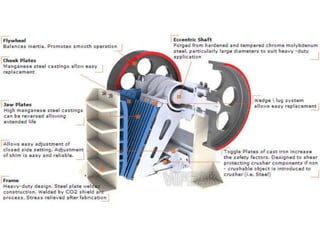
• Jaw crushers are heavy duty
machines and hence need to be
robustly constructed.
• The outer frame is generally made
of cast iron or steel.
• The jaws themselves are usually
constructed from cast steel.
• They are fitted with replaceable
liners which are made of manganese
steel.
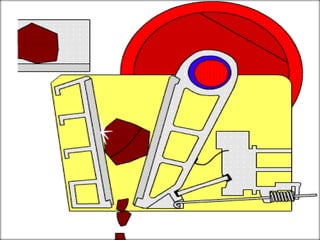
Figure 1
• Working Principle Of A Jaw
Crusher
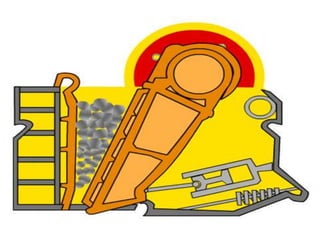
• A jaw crusher uses compressive
force for breaking of particle.
• A Jaw Crusher reduces large size
rocks or ore by placing the rock
into compression. A fixed jaw,
mounted in a "V" alignment is the
stationary breaking surface, while
the movable jaw exerts force on the
rock by forcing it against the
stationary plate.
• Working Principles
• The space at the bottom of the "V"
aligned jaw plates is the crusher
product size gap, or the size of
the crushed product from the jaw
crusher. The rock remains in the
jaws until it is small enough to
pass through the gap at the bottom
of the jaws.
• The Crushing Chamber
• The volume or cavity between the
two jaws is called the crushing
chamber.
• The movement of the swing jaw can
be quite small, since complete
crushing is not performed in one
stroke.
• The inertia required to crush the
material is provided by a weighted
flywheel that moves a shaft
creating an eccentric motion that
causes the closing of the gap.
• Jaws
• Angle between two jaws is between
20-30 degree.
• Larger lumps caught between upper
part of the jaw and broken into
small piece by impact force.
• Small pieces come to narrower space
at the bottom where compressive
force do a sufficient size
reduction and product obtained.
• Types Of Jaw Crusher
• Jaw crusher is classified into two
types.
1.Blake Jaw crusher
2.Dodge jaw crushers
• Both Crushers employs a compressive
force for size reduction.
• Blake Jaw
Crusher
• In Blake jaw
crusher, the
swing jaw is
pivoted at upper
position, the
greatest amount
of motion is at
the bottom which
means less
choking
• Dodge Jaw
Crusher
• In dodge jaw
crusher, the
swing jaw is
pivoted at
bottom
position, it has
a greater
tendency to
choke
• Blake Jaw Crusher
• The Blake type jaw crusher has a
fixed feed area and a variable
discharge area.
• Greatest amount of motion is at the
bottom of v which means that it
have a little tendency to chock.
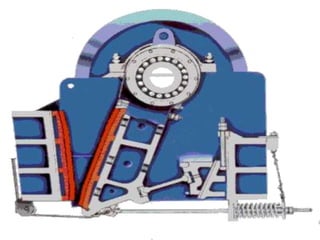
• Single Toggle Jaw Crusher
• In the single toggle jaw crushers,
the swing jaw is suspended on the
eccentric shaft which leads to a
much more compact design than that
of the double toggle jaw crusher.
• The swing jaw, suspended on the
eccentric, undergoes two types of
motion- swing motion towards the
fixed jaw due to the action of
toggle plate and vertical movement
due the rotation of the eccentric.
• Single Toggle Jaw Crusher
• These both motions, when combined,
lead to an elliptical jaw motion.
This motion is useful as it assists
in pushing the particles through
the crushing chamber.
• This phenomena leads to higher
capacity of the single toggle jaw
crushers but it also results in
higher wear of the crushing jaws.
• These type of jaw crushers are
preferred for the crushing of
softer particles.
• Double Toggle Jaw Crushers
• In the double toggle jaw crushers,
the oscillating motion of the swing
jaw is caused by the vertical
motion of the pitman.
• The pitman moves up and down. The
swing jaw closes, it moves towards
the fixed jaw when the pitman moves
upward and opens during the
downward motion of the pitman.
• This type is commonly used in
mines due to its ability to crush
tough and abrasive materials.
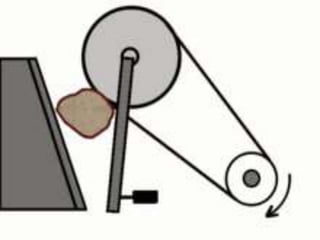
• Doge Jaw Crusher
• In the Dodge type jaw crushers, the
jaws are farther apart at the top
than at the bottom.
• which form a tapered chute so that
the material is crushed.
progressively smaller and smaller
as it travels downward until it is
small enough to escape from the
bottom opening.
• Doge Jaw Crusher
• Greatest amount of motion is at the
top of V which leads to chocking.
• The Dodge jaw crusher has a
variable feed area and a fixed
discharge area which leads to
choking of the crusher.
• used only for laboratory purposes
and not for heavy duty operations.
figure
• Advantages Of Jaw Crusher
• Simple construction makes for easy
maintenance
• Stable performance
• High crushing ratio
• Low operational cost
• High capacity
• Adjustable discharge port
• Industrial Applications
• Crushers are used
1.Heavy duty mining
2.Cement industry
3.Fertilizers industry
4.Plaster of Paris Plant
5.Animal (Cattle) Feed plants
6. Herbal plants
7.Cement plants
8.Ceramic Plant
• Industrial Applications
• Coconut Shell Plant
• Salt Plant
• Mines and Minerals
• Agro Based industries
• Others where size reduction
required
• Gyratory Crushers
• Gyratory crusher looked like a jaw
crusher with circular jaws between
which material is being crushed
some point all the time.
• Rpm is 125-425 gyration per minute.
• Give a continuous discharge because
some part of the crushing head
working all the time.
• Produces up to 4500 ton per hour of
material being crushed.
• Gyratory Crusher
• A gyratory crusher is similar in
basic concept to a jaw crusher,
consisting of a concave surface and
a conical head; both surfaces are
typically lined with manganese
steel surfaces.
• The inner cone has a slight
circular movement, but does not
rotate; the movement is generated
by an eccentric arrangement.
• Gyratory Crusher
• As with the jaw crusher, material
travels downward between the two
surfaces being progressively
crushed until it is small enough to
fall out through the gap between
the two surfaces.
Jaw crusher

Jaw crusher

  • 1.
  • 2.
    • Crusher • Crusheris size reduction equipment A crusher is a machine designed to reduce large rocks into smaller, more manageable particles. • Crusher is a machine which is used to crush heavy size particle into small size, also it’s a primary size reducer. • Crusher are low speed machine for coarse reduction of large particles • Approx. size of reduced of material from a crusher ranges from 150mm to 250 mm.
  • 3.
    • Working PrincipleOf A Crusher • A crusher uses compressive force for breaking of particle. • This mechanical pressure is achieved by the two jaws, one jaw is kept stationary and is called a fixed jaw while the other jaw, called a swing jaw, moves back and forth relative to it.
  • 5.
    • Types OfCrushers • Jaw crushers • Gyratory crushers • Difference • Difference between these jaw crushers is the feed rate and product rate and design, we are, however, going to talk about jaw crushers in this particular presentation.
  • 6.
    • Jaw Crusher •Jaw crusher is a type of crusher which produces coarse particle. • Feed size of the jaw crusher is 1500mm-40mm and the product size is from 50mm-5mm. • Compressive strength of jaw crushers is 320 mega Pascal. • Rpm for jaw crusher is between 200- 400.
  • 7.
    • Jaw Crushers •Jaw crushers are heavy duty machines and hence need to be robustly constructed. • The outer frame is generally made of cast iron or steel. • The jaws themselves are usually constructed from cast steel. • They are fitted with replaceable liners which are made of manganese steel.
  • 8.
  • 9.
    • Working PrincipleOf A Jaw Crusher • A jaw crusher uses compressive force for breaking of particle. • A Jaw Crusher reduces large size rocks or ore by placing the rock into compression. A fixed jaw, mounted in a "V" alignment is the stationary breaking surface, while the movable jaw exerts force on the rock by forcing it against the stationary plate.
  • 10.
    • Working Principles •The space at the bottom of the "V" aligned jaw plates is the crusher product size gap, or the size of the crushed product from the jaw crusher. The rock remains in the jaws until it is small enough to pass through the gap at the bottom of the jaws.
  • 12.
    • The CrushingChamber • The volume or cavity between the two jaws is called the crushing chamber. • The movement of the swing jaw can be quite small, since complete crushing is not performed in one stroke. • The inertia required to crush the material is provided by a weighted flywheel that moves a shaft creating an eccentric motion that causes the closing of the gap.
  • 13.
    • Jaws • Anglebetween two jaws is between 20-30 degree. • Larger lumps caught between upper part of the jaw and broken into small piece by impact force. • Small pieces come to narrower space at the bottom where compressive force do a sufficient size reduction and product obtained.
  • 14.
    • Types OfJaw Crusher • Jaw crusher is classified into two types. 1.Blake Jaw crusher 2.Dodge jaw crushers • Both Crushers employs a compressive force for size reduction.
  • 15.
    • Blake Jaw Crusher •In Blake jaw crusher, the swing jaw is pivoted at upper position, the greatest amount of motion is at the bottom which means less choking • Dodge Jaw Crusher • In dodge jaw crusher, the swing jaw is pivoted at bottom position, it has a greater tendency to choke
  • 16.
    • Blake JawCrusher • The Blake type jaw crusher has a fixed feed area and a variable discharge area. • Greatest amount of motion is at the bottom of v which means that it have a little tendency to chock.
  • 18.
    • Single ToggleJaw Crusher • In the single toggle jaw crushers, the swing jaw is suspended on the eccentric shaft which leads to a much more compact design than that of the double toggle jaw crusher. • The swing jaw, suspended on the eccentric, undergoes two types of motion- swing motion towards the fixed jaw due to the action of toggle plate and vertical movement due the rotation of the eccentric.
  • 19.
    • Single ToggleJaw Crusher • These both motions, when combined, lead to an elliptical jaw motion. This motion is useful as it assists in pushing the particles through the crushing chamber. • This phenomena leads to higher capacity of the single toggle jaw crushers but it also results in higher wear of the crushing jaws. • These type of jaw crushers are preferred for the crushing of softer particles.
  • 20.
    • Double ToggleJaw Crushers • In the double toggle jaw crushers, the oscillating motion of the swing jaw is caused by the vertical motion of the pitman. • The pitman moves up and down. The swing jaw closes, it moves towards the fixed jaw when the pitman moves upward and opens during the downward motion of the pitman. • This type is commonly used in mines due to its ability to crush tough and abrasive materials.
  • 21.
    • Doge JawCrusher • In the Dodge type jaw crushers, the jaws are farther apart at the top than at the bottom. • which form a tapered chute so that the material is crushed. progressively smaller and smaller as it travels downward until it is small enough to escape from the bottom opening.
  • 22.
    • Doge JawCrusher • Greatest amount of motion is at the top of V which leads to chocking. • The Dodge jaw crusher has a variable feed area and a fixed discharge area which leads to choking of the crusher. • used only for laboratory purposes and not for heavy duty operations.
  • 23.
  • 24.
    • Advantages OfJaw Crusher • Simple construction makes for easy maintenance • Stable performance • High crushing ratio • Low operational cost • High capacity • Adjustable discharge port
  • 25.
    • Industrial Applications •Crushers are used 1.Heavy duty mining 2.Cement industry 3.Fertilizers industry 4.Plaster of Paris Plant 5.Animal (Cattle) Feed plants 6. Herbal plants 7.Cement plants 8.Ceramic Plant
  • 26.
    • Industrial Applications •Coconut Shell Plant • Salt Plant • Mines and Minerals • Agro Based industries • Others where size reduction required
  • 27.
    • Gyratory Crushers •Gyratory crusher looked like a jaw crusher with circular jaws between which material is being crushed some point all the time. • Rpm is 125-425 gyration per minute. • Give a continuous discharge because some part of the crushing head working all the time. • Produces up to 4500 ton per hour of material being crushed.
  • 28.
    • Gyratory Crusher •A gyratory crusher is similar in basic concept to a jaw crusher, consisting of a concave surface and a conical head; both surfaces are typically lined with manganese steel surfaces. • The inner cone has a slight circular movement, but does not rotate; the movement is generated by an eccentric arrangement.
  • 29.
    • Gyratory Crusher •As with the jaw crusher, material travels downward between the two surfaces being progressively crushed until it is small enough to fall out through the gap between the two surfaces.