PERP/PERP ABSTRACTS 2009
Styrene/Ethylbenzene
Process Technology (including New
Developments such as Exelus' ExSyM
Process via Methanol and Toluene),
Production Costs, and Regional
Supply/Demand Forecasts are
discussed.
PERP07/08-4
Report Abstract
March 2009
PERP07/08-4
Styrene/Ethylbenzene
March 2009
www.chemsystems.com
The ChemSystems Process Evaluation/Research Planning (PERP) program is recognized globally as
the industry standard source for information relevant to the chemical process and refining industries.
PERP reports are available as a subscription program or on a report by report basis.
Nexant, Inc. (www.nexant.com) is a leading management consultancy to the global energy, chemical, and related industries. For over 38 years,
ChemSystems has helped clients increase business value through assistance in all aspects of business strategy, including business intelligence, project
feasibility and implementation, operational improvement, portfolio planning, and growth through M&A activities. Nexant has its main offices in
San Francisco (California), White Plains (New York), and London (UK), and satellite offices worldwide.
For further information about these reports, please contact the following:
New York, Dr. Jeffrey S. Plotkin, Vice President and Global Director, PERP Program, phone: + 1-914-609-0315, e-mail: jplotkin@nexant.com;
or Heidi Junker Coleman, Multi-client Programs Administrator, phone: + 1-914-609-0381, e-mail: hcoleman@nexant.com.
London, Dr. Alexander Coker, Senior Consultant, phone: + 44-(20)-709-1570, e-mail: acoker@nexant.com.
Bangkok, Maoliosa Denye, Marketing Manager, Energy & Chemicals Consulting: Asia, phone: + 66-2793-4612, e-mail: mdenye@nexant.com.
Website: www.chemsystems.com
Copyright © by Nexant Inc. 2009. All Rights Reserved.
www.chemsystems.com
CHEMSYSTEMS PERP PROGRAM
Report Abstract – Styrene/Ethylbenzene 07/08-4
1
PERP ABSTRACTS 2009 00101.0008.4104
Styrene/Ethylbenzene
INTRODUCTION
In recent years, technological developments in the ethylbenzene (EB) and styrene area have
focused on process optimization, catalyst upgrades, and equipment improvements. The major
licensors of EB technologies include: Lummus Technology with its EBOne™ process and
Badger Licensing LLC with its ExxonMobil/Badger EB Max process. These processes are
generally quite similar, the main distinguishing factors being the catalysts used in the alkylation
and transalkylation reactions and the specific operating conditions throughout the processes.
Lummus offers the CDTECH EB®
technology, which combines catalytic reaction and distillation
in a single operation. This technology can utilize dilute ethylene, such as ethylene in fluid
catalytic cracker (FCC) offgas streams, as a means of reducing feedstock costs. A liquid phase
alkylation system is typically used in the EBMax technology. However, for more dilute streams,
the alkylation reactor operates under partial liquid phase conditions.
Aluminum-chloride catalyzed alkylation remains in use in numerous existing plants where
suitable means of disposing of spent catalyst are available. However, this disposal can represent
a cost disadvantage in addition to those, which follow from these plants typically being older and
smaller than state-of-the-art zeolite-catalyzed EB plants.
Dehydrogenation of EB to styrene is a mature technology with continuing refinement of catalysts
and reactor designs in an attempt to increase EB conversion without losing selectivity to styrene.
Flameless Distributed Combustion (FDC) developed and supplied by Shell Oil is being
incorporated into the TOTAL/Badger process for heating of reactor feed streams. This technique
provides continuous heat input to the endothermic reaction and permits operation at lower
temperatures. Heat transfer is primarily by convection, as opposed to conduction as in
conventional heat exchangers.
The Lummus/UOP SMART oxidative dehydrogenation process is used primarily for revamp
projects where capacity increase at nominal capital cost is desired. In this approach, heat needed
for the dehydrogenation reaction is generated by controlled combustion of hydrogen. By
removing hydrogen from the reaction mixture, the reaction equilibrium is shifted towards higher
EB conversion.
The propylene oxide co-product process is a mature technology, which represents an important
source of styrene. Most propylene oxide is now made by co-product routes (styrene or tertiary-
butyl alcohol) rather than the environmentally disadvantaged chlorohydrin route. Although
propylene oxide demand controls the siting and capacity of these co-product plants, the primary
output is styrene by a weight ratio of 2.4 to 1.
Snamprogetti S.p.A. and Dow are jointly developing a process for the production of styrene
monomer from ethane and benzene. Ethane, along with ethylbenzene from the alkylation unit, is
fed to a dehydrogenation reactor with a catalyst capable of simultaneously producing styrene and
ethylene. The dehydrogenation reactor effluent is cooled and separated and the ethylene stream
is recycled to the alkylation unit. The catalyst suitable for this type of reaction is composed of
gallium, platinum and potassium on alumina modified with silica.
Styrene/Ethylbenzene
www.chemsystems.com
CHEMSYSTEMS PERP PROGRAM
Report Abstract – Styrene/Ethylbenzene 07/08-4
2
PERP ABSTRACTS 2009 00101.0008.4104
Recent technological developments from Exelus revolve around a new route to styrene using
methanol and toluene. This new route to styrene may influence the market in the future using
different feedstocks and reaction conditions that could significantly affect the production
economics of styrene. Exelus’ ExSyM process for making styrene via methanol and toluene is
discussed.
Updated economics are compared for commercial EB and styrene processes. Sensitivity
analyses show the effect of variations in economic parameters such as feed prices, capacities, etc.
Supply and demand estimates are presented for the United States, Western Europe, Japan, and
East Asia.
COMMERCIAL TECHNOLOGY
Ethylbenzene
Ethylbenzene (EB) is made by alkylation of benzene with ethylene in the presence of aluminum
chloride or zeolite catalyst.
CH2 CH2+
AlCl3 or
Zeolite
C2H5
Benzene Ethylene Ethylbenzene
Q109_00101.0008.4104.CDX
Successive alkylations occur, producing diethylbenzene (DEB) and higher ethylated benzenes:
CH2 CH2+
C2H5
Ethylbenzene Ethylene Diethylbenzene
Q109_00101.0008.4104.CDX
C2H5
C2H5
Zeolite catalysis removes the need for aqueous catalyst residue disposal. Other coupling
reactions occur to a minor extent, yielding materials such as butylbenzene, diphenyl ethane, and
higher boiling compounds. All the alkylation reactions are highly exothermic.
The polyethylbenzenes produced by successive alkylations can be transalkylated (transfer of
ethyl groups) with benzene to produce additional ethylbenzene. These reactions are slower than
alkylation and limited in extent by equilibrium. The following reaction is typical:
Styrene/Ethylbenzene
www.chemsystems.com
CHEMSYSTEMS PERP PROGRAM
Report Abstract – Styrene/Ethylbenzene 07/08-4
3
PERP ABSTRACTS 2009 00101.0008.4104
Liquid Phase Alkylation with Zeolite Catalysts
The Lummus/UOP EBOne™ process for ethylbenzene is a liquid phase alkylation
process using proprietary zeolite alkylation and transalkylation catalysts supplied by
UOP. A simplified process flow sheet and process description, including typical feed and
product specifications, are given in the report.
ExxonMobil/Badger EB Max Process is presently available for license. The EBMax
technology can accept both polymer grade ethylene and dilute ethylene feed streams.
The ethylbenzene unit has three subsystems: alkylation, transalkylation, and distillation.
A simplified process flowsheet and process description are given in the report.
Alkylation via Catalytic Distillation
FCC Plant and Propylene Recovery: A typical propylene recovery unit for an FCC plant is
shown schematically, as well as a schematic representation of the process to remove olefins from
FCC offgas to low levels.
CDTECH EB®
: key features of the process, as well as process description and flow diagram are
given in the report.
Aluminum Chloride Liquid Phase Alkylation: The process sequence, including diagram and
description, for the manufacture of ethylbenzene from ethylene or benzene using an aluminum
chloride catalyst is given.
Styrene
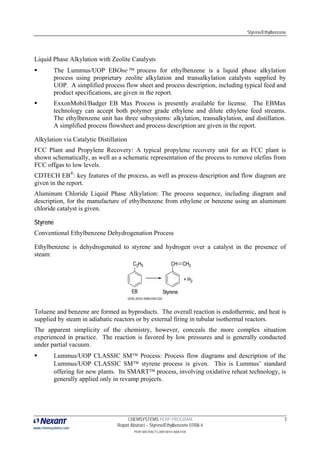
Conventional Ethylbenzene Dehydrogenation Process
Ethylbenzene is dehydrogenated to styrene and hydrogen over a catalyst in the presence of
steam:
Toluene and benzene are formed as byproducts. The overall reaction is endothermic, and heat is
supplied by steam in adiabatic reactors or by external firing in tubular isothermal reactors.
The apparent simplicity of the chemistry, however, conceals the more complex situation
experienced in practice. The reaction is favored by low pressures and is generally conducted
under partial vacuum.
Lummus/UOP CLASSIC SM™ Process: Process flow diagrams and description of the
Lummus/UOP CLASSIC SM™ styrene process is given. This is Lummus’ standard
offering for new plants. Its SMART™ process, involving oxidative reheat technology, is
generally applied only in revamp projects.
Styrene/Ethylbenzene
www.chemsystems.com
CHEMSYSTEMS PERP PROGRAM
Report Abstract – Styrene/Ethylbenzene 07/08-4
4
PERP ABSTRACTS 2009 00101.0008.4104
TOTAL/Badger Styrene Process: TOTAL and Badger have been jointly developing and
licensing styrene monomer technology since the early 1960s. This long-term association
has resulted in the development of six unique generations of technology. The
combination of TOTAL’s operations know-how and Badger’s engineering expertise has
resulted in a steady improvement in both variable operating cost and plant reliability.
This process is discussed in the report, as well as a process flow diagram of the Badger
dehydrogenation reaction system.
Lummus/UOP SMARTTM
SM Process: An alternative approach in styrene technology is
the combination of oxidative reheat technology and adiabatic dehydrogenation
technology as the Lummus/UOP SMARTTM
SM process. The special reactor design uses
two different catalysts to achieve what is, in effect, oxidative dehydrogenation. The
Lummus/UOP SMARTTM
system is shown schematically as well as discussed further in
the report.
Propylene Oxide/Styrene Monomer (POSM) Co-product Process
The hydroperoxidation technology for the production of styrene features co-production of
propylene oxide and styrene via an ethylbenzene hydroperoxide intermediate. The
hydroperoxide, made by direct air oxidation of ethylbenzene, is subsequently converted to an
alcohol in the epoxidation reaction with propylene. The alcohol is then dehydrated to styrene.
Schematic flow diagrams of the LyondellBasell process for producing propylene oxide
by ethylbenzene hydroperoxide are given along with a process description.
DEVELOPING TECHNOLOGIES
Styrene via Benzene and Ethane
Snamprogetti S.p.A. (the engineering and main contracting company of Italy’s Eni) and Dow are
jointly developing a process for the production of styrene monomer from ethane and benzene.
Ethane, along with ethylbenzene from the alkylation unit, is fed to a dehydrogenation reactor
with a catalyst capable of simultaneously producing styrene and ethylene. The dehydrogenation
reactor effluent is cooled and separated and the ethylene stream is recycled to the alkylation unit.
The process attempts to overcome previous shortcomings in the development of processes
employing ethane to produce styrene. These include inefficient recovery of aromatics,
production of high levels of heavies and tars, and inefficient separation of hydrogen and ethane.
A basic block flow diagram of the process is shown below.
Styrene/Ethylbenzene
www.chemsystems.com
CHEMSYSTEMS PERP PROGRAM
Report Abstract – Styrene/Ethylbenzene 07/08-4
5
PERP ABSTRACTS 2009 00101.0008.4104
Process descriptions and process flow diagrams are detailed in the report.
Styrene via Methanol and Toluene
The ability to successfully synthesize styrene on a commercial scale from toluene and methanol
would very likely have a significant impact on the styrene market. This has long been realized
and for that reason there has been a long history of attempts to develop such a process.
A small company called Exelus Inc. is developing a process based on this chemical route to
making styrene, i.e., using the side-chain alkylation of toluene with methanol. This is made
possible by a particular catalyst which allows for the side-chain alkylation of toluene to take
place when reacted with methanol.
Exelus claims to have invented a new catalytic technology that allows for a breakthrough
selectivity of 80 percent at full methanol conversion. If the claims of high selectivities are borne
out in Exelus’ pilot test, the cost of styrene production could be significantly reduced.
A literature review and the lesson learned from the review with respect to insights on the
developing Exelus process are discussed in the report
Process description based on information provided by Exelus combined with Nexant
ChemSystems judgment is given in the report, including a pertinent process flow diagram.
Patent Survey
A survey of key patents published since the last PERP report on this subject detailing assignee,
patent number, publication date, and title is provided.
ECONOMIC ANALYSIS
Cost of production estimates for the production of ethylbenzene by the following processes have
been carried out:
Ethylbenzene via a liquid-phase zeolite-catalyzed process
Reactive distillation process for ethylbenzene from dilute ethylene feedstock
Liquid-phase alkylation catalyzed by aluminum chloride
Cost of production estimates for the production of styrene by the following commercial and
developing process routes have been carried out:
Catalytic dehydrogenation of ethylbenzene to styrene
Production of styrene with propylene oxide as co-product
Cost of production estimates have been carried out with different valuations of byproduct
credit for propylene oxide, i.e., production via the chlorohydrin route with and without
integrated chlor-alkali plant, and valued at export price. The relationship between
propylene oxide co-product value and styrene cost is also illustrated
Speculative Dow ethane/benzene route to styrene
Speculative ExSyM process-to styrene using methanol and toluene
Styrene/Ethylbenzene
www.chemsystems.com
CHEMSYSTEMS PERP PROGRAM
Report Abstract – Styrene/Ethylbenzene 07/08-4
6
PERP ABSTRACTS 2009 00101.0008.4104
COMMERCIAL ANALYSIS
In response to overcapacity, styrenics producers are continuing to restructure, and close less
competitive plants in order to boost and restore profitability. The figure below shows U.S.
consumption of styrene by derivative. Overall, styrene consumption in the United States is
expected to grow through 2015.
U.S. Styrene Consumption by Derivative, 2008
(Weight percent)
ABS
8%
Polystyrene
53%
SBR
5%
SB Latex
7%
UPR
7%
Others
13%
EPS
7%
Q109_00101.0008.4104-Char ts.xl s/ F6.1
2008 Consumption = 9,119 Million Pounds
The report discusses consumption and supply in the United States, Western Europe, Japan,
South Korea, Taiwan, and China.
For each region/nation, supply, demand and trade data are given
Tables giving specific plant capacity by company and location for the various regions
(United States, Western Europe, Japan, South Korea, Taiwan, China) are listed
www.chemsystems.com
Nexant, Inc.
San Francisco
London
Tokyo
Bangkok
New York
Washington
Houston
Phoenix
Madison
Boulder
Dusseldorf
Beijing
Shanghai
Paris

0708 4 abs

  • 1.
    PERP/PERP ABSTRACTS 2009 Styrene/Ethylbenzene ProcessTechnology (including New Developments such as Exelus' ExSyM Process via Methanol and Toluene), Production Costs, and Regional Supply/Demand Forecasts are discussed. PERP07/08-4 Report Abstract March 2009
  • 2.
    PERP07/08-4 Styrene/Ethylbenzene March 2009 www.chemsystems.com The ChemSystemsProcess Evaluation/Research Planning (PERP) program is recognized globally as the industry standard source for information relevant to the chemical process and refining industries. PERP reports are available as a subscription program or on a report by report basis. Nexant, Inc. (www.nexant.com) is a leading management consultancy to the global energy, chemical, and related industries. For over 38 years, ChemSystems has helped clients increase business value through assistance in all aspects of business strategy, including business intelligence, project feasibility and implementation, operational improvement, portfolio planning, and growth through M&A activities. Nexant has its main offices in San Francisco (California), White Plains (New York), and London (UK), and satellite offices worldwide. For further information about these reports, please contact the following: New York, Dr. Jeffrey S. Plotkin, Vice President and Global Director, PERP Program, phone: + 1-914-609-0315, e-mail: jplotkin@nexant.com; or Heidi Junker Coleman, Multi-client Programs Administrator, phone: + 1-914-609-0381, e-mail: hcoleman@nexant.com. London, Dr. Alexander Coker, Senior Consultant, phone: + 44-(20)-709-1570, e-mail: acoker@nexant.com. Bangkok, Maoliosa Denye, Marketing Manager, Energy & Chemicals Consulting: Asia, phone: + 66-2793-4612, e-mail: mdenye@nexant.com. Website: www.chemsystems.com Copyright © by Nexant Inc. 2009. All Rights Reserved.
  • 3.
    www.chemsystems.com CHEMSYSTEMS PERP PROGRAM ReportAbstract – Styrene/Ethylbenzene 07/08-4 1 PERP ABSTRACTS 2009 00101.0008.4104 Styrene/Ethylbenzene INTRODUCTION In recent years, technological developments in the ethylbenzene (EB) and styrene area have focused on process optimization, catalyst upgrades, and equipment improvements. The major licensors of EB technologies include: Lummus Technology with its EBOne™ process and Badger Licensing LLC with its ExxonMobil/Badger EB Max process. These processes are generally quite similar, the main distinguishing factors being the catalysts used in the alkylation and transalkylation reactions and the specific operating conditions throughout the processes. Lummus offers the CDTECH EB® technology, which combines catalytic reaction and distillation in a single operation. This technology can utilize dilute ethylene, such as ethylene in fluid catalytic cracker (FCC) offgas streams, as a means of reducing feedstock costs. A liquid phase alkylation system is typically used in the EBMax technology. However, for more dilute streams, the alkylation reactor operates under partial liquid phase conditions. Aluminum-chloride catalyzed alkylation remains in use in numerous existing plants where suitable means of disposing of spent catalyst are available. However, this disposal can represent a cost disadvantage in addition to those, which follow from these plants typically being older and smaller than state-of-the-art zeolite-catalyzed EB plants. Dehydrogenation of EB to styrene is a mature technology with continuing refinement of catalysts and reactor designs in an attempt to increase EB conversion without losing selectivity to styrene. Flameless Distributed Combustion (FDC) developed and supplied by Shell Oil is being incorporated into the TOTAL/Badger process for heating of reactor feed streams. This technique provides continuous heat input to the endothermic reaction and permits operation at lower temperatures. Heat transfer is primarily by convection, as opposed to conduction as in conventional heat exchangers. The Lummus/UOP SMART oxidative dehydrogenation process is used primarily for revamp projects where capacity increase at nominal capital cost is desired. In this approach, heat needed for the dehydrogenation reaction is generated by controlled combustion of hydrogen. By removing hydrogen from the reaction mixture, the reaction equilibrium is shifted towards higher EB conversion. The propylene oxide co-product process is a mature technology, which represents an important source of styrene. Most propylene oxide is now made by co-product routes (styrene or tertiary- butyl alcohol) rather than the environmentally disadvantaged chlorohydrin route. Although propylene oxide demand controls the siting and capacity of these co-product plants, the primary output is styrene by a weight ratio of 2.4 to 1. Snamprogetti S.p.A. and Dow are jointly developing a process for the production of styrene monomer from ethane and benzene. Ethane, along with ethylbenzene from the alkylation unit, is fed to a dehydrogenation reactor with a catalyst capable of simultaneously producing styrene and ethylene. The dehydrogenation reactor effluent is cooled and separated and the ethylene stream is recycled to the alkylation unit. The catalyst suitable for this type of reaction is composed of gallium, platinum and potassium on alumina modified with silica.
  • 4.
    Styrene/Ethylbenzene www.chemsystems.com CHEMSYSTEMS PERP PROGRAM ReportAbstract – Styrene/Ethylbenzene 07/08-4 2 PERP ABSTRACTS 2009 00101.0008.4104 Recent technological developments from Exelus revolve around a new route to styrene using methanol and toluene. This new route to styrene may influence the market in the future using different feedstocks and reaction conditions that could significantly affect the production economics of styrene. Exelus’ ExSyM process for making styrene via methanol and toluene is discussed. Updated economics are compared for commercial EB and styrene processes. Sensitivity analyses show the effect of variations in economic parameters such as feed prices, capacities, etc. Supply and demand estimates are presented for the United States, Western Europe, Japan, and East Asia. COMMERCIAL TECHNOLOGY Ethylbenzene Ethylbenzene (EB) is made by alkylation of benzene with ethylene in the presence of aluminum chloride or zeolite catalyst. CH2 CH2+ AlCl3 or Zeolite C2H5 Benzene Ethylene Ethylbenzene Q109_00101.0008.4104.CDX Successive alkylations occur, producing diethylbenzene (DEB) and higher ethylated benzenes: CH2 CH2+ C2H5 Ethylbenzene Ethylene Diethylbenzene Q109_00101.0008.4104.CDX C2H5 C2H5 Zeolite catalysis removes the need for aqueous catalyst residue disposal. Other coupling reactions occur to a minor extent, yielding materials such as butylbenzene, diphenyl ethane, and higher boiling compounds. All the alkylation reactions are highly exothermic. The polyethylbenzenes produced by successive alkylations can be transalkylated (transfer of ethyl groups) with benzene to produce additional ethylbenzene. These reactions are slower than alkylation and limited in extent by equilibrium. The following reaction is typical:
  • 5.
    Styrene/Ethylbenzene www.chemsystems.com CHEMSYSTEMS PERP PROGRAM ReportAbstract – Styrene/Ethylbenzene 07/08-4 3 PERP ABSTRACTS 2009 00101.0008.4104 Liquid Phase Alkylation with Zeolite Catalysts The Lummus/UOP EBOne™ process for ethylbenzene is a liquid phase alkylation process using proprietary zeolite alkylation and transalkylation catalysts supplied by UOP. A simplified process flow sheet and process description, including typical feed and product specifications, are given in the report. ExxonMobil/Badger EB Max Process is presently available for license. The EBMax technology can accept both polymer grade ethylene and dilute ethylene feed streams. The ethylbenzene unit has three subsystems: alkylation, transalkylation, and distillation. A simplified process flowsheet and process description are given in the report. Alkylation via Catalytic Distillation FCC Plant and Propylene Recovery: A typical propylene recovery unit for an FCC plant is shown schematically, as well as a schematic representation of the process to remove olefins from FCC offgas to low levels. CDTECH EB® : key features of the process, as well as process description and flow diagram are given in the report. Aluminum Chloride Liquid Phase Alkylation: The process sequence, including diagram and description, for the manufacture of ethylbenzene from ethylene or benzene using an aluminum chloride catalyst is given. Styrene Conventional Ethylbenzene Dehydrogenation Process Ethylbenzene is dehydrogenated to styrene and hydrogen over a catalyst in the presence of steam: Toluene and benzene are formed as byproducts. The overall reaction is endothermic, and heat is supplied by steam in adiabatic reactors or by external firing in tubular isothermal reactors. The apparent simplicity of the chemistry, however, conceals the more complex situation experienced in practice. The reaction is favored by low pressures and is generally conducted under partial vacuum. Lummus/UOP CLASSIC SM™ Process: Process flow diagrams and description of the Lummus/UOP CLASSIC SM™ styrene process is given. This is Lummus’ standard offering for new plants. Its SMART™ process, involving oxidative reheat technology, is generally applied only in revamp projects.
  • 6.
    Styrene/Ethylbenzene www.chemsystems.com CHEMSYSTEMS PERP PROGRAM ReportAbstract – Styrene/Ethylbenzene 07/08-4 4 PERP ABSTRACTS 2009 00101.0008.4104 TOTAL/Badger Styrene Process: TOTAL and Badger have been jointly developing and licensing styrene monomer technology since the early 1960s. This long-term association has resulted in the development of six unique generations of technology. The combination of TOTAL’s operations know-how and Badger’s engineering expertise has resulted in a steady improvement in both variable operating cost and plant reliability. This process is discussed in the report, as well as a process flow diagram of the Badger dehydrogenation reaction system. Lummus/UOP SMARTTM SM Process: An alternative approach in styrene technology is the combination of oxidative reheat technology and adiabatic dehydrogenation technology as the Lummus/UOP SMARTTM SM process. The special reactor design uses two different catalysts to achieve what is, in effect, oxidative dehydrogenation. The Lummus/UOP SMARTTM system is shown schematically as well as discussed further in the report. Propylene Oxide/Styrene Monomer (POSM) Co-product Process The hydroperoxidation technology for the production of styrene features co-production of propylene oxide and styrene via an ethylbenzene hydroperoxide intermediate. The hydroperoxide, made by direct air oxidation of ethylbenzene, is subsequently converted to an alcohol in the epoxidation reaction with propylene. The alcohol is then dehydrated to styrene. Schematic flow diagrams of the LyondellBasell process for producing propylene oxide by ethylbenzene hydroperoxide are given along with a process description. DEVELOPING TECHNOLOGIES Styrene via Benzene and Ethane Snamprogetti S.p.A. (the engineering and main contracting company of Italy’s Eni) and Dow are jointly developing a process for the production of styrene monomer from ethane and benzene. Ethane, along with ethylbenzene from the alkylation unit, is fed to a dehydrogenation reactor with a catalyst capable of simultaneously producing styrene and ethylene. The dehydrogenation reactor effluent is cooled and separated and the ethylene stream is recycled to the alkylation unit. The process attempts to overcome previous shortcomings in the development of processes employing ethane to produce styrene. These include inefficient recovery of aromatics, production of high levels of heavies and tars, and inefficient separation of hydrogen and ethane. A basic block flow diagram of the process is shown below.
  • 7.
    Styrene/Ethylbenzene www.chemsystems.com CHEMSYSTEMS PERP PROGRAM ReportAbstract – Styrene/Ethylbenzene 07/08-4 5 PERP ABSTRACTS 2009 00101.0008.4104 Process descriptions and process flow diagrams are detailed in the report. Styrene via Methanol and Toluene The ability to successfully synthesize styrene on a commercial scale from toluene and methanol would very likely have a significant impact on the styrene market. This has long been realized and for that reason there has been a long history of attempts to develop such a process. A small company called Exelus Inc. is developing a process based on this chemical route to making styrene, i.e., using the side-chain alkylation of toluene with methanol. This is made possible by a particular catalyst which allows for the side-chain alkylation of toluene to take place when reacted with methanol. Exelus claims to have invented a new catalytic technology that allows for a breakthrough selectivity of 80 percent at full methanol conversion. If the claims of high selectivities are borne out in Exelus’ pilot test, the cost of styrene production could be significantly reduced. A literature review and the lesson learned from the review with respect to insights on the developing Exelus process are discussed in the report Process description based on information provided by Exelus combined with Nexant ChemSystems judgment is given in the report, including a pertinent process flow diagram. Patent Survey A survey of key patents published since the last PERP report on this subject detailing assignee, patent number, publication date, and title is provided. ECONOMIC ANALYSIS Cost of production estimates for the production of ethylbenzene by the following processes have been carried out: Ethylbenzene via a liquid-phase zeolite-catalyzed process Reactive distillation process for ethylbenzene from dilute ethylene feedstock Liquid-phase alkylation catalyzed by aluminum chloride Cost of production estimates for the production of styrene by the following commercial and developing process routes have been carried out: Catalytic dehydrogenation of ethylbenzene to styrene Production of styrene with propylene oxide as co-product Cost of production estimates have been carried out with different valuations of byproduct credit for propylene oxide, i.e., production via the chlorohydrin route with and without integrated chlor-alkali plant, and valued at export price. The relationship between propylene oxide co-product value and styrene cost is also illustrated Speculative Dow ethane/benzene route to styrene Speculative ExSyM process-to styrene using methanol and toluene
  • 8.
    Styrene/Ethylbenzene www.chemsystems.com CHEMSYSTEMS PERP PROGRAM ReportAbstract – Styrene/Ethylbenzene 07/08-4 6 PERP ABSTRACTS 2009 00101.0008.4104 COMMERCIAL ANALYSIS In response to overcapacity, styrenics producers are continuing to restructure, and close less competitive plants in order to boost and restore profitability. The figure below shows U.S. consumption of styrene by derivative. Overall, styrene consumption in the United States is expected to grow through 2015. U.S. Styrene Consumption by Derivative, 2008 (Weight percent) ABS 8% Polystyrene 53% SBR 5% SB Latex 7% UPR 7% Others 13% EPS 7% Q109_00101.0008.4104-Char ts.xl s/ F6.1 2008 Consumption = 9,119 Million Pounds The report discusses consumption and supply in the United States, Western Europe, Japan, South Korea, Taiwan, and China. For each region/nation, supply, demand and trade data are given Tables giving specific plant capacity by company and location for the various regions (United States, Western Europe, Japan, South Korea, Taiwan, China) are listed
  • 9.
    www.chemsystems.com Nexant, Inc. San Francisco London Tokyo Bangkok NewYork Washington Houston Phoenix Madison Boulder Dusseldorf Beijing Shanghai Paris