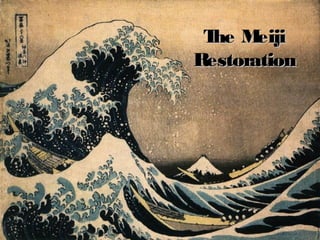
T M
  he eiji
Restoration
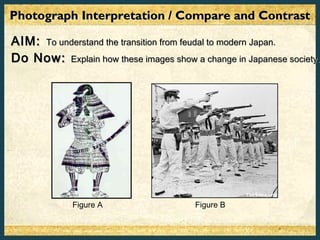
Photograph Interpretation / Compare and Contrast

AIM: To understand the transition from feudal to modern Japan.
Do Now: Explain how these images show a change in Japanese society.


             Figure A                  Figure B
Early Attitudes Toward Foreigners


Directions:
   1. Listen for your assigned role to follow.
   2. Analyze the video clip from Shogun.
   3a. Using 6 words (no more, no less), explain how the Japanese

      viewed the British.
   3b. Using 6 words (no more, no less), explain how the British
       viewed the Japanese.
   4. Be prepared to share your answers with the class.
 Japanese ________
   ________ thought    ________
                         the      ________
                                   British   ________
                                               were     ________
                                                        barbarians.

  British
  ________ thought
            ________   ________ Japanese
                        the     ________       were
                                             ________   uncivilized.
                                                        ________
Can’t We All Just Get Along?


Based upon what we have just discussed, is it possible for these two
      regions to establish positive relations with one another?


           →   If yes, list the steps that need to be taken to reach that goal.


           → If no, list the reasons why it will never happen.
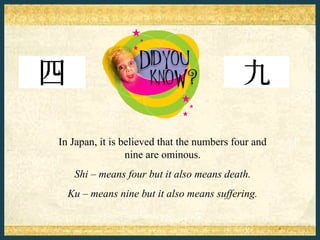
In Japan, it is believed that the numbers four and
                 nine are ominous.
   Shi – means four but it also means death.
  Ku – means nine but it also means suffering.
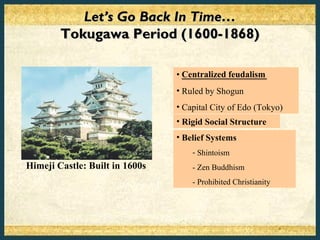
Let’s Go Back In Time…
        Tokugawa Period (1600-1868)

                                • Centralized feudalism
                                  ___________________
                                • Ruled by Shogun
                                • Capital City of Edo (Tokyo)
                                • Rigid Social Structure
                                • Belief Systems
                                    - Shintoism
Himeji Castle: Built in 1600s       - Zen Buddhism
                                    - Prohibited Christianity
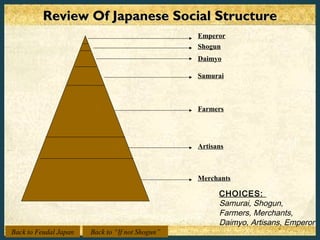
Review Of Japanese Social Structure
                                                 Emperor
                                                 Shogun
                                                 Daimyo

                                                 Samurai


                                                 Farmers


                                                 Artisans


                                                 Merchants

                                                       CHOICES:
                                                       Samurai, Shogun,
                                                       Farmers, Merchants,
                                                       Daimyo, Artisans, Emperor
Back to Feudal Japan   Back to “If not Shogun”
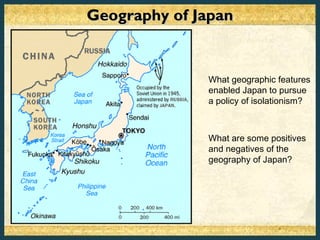
Geography of Japan


              What geographic features
              enabled Japan to pursue
              a policy of isolationism?


              What are some positives
              and negatives of the
              geography of Japan?
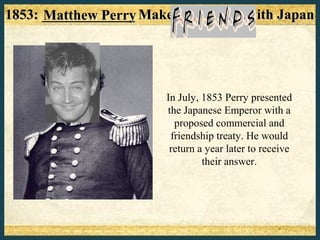
1853: _____________ Makes “Friends” with Japan
      Matthew Perry


                       In July, 1853 Perry presented
                       the Japanese Emperor with a
                         proposed commercial and
                        friendship treaty. He would
                        return a year later to receive
                                their answer.
The year is 1853. You are the Tokugawa Shogun of
 Japan. A letter has just arrived from U.S. President
  Millard Fillmore. Read what he has proposed and
   decide how you will respond. Then, answer the
                  questions attached.
Here’s The Real Deal

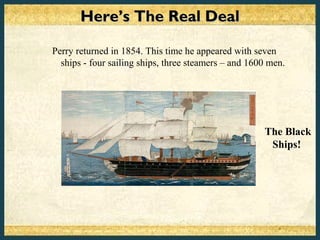
Perry returned in 1854. This time he appeared with seven
  ships - four sailing ships, three steamers – and 1600 men.


                                                      The Black
                                                       Ships!
What was the Outcome of Perry’s Visit?
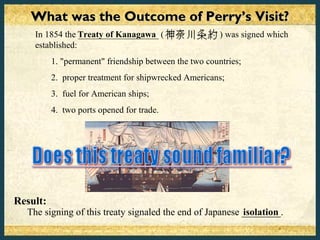
    In 1854 the Treaty of Kanagawa (
                 __________________                     ) was signed which
    established:
          1. "permanent" friendship between the two countries;
          2. proper treatment for shipwrecked Americans;
          3. fuel for American ships;
          4. two ports opened for trade.


Result:
  The signing of this treaty signaled the end of Japanese ________.
                                                          isolation
Fall of Tokugawa Shogunate


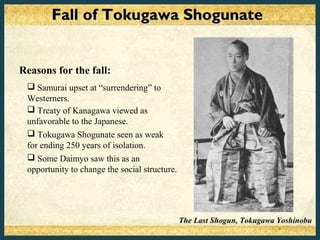
Reasons for the fall:
  Samurai upset at “surrendering” to
 Westerners.
  Treaty of Kanagawa viewed as
 unfavorable to the Japanese.
  Tokugawa Shogunate seen as weak
 for ending 250 years of isolation.
  Some Daimyo saw this as an
 opportunity to change the social structure.


                                               The Last Shogun, Tokugawa Yoshinobu
TASK: Before we continue on, you must rank the main causes of
           the fall of the Tokugawa Shogunate.

Starting with #1 being the most important cause, rank the reasons
    accordingly. Be sure to explain why you chose the order.
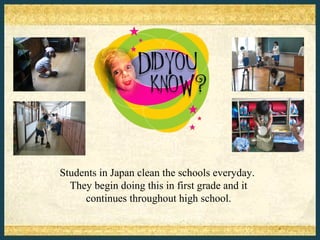
Students in Japan clean the schools everyday.
  They begin doing this in first grade and it
     continues throughout high school.
If Not The Shogun, Then Who?
The presence of the West triggered nationalist
    unrest. Who will most of the people in
     Japan turn to for leadership? Why?

       Need a hint?
      Let’s look back at the traditional
          social structure in Japan.

  People of all classes appealed to the ________
                                        emperor
  for support.
  They used the slogan sonno joi “Revere the
     ________, expel the barbarians.”
  emperor


                        TASK: Create Your Own Slogan
Imagine you are living in Japan and are upset with the decisions of the Tokugawa
                                                     Emperor Mutsuhito, Meiji.
  Shogunate. Create a protest sign, banner, bumper sticker, or T-shirt with a
                        slogan that expresses your opinion.
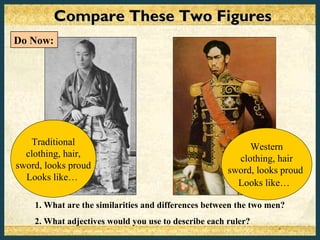
Compare These Two Figures
Do Now:


   Traditional                                             Western
  clothing, hair,                                       clothing, hair
sword, looks proud                                    sword, looks proud
  Looks like…
                                                        Looks like…

    1. What are the similarities and differences between the two men?
    2. What adjectives would you use to describe each ruler?
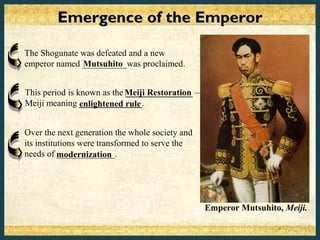
Emergence of the Emperor

The Shogunate was defeated and a new
emperor named __________was proclaimed.
              Mutsuhito


This period is known as the Meiji Restoration –
                            _______________
Meiji meaning ______________.
                enlightened rule


Over the next generation the whole society and
its institutions were transformed to serve the
needs of modernization
           _____________.


                                                  Emperor Mutsuhito, Meiji.
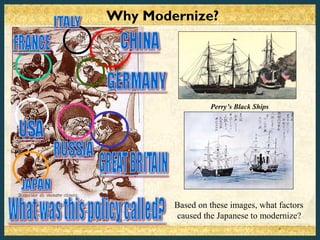
Why Modernize?


                 Perry’s Black Ships


        Based on these images, what factors
        caused the Japanese to modernize?
Changes During The Meiji Restoration
          Fukoku Kyohei: “Enrich the country and strengthen the military”
     Emperor promises to institute political and social reforms and work to strengthen the nation.


Major Changes:
 Abolished feudalism

 Eliminated samurai armies

 Reformed education

 Created a centralized gov’t and

encouraged loyalty to the emperor
 Created Japan's first Western-style
constitution (1889), followed the next
year by the country's first elected Diet.

Adopted Western technology

Opened up trade (ended isolation)
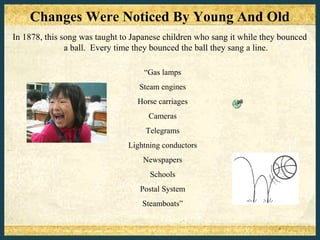
Changes Were Noticed By Young And Old
In 1878, this song was taught to Japanese children who sang it while they bounced
               a ball. Every time they bounced the ball they sang a line.

                                    “Gas lamps
                                  Steam engines
                                  Horse carriages
                                     Cameras
                                    Telegrams
                               Lightning conductors
                                   Newspapers
                                     Schools
                                   Postal System
                                   Steamboats”
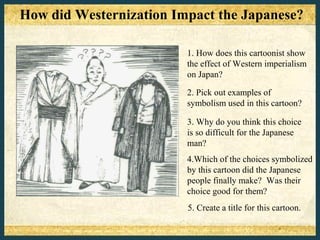
How did Westernization Impact the Japanese?

                         1. How does this cartoonist show
                         the effect of Western imperialism
                         on Japan?

                         2. Pick out examples of
                         symbolism used in this cartoon?

                         3. Why do you think this choice
                         is so difficult for the Japanese
                         man?
                         4.Which of the choices symbolized
                         by this cartoon did the Japanese
                         people finally make? Was their
                         choice good for them?
                         5. Create a title for this cartoon.
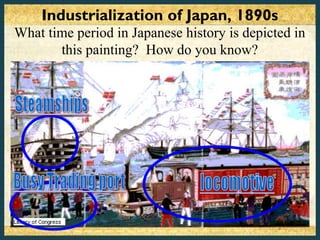
Industrialization of Japan, 1890s
What time period in Japanese history is depicted in
       this painting? How do you know?
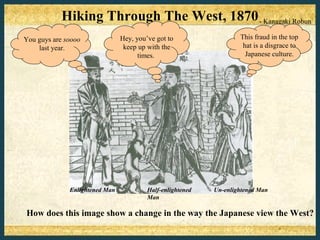
Hiking Through The West, 1870 - Kanagaki Robun
You guys are soooo              Hey, you’ve got to                  This fraud in the top
    last year.                   keep up with the                    hat is a disgrace to
                                      times.                          Japanese culture.


              Enlightened Man            Half-enlightened   Un-enlightened Man
                                         Man

How does this image show a change in the way the Japanese view the West?
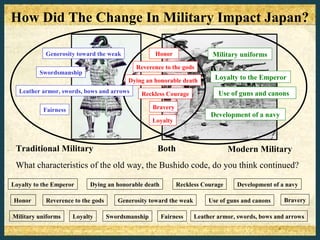
How Did The Change In Military Impact Japan?

            Generosity toward the weak              Honor                 Military uniforms
                                             Reverence to the gods
         Swordsmanship
                                          Dying an honorable death         Loyalty to the Emperor
  Leather armor, swords, bows and arrows       Reckless Courage             Use of guns and canons

           Fairness                                 Bravery
                                                                         Development of a navy
                                                    Loyalty


 Traditional Military                                Both                        Modern Military
 What characteristics of the old way, the Bushido code, do you think continued?

Loyalty to the Emperor     Dying an honorable death           Reckless Courage     Development of a navy

Honor       Reverence to the gods      Generosity toward the weak        Use of guns and canons    Bravery

Military uniforms     Loyalty       Swordsmanship     Fairness      Leather armor, swords, bows and arrows
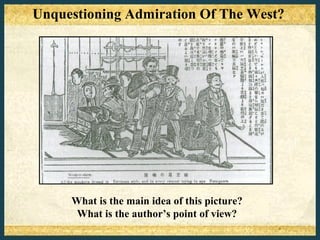
Unquestioning Admiration Of The West?


     What is the main idea of this picture?
      What is the author’s point of view?
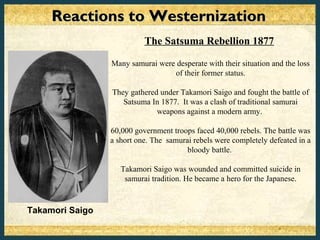
Reactions to Westernization
                           The Satsuma Rebellion 1877

                 Many samurai were desperate with their situation and the loss
                                  of their former status.

                 They gathered under Takamori Saigo and fought the battle of
                    Satsuma In 1877. It was a clash of traditional samurai
                              weapons against a modern army.

                 60,000 government troops faced 40,000 rebels. The battle was
                 a short one. The samurai rebels were completely defeated in a
                                        bloody battle.

                    Takamori Saigo was wounded and committed suicide in
                     samurai tradition. He became a hero for the Japanese.


Takamori Saigo
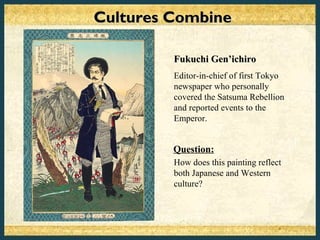
Cultures Combine

         Fukuchi Gen’ichiro
         Editor-in-chief of first Tokyo
         newspaper who personally
         covered the Satsuma Rebellion
         and reported events to the
         Emperor.


         Question:
         How does this painting reflect
         both Japanese and Western
         culture?
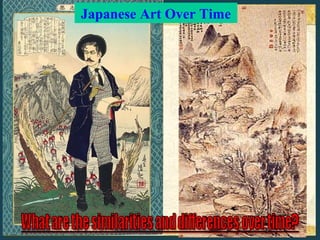
Japanese Art Over Time


  Landscape art of the 16th Century displays
themes of isolation, reflection, and simplicity.
 Japanese artists and scholars, emulated their
 Chinese mentors. This reflective, somewhat
 romantic ink landscape includes pale touches
               of red and yellow.
Social Changes and Continuities

          Changes:                            Continuities:
• Universal _________ system
             education                   • _________ gained followers
                                           Shintoism
stressing science, technology, and
                                         • Women still seen as _______
                                                               inferior
loyalty to the nation.
                                         • Manners, formalities, and
• Adopted western fashions in dress,
                                         diet remained constant
personal care, calendar, metric system
• ____________ led to smaller
  Urbanization
families, high divorce rate
Strains of Modernization
Problems:
•Poor living standards existed in crowded cities
•Political differences led to instability and frequent assassinations of leaders
•Constant questioning and debate about ______________
                                       Westernizatio
                                          n
•Disgruntled _________ class
             Samuarai
• Need for raw materials


Solutions:
•Urged loyalty to the Emperor as a center of _______________
                                             national identity
•Sino-Japanese War 1894-1895
•Russo-Japanese War 1904
•Imperialism of Korea: Annexed in 1910
Comparison to China


1. Compare the actions of Japan and
   China in these two political cartoons.


2. What do you think led to the
   condition of each nation?
Imperialism in East Asia


                          Which
                           nation
                       surprisingly
                       has a sphere
                       of influence
                        in China?
Value Line


 After viewing the problems that Japan has had to face, decide
     if you think Westernization was a good decision, a bad
     decision, or somewhere along the spectrum. Once you
   have decided, take your place accordingly on the value line
   in the front of the room. Be ready to explain the reasoning
                        behind your position.


  Bad                                                     Good
Decision                                                 Decision
Final Thoughts
     Western ____________ was adopted which
               technology
    allowed the Japanese to fully ______________
                                   industrialize
   in less than 50 years. By the end of the Meiji
    Restoration, the Japanese no longer feared
     that they would be _____________. Rather,
                         imperialized
        they set out to practice imperialism
      themselves to obtain power and natural
                                       ________
   __________.
   resources Japan was quickly emerging as a
    world-class power using western technology
       and methods while still maintaining its
            traditional _________ values.
            ___________ cultural

                             Meiji Restoration
This period was known as the _____ _____________.
Meijji Restoration

Meijji Restoration

  • 1.
    T M he eiji Restoration
  • 2.
    Photograph Interpretation /Compare and Contrast AIM: To understand the transition from feudal to modern Japan. Do Now: Explain how these images show a change in Japanese society. Figure A Figure B
  • 3.
    Early Attitudes TowardForeigners Directions: 1. Listen for your assigned role to follow. 2. Analyze the video clip from Shogun. 3a. Using 6 words (no more, no less), explain how the Japanese viewed the British. 3b. Using 6 words (no more, no less), explain how the British viewed the Japanese. 4. Be prepared to share your answers with the class. Japanese ________ ________ thought ________ the ________ British ________ were ________ barbarians. British ________ thought ________ ________ Japanese the ________ were ________ uncivilized. ________
  • 4.
    Can’t We AllJust Get Along? Based upon what we have just discussed, is it possible for these two regions to establish positive relations with one another? → If yes, list the steps that need to be taken to reach that goal. → If no, list the reasons why it will never happen.
  • 5.
    In Japan, itis believed that the numbers four and nine are ominous. Shi – means four but it also means death. Ku – means nine but it also means suffering.
  • 6.
    Let’s Go BackIn Time… Tokugawa Period (1600-1868) • Centralized feudalism ___________________ • Ruled by Shogun • Capital City of Edo (Tokyo) • Rigid Social Structure • Belief Systems - Shintoism Himeji Castle: Built in 1600s - Zen Buddhism - Prohibited Christianity
  • 7.
    Review Of JapaneseSocial Structure Emperor Shogun Daimyo Samurai Farmers Artisans Merchants CHOICES: Samurai, Shogun, Farmers, Merchants, Daimyo, Artisans, Emperor Back to Feudal Japan Back to “If not Shogun”
  • 8.
    Geography of Japan What geographic features enabled Japan to pursue a policy of isolationism? What are some positives and negatives of the geography of Japan?
  • 9.
    1853: _____________ Makes“Friends” with Japan Matthew Perry In July, 1853 Perry presented the Japanese Emperor with a proposed commercial and friendship treaty. He would return a year later to receive their answer.
  • 10.
    The year is1853. You are the Tokugawa Shogun of Japan. A letter has just arrived from U.S. President Millard Fillmore. Read what he has proposed and decide how you will respond. Then, answer the questions attached.
  • 11.
    Here’s The RealDeal Perry returned in 1854. This time he appeared with seven ships - four sailing ships, three steamers – and 1600 men. The Black Ships!
  • 12.
    What was theOutcome of Perry’s Visit? In 1854 the Treaty of Kanagawa ( __________________ ) was signed which established: 1. "permanent" friendship between the two countries; 2. proper treatment for shipwrecked Americans; 3. fuel for American ships; 4. two ports opened for trade. Result: The signing of this treaty signaled the end of Japanese ________. isolation
  • 13.
    Fall of TokugawaShogunate Reasons for the fall:  Samurai upset at “surrendering” to Westerners.  Treaty of Kanagawa viewed as unfavorable to the Japanese.  Tokugawa Shogunate seen as weak for ending 250 years of isolation.  Some Daimyo saw this as an opportunity to change the social structure. The Last Shogun, Tokugawa Yoshinobu
  • 14.
    TASK: Before wecontinue on, you must rank the main causes of the fall of the Tokugawa Shogunate. Starting with #1 being the most important cause, rank the reasons accordingly. Be sure to explain why you chose the order.
  • 15.
    Students in Japanclean the schools everyday. They begin doing this in first grade and it continues throughout high school.
  • 16.
    If Not TheShogun, Then Who? The presence of the West triggered nationalist unrest. Who will most of the people in Japan turn to for leadership? Why? Need a hint? Let’s look back at the traditional social structure in Japan. People of all classes appealed to the ________ emperor for support. They used the slogan sonno joi “Revere the ________, expel the barbarians.” emperor TASK: Create Your Own Slogan Imagine you are living in Japan and are upset with the decisions of the Tokugawa Emperor Mutsuhito, Meiji. Shogunate. Create a protest sign, banner, bumper sticker, or T-shirt with a slogan that expresses your opinion.
  • 17.
    Compare These TwoFigures Do Now: Traditional Western clothing, hair, clothing, hair sword, looks proud sword, looks proud Looks like… Looks like… 1. What are the similarities and differences between the two men? 2. What adjectives would you use to describe each ruler?
  • 18.
    Emergence of theEmperor The Shogunate was defeated and a new emperor named __________was proclaimed. Mutsuhito This period is known as the Meiji Restoration – _______________ Meiji meaning ______________. enlightened rule Over the next generation the whole society and its institutions were transformed to serve the needs of modernization _____________. Emperor Mutsuhito, Meiji.
  • 19.
    Why Modernize? Perry’s Black Ships Based on these images, what factors caused the Japanese to modernize?
  • 20.
    Changes During TheMeiji Restoration Fukoku Kyohei: “Enrich the country and strengthen the military” Emperor promises to institute political and social reforms and work to strengthen the nation. Major Changes:  Abolished feudalism  Eliminated samurai armies  Reformed education  Created a centralized gov’t and encouraged loyalty to the emperor  Created Japan's first Western-style constitution (1889), followed the next year by the country's first elected Diet. Adopted Western technology Opened up trade (ended isolation)
  • 21.
    Changes Were NoticedBy Young And Old In 1878, this song was taught to Japanese children who sang it while they bounced a ball. Every time they bounced the ball they sang a line. “Gas lamps Steam engines Horse carriages Cameras Telegrams Lightning conductors Newspapers Schools Postal System Steamboats”
  • 22.
    How did WesternizationImpact the Japanese? 1. How does this cartoonist show the effect of Western imperialism on Japan? 2. Pick out examples of symbolism used in this cartoon? 3. Why do you think this choice is so difficult for the Japanese man? 4.Which of the choices symbolized by this cartoon did the Japanese people finally make? Was their choice good for them? 5. Create a title for this cartoon.
  • 23.
    Industrialization of Japan,1890s What time period in Japanese history is depicted in this painting? How do you know?
  • 24.
    Hiking Through TheWest, 1870 - Kanagaki Robun You guys are soooo Hey, you’ve got to This fraud in the top last year. keep up with the hat is a disgrace to times. Japanese culture. Enlightened Man Half-enlightened Un-enlightened Man Man How does this image show a change in the way the Japanese view the West?
  • 25.
    How Did TheChange In Military Impact Japan? Generosity toward the weak Honor Military uniforms Reverence to the gods Swordsmanship Dying an honorable death Loyalty to the Emperor Leather armor, swords, bows and arrows Reckless Courage Use of guns and canons Fairness Bravery Development of a navy Loyalty Traditional Military Both Modern Military What characteristics of the old way, the Bushido code, do you think continued? Loyalty to the Emperor Dying an honorable death Reckless Courage Development of a navy Honor Reverence to the gods Generosity toward the weak Use of guns and canons Bravery Military uniforms Loyalty Swordsmanship Fairness Leather armor, swords, bows and arrows
  • 26.
    Unquestioning Admiration OfThe West? What is the main idea of this picture? What is the author’s point of view?
  • 27.
    Reactions to Westernization The Satsuma Rebellion 1877 Many samurai were desperate with their situation and the loss of their former status. They gathered under Takamori Saigo and fought the battle of Satsuma In 1877. It was a clash of traditional samurai weapons against a modern army. 60,000 government troops faced 40,000 rebels. The battle was a short one. The samurai rebels were completely defeated in a bloody battle. Takamori Saigo was wounded and committed suicide in samurai tradition. He became a hero for the Japanese. Takamori Saigo
  • 28.
    Cultures Combine Fukuchi Gen’ichiro Editor-in-chief of first Tokyo newspaper who personally covered the Satsuma Rebellion and reported events to the Emperor. Question: How does this painting reflect both Japanese and Western culture?
  • 29.
    Japanese Art OverTime Landscape art of the 16th Century displays themes of isolation, reflection, and simplicity. Japanese artists and scholars, emulated their Chinese mentors. This reflective, somewhat romantic ink landscape includes pale touches of red and yellow.
  • 30.
    Social Changes andContinuities Changes: Continuities: • Universal _________ system education • _________ gained followers Shintoism stressing science, technology, and • Women still seen as _______ inferior loyalty to the nation. • Manners, formalities, and • Adopted western fashions in dress, diet remained constant personal care, calendar, metric system • ____________ led to smaller Urbanization families, high divorce rate
  • 31.
    Strains of Modernization Problems: •Poorliving standards existed in crowded cities •Political differences led to instability and frequent assassinations of leaders •Constant questioning and debate about ______________ Westernizatio n •Disgruntled _________ class Samuarai • Need for raw materials Solutions: •Urged loyalty to the Emperor as a center of _______________ national identity •Sino-Japanese War 1894-1895 •Russo-Japanese War 1904 •Imperialism of Korea: Annexed in 1910
  • 32.
    Comparison to China 1.Compare the actions of Japan and China in these two political cartoons. 2. What do you think led to the condition of each nation?
  • 33.
    Imperialism in EastAsia Which nation surprisingly has a sphere of influence in China?
  • 34.
    Value Line Afterviewing the problems that Japan has had to face, decide if you think Westernization was a good decision, a bad decision, or somewhere along the spectrum. Once you have decided, take your place accordingly on the value line in the front of the room. Be ready to explain the reasoning behind your position. Bad Good Decision Decision
  • 35.
    Final Thoughts Western ____________ was adopted which technology allowed the Japanese to fully ______________ industrialize in less than 50 years. By the end of the Meiji Restoration, the Japanese no longer feared that they would be _____________. Rather, imperialized they set out to practice imperialism themselves to obtain power and natural ________ __________. resources Japan was quickly emerging as a world-class power using western technology and methods while still maintaining its traditional _________ values. ___________ cultural Meiji Restoration This period was known as the _____ _____________.