Ethnography Ethnography
What is Ethnography
• Ethnography deals with the study of the diversity of
human cultures in their particular cultural settings.
• According to Angrosino (2007), ethnographers search for
predictable patterns in the lived human experiences by
carefully observing and participating in the lives of those
under study.
• The aim is ‘to study people in their own “natural” setting,
with a focus on capturing and re-presenting the subjects’
own understanding of their world’ (Alexander 2006:400)
• Inductive science – works from empirical
evidence towards theory.
• Usually involves intensive fieldwork and high
levels of researcher involvement with
participants in context.
• A dual process of both fieldwork and writing
(Clifford and Marcus 1986)
Features
• A strong emphasis on exploring the nature of particular social
phenomenon, rather than setting out to test hypothesis about them.
• A tendency to work primarily with unstructured data, that is data
that have not been coded at the point of data collection in terms of
a closed set of analytical categories.
• Investigation of a small number of cases, perhaps just one case in
detail.
• Analysis of data that involves explicit interpretation of the
meanings and functions of human actions, the product of which
mainly takes the form of verbal descriptions and explanations, with
quantification and statistical analysis playing a subordinate role at
most.
Classical Ethnographic Work
Bronislaw Malinowski:
• Argonauts of the Western Pacific (1922)
• Fieldwork in the Trobriand Islands and the formalization of
ethnographic field research methods: participant observation
• His ethnography of the Trobriand Islands described the complex
institution of the Kula ring, and became foundational for subsequent
theories of reciprocity and exchange.
• He originated the school of social anthropology known as
Functionalism which believes that culture functions to meet the
needs of individuals rather than the society and when the needs of
the individuals are met, the needs of the society who are comprised
by individuals are also met unlike Radcliffe Brown’s structural
Classical Ethnographic Work
Margaret Mead
• Coming of Age in Samoa (1928)
• Studied Samoan social structure and the complex rules
to give a picture of the culture.
• She studied the problems facing adolescents in a
modern society and concluded that the passage from
childhood to adulthood (adolescence) was a smooth
transition in Samoa and not marked by emotional and
psychological distress as in the American society which
has conflicting value sets.
How Do We Collect Data In Ethnography?
• A range of methods are employed to
develop close connections with subjects
and contexts in order to gain in-depth,
detailed qualitative data:
• participant observation
• Indepth interviews
• mobile methods (‘walking and talking’)
• visual methodologies
Methodology
• Ethnographic methodology is based on rejection of
“positivism” which broadly conceives social research
should adopt scientific method which involves rigorous
testing of hypothesis by means of data that takes the
form of quantitative measurements.
• Such a methodology fails to capture the true nature of
human social behavior.
• However quantitative methods are not rejected in toto
by ethnographers. Structural forms of data collection
and quantitative data analysis are frequently employed
to some degree or other in ethnographic work.
Participant observation
• Erving Goffman -“It’s [a technique] of getting data by
subjecting yourself, to the set of contingencies that play
upon a set of individuals, so that researcher can physically
penetrate their social situation, or their work situation, or
their ethnic situation, or whatever...” (1989:125)
• Researcher should become a participant and gain access to
the field
• shares intimately as possible in the life and activities of the
setting under study.
• develop an insider’s view of what is happening.
• dilemma between increasing participation and maintenance
of distance for rationality - professional stranger.
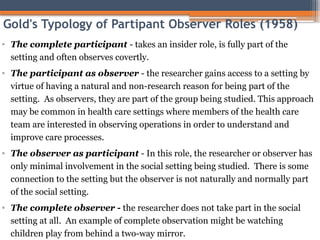
Gold's Typology of Partipant Observer Roles (1958)
• The complete participant - takes an insider role, is fully part of the
setting and often observes covertly.
• The participant as observer - the researcher gains access to a setting by
virtue of having a natural and non-research reason for being part of the
setting. As observers, they are part of the group being studied. This approach
may be common in health care settings where members of the health care
team are interested in observing operations in order to understand and
improve care processes.
• The observer as participant - In this role, the researcher or observer has
only minimal involvement in the social setting being studied. There is some
connection to the setting but the observer is not naturally and normally part
of the social setting.
• The complete observer - the researcher does not take part in the social
setting at all. An example of complete observation might be watching
children play from behind a two-way mirror.
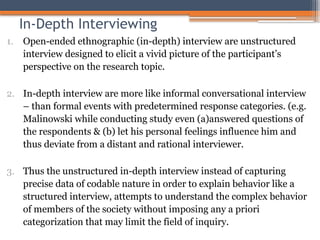
In-Depth Interviewing
1. Open-ended ethnographic (in-depth) interview are unstructured
interview designed to elicit a vivid picture of the participant’s
perspective on the research topic.
2. In-depth interview are more like informal conversational interview
– than formal events with predetermined response categories. (e.g.
Malinowski while conducting study even (a)answered questions of
the respondents & (b) let his personal feelings influence him and
thus deviate from a distant and rational interviewer.
3. Thus the unstructured in-depth interview instead of capturing
precise data of codable nature in order to explain behavior like a
structured interview, attempts to understand the complex behavior
of members of the society without imposing any a priori
categorization that may limit the field of inquiry.
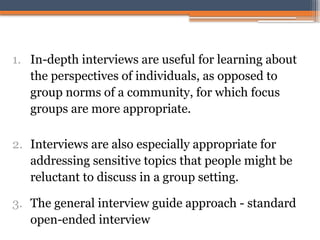
1. In-depth interviews are useful for learning about
the perspectives of individuals, as opposed to
group norms of a community, for which focus
groups are more appropriate.
2. Interviews are also especially appropriate for
addressing sensitive topics that people might be
reluctant to discuss in a group setting.
3. The general interview guide approach - standard
open-ended interview
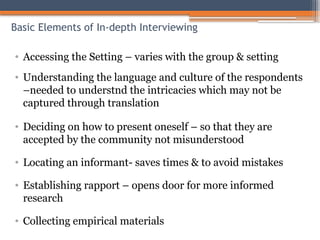
Basic Elements of In-depth Interviewing
• Accessing the Setting – varies with the group & setting
• Understanding the language and culture of the respondents
–needed to understnd the intricacies which may not be
captured through translation
• Deciding on how to present oneself – so that they are
accepted by the community not misunderstood
• Locating an informant- saves times & to avoid mistakes
• Establishing rapport – opens door for more informed
research
• Collecting empirical materials
Merits of Ethnography
• Ethnography can be conducted entirely by one
individual.
• It is longitudinal in nature, allowing you as the
researcher to observe and record changes over time.
• It provides you with a detailed and rich database for
further investigation and writing.
• It allows you to get an insider’s view of reality.
• It allows you to collect data in a realistic or naturalistic
setting in which people act naturally, focusing on both
verbal and nonverbal behaviors.
Challenges
• to arrive at a cultural understanding
• to get close: the ‘being there’ quality (Bate 1997)
• to gain access to some organisations, the elites
within them and organisational records e.g.
on health and safety, sexual harassment etc.
• not to become personally/emotionally involved
and to manage boundaries
• put in the time necessary to produce depth and
understanding
Stages in Conducting Ethnography?
Singleton and Straits (2005) identified the following stages:
• Problem formulation: Defining the main focus of the study by
formulating the problem about which you wish to learn more.
• Selecting a research setting
• Gaining access
• Presenting oneself
• Gathering and recording information:
o Running description /fieldnotes
o Forgotten episodes – at the end of the day
o Ideas and notes for further information use
o Personal impressions and feelings
o Methodological notes
Case Study
• Case study is not a methodological choice, but a choice of the
object or phenomenon to be studied.
• A case may be simple or complex. It may be a child or a
classroom of children.
• Not everything is a case. A doctor may be a case, but his
doctoring lacks the specificity to be called a case.
• Case is a bounded system (Louis Smith, 1978). Boundaries and
behavior patterns are key factors in understanding the case (R.E.
Stake, 1988)
• We may carry out more than one case study, but each case study
is a concentrated inquiry into a single case.
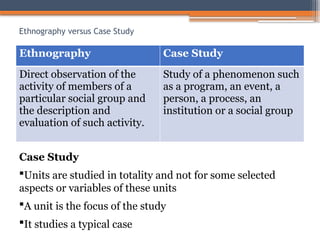
Ethnography versus Case Study
Ethnography Case Study
Direct observation of the
activity of members of a
particular social group and
the description and
evaluation of such activity.
Study of a phenomenon such
as a program, an event, a
person, a process, an
institution or a social group
Case Study
Units are studied in totality and not for some selected
aspects or variables of these units
A unit is the focus of the study
It studies a typical case
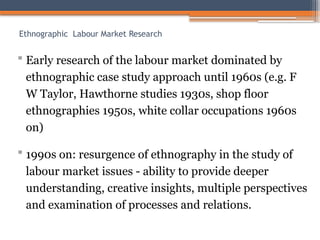
Ethnographic Labour Market Research
 Early research of the labour market dominated by
ethnographic case study approach until 1960s (e.g. F
W Taylor, Hawthorne studies 1930s, shop floor
ethnographies 1950s, white collar occupations 1960s
on)
 1990s on: resurgence of ethnography in the study of
labour market issues - ability to provide deeper
understanding, creative insights, multiple perspectives
and examination of processes and relations.
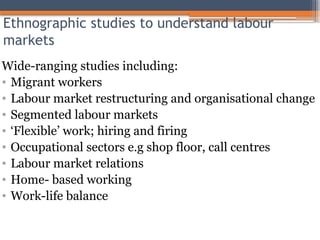
Ethnographic studies to understand labour
markets
Wide-ranging studies including:
• Migrant workers
• Labour market restructuring and organisational change
• Segmented labour markets
• ‘Flexible’ work; hiring and firing
• Occupational sectors e.g shop floor, call centres
• Labour market relations
• Home- based working
• Work-life balance
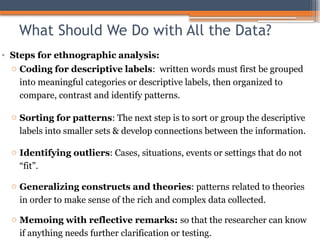
What Should We Do with All the Data?
• Steps for ethnographic analysis:
o Coding for descriptive labels: written words must first be grouped
into meaningful categories or descriptive labels, then organized to
compare, contrast and identify patterns.
o Sorting for patterns: The next step is to sort or group the descriptive
labels into smaller sets & develop connections between the information.
o Identifying outliers: Cases, situations, events or settings that do not
“fit”.
o Generalizing constructs and theories: patterns related to theories
in order to make sense of the rich and complex data collected.
o Memoing with reflective remarks: so that the researcher can know
if anything needs further clarification or testing.
References
• Handbook of Qualitative Research edited by
Norman K. Denzin and Yvonna S. Lincoln
• An Introduction to Qualitative Research by Uwe
Flick
• Qualitative Research Practice by Seale, Gobo,
Gubrium and Silverman

Ethnography_human_culture_study__diverse

  • 1.
  • 2.
    What is Ethnography •Ethnography deals with the study of the diversity of human cultures in their particular cultural settings. • According to Angrosino (2007), ethnographers search for predictable patterns in the lived human experiences by carefully observing and participating in the lives of those under study. • The aim is ‘to study people in their own “natural” setting, with a focus on capturing and re-presenting the subjects’ own understanding of their world’ (Alexander 2006:400)
  • 3.
    • Inductive science– works from empirical evidence towards theory. • Usually involves intensive fieldwork and high levels of researcher involvement with participants in context. • A dual process of both fieldwork and writing (Clifford and Marcus 1986)
  • 4.
    Features • A strongemphasis on exploring the nature of particular social phenomenon, rather than setting out to test hypothesis about them. • A tendency to work primarily with unstructured data, that is data that have not been coded at the point of data collection in terms of a closed set of analytical categories. • Investigation of a small number of cases, perhaps just one case in detail. • Analysis of data that involves explicit interpretation of the meanings and functions of human actions, the product of which mainly takes the form of verbal descriptions and explanations, with quantification and statistical analysis playing a subordinate role at most.
  • 5.
    Classical Ethnographic Work BronislawMalinowski: • Argonauts of the Western Pacific (1922) • Fieldwork in the Trobriand Islands and the formalization of ethnographic field research methods: participant observation • His ethnography of the Trobriand Islands described the complex institution of the Kula ring, and became foundational for subsequent theories of reciprocity and exchange. • He originated the school of social anthropology known as Functionalism which believes that culture functions to meet the needs of individuals rather than the society and when the needs of the individuals are met, the needs of the society who are comprised by individuals are also met unlike Radcliffe Brown’s structural
  • 6.
    Classical Ethnographic Work MargaretMead • Coming of Age in Samoa (1928) • Studied Samoan social structure and the complex rules to give a picture of the culture. • She studied the problems facing adolescents in a modern society and concluded that the passage from childhood to adulthood (adolescence) was a smooth transition in Samoa and not marked by emotional and psychological distress as in the American society which has conflicting value sets.
  • 7.
    How Do WeCollect Data In Ethnography? • A range of methods are employed to develop close connections with subjects and contexts in order to gain in-depth, detailed qualitative data: • participant observation • Indepth interviews • mobile methods (‘walking and talking’) • visual methodologies
  • 8.
    Methodology • Ethnographic methodologyis based on rejection of “positivism” which broadly conceives social research should adopt scientific method which involves rigorous testing of hypothesis by means of data that takes the form of quantitative measurements. • Such a methodology fails to capture the true nature of human social behavior. • However quantitative methods are not rejected in toto by ethnographers. Structural forms of data collection and quantitative data analysis are frequently employed to some degree or other in ethnographic work.
  • 9.
    Participant observation • ErvingGoffman -“It’s [a technique] of getting data by subjecting yourself, to the set of contingencies that play upon a set of individuals, so that researcher can physically penetrate their social situation, or their work situation, or their ethnic situation, or whatever...” (1989:125) • Researcher should become a participant and gain access to the field • shares intimately as possible in the life and activities of the setting under study. • develop an insider’s view of what is happening. • dilemma between increasing participation and maintenance of distance for rationality - professional stranger.
  • 10.
    Gold's Typology ofPartipant Observer Roles (1958) • The complete participant - takes an insider role, is fully part of the setting and often observes covertly. • The participant as observer - the researcher gains access to a setting by virtue of having a natural and non-research reason for being part of the setting. As observers, they are part of the group being studied. This approach may be common in health care settings where members of the health care team are interested in observing operations in order to understand and improve care processes. • The observer as participant - In this role, the researcher or observer has only minimal involvement in the social setting being studied. There is some connection to the setting but the observer is not naturally and normally part of the social setting. • The complete observer - the researcher does not take part in the social setting at all. An example of complete observation might be watching children play from behind a two-way mirror.
  • 11.
    In-Depth Interviewing 1. Open-endedethnographic (in-depth) interview are unstructured interview designed to elicit a vivid picture of the participant’s perspective on the research topic. 2. In-depth interview are more like informal conversational interview – than formal events with predetermined response categories. (e.g. Malinowski while conducting study even (a)answered questions of the respondents & (b) let his personal feelings influence him and thus deviate from a distant and rational interviewer. 3. Thus the unstructured in-depth interview instead of capturing precise data of codable nature in order to explain behavior like a structured interview, attempts to understand the complex behavior of members of the society without imposing any a priori categorization that may limit the field of inquiry.
  • 12.
    1. In-depth interviewsare useful for learning about the perspectives of individuals, as opposed to group norms of a community, for which focus groups are more appropriate. 2. Interviews are also especially appropriate for addressing sensitive topics that people might be reluctant to discuss in a group setting. 3. The general interview guide approach - standard open-ended interview
  • 13.
    Basic Elements ofIn-depth Interviewing • Accessing the Setting – varies with the group & setting • Understanding the language and culture of the respondents –needed to understnd the intricacies which may not be captured through translation • Deciding on how to present oneself – so that they are accepted by the community not misunderstood • Locating an informant- saves times & to avoid mistakes • Establishing rapport – opens door for more informed research • Collecting empirical materials
  • 14.
    Merits of Ethnography •Ethnography can be conducted entirely by one individual. • It is longitudinal in nature, allowing you as the researcher to observe and record changes over time. • It provides you with a detailed and rich database for further investigation and writing. • It allows you to get an insider’s view of reality. • It allows you to collect data in a realistic or naturalistic setting in which people act naturally, focusing on both verbal and nonverbal behaviors.
  • 15.
    Challenges • to arriveat a cultural understanding • to get close: the ‘being there’ quality (Bate 1997) • to gain access to some organisations, the elites within them and organisational records e.g. on health and safety, sexual harassment etc. • not to become personally/emotionally involved and to manage boundaries • put in the time necessary to produce depth and understanding
  • 16.
    Stages in ConductingEthnography? Singleton and Straits (2005) identified the following stages: • Problem formulation: Defining the main focus of the study by formulating the problem about which you wish to learn more. • Selecting a research setting • Gaining access • Presenting oneself • Gathering and recording information: o Running description /fieldnotes o Forgotten episodes – at the end of the day o Ideas and notes for further information use o Personal impressions and feelings o Methodological notes
  • 17.
    Case Study • Casestudy is not a methodological choice, but a choice of the object or phenomenon to be studied. • A case may be simple or complex. It may be a child or a classroom of children. • Not everything is a case. A doctor may be a case, but his doctoring lacks the specificity to be called a case. • Case is a bounded system (Louis Smith, 1978). Boundaries and behavior patterns are key factors in understanding the case (R.E. Stake, 1988) • We may carry out more than one case study, but each case study is a concentrated inquiry into a single case.
  • 18.
    Ethnography versus CaseStudy Ethnography Case Study Direct observation of the activity of members of a particular social group and the description and evaluation of such activity. Study of a phenomenon such as a program, an event, a person, a process, an institution or a social group Case Study Units are studied in totality and not for some selected aspects or variables of these units A unit is the focus of the study It studies a typical case
  • 19.
    Ethnographic Labour MarketResearch  Early research of the labour market dominated by ethnographic case study approach until 1960s (e.g. F W Taylor, Hawthorne studies 1930s, shop floor ethnographies 1950s, white collar occupations 1960s on)  1990s on: resurgence of ethnography in the study of labour market issues - ability to provide deeper understanding, creative insights, multiple perspectives and examination of processes and relations.
  • 20.
    Ethnographic studies tounderstand labour markets Wide-ranging studies including: • Migrant workers • Labour market restructuring and organisational change • Segmented labour markets • ‘Flexible’ work; hiring and firing • Occupational sectors e.g shop floor, call centres • Labour market relations • Home- based working • Work-life balance
  • 21.
    What Should WeDo with All the Data? • Steps for ethnographic analysis: o Coding for descriptive labels: written words must first be grouped into meaningful categories or descriptive labels, then organized to compare, contrast and identify patterns. o Sorting for patterns: The next step is to sort or group the descriptive labels into smaller sets & develop connections between the information. o Identifying outliers: Cases, situations, events or settings that do not “fit”. o Generalizing constructs and theories: patterns related to theories in order to make sense of the rich and complex data collected. o Memoing with reflective remarks: so that the researcher can know if anything needs further clarification or testing.
  • 22.
    References • Handbook ofQualitative Research edited by Norman K. Denzin and Yvonna S. Lincoln • An Introduction to Qualitative Research by Uwe Flick • Qualitative Research Practice by Seale, Gobo, Gubrium and Silverman