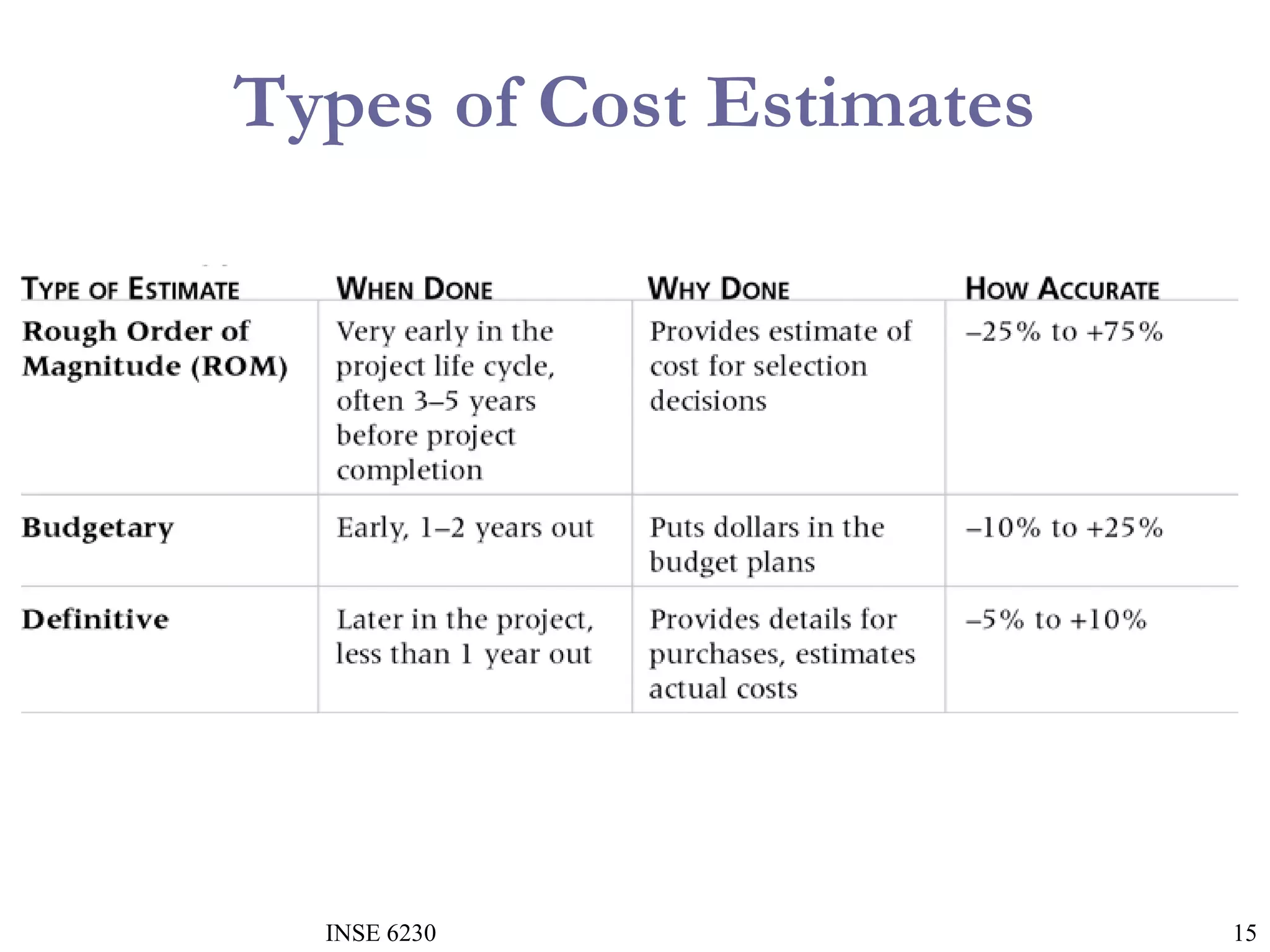
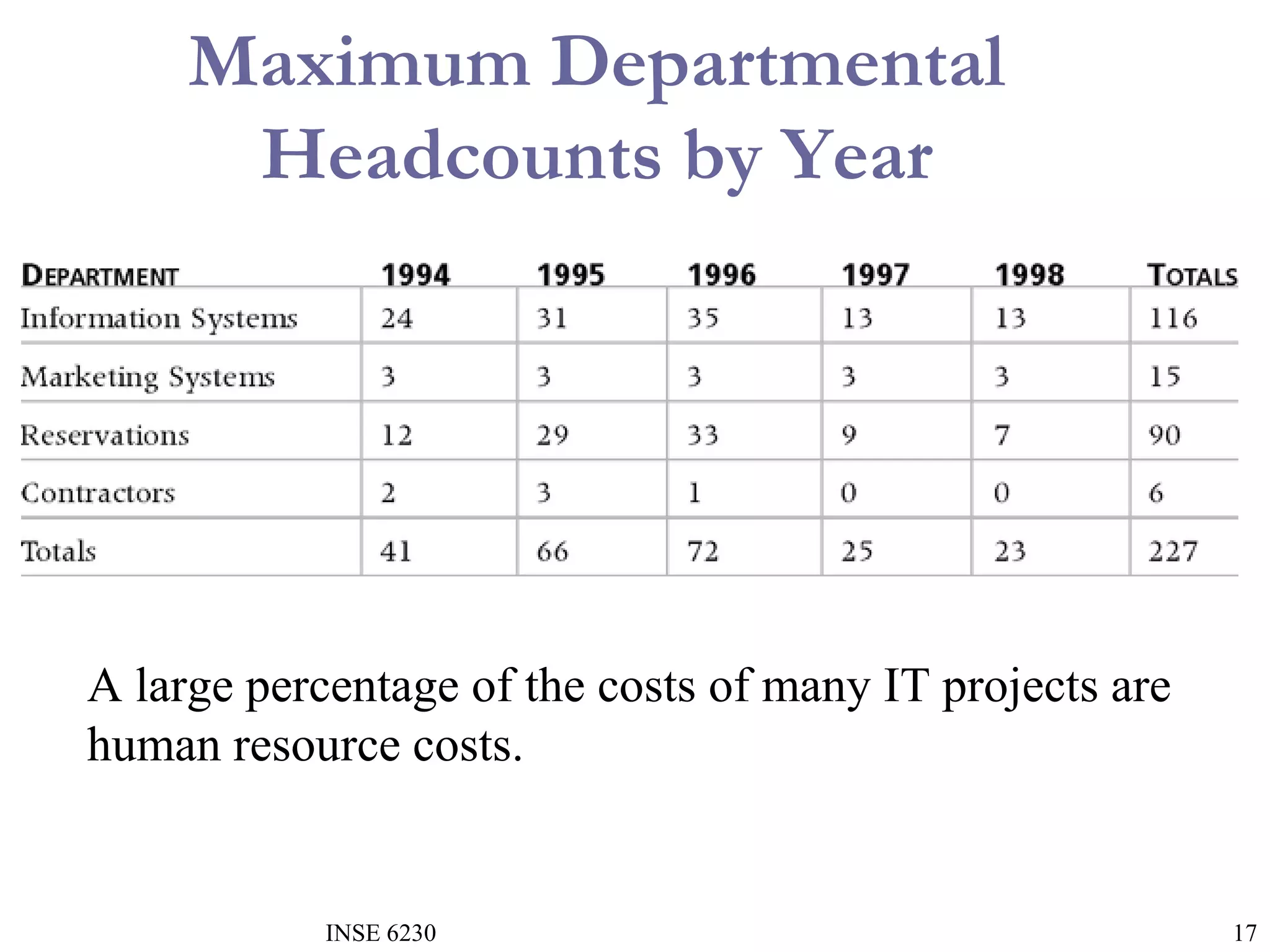
This 5-day training module covers project cost estimation and management. Day 1 includes an introduction and learning objectives. Day 2 focuses on the importance of cost management and estimation. Day 3 covers basic principles, tools, and techniques like the Constructive Cost Model. Day 4 involves portfolio management and tools like Earned Value Management. Day 5 is a review and uses software to assist with cost management. The module aims to help participants understand cost processes and speak the financial language needed to manage projects within budget.
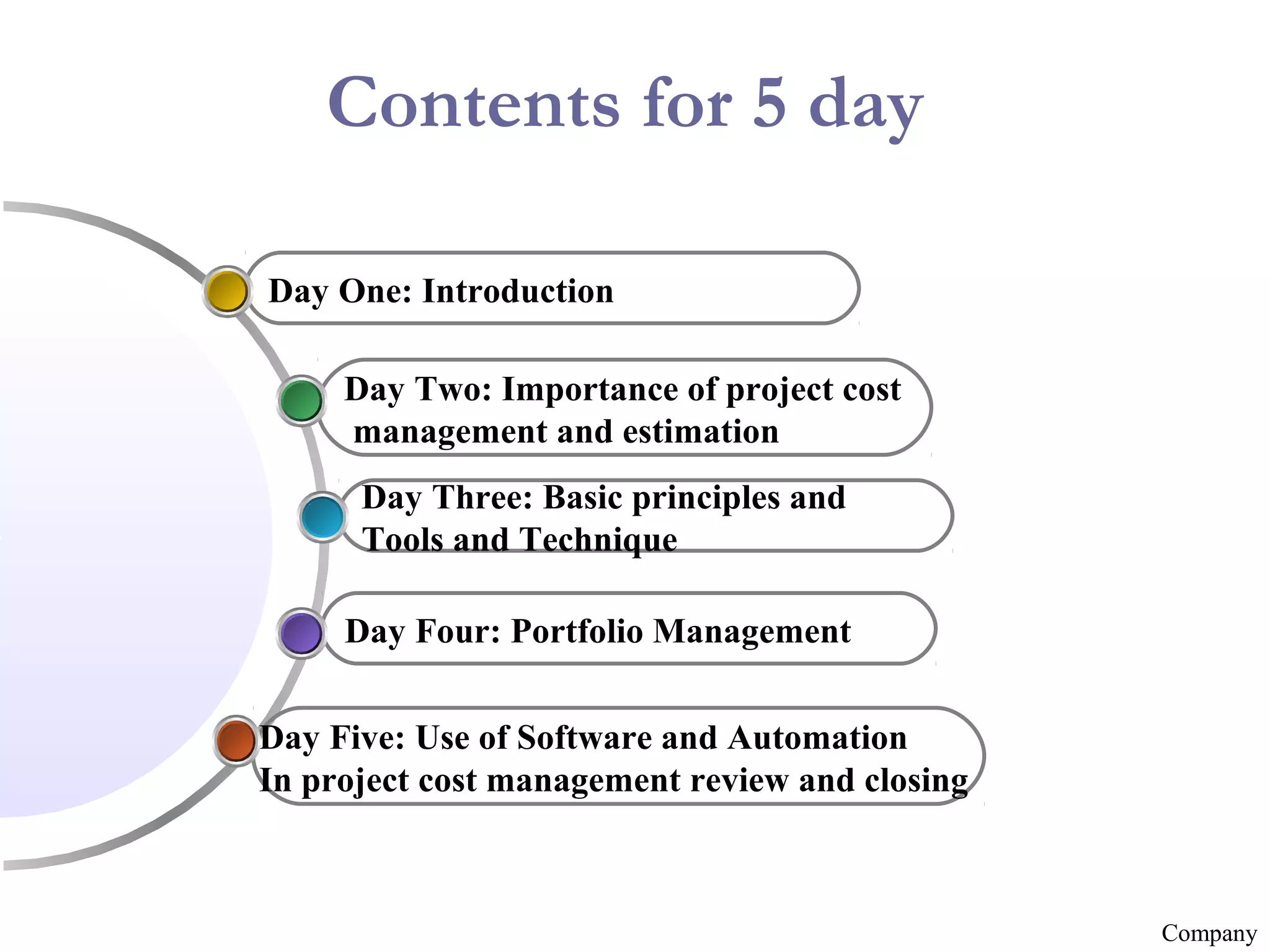
Contents for 5day
A five day Module covering 60 training hour
Day One: Introduction
Day Two: Importance of project cost
management and estimation
Day Three: Basic principles and
Tools and Technique
Day Four: Portfolio Management
Day Five: Use of Software and Automation
In project cost management review and closing
Company
3.
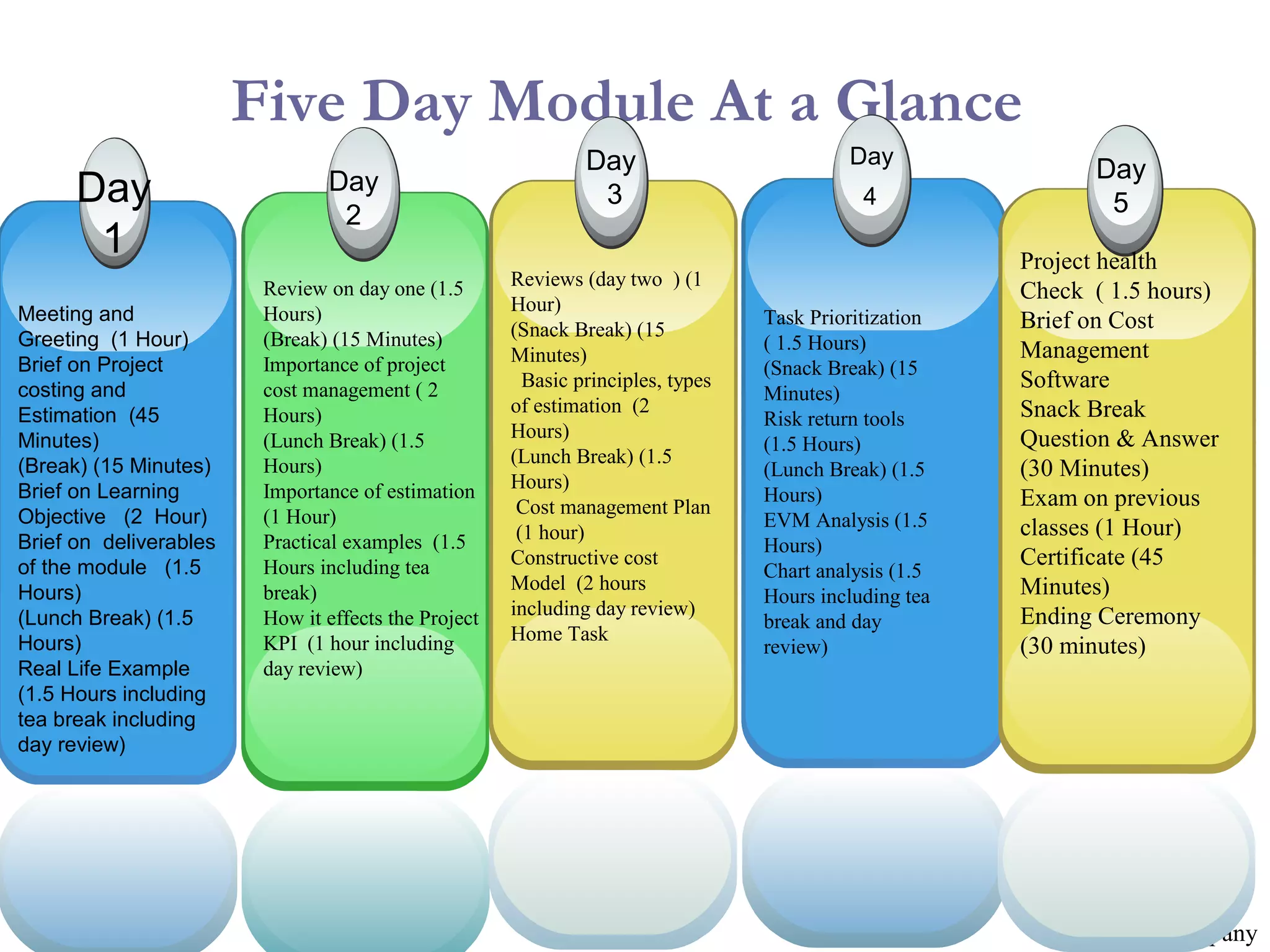
Five Day ModuleAt a Glance
Day
1
Meeting and
Greeting (1 Hour)
Brief on Project
costing and
Estimation (45
Minutes)
(Break) (15 Minutes)
Brief on Learning
Objective (2 Hour)
Brief on deliverables
of the module (1.5
Hours)
(Lunch Break) (1.5
Hours)
Real Life Example
(1.5 Hours including
tea break including
day review)
Day
2
Review on day one (1.5
Hours)
(Break) (15 Minutes)
Importance of project
cost management ( 2
Hours)
(Lunch Break) (1.5
Hours)
Importance of estimation
(1 Hour)
Practical examples (1.5
Hours including tea
break)
How it effects the Project
KPI (1 hour including
day review)
Day
3
Reviews (day two ) (1
Hour)
(Snack Break) (15
Minutes)
Basic principles, types
of estimation (2
Hours)
(Lunch Break) (1.5
Hours)
Cost management Plan
(1 hour)
Constructive cost
Model (2 hours
including day review)
Home Task
Day
4
Task Prioritization
( 1.5 Hours)
(Snack Break) (15
Minutes)
Risk return tools
(1.5 Hours)
(Lunch Break) (1.5
Hours)
EVM Analysis (1.5
Hours)
Chart analysis (1.5
Hours including tea
break and day
review)
Day
5
Project health
Check ( 1.5 hours)
Brief on Cost
Management
Software
Snack Break
Question & Answer
(30 Minutes)
Exam on previous
classes (1 Hour)
Certificate (45
Minutes)
Ending Ceremony
(30 minutes)
Company
4.
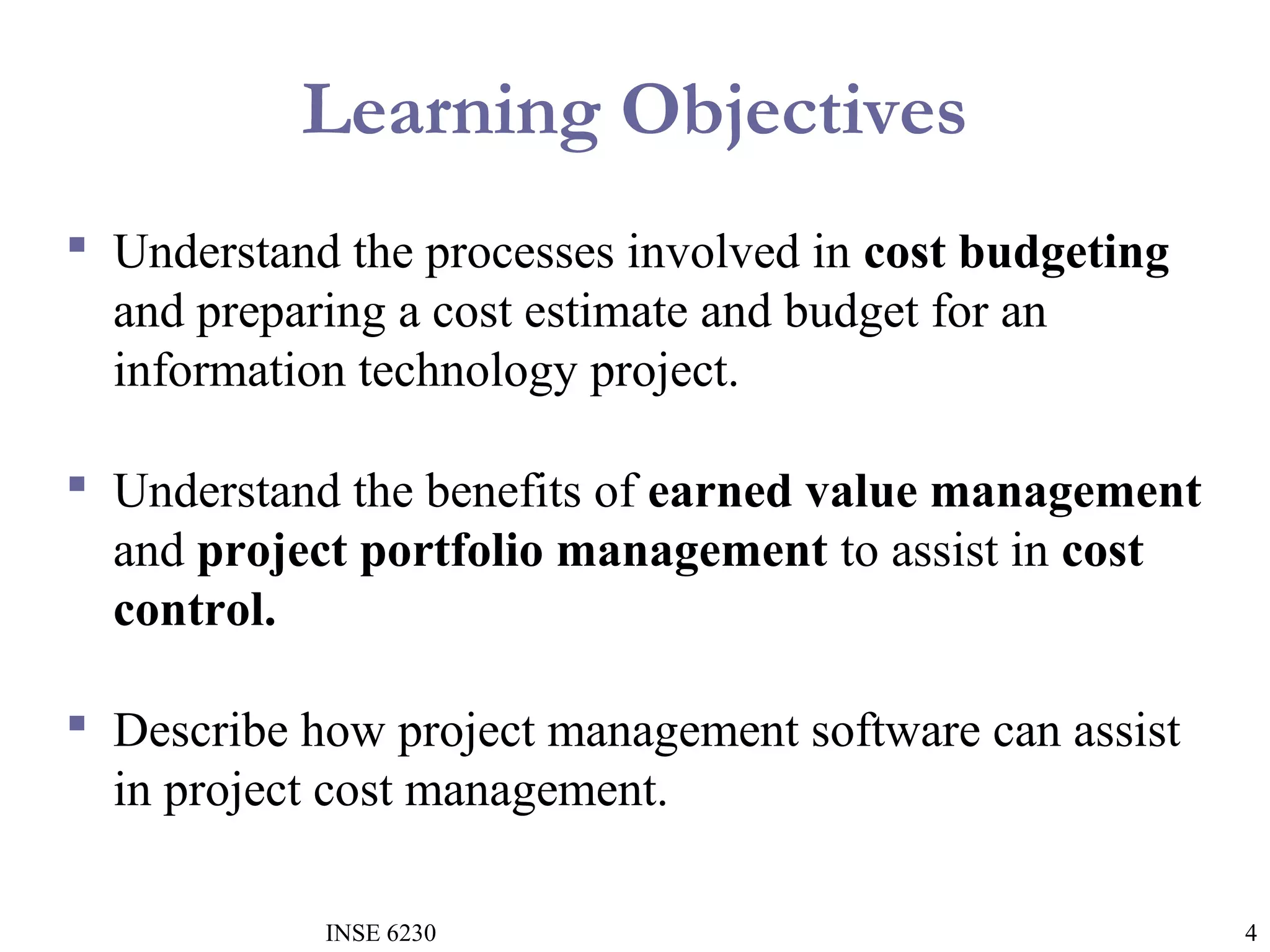
Learning Objectives
Understandthe processes involved in cost budgeting
and preparing a cost estimate and budget for an
information technology project.
Understand the benefits of earned value management
and project portfolio management to assist in cost
control.
Describe how project management software can assist
in project cost management.
INSE 6230
4
5.
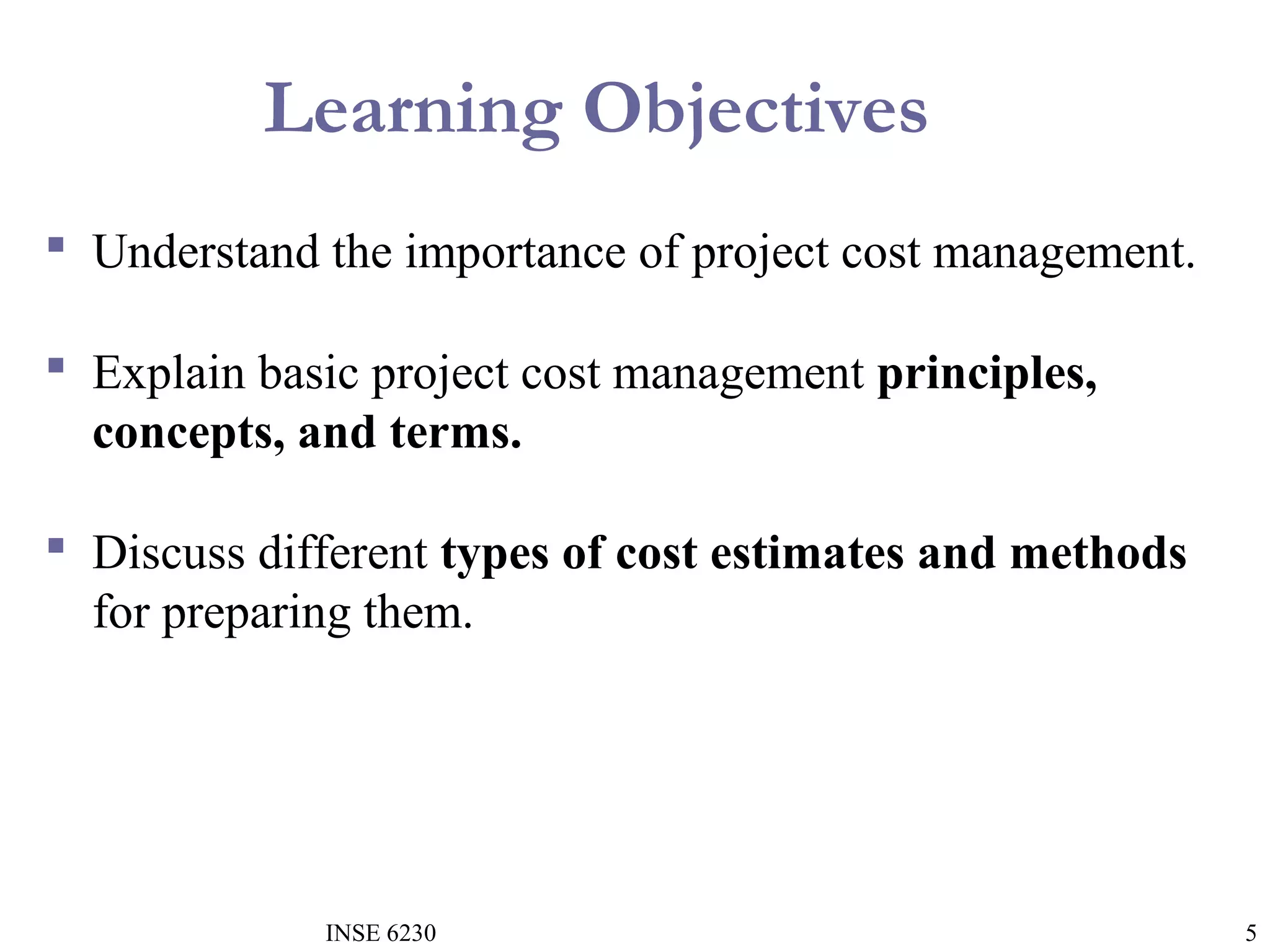
Learning Objectives
Understandthe importance of project cost management.
Explain basic project cost management principles,
concepts, and terms.
Discuss different types of cost estimates and methods
for preparing them.
INSE 6230
5
6.
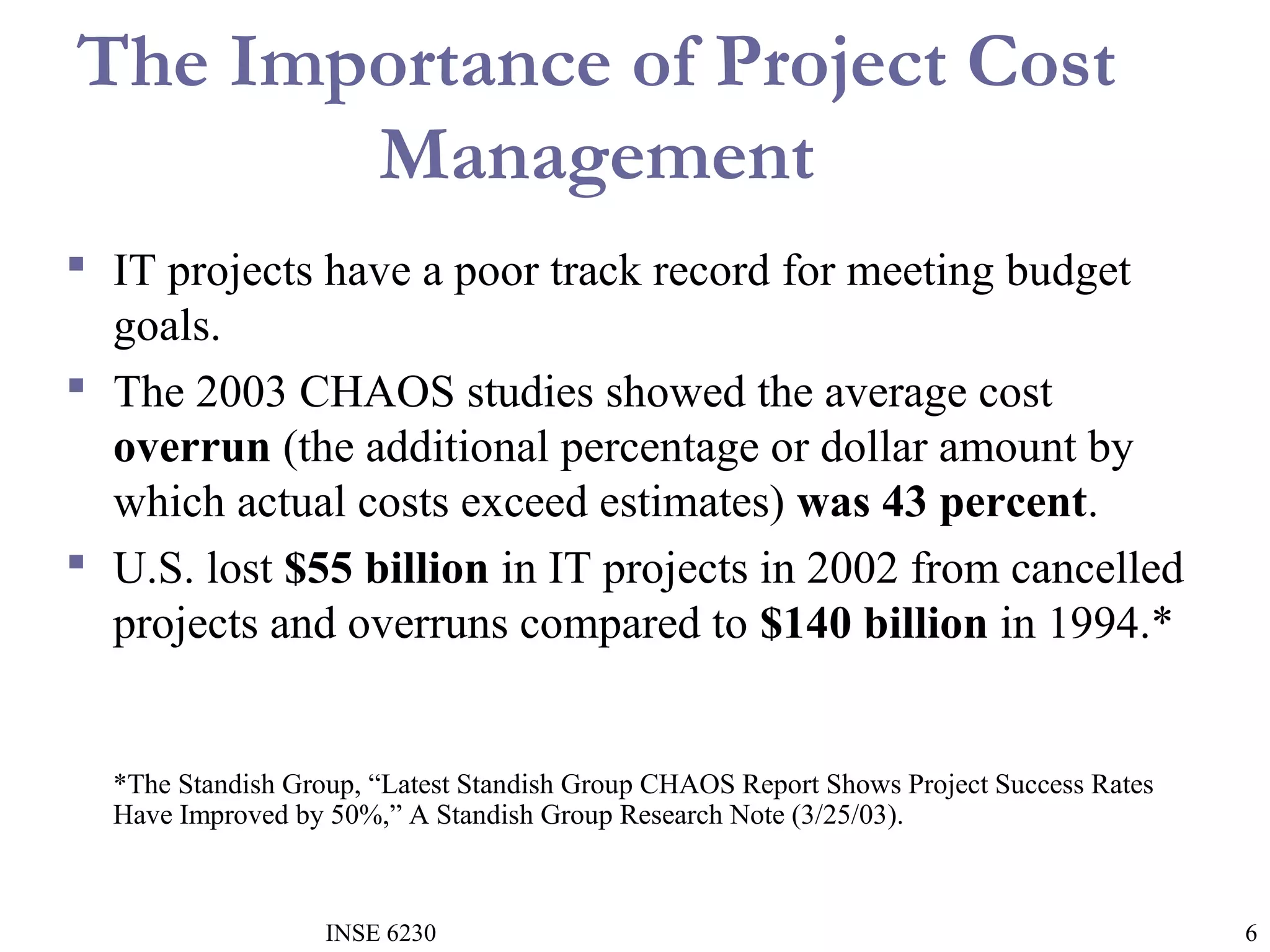
The Importance ofProject Cost
Management
IT projects have a poor track record for meeting budget
goals.
The 2003 CHAOS studies showed the average cost
overrun (the additional percentage or dollar amount by
which actual costs exceed estimates) was 43 percent.
U.S. lost $55 billion in IT projects in 2002 from cancelled
projects and overruns compared to $140 billion in 1994.*
*The Standish Group, “Latest Standish Group CHAOS Report Shows Project Success Rates
Have Improved by 50%,” A Standish Group Research Note (3/25/03).
INSE 6230
6
7.
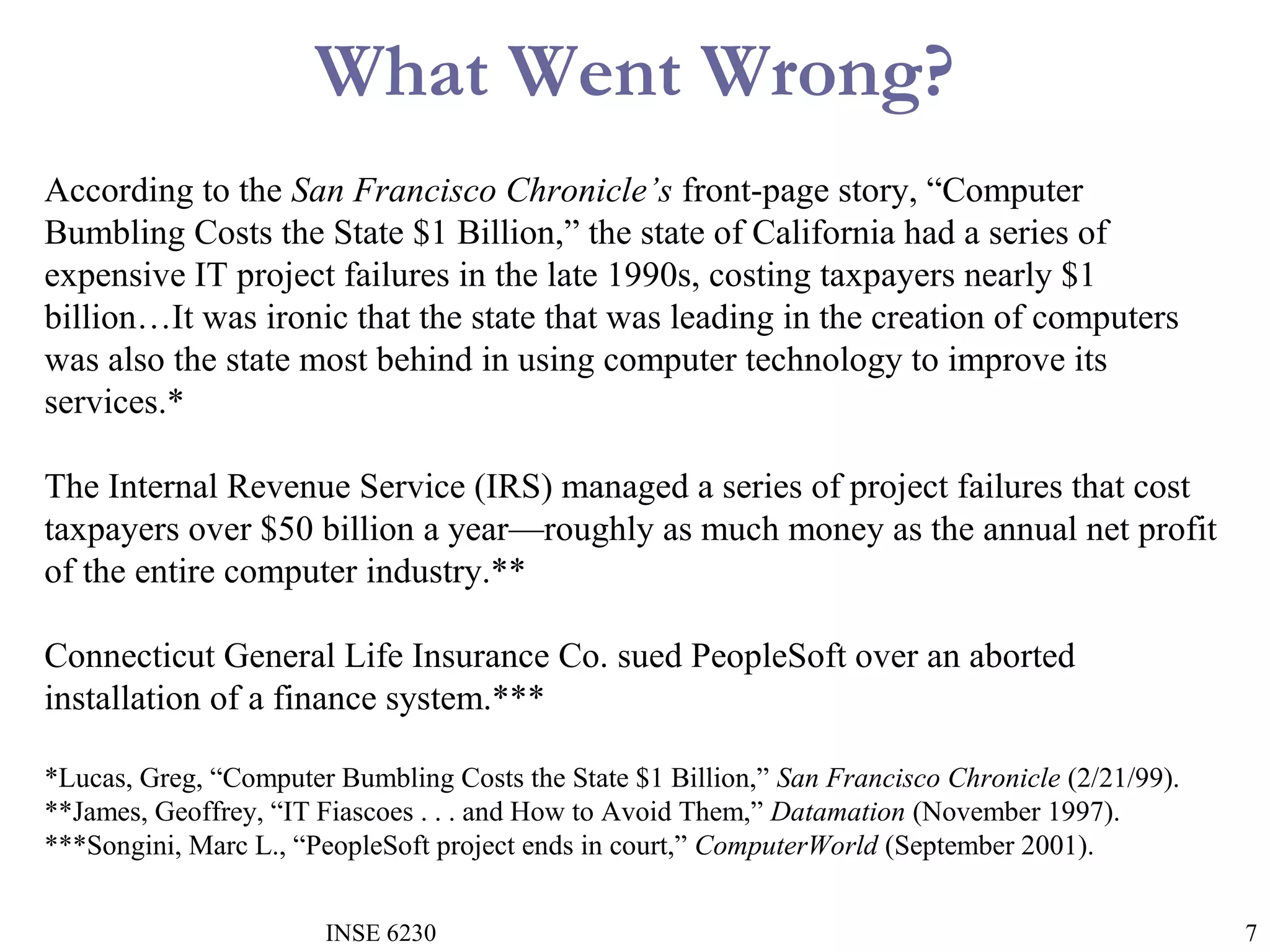
What Went Wrong?
Accordingto the San Francisco Chronicle’s front-page story, “Computer
Bumbling Costs the State $1 Billion,” the state of California had a series of
expensive IT project failures in the late 1990s, costing taxpayers nearly $1
billion…It was ironic that the state that was leading in the creation of computers
was also the state most behind in using computer technology to improve its
services.*
The Internal Revenue Service (IRS) managed a series of project failures that cost
taxpayers over $50 billion a year—roughly as much money as the annual net profit
of the entire computer industry.**
Connecticut General Life Insurance Co. sued PeopleSoft over an aborted
installation of a finance system.***
*Lucas, Greg, “Computer Bumbling Costs the State $1 Billion,” San Francisco Chronicle (2/21/99).
**James, Geoffrey, “IT Fiascoes . . . and How to Avoid Them,” Datamation (November 1997).
***Songini, Marc L., “PeopleSoft project ends in court,” ComputerWorld (September 2001).
INSE 6230
7
8.
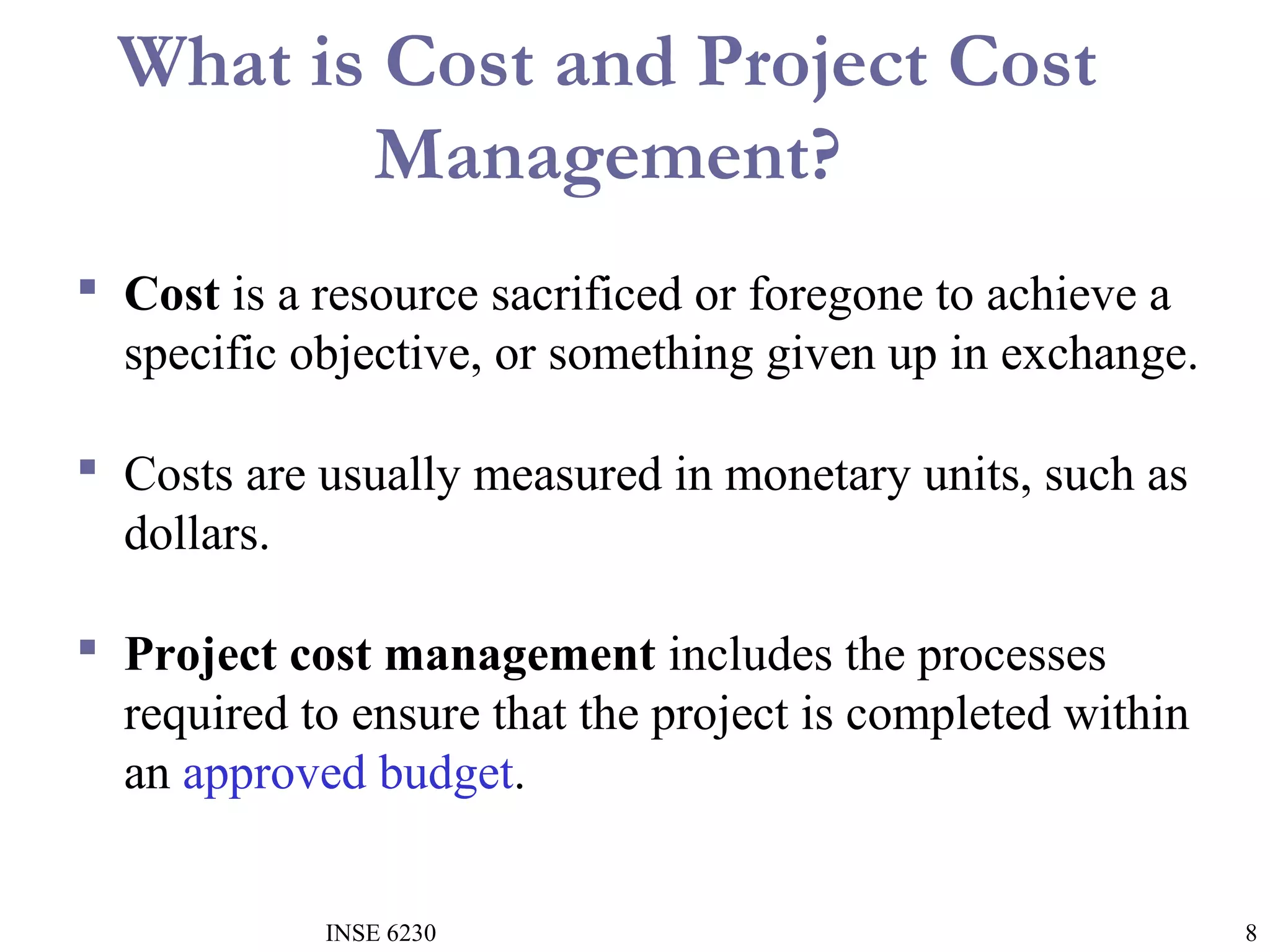
What is Costand Project Cost
Management?
Cost is a resource sacrificed or foregone to achieve a
specific objective, or something given up in exchange.
Costs are usually measured in monetary units, such as
dollars.
Project cost management includes the processes
required to ensure that the project is completed within
an approved budget.
INSE 6230
8
9.
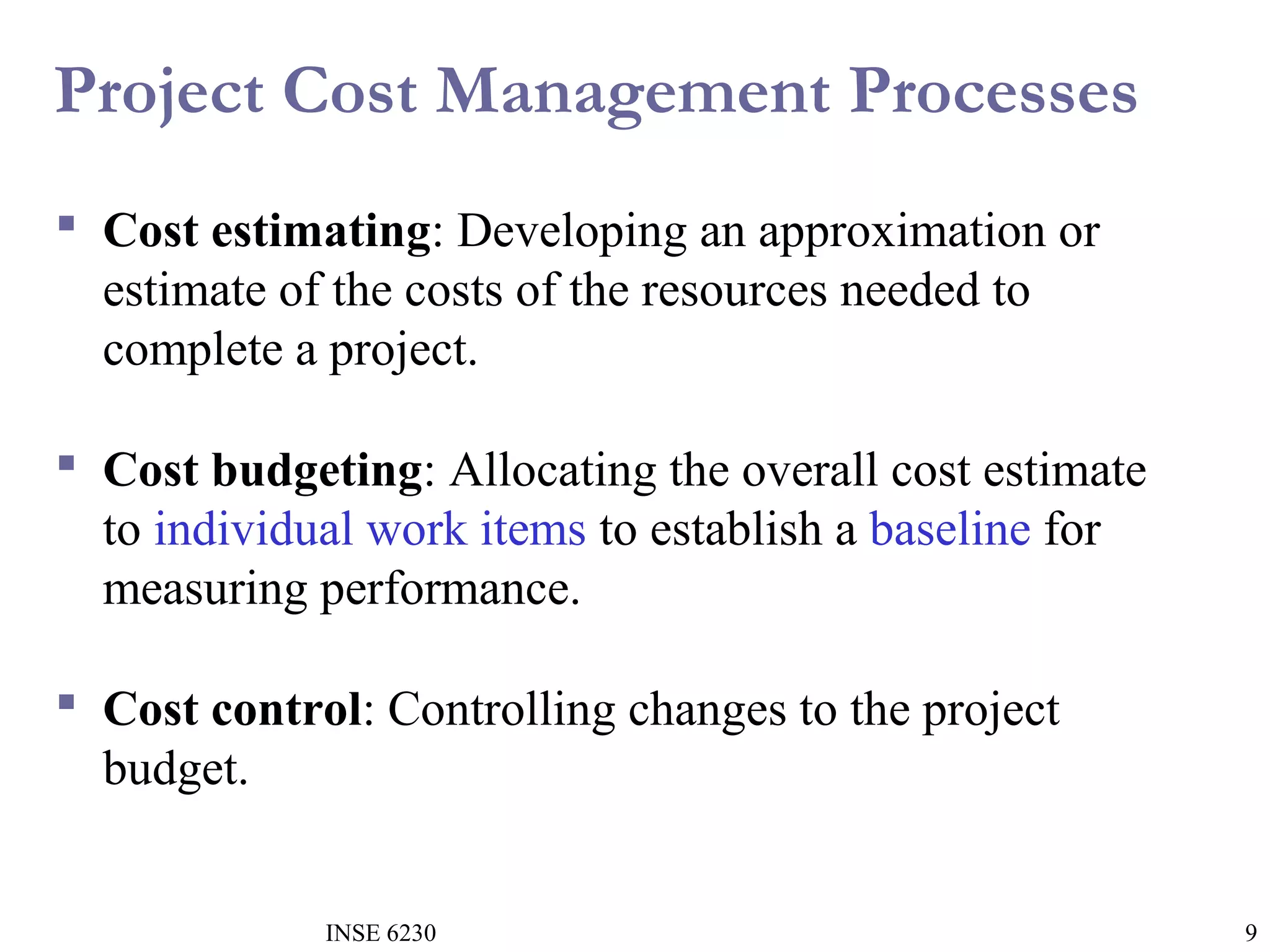
Project Cost ManagementProcesses
Cost estimating: Developing an approximation or
estimate of the costs of the resources needed to
complete a project.
Cost budgeting: Allocating the overall cost estimate
to individual work items to establish a baseline for
measuring performance.
Cost control: Controlling changes to the project
budget.
INSE 6230
9
10.
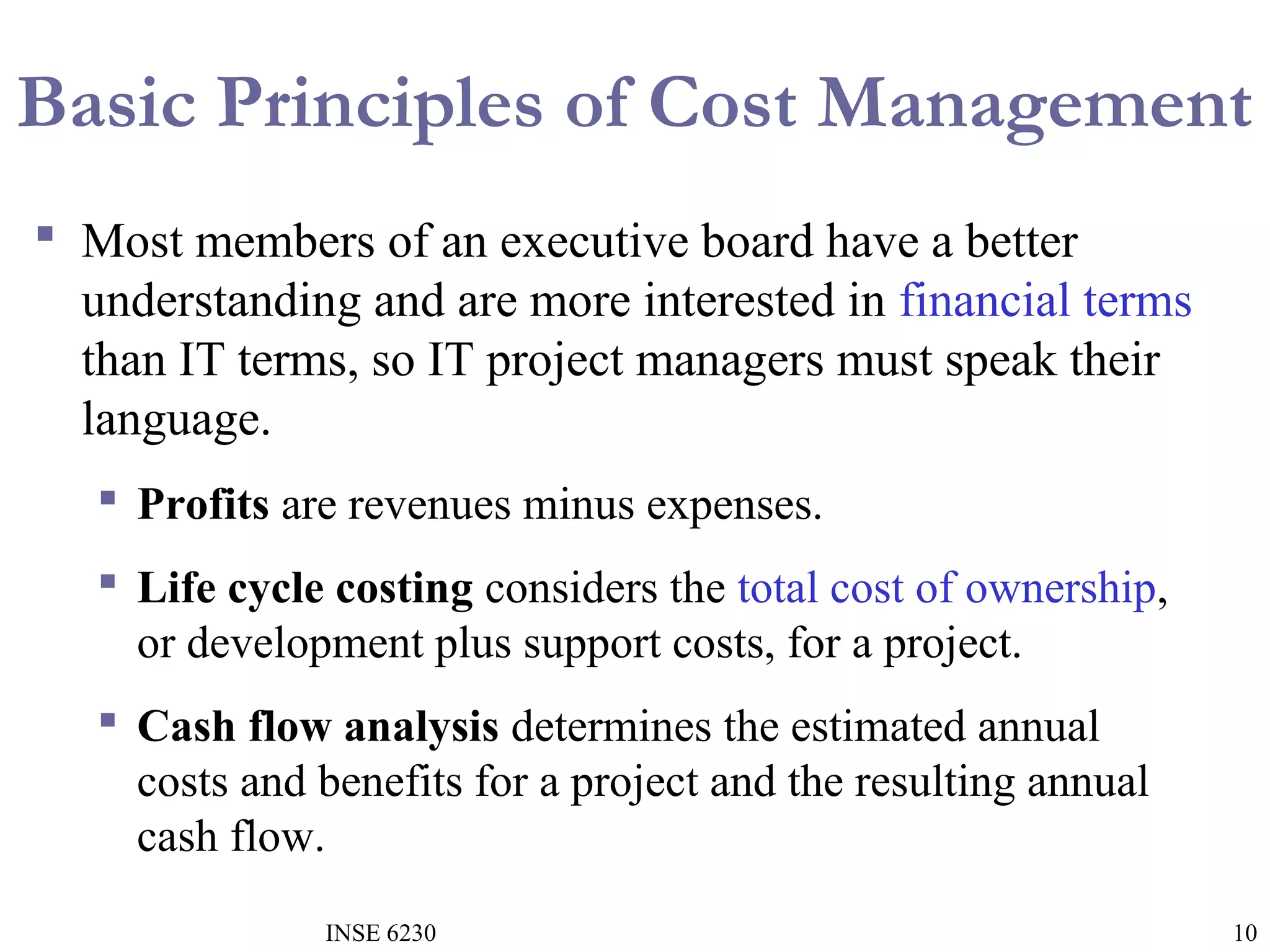
Basic Principles ofCost Management
Most members of an executive board have a better
understanding and are more interested in financial terms
than IT terms, so IT project managers must speak their
language.
Profits are revenues minus expenses.
Life cycle costing considers the total cost of ownership,
or development plus support costs, for a project.
Cash flow analysis determines the estimated annual
costs and benefits for a project and the resulting annual
cash flow.
INSE 6230
10
11.
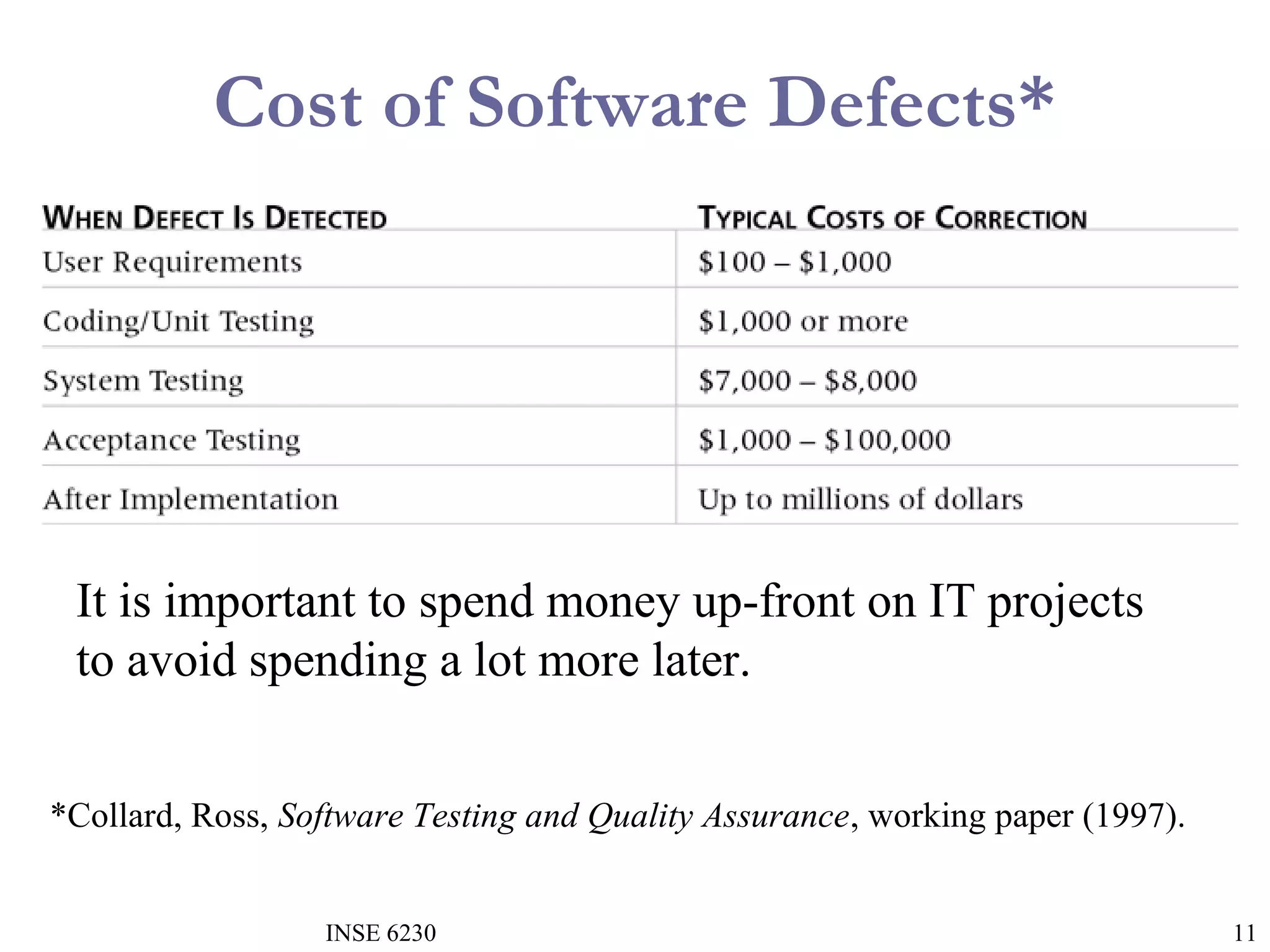
Cost of SoftwareDefects*
It is important to spend money up-front on IT projects
to avoid spending a lot more later.
*Collard, Ross, Software Testing and Quality Assurance, working paper (1997).
INSE 6230
11
12.
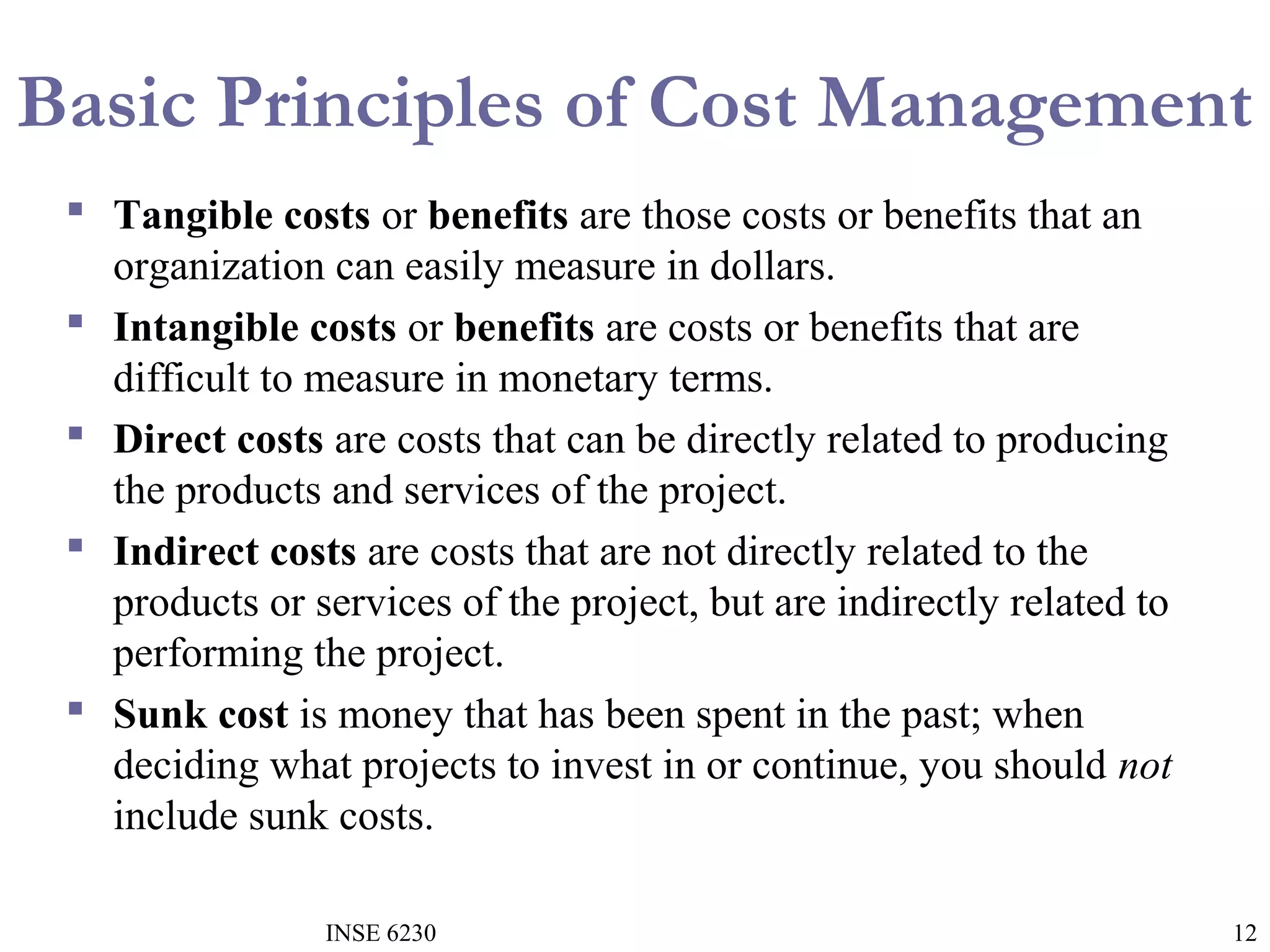
Basic Principles ofCost Management
Tangible costs or benefits are those costs or benefits that an
organization can easily measure in dollars.
Intangible costs or benefits are costs or benefits that are
difficult to measure in monetary terms.
Direct costs are costs that can be directly related to producing
the products and services of the project.
Indirect costs are costs that are not directly related to the
products or services of the project, but are indirectly related to
performing the project.
Sunk cost is money that has been spent in the past; when
deciding what projects to invest in or continue, you should not
include sunk costs.
INSE 6230
12
13.
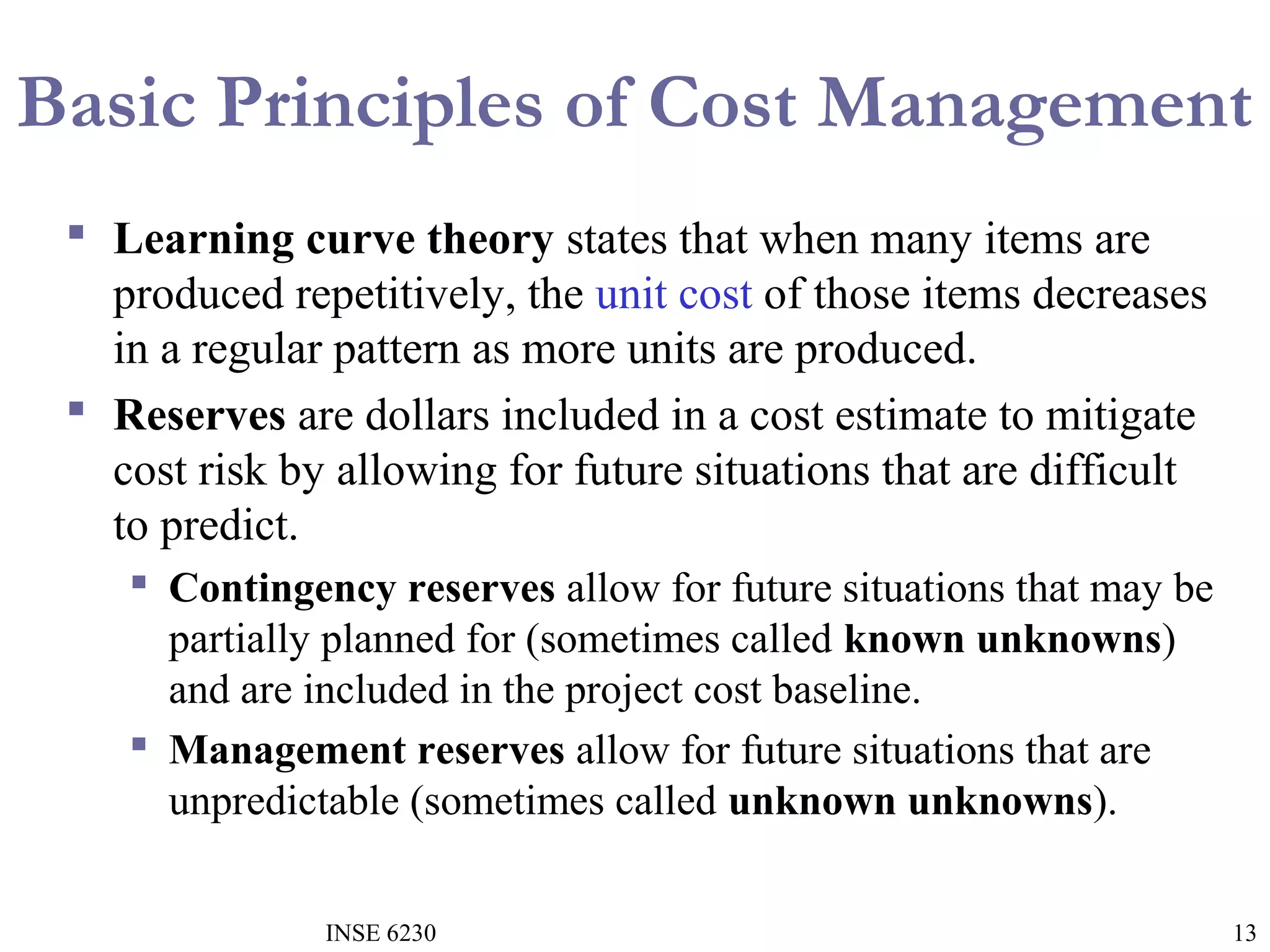
Basic Principles ofCost Management
Learning curve theory states that when many items are
produced repetitively, the unit cost of those items decreases
in a regular pattern as more units are produced.
Reserves are dollars included in a cost estimate to mitigate
cost risk by allowing for future situations that are difficult
to predict.
Contingency reserves allow for future situations that may be
partially planned for (sometimes called known unknowns)
and are included in the project cost baseline.
Management reserves allow for future situations that are
unpredictable (sometimes called unknown unknowns).
INSE 6230
13
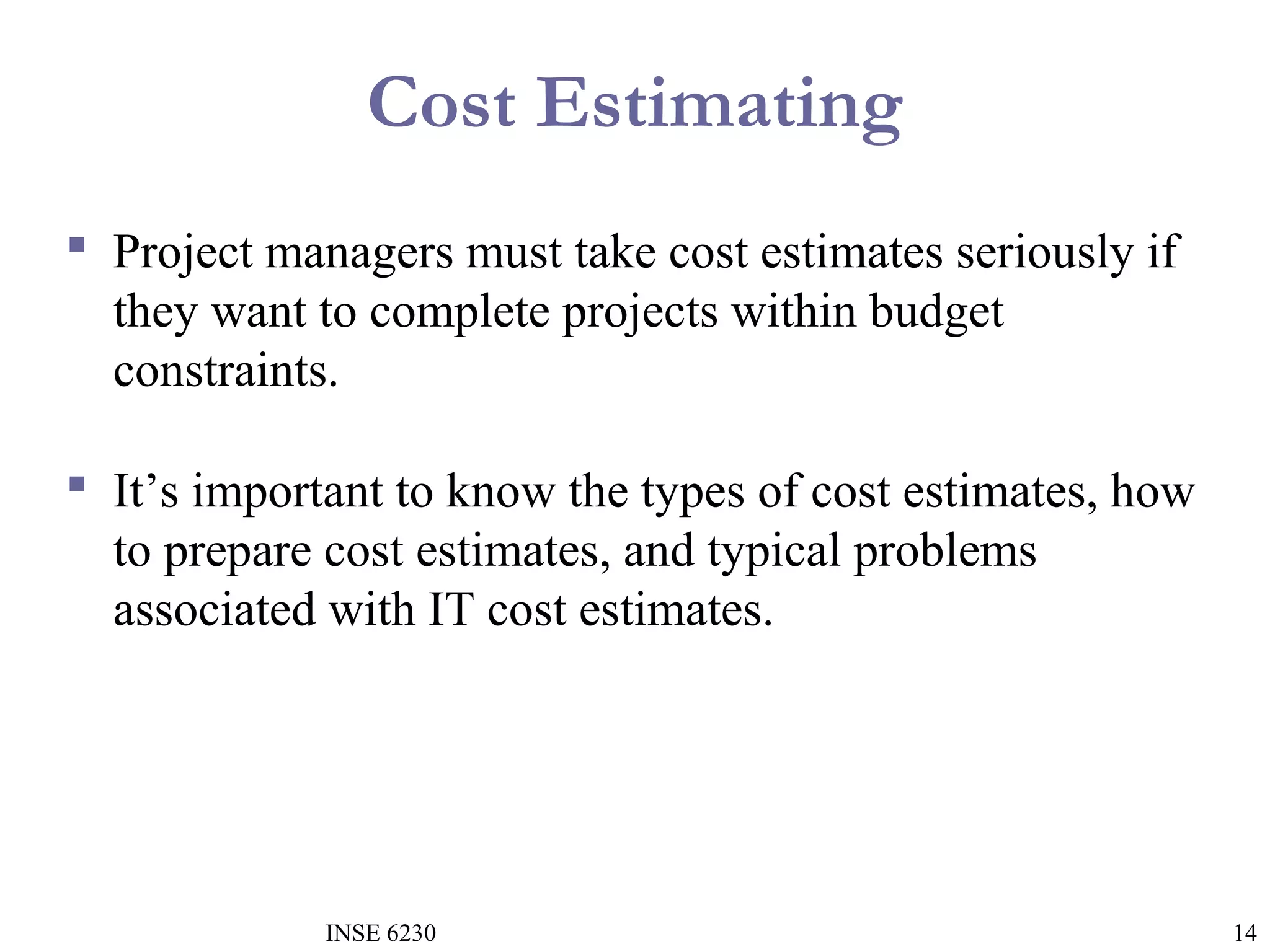
14.
Cost Estimating
Projectmanagers must take cost estimates seriously if
they want to complete projects within budget
constraints.
It’s important to know the types of cost estimates, how
to prepare cost estimates, and typical problems
associated with IT cost estimates.
INSE 6230
14
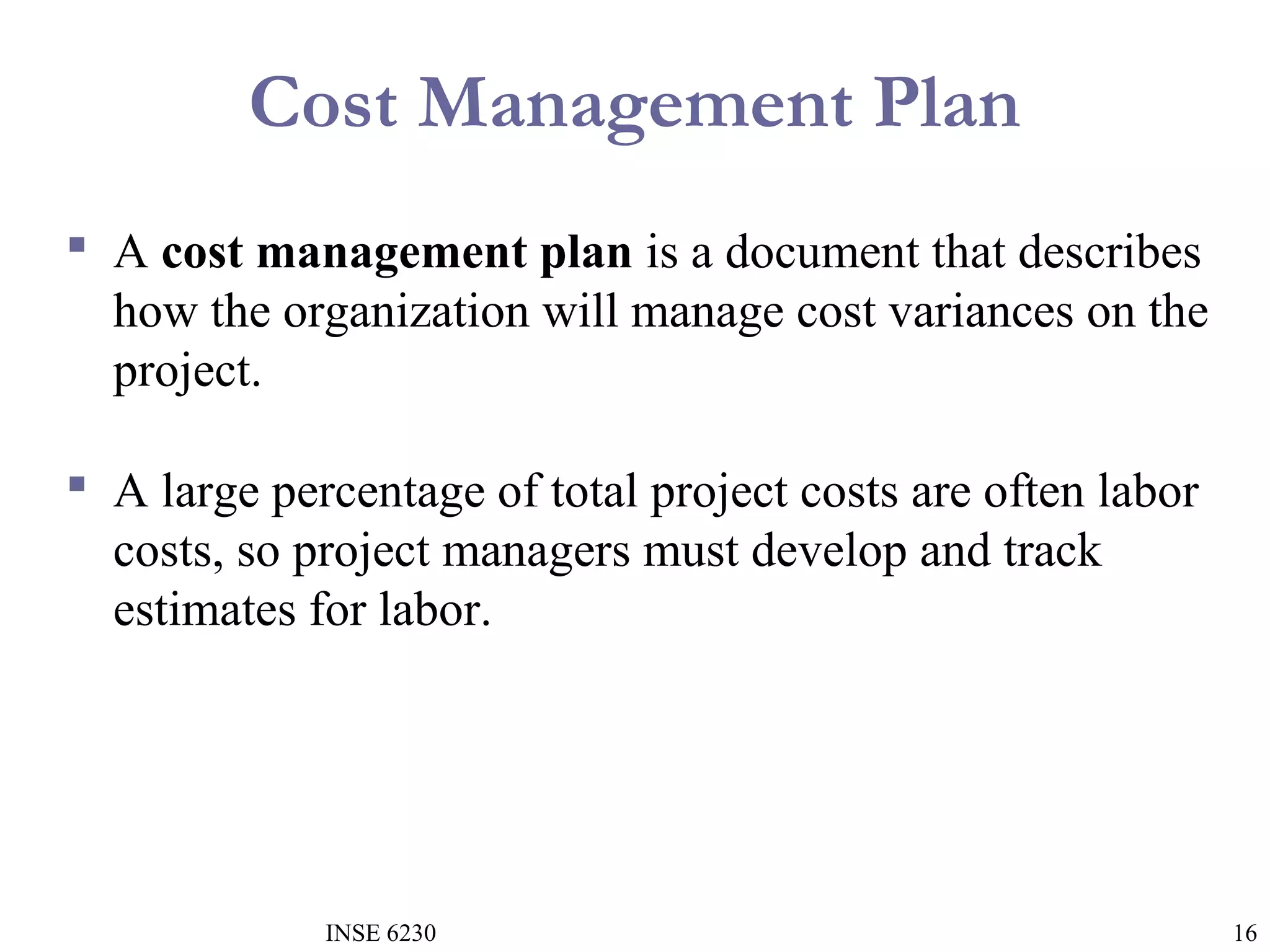
Cost Management Plan
A cost management plan is a document that describes
how the organization will manage cost variances on the
project.
A large percentage of total project costs are often labor
costs, so project managers must develop and track
estimates for labor.
INSE 6230
16
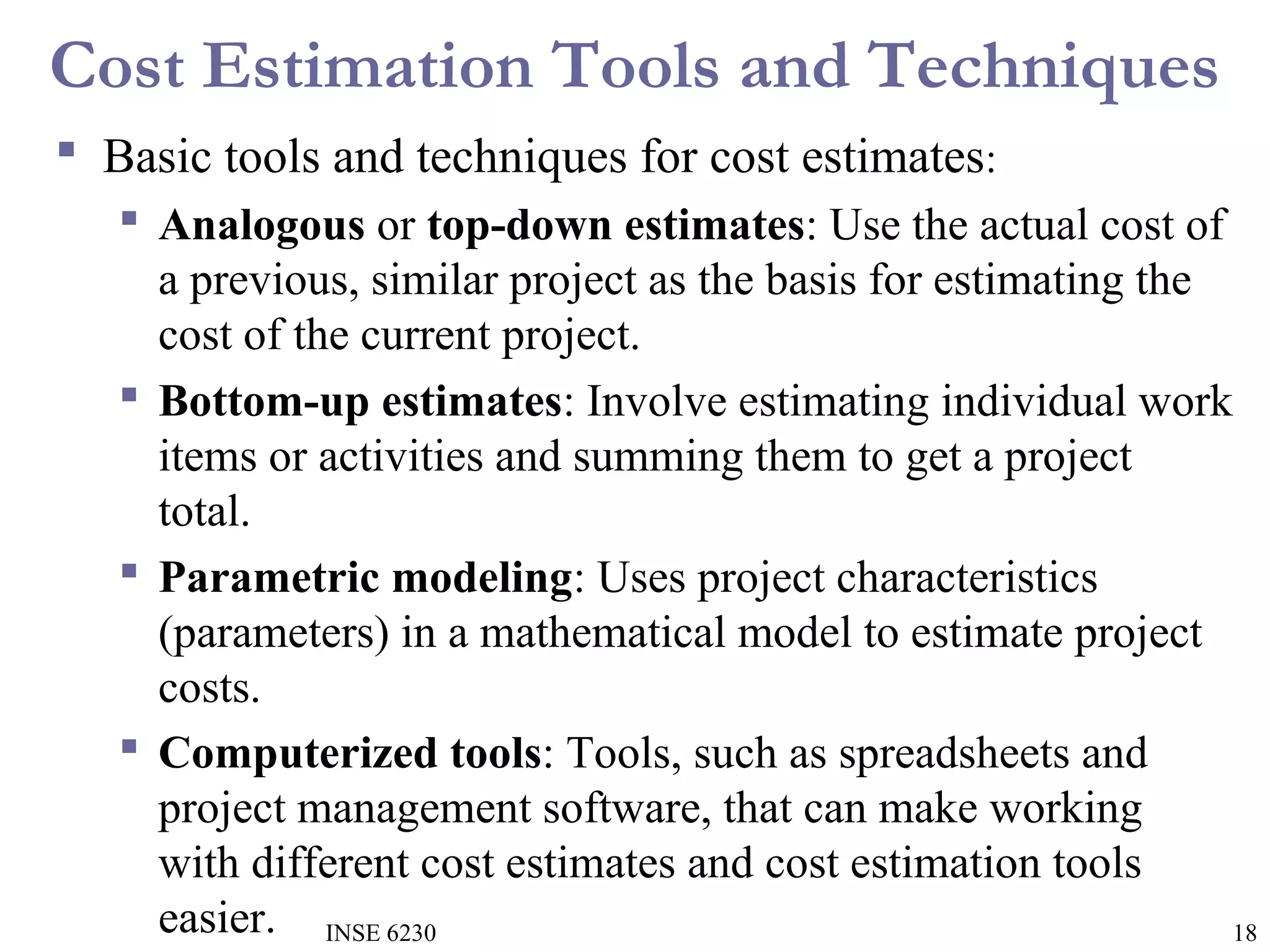
Cost Estimation Toolsand Techniques
Basic tools and techniques for cost estimates:
Analogous or top-down estimates: Use the actual cost of
a previous, similar project as the basis for estimating the
cost of the current project.
Bottom-up estimates: Involve estimating individual work
items or activities and summing them to get a project
total.
Parametric modeling: Uses project characteristics
(parameters) in a mathematical model to estimate project
costs.
Computerized tools: Tools, such as spreadsheets and
project management software, that can make working
with different cost estimates and cost estimation tools
easier. INSE 6230
18
19.
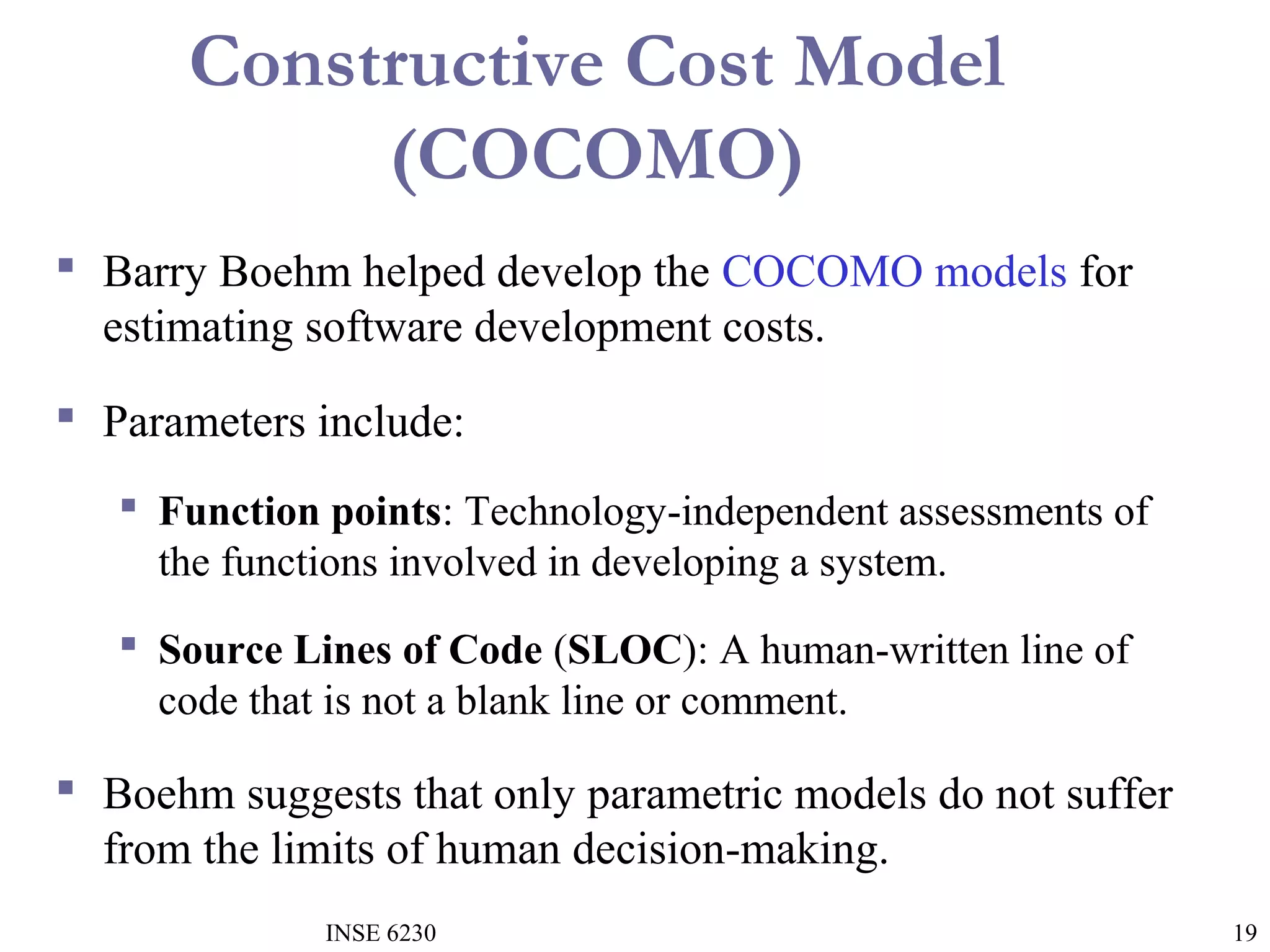
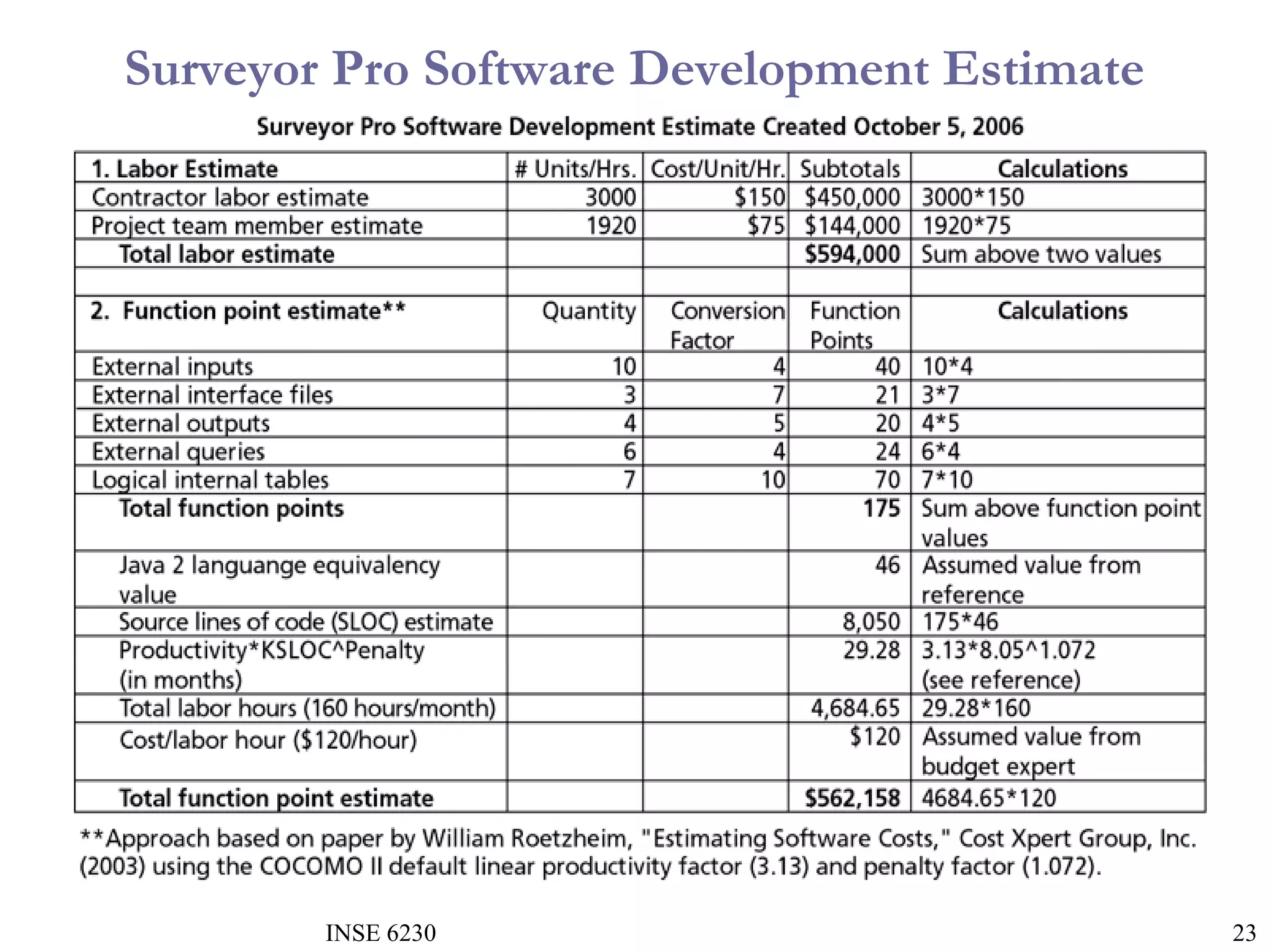
Constructive Cost Model
(COCOMO)
Barry Boehm helped develop the COCOMO models for
estimating software development costs.
Parameters include:
Function points: Technology-independent assessments of
the functions involved in developing a system.
Source Lines of Code (SLOC): A human-written line of
code that is not a blank line or comment.
Boehm suggests that only parametric models do not suffer
from the limits of human decision-making.
INSE 6230
19
20.
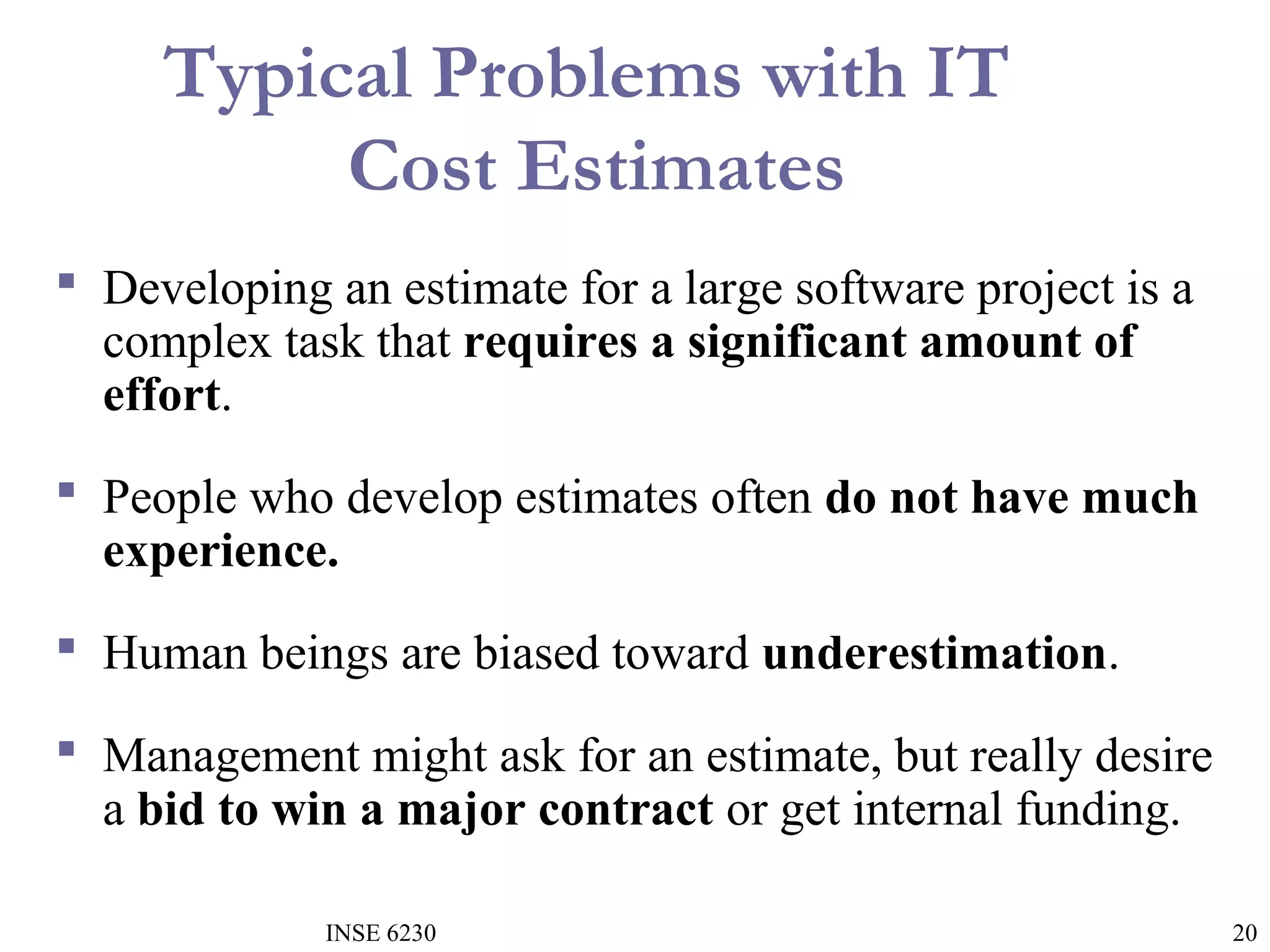
Typical Problems withIT
Cost Estimates
Developing an estimate for a large software project is a
complex task that requires a significant amount of
effort.
People who develop estimates often do not have much
experience.
Human beings are biased toward underestimation.
Management might ask for an estimate, but really desire
a bid to win a major contract or get internal funding.
INSE 6230
20
21.
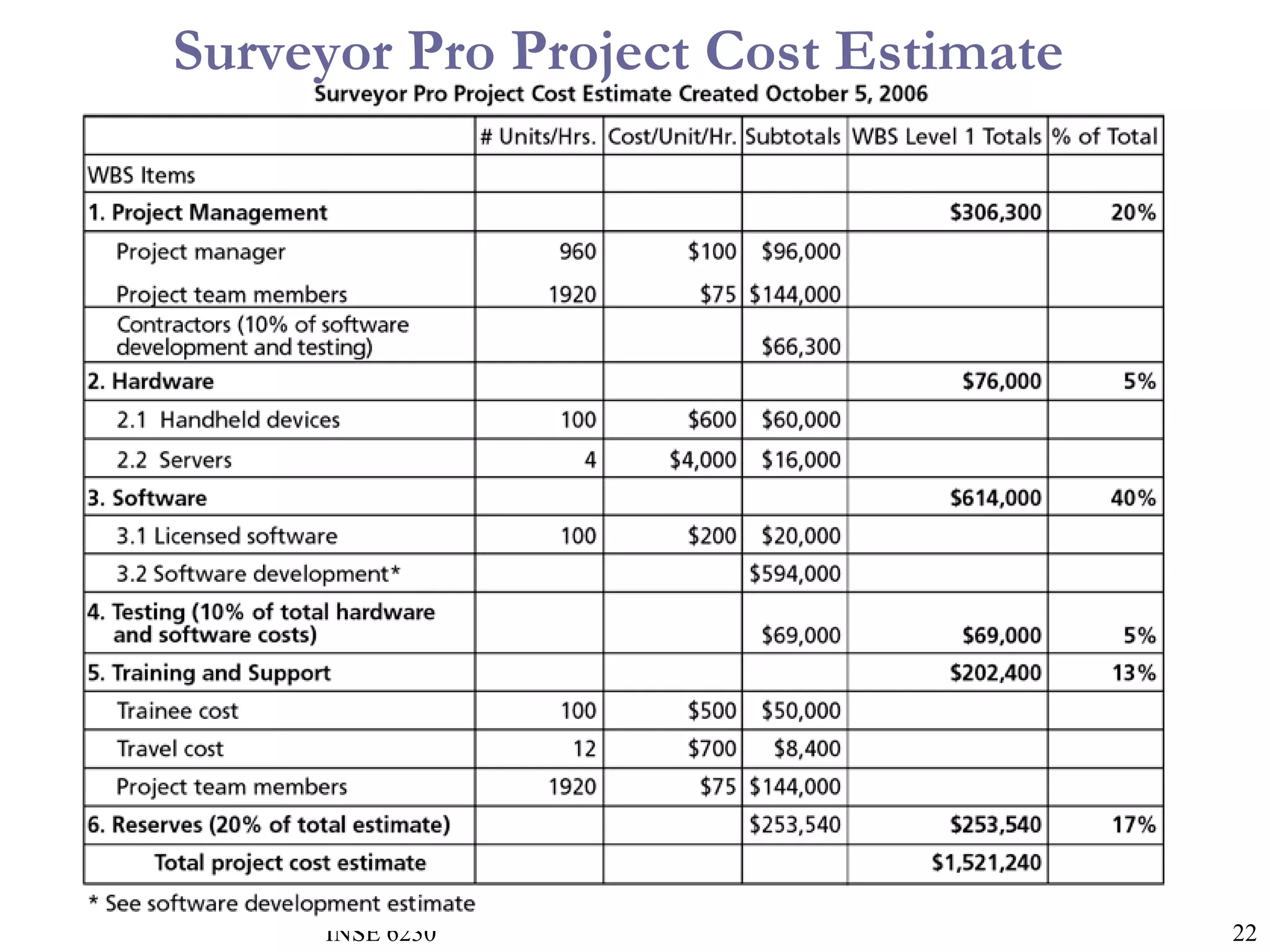
Sample Cost Estimate
See pages 262-266 for a detailed example that
describes how to create a cost estimate for the
Surveyor Pro project described in the opening case.
Before creating an estimate, we should know what it
will be used for, gather as much information about the
project as possible, and clarify the ground rules and
assumptions for the estimate.
If possible, estimate costs by major WBS categories.
Create a cost model to make it easy to change and
document the estimate.
INSE 6230
21
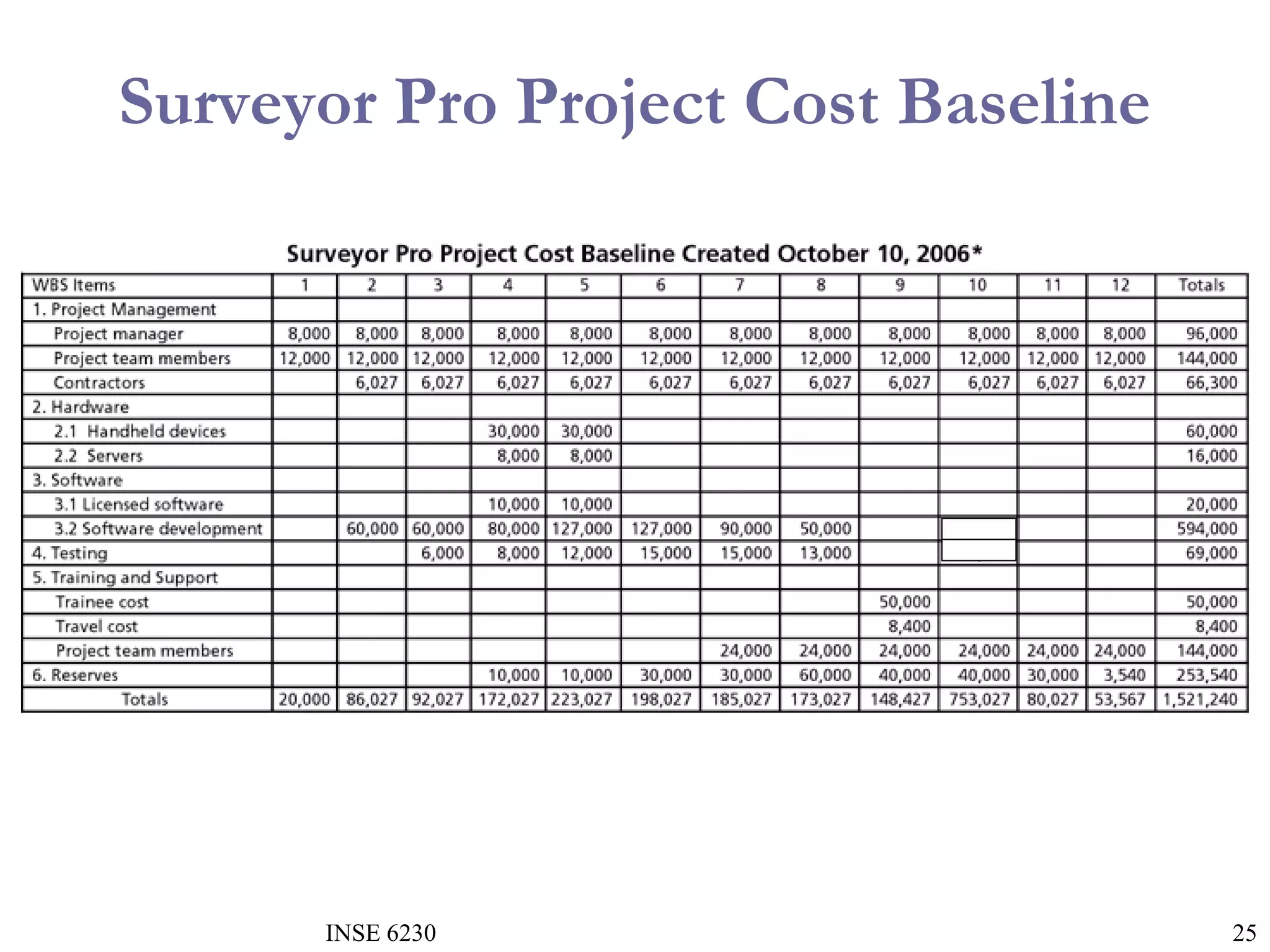
Cost Budgeting
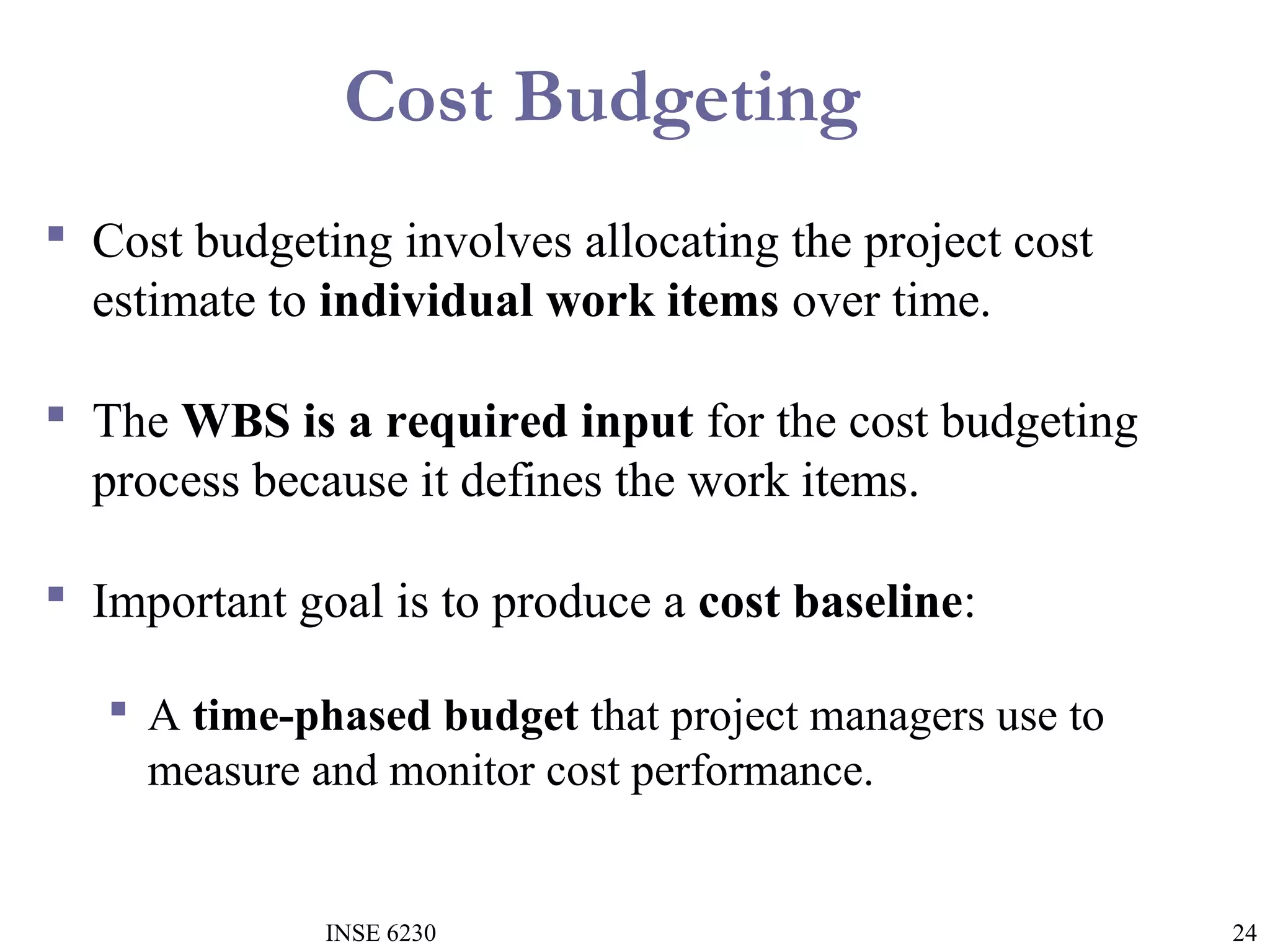
Costbudgeting involves allocating the project cost
estimate to individual work items over time.
The WBS is a required input for the cost budgeting
process because it defines the work items.
Important goal is to produce a cost baseline:
A time-phased budget that project managers use to
measure and monitor cost performance.
INSE 6230
24
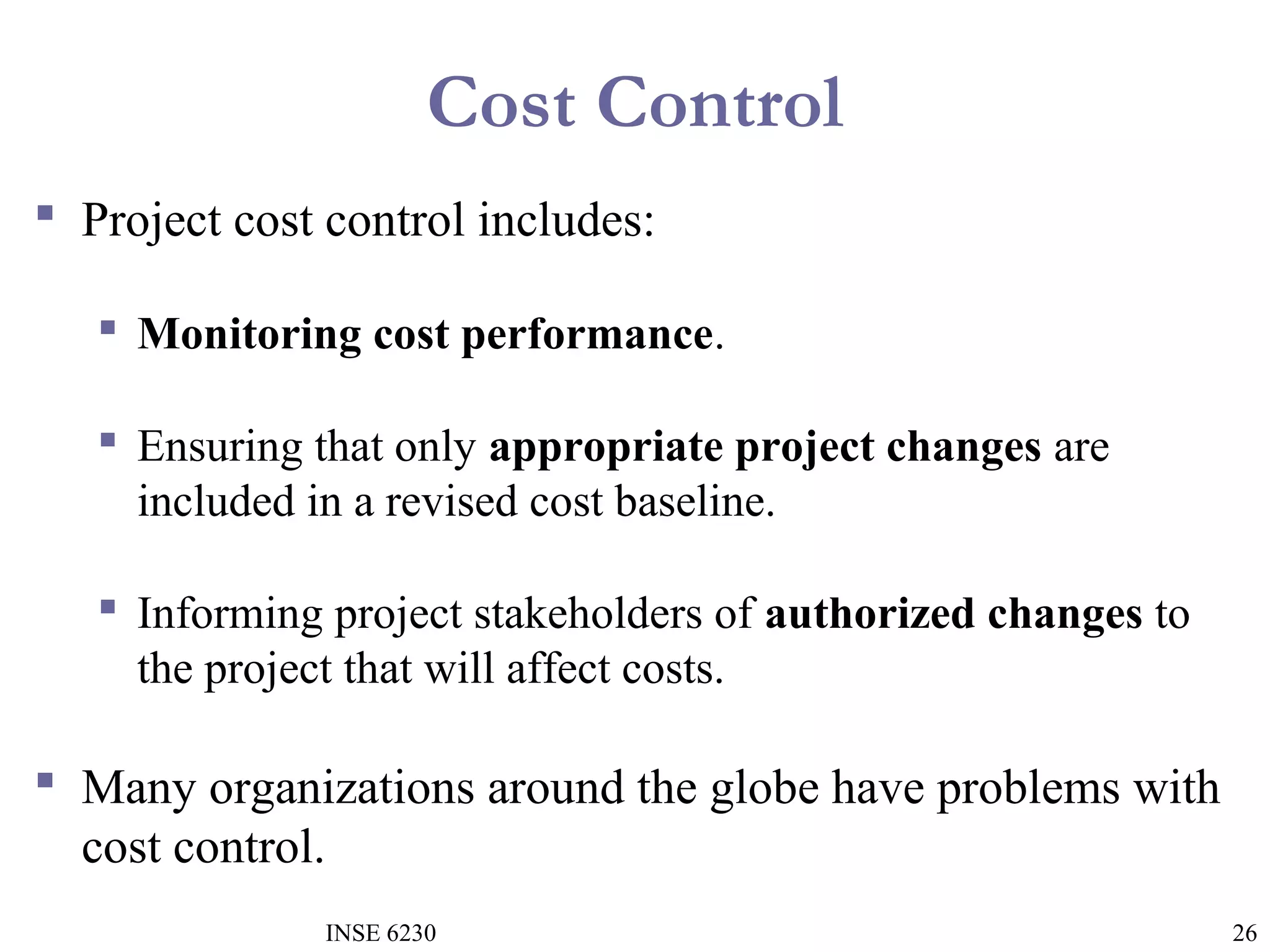
Cost Control
Projectcost control includes:
Monitoring cost performance.
Ensuring that only appropriate project changes are
included in a revised cost baseline.
Informing project stakeholders of authorized changes to
the project that will affect costs.
Many organizations around the globe have problems with
cost control.
INSE 6230
26
27.
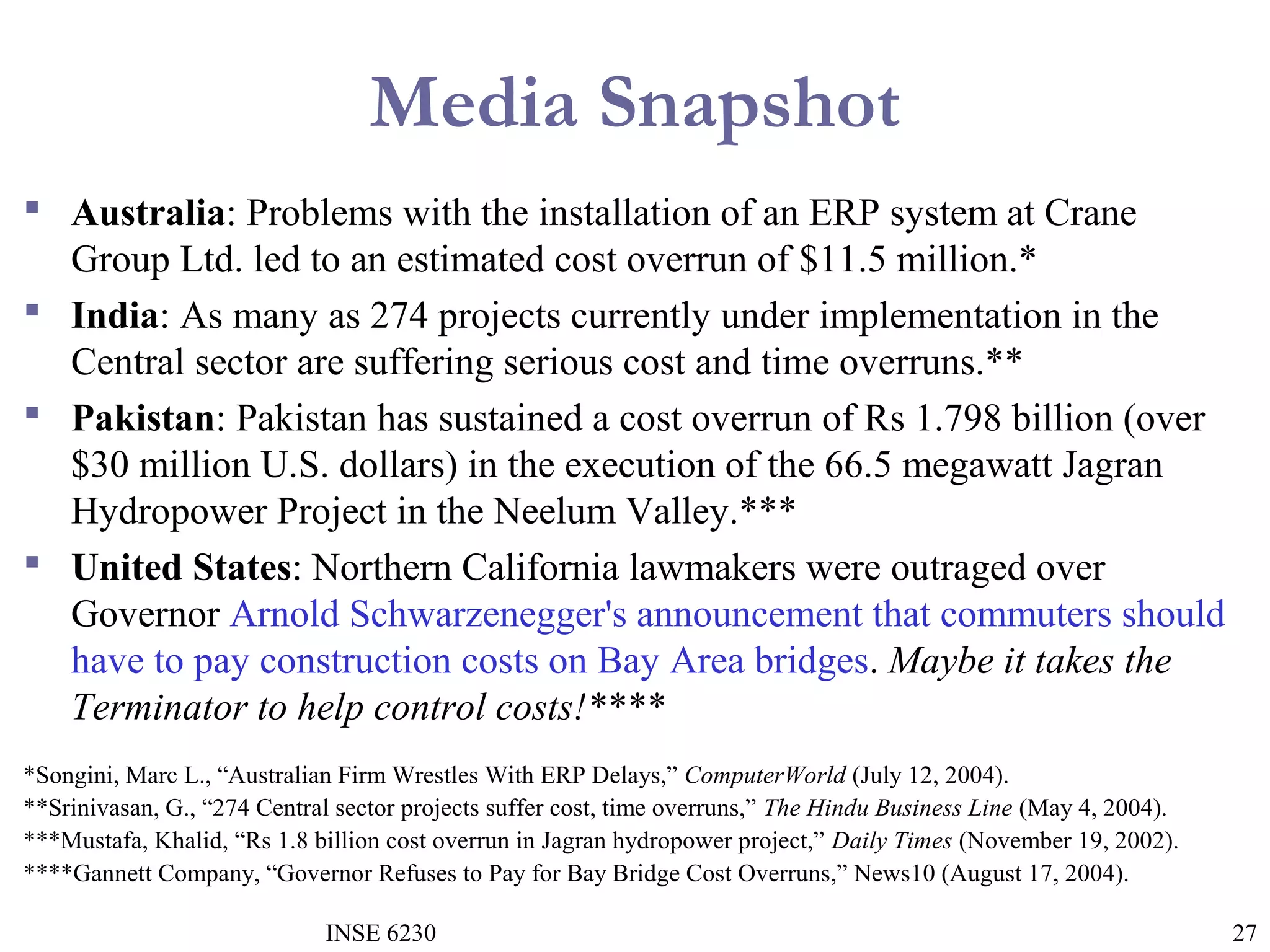
Media Snapshot
Australia:Problems with the installation of an ERP system at Crane
Group Ltd. led to an estimated cost overrun of $11.5 million.*
India: As many as 274 projects currently under implementation in the
Central sector are suffering serious cost and time overruns.**
Pakistan: Pakistan has sustained a cost overrun of Rs 1.798 billion (over
$30 million U.S. dollars) in the execution of the 66.5 megawatt Jagran
Hydropower Project in the Neelum Valley.***
United States: Northern California lawmakers were outraged over
Governor Arnold Schwarzenegger's announcement that commuters should
have to pay construction costs on Bay Area bridges. Maybe it takes the
Terminator to help control costs!****
*Songini, Marc L., “Australian Firm Wrestles With ERP Delays,” ComputerWorld (July 12, 2004).
**Srinivasan, G., “274 Central sector projects suffer cost, time overruns,” The Hindu Business Line (May 4, 2004).
***Mustafa, Khalid, “Rs 1.8 billion cost overrun in Jagran hydropower project,” Daily Times (November 19, 2002).
****Gannett Company, “Governor Refuses to Pay for Bay Bridge Cost Overruns,” News10 (August 17, 2004).
INSE 6230
27
28.
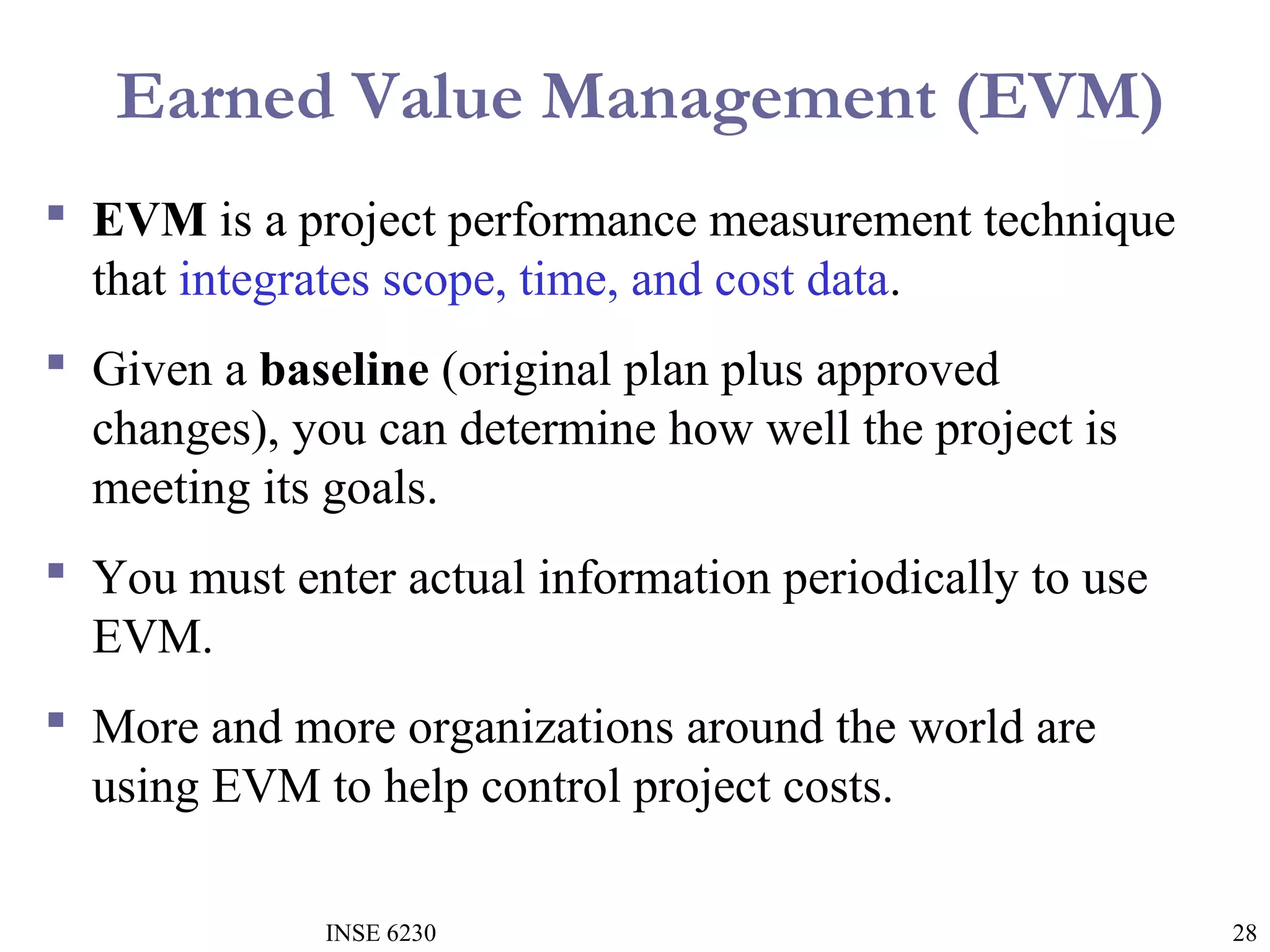
Earned Value Management(EVM)
EVM is a project performance measurement technique
that integrates scope, time, and cost data.
Given a baseline (original plan plus approved
changes), you can determine how well the project is
meeting its goals.
You must enter actual information periodically to use
EVM.
More and more organizations around the world are
using EVM to help control project costs.
INSE 6230
28
29.
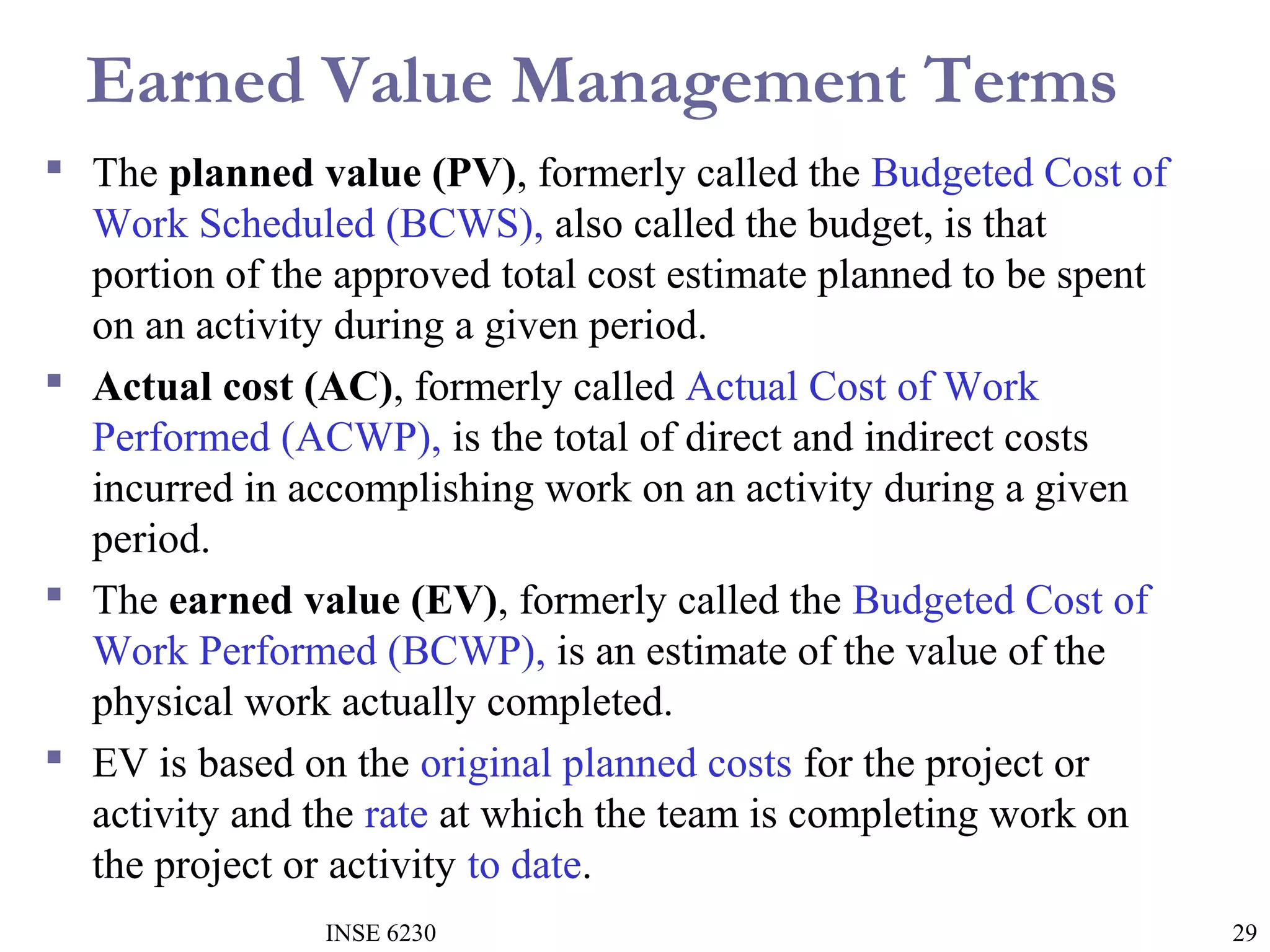
Earned Value ManagementTerms
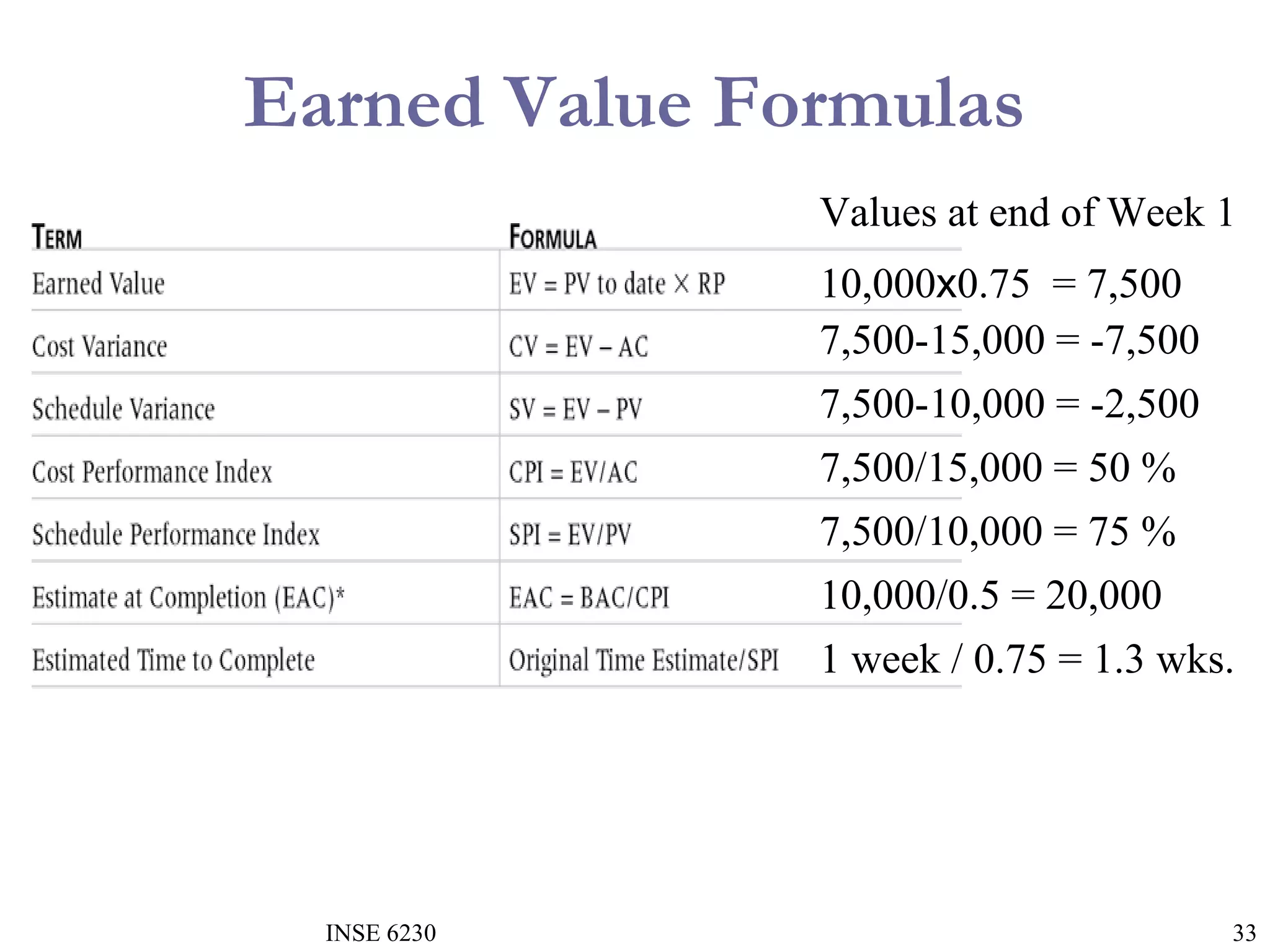
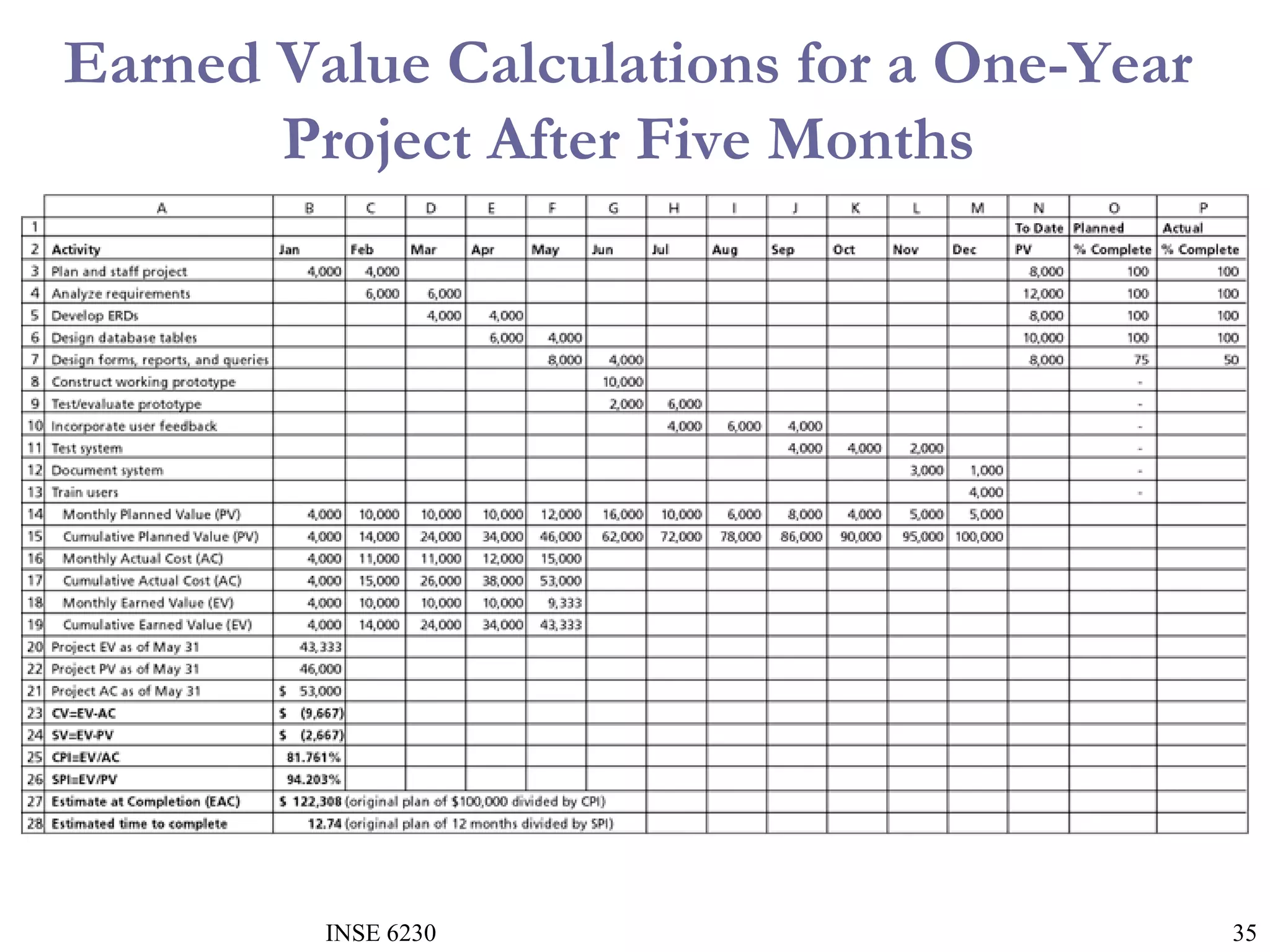
The planned value (PV), formerly called the Budgeted Cost of
Work Scheduled (BCWS), also called the budget, is that
portion of the approved total cost estimate planned to be spent
on an activity during a given period.
Actual cost (AC), formerly called Actual Cost of Work
Performed (ACWP), is the total of direct and indirect costs
incurred in accomplishing work on an activity during a given
period.
The earned value (EV), formerly called the Budgeted Cost of
Work Performed (BCWP), is an estimate of the value of the
physical work actually completed.
EV is based on the original planned costs for the project or
activity and the rate at which the team is completing work on
the project or activity to date.
INSE 6230
29
30.
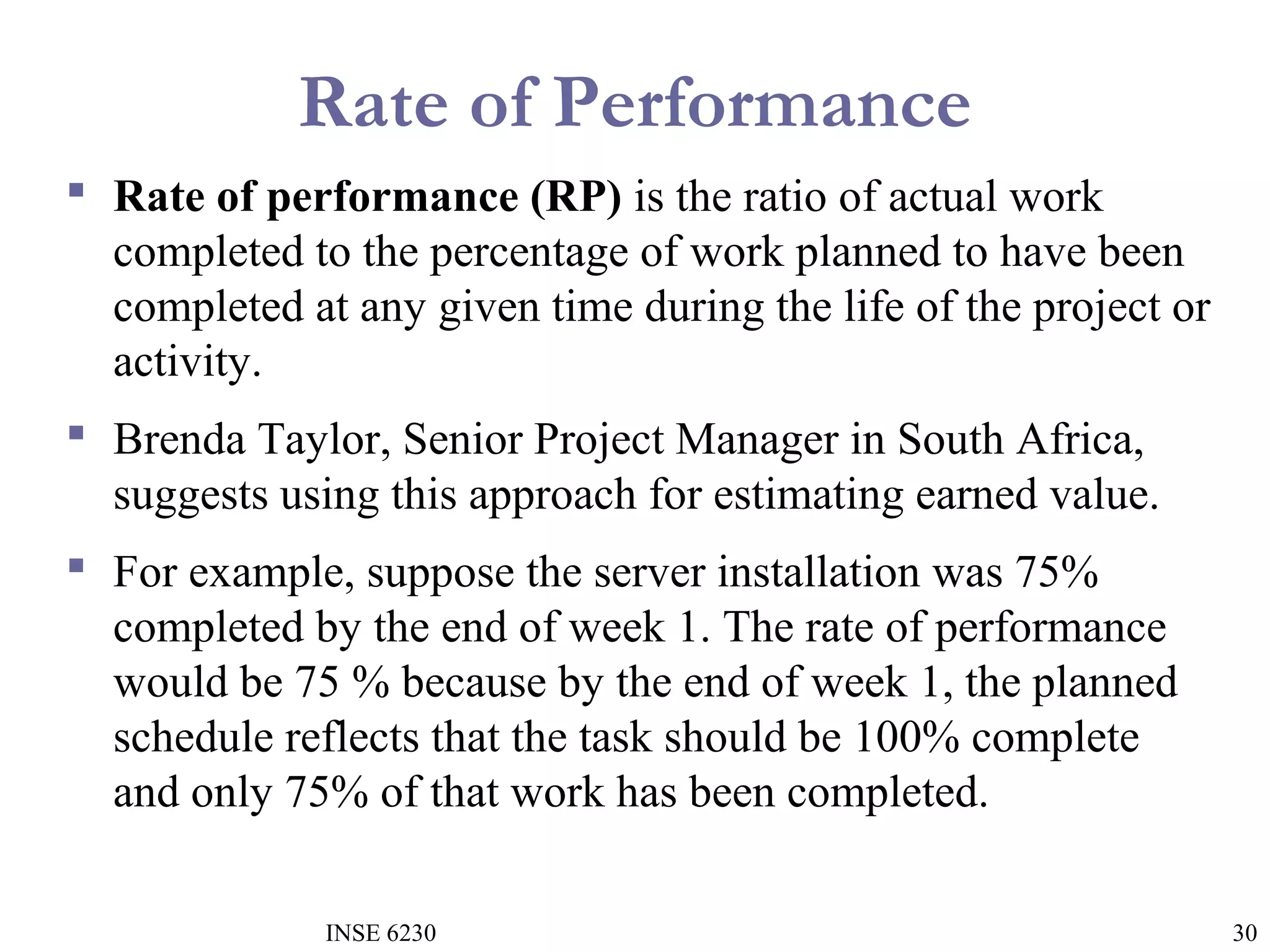
Rate of Performance
Rate of performance (RP) is the ratio of actual work
completed to the percentage of work planned to have been
completed at any given time during the life of the project or
activity.
Brenda Taylor, Senior Project Manager in South Africa,
suggests using this approach for estimating earned value.
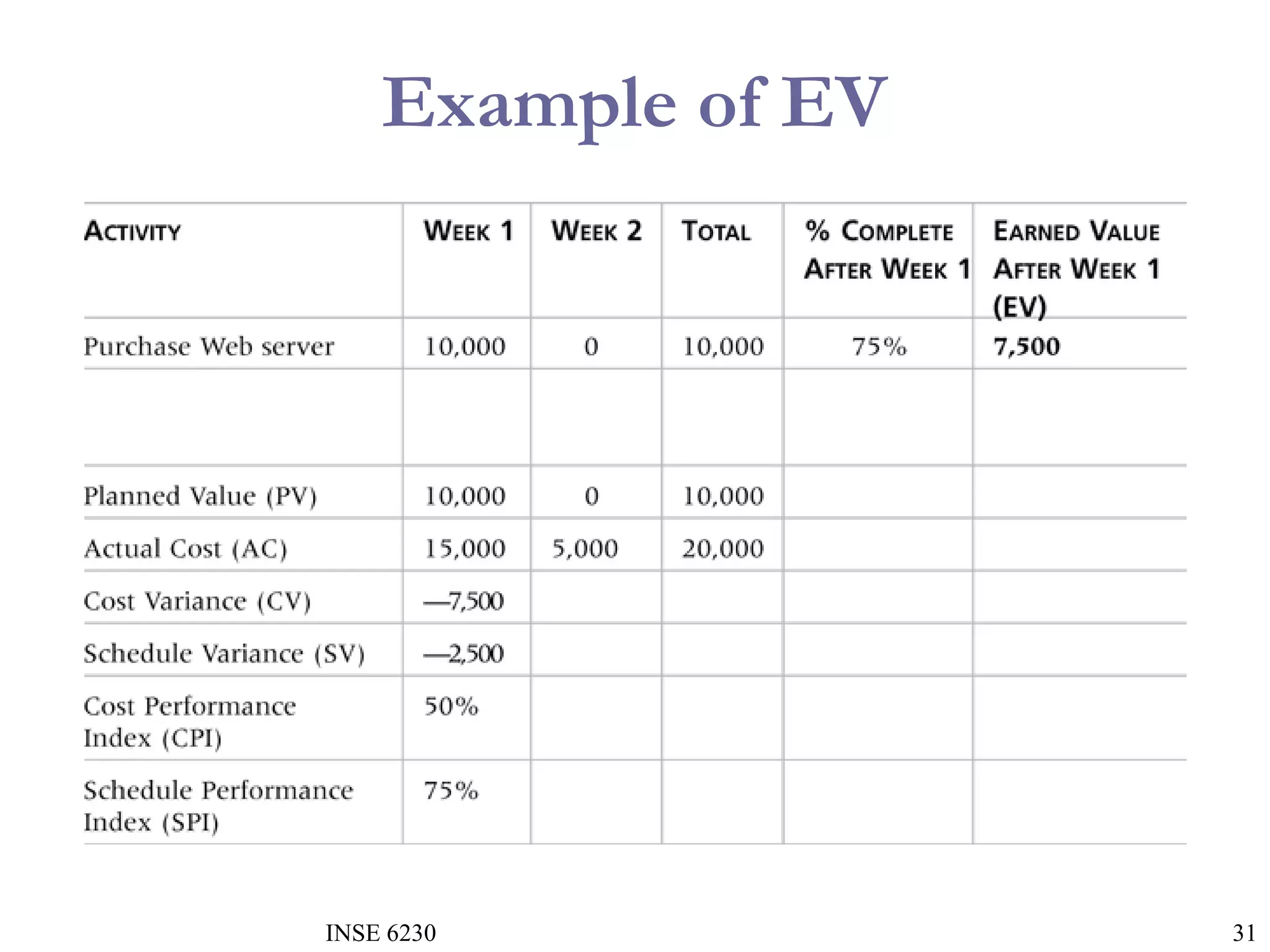
For example, suppose the server installation was 75%
completed by the end of week 1. The rate of performance
would be 75 % because by the end of week 1, the planned
schedule reflects that the task should be 100% complete
and only 75% of that work has been completed.
INSE 6230
30
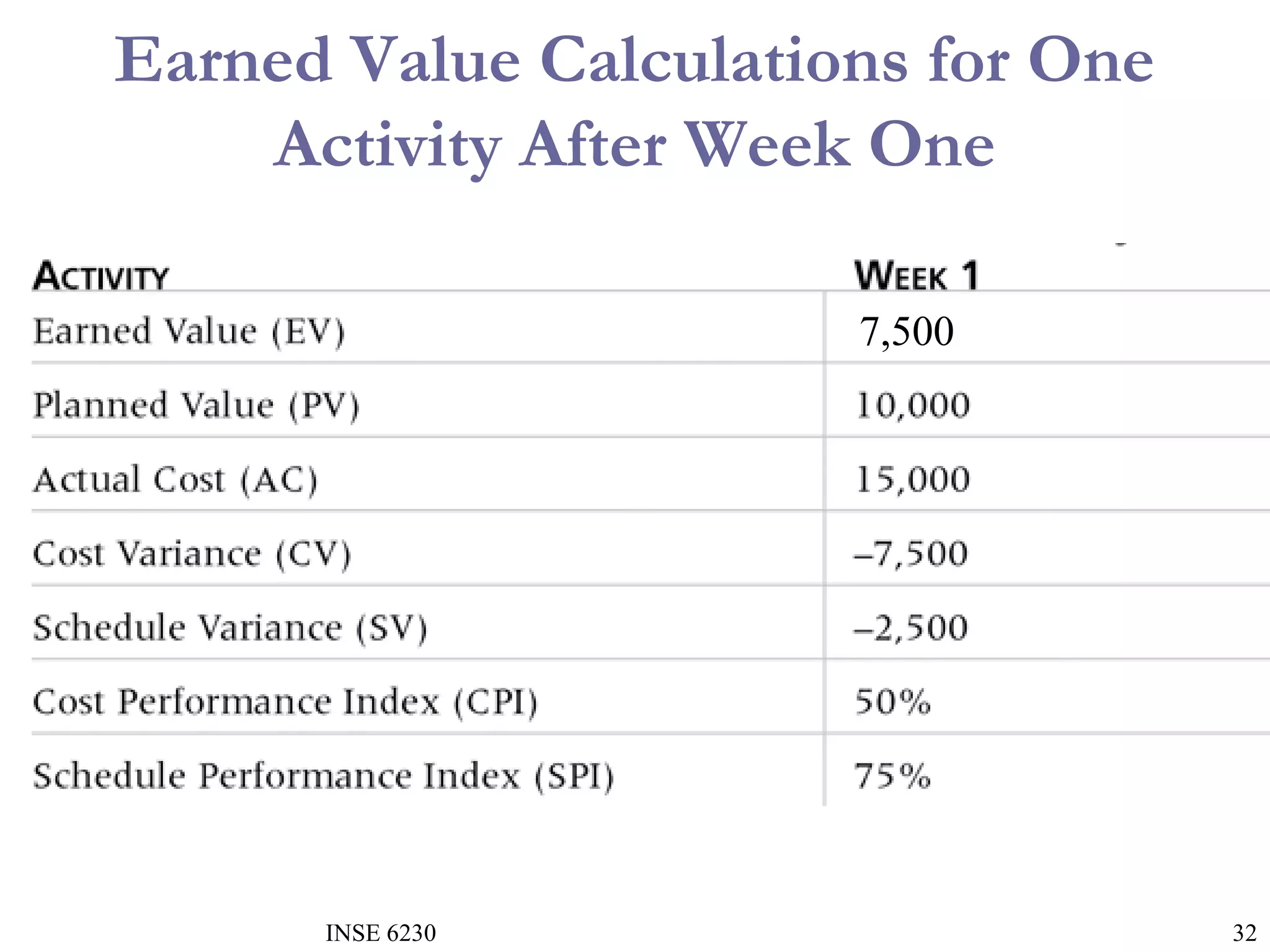
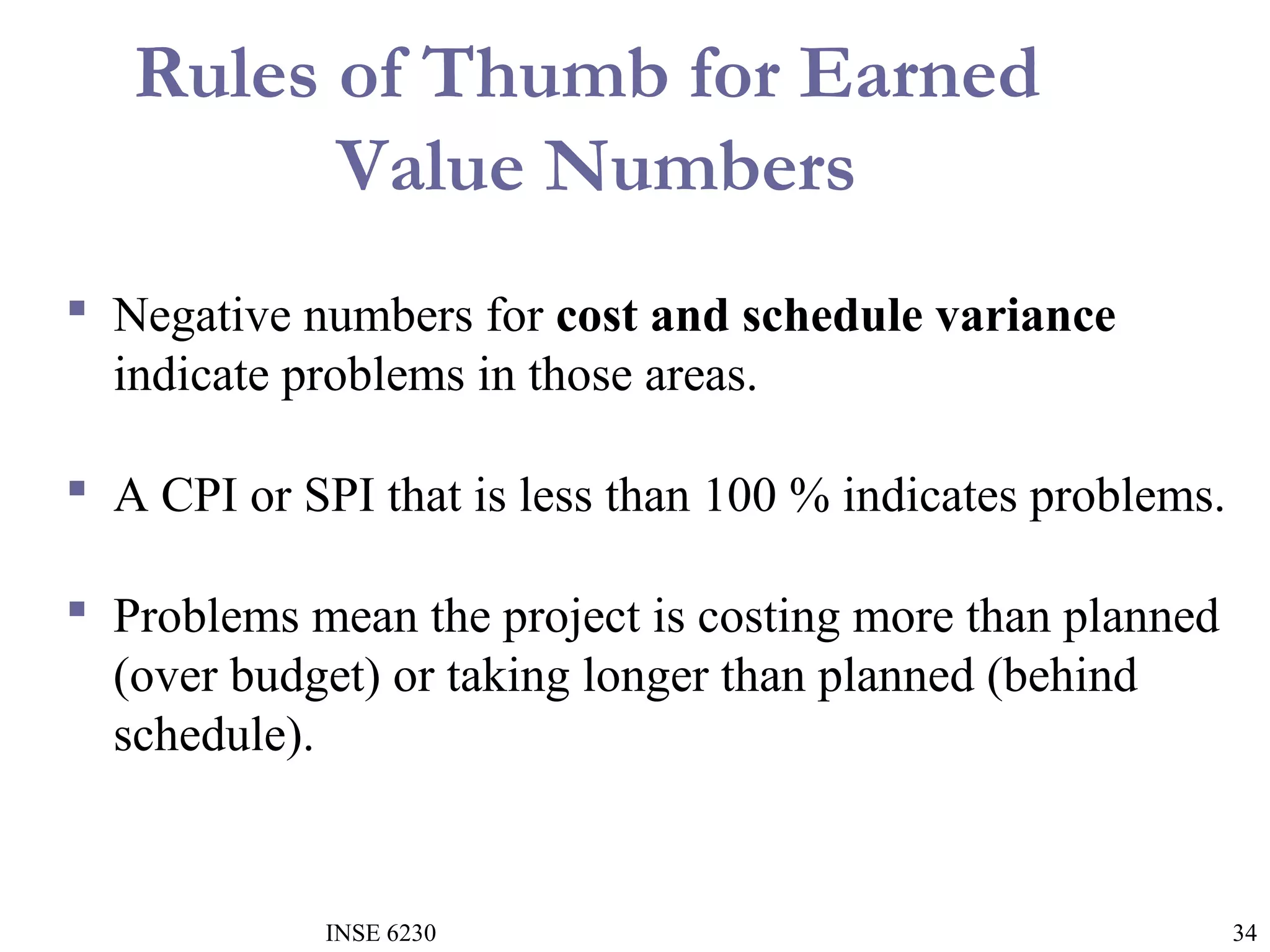
Rules of Thumbfor Earned
Value Numbers
Negative numbers for cost and schedule variance
indicate problems in those areas.
A CPI or SPI that is less than 100 % indicates problems.
Problems mean the project is costing more than planned
(over budget) or taking longer than planned (behind
schedule).
INSE 6230
34
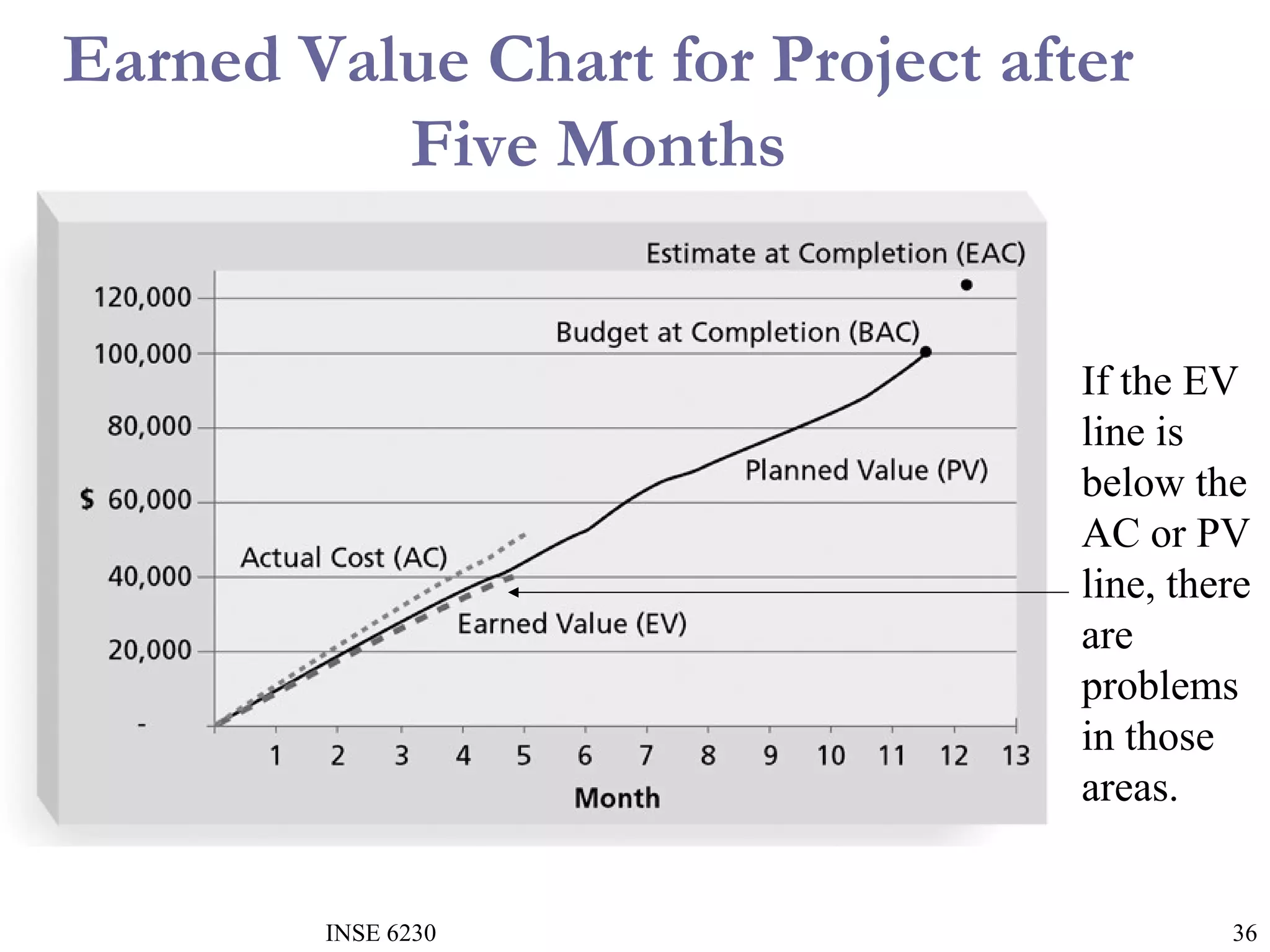
Earned Value Chartfor Project after
Five Months
If the EV
line is
below the
AC or PV
line, there
are
problems
in those
areas.
INSE 6230
36
37.
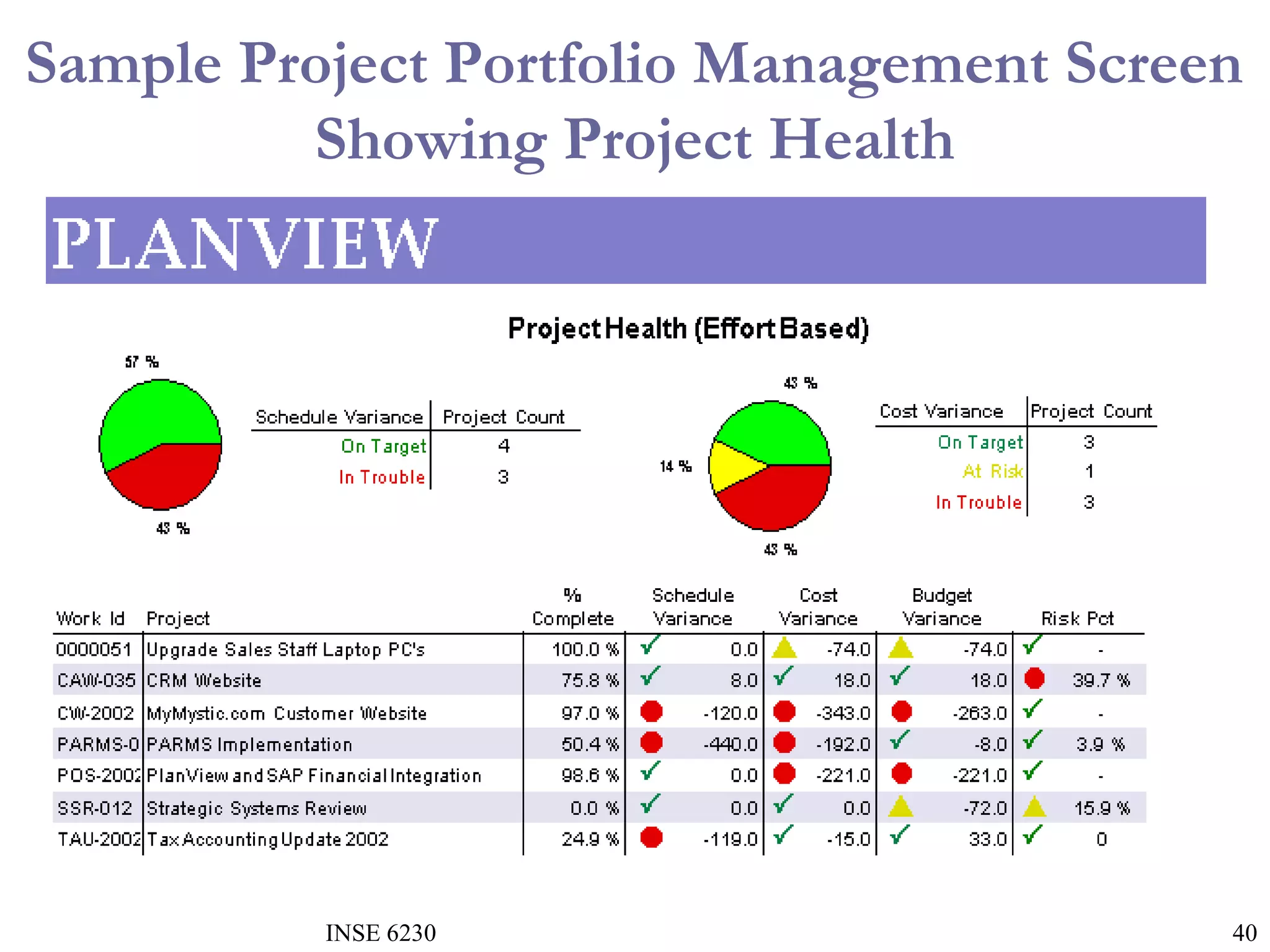
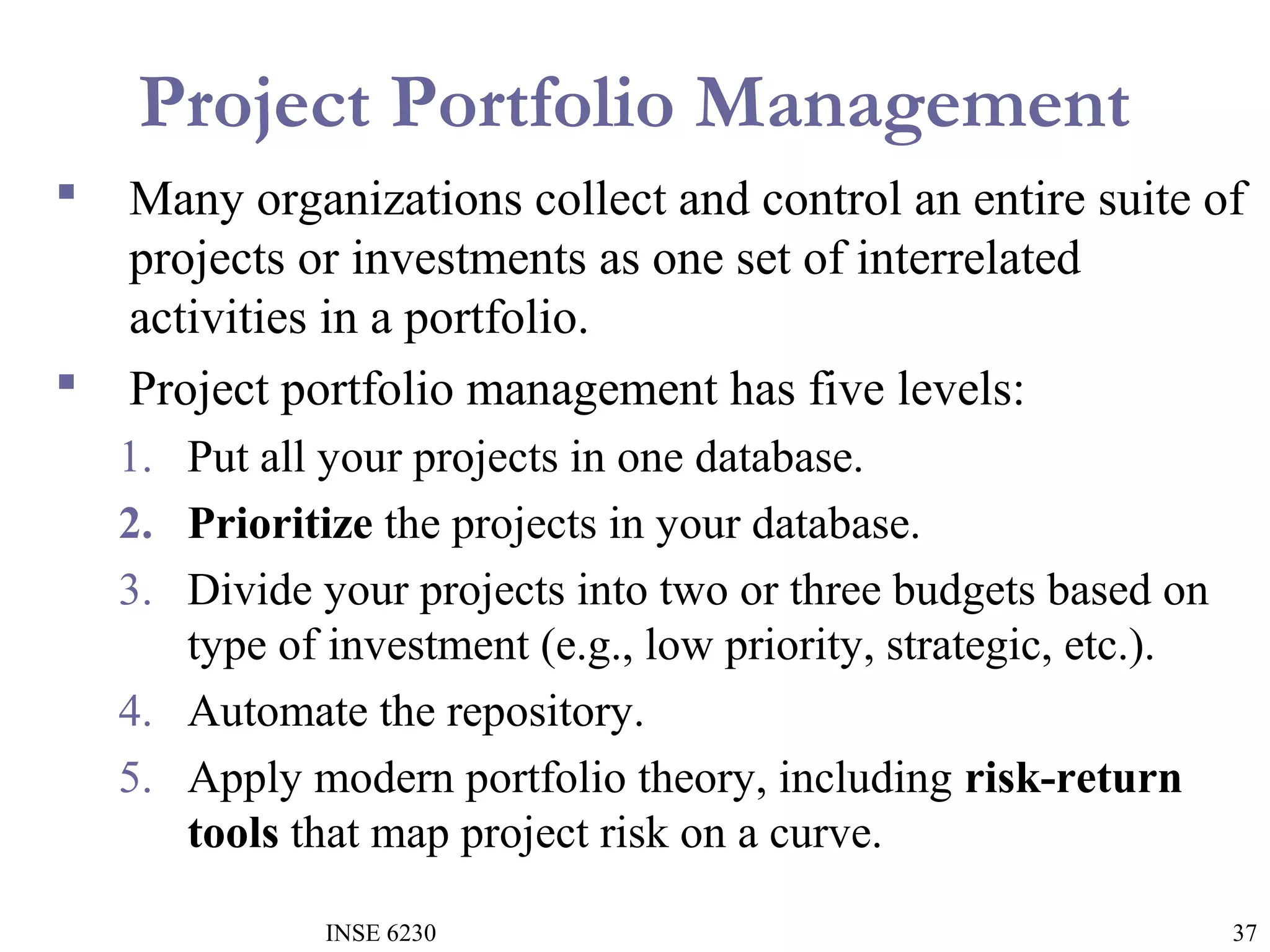
Project Portfolio Management
Manyorganizations collect and control an entire suite of
projects or investments as one set of interrelated
activities in a portfolio.
Project portfolio management has five levels:
1. Put all your projects in one database.
2. Prioritize the projects in your database.
3. Divide your projects into two or three budgets based on
type of investment (e.g., low priority, strategic, etc.).
4. Automate the repository.
5. Apply modern portfolio theory, including risk-return
tools that map project risk on a curve.
INSE 6230
37
38.
Benefits of PortfolioManagement
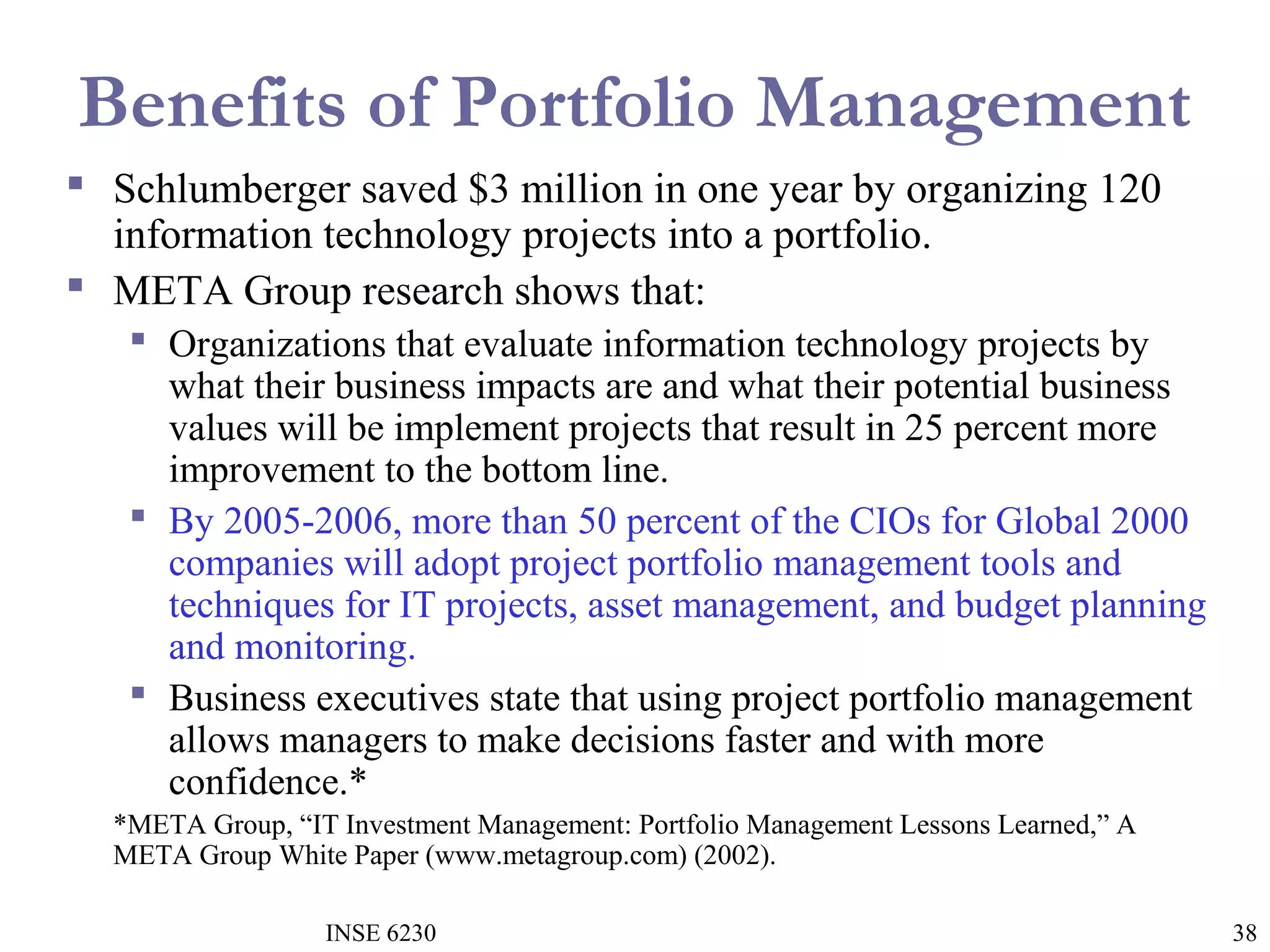
Schlumberger saved $3 million in one year by organizing 120
information technology projects into a portfolio.
META Group research shows that:
Organizations that evaluate information technology projects by
what their business impacts are and what their potential business
values will be implement projects that result in 25 percent more
improvement to the bottom line.
By 2005-2006, more than 50 percent of the CIOs for Global 2000
companies will adopt project portfolio management tools and
techniques for IT projects, asset management, and budget planning
and monitoring.
Business executives state that using project portfolio management
allows managers to make decisions faster and with more
confidence.*
*META Group, “IT Investment Management: Portfolio Management Lessons Learned,” A
META Group White Paper (www.metagroup.com) (2002).
INSE 6230
38
39.
Using Software toAssist in Cost
Management
Spreadsheets are a common tool for resource
planning, cost estimating, cost budgeting, and cost
control.
Many companies use more sophisticated and
centralized financial applications software for cost
information.
Project management software has many cost-related
features, especially enterprise PM software.
INSE 6230
39
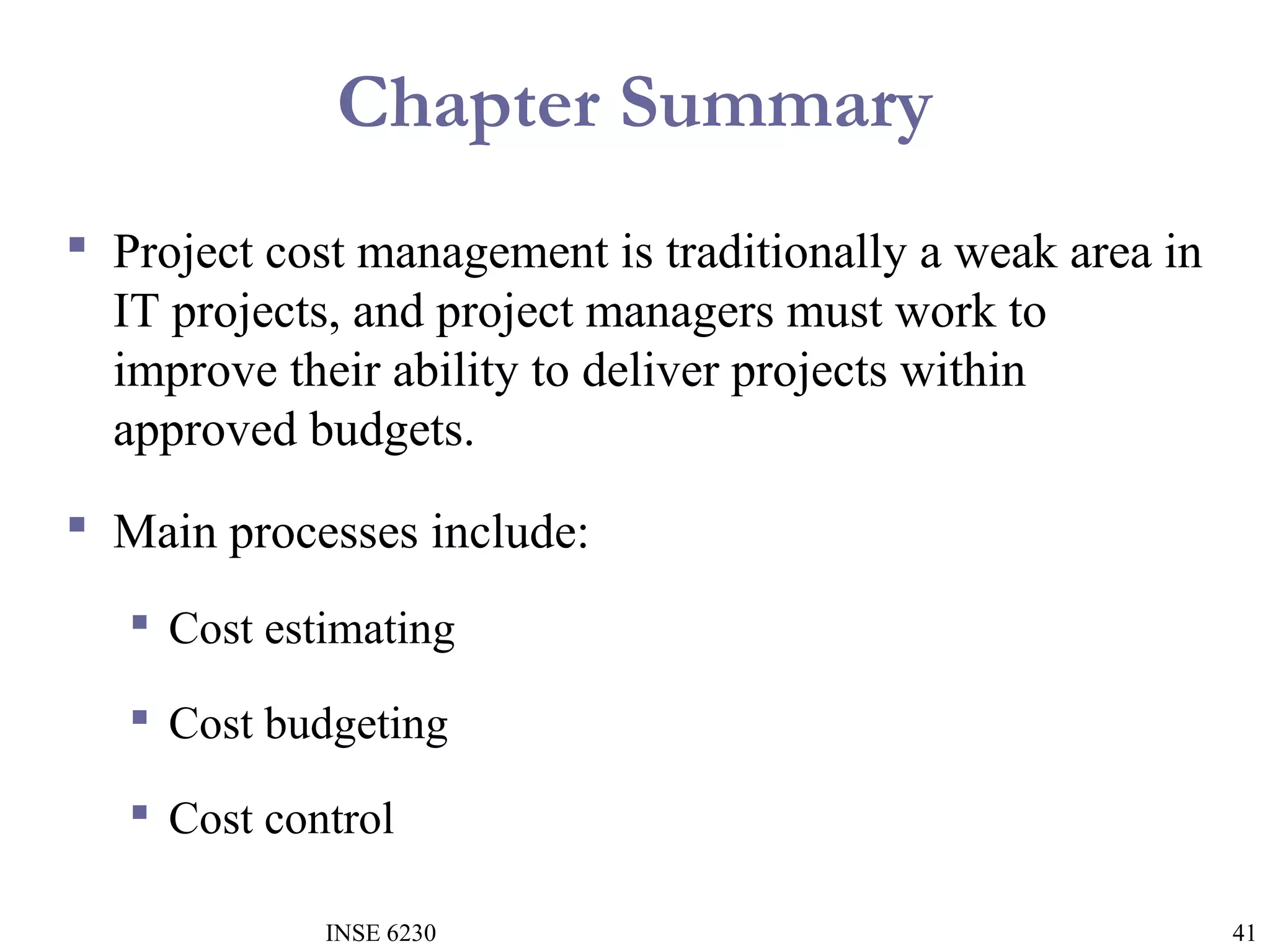
Chapter Summary
Projectcost management is traditionally a weak area in
IT projects, and project managers must work to
improve their ability to deliver projects within
approved budgets.
Main processes include:
Cost estimating
Cost budgeting
Cost control
INSE 6230
41