Project Management for Construction: Cost Estimation                                    http://pmbook.ce.cmu.edu/05_Cost_Estimation.html


           Go Up to Table of Contents
           Go To Chapter 4
                                     Go To Chapter 6
           (Labor, Material and
                                     (Economic Evaluation
           Equipment
                                     of Facility Investments)
           Utilization)
           Cost Estimation
             Costs Associated with Constructed Facilities
             Approaches to Cost Estimation
             Type of Construction Cost Estimates
             Effects of Scale on Construction Cost
             Unit Cost Method of Estimation
             Methods for Allocation of Joint Costs
             Historical Cost Data
             Cost Indices
             Applications of Cost Indices to Estimating
             Estimate Based on Engineer's List of
           Quantities
             Allocation of Construction Costs Over Time
             Computer Aided Cost Estimation
             Estimation of Operating Costs
             References
             Problems
             Footnotes


          5. Cost Estimation
          5.1 Costs Associated with Constructed Facilities
          The costs of a constructed facility to the owner include both the initial capital cost and the subsequent
          operation and maintenance costs. Each of these major cost categories consists of a number of cost
          components.

          The capital cost for a construction project includes the expenses related to the inital establishment of the
          facility:

                 Land acquisition, including assembly, holding and improvement
                 Planning and feasibility studies
                 Architectural and engineering design
                 Construction, including materials, equipment and labor
                 Field supervision of construction
                 Construction financing
                 Insurance and taxes during construction
                 Owner's general office overhead
                 Equipment and furnishings not included in construction
                 Inspection and testing

          The operation and maintenance cost in subsequent years over the project life cycle includes the following
          expenses:

                 Land rent, if applicable
                 Operating staff
                 Labor and material for maintenance and repairs
                 Periodic renovations


1 de 38                                                                                                                  23/6/2011 17:10
Project Management for Construction: Cost Estimation                                      http://pmbook.ce.cmu.edu/05_Cost_Estimation.html


                 Insurance and taxes
                 Financing costs
                 Utilities
                 Owner's other expenses

          The magnitude of each of these cost components depends on the nature, size and location of the project as
          well as the management organization, among many considerations. The owner is interested in achieving the
          lowest possible overall project cost that is consistent with its investment objectives.

          It is important for design professionals and construction managers to realize that while the construction cost
          may be the single largest component of the capital cost, other cost components are not insignificant. For
          example, land acquisition costs are a major expenditure for building construction in high-density urban areas,
          and construction financing costs can reach the same order of magnitude as the construction cost in large
          projects such as the construction of nuclear power plants.

          From the owner's perspective, it is equally important to estimate the corresponding operation and maintenance
          cost of each alternative for a proposed facility in order to analyze the life cycle costs. The large expenditures
          needed for facility maintenance, especially for publicly owned infrastructure, are reminders of the neglect in
          the past to consider fully the implications of operation and maintenance cost in the design stage.

          In most construction budgets, there is an allowance for contingencies or unexpected costs occuring during
          construction. This contingency amount may be included within each cost item or be included in a single
          category of construction contingency. The amount of contingency is based on historical experience and the
          expected difficulty of a particular construction project. For example, one construction firm makes estimates of
          the expected cost in five different areas:

                 Design development changes,
                 Schedule adjustments,
                 General administration changes (such as wage rates),
                 Differing site conditions for those expected, and
                 Third party requirements imposed during construction, such as new permits.

          Contingent amounts not spent for construction can be released near the end of construction to the owner or to
          add additional project elements.

          In this chapter, we shall focus on the estimation of construction cost, with only occasional reference to other
          cost components. In Chapter 6, we shall deal with the economic evaluation of a constructed facility on the
          basis of both the capital cost and the operation and maintenance cost in the life cycle of the facility. It is at this
          stage that tradeoffs between operating and capital costs can be analyzed.

          Example 5-1: Energy project resource demands [1]

                 The resources demands for three types of major energy projects investigated during the energy
                 crisis in the 1970's are shown in Table 5-1. These projects are: (1) an oil shale project with a
                 capacity of 50,000 barrels of oil product per day; (2) a coal gasification project that makes gas
                 with a heating value of 320 billions of British thermal units per day, or equivalent to about 50,000
                 barrels of oil product per day; and (3) a tar sand project with a capacity of 150,000 barrels of oil
                 product per day.

                 For each project, the cost in billions of dollars, the engineering manpower requirement for basic
                 design in thousands of hours, the engineering manpower requirement for detailed engineering in
                 millions of hours, the skilled labor requirement for construction in millions of hours and the
                 material requirement in billions of dollars are shown in Table 5-1. To build several projects of
                 such an order of magnitude concurrently could drive up the costs and strain the availability of all
                 resources required to complete the projects. Consequently, cost estimation often represents an
                 exercise in professional judgment instead of merely compiling a bill of quantities and collecting
                 cost data to reach a total estimate mechanically.


2 de 38                                                                                                                   23/6/2011 17:10
Project Management for Construction: Cost Estimation                                    http://pmbook.ce.cmu.edu/05_Cost_Estimation.html


          TABLE 5-1
           Resource                                     Oil shale       Coal gasification          Tar Sands
          Requirements                                   (50,000         (320 billions             (150,000
            of Some                                    barrels/day)       BTU/day)                barrels/day)
          Major Energy
            Projects Cost
                                                           2.5                  4                    8 to 10
                          ($ billion)
                         Basic design
                          (Thousands of                    80                  200                     100
                         hours)
                         Detailed engineering
                                                          3 to 4              4 to 5                  6 to 8
                          (Millions of hours)
                         Construction
                                                           20                   30                      40
                          (Millions of hours)
                         Materials
                                                            1                   2                      2.5
                          ($ billion)

                         Source: Exxon Research and Engineering Company, Florham Park, NJ

          Back to top

          5.2 Approaches to Cost Estimation
          Cost estimating is one of the most important steps in project management. A cost estimate establishes the base
          line of the project cost at different stages of development of the project. A cost estimate at a given stage of
          project development represents a prediction provided by the cost engineer or estimator on the basis of
          available data. According to the American Association of Cost Engineers, cost engineering is defined as that
          area of engineering practice where engineering judgment and experience are utilized in the application of
          scientific principles and techniques to the problem of cost estimation, cost control and profitability.

          Virtually all cost estimation is performed according to one or some combination of the following basic
          approaches:

          Production function. In microeconomics, the relationship between the output of a process and the necessary
          resources is referred to as the production function. In construction, the production function may be expressed
          by the relationship between the volume of construction and a factor of production such as labor or capital. A
          production function relates the amount or volume of output to the various inputs of labor, material and
          equipment. For example, the amount of output Q may be derived as a function of various input factors x1, x2,
          ..., xn by means of mathematical and/or statistical methods. Thus, for a specified level of output, we may
          attempt to find a set of values for the input factors so as to minimize the production cost. The relationship
          between the size of a building project (expressed in square feet) to the input labor (expressed in labor hours
          per square foot) is an example of a production function for construction. Several such production functions are
          shown in Figure 3-3 of Chapter 3.

          Empirical cost inference. Empirical estimation of cost functions requires statistical techniques which relate
          the cost of constructing or operating a facility to a few important characteristics or attributes of the system.
          The role of statistical inference is to estimate the best parameter values or constants in an assumed cost
          function. Usually, this is accomplished by means of regression analysis techniques.

          Unit costs for bill of quantities. A unit cost is assigned to each of the facility components or tasks as
          represented by the bill of quantities. The total cost is the summation of the products of the quantities
          multiplied by the corresponding unit costs. The unit cost method is straightforward in principle but quite
          laborious in application. The initial step is to break down or disaggregate a process into a number of tasks.
          Collectively, these tasks must be completed for the construction of a facility. Once these tasks are defined and
          quantities representing these tasks are assessed, a unit cost is assigned to each and then the total cost is
          determined by summing the costs incurred in each task. The level of detail in decomposing into tasks will vary


3 de 38                                                                                                                 23/6/2011 17:10
Project Management for Construction: Cost Estimation                                    http://pmbook.ce.cmu.edu/05_Cost_Estimation.html


          considerably from one estimate to another.

          Allocation of joint costs. Allocations of cost from existing accounts may be used to develop a cost function of
          an operation. The basic idea in this method is that each expenditure item can be assigned to particular
          characteristics of the operation. Ideally, the allocation of joint costs should be causally related to the category
          of basic costs in an allocation process. In many instances, however, a causal relationship between the
          allocation factor and the cost item cannot be identified or may not exist. For example, in construction projects,
          the accounts for basic costs may be classified according to (1) labor, (2) material, (3) construction equipment,
          (4) construction supervision, and (5) general office overhead. These basic costs may then be allocated
          proportionally to various tasks which are subdivisions of a project.

          Back to top

          5.3 Types of Construction Cost Estimates
          Construction cost constitutes only a fraction, though a substantial fraction, of the total project cost. However,
          it is the part of the cost under the control of the construction project manager. The required levels of accuracy
          of construction cost estimates vary at different stages of project development, ranging from ball park figures in
          the early stage to fairly reliable figures for budget control prior to construction. Since design decisions made at
          the beginning stage of a project life cycle are more tentative than those made at a later stage, the cost
          estimates made at the earlier stage are expected to be less accurate. Generally, the accuracy of a cost estimate
          will reflect the information available at the time of estimation.

          Construction cost estimates may be viewed from different perspectives because of different institutional
          requirements. In spite of the many types of cost estimates used at different stages of a project, cost estimates
          can best be classified into three major categories according to their functions. A construction cost estimate
          serves one of the three basic functions: design, bid and control. For establishing the financing of a project,
          either a design estimate or a bid estimate is used.

             1. Design Estimates. For the owner or its designated design professionals, the types of cost estimates
                encountered run parallel with the planning and design as follows:
                      Screening estimates (or order of magnitude estimates)
                      Preliminary estimates (or conceptual estimates)
                      Detailed estimates (or definitive estimates)
                      Engineer's estimates based on plans and specifications
                For each of these different estimates, the amount of design information available typically increases.
             2. Bid Estimates. For the contractor, a bid estimate submitted to the owner either for competitive bidding
                or negotiation consists of direct construction cost including field supervision, plus a markup to cover
                general overhead and profits. The direct cost of construction for bid estimates is usually derived from a
                combination of the following approaches.
                      Subcontractor quotations
                      Quantity takeoffs
                      Construction procedures.
             3. 3. Control Estimates. For monitoring the project during construction, a control estimate is derived from
                available information to establish:
                      Budget estimate for financing
                      Budgeted cost after contracting but prior to construction
                      Estimated cost to completion during the progress of construction.

          Design Estimates

          In the planning and design stages of a project, various design estimates reflect the progress of the design. At
          the very early stage, the screening estimate or order of magnitude estimate is usually made before the facility
          is designed, and must therefore rely on the cost data of similar facilities built in the past. A preliminary
          estimate or conceptual estimate is based on the conceptual design of the facility at the state when the basic
          technologies for the design are known. The detailed estimate or definitive estimate is made when the scope of


4 de 38                                                                                                                 23/6/2011 17:10
Project Management for Construction: Cost Estimation                                     http://pmbook.ce.cmu.edu/05_Cost_Estimation.html


          work is clearly defined and the detailed design is in progress so that the essential features of the facility are
          identifiable. The engineer's estimate is based on the completed plans and specifications when they are ready
          for the owner to solicit bids from construction contractors. In preparing these estimates, the design
          professional will include expected amounts for contractors' overhead and profits.

          The costs associated with a facility may be decomposed into a hierarchy of levels that are appropriate for the
          purpose of cost estimation. The level of detail in decomposing the facility into tasks depends on the type of
          cost estimate to be prepared. For conceptual estimates, for example, the level of detail in defining tasks is
          quite coarse; for detailed estimates, the level of detail can be quite fine.

          As an example, consider the cost estimates for a proposed bridge across a river. A screening estimate is made
          for each of the potential alternatives, such as a tied arch bridge or a cantilever truss bridge. As the bridge type
          is selected, e.g. the technology is chosen to be a tied arch bridge instead of some new bridge form, a
          preliminary estimate is made on the basis of the layout of the selected bridge form on the basis of the
          preliminary or conceptual design. When the detailed design has progressed to a point when the essential
          details are known, a detailed estimate is made on the basis of the well defined scope of the project. When the
          detailed plans and specifications are completed, an engineer's estimate can be made on the basis of items and
          quantities of work.

          Bid Estimates

          The contractor's bid estimates often reflect the desire of the contractor to secure the job as well as the
          estimating tools at its disposal. Some contractors have well established cost estimating procedures while others
          do not. Since only the lowest bidder will be the winner of the contract in most bidding contests, any effort
          devoted to cost estimating is a loss to the contractor who is not a successful bidder. Consequently, the
          contractor may put in the least amount of possible effort for making a cost estimate if it believes that its
          chance of success is not high.

          If a general contractor intends to use subcontractors in the construction of a facility, it may solicit price
          quotations for various tasks to be subcontracted to specialty subcontractors. Thus, the general subcontractor
          will shift the burden of cost estimating to subcontractors. If all or part of the construction is to be undertaken
          by the general contractor, a bid estimate may be prepared on the basis of the quantity takeoffs from the plans
          provided by the owner or on the basis of the construction procedures devised by the contractor for
          implementing the project. For example, the cost of a footing of a certain type and size may be found in
          commercial publications on cost data which can be used to facilitate cost estimates from quantity takeoffs.
          However, the contractor may want to assess the actual cost of construction by considering the actual
          construction procedures to be used and the associated costs if the project is deemed to be different from
          typical designs. Hence, items such as labor, material and equipment needed to perform various tasks may be
          used as parameters for the cost estimates.

          Control Estimates

          Both the owner and the contractor must adopt some base line for cost control during the construction. For the
          owner, a budget estimate must be adopted early enough for planning long term financing of the facility.
          Consequently, the detailed estimate is often used as the budget estimate since it is sufficient definitive to
          reflect the project scope and is available long before the engineer's estimate. As the work progresses, the
          budgeted cost must be revised periodically to reflect the estimated cost to completion. A revised estimated
          cost is necessary either because of change orders initiated by the owner or due to unexpected cost overruns or
          savings.

          For the contractor, the bid estimate is usually regarded as the budget estimate, which will be used for control
          purposes as well as for planning construction financing. The budgeted cost should also be updated periodically
          to reflect the estimated cost to completion as well as to insure adequate cash flows for the completion of the
          project.

          Example 5-2: Screening estimate of a grouting seal beneath a landfill [2]


5 de 38                                                                                                                  23/6/2011 17:10
Project Management for Construction: Cost Estimation                                     http://pmbook.ce.cmu.edu/05_Cost_Estimation.html


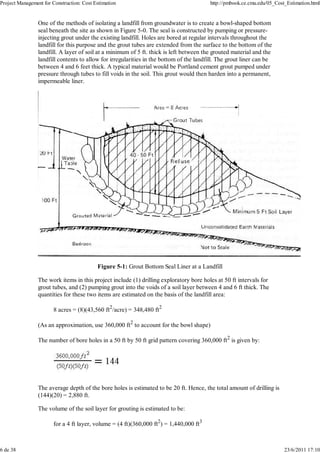
                 One of the methods of isolating a landfill from groundwater is to create a bowl-shaped bottom
                 seal beneath the site as shown in Figure 5-0. The seal is constructed by pumping or pressure-
                 injecting grout under the existing landfill. Holes are bored at regular intervals throughout the
                 landfill for this purpose and the grout tubes are extended from the surface to the bottom of the
                 landfill. A layer of soil at a minimum of 5 ft. thick is left between the grouted material and the
                 landfill contents to allow for irregularities in the bottom of the landfill. The grout liner can be
                 between 4 and 6 feet thick. A typical material would be Portland cement grout pumped under
                 pressure through tubes to fill voids in the soil. This grout would then harden into a permanent,
                 impermeable liner.


                                           Figure 5-1: Grout Bottom Seal Liner at a Landfill

                 The work items in this project include (1) drilling exploratory bore holes at 50 ft intervals for
                 grout tubes, and (2) pumping grout into the voids of a soil layer between 4 and 6 ft thick. The
                 quantities for these two items are estimated on the basis of the landfill area:

                        8 acres = (8)(43,560 ft2/acre) = 348,480 ft2

                 (As an approximation, use 360,000 ft2 to account for the bowl shape)

                 The number of bore holes in a 50 ft by 50 ft grid pattern covering 360,000 ft2 is given by:


                 The average depth of the bore holes is estimated to be 20 ft. Hence, the total amount of drilling is
                 (144)(20) = 2,880 ft.

                 The volume of the soil layer for grouting is estimated to be:

                        for a 4 ft layer, volume = (4 ft)(360,000 ft2) = 1,440,000 ft3


6 de 38                                                                                                                  23/6/2011 17:10
Project Management for Construction: Cost Estimation                                     http://pmbook.ce.cmu.edu/05_Cost_Estimation.html


                        for a 6 ft layer, volume = (6 ft)(360,000 ft2) = 2,160,000 ft3

                 It is estimated from soil tests that the voids in the soil layer are between 20% and 30% of the total
                 volume. Thus, for a 4 ft soil layer:

                        grouting in 20% voids = (20%)(1,440,000) = 288,000 ft3
                        grouting in 30 % voids = (30%)(1,440,000) = 432,000 ft3

                 and for a 6 ft soil layer:

                        grouting in 20% voids = (20%)(2,160,000) = 432,000 ft3
                        grouting in 30% voids = (30%)(2,160,000) = 648,000 ft3

                 The unit cost for drilling exploratory bore holes is estimated to be between $3 and $10 per foot (in
                 1978 dollars) including all expenses. Thus, the total cost of boring will be between (2,880)(3) = $
                 8,640 and (2,880)(10) = $28,800. The unit cost of Portland cement grout pumped into place is
                 between $4 and $10 per cubic foot including overhead and profit. In addition to the variation in
                 the unit cost, the total cost of the bottom seal will depend upon the thickness of the soil layer
                 grouted and the proportion of voids in the soil. That is:

                        for a 4 ft layer with 20% voids, grouting cost = $1,152,000 to $2,880,000
                        for a 4 ft layer with 30% voids, grouting cost = $1,728,000 to $4,320,000
                        for a 6 ft layer with 20% voids, grouting cost = $1,728,000 to $4,320,000
                        for a 6 ft layer with 30% voids, grouting cost = $2,592,000 to $6,480,000

                 The total cost of drilling bore holes is so small in comparison with the cost of grouting that the
                 former can be omitted in the screening estimate. Furthermore, the range of unit cost varies greatly
                 with soil characteristics, and the engineer must exercise judgment in narrowing the range of the
                 total cost. Alternatively, additional soil tests can be used to better estimate the unit cost of
                 pumping grout and the proportion of voids in the soil. Suppose that, in addition to ignoring the
                 cost of bore holes, an average value of a 5 ft soil layer with 25% voids is used together with a unit
                 cost of $ 7 per cubic foot of Portland cement grouting. In this case, the total project cost is
                 estimated to be:

                        (5 ft)(360,000 ft2)(25%)($7/ft3) = $3,150,000

                 An important point to note is that this screening estimate is based to a large degree on engineering
                 judgment of the soil characteristics, and the range of the actual cost may vary from $ 1,152,000 to
                 $ 6,480,000 even though the probabilities of having actual costs at the extremes are not very high.

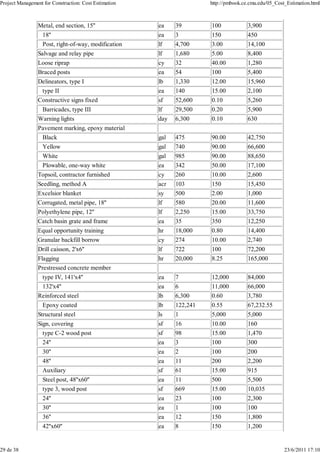
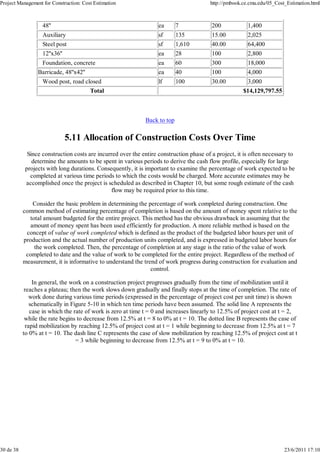
          Example 5-3: Example of engineer's estimate and contractors' bids[3]

                 The engineer's estimate for a project involving 14 miles of Interstate 70 roadway in Utah was
                 $20,950,859. Bids were submitted on March 10, 1987, for completing the project within 320
                 working days. The three low bidders were:


                        1. Ball, Ball & Brosame, Inc.,
                                                             $14,129,798
                        Danville CA
                        2. National Projects, Inc., Phoenix,
                                                             $15,381,789
                        AR
                        3. Kiewit Western Co., Murray, Utah $18,146,714

                 It was astounding that the winning bid was 32% below the engineer's estimate. Even the third
                 lowest bidder was 13% below the engineer's estimate for this project. The disparity in pricing can
                 be attributed either to the very conservative estimate of the engineer in the Utah Department of


7 de 38                                                                                                                  23/6/2011 17:10
Project Management for Construction: Cost Estimation                                       http://pmbook.ce.cmu.edu/05_Cost_Estimation.html


                 Transportation or to area contractors who are hungrier than usual to win jobs.

                 The unit prices for different items of work submitted for this project by (1) Ball, Ball & Brosame,
                 Inc. and (2) National Projects, Inc. are shown in Table 5-2. The similarity of their unit prices for
                 some items and the disparity in others submitted by the two contractors can be noted.


                  TABLE
                                                                                                                Unit price
                  5-2: Unit                      Items                        Unit       Quantity
                  Prices in                                                                                 1                2
                    Two       Mobilization                                   ls      1               115,000         569,554
                 Contractors' Removal, berm                                  lf      8,020           1.00            1.50
                   Bids for
                  Roadway Finish subgrade                                    sy      1,207,500       0.50            0.30
                 Construction Surface ditches                                lf      525             2.00            1.00
                              Excavation structures                          cy      7,000           3.00            5.00
                              Base course, untreated, 3/4''                  ton     362,200         4.50            5.00
                                 Lean concrete, 4'' thick                    sy      820,310         3.10            3.00
                                PCC, pavement, 10'' thick                    sy      76,010          10.90           12.00
                                Concrete, ci AA (AE)                         ls      1               200,000         190,000
                                  Small structure                            cy      50              500             475
                                  Barrier, precast                           lf      7,920           15.00           16.00
                                  Flatwork, 4'' thick                        sy      7,410           10.00           8.00
                                  10'' thick                                 sy      4,241           20.00           27.00
                                  Slope protection                           sy      2,104           25.00           30.00
                                Metal, end section, 15''                     ea      39              100             125
                                  18''                                       ea      3               150             200
                                  Post, right-of-way, modification           lf      4,700           3.00            2.50
                                Salvage and relay pipe                       lf      1,680           5.00            12.00
                                Loose riprap                                 cy      32              40.00           30.00
                                Braced posts                                 ea      54              100             110
                                Delineators, type I                          lb      1,330           12.00           12.00
                                 type II                                     ea      140             15.00           12.00
                                Constructive signs fixed                     sf      52,600          0.10            0.40
                                  Barricades, type III                       lf      29,500          0.20            0.20
                                Warning lights                               day     6,300           0.10            0.50
                                Pavement marking, epoxy material
                                 Black                                       gal     475             90.00           100
                                  Yellow                                     gal     740             90.00           80.00
                                  White                                      gal     985             90.00           70.00
                                  Plowable, one-way white                    ea      342             50.00           20.00
                                Topsoil, contractor furnished                cy      260             10.00           6.00
                                Seedling, method A                           acr     103             150             200
                                Excelsior blanket                            sy      500             2.00            2.00
                                Corrugated, metal pipe, 18''                 lf      580             20.00           18.00
                                Polyethylene pipe, 12''                      lf      2,250           15.00           13.00
                                Catch basin grate and frame                  ea      35              350             280


8 de 38                                                                                                                          23/6/2011 17:10
Project Management for Construction: Cost Estimation                                     http://pmbook.ce.cmu.edu/05_Cost_Estimation.html


                        Equal opportunity training                   hr     18,000        0.80        0.80
                        Granular backfill borrow                     cy     274           10.00       16.00
                        Drill caisson, 2'x6''                        lf     722           100         80.00
                        Flagging                                     hr     20,000        8.25        12.50
                        Prestressed concrete member
                          type IV, 141'x4''                          ea     7             12,000      16.00
                         132'x4''                                    ea     6             11,000      14.00
                        Reinforced steel                             lb     6,300         0.60        0.50
                         Epoxy coated                                lb     122,241       0.55        0.50
                        Structural steel                             ls     1             5,000       1,600
                        Sign, covering                               sf     16            10.00       4.00
                         type C-2 wood post                          sf     98            15.00       17.00
                         24''                                        ea     3             100         400
                         30''                                        ea     2             100         160
                         48''                                        ea     11            200         300
                         Auxiliary                                   sf     61            15.00       12.00
                         Steel post, 48''x60''                       ea     11            500         700
                         type 3, wood post                           sf     669           15.00       19.00
                         24''                                        ea     23            100         125
                         30''                                        ea     1             100         150
                         36''                                        ea     12            150         180
                         42''x60''                                   ea     8             150         220
                         48''                                        ea     7             200         270
                         Auxiliary                                   sf     135           15.00       13.00
                         Steel post                                  sf     1,610         40.00       35.00
                         12''x36''                                   ea     28            100         150
                         Foundation, concrete                        ea     60            300         650
                        Barricade, 48''x42''                         ea     40            100         100
                         Wood post, road closed                      lf     100           30.00       36.00

          Back to top

          5.4 Effects of Scale on Construction Cost
          Screening cost estimates are often based on a single variable representing the capacity or some physical
          measure of the design such as floor area in buildings, length of highways, volume of storage bins and
          production volumes of processing plants. Costs do not always vary linearly with respect to different facility
          sizes. Typically, scale economies or diseconomies exist. If the average cost per unit of capacity is declining,
          then scale economies exist. Conversely, scale diseconomies exist if average costs increase with greater size.
          Empirical data are sought to establish the economies of scale for various types of facility, if they exist, in order
          to take advantage of lower costs per unit of capacity.

          Let x be a variable representing the facility capacity, and y be the resulting construction cost. Then, a linear
          cost relationship can be expressed in the form:

          (5.1)

          where a and b are positive constants to be determined on the basis of historical data. Note that in Equation


9 de 38                                                                                                                  23/6/2011 17:10
Project Management for Construction: Cost Estimation                                      http://pmbook.ce.cmu.edu/05_Cost_Estimation.html


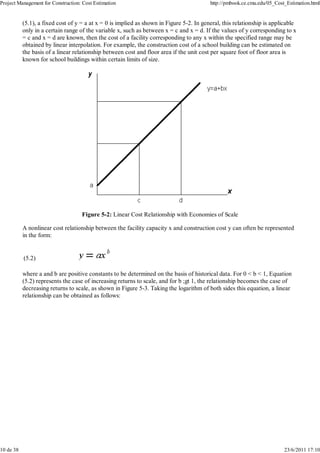
           (5.1), a fixed cost of y = a at x = 0 is implied as shown in Figure 5-2. In general, this relationship is applicable
           only in a certain range of the variable x, such as between x = c and x = d. If the values of y corresponding to x
           = c and x = d are known, then the cost of a facility corresponding to any x within the specified range may be
           obtained by linear interpolation. For example, the construction cost of a school building can be estimated on
           the basis of a linear relationship between cost and floor area if the unit cost per square foot of floor area is
           known for school buildings within certain limits of size.


                                    Figure 5-2: Linear Cost Relationship with Economies of Scale

           A nonlinear cost relationship between the facility capacity x and construction cost y can often be represented
           in the form:


           (5.2)

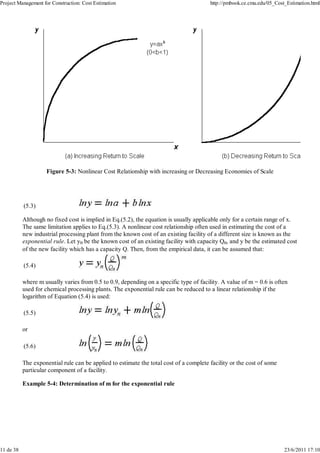
           where a and b are positive constants to be determined on the basis of historical data. For 0 < b < 1, Equation
           (5.2) represents the case of increasing returns to scale, and for b ;gt 1, the relationship becomes the case of
           decreasing returns to scale, as shown in Figure 5-3. Taking the logarithm of both sides this equation, a linear
           relationship can be obtained as follows:


10 de 38                                                                                                                  23/6/2011 17:10
Project Management for Construction: Cost Estimation                                    http://pmbook.ce.cmu.edu/05_Cost_Estimation.html


                    Figure 5-3: Nonlinear Cost Relationship with increasing or Decreasing Economies of Scale


           (5.3)

           Although no fixed cost is implied in Eq.(5.2), the equation is usually applicable only for a certain range of x.
           The same limitation applies to Eq.(5.3). A nonlinear cost relationship often used in estimating the cost of a
           new industrial processing plant from the known cost of an existing facility of a different size is known as the
           exponential rule. Let yn be the known cost of an existing facility with capacity Qn, and y be the estimated cost
           of the new facility which has a capacity Q. Then, from the empirical data, it can be assumed that:

           (5.4)

           where m usually varies from 0.5 to 0.9, depending on a specific type of facility. A value of m = 0.6 is often
           used for chemical processing plants. The exponential rule can be reduced to a linear relationship if the
           logarithm of Equation (5.4) is used:

           (5.5)

           or

           (5.6)

           The exponential rule can be applied to estimate the total cost of a complete facility or the cost of some
           particular component of a facility.

           Example 5-4: Determination of m for the exponential rule


11 de 38                                                                                                                23/6/2011 17:10
Project Management for Construction: Cost Estimation                                   http://pmbook.ce.cmu.edu/05_Cost_Estimation.html


                                   Figure 5-4: Log-Log Scale Graph of Exponential Rule Example


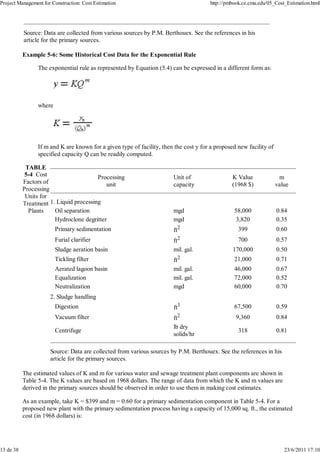
                 The empirical cost data from a number of sewage treatment plants are plotted on a log-log scale
                 for ln(Q/Qn) and ln(y/yn) and a linear relationship between these logarithmic ratios is shown in
                 Figure 5-4. For (Q/Qn) = 1 or ln(Q/Qn) = 0, ln(y/yn) = 0; and for Q/Qn = 2 or ln(Q/Qn) = 0.301,
                 ln(y/yn) = 0.1765. Since m is the slope of the line in the figure, it can be determined from the
                 geometric relation as follows:


                 For ln(y/yn) = 0.1765, y/yn = 1.5, while the corresponding value of Q/Qn is 2. In words, for m =
                 0.585, the cost of a plant increases only 1.5 times when the capacity is doubled.

           Example 5-5: Cost exponents for water and wastewater treatment plants[4]

                 The magnitude of the cost exponent m in the exponential rule provides a simple measure of the
                 economy of scale associated with building extra capacity for future growth and system reliability
                 for the present in the design of treatment plants. When m is small, there is considerable incentive
                 to provide extra capacity since scale economies exist as illustrated in Figure 5-3. When m is close
                 to 1, the cost is directly proportional to the design capacity. The value of m tends to increase as
                 the number of duplicate units in a system increases. The values of m for several types of
                 treatment plants with different plant components derived from statistical correlation of actual
                 construction costs are shown in Table 5-3.

            TABLE
              5-3                    Treatment plant                  Exponent                  Capacity range
           Estimated                      type                           m               (millions of gallons per day)
           Values of
              Cost
           Exponents 1. Water treatment                                  0.67                       1-100
           for Water 2. Waste treatment
           Treatment Primary with digestion (small)                      0.55                       0.1-10
             Plants     Primary with digestion (large)                   0.75                      0.7-100
                        Trickling filter                                 0.60                       0.1-20
                        Activated sludge                                 0.77                      0.1-100
                        Stabilization ponds                              0.57                      0.1-100


12 de 38                                                                                                                 23/6/2011 17:10
Project Management for Construction: Cost Estimation                                   http://pmbook.ce.cmu.edu/05_Cost_Estimation.html


           Source: Data are collected from various sources by P.M. Berthouex. See the references in his
           article for the primary sources.

           Example 5-6: Some Historical Cost Data for the Exponential Rule

                 The exponential rule as represented by Equation (5.4) can be expressed in a different form as:


                 where


                 If m and K are known for a given type of facility, then the cost y for a proposed new facility of
                 specified capacity Q can be readily computed.

            TABLE
            5-4 Cost                    Processing                      Unit of                  K Value              m
           Factors of                      unit                         capacity                 (1968 $)            value
           Processing
            Units for
           Treatment 1. Liquid processing
             Plants    Oil separation                                   mgd                      58,000              0.84
                       Hydroclone degritter                             mgd                       3,820              0.35
                         Primary sedimentation                          ft2                        399               0.60
                         Furial clarifier                               ft2                        700               0.57
                         Sludge aeration basin                          mil. gal.                170,000             0.50
                         Tickling filter                                ft2                      21,000              0.71
                         Aerated lagoon basin                           mil. gal.                46,000              0.67
                         Equalization                                   mil. gal.                72,000              0.52
                         Neutralization                                 mgd                      60,000              0.70
                      2. Sludge handling
                         Digestion                                      ft3                      67,500              0.59
                         Vacuum filter                                  ft2                       9,360              0.84
                                                                        lb dry
                         Centrifuge                                                                318               0.81
                                                                        solids/hr

                      Source: Data are collected from various sources by P.M. Berthouex. See the references in his
                      article for the primary sources.

           The estimated values of K and m for various water and sewage treatment plant components are shown in
           Table 5-4. The K values are based on 1968 dollars. The range of data from which the K and m values are
           derived in the primary sources should be observed in order to use them in making cost estimates.

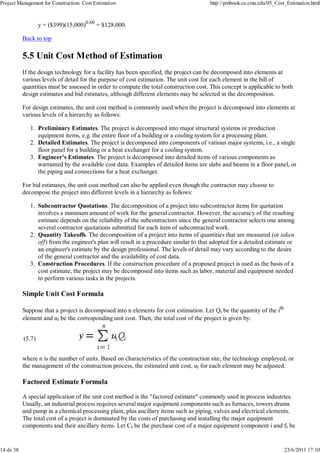
           As an example, take K = $399 and m = 0.60 for a primary sedimentation component in Table 5-4. For a
           proposed new plant with the primary sedimentation process having a capacity of 15,000 sq. ft., the estimated
           cost (in 1968 dollars) is:


13 de 38                                                                                                                23/6/2011 17:10
Project Management for Construction: Cost Estimation                                    http://pmbook.ce.cmu.edu/05_Cost_Estimation.html


                   y = ($399)(15,000)0.60 = $128,000.

           Back to top

           5.5 Unit Cost Method of Estimation
           If the design technology for a facility has been specified, the project can be decomposed into elements at
           various levels of detail for the purpose of cost estimation. The unit cost for each element in the bill of
           quantities must be assessed in order to compute the total construction cost. This concept is applicable to both
           design estimates and bid estimates, although different elements may be selected in the decomposition.

           For design estimates, the unit cost method is commonly used when the project is decomposed into elements at
           various levels of a hierarchy as follows:

              1. Preliminary Estimates. The project is decomposed into major structural systems or production
                 equipment items, e.g. the entire floor of a building or a cooling system for a processing plant.
              2. Detailed Estimates. The project is decomposed into components of various major systems, i.e., a single
                 floor panel for a building or a heat exchanger for a cooling system.
              3. Engineer's Estimates. The project is decomposed into detailed items of various components as
                 warranted by the available cost data. Examples of detailed items are slabs and beams in a floor panel, or
                 the piping and connections for a heat exchanger.

           For bid estimates, the unit cost method can also be applied even though the contractor may choose to
           decompose the project into different levels in a hierarchy as follows:

              1. Subcontractor Quotations. The decomposition of a project into subcontractor items for quotation
                 involves a minimum amount of work for the general contractor. However, the accuracy of the resulting
                 estimate depends on the reliability of the subcontractors since the general contractor selects one among
                 several contractor quotations submitted for each item of subcontracted work.
              2. Quantity Takeoffs. The decomposition of a project into items of quantities that are measured (or taken
                 off) from the engineer's plan will result in a procedure similar to that adopted for a detailed estimate or
                 an engineer's estimate by the design professional. The levels of detail may vary according to the desire
                 of the general contractor and the availability of cost data.
              3. Construction Procedures. If the construction procedure of a proposed project is used as the basis of a
                 cost estimate, the project may be decomposed into items such as labor, material and equipment needed
                 to perform various tasks in the projects.

           Simple Unit Cost Formula

           Suppose that a project is decomposed into n elements for cost estimation. Let Qi be the quantity of the ith
           element and ui be the corresponding unit cost. Then, the total cost of the project is given by:


           (5.7)


           where n is the number of units. Based on characteristics of the construction site, the technology employed, or
           the management of the construction process, the estimated unit cost, ui for each element may be adjusted.

           Factored Estimate Formula

           A special application of the unit cost method is the "factored estimate" commonly used in process industries.
           Usually, an industrial process requires several major equipment components such as furnaces, towers drums
           and pump in a chemical processing plant, plus ancillary items such as piping, valves and electrical elements.
           The total cost of a project is dominated by the costs of purchasing and installing the major equipment
           components and their ancillary items. Let Ci be the purchase cost of a major equipment component i and fi be


14 de 38                                                                                                                 23/6/2011 17:10
Project Management for Construction: Cost Estimation                                      http://pmbook.ce.cmu.edu/05_Cost_Estimation.html


           a factor accounting for the cost of ancillary items needed for the installation of this equipment component i.
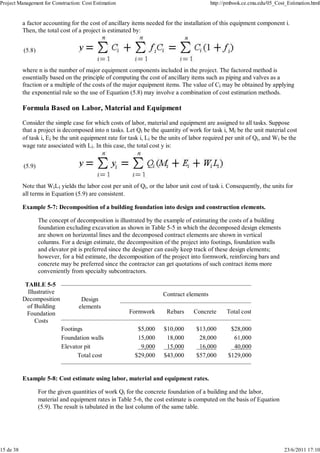
           Then, the total cost of a project is estimated by:


           (5.8)


           where n is the number of major equipment components included in the project. The factored method is
           essentially based on the principle of computing the cost of ancillary items such as piping and valves as a
           fraction or a multiple of the costs of the major equipment items. The value of Ci may be obtained by applying
           the exponential rule so the use of Equation (5.8) may involve a combination of cost estimation methods.

           Formula Based on Labor, Material and Equipment

           Consider the simple case for which costs of labor, material and equipment are assigned to all tasks. Suppose
           that a project is decomposed into n tasks. Let Qi be the quantity of work for task i, Mi be the unit material cost
           of task i, Ei be the unit equipment rate for task i, Li be the units of labor required per unit of Qi, and Wi be the
           wage rate associated with Li. In this case, the total cost y is:


           (5.9)


           Note that WiLi yields the labor cost per unit of Qi, or the labor unit cost of task i. Consequently, the units for
           all terms in Equation (5.9) are consistent.

           Example 5-7: Decomposition of a building foundation into design and construction elements.

                   The concept of decomposition is illustrated by the example of estimating the costs of a building
                   foundation excluding excavation as shown in Table 5-5 in which the decomposed design elements
                   are shown on horizontal lines and the decomposed contract elements are shown in vertical
                   columns. For a design estimate, the decomposition of the project into footings, foundation walls
                   and elevator pit is preferred since the designer can easily keep track of these design elements;
                   however, for a bid estimate, the decomposition of the project into formwork, reinforcing bars and
                   concrete may be preferred since the contractor can get quotations of such contract items more
                   conveniently from specialty subcontractors.

            TABLE 5-5
             Illustrative                                             Contract elements
           Decomposition            Design
             of Building           elements
            Foundation                                  Formwork       Rebars      Concrete      Total cost
                Costs
                            Footings                       $5,000     $10,000       $13,000       $28,000
                            Foundation walls               15,000      18,000        28,000        61,000
                            Elevator pit                    9,000      15,000        16,000        40,000
                                  Total cost              $29,000     $43,000       $57,000      $129,000


           Example 5-8: Cost estimate using labor, material and equipment rates.

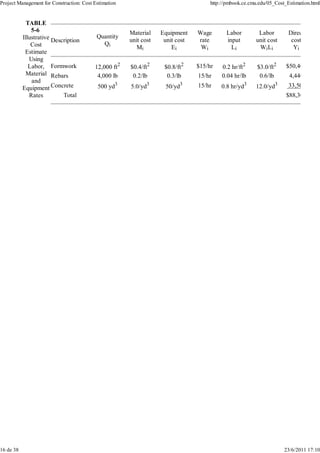
                   For the given quantities of work Qi for the concrete foundation of a building and the labor,
                   material and equipment rates in Table 5-6, the cost estimate is computed on the basis of Equation
                   (5.9). The result is tabulated in the last column of the same table.


15 de 38                                                                                                                  23/6/2011 17:10
Project Management for Construction: Cost Estimation                                 http://pmbook.ce.cmu.edu/05_Cost_Estimation.html


             TABLE
               5-6                                     Material    Equipment    Wage        Labor         Labor        Direct
           Illustrative Description        Quantity
                                                       unit cost    unit cost   rate        input        unit cost      cost
               Cost                          Qi
                                                          Mi           Ei        Wi           Li          Wi Li          Yi
            Estimate
              Using
              Labor, Formwork             12,000 ft2   $0.4/ft2     $0.8/ft2    $15/hr    0.2 hr/ft2     $3.0/ft2     $50,400
            Material Rebars                4,000 lb     0.2/lb       0.3/lb     15/hr     0.04 hr/lb      0.6/lb       4,440
               and                                 3          3           3                         3            3
           Equipment Concrete              500 yd      5.0/yd       50/yd       15/hr    0.8 hr/yd       12.0/yd       33,500
              Rates         Total                                                                                     $88,300


16 de 38                                                                                                             23/6/2011 17:10
Project Management for Construction: Cost Estimation                                        http://pmbook.ce.cmu.edu/05_Cost_Estimation.html


           Back to top

           5.6 Methods for Allocation of Joint Costs
           The principle of allocating joint costs to various elements in a project is often used in cost estimating. Because
           of the difficulty in establishing casual relationship between each element and its associated cost, the joint costs
           are often prorated in proportion to the basic costs for various elements.

           One common application is found in the allocation of field supervision cost among the basic costs of various
           elements based on labor, material and equipment costs, and the allocation of the general overhead cost to
           various elements according to the basic and field supervision cost. Suppose that a project is decomposed into n
           tasks. Let y be the total basic cost for the project and yi be the total basic cost for task i. If F is the total field
           supervision cost and Fi is the proration of that cost to task i, then a typical proportional allocation is:

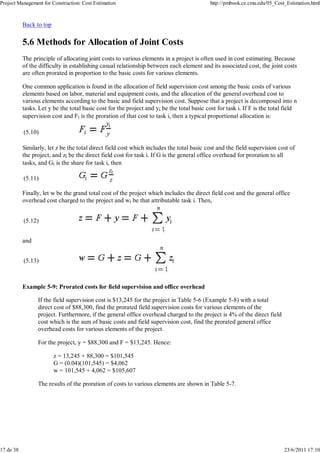
           (5.10)

           Similarly, let z be the total direct field cost which includes the total basic cost and the field supervision cost of
           the project, and zi be the direct field cost for task i. If G is the general office overhead for proration to all
           tasks, and Gi is the share for task i, then

           (5.11)

           Finally, let w be the grand total cost of the project which includes the direct field cost and the general office
           overhead cost charged to the project and wi be that attributable task i. Then,


           (5.12)


           and


           (5.13)


           Example 5-9: Prorated costs for field supervision and office overhead

                 If the field supervision cost is $13,245 for the project in Table 5-6 (Example 5-8) with a total
                 direct cost of $88,300, find the prorated field supervision costs for various elements of the
                 project. Furthermore, if the general office overhead charged to the project is 4% of the direct field
                 cost which is the sum of basic costs and field supervision cost, find the prorated general office
                 overhead costs for various elements of the project.

                 For the project, y = $88,300 and F = $13,245. Hence:

                         z = 13,245 + 88,300 = $101,545
                         G = (0.04)(101,545) = $4,062
                         w = 101,545 + 4,062 = $105,607

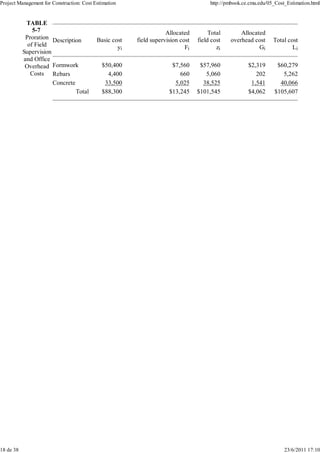
                 The results of the proration of costs to various elements are shown in Table 5-7.


17 de 38                                                                                                                    23/6/2011 17:10
Project Management for Construction: Cost Estimation                                  http://pmbook.ce.cmu.edu/05_Cost_Estimation.html


            TABLE
               5-7                                                  Allocated         Total       Allocated
            Proration Description          Basic cost   field supervision cost   field cost   overhead cost      Total cost
             of Field                              yi                       Fi           zi              Gi              Li
           Supervision
           and Office
            Overhead Formwork                $50,400                  $7,560      $57,960             $2,319       $60,279
              Costs Rebars                     4,400                     660        5,060                202         5,262
                       Concrete               33,500                   5,025       38,525              1,541        40,066
                                Total        $88,300                 $13,245     $101,545             $4,062      $105,607


18 de 38                                                                                                              23/6/2011 17:10
Project Management for Construction: Cost Estimation                                    http://pmbook.ce.cmu.edu/05_Cost_Estimation.html


           Example 5-10: A standard cost report for allocating overhead

                 The reliance on labor expenses as a means of allocating overhead burdens in typical management
                 accounting systems can be illustrated by the example of a particular product's standard cost
                 sheet. [5] Table 5-8 is an actual product's standard cost sheet of a company following the
                 procedure of using overhead burden rates assessed per direct labor hour. The material and labor
                 costs for manufacturing a type of valve were estimated from engineering studies and from current
                 material and labor prices. These amounts are summarized in Columns 2 and 3 of Table 5-8. The
                 overhead costs shown in Column 4 of Table 5-8 were obtained by allocating the expenses of
                 several departments to the various products manufactured in these departments in proportion to
                 the labor cost. As shown in the last line of the table, the material cost represents 29% of the total
                 cost, while labor costs are 11% of the total cost. The allocated overhead cost constitutes 60% of
                 the total cost. Even though material costs exceed labor costs, only the labor costs are used in
                 allocating overhead. Although this type of allocation method is common in industry, the arbitrary
                 allocation of joint costs introduces unintended cross subsidies among products and may produce
                 adverse consequences on sales and profits. For example, a particular type of part may incur few
                 overhead expenses in practice, but this phenomenon would not be reflected in the standard cost
                 report.

           TABLE
             5-8                                 (1) Material cost (2) Labor cost (3) Overhead cost (4) Total cost
           Standard
             Cost
            Report Purchased part                        $1.1980                                         $1.1980
             for a Operation
           Type of Drill, face, tap (2)                                  $0.0438           $0.2404       $0.2842
            Valve    Degrease                                             0.0031            0.0337        0.0368
                     Remove burs                                          0.0577            0.3241        0.3818
                       Total cost, this item              1.1980          0.1046            0.5982        1.9008
                     Other subassemblies                  0.3523          0.2994            1.8519        2.4766
                       Total cost, subassemblies          1.5233          0.4040            2.4501        4.3773
                     Assemble and test                                    0.1469            0.4987        0.6456
                     Pack without paper                                   0.0234            0.1349        0.1583
                       Total cost, this item             $1.5233         $0.5743           $3.0837       $5.1813
                    Cost component, %                        29%            11%               60%           100%

                    Source: H. T. Johnson and R. S. Kaplan, Relevance lost: The Rise and Fall of Management
                    Accounting, Harvard Business School Press, Boston. Reprinted with permission.

           Back to top

           5.7 Historical Cost Data
           Preparing cost estimates normally requires the use of historical data on construction costs. Historical cost data
           will be useful for cost estimation only if they are collected and organized in a way that is compatible with
           future applications. Organizations which are engaged in cost estimation continually should keep a file for their
           own use. The information must be updated with respect to changes that will inevitably occur. The format of
           cost data, such as unit costs for various items, should be organized according to the current standard of usage
           in the organization.

           Construction cost data are published in various forms by a number of organizations. These publications are
           useful as references for comparison. Basically, the following types of information are available:


19 de 38                                                                                                                 23/6/2011 17:10
Project Management for Construction: Cost Estimation                                        http://pmbook.ce.cmu.edu/05_Cost_Estimation.html


                 Catalogs of vendors' data on important features and specifications relating to their products for which
                 cost quotations are either published or can be obtained. A major source of vendors' information for
                 building products is Sweets' Catalog published by McGraw-Hill Information Systems Company.
                 Periodicals containing construction cost data and indices. One source of such information is ENR, the
                 McGraw-Hill Construction Weekly, which contains extensive cost data including quarterly cost reports.
                 Cost Engineering, a journal of the American Society of Cost Engineers, also publishes useful cost data
                 periodically.
                 Commercial cost reference manuals for estimating guides. An example is the Building Construction
                 Cost Data published annually by R.S. Means Company, Inc., which contains unit prices on building
                 construction items. Dodge Manual for Building Construction, published by McGraw-Hill, provides
                 similar information.
                 Digests of actual project costs. The Dodge Digest of Building Costs and Specifications provides
                 descriptions of design features and costs of actual projects by building type. Once a week, ENR
                 publishes the bid prices of a project chosen from all types of construction projects.

           Historical cost data must be used cautiously. Changes in relative prices may have substantial impacts on
           construction costs which have increased in relative price. Unfortunately, systematic changes over a long
           period of time for such factors are difficult to predict. Errors in analysis also serve to introduce uncertainty
           into cost estimates. It is difficult, of course, to foresee all the problems which may occur in construction and
           operation of facilities. There is some evidence that estimates of construction and operating costs have tended
           to persistently understate the actual costs. This is due to the effects of greater than anticipated increases in
           costs, changes in design during the construction process, or overoptimism.

           Since the future prices of constructed facilities are influenced by many uncertain factors, it is important to
           recognize that this risk must be borne to some degree by all parties involved, i.e., the owner, the design
           professionals, the construction contractors, and the financing institution. It is to the best interest of all parties
           that the risk sharing scheme implicit in the design/construct process adopted by the owner is fully understood
           by all. When inflation adjustment provisions have very different risk implications to various parties, the price
           level changes will also be treated differently for various situations. Back to top

           5.8 Cost Indices
           Since historical cost data are often used in making cost estimates, it is important to note the price level
           changes over time. Trends in price changes can also serve as a basis for forecasting future costs. The input
           price indices of labor and/or material reflect the price level changes of such input components of construction;
           the output price indices, where available, reflect the price level changes of the completed facilities, thus to
           some degree also measuring the productivity of construction.

           A price index is a weighted aggregate measure of constant quantities of goods and services selected for the
           package. The price index at a subsequent year represents a proportionate change in the same weighted
           aggregate measure because of changes in prices. Let lt be the price index in year t, and lt+1 be the price index
           in the following year t+1. Then, the percent change in price index for year t+1 is:

           (5.14)

           or

           (5.15)

           If the price index at the base year t=0 is set at a value of 100, then the price indices l1, l2...ln for the
           subsequent years t=1,2...n can be computed successively from changes in the total price charged for the
           package of goods measured in the index.

           The best-known indicators of general price changes are the Gross Domestic Product (GDP) deflators compiled
           periodically by the U.S. Department of Commerce, and the consumer price index (CPI) compiled periodically
           by the U.S. Department of Labor. They are widely used as broad gauges of the changes in production costs


20 de 38                                                                                                                    23/6/2011 17:10
Project Management for Construction: Cost Estimation                                       http://pmbook.ce.cmu.edu/05_Cost_Estimation.html


           and in consumer prices for essential goods and services. Special price indices related to construction are also
           collected by industry sources since some input factors for construction and the outputs from construction may
           disproportionately outpace or fall behind the general price indices. Examples of special price indices for
           construction input factors are the wholesale Building Material Price and Building Trades Union Wages, both
           compiled by the U.S. Department of Labor. In addition, the construction cost index and the building cost index
           are reported periodically in the Engineering News-Record (ENR). Both ENR cost indices measure the effects
           of wage rate and material price trends, but they are not adjusted for productivity, efficiency, competitive
           conditions, or technology changes. Consequently, all these indices measure only the price changes of
           respective construction input factors as represented by constant quantities of material and/or labor. On the
           other hand, the price indices of various types of completed facilities reflect the price changes of construction
           output including all pertinent factors in the construction process. The building construction output indices
           compiled by Turner Construction Company and Handy-Whitman Utilities are compiled in the U.S. Statistical
           Abstracts published each year.

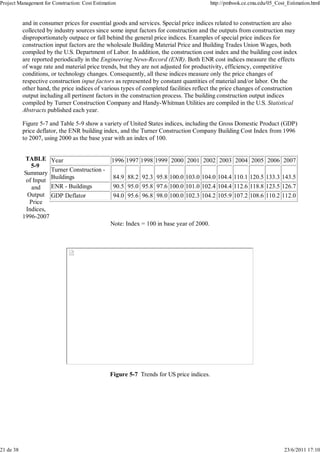
           Figure 5-7 and Table 5-9 show a variety of United States indices, including the Gross Domestic Product (GDP)
           price deflator, the ENR building index, and the Turner Construction Company Building Cost Index from 1996
           to 2007, using 2000 as the base year with an index of 100.


            TABLE Year                            1996 1997 1998 1999 2000 2001 2002 2003 2004 2005 2006 2007
               5-9
                      Turner Construction -
            Summary
                      Buildings                   84.9 88.2 92.3 95.8 100.0 103.0 104.0 104.4 110.1 120.5 133.3 143.5
             of Input
               and    ENR - Buildings             90.5 95.0 95.8 97.6 100.0 101.0 102.4 104.4 112.6 118.8 123.5 126.7
              Output GDP Deflator                 94.0 95.6 96.8 98.0 100.0 102.3 104.2 105.9 107.2 108.6 110.2 112.0
              Price
             Indices,
           1996-2007
                                                 Note: Index = 100 in base year of 2000.


                                                 Figure 5-7 Trends for US price indices.


21 de 38                                                                                                                   23/6/2011 17:10
Project Management for Construction: Cost Estimation                                        http://pmbook.ce.cmu.edu/05_Cost_Estimation.html


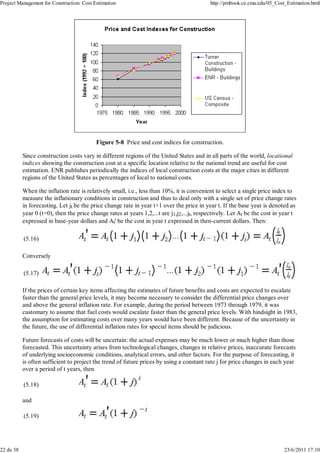
                                           Figure 5-8 Price and cost indices for construction.

           Since construction costs vary in different regions of the United States and in all parts of the world, locational
           indices showing the construction cost at a specific location relative to the national trend are useful for cost
           estimation. ENR publishes periodically the indices of local construction costs at the major cities in different
           regions of the United States as percentages of local to national costs.

           When the inflation rate is relatively small, i.e., less than 10%, it is convenient to select a single price index to
           measure the inflationary conditions in construction and thus to deal only with a single set of price change rates
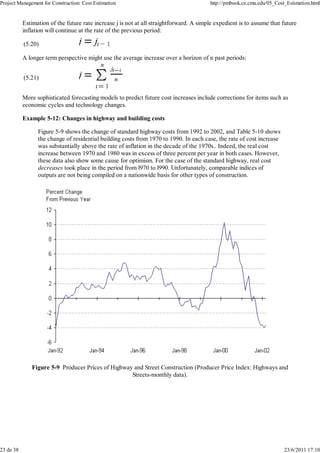
           in forecasting. Let jt be the price change rate in year t+1 over the price in year t. If the base year is denoted as
           year 0 (t=0), then the price change rates at years 1,2,...t are j1,j2,...jt, respectively. Let At be the cost in year t
           expressed in base-year dollars and At' be the cost in year t expressed in then-current dollars. Then:

           (5.16)

           Conversely

           (5.17)

           If the prices of certain key items affecting the estimates of future benefits and costs are expected to escalate
           faster than the general price levels, it may become necessary to consider the differential price changes over
           and above the general inflation rate. For example, during the period between 1973 through 1979, it was
           customary to assume that fuel costs would escalate faster than the general price levels. With hindsight in 1983,
           the assumption for estimating costs over many years would have been different. Because of the uncertainty in
           the future, the use of differential inflation rates for special items should be judicious.

           Future forecasts of costs will be uncertain: the actual expenses may be much lower or much higher than those
           forecasted. This uncertainty arises from technological changes, changes in relative prices, inaccurate forecasts
           of underlying socioeconomic conditions, analytical errors, and other factors. For the purpose of forecasting, it
           is often sufficient to project the trend of future prices by using a constant rate j for price changes in each year
           over a period of t years, then

           (5.18)

           and

           (5.19)


22 de 38                                                                                                                    23/6/2011 17:10
Project Management for Construction: Cost Estimation                                     http://pmbook.ce.cmu.edu/05_Cost_Estimation.html


           Estimation of the future rate increase j is not at all straightforward. A simple expedient is to assume that future
           inflation will continue at the rate of the previous period:

           (5.20)

           A longer term perspective might use the average increase over a horizon of n past periods:


           (5.21)


           More sophisticated forecasting models to predict future cost increases include corrections for items such as
           economic cycles and technology changes.

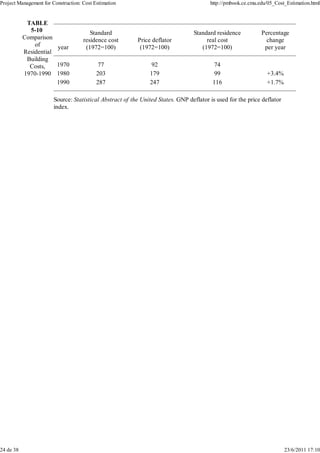
           Example 5-12: Changes in highway and building costs

                 Figure 5-9 shows the change of standard highway costs from 1992 to 2002, and Table 5-10 shows
                 the change of residential building costs from 1970 to 1990. In each case, the rate of cost increase
                 was substantially above the rate of inflation in the decade of the 1970s.. Indeed, the real cost
                 increase between 1970 and 1980 was in excess of three percent per year in both cases. However,
                 these data also show some cause for optimism. For the case of the standard highway, real cost
                 decreases took place in the period from l970 to l990. Unfortunately, comparable indices of
                 outputs are not being compiled on a nationwide basis for other types of construction.


              Figure 5-9 Producer Prices of Highway and Street Construction (Producer Price Index: Highways and
                                                   Streets-monthly data).


23 de 38                                                                                                                 23/6/2011 17:10
Project Management for Construction: Cost Estimation                                    http://pmbook.ce.cmu.edu/05_Cost_Estimation.html


            TABLE
             5-10                       Standard                                 Standard residence           Percentage
           Comparison                residence cost       Price deflator              real cost                 change
               of      year           (1972=100)           (1972=100)               (1972=100)                 per year
           Residential
            Building
             Costs,    1970                77                  92                        74
           1970-1990 1980                  203                 179                       99                     +3.4%
                       1990                287                 247                       116                    +1.7%

                        Source: Statistical Abstract of the United States. GNP deflator is used for the price deflator
                        index.


24 de 38                                                                                                                 23/6/2011 17:10
Project Management for Construction: Cost Estimation                                    http://pmbook.ce.cmu.edu/05_Cost_Estimation.html


           Back to top

           5.9 Applications of Cost Indices to Estimating
           In the screening estimate of a new facility, a single parameter is often used to describe a cost function. For
           example, the cost of a power plant is a function of electricity generating capacity expressed in megawatts, or
           the cost of a sewage treatment plant as a function of waste flow expressed in million gallons per day.

           The general conditions for the application of the single parameter cost function for screening estimates are:

              1. Exclude special local conditions in historical data
              2. Determine new facility cost on basis of specified size or capacity (using the methods described in
                 Sections 5.3 to 5.6)
              3. Adjust for inflation index
              4. Adjust for local index of construction costs
              5. Adjust for different regulatory constraints
              6. Adjust for local factors for the new facility

           Some of these adjustments may be done using compiled indices, whereas others may require field investigation
           and considerable professional judgment to reflect differences between a given project and standard projects
           performed in the past.

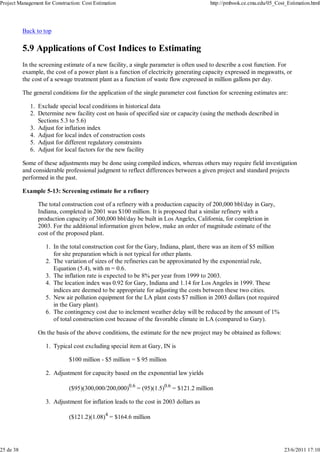
           Example 5-13: Screening estimate for a refinery

                 The total construction cost of a refinery with a production capacity of 200,000 bbl/day in Gary,
                 Indiana, completed in 2001 was $100 million. It is proposed that a similar refinery with a
                 production capacity of 300,000 bbl/day be built in Los Angeles, California, for completion in
                 2003. For the additional information given below, make an order of magnitude estimate of the
                 cost of the proposed plant.

                    1. In the total construction cost for the Gary, Indiana, plant, there was an item of $5 million
                       for site preparation which is not typical for other plants.
                    2. The variation of sizes of the refineries can be approximated by the exponential rule,
                       Equation (5.4), with m = 0.6.
                    3. The inflation rate is expected to be 8% per year from 1999 to 2003.
                    4. The location index was 0.92 for Gary, Indiana and 1.14 for Los Angeles in 1999. These
                       indices are deemed to be appropriate for adjusting the costs between these two cities.
                    5. New air pollution equipment for the LA plant costs $7 million in 2003 dollars (not required
                       in the Gary plant).
                    6. The contingency cost due to inclement weather delay will be reduced by the amount of 1%
                       of total construction cost because of the favorable climate in LA (compared to Gary).

                 On the basis of the above conditions, the estimate for the new project may be obtained as follows:

                    1. Typical cost excluding special item at Gary, IN is

                              $100 million - $5 million = $ 95 million

                    2. Adjustment for capacity based on the exponential law yields

                              ($95)(300,000/200,000)0.6 = (95)(1.5)0.6 = $121.2 million

                    3. Adjustment for inflation leads to the cost in 2003 dollars as

                              ($121.2)(1.08)4 = $164.6 million


25 de 38                                                                                                                23/6/2011 17:10
Project Management for Construction: Cost Estimation                                    http://pmbook.ce.cmu.edu/05_Cost_Estimation.html


                    4. Adjustment for location index gives

                              ($164.6)(1.14/0.92) = $204.6 million

                    5. Adjustment for new pollution equipment at the LA plant gives

                              $204.6 + $7 = $211.6 million

                    6. Reduction in contingency cost yields

                              ($211.6)(1-0.01) = $209.5 million

                 Since there is no adjustment for the cost of construction financing, the order of magnitude
                 estimate for the new project is $209.5 million.

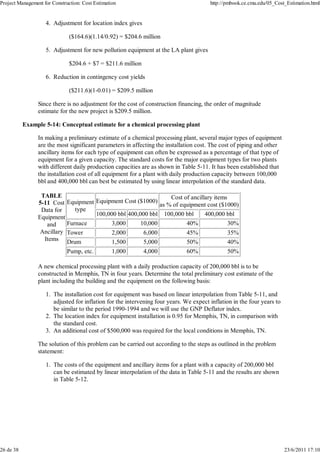
           Example 5-14: Conceptual estimate for a chemical processing plant

                 In making a preliminary estimate of a chemical processing plant, several major types of equipment
                 are the most significant parameters in affecting the installation cost. The cost of piping and other
                 ancillary items for each type of equipment can often be expressed as a percentage of that type of
                 equipment for a given capacity. The standard costs for the major equipment types for two plants
                 with different daily production capacities are as shown in Table 5-11. It has been established that
                 the installation cost of all equipment for a plant with daily production capacity between 100,000
                 bbl and 400,000 bbl can best be estimated by using linear interpolation of the standard data.

                  TABLE                                         Cost of ancillary items
                 5-11 Cost Equipment Equipment Cost ($1000) as % of equipment cost ($1000)
                  Data for     type
                                     100,000 bbl 400,000 bbl 100,000 bbl      400,000 bbl
                 Equipment
                    and     Furnace        3,000      10,000          40%               30%
                  Ancillary Tower          2,000       6,000          45%               35%
                   Items Drum              1,500       5,000          50%               40%
                              Pump, etc.          1,000      4,000            60%              50%

                 A new chemical processing plant with a daily production capacity of 200,000 bbl is to be
                 constructed in Memphis, TN in four years. Determine the total preliminary cost estimate of the
                 plant including the building and the equipment on the following basis:

                    1. The installation cost for equipment was based on linear interpolation from Table 5-11, and
                       adjusted for inflation for the intervening four years. We expect inflation in the four years to
                       be similar to the period 1990-1994 and we will use the GNP Deflator index.
                    2. The location index for equipment installation is 0.95 for Memphis, TN, in comparison with
                       the standard cost.
                    3. An additional cost of $500,000 was required for the local conditions in Memphis, TN.

                 The solution of this problem can be carried out according to the steps as outlined in the problem
                 statement:

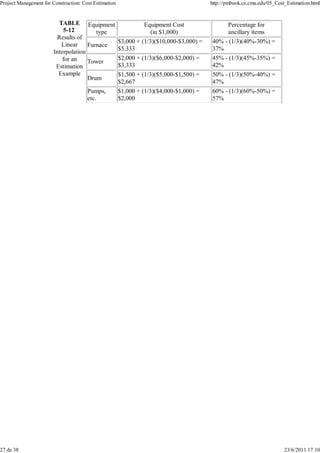
                    1. The costs of the equipment and ancillary items for a plant with a capacity of 200,000 bbl
                       can be estimated by linear interpolation of the data in Table 5-11 and the results are shown
                       in Table 5-12.


26 de 38                                                                                                                 23/6/2011 17:10
Project Management for Construction: Cost Estimation                                      http://pmbook.ce.cmu.edu/05_Cost_Estimation.html


                          TABLE Equipment                        Equipment Cost                Percentage for
                            5-12         type                       (in $1,000)                 ancillary items
                          Results of
                                                       $3,000 + (1/3)($10,000-$3,000) =   40% - (1/3)(40%-30%) =
                           Linear     Furnace
                                                       $5,333                             37%
                        Interpolation
                            for an                     $2,000 + (1/3)($6,000-$2,000) =    45% - (1/3)(45%-35%) =
                                      Tower
                         Estimation                    $3,333                             42%
                          Example                      $1,500 + (1/3)($5,000-$1,500) =    50% - (1/3)(50%-40%) =
                                      Drum
                                                       $2,667                             47%
                                       Pumps,          $1,000 + (1/3)($4,000-$1,000) =    60% - (1/3)(60%-50%) =
                                       etc.            $2,000                             57%


27 de 38                                                                                                                  23/6/2011 17:10
Project Management for Construction: Cost Estimation                                        http://pmbook.ce.cmu.edu/05_Cost_Estimation.html


                         Hence, the total project cost in thousands of current dollars is given by Equation (5.8) as:

                               ($5,333)(1.37) + ($3,333)(1.42) +($2,667)(1.47) + ($2,000)(1.57) =
                               = $2,307 + $4,733 + $3,920 + $3,140 = $ 19,000

                    2. The corresponding cost in thousands of four year in the future dollars using Equation (5.16)
                       and Table 5-9 is:

                               ($19,100)(105/94) = $21,335

                    3. The total cost of the project after adjustment for location is

                               (0.95)($21,335,000) + $500,000 $20,800,000

           Back to top

           5.10 Estimate Based on Engineer's List of Quantities
           The engineer's estimate is based on a list of items and the associated quantities from which the total
           construction cost is derived. This same list is also made available to the bidders if unit prices of the items on
           the list are also solicited from the bidders. Thus, the itemized costs submitted by the winning contractor may
           be used as the starting point for budget control.

           In general, the progress payments to the contractor are based on the units of work completed and the
           corresponding unit prices of the work items on the list. Hence, the estimate based on the engineers' list of
           quanitities for various work items essentially defines the level of detail to which subsequent measures of
           progress for the project will be made.

           Example 5-15: Bid estimate based on engineer's list of quantities

                 Using the unit prices in the bid of contractor 1 for the quantitites specified by the engineer in
                 Table 5-2 (Example 5-3), we can compute the total bid price of contractor 1 for the roadway
                 project. The itemized costs for various work items as well as the total bid price are shown in Table
                 5-13.


            TABLE
                                          Items                            Unit     Quantity        Unit price      Item cost
           5-13: Bid
            Price of Mobilization                                         ls      1               115,000         115,000
           Contractor Removal, berm                                       lf      8,020           1.00            8.020
              1 in a Finish subgrade                                      sy      1,207,500       0.50            603,750
            Highway
             Project Surface ditches                                      lf      525             2.00            1,050
                      Excavation structures                               cy      7,000           3.00            21,000
                       Base course, untreated, 3/4''                      ton     362,200         4.50            1,629,900
                        Lean concrete, 4'' thick                          sy      820,310         3.10            2,542,961
                       PCC, pavement, 10'' thick                          sy      76,010          10.90           7,695,509
                       Concrete, ci AA (AE)                               ls      1               200,000         200,000
                        Small structure                                   cy      50              500             25,000
                         Barrier, precast                                 lf      7,920           15.00           118,800
                         Flatwork, 4'' thick                              sy      7,410           10.00           74,100
                         10'' thick                                       sy      4,241           20.00           84,820
                         Slope protection                                 sy      2,104           25.00           52,600


28 de 38                                                                                                                    23/6/2011 17:10
Project Management for Construction: Cost Estimation                   http://pmbook.ce.cmu.edu/05_Cost_Estimation.html


                 Metal, end section, 15''              ea    39        100             3,900
                   18''                                ea    3         150             450
                   Post, right-of-way, modification    lf    4,700     3.00            14,100
                 Salvage and relay pipe                lf    1,680     5.00            8,400
                 Loose riprap                          cy    32        40.00           1,280
                 Braced posts                          ea    54        100             5,400
                 Delineators, type I                   lb    1,330     12.00           15,960
                  type II                              ea    140       15.00           2,100
                 Constructive signs fixed              sf    52,600    0.10            5,260
                  Barricades, type III                 lf    29,500    0.20            5,900
                 Warning lights                        day   6,300     0.10            630
                 Pavement marking, epoxy material
                   Black                               gal   475       90.00           42,750
                   Yellow                              gal   740       90.00           66,600
                   White                               gal   985       90.00           88,650
                   Plowable, one-way white             ea    342       50.00           17,100
                 Topsoil, contractor furnished         cy    260       10.00           2,600
                 Seedling, method A                    acr   103       150             15,450
                 Excelsior blanket                     sy    500       2.00            1,000
                 Corrugated, metal pipe, 18''          lf    580       20.00           11,600
                 Polyethylene pipe, 12''               lf    2,250     15.00           33,750
                 Catch basin grate and frame           ea    35        350             12,250
                 Equal opportunity training            hr    18,000    0.80            14,400
                 Granular backfill borrow              cy    274       10.00           2,740
                 Drill caisson, 2'x6''                 lf    722       100             72,200
                 Flagging                              hr    20,000    8.25            165,000
                 Prestressed concrete member
                  type IV, 141'x4''                    ea    7         12,000          84,000
                  132'x4''                             ea    6         11,000          66,000
                 Reinforced steel                      lb    6,300     0.60            3,780
                   Epoxy coated                        lb    122,241   0.55            67,232.55
                 Structural steel                      ls    1         5,000           5,000
                 Sign, covering                        sf    16        10.00           160
                   type C-2 wood post                  sf    98        15.00           1,470
                   24''                                ea    3         100             300
                   30''                                ea    2         100             200
                   48''                                ea    11        200             2,200
                   Auxiliary                           sf    61        15.00           915
                   Steel post, 48''x60''               ea    11        500             5,500
                   type 3, wood post                   sf    669       15.00           10,035
                   24''                                ea    23        100             2,300
                   30''                                ea    1         100             100
                   36''                                ea    12        150             1,800
                   42''x60''                           ea    8         150             1,200


29 de 38                                                                                               23/6/2011 17:10
Project Management for Construction: Cost Estimation                                    http://pmbook.ce.cmu.edu/05_Cost_Estimation.html


                   48''                                            ea      7             200            1,400
                   Auxiliary                                       sf      135           15.00          2,025
                   Steel post                                      sf      1,610         40.00          64,400
                   12''x36''                                       ea      28            100            2,800
                  Foundation, concrete                             ea      60            300            18,000
                 Barricade, 48''x42''                              ea      40            100            4,000
                   Wood post, road closed                          lf      100           30.00          3,000
                                     Total                                                            $14,129,797.55


                                                             Back to top

                               5.11 Allocation of Construction Costs Over Time
             Since construction costs are incurred over the entire construction phase of a project, it is often necessary to
               determine the amounts to be spent in various periods to derive the cash flow profile, especially for large
            projects with long durations. Consequently, it is important to examine the percentage of work expected to be
              completed at various time periods to which the costs would be charged. More accurate estimates may be
            accomplished once the project is scheduled as described in Chapter 10, but some rough estimate of the cash
                                               flow may be required prior to this time.

               Consider the basic problem in determining the percentage of work completed during construction. One
           common method of estimating percentage of completion is based on the amount of money spent relative to the
             total amount budgeted for the entire project. This method has the obvious drawback in assuming that the
              amount of money spent has been used efficiently for production. A more reliable method is based on the
            concept of value of work completed which is defined as the product of the budgeted labor hours per unit of
           production and the actual number of production units completed, and is expressed in budgeted labor hours for
               the work completed. Then, the percentage of completion at any stage is the ratio of the value of work
            completed to date and the value of work to be completed for the entire project. Regardless of the method of
           measurement, it is informative to understand the trend of work progress during construction for evaluation and
                                                               control.

                In general, the work on a construction project progresses gradually from the time of mobilization until it
            reaches a plateau; then the work slows down gradually and finally stops at the time of completion. The rate of
               work done during various time periods (expressed in the percentage of project cost per unit time) is shown
               schematically in Figure 5-10 in which ten time periods have been assumed. The solid line A represents the
               case in which the rate of work is zero at time t = 0 and increases linearly to 12.5% of project cost at t = 2,
            while the rate begins to decrease from 12.5% at t = 8 to 0% at t = 10. The dotted line B represents the case of
             rapid mobilization by reaching 12.5% of project cost at t = 1 while beginning to decrease from 12.5% at t = 7
           to 0% at t = 10. The dash line C represents the case of slow mobilization by reaching 12.5% of project cost at t
                                  = 3 while beginning to decrease from 12.5% at t = 9 to 0% at t = 10.


30 de 38                                                                                                                23/6/2011 17:10
Project Management for Construction: Cost Estimation                                  http://pmbook.ce.cmu.edu/05_Cost_Estimation.html


                                        Figure 5-10: Rate of Work Progress over Project Time


           The value of work completed at a given time (expressed as a cumulative percentage of project cost) is shown
           schematically in Figure 5-11. In each case (A, B or C), the value of work completed can be represented by an
             "S-shaped" curve. The effects of rapid mobilization and slow mobilization are indicated by the positions of
                                          curves B and C relative to curve A, respectively.


                                      Figure 5-11: Value of Work Completed over Project Time


           While the curves shown in Figures 5-10 and 5-11 represent highly idealized cases, they do suggest the latitude
           for adjusting the schedules for various activities in a project. While the rate of work progress may be changed
            quite drastically within a single period, such as the change from rapid mobilization to a slow mobilization in
               periods 1, 2 and 3 in Figure 5-10, the effect on the value of work completed over time will diminish in
            significance as indicated by the cumulative percentages for later periods in Figure 5-11. Thus, adjustment of
           the scheduling of some activities may improve the utilization of labor, material and equipment, and any delay
            caused by such adjustments for individual activities is not likely to cause problems for the eventual progress


31 de 38                                                                                                              23/6/2011 17:10
Project Management for Construction: Cost Estimation                                         http://pmbook.ce.cmu.edu/05_Cost_Estimation.html


                                                       toward the completion of a project.

            In addition to the speed of resource mobilization, another important consideration is the overall duration of a
           project and the amount of resources applied. Various strategies may be applied to shorten the overall duration
           of a project such as overlapping design and construction activities (as described in Chapter 2) or increasing the
             peak amounts of labor and equipment working on a site. However, spatial, managerial and technical factors
            will typically place a minimum limit on the project duration or cause costs to escalate with shorter durations.

                                      Example 5-16: Calculation of Value of Work Completed

                 From the area of work progress in Figure 5-10, the value of work completed at any point in Figure
                 5-11 can be derived by noting the area under the curve up to that point in Figure 5-10. The result
                            for t = 0 through t = 10 is shown in Table 5-14 and plotted in Figure 5-11.


            TABLE
              5-14          Time               Case A                  Case B                Case C
           Calculation
           of Value of
              Work            0                   0                       0                     0
           Completed          1                 3.1%                    6.2%                 2.1%
                              2                  12.5                    18.7                  8.3
                              3                  25.0                    31.2                 18.8
                              4                  37.5                    43.7                 31.3
                              5                  50.0                    56.2                 43.8
                              6                  62.5                    68.7                 56.3
                              7                  75.0                    81.2                 68.8
                              8                  87.5                    91.7                 81.9
                              9                  96.9                    97.9                 93.8
                              10                100.0                   100.0                100.0


                                                                  Back to top

                                      5.12 Computer Aided Cost Estimation
            Numerous computer aided cost estimation software systems are now available. These range in sophistication
           from simple spreadsheet calculation software to integrated systems involving design and price negotiation over
             the Internet. While this software involves costs for purchase, maintenance, training and computer hardware,
            some significant efficiencies often result. In particular, cost estimates may be prepared more rapidly and with
                                                                less effort.

                         Some of the common features of computer aided cost estimation software include:

                    Databases for unit cost items such as worker wage rates, equipment rental or material prices. These
                 databases can be used for any cost estimate required. If these rates change, cost estimates can be rapidly
                                                re-computed after the databases are updated.
                     Databases of expected productivity for different components types, equiptment and construction
                                                                  processes.
                   Import utilities from computer aided design software for automatic quantity-take-off of components.
                  Alternatively, special user interfaces may exist to enter geometric descriptions of components to allow
                                                         automatic quantity-take-off.
                  Export utilities to send estimates to cost control and scheduling software. This is very helpful to begin


32 de 38                                                                                                                     23/6/2011 17:10
Project Management for Construction: Cost Estimation                                      http://pmbook.ce.cmu.edu/05_Cost_Estimation.html


                                                the management of costs during construction.
                 Version control to allow simulation of different construction processes or design changes for the purpose
                                                    of tracking changes in expected costs.
                      Provisions for manual review, over-ride and editing of any cost element resulting from the cost
                                                               estimation system
                  Flexible reporting formats, including provisions for electronic reporting rather than simply printing cost
                                                              estimates on paper.
                    Archives of past projects to allow rapid cost-estimate updating or modification for similar designs.

                     A typical process for developing a cost estimate using one of these systems would include:

                  1. If a similar design has already been estimated or exists in the company archive, the old project
                                                          information is retreived.
               2. A cost engineer modifies, add or deletes components in the project information set. If a similar project
                            exists, many of the components may have few or no updates, thereby saving time.
              3. A cost estimate is calculated using the unit cost method of estimation. Productivities and unit prices are
                   retrieved from the system databases. Thus, the latest price information is used for the cost estimate.
                                   4. The cost estimation is summarized and reviewed for any errors.

                                                               Back to top

                                        5.13 Estimation of Operating Costs
              In order to analyze the life cycle costs of a proposed facility, it is necessary to estimate the operation and
           maintenance costs over time after the start up of the facility. The stream of operating costs over the life of the
           facility depends upon subsequent maintenance policies and facility use. In particular, the magnitude of routine
              maintenance costs will be reduced if the facility undergoes periodic repairs and rehabilitation at periodic
                                                                intervals.

                Since the tradeoff between the capital cost and the operating cost is an essential part of the economic
            evaluation of a facility, the operating cost is viewed not as a separate entity, but as a part of the larger parcel
            of life cycle cost at the planning and design stage. The techniques of estimating life cycle costs are similar to
                those used for estimating capital costs, including empirical cost functions and the unit cost method of
            estimating the labor, material and equipment costs. However, it is the interaction of the operating and capital
                                                  costs which deserve special attention.

             As suggested earlier in the discussion of the exponential rule for estimating, the value of the cost exponent
            may influence the decision whether extra capacity should be built to accommodate future growth. Similarly,
            the economy of scale may also influence the decision on rehabilitation at a given time. As the rehabilitation
           work becomes extensive, it becomes a capital project with all the implications of its own life cycle. Hence, the
                      cost estimation of a rehabilitation project may also involve capital and operating costs.

           While deferring the discussion of the economic evaluation of constructed facilities to Chapter 6, it is sufficient
            to point out that the stream of operating costs over time represents a series of costs at different time periods
           which have different values with respect to the present. Consequently, the cost data at different time periods
                           must be converted to a common base line if meaningful comparison is desired.

                                          Example 5-17: Maintenance cost on a roadway [6]

              Maintenance costs for constructed roadways tend to increase with both age and use of the facility. As an
            example, the following empirical model was estimated for maintenance expenditures on sections of the Ohio
                                                            Turnpike:

                                                       C = 596 + 0.0019 V + 21.7 A

           where C is the annual cost of routine maintenance per lane-mile (in 1967 dollars), V is the volume of traffic on
             the roadway (measured in equivalent standard axle loads, ESAL, so that a heavy truck is represented as


33 de 38                                                                                                                  23/6/2011 17:10
Project Management for Construction: Cost Estimation                                    http://pmbook.ce.cmu.edu/05_Cost_Estimation.html


              equivalent to many automobiles), and A is the age of the pavement in years since the last resurfacing.
               According to this model, routine maintenance costs will increase each year as the pavement service
           deteriorates. In addition, maintenance costs increase with additional pavement stress due to increased traffic
                                       or to heavier axle loads, as reflected in the variable V.

           For example, for V = 500,300 ESAL and A = 5 years, the annual cost of routine maintenance per lane-mile is
                                                      estimated to be:

                                                C = 596 + (0.0019)(500,300) + (21.7)(5)
                                             = 596 + 950.5 + 108.5 = 1,655 (in 1967 dollars)

                                 Example 5-18: Time stream of costs over the life of a roadway [7]

             The time stream of costs over the life of a roadway depends upon the intervals at which rehabilitation is
           carried out. If the rehabilitation strategy and the traffic are known, the time stream of costs can be estimated.

           Using a life cycle model which predicts the economic life of highway pavement on the basis of the effects of
           traffic and other factors, an optimal schedule for rehabilitation can be developed. For example, a time stream
              of costs and resurfacing projects for one pavement section is shown in Figure 5-11. As described in the
            previous example, the routine maintenance costs increase as the pavement ages, but decline after each new
              resurfacing. As the pavement continues to age, resurfacing becomes more frequent until the roadway is
                                           completely reconstructed at the end of 35 years.


                              Figure 5-11: Time Stream of Costs over the Life of a Highway Pavement

                                                              Back to top

                                                        5.14 References
                  1. Ahuja, H.N. and W.J. Campbell, Estimating: From Concept to Completion, Prentice-Hall, Inc.,
                                                      Englewood Cliffs, NJ, 1987.
                2. Clark, F.D., and A.B. Lorenzoni, Applied Cost Engineering, Marcel Dekker, Inc., New York, 1978.
                      3. Clark, J.E., Structural Concrete Cost Estimating, McGraw-Hill, Inc., New York, 1983.
                   4. Diekmann, J.R., "Probabilistic Estimating: Mathematics and Applications," ASCE Journal of


34 de 38                                                                                                                23/6/2011 17:10
Project Management for Construction: Cost Estimation                                    http://pmbook.ce.cmu.edu/05_Cost_Estimation.html


                              Construction Engineering and Management, Vol. 109, 1983, pp. 297-308.
             5. Humphreys, K.K. (ed.) Project and Cost Engineers' Handbook (sponsored by American Association of
                                  Cost Engineers), 2nd Ed., Marcel Dekker, Inc., New York, 1984.
             6. Maevis, A.C., "Construction Cost Control by the Owners," ASCE Journal of the Construction Division,
                                                    Vol. 106, 1980, pp. 435-446.
             7. Wohl, M. and C. Hendrickson, Transportation Investment and Pricing Principles, John Wiley & Sons,
                                                          New York, 1984.

                                                             Back to top

                                                        5.15 Problems
               1. Suppose that the grouting method described in Example 5-2 is used to provide a grouting seal beneath
                   another landfill of 12 acres. The grout line is expected to be between 4.5 and 5.5 feet thickness. The
                 voids in the soil layer are between 25% to 35%. Using the same unit cost data (in 1978 dollars), find the
                                        range of costs in a screening estimate for the grouting project.

               2. To avoid submerging part of U.S. Route 40 south and east of Salt Lake City due to the construction of
                  the Jardinal Dam and Reservoir, 22 miles of highway were relocated to the west around the site of the
                  future reservoir. Three separate contracts were let, including one covering 10 miles of the work which
                       had an engineer's estimate of $34,095,545. The bids were submitted on July 21, 1987 and the
                  completion date of the project under the contract was August 15, 1989. (See ENR, October 8, 1987, p.
                                                      34). The three lowest bids were:
                             1) W.W. Clyde & Co., Springville, Utah                               $21,384,919
                             2) Sletten Construction company, Great Falls, Montana                $26,701,018
                             3) Gilbert Western Corporation, Salt Lake city, Utah                 $30,896,203

                              Find the percentage of each of these bidders below the engineer's cost estimate.

                  3. In making a screening estimate of an industrial plant for the production of batteries, an empirical
                           formula based on data of a similar buildings completed before 1987 was proposed:

                                                        C = (16,000)(Q + 50,000)1/2

                 where Q is the daily production capacity of batteries and C is the cost of the building in 1987 dollars. If
                    a similar plant is planned for a daily production capacity of 200,000 batteries, find the screening
                                                  estimate of the building in 1987 dollars.

               4. For the cost factor K = $46,000 (in 1968 dollars) and m = 0.67 for an aerated lagoon basin of a water
                    treatment plant in Table 5-4 (Example 5-6), find the estimated cost of a proposed new plant with a
                 similar treatment process having a capacity of 480 million gallons (in 1968 dollars). If another new plant
                     was estimated to cost $160,000 by using the same exponential rule, what would be the proposed
                                                         capacity of that plant?

               5. Using the cost data in Figure 5-5 (Example 5-11), find the total cost including overhead and profit of
                excavating 90,000 cu.yd. of bulk material using a backhoe of 1.5 cu.yd. capacity for a detailed estimate.
                              Assume that the excavated material will be loaded onto trucks for disposal.

              6. The basic costs (labor, material and equipment) for various elements of a construction project are given
                                                               as follows:

                                                Excavation                          $240,000
                  Assuming that field supervision cost is 10% of the basic cost, and the general office overhead is 5% of
                                                Subgrade                            $100,000
                   the direct costs (sum of the basic costs and field supervision cost), find the prorated field supervision
                                                Base course and total costs for the$420,000
                        costs, general office overhead costs                         various elements of the project.
                                                Concrete pavement                   $640,000
                                                  Total                           $1,400,000
               7. In making a preliminary estimate of a chemical processing plant, several major types of equipment are


35 de 38                                                                                                                23/6/2011 17:10
Project Management for Construction: Cost Estimation                                    http://pmbook.ce.cmu.edu/05_Cost_Estimation.html


                  the most significant components in affecting the installation cost. The cost of piping and other ancillary
                 items for each type of equipment can often be expressed as a percentage of that type of equipment for a
                    given capacity. The standard costs for the major equipment types for two plants with different daily
                  production capacities are as shown in Table 5-15. It has been established that the installation cost of all
                  equipment for a plant with daily production capacity between 150,000 bbl and 600,000 bbl can best be
                 estimated by using liner interpolation of the standard data. A new chemical processing plant with a daily
                   production capacity of 400,000 bbl is being planned. Assuming that all other factors remain the same,
                                                     estimate the cost of the new plant.

                 Table                                     Equipment cost ($1,000)           Factor for ancillary items
                 5-15      Equipment type
                                                       150,000 bbl        600,000 bbl      150,000 bbl       600,000 bbl
                               Furnace
                                                         $3,000            $10,000             0.32               0.24
                               Tower
                                                          2,000              6,000             0.42               0.36
                               Drum
                                                          1,500              5,000             0.42               0.32
                               Pumps,
                                                          1,000              4,000             0.54               0.42
                               etc.


                8. The total construction cost of a refinery with a production capacity of 100,000 bbl/day in Caracas,
                Venezuela, completed in 1977 was $40 million. It was proposed that a similar refinery with a production
                  capacity of $160,000 bbl/day be built in New Orleans, LA for completion in 1980. For the additional
                         information given below, make a screening estimate of the cost of the proposed plant.
                   1. In the total construction cost for the Caracus, Venezuela plant, there was an item of $2 million for
                                        site preparation and travel which is not typical for similar plants.
                    2. The variation of sizes of the refineries can be approximated by the exponential law with m = 0.6.
                          3. The inflation rate in U.S. dollars was approximately 9% per year from 1977 to 1980.
                     4. An adjustment factor of 1.40 was suggested for the project to account for the increase of labor
                                               cost from Caracas, Venezuela to New Orleans, LA.
                     5. New air pollution equipment for the New Orleans, LA plant cost $4 million in 1980 dollars (not
                                                          required for the Caracas plant).
                      6. The site condition at New Orleans required special piling foundation which cost $2 million in
                                                                   1980 dollars.

              9. The total cost of a sewage treatment plant with a capacity of 50 million gallons per day completed 1981
                   for a new town in Colorado was $4.5 million. It was proposed that a similar treatment plant with a
                  capacity of 80 million gallons per day be built in another town in New Jersey for completion in 1985.
                  For additional information given below, make a screening estimate of the cost of the proposed plant.
                    1. In the total construction cost in Colorado, an item of $300,000 for site preparation is not typical
                                                                 for similar plants.
                     2. The variation of sizes for this type of treatment plants can be approximated by the exponential
                                                                 law with m = 0.5.
                                   3. The inflation rate was approximately 5% per year from 1981 to 1985.
                    4. The locational indices of Colorado and New Jersey areas are 0.95 and 1.10, respectively, against
                                                           the national average of 1.00.
                     5. The installation of a special equipment to satisfy the new environmental standard cost an extra
                                                $200,000 in 1985 dollar for the New Jersey plant.
                    6. The site condition in New Jersey required special foundation which cost $500,00 in 1985 dollars.

             10. Using the ENR building cost index, estimate the 1985 cost of the grouting seal on a landfill described in
                            Example 5-2, including the most likely estimate and the range of possible cost.

             11. Using the unit prices in the bid of contractor 2 for the quantitites specified by the engineer in Table 5-2
                    (Example 5-3), compute the total bid price of contractor 2 for the roadway project including the
                                                     expenditure on each item of work.

               12. The rate of work progress in percent of completion per period of a construction project is shown in


36 de 38                                                                                                                 23/6/2011 17:10
Project Management for Construction: Cost Estimation                                       http://pmbook.ce.cmu.edu/05_Cost_Estimation.html


                  Figure 5-13 in which 13 time periods have been assumed. The cases A, B and C represent the normal
                  mobilization time, rapid mobilization and slow mobilization for the project, respectively. Calculate the
                  value of work completed in cumulative percentage for periods 1 through 13 for each of the cases A, B
                               and C. Also plot the volume of work completed versus time for these cases.


                                                                  Figure 5-13


               13. The rate of work progress in percent of completion per period of a construction project is shown in
                   Figure 5-14 in which 10 time periods have been assumed. The cases A, B and C represent the rapid
                mobilization time, normal mobilization and slow mobilization for the project, respectively. Calculate the
                 value of work completed in cumulative percentage for periods 1 through 10 for each of the cases A, B
                               and C. Also plot the volume of work completed versus time for these cases.


                                                                  Figure 5-14


             14. Suppose that the empirical model for estimating annual cost of routine maintenance in Example 5-17 is
                 applicable to sections of the Pennsylvania Turnpike in 1985 if the ENR building cost index is applied to
                inflate the 1967 dollars. Estimate the annual cost of maintenance per lane-mile of the tunrpike for which
                   the traffic volume on the roadway is 750,000 ESAL and the age of the pavement is 4 years in 1985.

              15. The initial construction cost for a electric rower line is known to be a function of the cross-sectional
                 area A (in cm2) and the length L (in kilometers). Let C1 be the unit cost of construction (in dollars per
                                       cm3). Then, the initial construction cost P (in dollars) is given by

                                                                P = C1AL(105)

                   The annual operating cost of the power line is assumed to be measured by the power loss. The power
                                                      loss S (in kwh) is known to be


37 de 38                                                                                                                   23/6/2011 17:10
Project Management for Construction: Cost Estimation                                    http://pmbook.ce.cmu.edu/05_Cost_Estimation.html


                   where J is the electric current in amperes, R is the resistivity in ohm-centimeters. Let C2 be the unit
                      operating cost (in dollars per kwh). Then, the annual operating cost U (in dollars) is given by


                    Suppose that the power line is expected to last n years and the life cycle cost T of the power line is
                                                                 equal to:

                                                                T = P + UK

                 where K is a discount factor depending on the useful life cycle n and the discount rate i (to be explained
                 in Chapter 6). In designing the power line, all quantitites are assumed to be known except A which is to
                 be determined. If the owner wants to minimize the life cycle cost, find the best cross-sectional area A in
                                                     terms of the known quantities.

                                                             Back to top

                                                        5.16 Footnotes
            1. This example was adapted with permission from a paper, "Forecasting Industry Resources," presented by
                    A.R. Crosby at the Institution of Chemical Engineers in London, November 4, 1981. (Back)

             2. This example is adapted from a cost estimate in A.L. Tolman, A.P. Ballestero, W.W. Beck and G.H.
            Emrich, Guidance Manual for Minimizing Pollution from Waste Disposal Sites, Municipal Environmental
                  Research Laboratory, U.S. Environmental Protection Agency, Cincinatti, Ohio, 1978. (Back)

                                  3. See "Utah Interstate Forges On," ENR, July 2, 1987, p. 39.(Back)

             4. This and the next example have been adapted from P.M. Berthouex, "Evaluating Economy of Scale,"
           Journal of the Water Pollution Control Federation, Vol. 44, No. 11, November 1972, pp. 2111-2118. (Back)

              5. See H.T. Johnson and R.S. Kaplan, Relevance Lost: The Rise and Fall of Management Accounting,
                                Harvard Business School Press, Boston, MA 1987, p. 185. (Back)

                6. This example is adapted from McNeil, S. and C. Hendrickson, "A Statistical Model of Pavement
                 Maintenance Expenditure," Transportation Research Record No. 846, 1982, pp. 71-76. (Back)

               7. This example is adapted from S. McNeil, Three Statistical Models of Road Management Based on
                      Turnpike Data, M.S. Thesis, Carnegie-Mellon University, Pittsburgh, PA, 1981. (Back)


                                          Previous Chapter | Table of Contents | Next Chapter


38 de 38                                                                                                                23/6/2011 17:10

5. cost estimation

  • 1.
    Project Management forConstruction: Cost Estimation http://pmbook.ce.cmu.edu/05_Cost_Estimation.html Go Up to Table of Contents Go To Chapter 4 Go To Chapter 6 (Labor, Material and (Economic Evaluation Equipment of Facility Investments) Utilization) Cost Estimation Costs Associated with Constructed Facilities Approaches to Cost Estimation Type of Construction Cost Estimates Effects of Scale on Construction Cost Unit Cost Method of Estimation Methods for Allocation of Joint Costs Historical Cost Data Cost Indices Applications of Cost Indices to Estimating Estimate Based on Engineer's List of Quantities Allocation of Construction Costs Over Time Computer Aided Cost Estimation Estimation of Operating Costs References Problems Footnotes 5. Cost Estimation 5.1 Costs Associated with Constructed Facilities The costs of a constructed facility to the owner include both the initial capital cost and the subsequent operation and maintenance costs. Each of these major cost categories consists of a number of cost components. The capital cost for a construction project includes the expenses related to the inital establishment of the facility: Land acquisition, including assembly, holding and improvement Planning and feasibility studies Architectural and engineering design Construction, including materials, equipment and labor Field supervision of construction Construction financing Insurance and taxes during construction Owner's general office overhead Equipment and furnishings not included in construction Inspection and testing The operation and maintenance cost in subsequent years over the project life cycle includes the following expenses: Land rent, if applicable Operating staff Labor and material for maintenance and repairs Periodic renovations 1 de 38 23/6/2011 17:10
  • 2.
    Project Management forConstruction: Cost Estimation http://pmbook.ce.cmu.edu/05_Cost_Estimation.html Insurance and taxes Financing costs Utilities Owner's other expenses The magnitude of each of these cost components depends on the nature, size and location of the project as well as the management organization, among many considerations. The owner is interested in achieving the lowest possible overall project cost that is consistent with its investment objectives. It is important for design professionals and construction managers to realize that while the construction cost may be the single largest component of the capital cost, other cost components are not insignificant. For example, land acquisition costs are a major expenditure for building construction in high-density urban areas, and construction financing costs can reach the same order of magnitude as the construction cost in large projects such as the construction of nuclear power plants. From the owner's perspective, it is equally important to estimate the corresponding operation and maintenance cost of each alternative for a proposed facility in order to analyze the life cycle costs. The large expenditures needed for facility maintenance, especially for publicly owned infrastructure, are reminders of the neglect in the past to consider fully the implications of operation and maintenance cost in the design stage. In most construction budgets, there is an allowance for contingencies or unexpected costs occuring during construction. This contingency amount may be included within each cost item or be included in a single category of construction contingency. The amount of contingency is based on historical experience and the expected difficulty of a particular construction project. For example, one construction firm makes estimates of the expected cost in five different areas: Design development changes, Schedule adjustments, General administration changes (such as wage rates), Differing site conditions for those expected, and Third party requirements imposed during construction, such as new permits. Contingent amounts not spent for construction can be released near the end of construction to the owner or to add additional project elements. In this chapter, we shall focus on the estimation of construction cost, with only occasional reference to other cost components. In Chapter 6, we shall deal with the economic evaluation of a constructed facility on the basis of both the capital cost and the operation and maintenance cost in the life cycle of the facility. It is at this stage that tradeoffs between operating and capital costs can be analyzed. Example 5-1: Energy project resource demands [1] The resources demands for three types of major energy projects investigated during the energy crisis in the 1970's are shown in Table 5-1. These projects are: (1) an oil shale project with a capacity of 50,000 barrels of oil product per day; (2) a coal gasification project that makes gas with a heating value of 320 billions of British thermal units per day, or equivalent to about 50,000 barrels of oil product per day; and (3) a tar sand project with a capacity of 150,000 barrels of oil product per day. For each project, the cost in billions of dollars, the engineering manpower requirement for basic design in thousands of hours, the engineering manpower requirement for detailed engineering in millions of hours, the skilled labor requirement for construction in millions of hours and the material requirement in billions of dollars are shown in Table 5-1. To build several projects of such an order of magnitude concurrently could drive up the costs and strain the availability of all resources required to complete the projects. Consequently, cost estimation often represents an exercise in professional judgment instead of merely compiling a bill of quantities and collecting cost data to reach a total estimate mechanically. 2 de 38 23/6/2011 17:10
  • 3.
    Project Management forConstruction: Cost Estimation http://pmbook.ce.cmu.edu/05_Cost_Estimation.html TABLE 5-1 Resource Oil shale Coal gasification Tar Sands Requirements (50,000 (320 billions (150,000 of Some barrels/day) BTU/day) barrels/day) Major Energy Projects Cost 2.5 4 8 to 10 ($ billion) Basic design (Thousands of 80 200 100 hours) Detailed engineering 3 to 4 4 to 5 6 to 8 (Millions of hours) Construction 20 30 40 (Millions of hours) Materials 1 2 2.5 ($ billion) Source: Exxon Research and Engineering Company, Florham Park, NJ Back to top 5.2 Approaches to Cost Estimation Cost estimating is one of the most important steps in project management. A cost estimate establishes the base line of the project cost at different stages of development of the project. A cost estimate at a given stage of project development represents a prediction provided by the cost engineer or estimator on the basis of available data. According to the American Association of Cost Engineers, cost engineering is defined as that area of engineering practice where engineering judgment and experience are utilized in the application of scientific principles and techniques to the problem of cost estimation, cost control and profitability. Virtually all cost estimation is performed according to one or some combination of the following basic approaches: Production function. In microeconomics, the relationship between the output of a process and the necessary resources is referred to as the production function. In construction, the production function may be expressed by the relationship between the volume of construction and a factor of production such as labor or capital. A production function relates the amount or volume of output to the various inputs of labor, material and equipment. For example, the amount of output Q may be derived as a function of various input factors x1, x2, ..., xn by means of mathematical and/or statistical methods. Thus, for a specified level of output, we may attempt to find a set of values for the input factors so as to minimize the production cost. The relationship between the size of a building project (expressed in square feet) to the input labor (expressed in labor hours per square foot) is an example of a production function for construction. Several such production functions are shown in Figure 3-3 of Chapter 3. Empirical cost inference. Empirical estimation of cost functions requires statistical techniques which relate the cost of constructing or operating a facility to a few important characteristics or attributes of the system. The role of statistical inference is to estimate the best parameter values or constants in an assumed cost function. Usually, this is accomplished by means of regression analysis techniques. Unit costs for bill of quantities. A unit cost is assigned to each of the facility components or tasks as represented by the bill of quantities. The total cost is the summation of the products of the quantities multiplied by the corresponding unit costs. The unit cost method is straightforward in principle but quite laborious in application. The initial step is to break down or disaggregate a process into a number of tasks. Collectively, these tasks must be completed for the construction of a facility. Once these tasks are defined and quantities representing these tasks are assessed, a unit cost is assigned to each and then the total cost is determined by summing the costs incurred in each task. The level of detail in decomposing into tasks will vary 3 de 38 23/6/2011 17:10
  • 4.
    Project Management forConstruction: Cost Estimation http://pmbook.ce.cmu.edu/05_Cost_Estimation.html considerably from one estimate to another. Allocation of joint costs. Allocations of cost from existing accounts may be used to develop a cost function of an operation. The basic idea in this method is that each expenditure item can be assigned to particular characteristics of the operation. Ideally, the allocation of joint costs should be causally related to the category of basic costs in an allocation process. In many instances, however, a causal relationship between the allocation factor and the cost item cannot be identified or may not exist. For example, in construction projects, the accounts for basic costs may be classified according to (1) labor, (2) material, (3) construction equipment, (4) construction supervision, and (5) general office overhead. These basic costs may then be allocated proportionally to various tasks which are subdivisions of a project. Back to top 5.3 Types of Construction Cost Estimates Construction cost constitutes only a fraction, though a substantial fraction, of the total project cost. However, it is the part of the cost under the control of the construction project manager. The required levels of accuracy of construction cost estimates vary at different stages of project development, ranging from ball park figures in the early stage to fairly reliable figures for budget control prior to construction. Since design decisions made at the beginning stage of a project life cycle are more tentative than those made at a later stage, the cost estimates made at the earlier stage are expected to be less accurate. Generally, the accuracy of a cost estimate will reflect the information available at the time of estimation. Construction cost estimates may be viewed from different perspectives because of different institutional requirements. In spite of the many types of cost estimates used at different stages of a project, cost estimates can best be classified into three major categories according to their functions. A construction cost estimate serves one of the three basic functions: design, bid and control. For establishing the financing of a project, either a design estimate or a bid estimate is used. 1. Design Estimates. For the owner or its designated design professionals, the types of cost estimates encountered run parallel with the planning and design as follows: Screening estimates (or order of magnitude estimates) Preliminary estimates (or conceptual estimates) Detailed estimates (or definitive estimates) Engineer's estimates based on plans and specifications For each of these different estimates, the amount of design information available typically increases. 2. Bid Estimates. For the contractor, a bid estimate submitted to the owner either for competitive bidding or negotiation consists of direct construction cost including field supervision, plus a markup to cover general overhead and profits. The direct cost of construction for bid estimates is usually derived from a combination of the following approaches. Subcontractor quotations Quantity takeoffs Construction procedures. 3. 3. Control Estimates. For monitoring the project during construction, a control estimate is derived from available information to establish: Budget estimate for financing Budgeted cost after contracting but prior to construction Estimated cost to completion during the progress of construction. Design Estimates In the planning and design stages of a project, various design estimates reflect the progress of the design. At the very early stage, the screening estimate or order of magnitude estimate is usually made before the facility is designed, and must therefore rely on the cost data of similar facilities built in the past. A preliminary estimate or conceptual estimate is based on the conceptual design of the facility at the state when the basic technologies for the design are known. The detailed estimate or definitive estimate is made when the scope of 4 de 38 23/6/2011 17:10
  • 5.
    Project Management forConstruction: Cost Estimation http://pmbook.ce.cmu.edu/05_Cost_Estimation.html work is clearly defined and the detailed design is in progress so that the essential features of the facility are identifiable. The engineer's estimate is based on the completed plans and specifications when they are ready for the owner to solicit bids from construction contractors. In preparing these estimates, the design professional will include expected amounts for contractors' overhead and profits. The costs associated with a facility may be decomposed into a hierarchy of levels that are appropriate for the purpose of cost estimation. The level of detail in decomposing the facility into tasks depends on the type of cost estimate to be prepared. For conceptual estimates, for example, the level of detail in defining tasks is quite coarse; for detailed estimates, the level of detail can be quite fine. As an example, consider the cost estimates for a proposed bridge across a river. A screening estimate is made for each of the potential alternatives, such as a tied arch bridge or a cantilever truss bridge. As the bridge type is selected, e.g. the technology is chosen to be a tied arch bridge instead of some new bridge form, a preliminary estimate is made on the basis of the layout of the selected bridge form on the basis of the preliminary or conceptual design. When the detailed design has progressed to a point when the essential details are known, a detailed estimate is made on the basis of the well defined scope of the project. When the detailed plans and specifications are completed, an engineer's estimate can be made on the basis of items and quantities of work. Bid Estimates The contractor's bid estimates often reflect the desire of the contractor to secure the job as well as the estimating tools at its disposal. Some contractors have well established cost estimating procedures while others do not. Since only the lowest bidder will be the winner of the contract in most bidding contests, any effort devoted to cost estimating is a loss to the contractor who is not a successful bidder. Consequently, the contractor may put in the least amount of possible effort for making a cost estimate if it believes that its chance of success is not high. If a general contractor intends to use subcontractors in the construction of a facility, it may solicit price quotations for various tasks to be subcontracted to specialty subcontractors. Thus, the general subcontractor will shift the burden of cost estimating to subcontractors. If all or part of the construction is to be undertaken by the general contractor, a bid estimate may be prepared on the basis of the quantity takeoffs from the plans provided by the owner or on the basis of the construction procedures devised by the contractor for implementing the project. For example, the cost of a footing of a certain type and size may be found in commercial publications on cost data which can be used to facilitate cost estimates from quantity takeoffs. However, the contractor may want to assess the actual cost of construction by considering the actual construction procedures to be used and the associated costs if the project is deemed to be different from typical designs. Hence, items such as labor, material and equipment needed to perform various tasks may be used as parameters for the cost estimates. Control Estimates Both the owner and the contractor must adopt some base line for cost control during the construction. For the owner, a budget estimate must be adopted early enough for planning long term financing of the facility. Consequently, the detailed estimate is often used as the budget estimate since it is sufficient definitive to reflect the project scope and is available long before the engineer's estimate. As the work progresses, the budgeted cost must be revised periodically to reflect the estimated cost to completion. A revised estimated cost is necessary either because of change orders initiated by the owner or due to unexpected cost overruns or savings. For the contractor, the bid estimate is usually regarded as the budget estimate, which will be used for control purposes as well as for planning construction financing. The budgeted cost should also be updated periodically to reflect the estimated cost to completion as well as to insure adequate cash flows for the completion of the project. Example 5-2: Screening estimate of a grouting seal beneath a landfill [2] 5 de 38 23/6/2011 17:10
  • 6.
    Project Management forConstruction: Cost Estimation http://pmbook.ce.cmu.edu/05_Cost_Estimation.html One of the methods of isolating a landfill from groundwater is to create a bowl-shaped bottom seal beneath the site as shown in Figure 5-0. The seal is constructed by pumping or pressure- injecting grout under the existing landfill. Holes are bored at regular intervals throughout the landfill for this purpose and the grout tubes are extended from the surface to the bottom of the landfill. A layer of soil at a minimum of 5 ft. thick is left between the grouted material and the landfill contents to allow for irregularities in the bottom of the landfill. The grout liner can be between 4 and 6 feet thick. A typical material would be Portland cement grout pumped under pressure through tubes to fill voids in the soil. This grout would then harden into a permanent, impermeable liner. Figure 5-1: Grout Bottom Seal Liner at a Landfill The work items in this project include (1) drilling exploratory bore holes at 50 ft intervals for grout tubes, and (2) pumping grout into the voids of a soil layer between 4 and 6 ft thick. The quantities for these two items are estimated on the basis of the landfill area: 8 acres = (8)(43,560 ft2/acre) = 348,480 ft2 (As an approximation, use 360,000 ft2 to account for the bowl shape) The number of bore holes in a 50 ft by 50 ft grid pattern covering 360,000 ft2 is given by: The average depth of the bore holes is estimated to be 20 ft. Hence, the total amount of drilling is (144)(20) = 2,880 ft. The volume of the soil layer for grouting is estimated to be: for a 4 ft layer, volume = (4 ft)(360,000 ft2) = 1,440,000 ft3 6 de 38 23/6/2011 17:10
  • 7.
    Project Management forConstruction: Cost Estimation http://pmbook.ce.cmu.edu/05_Cost_Estimation.html for a 6 ft layer, volume = (6 ft)(360,000 ft2) = 2,160,000 ft3 It is estimated from soil tests that the voids in the soil layer are between 20% and 30% of the total volume. Thus, for a 4 ft soil layer: grouting in 20% voids = (20%)(1,440,000) = 288,000 ft3 grouting in 30 % voids = (30%)(1,440,000) = 432,000 ft3 and for a 6 ft soil layer: grouting in 20% voids = (20%)(2,160,000) = 432,000 ft3 grouting in 30% voids = (30%)(2,160,000) = 648,000 ft3 The unit cost for drilling exploratory bore holes is estimated to be between $3 and $10 per foot (in 1978 dollars) including all expenses. Thus, the total cost of boring will be between (2,880)(3) = $ 8,640 and (2,880)(10) = $28,800. The unit cost of Portland cement grout pumped into place is between $4 and $10 per cubic foot including overhead and profit. In addition to the variation in the unit cost, the total cost of the bottom seal will depend upon the thickness of the soil layer grouted and the proportion of voids in the soil. That is: for a 4 ft layer with 20% voids, grouting cost = $1,152,000 to $2,880,000 for a 4 ft layer with 30% voids, grouting cost = $1,728,000 to $4,320,000 for a 6 ft layer with 20% voids, grouting cost = $1,728,000 to $4,320,000 for a 6 ft layer with 30% voids, grouting cost = $2,592,000 to $6,480,000 The total cost of drilling bore holes is so small in comparison with the cost of grouting that the former can be omitted in the screening estimate. Furthermore, the range of unit cost varies greatly with soil characteristics, and the engineer must exercise judgment in narrowing the range of the total cost. Alternatively, additional soil tests can be used to better estimate the unit cost of pumping grout and the proportion of voids in the soil. Suppose that, in addition to ignoring the cost of bore holes, an average value of a 5 ft soil layer with 25% voids is used together with a unit cost of $ 7 per cubic foot of Portland cement grouting. In this case, the total project cost is estimated to be: (5 ft)(360,000 ft2)(25%)($7/ft3) = $3,150,000 An important point to note is that this screening estimate is based to a large degree on engineering judgment of the soil characteristics, and the range of the actual cost may vary from $ 1,152,000 to $ 6,480,000 even though the probabilities of having actual costs at the extremes are not very high. Example 5-3: Example of engineer's estimate and contractors' bids[3] The engineer's estimate for a project involving 14 miles of Interstate 70 roadway in Utah was $20,950,859. Bids were submitted on March 10, 1987, for completing the project within 320 working days. The three low bidders were: 1. Ball, Ball & Brosame, Inc., $14,129,798 Danville CA 2. National Projects, Inc., Phoenix, $15,381,789 AR 3. Kiewit Western Co., Murray, Utah $18,146,714 It was astounding that the winning bid was 32% below the engineer's estimate. Even the third lowest bidder was 13% below the engineer's estimate for this project. The disparity in pricing can be attributed either to the very conservative estimate of the engineer in the Utah Department of 7 de 38 23/6/2011 17:10
  • 8.
    Project Management forConstruction: Cost Estimation http://pmbook.ce.cmu.edu/05_Cost_Estimation.html Transportation or to area contractors who are hungrier than usual to win jobs. The unit prices for different items of work submitted for this project by (1) Ball, Ball & Brosame, Inc. and (2) National Projects, Inc. are shown in Table 5-2. The similarity of their unit prices for some items and the disparity in others submitted by the two contractors can be noted. TABLE Unit price 5-2: Unit Items Unit Quantity Prices in 1 2 Two Mobilization ls 1 115,000 569,554 Contractors' Removal, berm lf 8,020 1.00 1.50 Bids for Roadway Finish subgrade sy 1,207,500 0.50 0.30 Construction Surface ditches lf 525 2.00 1.00 Excavation structures cy 7,000 3.00 5.00 Base course, untreated, 3/4'' ton 362,200 4.50 5.00 Lean concrete, 4'' thick sy 820,310 3.10 3.00 PCC, pavement, 10'' thick sy 76,010 10.90 12.00 Concrete, ci AA (AE) ls 1 200,000 190,000 Small structure cy 50 500 475 Barrier, precast lf 7,920 15.00 16.00 Flatwork, 4'' thick sy 7,410 10.00 8.00 10'' thick sy 4,241 20.00 27.00 Slope protection sy 2,104 25.00 30.00 Metal, end section, 15'' ea 39 100 125 18'' ea 3 150 200 Post, right-of-way, modification lf 4,700 3.00 2.50 Salvage and relay pipe lf 1,680 5.00 12.00 Loose riprap cy 32 40.00 30.00 Braced posts ea 54 100 110 Delineators, type I lb 1,330 12.00 12.00 type II ea 140 15.00 12.00 Constructive signs fixed sf 52,600 0.10 0.40 Barricades, type III lf 29,500 0.20 0.20 Warning lights day 6,300 0.10 0.50 Pavement marking, epoxy material Black gal 475 90.00 100 Yellow gal 740 90.00 80.00 White gal 985 90.00 70.00 Plowable, one-way white ea 342 50.00 20.00 Topsoil, contractor furnished cy 260 10.00 6.00 Seedling, method A acr 103 150 200 Excelsior blanket sy 500 2.00 2.00 Corrugated, metal pipe, 18'' lf 580 20.00 18.00 Polyethylene pipe, 12'' lf 2,250 15.00 13.00 Catch basin grate and frame ea 35 350 280 8 de 38 23/6/2011 17:10
  • 9.
    Project Management forConstruction: Cost Estimation http://pmbook.ce.cmu.edu/05_Cost_Estimation.html Equal opportunity training hr 18,000 0.80 0.80 Granular backfill borrow cy 274 10.00 16.00 Drill caisson, 2'x6'' lf 722 100 80.00 Flagging hr 20,000 8.25 12.50 Prestressed concrete member type IV, 141'x4'' ea 7 12,000 16.00 132'x4'' ea 6 11,000 14.00 Reinforced steel lb 6,300 0.60 0.50 Epoxy coated lb 122,241 0.55 0.50 Structural steel ls 1 5,000 1,600 Sign, covering sf 16 10.00 4.00 type C-2 wood post sf 98 15.00 17.00 24'' ea 3 100 400 30'' ea 2 100 160 48'' ea 11 200 300 Auxiliary sf 61 15.00 12.00 Steel post, 48''x60'' ea 11 500 700 type 3, wood post sf 669 15.00 19.00 24'' ea 23 100 125 30'' ea 1 100 150 36'' ea 12 150 180 42''x60'' ea 8 150 220 48'' ea 7 200 270 Auxiliary sf 135 15.00 13.00 Steel post sf 1,610 40.00 35.00 12''x36'' ea 28 100 150 Foundation, concrete ea 60 300 650 Barricade, 48''x42'' ea 40 100 100 Wood post, road closed lf 100 30.00 36.00 Back to top 5.4 Effects of Scale on Construction Cost Screening cost estimates are often based on a single variable representing the capacity or some physical measure of the design such as floor area in buildings, length of highways, volume of storage bins and production volumes of processing plants. Costs do not always vary linearly with respect to different facility sizes. Typically, scale economies or diseconomies exist. If the average cost per unit of capacity is declining, then scale economies exist. Conversely, scale diseconomies exist if average costs increase with greater size. Empirical data are sought to establish the economies of scale for various types of facility, if they exist, in order to take advantage of lower costs per unit of capacity. Let x be a variable representing the facility capacity, and y be the resulting construction cost. Then, a linear cost relationship can be expressed in the form: (5.1) where a and b are positive constants to be determined on the basis of historical data. Note that in Equation 9 de 38 23/6/2011 17:10
  • 10.
    Project Management forConstruction: Cost Estimation http://pmbook.ce.cmu.edu/05_Cost_Estimation.html (5.1), a fixed cost of y = a at x = 0 is implied as shown in Figure 5-2. In general, this relationship is applicable only in a certain range of the variable x, such as between x = c and x = d. If the values of y corresponding to x = c and x = d are known, then the cost of a facility corresponding to any x within the specified range may be obtained by linear interpolation. For example, the construction cost of a school building can be estimated on the basis of a linear relationship between cost and floor area if the unit cost per square foot of floor area is known for school buildings within certain limits of size. Figure 5-2: Linear Cost Relationship with Economies of Scale A nonlinear cost relationship between the facility capacity x and construction cost y can often be represented in the form: (5.2) where a and b are positive constants to be determined on the basis of historical data. For 0 < b < 1, Equation (5.2) represents the case of increasing returns to scale, and for b ;gt 1, the relationship becomes the case of decreasing returns to scale, as shown in Figure 5-3. Taking the logarithm of both sides this equation, a linear relationship can be obtained as follows: 10 de 38 23/6/2011 17:10
  • 11.
    Project Management forConstruction: Cost Estimation http://pmbook.ce.cmu.edu/05_Cost_Estimation.html Figure 5-3: Nonlinear Cost Relationship with increasing or Decreasing Economies of Scale (5.3) Although no fixed cost is implied in Eq.(5.2), the equation is usually applicable only for a certain range of x. The same limitation applies to Eq.(5.3). A nonlinear cost relationship often used in estimating the cost of a new industrial processing plant from the known cost of an existing facility of a different size is known as the exponential rule. Let yn be the known cost of an existing facility with capacity Qn, and y be the estimated cost of the new facility which has a capacity Q. Then, from the empirical data, it can be assumed that: (5.4) where m usually varies from 0.5 to 0.9, depending on a specific type of facility. A value of m = 0.6 is often used for chemical processing plants. The exponential rule can be reduced to a linear relationship if the logarithm of Equation (5.4) is used: (5.5) or (5.6) The exponential rule can be applied to estimate the total cost of a complete facility or the cost of some particular component of a facility. Example 5-4: Determination of m for the exponential rule 11 de 38 23/6/2011 17:10
  • 12.
    Project Management forConstruction: Cost Estimation http://pmbook.ce.cmu.edu/05_Cost_Estimation.html Figure 5-4: Log-Log Scale Graph of Exponential Rule Example The empirical cost data from a number of sewage treatment plants are plotted on a log-log scale for ln(Q/Qn) and ln(y/yn) and a linear relationship between these logarithmic ratios is shown in Figure 5-4. For (Q/Qn) = 1 or ln(Q/Qn) = 0, ln(y/yn) = 0; and for Q/Qn = 2 or ln(Q/Qn) = 0.301, ln(y/yn) = 0.1765. Since m is the slope of the line in the figure, it can be determined from the geometric relation as follows: For ln(y/yn) = 0.1765, y/yn = 1.5, while the corresponding value of Q/Qn is 2. In words, for m = 0.585, the cost of a plant increases only 1.5 times when the capacity is doubled. Example 5-5: Cost exponents for water and wastewater treatment plants[4] The magnitude of the cost exponent m in the exponential rule provides a simple measure of the economy of scale associated with building extra capacity for future growth and system reliability for the present in the design of treatment plants. When m is small, there is considerable incentive to provide extra capacity since scale economies exist as illustrated in Figure 5-3. When m is close to 1, the cost is directly proportional to the design capacity. The value of m tends to increase as the number of duplicate units in a system increases. The values of m for several types of treatment plants with different plant components derived from statistical correlation of actual construction costs are shown in Table 5-3. TABLE 5-3 Treatment plant Exponent Capacity range Estimated type m (millions of gallons per day) Values of Cost Exponents 1. Water treatment 0.67 1-100 for Water 2. Waste treatment Treatment Primary with digestion (small) 0.55 0.1-10 Plants Primary with digestion (large) 0.75 0.7-100 Trickling filter 0.60 0.1-20 Activated sludge 0.77 0.1-100 Stabilization ponds 0.57 0.1-100 12 de 38 23/6/2011 17:10
  • 13.
    Project Management forConstruction: Cost Estimation http://pmbook.ce.cmu.edu/05_Cost_Estimation.html Source: Data are collected from various sources by P.M. Berthouex. See the references in his article for the primary sources. Example 5-6: Some Historical Cost Data for the Exponential Rule The exponential rule as represented by Equation (5.4) can be expressed in a different form as: where If m and K are known for a given type of facility, then the cost y for a proposed new facility of specified capacity Q can be readily computed. TABLE 5-4 Cost Processing Unit of K Value m Factors of unit capacity (1968 $) value Processing Units for Treatment 1. Liquid processing Plants Oil separation mgd 58,000 0.84 Hydroclone degritter mgd 3,820 0.35 Primary sedimentation ft2 399 0.60 Furial clarifier ft2 700 0.57 Sludge aeration basin mil. gal. 170,000 0.50 Tickling filter ft2 21,000 0.71 Aerated lagoon basin mil. gal. 46,000 0.67 Equalization mil. gal. 72,000 0.52 Neutralization mgd 60,000 0.70 2. Sludge handling Digestion ft3 67,500 0.59 Vacuum filter ft2 9,360 0.84 lb dry Centrifuge 318 0.81 solids/hr Source: Data are collected from various sources by P.M. Berthouex. See the references in his article for the primary sources. The estimated values of K and m for various water and sewage treatment plant components are shown in Table 5-4. The K values are based on 1968 dollars. The range of data from which the K and m values are derived in the primary sources should be observed in order to use them in making cost estimates. As an example, take K = $399 and m = 0.60 for a primary sedimentation component in Table 5-4. For a proposed new plant with the primary sedimentation process having a capacity of 15,000 sq. ft., the estimated cost (in 1968 dollars) is: 13 de 38 23/6/2011 17:10
  • 14.
    Project Management forConstruction: Cost Estimation http://pmbook.ce.cmu.edu/05_Cost_Estimation.html y = ($399)(15,000)0.60 = $128,000. Back to top 5.5 Unit Cost Method of Estimation If the design technology for a facility has been specified, the project can be decomposed into elements at various levels of detail for the purpose of cost estimation. The unit cost for each element in the bill of quantities must be assessed in order to compute the total construction cost. This concept is applicable to both design estimates and bid estimates, although different elements may be selected in the decomposition. For design estimates, the unit cost method is commonly used when the project is decomposed into elements at various levels of a hierarchy as follows: 1. Preliminary Estimates. The project is decomposed into major structural systems or production equipment items, e.g. the entire floor of a building or a cooling system for a processing plant. 2. Detailed Estimates. The project is decomposed into components of various major systems, i.e., a single floor panel for a building or a heat exchanger for a cooling system. 3. Engineer's Estimates. The project is decomposed into detailed items of various components as warranted by the available cost data. Examples of detailed items are slabs and beams in a floor panel, or the piping and connections for a heat exchanger. For bid estimates, the unit cost method can also be applied even though the contractor may choose to decompose the project into different levels in a hierarchy as follows: 1. Subcontractor Quotations. The decomposition of a project into subcontractor items for quotation involves a minimum amount of work for the general contractor. However, the accuracy of the resulting estimate depends on the reliability of the subcontractors since the general contractor selects one among several contractor quotations submitted for each item of subcontracted work. 2. Quantity Takeoffs. The decomposition of a project into items of quantities that are measured (or taken off) from the engineer's plan will result in a procedure similar to that adopted for a detailed estimate or an engineer's estimate by the design professional. The levels of detail may vary according to the desire of the general contractor and the availability of cost data. 3. Construction Procedures. If the construction procedure of a proposed project is used as the basis of a cost estimate, the project may be decomposed into items such as labor, material and equipment needed to perform various tasks in the projects. Simple Unit Cost Formula Suppose that a project is decomposed into n elements for cost estimation. Let Qi be the quantity of the ith element and ui be the corresponding unit cost. Then, the total cost of the project is given by: (5.7) where n is the number of units. Based on characteristics of the construction site, the technology employed, or the management of the construction process, the estimated unit cost, ui for each element may be adjusted. Factored Estimate Formula A special application of the unit cost method is the "factored estimate" commonly used in process industries. Usually, an industrial process requires several major equipment components such as furnaces, towers drums and pump in a chemical processing plant, plus ancillary items such as piping, valves and electrical elements. The total cost of a project is dominated by the costs of purchasing and installing the major equipment components and their ancillary items. Let Ci be the purchase cost of a major equipment component i and fi be 14 de 38 23/6/2011 17:10
  • 15.
    Project Management forConstruction: Cost Estimation http://pmbook.ce.cmu.edu/05_Cost_Estimation.html a factor accounting for the cost of ancillary items needed for the installation of this equipment component i. Then, the total cost of a project is estimated by: (5.8) where n is the number of major equipment components included in the project. The factored method is essentially based on the principle of computing the cost of ancillary items such as piping and valves as a fraction or a multiple of the costs of the major equipment items. The value of Ci may be obtained by applying the exponential rule so the use of Equation (5.8) may involve a combination of cost estimation methods. Formula Based on Labor, Material and Equipment Consider the simple case for which costs of labor, material and equipment are assigned to all tasks. Suppose that a project is decomposed into n tasks. Let Qi be the quantity of work for task i, Mi be the unit material cost of task i, Ei be the unit equipment rate for task i, Li be the units of labor required per unit of Qi, and Wi be the wage rate associated with Li. In this case, the total cost y is: (5.9) Note that WiLi yields the labor cost per unit of Qi, or the labor unit cost of task i. Consequently, the units for all terms in Equation (5.9) are consistent. Example 5-7: Decomposition of a building foundation into design and construction elements. The concept of decomposition is illustrated by the example of estimating the costs of a building foundation excluding excavation as shown in Table 5-5 in which the decomposed design elements are shown on horizontal lines and the decomposed contract elements are shown in vertical columns. For a design estimate, the decomposition of the project into footings, foundation walls and elevator pit is preferred since the designer can easily keep track of these design elements; however, for a bid estimate, the decomposition of the project into formwork, reinforcing bars and concrete may be preferred since the contractor can get quotations of such contract items more conveniently from specialty subcontractors. TABLE 5-5 Illustrative Contract elements Decomposition Design of Building elements Foundation Formwork Rebars Concrete Total cost Costs Footings $5,000 $10,000 $13,000 $28,000 Foundation walls 15,000 18,000 28,000 61,000 Elevator pit 9,000 15,000 16,000 40,000 Total cost $29,000 $43,000 $57,000 $129,000 Example 5-8: Cost estimate using labor, material and equipment rates. For the given quantities of work Qi for the concrete foundation of a building and the labor, material and equipment rates in Table 5-6, the cost estimate is computed on the basis of Equation (5.9). The result is tabulated in the last column of the same table. 15 de 38 23/6/2011 17:10
  • 16.
    Project Management forConstruction: Cost Estimation http://pmbook.ce.cmu.edu/05_Cost_Estimation.html TABLE 5-6 Material Equipment Wage Labor Labor Direct Illustrative Description Quantity unit cost unit cost rate input unit cost cost Cost Qi Mi Ei Wi Li Wi Li Yi Estimate Using Labor, Formwork 12,000 ft2 $0.4/ft2 $0.8/ft2 $15/hr 0.2 hr/ft2 $3.0/ft2 $50,400 Material Rebars 4,000 lb 0.2/lb 0.3/lb 15/hr 0.04 hr/lb 0.6/lb 4,440 and 3 3 3 3 3 Equipment Concrete 500 yd 5.0/yd 50/yd 15/hr 0.8 hr/yd 12.0/yd 33,500 Rates Total $88,300 16 de 38 23/6/2011 17:10
  • 17.
    Project Management forConstruction: Cost Estimation http://pmbook.ce.cmu.edu/05_Cost_Estimation.html Back to top 5.6 Methods for Allocation of Joint Costs The principle of allocating joint costs to various elements in a project is often used in cost estimating. Because of the difficulty in establishing casual relationship between each element and its associated cost, the joint costs are often prorated in proportion to the basic costs for various elements. One common application is found in the allocation of field supervision cost among the basic costs of various elements based on labor, material and equipment costs, and the allocation of the general overhead cost to various elements according to the basic and field supervision cost. Suppose that a project is decomposed into n tasks. Let y be the total basic cost for the project and yi be the total basic cost for task i. If F is the total field supervision cost and Fi is the proration of that cost to task i, then a typical proportional allocation is: (5.10) Similarly, let z be the total direct field cost which includes the total basic cost and the field supervision cost of the project, and zi be the direct field cost for task i. If G is the general office overhead for proration to all tasks, and Gi is the share for task i, then (5.11) Finally, let w be the grand total cost of the project which includes the direct field cost and the general office overhead cost charged to the project and wi be that attributable task i. Then, (5.12) and (5.13) Example 5-9: Prorated costs for field supervision and office overhead If the field supervision cost is $13,245 for the project in Table 5-6 (Example 5-8) with a total direct cost of $88,300, find the prorated field supervision costs for various elements of the project. Furthermore, if the general office overhead charged to the project is 4% of the direct field cost which is the sum of basic costs and field supervision cost, find the prorated general office overhead costs for various elements of the project. For the project, y = $88,300 and F = $13,245. Hence: z = 13,245 + 88,300 = $101,545 G = (0.04)(101,545) = $4,062 w = 101,545 + 4,062 = $105,607 The results of the proration of costs to various elements are shown in Table 5-7. 17 de 38 23/6/2011 17:10
  • 18.
    Project Management forConstruction: Cost Estimation http://pmbook.ce.cmu.edu/05_Cost_Estimation.html TABLE 5-7 Allocated Total Allocated Proration Description Basic cost field supervision cost field cost overhead cost Total cost of Field yi Fi zi Gi Li Supervision and Office Overhead Formwork $50,400 $7,560 $57,960 $2,319 $60,279 Costs Rebars 4,400 660 5,060 202 5,262 Concrete 33,500 5,025 38,525 1,541 40,066 Total $88,300 $13,245 $101,545 $4,062 $105,607 18 de 38 23/6/2011 17:10
  • 19.
    Project Management forConstruction: Cost Estimation http://pmbook.ce.cmu.edu/05_Cost_Estimation.html Example 5-10: A standard cost report for allocating overhead The reliance on labor expenses as a means of allocating overhead burdens in typical management accounting systems can be illustrated by the example of a particular product's standard cost sheet. [5] Table 5-8 is an actual product's standard cost sheet of a company following the procedure of using overhead burden rates assessed per direct labor hour. The material and labor costs for manufacturing a type of valve were estimated from engineering studies and from current material and labor prices. These amounts are summarized in Columns 2 and 3 of Table 5-8. The overhead costs shown in Column 4 of Table 5-8 were obtained by allocating the expenses of several departments to the various products manufactured in these departments in proportion to the labor cost. As shown in the last line of the table, the material cost represents 29% of the total cost, while labor costs are 11% of the total cost. The allocated overhead cost constitutes 60% of the total cost. Even though material costs exceed labor costs, only the labor costs are used in allocating overhead. Although this type of allocation method is common in industry, the arbitrary allocation of joint costs introduces unintended cross subsidies among products and may produce adverse consequences on sales and profits. For example, a particular type of part may incur few overhead expenses in practice, but this phenomenon would not be reflected in the standard cost report. TABLE 5-8 (1) Material cost (2) Labor cost (3) Overhead cost (4) Total cost Standard Cost Report Purchased part $1.1980 $1.1980 for a Operation Type of Drill, face, tap (2) $0.0438 $0.2404 $0.2842 Valve Degrease 0.0031 0.0337 0.0368 Remove burs 0.0577 0.3241 0.3818 Total cost, this item 1.1980 0.1046 0.5982 1.9008 Other subassemblies 0.3523 0.2994 1.8519 2.4766 Total cost, subassemblies 1.5233 0.4040 2.4501 4.3773 Assemble and test 0.1469 0.4987 0.6456 Pack without paper 0.0234 0.1349 0.1583 Total cost, this item $1.5233 $0.5743 $3.0837 $5.1813 Cost component, % 29% 11% 60% 100% Source: H. T. Johnson and R. S. Kaplan, Relevance lost: The Rise and Fall of Management Accounting, Harvard Business School Press, Boston. Reprinted with permission. Back to top 5.7 Historical Cost Data Preparing cost estimates normally requires the use of historical data on construction costs. Historical cost data will be useful for cost estimation only if they are collected and organized in a way that is compatible with future applications. Organizations which are engaged in cost estimation continually should keep a file for their own use. The information must be updated with respect to changes that will inevitably occur. The format of cost data, such as unit costs for various items, should be organized according to the current standard of usage in the organization. Construction cost data are published in various forms by a number of organizations. These publications are useful as references for comparison. Basically, the following types of information are available: 19 de 38 23/6/2011 17:10
  • 20.
    Project Management forConstruction: Cost Estimation http://pmbook.ce.cmu.edu/05_Cost_Estimation.html Catalogs of vendors' data on important features and specifications relating to their products for which cost quotations are either published or can be obtained. A major source of vendors' information for building products is Sweets' Catalog published by McGraw-Hill Information Systems Company. Periodicals containing construction cost data and indices. One source of such information is ENR, the McGraw-Hill Construction Weekly, which contains extensive cost data including quarterly cost reports. Cost Engineering, a journal of the American Society of Cost Engineers, also publishes useful cost data periodically. Commercial cost reference manuals for estimating guides. An example is the Building Construction Cost Data published annually by R.S. Means Company, Inc., which contains unit prices on building construction items. Dodge Manual for Building Construction, published by McGraw-Hill, provides similar information. Digests of actual project costs. The Dodge Digest of Building Costs and Specifications provides descriptions of design features and costs of actual projects by building type. Once a week, ENR publishes the bid prices of a project chosen from all types of construction projects. Historical cost data must be used cautiously. Changes in relative prices may have substantial impacts on construction costs which have increased in relative price. Unfortunately, systematic changes over a long period of time for such factors are difficult to predict. Errors in analysis also serve to introduce uncertainty into cost estimates. It is difficult, of course, to foresee all the problems which may occur in construction and operation of facilities. There is some evidence that estimates of construction and operating costs have tended to persistently understate the actual costs. This is due to the effects of greater than anticipated increases in costs, changes in design during the construction process, or overoptimism. Since the future prices of constructed facilities are influenced by many uncertain factors, it is important to recognize that this risk must be borne to some degree by all parties involved, i.e., the owner, the design professionals, the construction contractors, and the financing institution. It is to the best interest of all parties that the risk sharing scheme implicit in the design/construct process adopted by the owner is fully understood by all. When inflation adjustment provisions have very different risk implications to various parties, the price level changes will also be treated differently for various situations. Back to top 5.8 Cost Indices Since historical cost data are often used in making cost estimates, it is important to note the price level changes over time. Trends in price changes can also serve as a basis for forecasting future costs. The input price indices of labor and/or material reflect the price level changes of such input components of construction; the output price indices, where available, reflect the price level changes of the completed facilities, thus to some degree also measuring the productivity of construction. A price index is a weighted aggregate measure of constant quantities of goods and services selected for the package. The price index at a subsequent year represents a proportionate change in the same weighted aggregate measure because of changes in prices. Let lt be the price index in year t, and lt+1 be the price index in the following year t+1. Then, the percent change in price index for year t+1 is: (5.14) or (5.15) If the price index at the base year t=0 is set at a value of 100, then the price indices l1, l2...ln for the subsequent years t=1,2...n can be computed successively from changes in the total price charged for the package of goods measured in the index. The best-known indicators of general price changes are the Gross Domestic Product (GDP) deflators compiled periodically by the U.S. Department of Commerce, and the consumer price index (CPI) compiled periodically by the U.S. Department of Labor. They are widely used as broad gauges of the changes in production costs 20 de 38 23/6/2011 17:10
  • 21.
    Project Management forConstruction: Cost Estimation http://pmbook.ce.cmu.edu/05_Cost_Estimation.html and in consumer prices for essential goods and services. Special price indices related to construction are also collected by industry sources since some input factors for construction and the outputs from construction may disproportionately outpace or fall behind the general price indices. Examples of special price indices for construction input factors are the wholesale Building Material Price and Building Trades Union Wages, both compiled by the U.S. Department of Labor. In addition, the construction cost index and the building cost index are reported periodically in the Engineering News-Record (ENR). Both ENR cost indices measure the effects of wage rate and material price trends, but they are not adjusted for productivity, efficiency, competitive conditions, or technology changes. Consequently, all these indices measure only the price changes of respective construction input factors as represented by constant quantities of material and/or labor. On the other hand, the price indices of various types of completed facilities reflect the price changes of construction output including all pertinent factors in the construction process. The building construction output indices compiled by Turner Construction Company and Handy-Whitman Utilities are compiled in the U.S. Statistical Abstracts published each year. Figure 5-7 and Table 5-9 show a variety of United States indices, including the Gross Domestic Product (GDP) price deflator, the ENR building index, and the Turner Construction Company Building Cost Index from 1996 to 2007, using 2000 as the base year with an index of 100. TABLE Year 1996 1997 1998 1999 2000 2001 2002 2003 2004 2005 2006 2007 5-9 Turner Construction - Summary Buildings 84.9 88.2 92.3 95.8 100.0 103.0 104.0 104.4 110.1 120.5 133.3 143.5 of Input and ENR - Buildings 90.5 95.0 95.8 97.6 100.0 101.0 102.4 104.4 112.6 118.8 123.5 126.7 Output GDP Deflator 94.0 95.6 96.8 98.0 100.0 102.3 104.2 105.9 107.2 108.6 110.2 112.0 Price Indices, 1996-2007 Note: Index = 100 in base year of 2000. Figure 5-7 Trends for US price indices. 21 de 38 23/6/2011 17:10
  • 22.
    Project Management forConstruction: Cost Estimation http://pmbook.ce.cmu.edu/05_Cost_Estimation.html Figure 5-8 Price and cost indices for construction. Since construction costs vary in different regions of the United States and in all parts of the world, locational indices showing the construction cost at a specific location relative to the national trend are useful for cost estimation. ENR publishes periodically the indices of local construction costs at the major cities in different regions of the United States as percentages of local to national costs. When the inflation rate is relatively small, i.e., less than 10%, it is convenient to select a single price index to measure the inflationary conditions in construction and thus to deal only with a single set of price change rates in forecasting. Let jt be the price change rate in year t+1 over the price in year t. If the base year is denoted as year 0 (t=0), then the price change rates at years 1,2,...t are j1,j2,...jt, respectively. Let At be the cost in year t expressed in base-year dollars and At' be the cost in year t expressed in then-current dollars. Then: (5.16) Conversely (5.17) If the prices of certain key items affecting the estimates of future benefits and costs are expected to escalate faster than the general price levels, it may become necessary to consider the differential price changes over and above the general inflation rate. For example, during the period between 1973 through 1979, it was customary to assume that fuel costs would escalate faster than the general price levels. With hindsight in 1983, the assumption for estimating costs over many years would have been different. Because of the uncertainty in the future, the use of differential inflation rates for special items should be judicious. Future forecasts of costs will be uncertain: the actual expenses may be much lower or much higher than those forecasted. This uncertainty arises from technological changes, changes in relative prices, inaccurate forecasts of underlying socioeconomic conditions, analytical errors, and other factors. For the purpose of forecasting, it is often sufficient to project the trend of future prices by using a constant rate j for price changes in each year over a period of t years, then (5.18) and (5.19) 22 de 38 23/6/2011 17:10
  • 23.
    Project Management forConstruction: Cost Estimation http://pmbook.ce.cmu.edu/05_Cost_Estimation.html Estimation of the future rate increase j is not at all straightforward. A simple expedient is to assume that future inflation will continue at the rate of the previous period: (5.20) A longer term perspective might use the average increase over a horizon of n past periods: (5.21) More sophisticated forecasting models to predict future cost increases include corrections for items such as economic cycles and technology changes. Example 5-12: Changes in highway and building costs Figure 5-9 shows the change of standard highway costs from 1992 to 2002, and Table 5-10 shows the change of residential building costs from 1970 to 1990. In each case, the rate of cost increase was substantially above the rate of inflation in the decade of the 1970s.. Indeed, the real cost increase between 1970 and 1980 was in excess of three percent per year in both cases. However, these data also show some cause for optimism. For the case of the standard highway, real cost decreases took place in the period from l970 to l990. Unfortunately, comparable indices of outputs are not being compiled on a nationwide basis for other types of construction. Figure 5-9 Producer Prices of Highway and Street Construction (Producer Price Index: Highways and Streets-monthly data). 23 de 38 23/6/2011 17:10
  • 24.
    Project Management forConstruction: Cost Estimation http://pmbook.ce.cmu.edu/05_Cost_Estimation.html TABLE 5-10 Standard Standard residence Percentage Comparison residence cost Price deflator real cost change of year (1972=100) (1972=100) (1972=100) per year Residential Building Costs, 1970 77 92 74 1970-1990 1980 203 179 99 +3.4% 1990 287 247 116 +1.7% Source: Statistical Abstract of the United States. GNP deflator is used for the price deflator index. 24 de 38 23/6/2011 17:10
  • 25.
    Project Management forConstruction: Cost Estimation http://pmbook.ce.cmu.edu/05_Cost_Estimation.html Back to top 5.9 Applications of Cost Indices to Estimating In the screening estimate of a new facility, a single parameter is often used to describe a cost function. For example, the cost of a power plant is a function of electricity generating capacity expressed in megawatts, or the cost of a sewage treatment plant as a function of waste flow expressed in million gallons per day. The general conditions for the application of the single parameter cost function for screening estimates are: 1. Exclude special local conditions in historical data 2. Determine new facility cost on basis of specified size or capacity (using the methods described in Sections 5.3 to 5.6) 3. Adjust for inflation index 4. Adjust for local index of construction costs 5. Adjust for different regulatory constraints 6. Adjust for local factors for the new facility Some of these adjustments may be done using compiled indices, whereas others may require field investigation and considerable professional judgment to reflect differences between a given project and standard projects performed in the past. Example 5-13: Screening estimate for a refinery The total construction cost of a refinery with a production capacity of 200,000 bbl/day in Gary, Indiana, completed in 2001 was $100 million. It is proposed that a similar refinery with a production capacity of 300,000 bbl/day be built in Los Angeles, California, for completion in 2003. For the additional information given below, make an order of magnitude estimate of the cost of the proposed plant. 1. In the total construction cost for the Gary, Indiana, plant, there was an item of $5 million for site preparation which is not typical for other plants. 2. The variation of sizes of the refineries can be approximated by the exponential rule, Equation (5.4), with m = 0.6. 3. The inflation rate is expected to be 8% per year from 1999 to 2003. 4. The location index was 0.92 for Gary, Indiana and 1.14 for Los Angeles in 1999. These indices are deemed to be appropriate for adjusting the costs between these two cities. 5. New air pollution equipment for the LA plant costs $7 million in 2003 dollars (not required in the Gary plant). 6. The contingency cost due to inclement weather delay will be reduced by the amount of 1% of total construction cost because of the favorable climate in LA (compared to Gary). On the basis of the above conditions, the estimate for the new project may be obtained as follows: 1. Typical cost excluding special item at Gary, IN is $100 million - $5 million = $ 95 million 2. Adjustment for capacity based on the exponential law yields ($95)(300,000/200,000)0.6 = (95)(1.5)0.6 = $121.2 million 3. Adjustment for inflation leads to the cost in 2003 dollars as ($121.2)(1.08)4 = $164.6 million 25 de 38 23/6/2011 17:10
  • 26.
    Project Management forConstruction: Cost Estimation http://pmbook.ce.cmu.edu/05_Cost_Estimation.html 4. Adjustment for location index gives ($164.6)(1.14/0.92) = $204.6 million 5. Adjustment for new pollution equipment at the LA plant gives $204.6 + $7 = $211.6 million 6. Reduction in contingency cost yields ($211.6)(1-0.01) = $209.5 million Since there is no adjustment for the cost of construction financing, the order of magnitude estimate for the new project is $209.5 million. Example 5-14: Conceptual estimate for a chemical processing plant In making a preliminary estimate of a chemical processing plant, several major types of equipment are the most significant parameters in affecting the installation cost. The cost of piping and other ancillary items for each type of equipment can often be expressed as a percentage of that type of equipment for a given capacity. The standard costs for the major equipment types for two plants with different daily production capacities are as shown in Table 5-11. It has been established that the installation cost of all equipment for a plant with daily production capacity between 100,000 bbl and 400,000 bbl can best be estimated by using linear interpolation of the standard data. TABLE Cost of ancillary items 5-11 Cost Equipment Equipment Cost ($1000) as % of equipment cost ($1000) Data for type 100,000 bbl 400,000 bbl 100,000 bbl 400,000 bbl Equipment and Furnace 3,000 10,000 40% 30% Ancillary Tower 2,000 6,000 45% 35% Items Drum 1,500 5,000 50% 40% Pump, etc. 1,000 4,000 60% 50% A new chemical processing plant with a daily production capacity of 200,000 bbl is to be constructed in Memphis, TN in four years. Determine the total preliminary cost estimate of the plant including the building and the equipment on the following basis: 1. The installation cost for equipment was based on linear interpolation from Table 5-11, and adjusted for inflation for the intervening four years. We expect inflation in the four years to be similar to the period 1990-1994 and we will use the GNP Deflator index. 2. The location index for equipment installation is 0.95 for Memphis, TN, in comparison with the standard cost. 3. An additional cost of $500,000 was required for the local conditions in Memphis, TN. The solution of this problem can be carried out according to the steps as outlined in the problem statement: 1. The costs of the equipment and ancillary items for a plant with a capacity of 200,000 bbl can be estimated by linear interpolation of the data in Table 5-11 and the results are shown in Table 5-12. 26 de 38 23/6/2011 17:10
  • 27.
    Project Management forConstruction: Cost Estimation http://pmbook.ce.cmu.edu/05_Cost_Estimation.html TABLE Equipment Equipment Cost Percentage for 5-12 type (in $1,000) ancillary items Results of $3,000 + (1/3)($10,000-$3,000) = 40% - (1/3)(40%-30%) = Linear Furnace $5,333 37% Interpolation for an $2,000 + (1/3)($6,000-$2,000) = 45% - (1/3)(45%-35%) = Tower Estimation $3,333 42% Example $1,500 + (1/3)($5,000-$1,500) = 50% - (1/3)(50%-40%) = Drum $2,667 47% Pumps, $1,000 + (1/3)($4,000-$1,000) = 60% - (1/3)(60%-50%) = etc. $2,000 57% 27 de 38 23/6/2011 17:10
  • 28.
    Project Management forConstruction: Cost Estimation http://pmbook.ce.cmu.edu/05_Cost_Estimation.html Hence, the total project cost in thousands of current dollars is given by Equation (5.8) as: ($5,333)(1.37) + ($3,333)(1.42) +($2,667)(1.47) + ($2,000)(1.57) = = $2,307 + $4,733 + $3,920 + $3,140 = $ 19,000 2. The corresponding cost in thousands of four year in the future dollars using Equation (5.16) and Table 5-9 is: ($19,100)(105/94) = $21,335 3. The total cost of the project after adjustment for location is (0.95)($21,335,000) + $500,000 $20,800,000 Back to top 5.10 Estimate Based on Engineer's List of Quantities The engineer's estimate is based on a list of items and the associated quantities from which the total construction cost is derived. This same list is also made available to the bidders if unit prices of the items on the list are also solicited from the bidders. Thus, the itemized costs submitted by the winning contractor may be used as the starting point for budget control. In general, the progress payments to the contractor are based on the units of work completed and the corresponding unit prices of the work items on the list. Hence, the estimate based on the engineers' list of quanitities for various work items essentially defines the level of detail to which subsequent measures of progress for the project will be made. Example 5-15: Bid estimate based on engineer's list of quantities Using the unit prices in the bid of contractor 1 for the quantitites specified by the engineer in Table 5-2 (Example 5-3), we can compute the total bid price of contractor 1 for the roadway project. The itemized costs for various work items as well as the total bid price are shown in Table 5-13. TABLE Items Unit Quantity Unit price Item cost 5-13: Bid Price of Mobilization ls 1 115,000 115,000 Contractor Removal, berm lf 8,020 1.00 8.020 1 in a Finish subgrade sy 1,207,500 0.50 603,750 Highway Project Surface ditches lf 525 2.00 1,050 Excavation structures cy 7,000 3.00 21,000 Base course, untreated, 3/4'' ton 362,200 4.50 1,629,900 Lean concrete, 4'' thick sy 820,310 3.10 2,542,961 PCC, pavement, 10'' thick sy 76,010 10.90 7,695,509 Concrete, ci AA (AE) ls 1 200,000 200,000 Small structure cy 50 500 25,000 Barrier, precast lf 7,920 15.00 118,800 Flatwork, 4'' thick sy 7,410 10.00 74,100 10'' thick sy 4,241 20.00 84,820 Slope protection sy 2,104 25.00 52,600 28 de 38 23/6/2011 17:10
  • 29.
    Project Management forConstruction: Cost Estimation http://pmbook.ce.cmu.edu/05_Cost_Estimation.html Metal, end section, 15'' ea 39 100 3,900 18'' ea 3 150 450 Post, right-of-way, modification lf 4,700 3.00 14,100 Salvage and relay pipe lf 1,680 5.00 8,400 Loose riprap cy 32 40.00 1,280 Braced posts ea 54 100 5,400 Delineators, type I lb 1,330 12.00 15,960 type II ea 140 15.00 2,100 Constructive signs fixed sf 52,600 0.10 5,260 Barricades, type III lf 29,500 0.20 5,900 Warning lights day 6,300 0.10 630 Pavement marking, epoxy material Black gal 475 90.00 42,750 Yellow gal 740 90.00 66,600 White gal 985 90.00 88,650 Plowable, one-way white ea 342 50.00 17,100 Topsoil, contractor furnished cy 260 10.00 2,600 Seedling, method A acr 103 150 15,450 Excelsior blanket sy 500 2.00 1,000 Corrugated, metal pipe, 18'' lf 580 20.00 11,600 Polyethylene pipe, 12'' lf 2,250 15.00 33,750 Catch basin grate and frame ea 35 350 12,250 Equal opportunity training hr 18,000 0.80 14,400 Granular backfill borrow cy 274 10.00 2,740 Drill caisson, 2'x6'' lf 722 100 72,200 Flagging hr 20,000 8.25 165,000 Prestressed concrete member type IV, 141'x4'' ea 7 12,000 84,000 132'x4'' ea 6 11,000 66,000 Reinforced steel lb 6,300 0.60 3,780 Epoxy coated lb 122,241 0.55 67,232.55 Structural steel ls 1 5,000 5,000 Sign, covering sf 16 10.00 160 type C-2 wood post sf 98 15.00 1,470 24'' ea 3 100 300 30'' ea 2 100 200 48'' ea 11 200 2,200 Auxiliary sf 61 15.00 915 Steel post, 48''x60'' ea 11 500 5,500 type 3, wood post sf 669 15.00 10,035 24'' ea 23 100 2,300 30'' ea 1 100 100 36'' ea 12 150 1,800 42''x60'' ea 8 150 1,200 29 de 38 23/6/2011 17:10
  • 30.
    Project Management forConstruction: Cost Estimation http://pmbook.ce.cmu.edu/05_Cost_Estimation.html 48'' ea 7 200 1,400 Auxiliary sf 135 15.00 2,025 Steel post sf 1,610 40.00 64,400 12''x36'' ea 28 100 2,800 Foundation, concrete ea 60 300 18,000 Barricade, 48''x42'' ea 40 100 4,000 Wood post, road closed lf 100 30.00 3,000 Total $14,129,797.55 Back to top 5.11 Allocation of Construction Costs Over Time Since construction costs are incurred over the entire construction phase of a project, it is often necessary to determine the amounts to be spent in various periods to derive the cash flow profile, especially for large projects with long durations. Consequently, it is important to examine the percentage of work expected to be completed at various time periods to which the costs would be charged. More accurate estimates may be accomplished once the project is scheduled as described in Chapter 10, but some rough estimate of the cash flow may be required prior to this time. Consider the basic problem in determining the percentage of work completed during construction. One common method of estimating percentage of completion is based on the amount of money spent relative to the total amount budgeted for the entire project. This method has the obvious drawback in assuming that the amount of money spent has been used efficiently for production. A more reliable method is based on the concept of value of work completed which is defined as the product of the budgeted labor hours per unit of production and the actual number of production units completed, and is expressed in budgeted labor hours for the work completed. Then, the percentage of completion at any stage is the ratio of the value of work completed to date and the value of work to be completed for the entire project. Regardless of the method of measurement, it is informative to understand the trend of work progress during construction for evaluation and control. In general, the work on a construction project progresses gradually from the time of mobilization until it reaches a plateau; then the work slows down gradually and finally stops at the time of completion. The rate of work done during various time periods (expressed in the percentage of project cost per unit time) is shown schematically in Figure 5-10 in which ten time periods have been assumed. The solid line A represents the case in which the rate of work is zero at time t = 0 and increases linearly to 12.5% of project cost at t = 2, while the rate begins to decrease from 12.5% at t = 8 to 0% at t = 10. The dotted line B represents the case of rapid mobilization by reaching 12.5% of project cost at t = 1 while beginning to decrease from 12.5% at t = 7 to 0% at t = 10. The dash line C represents the case of slow mobilization by reaching 12.5% of project cost at t = 3 while beginning to decrease from 12.5% at t = 9 to 0% at t = 10. 30 de 38 23/6/2011 17:10
  • 31.
    Project Management forConstruction: Cost Estimation http://pmbook.ce.cmu.edu/05_Cost_Estimation.html Figure 5-10: Rate of Work Progress over Project Time The value of work completed at a given time (expressed as a cumulative percentage of project cost) is shown schematically in Figure 5-11. In each case (A, B or C), the value of work completed can be represented by an "S-shaped" curve. The effects of rapid mobilization and slow mobilization are indicated by the positions of curves B and C relative to curve A, respectively. Figure 5-11: Value of Work Completed over Project Time While the curves shown in Figures 5-10 and 5-11 represent highly idealized cases, they do suggest the latitude for adjusting the schedules for various activities in a project. While the rate of work progress may be changed quite drastically within a single period, such as the change from rapid mobilization to a slow mobilization in periods 1, 2 and 3 in Figure 5-10, the effect on the value of work completed over time will diminish in significance as indicated by the cumulative percentages for later periods in Figure 5-11. Thus, adjustment of the scheduling of some activities may improve the utilization of labor, material and equipment, and any delay caused by such adjustments for individual activities is not likely to cause problems for the eventual progress 31 de 38 23/6/2011 17:10
  • 32.
    Project Management forConstruction: Cost Estimation http://pmbook.ce.cmu.edu/05_Cost_Estimation.html toward the completion of a project. In addition to the speed of resource mobilization, another important consideration is the overall duration of a project and the amount of resources applied. Various strategies may be applied to shorten the overall duration of a project such as overlapping design and construction activities (as described in Chapter 2) or increasing the peak amounts of labor and equipment working on a site. However, spatial, managerial and technical factors will typically place a minimum limit on the project duration or cause costs to escalate with shorter durations. Example 5-16: Calculation of Value of Work Completed From the area of work progress in Figure 5-10, the value of work completed at any point in Figure 5-11 can be derived by noting the area under the curve up to that point in Figure 5-10. The result for t = 0 through t = 10 is shown in Table 5-14 and plotted in Figure 5-11. TABLE 5-14 Time Case A Case B Case C Calculation of Value of Work 0 0 0 0 Completed 1 3.1% 6.2% 2.1% 2 12.5 18.7 8.3 3 25.0 31.2 18.8 4 37.5 43.7 31.3 5 50.0 56.2 43.8 6 62.5 68.7 56.3 7 75.0 81.2 68.8 8 87.5 91.7 81.9 9 96.9 97.9 93.8 10 100.0 100.0 100.0 Back to top 5.12 Computer Aided Cost Estimation Numerous computer aided cost estimation software systems are now available. These range in sophistication from simple spreadsheet calculation software to integrated systems involving design and price negotiation over the Internet. While this software involves costs for purchase, maintenance, training and computer hardware, some significant efficiencies often result. In particular, cost estimates may be prepared more rapidly and with less effort. Some of the common features of computer aided cost estimation software include: Databases for unit cost items such as worker wage rates, equipment rental or material prices. These databases can be used for any cost estimate required. If these rates change, cost estimates can be rapidly re-computed after the databases are updated. Databases of expected productivity for different components types, equiptment and construction processes. Import utilities from computer aided design software for automatic quantity-take-off of components. Alternatively, special user interfaces may exist to enter geometric descriptions of components to allow automatic quantity-take-off. Export utilities to send estimates to cost control and scheduling software. This is very helpful to begin 32 de 38 23/6/2011 17:10
  • 33.
    Project Management forConstruction: Cost Estimation http://pmbook.ce.cmu.edu/05_Cost_Estimation.html the management of costs during construction. Version control to allow simulation of different construction processes or design changes for the purpose of tracking changes in expected costs. Provisions for manual review, over-ride and editing of any cost element resulting from the cost estimation system Flexible reporting formats, including provisions for electronic reporting rather than simply printing cost estimates on paper. Archives of past projects to allow rapid cost-estimate updating or modification for similar designs. A typical process for developing a cost estimate using one of these systems would include: 1. If a similar design has already been estimated or exists in the company archive, the old project information is retreived. 2. A cost engineer modifies, add or deletes components in the project information set. If a similar project exists, many of the components may have few or no updates, thereby saving time. 3. A cost estimate is calculated using the unit cost method of estimation. Productivities and unit prices are retrieved from the system databases. Thus, the latest price information is used for the cost estimate. 4. The cost estimation is summarized and reviewed for any errors. Back to top 5.13 Estimation of Operating Costs In order to analyze the life cycle costs of a proposed facility, it is necessary to estimate the operation and maintenance costs over time after the start up of the facility. The stream of operating costs over the life of the facility depends upon subsequent maintenance policies and facility use. In particular, the magnitude of routine maintenance costs will be reduced if the facility undergoes periodic repairs and rehabilitation at periodic intervals. Since the tradeoff between the capital cost and the operating cost is an essential part of the economic evaluation of a facility, the operating cost is viewed not as a separate entity, but as a part of the larger parcel of life cycle cost at the planning and design stage. The techniques of estimating life cycle costs are similar to those used for estimating capital costs, including empirical cost functions and the unit cost method of estimating the labor, material and equipment costs. However, it is the interaction of the operating and capital costs which deserve special attention. As suggested earlier in the discussion of the exponential rule for estimating, the value of the cost exponent may influence the decision whether extra capacity should be built to accommodate future growth. Similarly, the economy of scale may also influence the decision on rehabilitation at a given time. As the rehabilitation work becomes extensive, it becomes a capital project with all the implications of its own life cycle. Hence, the cost estimation of a rehabilitation project may also involve capital and operating costs. While deferring the discussion of the economic evaluation of constructed facilities to Chapter 6, it is sufficient to point out that the stream of operating costs over time represents a series of costs at different time periods which have different values with respect to the present. Consequently, the cost data at different time periods must be converted to a common base line if meaningful comparison is desired. Example 5-17: Maintenance cost on a roadway [6] Maintenance costs for constructed roadways tend to increase with both age and use of the facility. As an example, the following empirical model was estimated for maintenance expenditures on sections of the Ohio Turnpike: C = 596 + 0.0019 V + 21.7 A where C is the annual cost of routine maintenance per lane-mile (in 1967 dollars), V is the volume of traffic on the roadway (measured in equivalent standard axle loads, ESAL, so that a heavy truck is represented as 33 de 38 23/6/2011 17:10
  • 34.
    Project Management forConstruction: Cost Estimation http://pmbook.ce.cmu.edu/05_Cost_Estimation.html equivalent to many automobiles), and A is the age of the pavement in years since the last resurfacing. According to this model, routine maintenance costs will increase each year as the pavement service deteriorates. In addition, maintenance costs increase with additional pavement stress due to increased traffic or to heavier axle loads, as reflected in the variable V. For example, for V = 500,300 ESAL and A = 5 years, the annual cost of routine maintenance per lane-mile is estimated to be: C = 596 + (0.0019)(500,300) + (21.7)(5) = 596 + 950.5 + 108.5 = 1,655 (in 1967 dollars) Example 5-18: Time stream of costs over the life of a roadway [7] The time stream of costs over the life of a roadway depends upon the intervals at which rehabilitation is carried out. If the rehabilitation strategy and the traffic are known, the time stream of costs can be estimated. Using a life cycle model which predicts the economic life of highway pavement on the basis of the effects of traffic and other factors, an optimal schedule for rehabilitation can be developed. For example, a time stream of costs and resurfacing projects for one pavement section is shown in Figure 5-11. As described in the previous example, the routine maintenance costs increase as the pavement ages, but decline after each new resurfacing. As the pavement continues to age, resurfacing becomes more frequent until the roadway is completely reconstructed at the end of 35 years. Figure 5-11: Time Stream of Costs over the Life of a Highway Pavement Back to top 5.14 References 1. Ahuja, H.N. and W.J. Campbell, Estimating: From Concept to Completion, Prentice-Hall, Inc., Englewood Cliffs, NJ, 1987. 2. Clark, F.D., and A.B. Lorenzoni, Applied Cost Engineering, Marcel Dekker, Inc., New York, 1978. 3. Clark, J.E., Structural Concrete Cost Estimating, McGraw-Hill, Inc., New York, 1983. 4. Diekmann, J.R., "Probabilistic Estimating: Mathematics and Applications," ASCE Journal of 34 de 38 23/6/2011 17:10
  • 35.
    Project Management forConstruction: Cost Estimation http://pmbook.ce.cmu.edu/05_Cost_Estimation.html Construction Engineering and Management, Vol. 109, 1983, pp. 297-308. 5. Humphreys, K.K. (ed.) Project and Cost Engineers' Handbook (sponsored by American Association of Cost Engineers), 2nd Ed., Marcel Dekker, Inc., New York, 1984. 6. Maevis, A.C., "Construction Cost Control by the Owners," ASCE Journal of the Construction Division, Vol. 106, 1980, pp. 435-446. 7. Wohl, M. and C. Hendrickson, Transportation Investment and Pricing Principles, John Wiley & Sons, New York, 1984. Back to top 5.15 Problems 1. Suppose that the grouting method described in Example 5-2 is used to provide a grouting seal beneath another landfill of 12 acres. The grout line is expected to be between 4.5 and 5.5 feet thickness. The voids in the soil layer are between 25% to 35%. Using the same unit cost data (in 1978 dollars), find the range of costs in a screening estimate for the grouting project. 2. To avoid submerging part of U.S. Route 40 south and east of Salt Lake City due to the construction of the Jardinal Dam and Reservoir, 22 miles of highway were relocated to the west around the site of the future reservoir. Three separate contracts were let, including one covering 10 miles of the work which had an engineer's estimate of $34,095,545. The bids were submitted on July 21, 1987 and the completion date of the project under the contract was August 15, 1989. (See ENR, October 8, 1987, p. 34). The three lowest bids were: 1) W.W. Clyde & Co., Springville, Utah $21,384,919 2) Sletten Construction company, Great Falls, Montana $26,701,018 3) Gilbert Western Corporation, Salt Lake city, Utah $30,896,203 Find the percentage of each of these bidders below the engineer's cost estimate. 3. In making a screening estimate of an industrial plant for the production of batteries, an empirical formula based on data of a similar buildings completed before 1987 was proposed: C = (16,000)(Q + 50,000)1/2 where Q is the daily production capacity of batteries and C is the cost of the building in 1987 dollars. If a similar plant is planned for a daily production capacity of 200,000 batteries, find the screening estimate of the building in 1987 dollars. 4. For the cost factor K = $46,000 (in 1968 dollars) and m = 0.67 for an aerated lagoon basin of a water treatment plant in Table 5-4 (Example 5-6), find the estimated cost of a proposed new plant with a similar treatment process having a capacity of 480 million gallons (in 1968 dollars). If another new plant was estimated to cost $160,000 by using the same exponential rule, what would be the proposed capacity of that plant? 5. Using the cost data in Figure 5-5 (Example 5-11), find the total cost including overhead and profit of excavating 90,000 cu.yd. of bulk material using a backhoe of 1.5 cu.yd. capacity for a detailed estimate. Assume that the excavated material will be loaded onto trucks for disposal. 6. The basic costs (labor, material and equipment) for various elements of a construction project are given as follows: Excavation $240,000 Assuming that field supervision cost is 10% of the basic cost, and the general office overhead is 5% of Subgrade $100,000 the direct costs (sum of the basic costs and field supervision cost), find the prorated field supervision Base course and total costs for the$420,000 costs, general office overhead costs various elements of the project. Concrete pavement $640,000 Total $1,400,000 7. In making a preliminary estimate of a chemical processing plant, several major types of equipment are 35 de 38 23/6/2011 17:10
  • 36.
    Project Management forConstruction: Cost Estimation http://pmbook.ce.cmu.edu/05_Cost_Estimation.html the most significant components in affecting the installation cost. The cost of piping and other ancillary items for each type of equipment can often be expressed as a percentage of that type of equipment for a given capacity. The standard costs for the major equipment types for two plants with different daily production capacities are as shown in Table 5-15. It has been established that the installation cost of all equipment for a plant with daily production capacity between 150,000 bbl and 600,000 bbl can best be estimated by using liner interpolation of the standard data. A new chemical processing plant with a daily production capacity of 400,000 bbl is being planned. Assuming that all other factors remain the same, estimate the cost of the new plant. Table Equipment cost ($1,000) Factor for ancillary items 5-15 Equipment type 150,000 bbl 600,000 bbl 150,000 bbl 600,000 bbl Furnace $3,000 $10,000 0.32 0.24 Tower 2,000 6,000 0.42 0.36 Drum 1,500 5,000 0.42 0.32 Pumps, 1,000 4,000 0.54 0.42 etc. 8. The total construction cost of a refinery with a production capacity of 100,000 bbl/day in Caracas, Venezuela, completed in 1977 was $40 million. It was proposed that a similar refinery with a production capacity of $160,000 bbl/day be built in New Orleans, LA for completion in 1980. For the additional information given below, make a screening estimate of the cost of the proposed plant. 1. In the total construction cost for the Caracus, Venezuela plant, there was an item of $2 million for site preparation and travel which is not typical for similar plants. 2. The variation of sizes of the refineries can be approximated by the exponential law with m = 0.6. 3. The inflation rate in U.S. dollars was approximately 9% per year from 1977 to 1980. 4. An adjustment factor of 1.40 was suggested for the project to account for the increase of labor cost from Caracas, Venezuela to New Orleans, LA. 5. New air pollution equipment for the New Orleans, LA plant cost $4 million in 1980 dollars (not required for the Caracas plant). 6. The site condition at New Orleans required special piling foundation which cost $2 million in 1980 dollars. 9. The total cost of a sewage treatment plant with a capacity of 50 million gallons per day completed 1981 for a new town in Colorado was $4.5 million. It was proposed that a similar treatment plant with a capacity of 80 million gallons per day be built in another town in New Jersey for completion in 1985. For additional information given below, make a screening estimate of the cost of the proposed plant. 1. In the total construction cost in Colorado, an item of $300,000 for site preparation is not typical for similar plants. 2. The variation of sizes for this type of treatment plants can be approximated by the exponential law with m = 0.5. 3. The inflation rate was approximately 5% per year from 1981 to 1985. 4. The locational indices of Colorado and New Jersey areas are 0.95 and 1.10, respectively, against the national average of 1.00. 5. The installation of a special equipment to satisfy the new environmental standard cost an extra $200,000 in 1985 dollar for the New Jersey plant. 6. The site condition in New Jersey required special foundation which cost $500,00 in 1985 dollars. 10. Using the ENR building cost index, estimate the 1985 cost of the grouting seal on a landfill described in Example 5-2, including the most likely estimate and the range of possible cost. 11. Using the unit prices in the bid of contractor 2 for the quantitites specified by the engineer in Table 5-2 (Example 5-3), compute the total bid price of contractor 2 for the roadway project including the expenditure on each item of work. 12. The rate of work progress in percent of completion per period of a construction project is shown in 36 de 38 23/6/2011 17:10
  • 37.
    Project Management forConstruction: Cost Estimation http://pmbook.ce.cmu.edu/05_Cost_Estimation.html Figure 5-13 in which 13 time periods have been assumed. The cases A, B and C represent the normal mobilization time, rapid mobilization and slow mobilization for the project, respectively. Calculate the value of work completed in cumulative percentage for periods 1 through 13 for each of the cases A, B and C. Also plot the volume of work completed versus time for these cases. Figure 5-13 13. The rate of work progress in percent of completion per period of a construction project is shown in Figure 5-14 in which 10 time periods have been assumed. The cases A, B and C represent the rapid mobilization time, normal mobilization and slow mobilization for the project, respectively. Calculate the value of work completed in cumulative percentage for periods 1 through 10 for each of the cases A, B and C. Also plot the volume of work completed versus time for these cases. Figure 5-14 14. Suppose that the empirical model for estimating annual cost of routine maintenance in Example 5-17 is applicable to sections of the Pennsylvania Turnpike in 1985 if the ENR building cost index is applied to inflate the 1967 dollars. Estimate the annual cost of maintenance per lane-mile of the tunrpike for which the traffic volume on the roadway is 750,000 ESAL and the age of the pavement is 4 years in 1985. 15. The initial construction cost for a electric rower line is known to be a function of the cross-sectional area A (in cm2) and the length L (in kilometers). Let C1 be the unit cost of construction (in dollars per cm3). Then, the initial construction cost P (in dollars) is given by P = C1AL(105) The annual operating cost of the power line is assumed to be measured by the power loss. The power loss S (in kwh) is known to be 37 de 38 23/6/2011 17:10
  • 38.
    Project Management forConstruction: Cost Estimation http://pmbook.ce.cmu.edu/05_Cost_Estimation.html where J is the electric current in amperes, R is the resistivity in ohm-centimeters. Let C2 be the unit operating cost (in dollars per kwh). Then, the annual operating cost U (in dollars) is given by Suppose that the power line is expected to last n years and the life cycle cost T of the power line is equal to: T = P + UK where K is a discount factor depending on the useful life cycle n and the discount rate i (to be explained in Chapter 6). In designing the power line, all quantitites are assumed to be known except A which is to be determined. If the owner wants to minimize the life cycle cost, find the best cross-sectional area A in terms of the known quantities. Back to top 5.16 Footnotes 1. This example was adapted with permission from a paper, "Forecasting Industry Resources," presented by A.R. Crosby at the Institution of Chemical Engineers in London, November 4, 1981. (Back) 2. This example is adapted from a cost estimate in A.L. Tolman, A.P. Ballestero, W.W. Beck and G.H. Emrich, Guidance Manual for Minimizing Pollution from Waste Disposal Sites, Municipal Environmental Research Laboratory, U.S. Environmental Protection Agency, Cincinatti, Ohio, 1978. (Back) 3. See "Utah Interstate Forges On," ENR, July 2, 1987, p. 39.(Back) 4. This and the next example have been adapted from P.M. Berthouex, "Evaluating Economy of Scale," Journal of the Water Pollution Control Federation, Vol. 44, No. 11, November 1972, pp. 2111-2118. (Back) 5. See H.T. Johnson and R.S. Kaplan, Relevance Lost: The Rise and Fall of Management Accounting, Harvard Business School Press, Boston, MA 1987, p. 185. (Back) 6. This example is adapted from McNeil, S. and C. Hendrickson, "A Statistical Model of Pavement Maintenance Expenditure," Transportation Research Record No. 846, 1982, pp. 71-76. (Back) 7. This example is adapted from S. McNeil, Three Statistical Models of Road Management Based on Turnpike Data, M.S. Thesis, Carnegie-Mellon University, Pittsburgh, PA, 1981. (Back) Previous Chapter | Table of Contents | Next Chapter 38 de 38 23/6/2011 17:10