Instructor: Er. Ahmed Baasaay
LECTURE 4
Procurement Management Processes
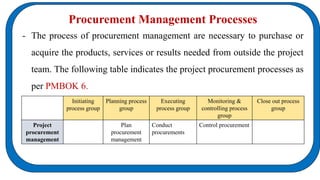
- The process of procurement management are necessary to purchase or
acquire the products, services or results needed from outside the project
team. The following table indicates the project procurement processes as
per PMBOK 6.
Initiating
process group
Planning process
group
Executing
process group
Monitoring &
controlling process
group
Close out process
group
Project
procurement
management
Plan
procurement
management
Conduct
procurements
Control procurement
- Plan procurement management
This is the process of documenting project purchasing decision, specifying
the approach and identifying potential sellers.
- Conduct procurements
This is the process of obtaining seller responses, selecting a seller and
awarding a contract.
- Control procurements
This is the process of managing procurement relationships, monitoring
contract performance and making changes and corrections as needed.
- Plan procurement management
This is the process where you figure out what all work you actually need
to contract out to third party.
- Another important aspect of this process is creating a plan of how you are
going to do it.
- Procurement management in itself could be a bit difficult topic for those
have not done procurement in their projects. It is thus difficult to visualize
an example of this process too.
Plan procurement management
Consider a simple office renovation project. Questions to look at,
1. Would you do the job of the interior designer, carpenter, electrician and
painter all by yourself? And also buy all specialized power tools they use?
2. Would you hire a full time interior designer, carpenter, electrician and painter
and then fire them after the work is done in, lets say 1 month?
3. Would you sign a con a contract specifically for this task with interior designer,
carpenter, electrician, and painter so that they know their scope of work in
advance?
- Hopefully, your answer is 3
Make or Buy Analysis
- Make or buy analysis is one of the most important tools of the plan
procurement management process.
- Make or buy analysis basically means figuring out whether you should
be contracting the work or doing it yourself.
- Another way of looking at, it is to consider whether you want to create
your own solution or buy one that is already available.
The ‘Make’ Decision.
- Less costly
- Easy fitment or integration in current systems
- Available suppliers are unreliable or unable to serve.
- Utilize existing resources that have bandwidth available
- Maintain control over the solution and thus maintaining confidentiality.
The ‘buy’ Decision.
- Less costly
- Suppliers have better skills than you do
- Get more than one vendor on board.
- Smaller volume required
Make or buy Analysis
- Of course there are other questions to consider while making this
decision. For example, how will this decision impact the schedule, cost,
scope and quality of the project?
- However, there are some resources like heavy equipment which is
always better to rent or lease instead of buying or creating especially if
they are to be used only once.
Procurement Management Plan
This is one of the most important outputs of the Plan Procurement
Management process. This document contains,
- Planned schedule for the deliverables that are contracted.
- Procurement related templates that will be used in the project.
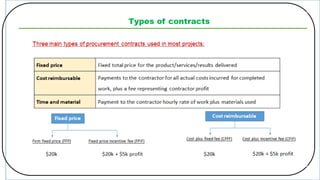
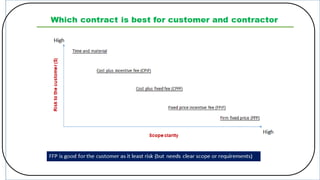
- Contract types that will be used as part of the project.
- Metrics to be used to measure contractor’s performance.
- Assumptions or constraints related to procurement that the project team is
aware of.
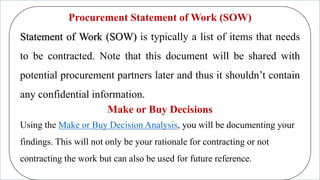
Procurement Statement of Work (SOW)
Statement of Work (SOW) is typically a list of items that needs
to be contracted. Note that this document will be shared with
potential procurement partners later and thus it shouldn’t contain
any confidential information.
Make or Buy Decisions
Using the Make or Buy Decision Analysis, you will be documenting your
findings. This will not only be your rationale for contracting or not
contracting the work but can also be used for future reference.
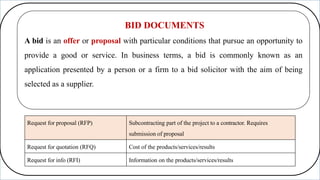
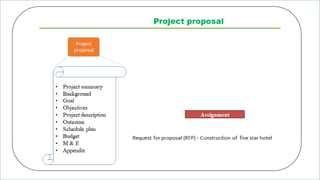
Request for proposal (RFP) Subcontracting part of the project to a contractor. Requires
submission of proposal
Request for quotation (RFQ) Cost of the products/services/results
Request for info (RFI) Information on the products/services/results
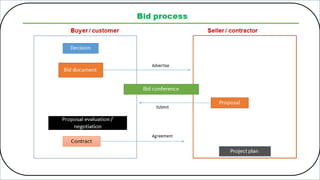
BID DOCUMENTS
A bid is an offer or proposal with particular conditions that pursue an opportunity to
provide a good or service. In business terms, a bid is commonly known as an
application presented by a person or a firm to a bid solicitor with the aim of being
selected as a supplier.
Procurement Manager
• If you think that the Project Manager alone is responsible for everything
related to Procurement, you are wrong. This is where the Procurement
Manager comes into the picture.
• Procurement Manager is also sometimes referred to as a Contract
Administrator or a Contract Manager. A Procurement Manager administers
the contract and is the only person who has the authority to make any
changes in the same.
• It should be noted here that the Procurement Statement of Work (SOW) is
also a part of the contract. This means any change in the Procurement
(SOW), in addition to going through the usual Change Management
process, will also have to be approved by the Procurement Manager.
THANK YOU