Terms of Reference (ToR)
Non-Consulting Services
For
Foundation Skills Training Program for the ITES-BPO industry
1. Background
Bangladesh Computer Council under the Ministry of information & Communication has
taken the project titled Leveraging Information and Communication Technologies (ICT) for
Growth, Employment and Governance Project with the financial assistance of IDA. The
objectives to catalyse the growth of Bangladesh's IT-Enabled Services (ITES) industry for
employment creation and export diversification; and establish basic e-government
foundations to support public sector modernisation. IT/ITES Industry Development is one of
the three components of the project by which quantity and quality of skills and
competitiveness of Bangladesh’s ITES industry would be increased.
2 The Assignment and Objective
The assignment will develop foundational skills of 20,000 professionals for ITES or business
process outsourcing (BPO) services jobs including back/front office outsourcing. BPO is a
subset of outsourcing that’s involves the contracting of the operations and responsibilities
of specific business functions (or processes) to a third-party service provider.
BPO is typically categorised into back office outsourcing, which includes internal business
functions such as human resources or finance and accounting, and front office outsourcing
which includes customer-related services such as contract centre services. BPO that is
contracted outside a company’s country is called offshore outsourcing. BPO that is
contracted to a company’s neighbouring (or nearby) country is called near shore
outsourcing. Often the business processes are information technology-based, and are
referred to as ITES-BPO. Knowledge process outsourcing (KPO) and legal process
outsourcing (LPO) are some of the sub-segments of business process outsourcing industry.
It will be developed in a way that is closely aligned with the requirements of global
markets. Training grants will be provided to companies meeting a minimum set of skills
development and hiring criteria that support the GOB’s existing National ICT Internship
Program administered by BCC. Foundational work skills are fundamental to creating a
competitive ITES labor forces these are necessary for virtually all its sub-segments;
including voice and non-voice based ITES/BPO services, and the emerging area of online
work/micro-work as an alternative channel for global service outsourcing. These skills
address areas such as cultural sensitization, basic PC and data skills, interpersonal
communication, and a good professional attitude in general. The coverage includes skills in
speaking, listening, analytical and quantitative reasoning, writing, learning ability,
keyboarding, Social media marketing, SEO etc.
The Program will have multiple components, including definition of skills set standards,
curriculum design, training and certification, and program accreditation. It will also have
various processes, including diagnostic tests, faculty and student training, final
certifications, post-training assessments and establishing connections for
industry/academia placements. The assessment of foundational skills should be done in a
manner that helps benchmark the skills of Bangladeshi students against the skill profiles of
candidates successfully hired by leading ITES companies.
The success of the foundational skills training program linked to global ITES players is
highly dependent on the willingness of leading companies to provide master trainers in
Bangladesh.
Initially the linkage with global companies would be essential for a period of about two
years, the arrangement could thereafter be systematically integrated as part of the
curriculum design and training programs coordinated and managed by the anchor
institution. Once the quality standards have been determined, and trainers trained
according to international standards, it will become much easier to integrate the content,
pedagogy and skills development activities into regular programs to be conducted by the
anchor institution.
Scope of Services
The selected firm, among others will be responsible to perform the following
services;
i.Analysis of Skills Gap: Conduct research and analysis of the gaps and weaknesses with
regard to skills availability in Bangladesh for the global and local ITES-BPO industry.
Based on this analysis identify specific skill areas where training will be necessary. The
analysis should be systematic, multidimensional and conducted in collaboration with
relevant partners - including leading international and local IT/ITES companies,
academic institutions, governments, international standards bodies and industry/trade
associations. It should cover the current talent and training situation and provide
recommendations on prioritized areas for ITES-BPO skills development. The analysis
should also recommend changes in curriculum and pedagogy required as part of
broader education reforms in Bangladesh and show local young people the possibilities
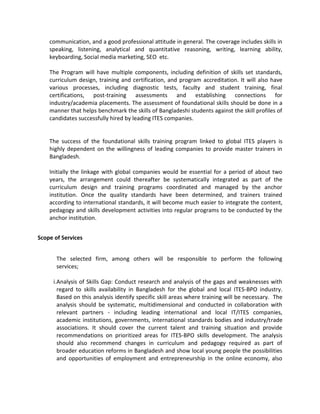
and opportunities of employment and entrepreneurship in the online economy, also
known as virtual / digital economy. Converting the virtual economy into development
potential.
ii. Develop Skill Set Dictionary and Standards: Develop a comprehensive dictionary of skills
required for the ITES-BPO sector together with standards for each skill set category,
create a database of job role profiles and performance indicators for various ITES-BPO
functions. These standards should be developed in close collaboration with the relevant
partners described above, and have their explicit support in terms of quality and
relevance.
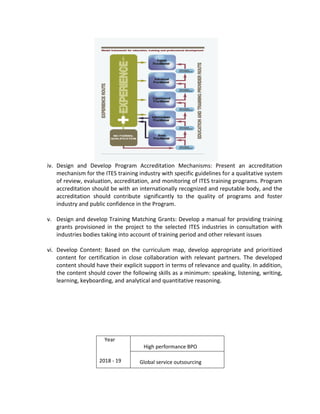
iii. Design and develop Curriculum: Develop a streamlined ITES Training Curriculum that is
based on the global skill set standards, aligned with the specific skill requirements in the
case of Bangladesh, and has explicit support of the relevant partners in terms the
curriculum’s quality and relevance. In addition, a curriculum map should be developed
for the short, medium and long term skills development. The map should start with
basic employability skills for the mass ITES workforce, and graduate to strategic and
operation skills for senior management roles in ITES. It also includes the development of
modules based on curriculum.
iv. Design and Develop Program Accreditation Mechanisms: Present an accreditation
mechanism for the ITES training industry with specific guidelines for a qualitative system
of review, evaluation, accreditation, and monitoring of ITES training programs. Program
accreditation should be with an internationally recognized and reputable body, and the
accreditation should contribute significantly to the quality of programs and foster
industry and public confidence in the Program.
v. Design and develop Training Matching Grants: Develop a manual for providing training
grants provisioned in the project to the selected ITES industries in consultation with
industries bodies taking into account of training period and other relevant issues
vi. Develop Content: Based on the curriculum map, develop appropriate and prioritized
content for certification in close collaboration with relevant partners. The developed
content should have their explicit support in terms of relevance and quality. In addition,
the content should cover the following skills as a minimum: speaking, listening, writing,
learning, keyboarding, and analytical and quantitative reasoning.
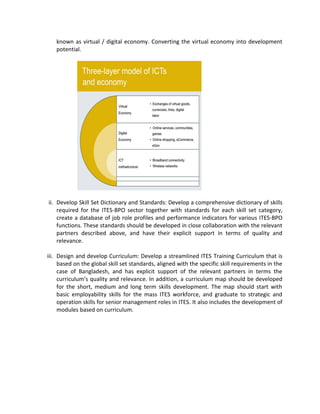
Year
2018 - 19
High performance BPO
Global service outsourcing
vii. Develop Certification Process: Develop an internationally recognized, authentic, secure
and valid process for ITES foundational skills assessment and certification. This process
should be developed in consultation with leading ITES companies and academic
institutions. In addition, the process should be based on proven experiences in similar
certification programs, and the testing process should be representative of real-life,
professional ITES functions. The examinations should be refreshed annually; and
extendable to other emerging ITES foundational skills as needed. The examination must
be developed using recognized techniques for validation and verification of quality, and
linkages may be established with one or more leading testing and certification
organizations to ensure that the certification will be conducted in a secure and
proctored setting.
viii.Piloting, Evaluation and Refinement: To pilot the Program with an initial batch of at least
2000 local students, and to benchmark results against an international control group. To
conduct an evaluation of the pilot to prepare a detailed report to recommend strategies
and action plans for improving the Program, and refine the Program based on the
agreed recommendations of the Evaluation Report.
ix. Mass Rollout and Marketing, and Business Model Implementation: Implement mass
rollout and marketing campaign for the Program across Bangladesh, train master
trainers, and provide skills development training at least 18,000 local students from
various levels of educational background. In addition, to implement a business model
for the Program that is internationally recognized, financially self-sustaining and
affordable for aspirants seeking employment in the ITES industry by the end of this
consultancy service (15 months after contract signature). A final report is to be prepared
to highlight the next steps to be taken by Bangladesh for the Program, including future
steps on training content development, certification process, local capacity building,
program accreditation and training matching grants.
x. Develop Local Capacity : For building local capacity in the host country, the selected
consultancy will impart training to local faculty in the areas of exam proctoring,
interpretation of assessment results and developing of metrics for quality enhancement
of educational programs. This capacity building would occur within an overall
knowledge transfer framework proposed and developed by the Consultant. Besides
delivering training for capacity building, the knowledge transfer mechanism would also
specify how the transfer of knowledge products and material (documents, reports,
questions banks, software) would happen during the course of assignment.
2014 - 17
Typical BPO
Entrepreneurs
3. Reporting and Time Schedules
S/No. Deliverable Timing
(Months after
Contract Signature)
i. Inception Report (inclusive of Detailed Work Plan,
Methodologies, Business Plan & Skills Gap Analysis.
Stakeholders Workshop I)
3
ii. Skill Set Standards and design and development of
Curriculum, Modules
6
iii. Program Accreditation and design and development of
Training Matching Grants
6
iv. Content, certification processes and credentialing program 6
v. Pilot rollout, Evaluation Report and Refinement 6
x.. Mass Rollout and Marketing 7 – 50
xi. Business Model Implementation 50-60
4. Local Implementation Partner
In Bangladesh, the assessment organization will work in a close partnership with a local training
or educational institution which will be its local implementation partner. The host institution
will provide inputs and be extensively involved in all stages of inception, design, and
implementation of the Program for ITES skills. The host institution together with the GOB’s
relevant agencies will also help the selected institution for this consultancy build linkages with
universities and training institutes in Bangladesh.
5. FIRM QUALIFICATIONS
 Leading assessment organization with experience of rolling out similar assessments in at
least two countries
 Demonstrated capability in design, development and delivery of skills development and
certification programs for the ITES/BPO sector as evidenced by the qualifications and
experience of professional staff, and similar experience of delivering such programs in at
least one other country
 At least 5 years of experience in conducting similar assessments
 Testing frameworks and content should have wide industry acceptance including
support of at least one leading industry association for the IT/ITES industry
 Should have strong partnerships with reputed testing organizations
 There should be no conflict of interest between the skills assessments undertaken by
the firm and any training, placements or other related activities of the firm.
6. STAFFING
 Team leader: Have an advanced degree in Human Resource Development. Minimum of
5 year experience in a leadership role in designing, conducting and implementing
training in ITES sector; experience in at least 2 countries that are considered to be
global players in IT services; successful track record of collaborating with one or more
international IT/ITES industry associations.
 Expert in curriculum design, content development and certification: Have a minimum
of 5 year experience in the areas of curriculum design, content development and
certification relevant to the IT services industry; successful track record of working in or
collaborating with three or more leading IT services companies on IT services training
activities; successful track record of working in or collaborating with one or more
leading academic institutions on subjects relevant to training for the IT services sector.
Having advanced degree in education or equivalent.
 Expert in training: Have a minimum of bachelor’s degree in Human Resource
Development or equivalent. Minimum of 5 year experience in the area of conducting
training for the IT services sector, latest knowledge of capacity building training on
IT/ITES industry requirement, preparation of training materials like modules.
 Expert in financial analysis and performance metrics: Have an advanced degree in
finance or accountancy, Minimum of 5 year experience in the area of financial analysis,
business models and performance metrics;; experience of making financial projections
and budgets for large scale training related activities.

Terms of reference draft 1st

  • 1.
    Terms of Reference(ToR) Non-Consulting Services For Foundation Skills Training Program for the ITES-BPO industry 1. Background Bangladesh Computer Council under the Ministry of information & Communication has taken the project titled Leveraging Information and Communication Technologies (ICT) for Growth, Employment and Governance Project with the financial assistance of IDA. The objectives to catalyse the growth of Bangladesh's IT-Enabled Services (ITES) industry for employment creation and export diversification; and establish basic e-government foundations to support public sector modernisation. IT/ITES Industry Development is one of the three components of the project by which quantity and quality of skills and competitiveness of Bangladesh’s ITES industry would be increased. 2 The Assignment and Objective The assignment will develop foundational skills of 20,000 professionals for ITES or business process outsourcing (BPO) services jobs including back/front office outsourcing. BPO is a subset of outsourcing that’s involves the contracting of the operations and responsibilities of specific business functions (or processes) to a third-party service provider. BPO is typically categorised into back office outsourcing, which includes internal business functions such as human resources or finance and accounting, and front office outsourcing which includes customer-related services such as contract centre services. BPO that is contracted outside a company’s country is called offshore outsourcing. BPO that is contracted to a company’s neighbouring (or nearby) country is called near shore outsourcing. Often the business processes are information technology-based, and are referred to as ITES-BPO. Knowledge process outsourcing (KPO) and legal process outsourcing (LPO) are some of the sub-segments of business process outsourcing industry. It will be developed in a way that is closely aligned with the requirements of global markets. Training grants will be provided to companies meeting a minimum set of skills development and hiring criteria that support the GOB’s existing National ICT Internship Program administered by BCC. Foundational work skills are fundamental to creating a competitive ITES labor forces these are necessary for virtually all its sub-segments; including voice and non-voice based ITES/BPO services, and the emerging area of online work/micro-work as an alternative channel for global service outsourcing. These skills address areas such as cultural sensitization, basic PC and data skills, interpersonal
  • 2.
    communication, and agood professional attitude in general. The coverage includes skills in speaking, listening, analytical and quantitative reasoning, writing, learning ability, keyboarding, Social media marketing, SEO etc. The Program will have multiple components, including definition of skills set standards, curriculum design, training and certification, and program accreditation. It will also have various processes, including diagnostic tests, faculty and student training, final certifications, post-training assessments and establishing connections for industry/academia placements. The assessment of foundational skills should be done in a manner that helps benchmark the skills of Bangladeshi students against the skill profiles of candidates successfully hired by leading ITES companies. The success of the foundational skills training program linked to global ITES players is highly dependent on the willingness of leading companies to provide master trainers in Bangladesh. Initially the linkage with global companies would be essential for a period of about two years, the arrangement could thereafter be systematically integrated as part of the curriculum design and training programs coordinated and managed by the anchor institution. Once the quality standards have been determined, and trainers trained according to international standards, it will become much easier to integrate the content, pedagogy and skills development activities into regular programs to be conducted by the anchor institution. Scope of Services The selected firm, among others will be responsible to perform the following services; i.Analysis of Skills Gap: Conduct research and analysis of the gaps and weaknesses with regard to skills availability in Bangladesh for the global and local ITES-BPO industry. Based on this analysis identify specific skill areas where training will be necessary. The analysis should be systematic, multidimensional and conducted in collaboration with relevant partners - including leading international and local IT/ITES companies, academic institutions, governments, international standards bodies and industry/trade associations. It should cover the current talent and training situation and provide recommendations on prioritized areas for ITES-BPO skills development. The analysis should also recommend changes in curriculum and pedagogy required as part of broader education reforms in Bangladesh and show local young people the possibilities and opportunities of employment and entrepreneurship in the online economy, also
  • 3.
    known as virtual/ digital economy. Converting the virtual economy into development potential. ii. Develop Skill Set Dictionary and Standards: Develop a comprehensive dictionary of skills required for the ITES-BPO sector together with standards for each skill set category, create a database of job role profiles and performance indicators for various ITES-BPO functions. These standards should be developed in close collaboration with the relevant partners described above, and have their explicit support in terms of quality and relevance. iii. Design and develop Curriculum: Develop a streamlined ITES Training Curriculum that is based on the global skill set standards, aligned with the specific skill requirements in the case of Bangladesh, and has explicit support of the relevant partners in terms the curriculum’s quality and relevance. In addition, a curriculum map should be developed for the short, medium and long term skills development. The map should start with basic employability skills for the mass ITES workforce, and graduate to strategic and operation skills for senior management roles in ITES. It also includes the development of modules based on curriculum.
  • 4.
    iv. Design andDevelop Program Accreditation Mechanisms: Present an accreditation mechanism for the ITES training industry with specific guidelines for a qualitative system of review, evaluation, accreditation, and monitoring of ITES training programs. Program accreditation should be with an internationally recognized and reputable body, and the accreditation should contribute significantly to the quality of programs and foster industry and public confidence in the Program. v. Design and develop Training Matching Grants: Develop a manual for providing training grants provisioned in the project to the selected ITES industries in consultation with industries bodies taking into account of training period and other relevant issues vi. Develop Content: Based on the curriculum map, develop appropriate and prioritized content for certification in close collaboration with relevant partners. The developed content should have their explicit support in terms of relevance and quality. In addition, the content should cover the following skills as a minimum: speaking, listening, writing, learning, keyboarding, and analytical and quantitative reasoning. Year 2018 - 19 High performance BPO Global service outsourcing
  • 5.
    vii. Develop CertificationProcess: Develop an internationally recognized, authentic, secure and valid process for ITES foundational skills assessment and certification. This process should be developed in consultation with leading ITES companies and academic institutions. In addition, the process should be based on proven experiences in similar certification programs, and the testing process should be representative of real-life, professional ITES functions. The examinations should be refreshed annually; and extendable to other emerging ITES foundational skills as needed. The examination must be developed using recognized techniques for validation and verification of quality, and linkages may be established with one or more leading testing and certification organizations to ensure that the certification will be conducted in a secure and proctored setting. viii.Piloting, Evaluation and Refinement: To pilot the Program with an initial batch of at least 2000 local students, and to benchmark results against an international control group. To conduct an evaluation of the pilot to prepare a detailed report to recommend strategies and action plans for improving the Program, and refine the Program based on the agreed recommendations of the Evaluation Report. ix. Mass Rollout and Marketing, and Business Model Implementation: Implement mass rollout and marketing campaign for the Program across Bangladesh, train master trainers, and provide skills development training at least 18,000 local students from various levels of educational background. In addition, to implement a business model for the Program that is internationally recognized, financially self-sustaining and affordable for aspirants seeking employment in the ITES industry by the end of this consultancy service (15 months after contract signature). A final report is to be prepared to highlight the next steps to be taken by Bangladesh for the Program, including future steps on training content development, certification process, local capacity building, program accreditation and training matching grants. x. Develop Local Capacity : For building local capacity in the host country, the selected consultancy will impart training to local faculty in the areas of exam proctoring, interpretation of assessment results and developing of metrics for quality enhancement of educational programs. This capacity building would occur within an overall knowledge transfer framework proposed and developed by the Consultant. Besides delivering training for capacity building, the knowledge transfer mechanism would also specify how the transfer of knowledge products and material (documents, reports, questions banks, software) would happen during the course of assignment. 2014 - 17 Typical BPO Entrepreneurs
  • 6.
    3. Reporting andTime Schedules S/No. Deliverable Timing (Months after Contract Signature) i. Inception Report (inclusive of Detailed Work Plan, Methodologies, Business Plan & Skills Gap Analysis. Stakeholders Workshop I) 3 ii. Skill Set Standards and design and development of Curriculum, Modules 6 iii. Program Accreditation and design and development of Training Matching Grants 6 iv. Content, certification processes and credentialing program 6 v. Pilot rollout, Evaluation Report and Refinement 6 x.. Mass Rollout and Marketing 7 – 50 xi. Business Model Implementation 50-60 4. Local Implementation Partner In Bangladesh, the assessment organization will work in a close partnership with a local training or educational institution which will be its local implementation partner. The host institution will provide inputs and be extensively involved in all stages of inception, design, and implementation of the Program for ITES skills. The host institution together with the GOB’s relevant agencies will also help the selected institution for this consultancy build linkages with universities and training institutes in Bangladesh. 5. FIRM QUALIFICATIONS  Leading assessment organization with experience of rolling out similar assessments in at least two countries  Demonstrated capability in design, development and delivery of skills development and certification programs for the ITES/BPO sector as evidenced by the qualifications and experience of professional staff, and similar experience of delivering such programs in at least one other country  At least 5 years of experience in conducting similar assessments  Testing frameworks and content should have wide industry acceptance including support of at least one leading industry association for the IT/ITES industry  Should have strong partnerships with reputed testing organizations  There should be no conflict of interest between the skills assessments undertaken by the firm and any training, placements or other related activities of the firm.
  • 7.
    6. STAFFING  Teamleader: Have an advanced degree in Human Resource Development. Minimum of 5 year experience in a leadership role in designing, conducting and implementing training in ITES sector; experience in at least 2 countries that are considered to be global players in IT services; successful track record of collaborating with one or more international IT/ITES industry associations.  Expert in curriculum design, content development and certification: Have a minimum of 5 year experience in the areas of curriculum design, content development and certification relevant to the IT services industry; successful track record of working in or collaborating with three or more leading IT services companies on IT services training activities; successful track record of working in or collaborating with one or more leading academic institutions on subjects relevant to training for the IT services sector. Having advanced degree in education or equivalent.  Expert in training: Have a minimum of bachelor’s degree in Human Resource Development or equivalent. Minimum of 5 year experience in the area of conducting training for the IT services sector, latest knowledge of capacity building training on IT/ITES industry requirement, preparation of training materials like modules.  Expert in financial analysis and performance metrics: Have an advanced degree in finance or accountancy, Minimum of 5 year experience in the area of financial analysis, business models and performance metrics;; experience of making financial projections and budgets for large scale training related activities.