ESO-ESO-44 English DepartmentEnglish Department
Revision ofRevision of tenses: form and usetenses: form and use CPI Tino GrandíoCPI Tino Grandío
……………………………………………………………………………………………………………………………………………………
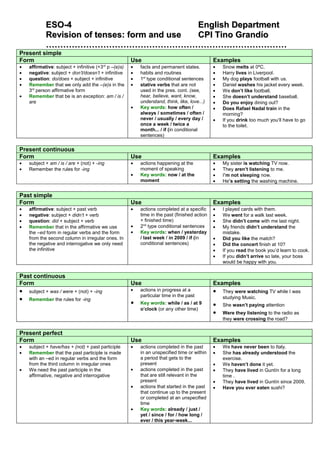
Present simple
Form Use Examples
• affirmative: subject + infinitive (+3rd
p –(e)s)
• negative: subject + don’t/doesn’t + infinitive
• question: do/does + subject + infinitive
• Remember that we only add the –(e)s in the
3rd
person affirmative form
• Remember that be is an exception: am / is /
are
• facts and permanent states.
• habits and routines
• 1st
type conditional sentences
• stative verbs that are not
used in the pres. cont. (see,
hear, believe, want, know,
understand, think, like, love...)
• Key words: how often /
always / sometimes / often /
never / usually / every day /
once a week / twice a
month... / if (in conditional
sentences)
• Snow melts at 0ºC.
• Harry lives in Liverpool.
• My dog plays football with us.
• Daniel washes his jacket every week.
• We don’t like football.
• She doesn’t understand baseball.
• Do you enjoy dining out?
• Does Rafael Nadal train in the
morning?
• If you drink too much you’ll have to go
to the toilet.
Present continuous
Form Use Examples
• subject + am / is / are + (not) + -ing
• Remember the rules for -ing
• actions happening at the
moment of speaking
• Key words: now / at the
moment
• My sister is watching TV now.
• They aren’t listening to me.
• I’m not sleeping now.
• He’s setting the washing machine.
Past simple
Form Use Examples
• affirmative: subject + past verb
• negative: subject + didn’t + verb
• question: did + subject + verb
• Remember that in the affirmative we use
the –ed form in regular verbs and the form
from the second column in irregular ones. In
the negative and interrogative we only need
the infinitive
• actions completed at a specific
time in the past (finished action
+ finished time)
• 2nd
type conditional sentences
• Key words: when / yesterday
/ last week / in 2009 / if (in
conditional sentences)
• I played cards with them.
• We went for a walk last week.
• She didn’t come with me last night.
• My friends didn’t understand the
mistake.
• Did you like the match?
• Did the concert finish at 10?
• If you read the book you’d learn to cook.
• If you didn’t arrive so late, your boss
would be happy with you.
Past continuous
Form Use Examples
• subject + was / were + (not) + -ing
• Remember the rules for -ing
• actions in progress at a
particular time in the past
• Key words: while / as / at 9
o’clock (or any other time)
• They were watching TV while I was
studying Music.
• She wasn’t paying attention
• Were they listening to the radio as
they were crossing the road?
Present perfect
Form Use Examples
• subject + have/has + (not) + past participle
• Remember that the past participle is made
with an –ed in regular verbs and the form
from the third column in irregular ones
• We need the past participle in the
affirmative, negative and interrogative
• actions completed in the past
in an unspecified time or within
a period that gets to the
present
• actions completed in the past
that are still relevant in the
present
• actions that started in the past
that continue up to the present
or completed at an unspecified
time
• Key words: already / just /
yet / since / for / how long /
ever / this year-week...
• We have never been to Italy.
• She has already understood the
exercise.
• We haven’t done it yet.
• They have lived in Guntín for a long
time .
• They have lived in Guntín since 2009.
• Have you ever eaten sushi?
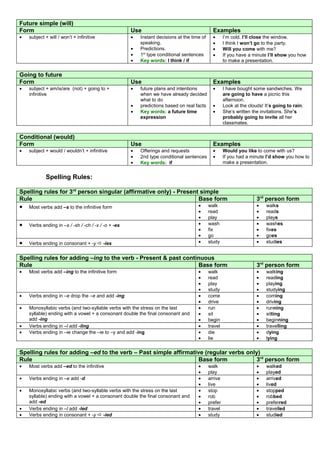
Future simple (will)
Form Use Examples
• subject + will / won’t + infinitive • Instant decisions at the time of
speaking.
• Predictions.
• 1st
type conditional sentences
• Key words: I think / if
• I’m cold. I’ll close the window.
• I think I won’t go to the party.
• Will you come with me?
• If you have a minute I’ll show you how
to make a presentation.
Going to future
Form Use Examples
• subject + am/is/are (not) + going to +
infinitive
• future plans and intentions
when we have already decided
what to do
• predictions based on real facts
• Key words: a future time
expression
• I have bought some sandwiches. We
are going to have a picnic this
afternoon.
• Look at the clouds! It’s going to rain.
• She’s written the invitations. She’s
probably going to invite all her
classmates.
Conditional (would)
Form Use Examples
• subject + would / wouldn’t + infinitive • Offerings and requests
• 2nd type conditional sentences
• Key words: if
• Would you like to come with us?
• If you had a minute I’d show you how to
make a presentation.
Spelling Rules:
Spelling rules for 3rd
person singular (affirmative only) - Present simple
Rule Base form 3rd
person form
• Most verbs add –s to the infinitive form • walk
• read
• play
• walks
• reads
• plays
• Verbs ending in –s / -sh / -ch / -x / -o + -es • wash
• fix
• go
• washes
• fixes
• goes
• Verbs ending in consonant + -y  -ies • study • studies
Spelling rules for adding –ing to the verb - Present & past continuous
Rule Base form 3rd
person form
• Most verbs add –ing to the infinitive form • walk
• read
• play
• study
• walking
• reading
• playing
• studying
• Verbs ending in –e drop the –e and add -ing • come
• drive
• coming
• driving
• Monosyllabic verbs (and two-syllable verbs with the stress on the last
syllable) ending with a vowel + a consonant double the final consonant and
add -ing
• run
• sit
• begin
• running
• sitting
• beginning
• Verbs ending in –l add -ling • travel • travelling
• Verbs ending in –ie change the –ie to –y and add -ing • die
• lie
• dying
• lying
Spelling rules for adding –ed to the verb – Past simple affirmative (regular verbs only)
Rule Base form 3rd
person form
• Most verbs add –ed to the infinitive • walk
• play
• walked
• played
• Verbs ending in –e add -d • arrive
• live
• arrived
• lived
• Monosyllabic verbs (and two-syllable verbs with the stress on the last
syllable) ending with a vowel + a consonant double the final consonant and
add -ed
• stop
• rob
• prefer
• stopped
• robbed
• preferred
• Verbs ending in –l add -led • travel • travelled
• Verbs ending in consonant + -y  -ied • study • studied

Eso 4-tenses

  • 1.
    ESO-ESO-44 English DepartmentEnglishDepartment Revision ofRevision of tenses: form and usetenses: form and use CPI Tino GrandíoCPI Tino Grandío …………………………………………………………………………………………………………………………………………………… Present simple Form Use Examples • affirmative: subject + infinitive (+3rd p –(e)s) • negative: subject + don’t/doesn’t + infinitive • question: do/does + subject + infinitive • Remember that we only add the –(e)s in the 3rd person affirmative form • Remember that be is an exception: am / is / are • facts and permanent states. • habits and routines • 1st type conditional sentences • stative verbs that are not used in the pres. cont. (see, hear, believe, want, know, understand, think, like, love...) • Key words: how often / always / sometimes / often / never / usually / every day / once a week / twice a month... / if (in conditional sentences) • Snow melts at 0ºC. • Harry lives in Liverpool. • My dog plays football with us. • Daniel washes his jacket every week. • We don’t like football. • She doesn’t understand baseball. • Do you enjoy dining out? • Does Rafael Nadal train in the morning? • If you drink too much you’ll have to go to the toilet. Present continuous Form Use Examples • subject + am / is / are + (not) + -ing • Remember the rules for -ing • actions happening at the moment of speaking • Key words: now / at the moment • My sister is watching TV now. • They aren’t listening to me. • I’m not sleeping now. • He’s setting the washing machine. Past simple Form Use Examples • affirmative: subject + past verb • negative: subject + didn’t + verb • question: did + subject + verb • Remember that in the affirmative we use the –ed form in regular verbs and the form from the second column in irregular ones. In the negative and interrogative we only need the infinitive • actions completed at a specific time in the past (finished action + finished time) • 2nd type conditional sentences • Key words: when / yesterday / last week / in 2009 / if (in conditional sentences) • I played cards with them. • We went for a walk last week. • She didn’t come with me last night. • My friends didn’t understand the mistake. • Did you like the match? • Did the concert finish at 10? • If you read the book you’d learn to cook. • If you didn’t arrive so late, your boss would be happy with you. Past continuous Form Use Examples • subject + was / were + (not) + -ing • Remember the rules for -ing • actions in progress at a particular time in the past • Key words: while / as / at 9 o’clock (or any other time) • They were watching TV while I was studying Music. • She wasn’t paying attention • Were they listening to the radio as they were crossing the road? Present perfect Form Use Examples • subject + have/has + (not) + past participle • Remember that the past participle is made with an –ed in regular verbs and the form from the third column in irregular ones • We need the past participle in the affirmative, negative and interrogative • actions completed in the past in an unspecified time or within a period that gets to the present • actions completed in the past that are still relevant in the present • actions that started in the past that continue up to the present or completed at an unspecified time • Key words: already / just / yet / since / for / how long / ever / this year-week... • We have never been to Italy. • She has already understood the exercise. • We haven’t done it yet. • They have lived in Guntín for a long time . • They have lived in Guntín since 2009. • Have you ever eaten sushi?
  • 2.
    Future simple (will) FormUse Examples • subject + will / won’t + infinitive • Instant decisions at the time of speaking. • Predictions. • 1st type conditional sentences • Key words: I think / if • I’m cold. I’ll close the window. • I think I won’t go to the party. • Will you come with me? • If you have a minute I’ll show you how to make a presentation. Going to future Form Use Examples • subject + am/is/are (not) + going to + infinitive • future plans and intentions when we have already decided what to do • predictions based on real facts • Key words: a future time expression • I have bought some sandwiches. We are going to have a picnic this afternoon. • Look at the clouds! It’s going to rain. • She’s written the invitations. She’s probably going to invite all her classmates. Conditional (would) Form Use Examples • subject + would / wouldn’t + infinitive • Offerings and requests • 2nd type conditional sentences • Key words: if • Would you like to come with us? • If you had a minute I’d show you how to make a presentation. Spelling Rules: Spelling rules for 3rd person singular (affirmative only) - Present simple Rule Base form 3rd person form • Most verbs add –s to the infinitive form • walk • read • play • walks • reads • plays • Verbs ending in –s / -sh / -ch / -x / -o + -es • wash • fix • go • washes • fixes • goes • Verbs ending in consonant + -y  -ies • study • studies Spelling rules for adding –ing to the verb - Present & past continuous Rule Base form 3rd person form • Most verbs add –ing to the infinitive form • walk • read • play • study • walking • reading • playing • studying • Verbs ending in –e drop the –e and add -ing • come • drive • coming • driving • Monosyllabic verbs (and two-syllable verbs with the stress on the last syllable) ending with a vowel + a consonant double the final consonant and add -ing • run • sit • begin • running • sitting • beginning • Verbs ending in –l add -ling • travel • travelling • Verbs ending in –ie change the –ie to –y and add -ing • die • lie • dying • lying Spelling rules for adding –ed to the verb – Past simple affirmative (regular verbs only) Rule Base form 3rd person form • Most verbs add –ed to the infinitive • walk • play • walked • played • Verbs ending in –e add -d • arrive • live • arrived • lived • Monosyllabic verbs (and two-syllable verbs with the stress on the last syllable) ending with a vowel + a consonant double the final consonant and add -ed • stop • rob • prefer • stopped • robbed • preferred • Verbs ending in –l add -led • travel • travelled • Verbs ending in consonant + -y  -ied • study • studied