Northeast school of
Agriculture
PRACTICE ENGLISH 5
ENGINEER OSCAR GARCIA
GROUP PRACTICE #1
NAME: Cristian Estuardo cruz rivera
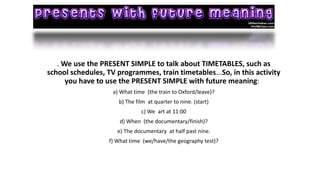
. We use the PRESENT SIMPLE to talk about TIMETABLES, such as
school schedules, TV programmes, train timetables...So, in this activity
you have to use the PRESENT SIMPLE with future meaning:
a) What time (the train to Oxford/leave)?
b) The film at quarter to nine. (start)
c) We art at 11:00
d) When (the documentary/finish)?
e) The documentary at half past nine.
f) What time (we/have/the geography test)?
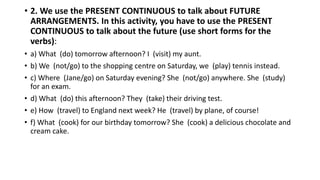
• 2. We use the PRESENT CONTINUOUS to talk about FUTURE
ARRANGEMENTS. In this activity, you have to use the PRESENT
CONTINUOUS to talk about the future (use short forms for the
verbs):
• a) What (do) tomorrow afternoon? I (visit) my aunt.
• b) We (not/go) to the shopping centre on Saturday, we (play) tennis instead.
• c) Where (Jane/go) on Saturday evening? She (not/go) anywhere. She (study)
for an exam.
• d) What (do) this afternoon? They (take) their driving test.
• e) How (travel) to England next week? He (travel) by plane, of course!
• f) What (cook) for our birthday tomorrow? She (cook) a delicious chocolate and
cream cake.
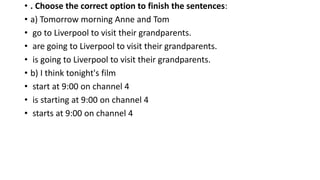
• . Choose the correct option to finish the sentences:
• a) Tomorrow morning Anne and Tom
• go to Liverpool to visit their grandparents.
• are going to Liverpool to visit their grandparents.
• is going to Liverpool to visit their grandparents.
• b) I think tonight's film
• start at 9:00 on channel 4
• is starting at 9:00 on channel 4
• starts at 9:00 on channel 4
B. Future Infinitive ( Be + To Infinitve )
• Dear Learners,
We use future infinitve to express a sense of instruction or necessity.
1. President Obama is to visit Burma next week. ( Active )
2. Humanitarian aids are to be airlifted to the flooded Irrawaddy
region. ( Passive )
I hope you like it.
kind regards.
• We use be to + infinitive when discussing formal or official
arrangements or to give formal instructions or orders and your
examples illustrate these aspects very well. Further examples might
be:
•The Prime Minister is to make a further visit to Devon next week.
•We are to receive a pay rise in line with inflation in September.
•I don't mind her going to Ruth's party but she's not to be back late.
•You are not to leave this house without my permission. Is that clear?
• The be to + infinitive structure is also frequently used in newspaper, radio and television
reports to refer to future events. It expresses near certainty that what is forecast will happen.
Study the following:
•A man is to appear in court later this morning charged with the murder of the footballer,
Darren Gough.
•The Ministry of Trade and Industry has announced that it is to move three thousand jobs out
of the capital and re-locate them in the North East.
•Work is to begin this week on the new bridge across the Nile north of Aswan.
Ir a + infinitive
•
• The written lesson is below.
• Links to quizzes, tests, etc. are to the left.
•
• In Spanish, many useful expressions are formed by combining two
verbs. When this occurs, the first verb is conjugated, while the second
verb remains in the infinitive form.
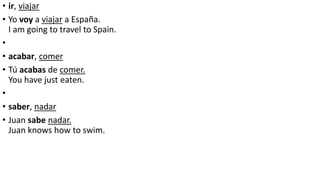
• ir, viajar
• Yo voy a viajar a España.
I am going to travel to Spain.
•
• acabar, comer
• Tú acabas de comer.
You have just eaten.
•
• saber, nadar
• Juan sabe nadar.
Juan knows how to swim.
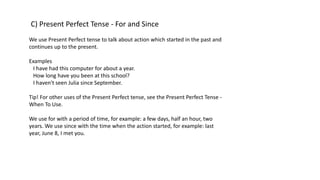
C) Present Perfect Tense - For and Since
We use Present Perfect tense to talk about action which started in the past and
continues up to the present.
Examples
I have had this computer for about a year.
How long have you been at this school?
I haven't seen Julia since September.
Tip! For other uses of the Present Perfect tense, see the Present Perfect Tense -
When To Use.
We use for with a period of time, for example: a few days, half an hour, two
years. We use since with the time when the action started, for example: last
year, June 8, I met you.
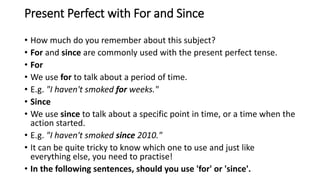
Present Perfect with For and Since
• How much do you remember about this subject?
• For and since are commonly used with the present perfect tense.
• For
• We use for to talk about a period of time.
• E.g. "I haven't smoked for weeks."
• Since
• We use since to talk about a specific point in time, or a time when the
action started.
• E.g. "I haven't smoked since 2010."
• It can be quite tricky to know which one to use and just like
everything else, you need to practise!
• In the following sentences, should you use 'for' or 'since'.
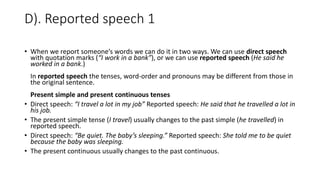
D). Reported speech 1
• When we report someone’s words we can do it in two ways. We can use direct speech
with quotation marks (“I work in a bank”), or we can use reported speech (He said he
worked in a bank.)
In reported speech the tenses, word-order and pronouns may be different from those in
the original sentence.
Present simple and present continuous tenses
• Direct speech: “I travel a lot in my job” Reported speech: He said that he travelled a lot in
his job.
• The present simple tense (I travel) usually changes to the past simple (he travelled) in
reported speech.
• Direct speech: “Be quiet. The baby’s sleeping.” Reported speech: She told me to be quiet
because the baby was sleeping.
• The present continuous usually changes to the past continuous.
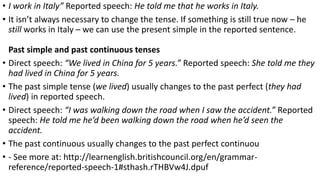
• I work in Italy” Reported speech: He told me that he works in Italy.
• It isn’t always necessary to change the tense. If something is still true now – he
still works in Italy – we can use the present simple in the reported sentence.
Past simple and past continuous tenses
• Direct speech: “We lived in China for 5 years.” Reported speech: She told me they
had lived in China for 5 years.
• The past simple tense (we lived) usually changes to the past perfect (they had
lived) in reported speech.
• Direct speech: “I was walking down the road when I saw the accident.” Reported
speech: He told me he’d been walking down the road when he’d seen the
accident.
• The past continuous usually changes to the past perfect continuou
• - See more at: http://learnenglish.britishcouncil.org/en/grammar-
reference/reported-speech-1#sthash.rTHBVw4J.dpuf
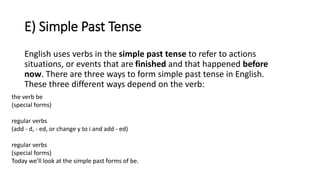
E) Simple Past Tense
English uses verbs in the simple past tense to refer to actions
situations, or events that are finished and that happened before
now. There are three ways to form simple past tense in English.
These three different ways depend on the verb:
the verb be
(special forms)
regular verbs
(add - d, - ed, or change y to i and add - ed)
regular verbs
(special forms)
Today we'll look at the simple past forms of be.
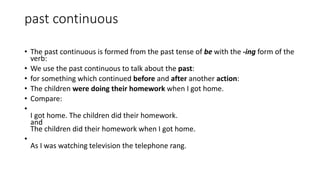
past continuous
• The past continuous is formed from the past tense of be with the -ing form of the
verb:
• We use the past continuous to talk about the past:
• for something which continued before and after another action:
• The children were doing their homework when I got home.
• Compare:
•
I got home. The children did their homework.
and
The children did their homework when I got home.
•
As I was watching television the telephone rang.
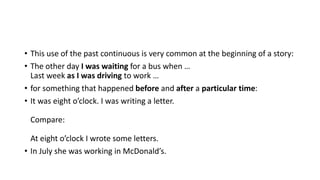
• This use of the past continuous is very common at the beginning of a story:
• The other day I was waiting for a bus when …
Last week as I was driving to work …
• for something that happened before and after a particular time:
• It was eight o’clock. I was writing a letter.
Compare:
At eight o’clock I wrote some letters.
• In July she was working in McDonald’s.
G) Passive voice – introduction
• Passive Voice
• Mice are eaten by cats.
• Although the passive voice is less common than the active voice,
there are several good reasons to sometimes use the passive. On this
page we look at how to construct the passive voice and when and
why to use it. (For a basic explanation of the difference between
active and passive, please see voice.)
• Explanation
• This is one way of introducing your students to the passive voice, and illustrating
it’s meaning.
• 1. Using a series of picture cards of different kinds of money from around the
world, show the students a picture of one form of money, and ask the students
“Where is this used?” If they don’t get the basic gist of what you are asking, you
may ask “what country is this from” and then revert to “where is this used” later.
Let the students guess which country the money is from, and when one of them
gets it right, announce “It is used in (country)” and repeat the sentence a second
time.
• 2. After repeating this process with a number of different currencies, ask the
students what sentence you kept repeating. Write “It is used in Japan” (or
whatever country you choose) on the black board, and ask the students to try to
guess the meaning. Guide the students to the proper translation in Japanese (ask
your JTE to help if necessary).
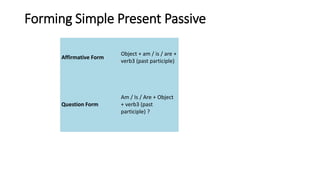
Forming Simple Present Passive
Affirmative Form
Object + am / is / are +
verb3 (past participle)
Question Form
Am / Is / Are + Object
+ verb3 (past
participle) ?
• Something is done by someone regularly / everyday / as expected...
Active : The gardener waters the flowers every evening.
Passive: The flowers are watered by the gardener every evening.
Active : Helen doesn't drink anything in parties.
Passive: Nothing is drunk by Helen in parties.
Active : Who sells umbrellas?
Passive: Who are umbrellas sold by?
Active : My mother doesn't paint the walls.
Passive: The walls aren't painted by my mother.
• E-GRAFY
• www.ego4u.com/en/cram-up/.../present-perfect-simp.
• www.eslcafe.com/grammar/simple_past_tense01.htm
• learnenglish.britishcouncil.org › ... › past tense
• letsteachenglish.com/view_activity.php?a=131

Cristian rive3 ra practica 5

  • 1.
    Northeast school of Agriculture PRACTICEENGLISH 5 ENGINEER OSCAR GARCIA GROUP PRACTICE #1 NAME: Cristian Estuardo cruz rivera
  • 2.
    . We usethe PRESENT SIMPLE to talk about TIMETABLES, such as school schedules, TV programmes, train timetables...So, in this activity you have to use the PRESENT SIMPLE with future meaning: a) What time (the train to Oxford/leave)? b) The film at quarter to nine. (start) c) We art at 11:00 d) When (the documentary/finish)? e) The documentary at half past nine. f) What time (we/have/the geography test)?
  • 3.
    • 2. Weuse the PRESENT CONTINUOUS to talk about FUTURE ARRANGEMENTS. In this activity, you have to use the PRESENT CONTINUOUS to talk about the future (use short forms for the verbs): • a) What (do) tomorrow afternoon? I (visit) my aunt. • b) We (not/go) to the shopping centre on Saturday, we (play) tennis instead. • c) Where (Jane/go) on Saturday evening? She (not/go) anywhere. She (study) for an exam. • d) What (do) this afternoon? They (take) their driving test. • e) How (travel) to England next week? He (travel) by plane, of course! • f) What (cook) for our birthday tomorrow? She (cook) a delicious chocolate and cream cake.
  • 4.
    • . Choosethe correct option to finish the sentences: • a) Tomorrow morning Anne and Tom • go to Liverpool to visit their grandparents. • are going to Liverpool to visit their grandparents. • is going to Liverpool to visit their grandparents. • b) I think tonight's film • start at 9:00 on channel 4 • is starting at 9:00 on channel 4 • starts at 9:00 on channel 4
  • 5.
    B. Future Infinitive( Be + To Infinitve ) • Dear Learners, We use future infinitve to express a sense of instruction or necessity. 1. President Obama is to visit Burma next week. ( Active ) 2. Humanitarian aids are to be airlifted to the flooded Irrawaddy region. ( Passive ) I hope you like it. kind regards.
  • 6.
    • We usebe to + infinitive when discussing formal or official arrangements or to give formal instructions or orders and your examples illustrate these aspects very well. Further examples might be: •The Prime Minister is to make a further visit to Devon next week. •We are to receive a pay rise in line with inflation in September. •I don't mind her going to Ruth's party but she's not to be back late. •You are not to leave this house without my permission. Is that clear?
  • 7.
    • The beto + infinitive structure is also frequently used in newspaper, radio and television reports to refer to future events. It expresses near certainty that what is forecast will happen. Study the following: •A man is to appear in court later this morning charged with the murder of the footballer, Darren Gough. •The Ministry of Trade and Industry has announced that it is to move three thousand jobs out of the capital and re-locate them in the North East. •Work is to begin this week on the new bridge across the Nile north of Aswan.
  • 8.
    Ir a +infinitive • • The written lesson is below. • Links to quizzes, tests, etc. are to the left. • • In Spanish, many useful expressions are formed by combining two verbs. When this occurs, the first verb is conjugated, while the second verb remains in the infinitive form.
  • 9.
    • ir, viajar •Yo voy a viajar a España. I am going to travel to Spain. • • acabar, comer • Tú acabas de comer. You have just eaten. • • saber, nadar • Juan sabe nadar. Juan knows how to swim.
  • 10.
    C) Present PerfectTense - For and Since We use Present Perfect tense to talk about action which started in the past and continues up to the present. Examples I have had this computer for about a year. How long have you been at this school? I haven't seen Julia since September. Tip! For other uses of the Present Perfect tense, see the Present Perfect Tense - When To Use. We use for with a period of time, for example: a few days, half an hour, two years. We use since with the time when the action started, for example: last year, June 8, I met you.
  • 11.
    Present Perfect withFor and Since • How much do you remember about this subject? • For and since are commonly used with the present perfect tense. • For • We use for to talk about a period of time. • E.g. "I haven't smoked for weeks." • Since • We use since to talk about a specific point in time, or a time when the action started. • E.g. "I haven't smoked since 2010." • It can be quite tricky to know which one to use and just like everything else, you need to practise! • In the following sentences, should you use 'for' or 'since'.
  • 12.
    D). Reported speech1 • When we report someone’s words we can do it in two ways. We can use direct speech with quotation marks (“I work in a bank”), or we can use reported speech (He said he worked in a bank.) In reported speech the tenses, word-order and pronouns may be different from those in the original sentence. Present simple and present continuous tenses • Direct speech: “I travel a lot in my job” Reported speech: He said that he travelled a lot in his job. • The present simple tense (I travel) usually changes to the past simple (he travelled) in reported speech. • Direct speech: “Be quiet. The baby’s sleeping.” Reported speech: She told me to be quiet because the baby was sleeping. • The present continuous usually changes to the past continuous.
  • 13.
    • I workin Italy” Reported speech: He told me that he works in Italy. • It isn’t always necessary to change the tense. If something is still true now – he still works in Italy – we can use the present simple in the reported sentence. Past simple and past continuous tenses • Direct speech: “We lived in China for 5 years.” Reported speech: She told me they had lived in China for 5 years. • The past simple tense (we lived) usually changes to the past perfect (they had lived) in reported speech. • Direct speech: “I was walking down the road when I saw the accident.” Reported speech: He told me he’d been walking down the road when he’d seen the accident. • The past continuous usually changes to the past perfect continuou • - See more at: http://learnenglish.britishcouncil.org/en/grammar- reference/reported-speech-1#sthash.rTHBVw4J.dpuf
  • 14.
    E) Simple PastTense English uses verbs in the simple past tense to refer to actions situations, or events that are finished and that happened before now. There are three ways to form simple past tense in English. These three different ways depend on the verb: the verb be (special forms) regular verbs (add - d, - ed, or change y to i and add - ed) regular verbs (special forms) Today we'll look at the simple past forms of be.
  • 15.
    past continuous • Thepast continuous is formed from the past tense of be with the -ing form of the verb: • We use the past continuous to talk about the past: • for something which continued before and after another action: • The children were doing their homework when I got home. • Compare: • I got home. The children did their homework. and The children did their homework when I got home. • As I was watching television the telephone rang.
  • 16.
    • This useof the past continuous is very common at the beginning of a story: • The other day I was waiting for a bus when … Last week as I was driving to work … • for something that happened before and after a particular time: • It was eight o’clock. I was writing a letter. Compare: At eight o’clock I wrote some letters. • In July she was working in McDonald’s.
  • 17.
    G) Passive voice– introduction • Passive Voice • Mice are eaten by cats. • Although the passive voice is less common than the active voice, there are several good reasons to sometimes use the passive. On this page we look at how to construct the passive voice and when and why to use it. (For a basic explanation of the difference between active and passive, please see voice.)
  • 18.
    • Explanation • Thisis one way of introducing your students to the passive voice, and illustrating it’s meaning. • 1. Using a series of picture cards of different kinds of money from around the world, show the students a picture of one form of money, and ask the students “Where is this used?” If they don’t get the basic gist of what you are asking, you may ask “what country is this from” and then revert to “where is this used” later. Let the students guess which country the money is from, and when one of them gets it right, announce “It is used in (country)” and repeat the sentence a second time. • 2. After repeating this process with a number of different currencies, ask the students what sentence you kept repeating. Write “It is used in Japan” (or whatever country you choose) on the black board, and ask the students to try to guess the meaning. Guide the students to the proper translation in Japanese (ask your JTE to help if necessary).
  • 19.
    Forming Simple PresentPassive Affirmative Form Object + am / is / are + verb3 (past participle) Question Form Am / Is / Are + Object + verb3 (past participle) ?
  • 20.
    • Something isdone by someone regularly / everyday / as expected... Active : The gardener waters the flowers every evening. Passive: The flowers are watered by the gardener every evening. Active : Helen doesn't drink anything in parties. Passive: Nothing is drunk by Helen in parties. Active : Who sells umbrellas? Passive: Who are umbrellas sold by? Active : My mother doesn't paint the walls. Passive: The walls aren't painted by my mother.
  • 21.
    • E-GRAFY • www.ego4u.com/en/cram-up/.../present-perfect-simp. •www.eslcafe.com/grammar/simple_past_tense01.htm • learnenglish.britishcouncil.org › ... › past tense • letsteachenglish.com/view_activity.php?a=131