Simple Past and Past
Continuous
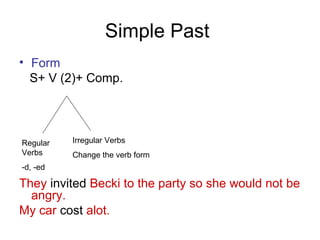
Simple Past
• Form
S+ V (2)+ Comp.
They invited Becki to the party so she would not be
angry.
My car cost alot.
Regular
Verbs
-d, -ed
Irregular Verbs
Change the verb form
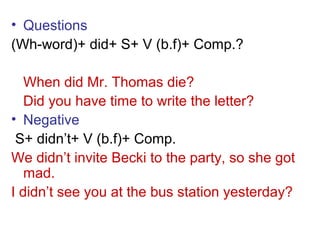
• Questions
(Wh-word)+ did+ S+ V (b.f)+ Comp.?
When did Mr. Thomas die?
Did you have time to write the letter?
• Negative
S+ didn’t+ V (b.f)+ Comp.
We didn’t invite Becki to the party, so she got
mad.
I didn’t see you at the bus station yesterday?
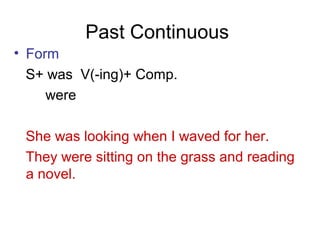
Past Continuous
• Form
S+ was V(-ing)+ Comp.
were
She was looking when I waved for her.
They were sitting on the grass and reading
a novel.
• Questions
(Wh-word)+ was+ S+ V(-ing)+ Comp.?
were
What were you doing this time yesterday?
Was he studying when you called?
• Negatives
S+ was NOT V(-ing)+ Comp.
were
She wasn’t looking when I waved for her.
They weren’t reading a novel this time yesterday.
Simple past and Past Continuous in
Time Clauses
I was working in the garden when I hurt my
back.
While the teacher was talking, a student
came in.
Water flooded the ship after it struck the
iceberg.
Before the noise interrupted them, they were
playing cards.
• Freewriting activity (p.28)
http://www.youtube.com/watch?v=XIpKGug
9Wo
What does the passage talk about?
In a short paragraph use the simple past and
the past continuous to summarize the story
on p.28?
In your evaluation, would the Titanic have
been saved if the ship lookouts had paid
attention earlier? Who do you think was
responsible for what happened?
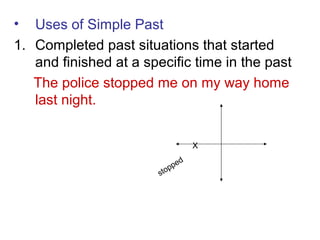
• Uses of Simple Past
1. Completed past situations that started
and finished at a specific time in the past
The police stopped me on my way home
last night.
X
stopped
XX
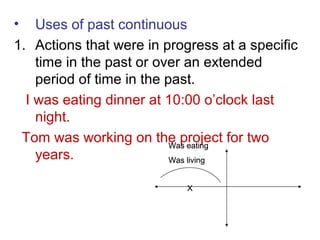
2. Short/long … single/repeated…
recent/distant
It was cold, so I shut the window.
He took the train to work everyday.
He was very sick last week/last year.
XX X
Took
Took
Took
• Uses of past continuous
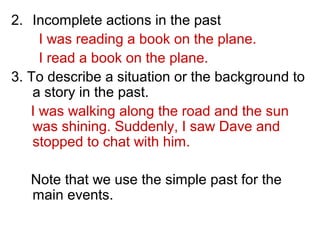
1. Actions that were in progress at a specific
time in the past or over an extended
period of time in the past.
I was eating dinner at 10:00 o’clock last
night.
Tom was working on the project for two
years.
X
Was eating
Was living
Was eating
Was living
Was eating
Was living
Was eating
Was living
X
Was eating
Was living
Was eating
Was living
Was eating
Wa
X
2. Incomplete actions in the past
I was reading a book on the plane.
I read a book on the plane.
3. To describe a situation or the background to
a story in the past.
I was walking along the road and the sun
was shining. Suddenly, I saw Dave and
stopped to chat with him.
Note that we use the simple past for the
main events.
State Verbs
• We were good friends. We …………..
(know) each other well.
• We are good friends. We …………. (know)
each other well.
• I was enjoying the party, but Chris ……….
(want) to go home.
• I am enjoying the party, but Chris………….
(want) to go home.
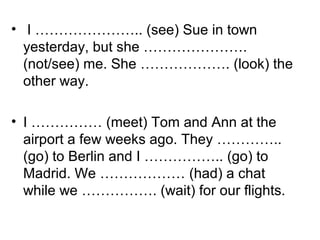
• I ………………….. (see) Sue in town
yesterday, but she ………………….
(not/see) me. She ………………. (look) the
other way.
• I …………… (meet) Tom and Ann at the
airport a few weeks ago. They …………..
(go) to Berlin and I …………….. (go) to
Madrid. We ……………… (had) a chat
while we ……………. (wait) for our flights.
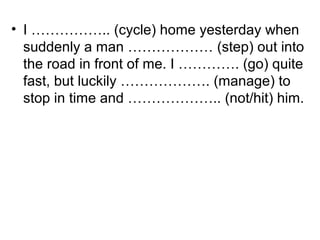
• I …………….. (cycle) home yesterday when
suddenly a man ……………… (step) out into
the road in front of me. I …………. (go) quite
fast, but luckily ………………. (manage) to
stop in time and ……………….. (not/hit) him.
Contrasting Past and Present
Used to & Would
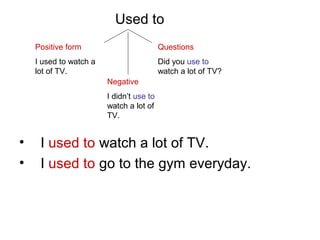
Used to
• I used to watch a lot of TV.
• I used to go to the gym everyday.
Positive form
I used to watch a
lot of TV.
Negative
I didn’t use to
watch a lot of
TV.
Questions
Did you use to
watch a lot of TV?
1. We use (used to) to talk about habits,
states, and actions that were true in the
past, but they are not true now.
We used to go skating a lot.
We didn’t use to play cards.
Contrast the past and the present
Would
(Affirmative sentences)
We use would to combine verbs that express
actions.
When I was young, we would go skating a
lot.
*****We would live in China.******
Thus, both would and used to are used to talk
repeated events and actions in the past,
usually things that happened a long time
ago and are now finished.
When I was young I used to play with my dolls. =
When I was young I would play with my dolls.
Of course I no longer play with dolls!
• However, If you want to talk about repeated
states or habits in the past, you must use
used to, you cannot use would :
My dog used to bark at cats.
I used to smoke.
I used to be an administrative assistant.
I used to live in England.
Used to can refer to past states: being,
possession, mind, and major, unbreakable
habits (usually bad) etc.
• In a description about the past, used to can
appear once of twice at the beginning of a
paragraph, but would is used to provide the
details in the rest of the story.
See the example on page 39.
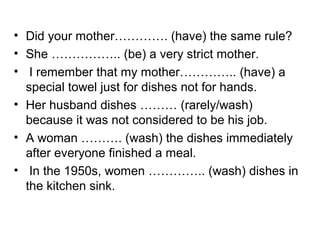
• Did your mother…………. (have) the same rule?
• She …………….. (be) a very strict mother.
• I remember that my mother………….. (have) a
special towel just for dishes not for hands.
• Her husband dishes ……… (rarely/wash)
because it was not considered to be his job.
• A woman ………. (wash) the dishes immediately
after everyone finished a meal.
• In the 1950s, women ………….. (wash) dishes in
the kitchen sink.

Simple Past and Past Continuous Tense

  • 1.
    Simple Past andPast Continuous
  • 2.
    Simple Past • Form S+V (2)+ Comp. They invited Becki to the party so she would not be angry. My car cost alot. Regular Verbs -d, -ed Irregular Verbs Change the verb form
  • 3.
    • Questions (Wh-word)+ did+S+ V (b.f)+ Comp.? When did Mr. Thomas die? Did you have time to write the letter? • Negative S+ didn’t+ V (b.f)+ Comp. We didn’t invite Becki to the party, so she got mad. I didn’t see you at the bus station yesterday?
  • 4.
    Past Continuous • Form S+was V(-ing)+ Comp. were She was looking when I waved for her. They were sitting on the grass and reading a novel.
  • 5.
    • Questions (Wh-word)+ was+S+ V(-ing)+ Comp.? were What were you doing this time yesterday? Was he studying when you called? • Negatives S+ was NOT V(-ing)+ Comp. were She wasn’t looking when I waved for her. They weren’t reading a novel this time yesterday.
  • 6.
    Simple past andPast Continuous in Time Clauses I was working in the garden when I hurt my back. While the teacher was talking, a student came in. Water flooded the ship after it struck the iceberg. Before the noise interrupted them, they were playing cards.
  • 7.
    • Freewriting activity(p.28) http://www.youtube.com/watch?v=XIpKGug 9Wo What does the passage talk about? In a short paragraph use the simple past and the past continuous to summarize the story on p.28? In your evaluation, would the Titanic have been saved if the ship lookouts had paid attention earlier? Who do you think was responsible for what happened?
  • 8.
    • Uses ofSimple Past 1. Completed past situations that started and finished at a specific time in the past The police stopped me on my way home last night. X stopped XX
  • 9.
    2. Short/long …single/repeated… recent/distant It was cold, so I shut the window. He took the train to work everyday. He was very sick last week/last year. XX X Took Took Took
  • 10.
    • Uses ofpast continuous 1. Actions that were in progress at a specific time in the past or over an extended period of time in the past. I was eating dinner at 10:00 o’clock last night. Tom was working on the project for two years. X Was eating Was living Was eating Was living Was eating Was living Was eating Was living X Was eating Was living Was eating Was living Was eating Wa X
  • 11.
    2. Incomplete actionsin the past I was reading a book on the plane. I read a book on the plane. 3. To describe a situation or the background to a story in the past. I was walking along the road and the sun was shining. Suddenly, I saw Dave and stopped to chat with him. Note that we use the simple past for the main events.
  • 12.
    State Verbs • Wewere good friends. We ………….. (know) each other well. • We are good friends. We …………. (know) each other well. • I was enjoying the party, but Chris ………. (want) to go home. • I am enjoying the party, but Chris…………. (want) to go home.
  • 13.
    • I …………………..(see) Sue in town yesterday, but she …………………. (not/see) me. She ………………. (look) the other way. • I …………… (meet) Tom and Ann at the airport a few weeks ago. They ………….. (go) to Berlin and I …………….. (go) to Madrid. We ……………… (had) a chat while we ……………. (wait) for our flights.
  • 14.
    • I ……………..(cycle) home yesterday when suddenly a man ……………… (step) out into the road in front of me. I …………. (go) quite fast, but luckily ………………. (manage) to stop in time and ……………….. (not/hit) him.
  • 15.
    Contrasting Past andPresent Used to & Would
  • 16.
    Used to • Iused to watch a lot of TV. • I used to go to the gym everyday. Positive form I used to watch a lot of TV. Negative I didn’t use to watch a lot of TV. Questions Did you use to watch a lot of TV?
  • 17.
    1. We use(used to) to talk about habits, states, and actions that were true in the past, but they are not true now. We used to go skating a lot. We didn’t use to play cards. Contrast the past and the present
  • 18.
    Would (Affirmative sentences) We usewould to combine verbs that express actions. When I was young, we would go skating a lot. *****We would live in China.******
  • 19.
    Thus, both wouldand used to are used to talk repeated events and actions in the past, usually things that happened a long time ago and are now finished. When I was young I used to play with my dolls. = When I was young I would play with my dolls. Of course I no longer play with dolls!
  • 20.
    • However, Ifyou want to talk about repeated states or habits in the past, you must use used to, you cannot use would : My dog used to bark at cats. I used to smoke. I used to be an administrative assistant. I used to live in England. Used to can refer to past states: being, possession, mind, and major, unbreakable habits (usually bad) etc.
  • 21.
    • In adescription about the past, used to can appear once of twice at the beginning of a paragraph, but would is used to provide the details in the rest of the story. See the example on page 39.
  • 22.
    • Did yourmother…………. (have) the same rule? • She …………….. (be) a very strict mother. • I remember that my mother………….. (have) a special towel just for dishes not for hands. • Her husband dishes ……… (rarely/wash) because it was not considered to be his job. • A woman ………. (wash) the dishes immediately after everyone finished a meal. • In the 1950s, women ………….. (wash) dishes in the kitchen sink.