PRESENT PERFECT
TENSE
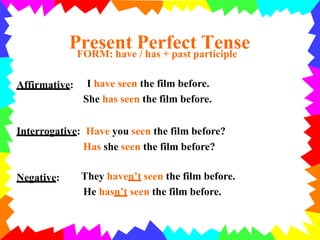
Present Perfect Tense
FORM: have / has + past participle
Affirmative: I have seen the film before.
She has seen the film before.
Interrogative: Have you seen the film before?
Has she seen the film before?
Negative: They haven’t seen the film before.
He hasn’t seen the film before.
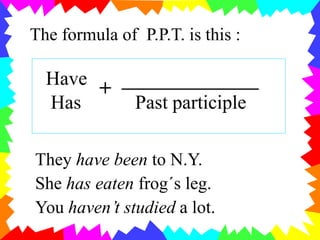
The formula of P.P.T. is this :
Have
+
Has Past participle
They have been to N.Y.
She has eaten frog´s leg.
You haven’t studied a lot.
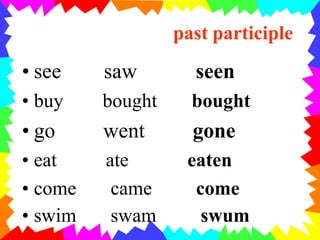
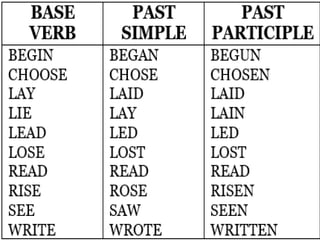
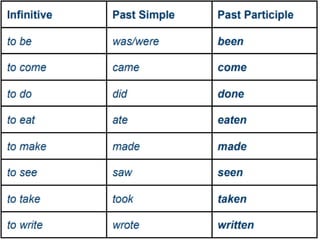
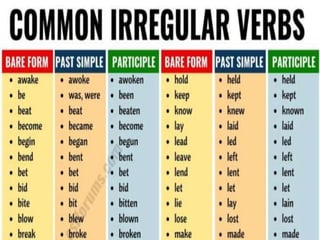
past participle
• see saw seen
• buy bought bought
• go went gone
• eat ate eaten
• come came come
• swim swam swum
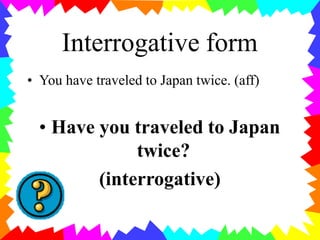
Interrogative form
• You have traveled to Japan twice. (aff)
• Have you traveled to Japan
twice?
(interrogative)
Have you traveled to Japan
twice?
• Yes, I have.
• No, I haven’t.
Negative form
• I have visited the Taj Mahal.
• I have .... visited the Taj Mahal.
• I have NOT visited the Taj Mahal.
• I haven’t seen you for weeks !
• He hasn’t arrived home.
1- Recent events: It is used to describe recent events without
a definite time. The idea of time or place in the speaker’s
mind makes the event recent. A time expression may
emphasize recentness: just, recently, lately
Uses of the present perfect
Why are they so happy?
They have just won a prize so
they are really pleased
JUST
I have just finished my exercise.
He has just had lunch.
2- Personal experiences: It is used to express personal
experiences, there is not a definite time given. The time
expressions ever and never are very often used with this
meaning
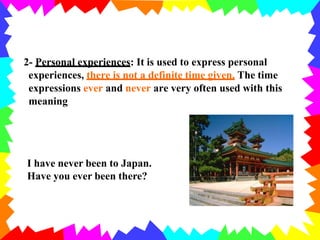
I have never been to Japan.
Have you ever been there?
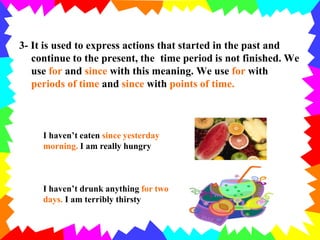
3- It is used to express actions that started in the past and
continue to the present, the time period is not finished. We
use for and since with this meaning. We use for with
periods of time and since with points of time.
I haven’t eaten since yesterday
morning. I am really hungry
I haven’t drunk anything for two
days. I am terribly thirsty
An action started in the past
• We use PPT to indicate an action that began
in the past and continues up to the present.
(the verb in Portuguese is in the present).
• Eg.:
•
•
I’ve lived in Limeira for three years.
She has studied English since January.
• I have worked here since last year.
( How long? )
• She has played tennis for 10 years.
( How long? )
SINCE
FOR
I have studied here since 1999.
I have studied here for 5 years.
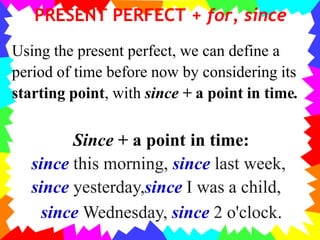
PRESENT PERFECT + for, since
Using the present perfect, we can define a
period of time before now by considering its
starting point, with since + a point in time.
Since + a point in time:
since this morning, since last week,
since yesterday,since I was a child,
since Wednesday, since 2 o'clock.
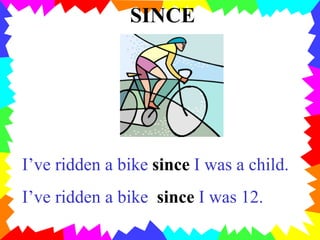
SINCE
I’ve ridden a bike since I was a child.
I’ve ridden a bike since I was 12.
•She has lived here since 1980.
•We have taught at this school since 1965.
•Alice has been married since March 2nd.
•They have been at the hotel since last week.
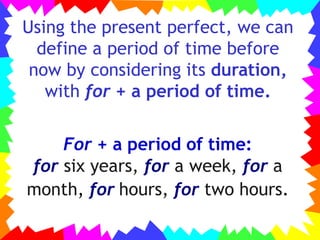
Using the present perfect, we can
define a period of time before
now by considering its duration,
with for + a period of time.
For + a period of time:
for six years, for a week, for a
month, for hours, for two hours.
FOR
They’ve been married for 1 year.
They’ve dated for 3 years.
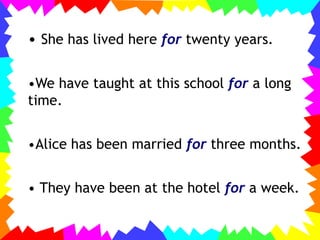
• She has lived here for twenty years.
•We have taught at this school for a long
time.
•Alice has been married for three months.
• They have been at the hotel for a week.
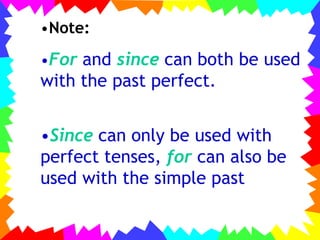
•Note:
•For and since can both be used
with the past perfect.
•Since can only be used with
perfect tenses, for can also be
used with the simple past
I’VE STUDIED ENGLISH SINCE...
FOR....
Present perfect tense

Present perfect tense

  • 1.
  • 2.
    Present Perfect Tense FORM:have / has + past participle Affirmative: I have seen the film before. She has seen the film before. Interrogative: Have you seen the film before? Has she seen the film before? Negative: They haven’t seen the film before. He hasn’t seen the film before.
  • 3.
    The formula ofP.P.T. is this : Have + Has Past participle They have been to N.Y. She has eaten frog´s leg. You haven’t studied a lot.
  • 4.
    past participle • seesaw seen • buy bought bought • go went gone • eat ate eaten • come came come • swim swam swum
  • 5.
    Interrogative form • Youhave traveled to Japan twice. (aff) • Have you traveled to Japan twice? (interrogative)
  • 6.
    Have you traveledto Japan twice? • Yes, I have. • No, I haven’t.
  • 7.
    Negative form • Ihave visited the Taj Mahal. • I have .... visited the Taj Mahal. • I have NOT visited the Taj Mahal. • I haven’t seen you for weeks ! • He hasn’t arrived home.
  • 8.
    1- Recent events:It is used to describe recent events without a definite time. The idea of time or place in the speaker’s mind makes the event recent. A time expression may emphasize recentness: just, recently, lately Uses of the present perfect Why are they so happy? They have just won a prize so they are really pleased
  • 9.
    JUST I have justfinished my exercise. He has just had lunch.
  • 10.
    2- Personal experiences:It is used to express personal experiences, there is not a definite time given. The time expressions ever and never are very often used with this meaning I have never been to Japan. Have you ever been there?
  • 11.
    3- It isused to express actions that started in the past and continue to the present, the time period is not finished. We use for and since with this meaning. We use for with periods of time and since with points of time. I haven’t eaten since yesterday morning. I am really hungry I haven’t drunk anything for two days. I am terribly thirsty
  • 12.
    An action startedin the past • We use PPT to indicate an action that began in the past and continues up to the present. (the verb in Portuguese is in the present). • Eg.: • • I’ve lived in Limeira for three years. She has studied English since January.
  • 13.
    • I haveworked here since last year. ( How long? ) • She has played tennis for 10 years. ( How long? )
  • 14.
    SINCE FOR I have studiedhere since 1999. I have studied here for 5 years.
  • 15.
    PRESENT PERFECT +for, since Using the present perfect, we can define a period of time before now by considering its starting point, with since + a point in time. Since + a point in time: since this morning, since last week, since yesterday,since I was a child, since Wednesday, since 2 o'clock.
  • 16.
    SINCE I’ve ridden abike since I was a child. I’ve ridden a bike since I was 12.
  • 17.
    •She has livedhere since 1980. •We have taught at this school since 1965. •Alice has been married since March 2nd. •They have been at the hotel since last week.
  • 18.
    Using the presentperfect, we can define a period of time before now by considering its duration, with for + a period of time. For + a period of time: for six years, for a week, for a month, for hours, for two hours.
  • 19.
    FOR They’ve been marriedfor 1 year. They’ve dated for 3 years.
  • 20.
    • She haslived here for twenty years. •We have taught at this school for a long time. •Alice has been married for three months. • They have been at the hotel for a week.
  • 21.
    •Note: •For and sincecan both be used with the past perfect. •Since can only be used with perfect tenses, for can also be used with the simple past
  • 22.
    I’VE STUDIED ENGLISHSINCE... FOR....