Short Answers
Cansu SÜER
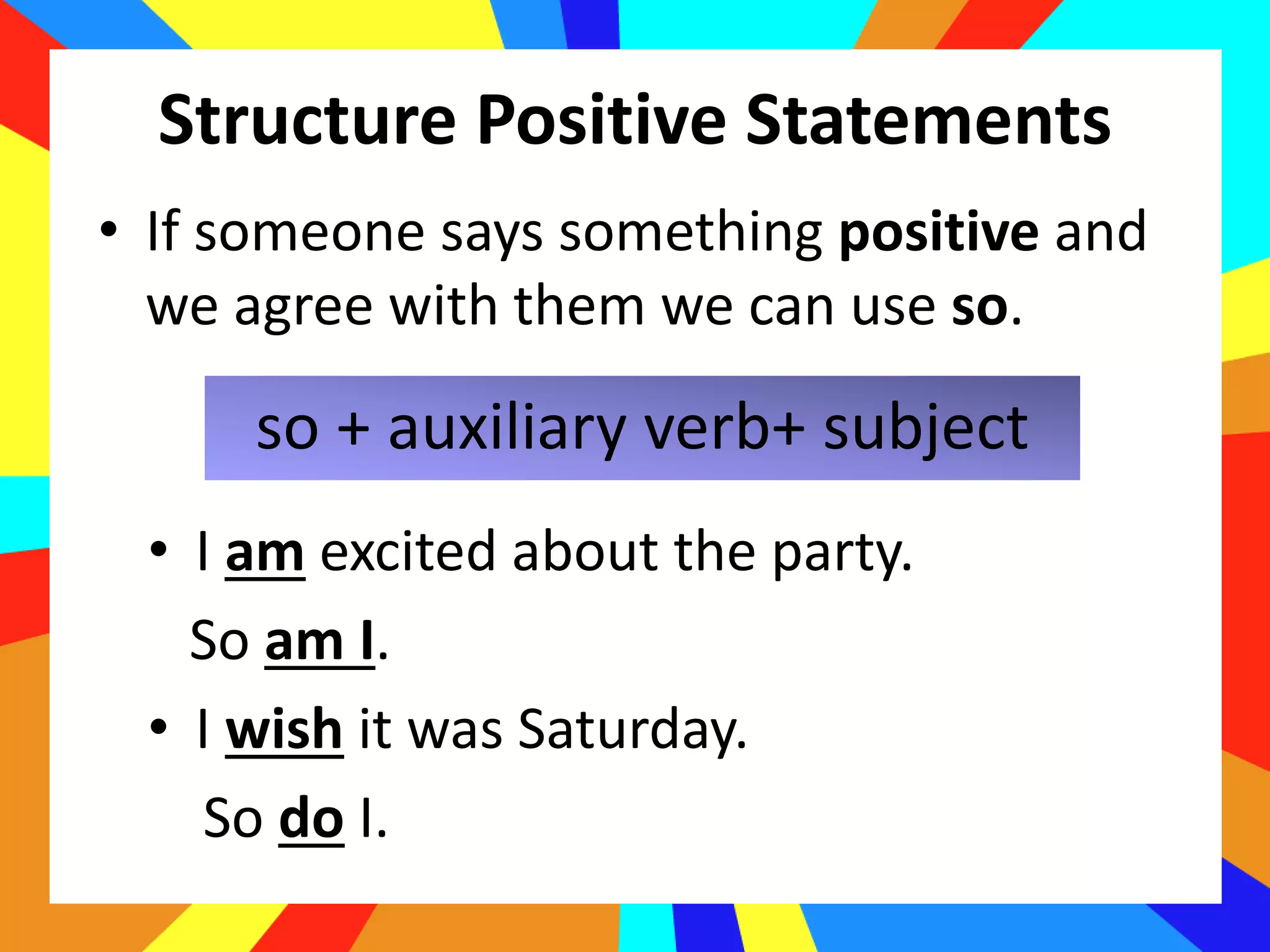
Structure Positive Statements
so + auxiliary verb+ subject
• If someone says something positive and
we agree with them we can use so.
• I am excited about the party.
So am I.
• I wish it was Saturday.
So do I.
Structure Positive Statements
• We can also express that we have the
same idea with sb using «so» in place of
the previous statement.
- I think Fenerbahçe will win the match.
- I think so too.
- I don’t think so.
Structure Positive Statements
• We must also remember that the
verb in the statement needs to
agree with the verb in the response.
• I have got 3 sisters.
So has she.
• I enjoyed the concert.
So did I.
Too/as well/also
• "Too", "as well", and "also" have similar
meanings, but they are used in
different positions in a sentence.
- Jeff plays soccer. Greg plays soccer, too.
- Jeff plays soccer. Greg also plays soccer.
- Jeff plays soccer. Greg plays soccer as
well.
Too/as well/also
• Also cannot be used in short answers
or imperatives, however; we can use
as well and too in this way.
- Sarah is a self confident girl. Her
sister is (self confident) as well. (Her
sister is, too.)
- I met him yesterday. I did too. (I did
also)
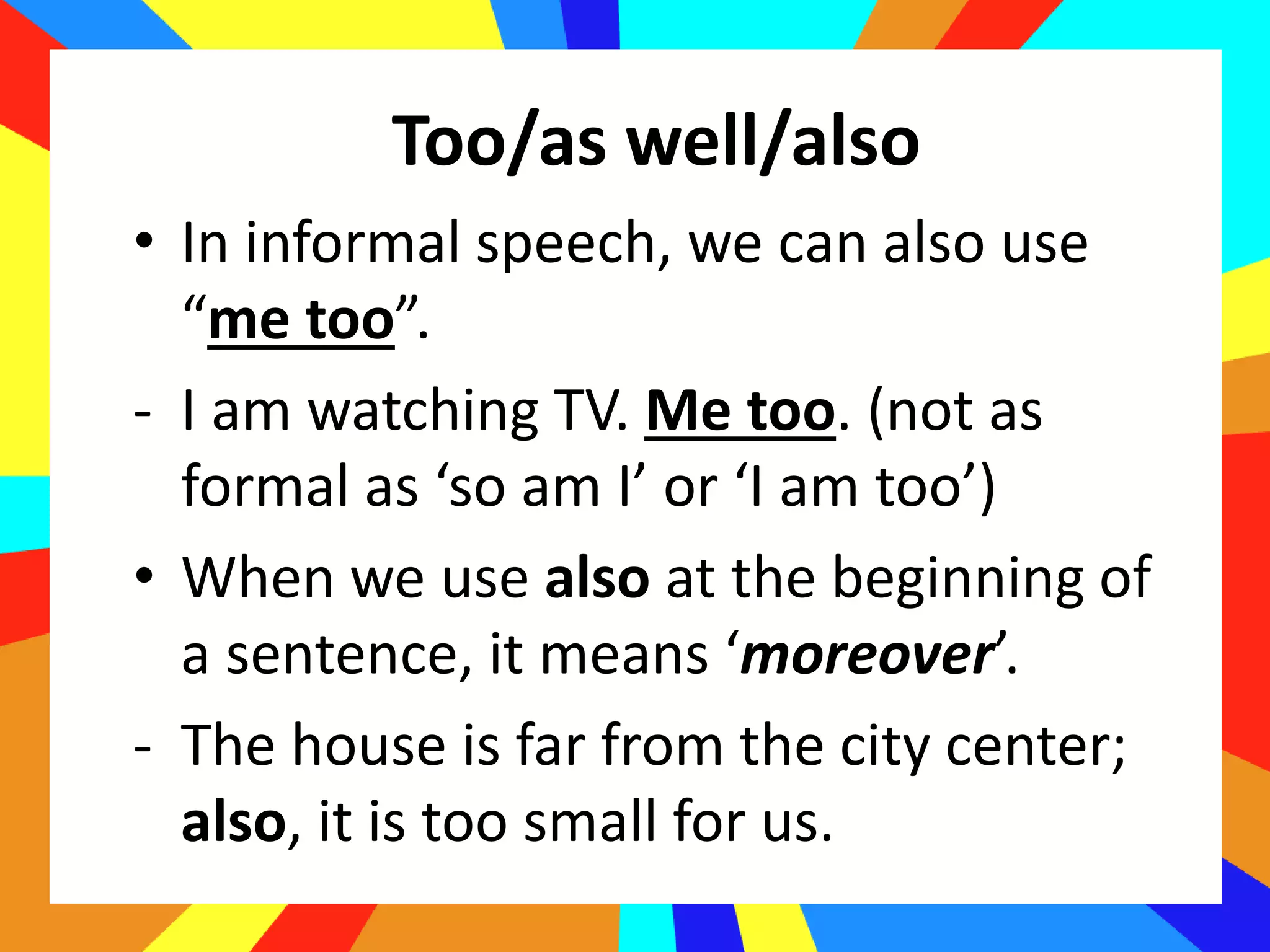
• In informal speech, we can also use
“me too”.
- I am watching TV. Me too. (not as
formal as ‘so am I’ or ‘I am too’)
• When we use also at the beginning of
a sentence, it means ‘moreover’.
- The house is far from the city center;
also, it is too small for us.
Too/as well/also
• In a very formal style, we can
use too directly after the subject.
- I, too, have a very fast car.
• As well is more formal than too.
Too/as well/also
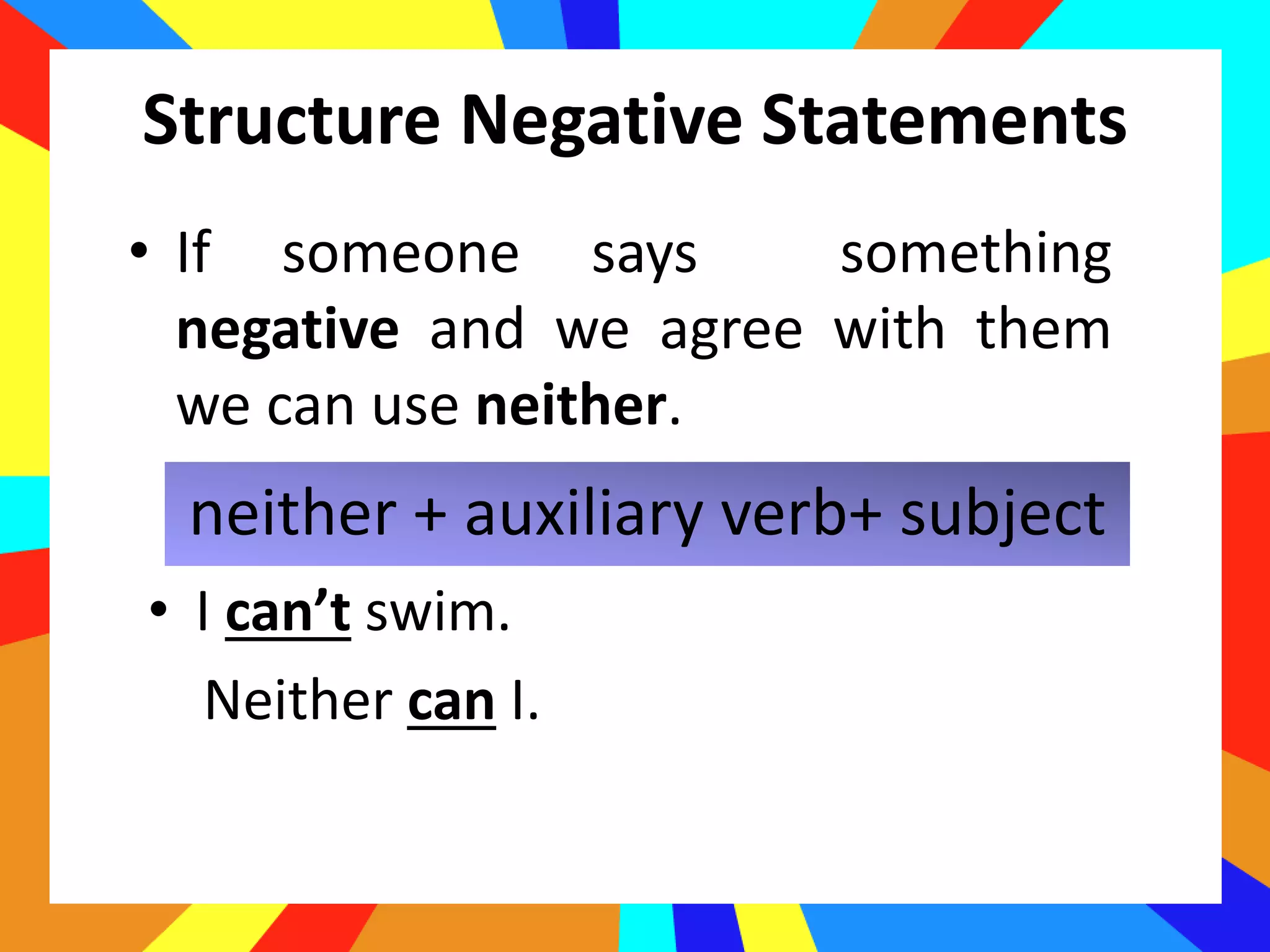
Structure Negative Statements
neither + auxiliary verb+ subject
• If someone says something
negative and we agree with them
we can use neither.
• I can’t swim.
Neither can I.
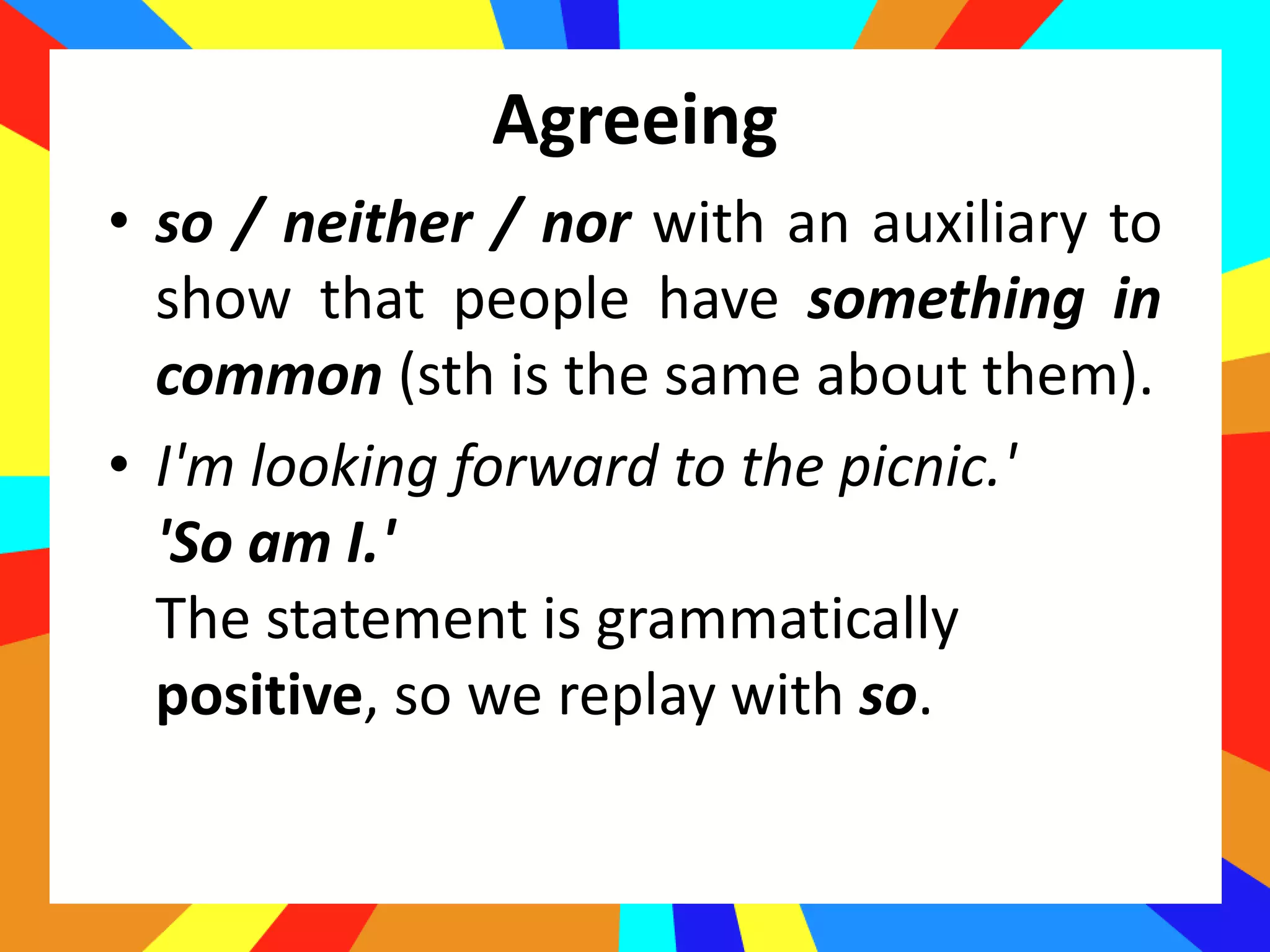
Agreeing
• so / neither / nor with an auxiliary to
show that people have something in
common (sth is the same about them).
• I'm looking forward to the picnic.'
'So am I.'
The statement is grammatically
positive, so we replay with so.
Nor or Neither?
(There is no difference in meaning.)
• 'I don't want to go.'
'Neither do I.'
'Nor do I.'
Nor or Neither?
• We use neither and nor +
auxiliary/modal verb + subject to
mean ‘also not’:
• A: I hate snakes. I can’t even look at a
picture of a snake.
• B: Neither can I.
• Not: I can’t also.
Not either
• We can use not … either to mean ‘also
not’, but we do not change the word
order of the auxiliary or modal verb
and subject:
A: I haven’t ever tasted caviar.
B: I haven’t either. (or Neither have
I./Nor have I.)
Not either
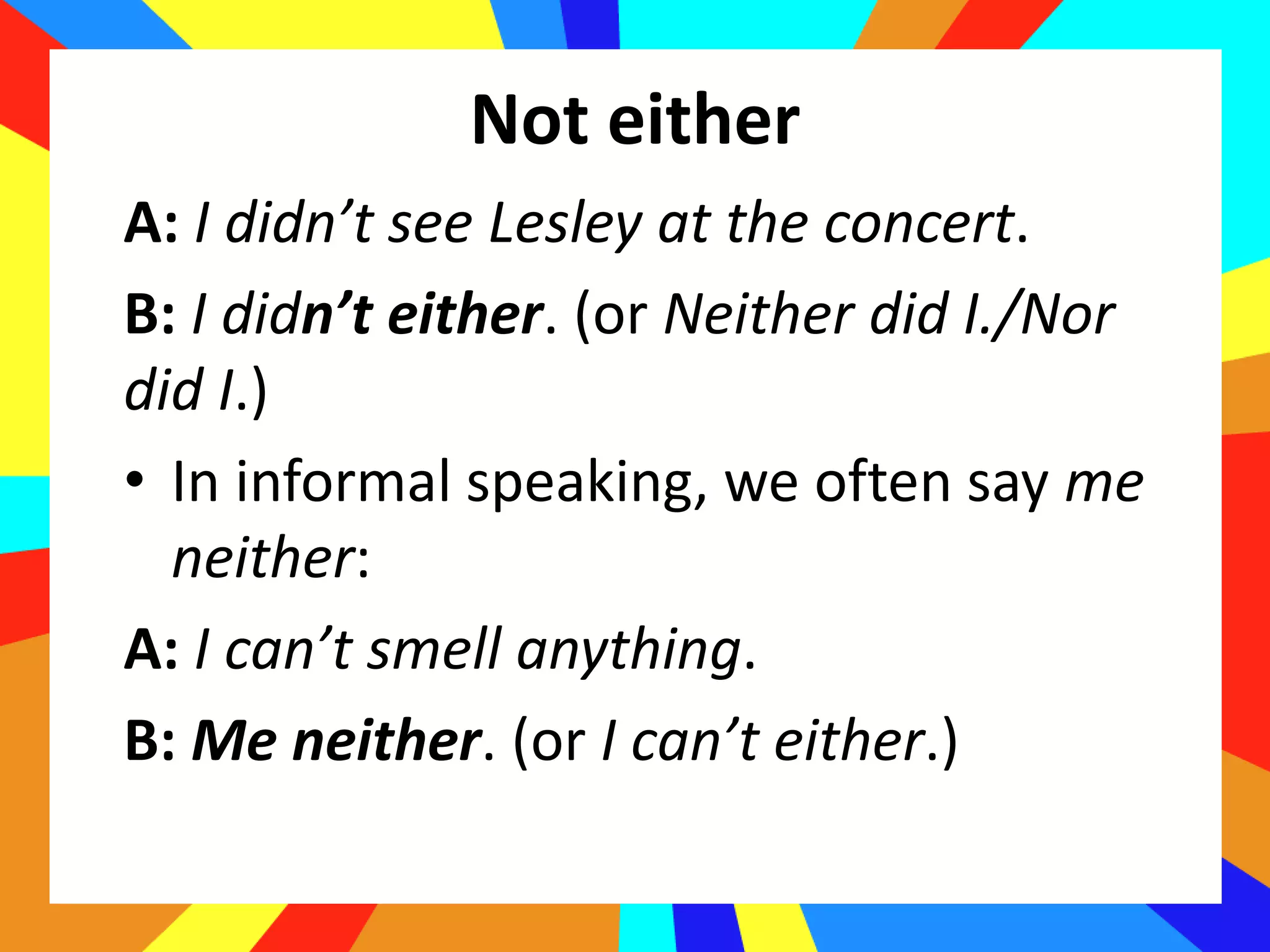
A: I didn’t see Lesley at the concert.
B: I didn’t either. (or Neither did I./Nor
did I.)
• In informal speaking, we often say me
neither:
A: I can’t smell anything.
B: Me neither. (or I can’t either.)
Comparing
- Tim wants to go and so does Janet.
- Mandy's not going on the trip
and neither is Sue.
Hardly/Scarcely
• Only Neither do I or Nor do I is
possible here because hardly/scarcely
has a negative meaning. It means
almost not at all. So if you wish to
agree with what is being said, you will
also need a negative adverb and
use neither or nor in response.
Hardly/Scarcely
• Note that scarcely has the same
negative meaning as hardly and that
either of them can be used here.
Compare the following:
• I can hardly / scarcely believe you're
twenty years old now.
~ Nor / Neither can I!
Hardly/Scarcely
• They're hardly / scarcely ever at
home.
~ Neither / Nor are we!
• He's dead now, but
I hardly / scarcely knew him.
~ Neither / Nor did I.
Hardly/Scarcely
• As an alternative to neither/nor you
can also use not either which has the
same meaning, but normal word
order:
• She had changed so much. I
could hardly /scarcely recognize her. ~ I
couldn't either.
• I've got hardly /scarcely any money left.
What about you? ~ I haven't either.
Disagreeing
• When you don’t have something in
common: If we want to make it clear
that we are different, other short
answers are used.
- I thought the film was quite boring.'
'Oh, I didn't. I really liked it.‘
Disagreeing
• The second speaker gives a short
answer with an auxiliary I didn't and a
short explanation.
• 'I don't like this music.'
'Really? I do. I like heavy metal.'
Typical Errors
• We use neither, not none, when we
are talking about two people or
things:
• Books and television are
different. Neither of them should
replace the other.
• Not: None of them …
Typical Errors
• We don’t normally use both (of) +
not to make a negative statement
about two people or things:
• Neither of these shirts is/are dry yet.
• Not: Both of these shirts aren’t dry
yet.
• Take care to spell neither correctly:
not ‘niether’ or ‘neighter’.
Sample Questions
• I can barely see the road in
front of me, ________ can
Hasan.
a) so
b) neither
Sample Questions
• I can barely see the road in
front of me, ________ can
Hasan.
a) so
b) neither
Cevap B
Sample Questions
• Nobody wanted to go home,
and to be honest, _______ did I.
a) so
b) neither
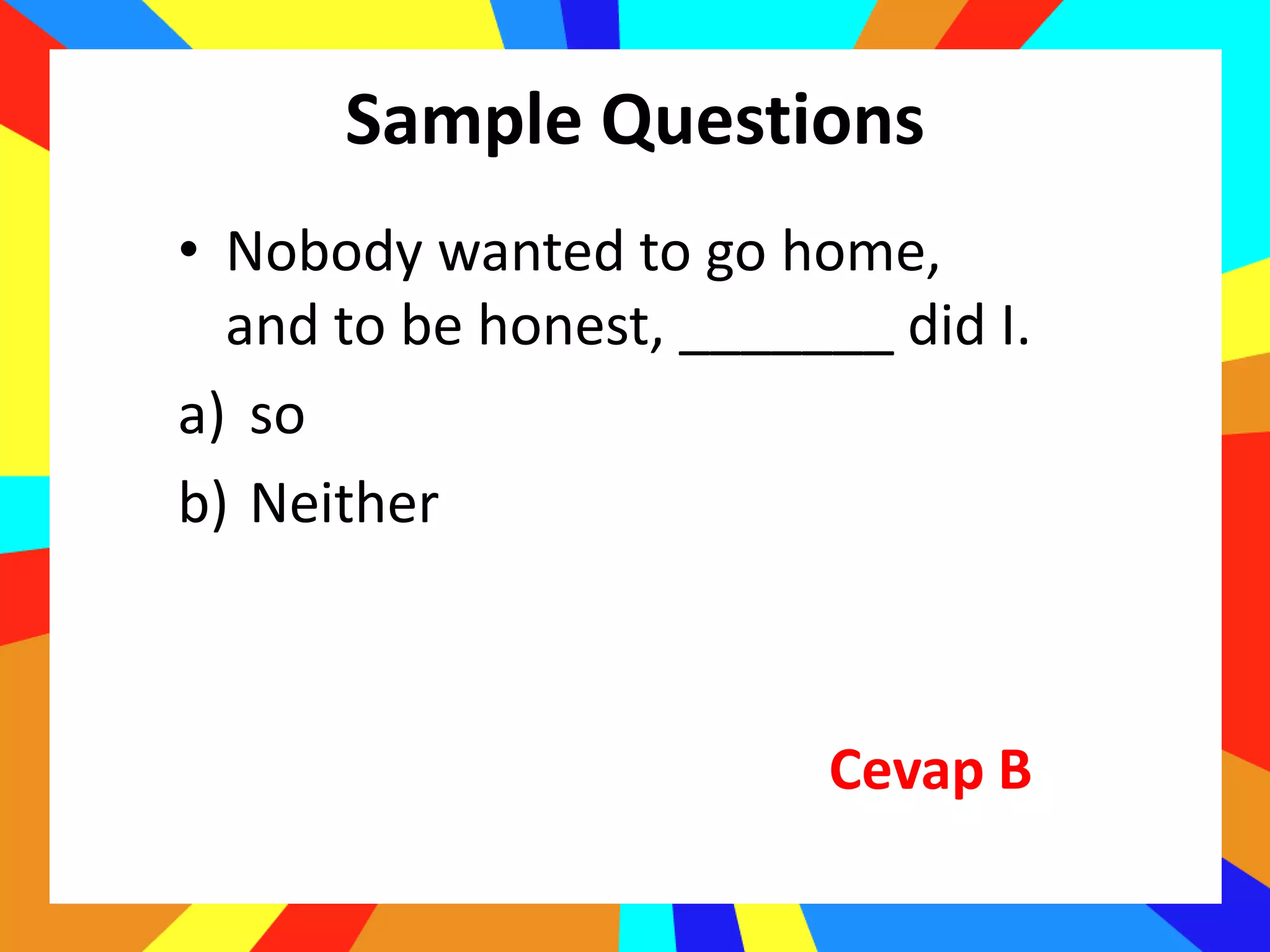
Sample Questions
• Nobody wanted to go home,
and to be honest, _______ did I.
a) so
b) Neither
Cevap B
Sample Questions
• Neighbours complained to the
police about dogs barking, and
________did my landlord.
a) so
b) neither
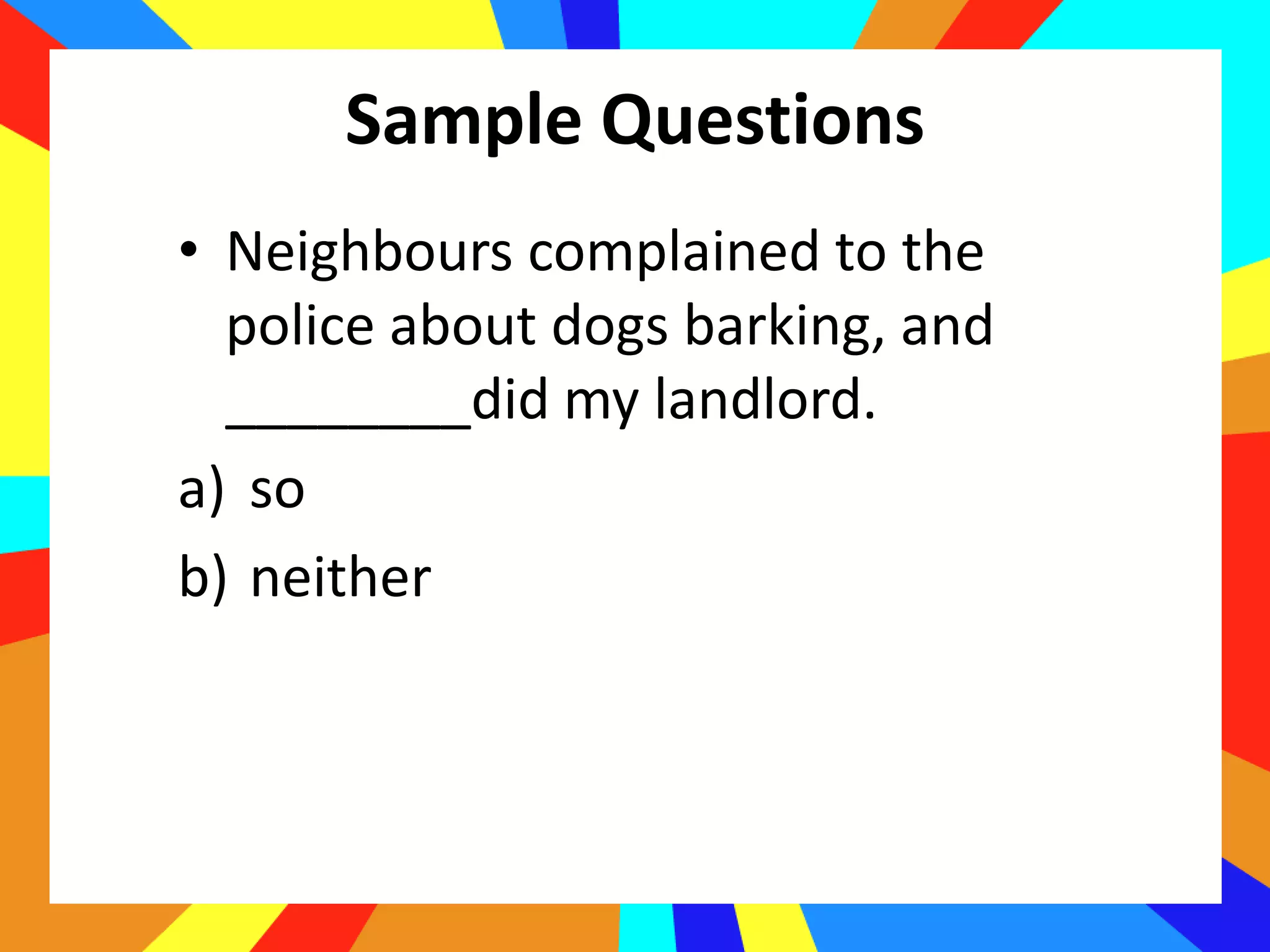
Sample Questions
• Neighbours complained to the
police about dogs barking, and
________did my landlord.
a) so
b) neither
Cevap A
Sample Questions
• Few people had expected
Labor’s Landslide victory in
England, and _______had I.
a) so
b) neither
Sample Questions
• Few people had expected
Labor’s Landslide victory in
England, and _______had I.
a) so
b) Neither
Cevap A

Short answers for agree disagree

  • 1.
  • 2.
    Structure Positive Statements so+ auxiliary verb+ subject • If someone says something positive and we agree with them we can use so. • I am excited about the party. So am I. • I wish it was Saturday. So do I.
  • 3.
    Structure Positive Statements •We can also express that we have the same idea with sb using «so» in place of the previous statement. - I think Fenerbahçe will win the match. - I think so too. - I don’t think so.
  • 4.
    Structure Positive Statements •We must also remember that the verb in the statement needs to agree with the verb in the response. • I have got 3 sisters. So has she. • I enjoyed the concert. So did I.
  • 5.
    Too/as well/also • "Too","as well", and "also" have similar meanings, but they are used in different positions in a sentence. - Jeff plays soccer. Greg plays soccer, too. - Jeff plays soccer. Greg also plays soccer. - Jeff plays soccer. Greg plays soccer as well.
  • 6.
    Too/as well/also • Alsocannot be used in short answers or imperatives, however; we can use as well and too in this way. - Sarah is a self confident girl. Her sister is (self confident) as well. (Her sister is, too.) - I met him yesterday. I did too. (I did also)
  • 7.
    • In informalspeech, we can also use “me too”. - I am watching TV. Me too. (not as formal as ‘so am I’ or ‘I am too’) • When we use also at the beginning of a sentence, it means ‘moreover’. - The house is far from the city center; also, it is too small for us. Too/as well/also
  • 8.
    • In avery formal style, we can use too directly after the subject. - I, too, have a very fast car. • As well is more formal than too. Too/as well/also
  • 9.
    Structure Negative Statements neither+ auxiliary verb+ subject • If someone says something negative and we agree with them we can use neither. • I can’t swim. Neither can I.
  • 10.
    Agreeing • so /neither / nor with an auxiliary to show that people have something in common (sth is the same about them). • I'm looking forward to the picnic.' 'So am I.' The statement is grammatically positive, so we replay with so.
  • 11.
    Nor or Neither? (Thereis no difference in meaning.) • 'I don't want to go.' 'Neither do I.' 'Nor do I.'
  • 12.
    Nor or Neither? •We use neither and nor + auxiliary/modal verb + subject to mean ‘also not’: • A: I hate snakes. I can’t even look at a picture of a snake. • B: Neither can I. • Not: I can’t also.
  • 13.
    Not either • Wecan use not … either to mean ‘also not’, but we do not change the word order of the auxiliary or modal verb and subject: A: I haven’t ever tasted caviar. B: I haven’t either. (or Neither have I./Nor have I.)
  • 14.
    Not either A: Ididn’t see Lesley at the concert. B: I didn’t either. (or Neither did I./Nor did I.) • In informal speaking, we often say me neither: A: I can’t smell anything. B: Me neither. (or I can’t either.)
  • 15.
    Comparing - Tim wantsto go and so does Janet. - Mandy's not going on the trip and neither is Sue.
  • 16.
    Hardly/Scarcely • Only Neitherdo I or Nor do I is possible here because hardly/scarcely has a negative meaning. It means almost not at all. So if you wish to agree with what is being said, you will also need a negative adverb and use neither or nor in response.
  • 17.
    Hardly/Scarcely • Note thatscarcely has the same negative meaning as hardly and that either of them can be used here. Compare the following: • I can hardly / scarcely believe you're twenty years old now. ~ Nor / Neither can I!
  • 18.
    Hardly/Scarcely • They're hardly/ scarcely ever at home. ~ Neither / Nor are we! • He's dead now, but I hardly / scarcely knew him. ~ Neither / Nor did I.
  • 19.
    Hardly/Scarcely • As analternative to neither/nor you can also use not either which has the same meaning, but normal word order: • She had changed so much. I could hardly /scarcely recognize her. ~ I couldn't either. • I've got hardly /scarcely any money left. What about you? ~ I haven't either.
  • 20.
    Disagreeing • When youdon’t have something in common: If we want to make it clear that we are different, other short answers are used. - I thought the film was quite boring.' 'Oh, I didn't. I really liked it.‘
  • 21.
    Disagreeing • The secondspeaker gives a short answer with an auxiliary I didn't and a short explanation. • 'I don't like this music.' 'Really? I do. I like heavy metal.'
  • 22.
    Typical Errors • Weuse neither, not none, when we are talking about two people or things: • Books and television are different. Neither of them should replace the other. • Not: None of them …
  • 23.
    Typical Errors • Wedon’t normally use both (of) + not to make a negative statement about two people or things: • Neither of these shirts is/are dry yet. • Not: Both of these shirts aren’t dry yet. • Take care to spell neither correctly: not ‘niether’ or ‘neighter’.
  • 24.
    Sample Questions • Ican barely see the road in front of me, ________ can Hasan. a) so b) neither
  • 25.
    Sample Questions • Ican barely see the road in front of me, ________ can Hasan. a) so b) neither Cevap B
  • 26.
    Sample Questions • Nobodywanted to go home, and to be honest, _______ did I. a) so b) neither
  • 27.
    Sample Questions • Nobodywanted to go home, and to be honest, _______ did I. a) so b) Neither Cevap B
  • 28.
    Sample Questions • Neighbourscomplained to the police about dogs barking, and ________did my landlord. a) so b) neither
  • 29.
    Sample Questions • Neighbourscomplained to the police about dogs barking, and ________did my landlord. a) so b) neither Cevap A
  • 30.
    Sample Questions • Fewpeople had expected Labor’s Landslide victory in England, and _______had I. a) so b) neither
  • 31.
    Sample Questions • Fewpeople had expected Labor’s Landslide victory in England, and _______had I. a) so b) Neither Cevap A