ESCUELA :  Ciencias de la Educación – Carrera de Inglés. NOMBRES: COMMUNICATIVE GRAMMAR 4 FECHA: ABRIL  – AGOSTO 2009 Lic. César Ochoa Cueva. II BIMESTRE
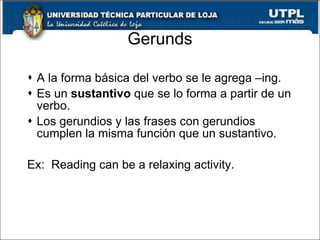
Gerunds A la forma básica del verbo se le agrega –ing. Es un  sustantivo  que se lo forma a partir de un verbo. Los gerundios y las frases con gerundios  cumplen la misma función que un sustantivo. Ex:  Reading can be a relaxing activity.
No se puede confundir entre un verbo con –ing en un tiempo progresivo y un gerundio.  Ex: Mark is playing soccer with his friends. (jugando)- verbo en forma progressiva Playing is his favorite hobby. (jugar)(juego)-sustantivo
Los gerundios pueden actuar en la oración de diferentes formas: Como sujeto: Acting in that movie  was a new  s experience. Learning other languages  is challenging. s
Como objetos: Aquí debemos tomar en cuenta los verbos que nos permiten utilizar un gerundio despues de los mismos: love / like / advise /suggest /enjoy /consider Ex: Judy suggested  going to her house .   objeto Walter enjoys  working in the garden .   objeto
Como complementos (frases que describen o explican al sujeto u objeto de la oración) Ex: Ann’s favorite hobby is  reading books . c (esta describiendo el sujeto)
Como objetos de una preposición. Ex: The kid was afraid  of  opening the door. Mary is good  at  playing tennis. Daniel is happy  about  going to the trip. Nota: be careful with the preposition (to) I look forward to hearing from you.
Para demostrar posesión. (cuando se escribe o habla formalmente) Ex: David’s  talking about everything upsets me. His  talking about everything upsets me. (possessive noun / pronoun) I don’t like  David  talking about everything. I don’t like  him  talking about everything. (name / object pronoun)
En presente Going camping can be a great experience. En pasado Having worked so hard made me feel happy. En forma pasiva : Present: Nancy loves being praised. Past:  He does not feel good about having been punished.
Infinitives ¿ Cómo se forma un infinitivo? to + forma base de un verbo to+ work / to play / to run / to read… Cumplen la misma función que un sustantivo. Actúan dentro de una oración de diferentes maneras:
Como sujetos: (formal) To complete the task helps me to improve my knowledge. (frases con  It ) It’s important   to go  to the doctor when you feel sick. It’s helpful  for students  to finish  this activity.
Como objetos (de sujeto para describirlo o explicarlo) The students’ activity is  to draw  a picture.  ¿Cómo hacemos una forma negativa? Le anteponemos la palabra “not” al infinitivo. I asked you  not to close  the door.
Algunos verbos van seguidos solamente por infinitivos. My brother decided to study abroad. Otros requieren un sustantivo o pronombre My friend invited  me  to play cards. Otros van seguidos de un sustantivo o pronombre mas un infinitivo dependiendo del significado del verbo. We expected to finish on time. We expected Jim to finish on time.
Verbs followed by infinitives or gerunds with no change in meaning: They began to encourage her. They began encouraging her. Verbs followed by infinitives or gerunds with a significant change in  meaning : I stopped to go to the store. I stopped going to the store.
Too+ Adjective / Adverb Infinitive The project is too complicated to finish  on time. Luis works too slowly to meet  the deadline.
Adjective / Adverb + enough Infinitive Arthur is intelligent enough to complete the task. He didn’t study hard enough to pass  the test.
Enough + Noun Infinitive They have enough patience to teach kids patience enough
Simple infinitive Andrea allowed us to get in. Past infinitive Clark seems to have had trouble at school. Passive The assignment was supposed to have been finished by this morning.
Function To modify verbs The topic  often  causes controversy. To modify adjectives The topic is  extremely  controversial. To modify other adverbs He treated the topic  very  fairly. To modify entire sentences Unfortunately , the topic is controversial.
Types Manner Carol performed the play  amazingly. Time Researchers discovered a new vaccine  recently . Place We can camp  here . Frequency We apply questionnaires very  often .
Sentence Adverbs: Placement Beginning Definitely , she is an excellent student. Definitely , she works hard. Middle She is  definitely  an excellent student. She  definitely  works hard. End She is an excellent student,  definitely . She works hard,  definitely .
Focus Adverbs: Placement and Meaning They just don’t support what he says. They think he’s wrong. don’t just They agree with him 100%. Even she can do that. Anyone can do that She  can do even that. It’s amazing how many things she can do. Only men can participate. Women can’t. Men can only participate. They can’t do anything else.
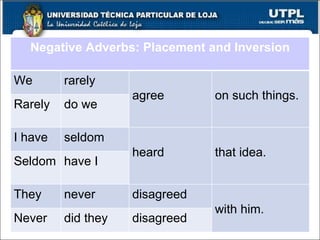
Negative Adverbs: Placement and Inversion We  rarely agree on such things. Rarely do we I have seldom heard that idea. Seldom have I They never disagreed with him. Never  did they disagreed
Other adverbs that force inversion Here is your money. There goes the bus. Here it is. There it goes.
Características: Dependant clauses Function as regular nouns (sustantivos) They can act in the sentence in different positions Noun Clauses That, QW: why, what  or  whether or if
What is not clear about this assignment   is noun   v the objective c That funny face   make   me laugh. noun   v  c Subjects
I   can’t believe   that you are relatives . s  v  (noun) object I   wonder   what I should give her . s  v   (noun) object Objects
The problem   is   whether Mark will finish the  s  v  (noun) c task . The situation   is   that she needs to continue  s  v  (noun) c  studying. Subject complements
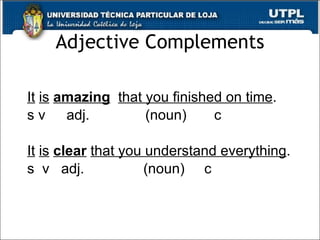
It   is   amazing   that you finished on time . s v   adj.   (noun)  c It   is   clear   that you understand everything . s  v  adj.  (noun)  c Adjective Complements
“ That” is a grammatical word that simply introduces a clause. (no clear meaning) “ That” can be omitted when it introduces an object noun clause or a complement noun clause. Ex: I think (that) she is smart. It is incredible (that) you are the one in the picture. Subject noun clauses beginning with “that” are formal. Algunas otras características
They can occur within a statement or within another question. These questions are more polite. Do not use  If  to introduce a subject noun clause. Embedded Questions
Direct Questions: What time   is   it ? wh-  aux  s Indirect Questions: Do you know  what time   it   is ?   wh-  s  aux I can’t believe  what time   it   is . Embedded Questions
Wh-questions
 
Yes/No questions Is Sophia free on Friday? Do you know if/whether Sophia is free on Friday? Is Bob in town? We are not sure if/whether Bob is in town.
Do  you have my number? I have no idea if/whether she has my number. Will Mary be at the party? Please ask Mary if/whether she will be at the party.
Conditionals In English, there are many different ways of making sentences with If. It is important that: 1) You understand the difference between sentences that express real possibilities, and those that express unreal situations. 2) You learn which tenses follow each conditional.
Zero Conditional We use the zero conditional to express a  situation that is always true .  Present simple + present simple  If I read too much, I get a headache
First Conditional We use the first conditional to express  real possibilities.   Present simple + future If I go to the concert, I'll see Ricky Martin.
Second Conditional We use the second conditional to express an  unreal situation . The situation or condition is improbable, impossible, imaginary or contrary to known facts.  Past simple + would (conditional) If I won the lottery, I would buy a house.
Third Conditional We use the third conditional to imagine the  consequence of events that happened or began to happen in the past . Past Perfect + would have + past participle If I had known, I would have gone to visit you.
Mixed Conditional (2nd & 3rd Conditional) The mixed conditional is a  mixture between the 2nd and 3rd conditional . If the weather had been better, we would go back next year. If I'd been born in 1980, I'd be 23 years old now.  (remember: I'd been born - I'd = I had; I'd be 23 years - I'd = I would)
The Subjunctive   Some adjectives can be followed by a subjunctive verb, like anxious, determined, eager. He was determined that they do not    separate.   The political campaign is eager that their    candidate step out of the shadows. I am anxious that he discuss this with me    soon.
The Subjunctive Certain adjectives can also be used with the subjunctive and `It`, like advisable, critical, desirable, essential, fitting, imperative, important, necessary, vital.  It is imperative that you get home before    dark.  It is important that everyone follow the  rules.  It is necessary that everyone be calm in times of danger.  It is essential that you arrive before 5pm.
 
Communicative Grammar 4,II Bim

Communicative Grammar 4,II Bim

  • 1.
    ESCUELA : Ciencias de la Educación – Carrera de Inglés. NOMBRES: COMMUNICATIVE GRAMMAR 4 FECHA: ABRIL – AGOSTO 2009 Lic. César Ochoa Cueva. II BIMESTRE
  • 2.
    Gerunds A laforma básica del verbo se le agrega –ing. Es un sustantivo que se lo forma a partir de un verbo. Los gerundios y las frases con gerundios cumplen la misma función que un sustantivo. Ex: Reading can be a relaxing activity.
  • 3.
    No se puedeconfundir entre un verbo con –ing en un tiempo progresivo y un gerundio. Ex: Mark is playing soccer with his friends. (jugando)- verbo en forma progressiva Playing is his favorite hobby. (jugar)(juego)-sustantivo
  • 4.
    Los gerundios puedenactuar en la oración de diferentes formas: Como sujeto: Acting in that movie was a new s experience. Learning other languages is challenging. s
  • 5.
    Como objetos: Aquídebemos tomar en cuenta los verbos que nos permiten utilizar un gerundio despues de los mismos: love / like / advise /suggest /enjoy /consider Ex: Judy suggested going to her house . objeto Walter enjoys working in the garden . objeto
  • 6.
    Como complementos (frasesque describen o explican al sujeto u objeto de la oración) Ex: Ann’s favorite hobby is reading books . c (esta describiendo el sujeto)
  • 7.
    Como objetos deuna preposición. Ex: The kid was afraid of opening the door. Mary is good at playing tennis. Daniel is happy about going to the trip. Nota: be careful with the preposition (to) I look forward to hearing from you.
  • 8.
    Para demostrar posesión.(cuando se escribe o habla formalmente) Ex: David’s talking about everything upsets me. His talking about everything upsets me. (possessive noun / pronoun) I don’t like David talking about everything. I don’t like him talking about everything. (name / object pronoun)
  • 9.
    En presente Goingcamping can be a great experience. En pasado Having worked so hard made me feel happy. En forma pasiva : Present: Nancy loves being praised. Past: He does not feel good about having been punished.
  • 10.
    Infinitives ¿ Cómose forma un infinitivo? to + forma base de un verbo to+ work / to play / to run / to read… Cumplen la misma función que un sustantivo. Actúan dentro de una oración de diferentes maneras:
  • 11.
    Como sujetos: (formal)To complete the task helps me to improve my knowledge. (frases con It ) It’s important to go to the doctor when you feel sick. It’s helpful for students to finish this activity.
  • 12.
    Como objetos (desujeto para describirlo o explicarlo) The students’ activity is to draw a picture. ¿Cómo hacemos una forma negativa? Le anteponemos la palabra “not” al infinitivo. I asked you not to close the door.
  • 13.
    Algunos verbos vanseguidos solamente por infinitivos. My brother decided to study abroad. Otros requieren un sustantivo o pronombre My friend invited me to play cards. Otros van seguidos de un sustantivo o pronombre mas un infinitivo dependiendo del significado del verbo. We expected to finish on time. We expected Jim to finish on time.
  • 14.
    Verbs followed byinfinitives or gerunds with no change in meaning: They began to encourage her. They began encouraging her. Verbs followed by infinitives or gerunds with a significant change in meaning : I stopped to go to the store. I stopped going to the store.
  • 15.
    Too+ Adjective /Adverb Infinitive The project is too complicated to finish on time. Luis works too slowly to meet the deadline.
  • 16.
    Adjective / Adverb+ enough Infinitive Arthur is intelligent enough to complete the task. He didn’t study hard enough to pass the test.
  • 17.
    Enough + NounInfinitive They have enough patience to teach kids patience enough
  • 18.
    Simple infinitive Andreaallowed us to get in. Past infinitive Clark seems to have had trouble at school. Passive The assignment was supposed to have been finished by this morning.
  • 19.
    Function To modifyverbs The topic often causes controversy. To modify adjectives The topic is extremely controversial. To modify other adverbs He treated the topic very fairly. To modify entire sentences Unfortunately , the topic is controversial.
  • 20.
    Types Manner Carolperformed the play amazingly. Time Researchers discovered a new vaccine recently . Place We can camp here . Frequency We apply questionnaires very often .
  • 21.
    Sentence Adverbs: PlacementBeginning Definitely , she is an excellent student. Definitely , she works hard. Middle She is definitely an excellent student. She definitely works hard. End She is an excellent student, definitely . She works hard, definitely .
  • 22.
    Focus Adverbs: Placementand Meaning They just don’t support what he says. They think he’s wrong. don’t just They agree with him 100%. Even she can do that. Anyone can do that She can do even that. It’s amazing how many things she can do. Only men can participate. Women can’t. Men can only participate. They can’t do anything else.
  • 23.
    Negative Adverbs: Placementand Inversion We rarely agree on such things. Rarely do we I have seldom heard that idea. Seldom have I They never disagreed with him. Never did they disagreed
  • 24.
    Other adverbs thatforce inversion Here is your money. There goes the bus. Here it is. There it goes.
  • 25.
    Características: Dependant clausesFunction as regular nouns (sustantivos) They can act in the sentence in different positions Noun Clauses That, QW: why, what or whether or if
  • 26.
    What is notclear about this assignment is noun v the objective c That funny face make me laugh. noun v c Subjects
  • 27.
    I can’t believe that you are relatives . s v (noun) object I wonder what I should give her . s v (noun) object Objects
  • 28.
    The problem is whether Mark will finish the s v (noun) c task . The situation is that she needs to continue s v (noun) c studying. Subject complements
  • 29.
    It is amazing that you finished on time . s v adj. (noun) c It is clear that you understand everything . s v adj. (noun) c Adjective Complements
  • 30.
    “ That” isa grammatical word that simply introduces a clause. (no clear meaning) “ That” can be omitted when it introduces an object noun clause or a complement noun clause. Ex: I think (that) she is smart. It is incredible (that) you are the one in the picture. Subject noun clauses beginning with “that” are formal. Algunas otras características
  • 31.
    They can occurwithin a statement or within another question. These questions are more polite. Do not use If to introduce a subject noun clause. Embedded Questions
  • 32.
    Direct Questions: Whattime is it ? wh- aux s Indirect Questions: Do you know what time it is ? wh- s aux I can’t believe what time it is . Embedded Questions
  • 33.
  • 34.
  • 35.
    Yes/No questions IsSophia free on Friday? Do you know if/whether Sophia is free on Friday? Is Bob in town? We are not sure if/whether Bob is in town.
  • 36.
    Do youhave my number? I have no idea if/whether she has my number. Will Mary be at the party? Please ask Mary if/whether she will be at the party.
  • 37.
    Conditionals In English,there are many different ways of making sentences with If. It is important that: 1) You understand the difference between sentences that express real possibilities, and those that express unreal situations. 2) You learn which tenses follow each conditional.
  • 38.
    Zero Conditional Weuse the zero conditional to express a situation that is always true . Present simple + present simple If I read too much, I get a headache
  • 39.
    First Conditional Weuse the first conditional to express real possibilities. Present simple + future If I go to the concert, I'll see Ricky Martin.
  • 40.
    Second Conditional Weuse the second conditional to express an unreal situation . The situation or condition is improbable, impossible, imaginary or contrary to known facts. Past simple + would (conditional) If I won the lottery, I would buy a house.
  • 41.
    Third Conditional Weuse the third conditional to imagine the consequence of events that happened or began to happen in the past . Past Perfect + would have + past participle If I had known, I would have gone to visit you.
  • 42.
    Mixed Conditional (2nd& 3rd Conditional) The mixed conditional is a mixture between the 2nd and 3rd conditional . If the weather had been better, we would go back next year. If I'd been born in 1980, I'd be 23 years old now. (remember: I'd been born - I'd = I had; I'd be 23 years - I'd = I would)
  • 43.
    The Subjunctive Some adjectives can be followed by a subjunctive verb, like anxious, determined, eager. He was determined that they do not separate.   The political campaign is eager that their candidate step out of the shadows. I am anxious that he discuss this with me soon.
  • 44.
    The Subjunctive Certainadjectives can also be used with the subjunctive and `It`, like advisable, critical, desirable, essential, fitting, imperative, important, necessary, vital. It is imperative that you get home before dark. It is important that everyone follow the rules. It is necessary that everyone be calm in times of danger. It is essential that you arrive before 5pm.
  • 45.

Editor's Notes