Tense Form Use Wordsrelated
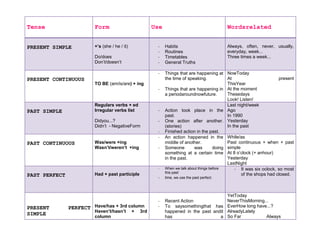
PRESENT SIMPLE +’s (she / he / it)
Do/does
Don’t/doesn’t
- Habits
- Routines
- Timetables
- General Truths
Always, often, never, usually,
everyday, week...
Three times a week...
PRESENT CONTINUOUS
TO BE (am/is/are) + ing
- Things that are happening at
the time of speaking.
- Things that are happening in
a periodaroundnowfuture.
NowToday
At present
ThisYear
At the moment
Thesedays
Look! Listen!
PAST SIMPLE
Regulars verbs + ed
Irregular verbs list
Didyou...?
Didn’t - NegativeForm
- Action took place in the
past.
- One action after another.
(stories)
- Finished action in the past.
Last night/week
Ago
In 1990
Yesterday
In the past
PAST CONTINUOUS Was/were +ing
Wasn’t/weren’t +ing
- An action happened in the
middle of another.
- Someone was doing
something at a certain time
in the past.
While/as
Past continuous + when + past
simple
At 8 o’clock (+ anhour)
Yesterday
LastNight
PAST PERFECT Had + past participle
- When we talk about things before
this past
- time, we use the past perfect.
- It was six oclock, so most
of the shops had closed.
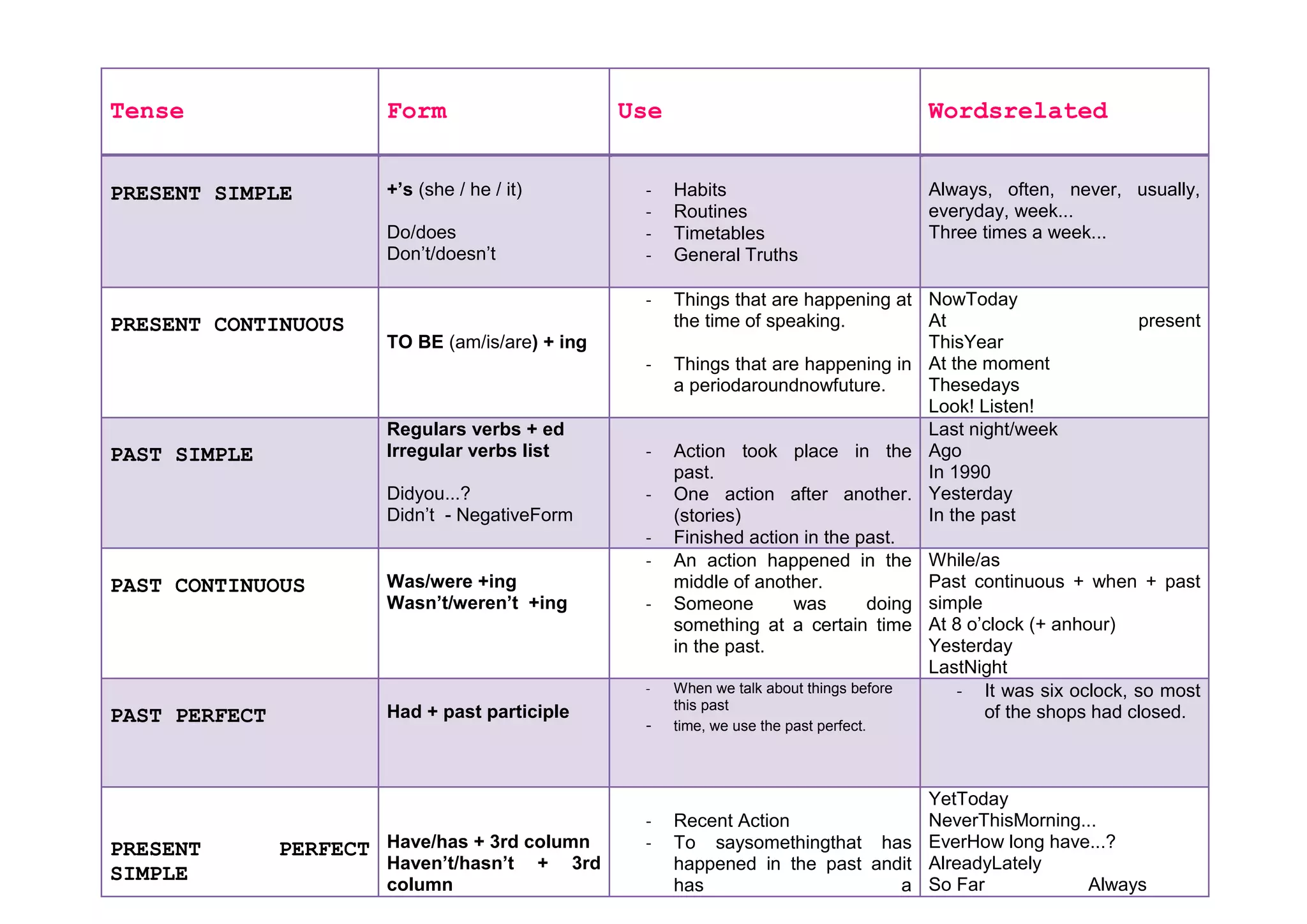
PRESENT PERFECT
SIMPLE
Have/has + 3rd column
Haven’t/hasn’t + 3rd
column
- Recent Action
- To saysomethingthat has
happened in the past andit
has a
YetToday
NeverThisMorning...
EverHow long have...?
AlreadyLately
So Far Always
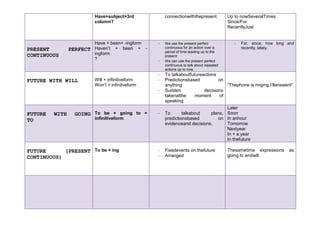
Have+subject+3rd
column?
connectionwiththepresent. Up to nowSeveralTimes
Since/For
RecentlyJust
PRESENT PERFECT
CONTINUOUS
Have + been+ -ingform
Haven’t + been + -
ingform
?
- We use the present perfect
continuous for an action over a
period of time leading up to the
present
- We can use the present perfect
continuous to talk about repeated
actions up to now.
- For, since, how long and
recently, lately.
FUTURE WITH WILL Will + infinitiveform
Won’t + infinitveform
- To talkaboutfutureactions
- Predictionsbased on
anything
- Sudden decisions
takenatthe moment of
speaking
“Thephone is ringing.I’llanswerit”
FUTURE WITH GOING
TO
To be + going to +
infinitiveform
- To talkabout plans,
predictionsbased on
evidenceand decisions.
Later
Soon
In anhour
Tomorrow
Nextyear
In + a year
In thefuture
FUTURE (PRESENT
CONTINUOUS)
To be + ing - Fixedevents on thefuture
- Arranged
Thesametime expressions as
going to andwill.
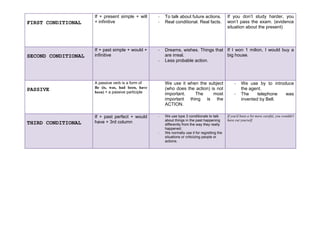
FIRST CONDITIONAL
If + present simple + will
+ infinitive
- To talk about future actions.
- Real conditional. Real facts.
If you don’t study harder, you
won’t pass the exam. (evidence
situation about the present)
SECOND CONDITIONAL
If + past simple + would +
infinitive
- Dreams, wishes. Things that
are irreal.
- Less probable action.
If I won 1 milion, I would buy a
big house.
PASSIVE
A passive verb is a form of
Be (is, was, had been, have
been) + a passive participle
We use it when the subject
(who does the action) is not
important. The most
important thing is the
ACTION.
- We use by to introduce
the agent.
- The telephone was
invented by Bell.
THIRD CONDITIONAL
If + past perfect + would
have + 3rd column
- We use type 3 conditionals to talk
about things in the past happening
differently from the way they really
happened.
- We normally use it for regretting the
situations or criticizing people or
actions.
If you'd been a bit more careful, you wouldn't
have cut yourself.

English tenses

  • 1.
    Tense Form UseWordsrelated PRESENT SIMPLE +’s (she / he / it) Do/does Don’t/doesn’t - Habits - Routines - Timetables - General Truths Always, often, never, usually, everyday, week... Three times a week... PRESENT CONTINUOUS TO BE (am/is/are) + ing - Things that are happening at the time of speaking. - Things that are happening in a periodaroundnowfuture. NowToday At present ThisYear At the moment Thesedays Look! Listen! PAST SIMPLE Regulars verbs + ed Irregular verbs list Didyou...? Didn’t - NegativeForm - Action took place in the past. - One action after another. (stories) - Finished action in the past. Last night/week Ago In 1990 Yesterday In the past PAST CONTINUOUS Was/were +ing Wasn’t/weren’t +ing - An action happened in the middle of another. - Someone was doing something at a certain time in the past. While/as Past continuous + when + past simple At 8 o’clock (+ anhour) Yesterday LastNight PAST PERFECT Had + past participle - When we talk about things before this past - time, we use the past perfect. - It was six oclock, so most of the shops had closed. PRESENT PERFECT SIMPLE Have/has + 3rd column Haven’t/hasn’t + 3rd column - Recent Action - To saysomethingthat has happened in the past andit has a YetToday NeverThisMorning... EverHow long have...? AlreadyLately So Far Always
  • 2.
    Have+subject+3rd column? connectionwiththepresent. Up tonowSeveralTimes Since/For RecentlyJust PRESENT PERFECT CONTINUOUS Have + been+ -ingform Haven’t + been + - ingform ? - We use the present perfect continuous for an action over a period of time leading up to the present - We can use the present perfect continuous to talk about repeated actions up to now. - For, since, how long and recently, lately. FUTURE WITH WILL Will + infinitiveform Won’t + infinitveform - To talkaboutfutureactions - Predictionsbased on anything - Sudden decisions takenatthe moment of speaking “Thephone is ringing.I’llanswerit” FUTURE WITH GOING TO To be + going to + infinitiveform - To talkabout plans, predictionsbased on evidenceand decisions. Later Soon In anhour Tomorrow Nextyear In + a year In thefuture FUTURE (PRESENT CONTINUOUS) To be + ing - Fixedevents on thefuture - Arranged Thesametime expressions as going to andwill.
  • 3.
    FIRST CONDITIONAL If +present simple + will + infinitive - To talk about future actions. - Real conditional. Real facts. If you don’t study harder, you won’t pass the exam. (evidence situation about the present) SECOND CONDITIONAL If + past simple + would + infinitive - Dreams, wishes. Things that are irreal. - Less probable action. If I won 1 milion, I would buy a big house. PASSIVE A passive verb is a form of Be (is, was, had been, have been) + a passive participle We use it when the subject (who does the action) is not important. The most important thing is the ACTION. - We use by to introduce the agent. - The telephone was invented by Bell. THIRD CONDITIONAL If + past perfect + would have + 3rd column - We use type 3 conditionals to talk about things in the past happening differently from the way they really happened. - We normally use it for regretting the situations or criticizing people or actions. If you'd been a bit more careful, you wouldn't have cut yourself.