Charles Horton Cooley
Dr. Syed Mehdi Abbas Zaidi
Department of Sociology
Shia PG College, Lucknow
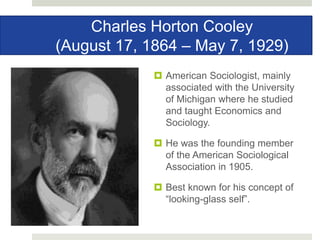
Charles Horton Cooley
(August 17, 1864 – May 7, 1929)
 American Sociologist, mainly
associated with the University
of Michigan where he studied
and taught Economics and
Sociology.
 He was the founding member
of the American Sociological
Association in 1905.
 Best known for his concept of
“looking-glass self”.
Cooley’s Major Works
Some of Cooley’s Works
 1897: Genius, Fame and the Comparison of Races
 1897: The Process of Social Change
 1902: Human Nature and the Social Order
 1907: Social Consciousness
 1908: A Study of the Early Use of Self-Words by a Child
 1909: Social Organization: a Study of the Larger Mind
 1917: Social Control in International Relations
 1929: The Life-Study Method as Applied to Rural Social Research
 1930: Sociological Theory and Social Research, New York: Henry Holt
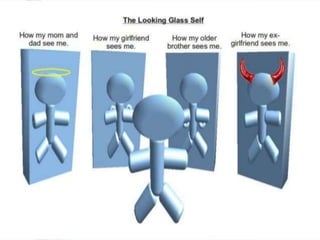
Looking Glass Self
 The Looking-glass self is a social psychological concept,
fashioned by Charles Horton Cooley in 1932.
 This concept of the “looking glass-self” is without a doubt
is his most renowned, and is known and accepted by
most psychologists and sociologists today.
 The term “looking glass self” was first used by Cooley in
his work, Human Nature and the Social Order in 1902.
Steps of Looking Glass Self
 As per C.H. Cooley (1902), in his work Human Nature and
the Social Order, his “Looking-Glass Self” involves three
steps:
1. Self imagination of how you appear to the other person.
2. Imagination of the judgment of the other person.
3. You feel some sense of happiness, pride, guilt, or of
shame.
Concept of Self
The self is the subject of one’s own experience of
phenomena: perception, emotions, thoughts, etc.
Definition of one’s identity, character, abilities,
and attitudes, especially in relation to persons of
things out side itself or oneself.
Example of Self
 The real Alice, known only to her maker.
 Her idea of herself
 “I [Alice] look well in this hat”
 Her idea of Angela’s idea of her
 “Angela thinks I look well in this hat”
 Her Idea of what Angela thinks she thinks of herself
 “Angela thinks I am proud of my looks in this hat”
 Angela’s idea of what Alice thinks of herself
 “Alice thinks she looks stunning in that hat”
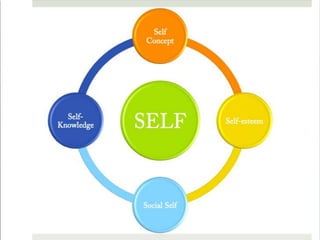
Self Concept
Self concept, self-construction, self-identity or
self-perspective is a collection of beliefs about
oneself.
It includes elements such a academic
performance, gender roles an racial identity.
 Generally, the concept of self contains the
answer to the question Who am I?
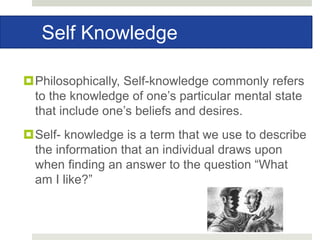
Self Knowledge
Philosophically, Self-knowledge commonly refers
to the knowledge of one’s particular mental state
that include one’s beliefs and desires.
Self- knowledge is a term that we use to describe
the information that an individual draws upon
when finding an answer to the question “What
am I like?”
Self Esteem
Self esteem refers to having esteem in one’s own
self (It includes having self confidence and the
feeling of good about oneself.)
In simple terms, a confidence and satisfaction in
oneself.
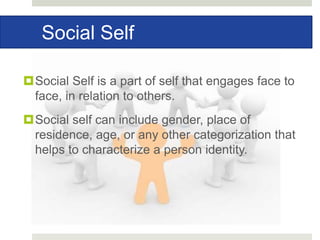
Social Self
Social Self is a part of self that engages face to
face, in relation to others.
Social self can include gender, place of
residence, age, or any other categorization that
helps to characterize a person identity.
Concept of Society
 Society is an interweaving and interworking of mental
selves.
 He imagine your mind and especially what your mind
thinks about his mind.
 He dress his mind before yours and expect that you will
dress yours before his.
 Whoever cannot or will not perform these feats is not
properly in the game.
Concept of Primary Group
 Emphasis on the wholeness of social life led Cooley to
focus his analysis on those human groupings that he
conceived to be primary in linking man with his society.
 By primary group he mean those characterized by
intimate face-to-face cooperation and association.
 However, he himself never used the term secondary
group. In this concept men may be related to one another
through formal relationships.
Thank You
Reference Books
1. Sociological Theory and Social Research, Cooley, Charles
Horton, Kelley (Augustus M.), Publishers, US
2. Cooley Charles Horton: Imagining Social Reality, Glenn
Jacobs, University of Massachusetts Press
3. Looking Glass Self, Charles Horton Cooley, Daniel Sharp
Editor, Wall Flower Books
4. Updating Charles H. Cooley Contemporary Perspectives on a
sociological Classic, Edited by Natalia Ruiz- Junco and
Baptize Brossard, Publisher- Rout ledge

Charles Horton Cooley

  • 1.
    Charles Horton Cooley Dr.Syed Mehdi Abbas Zaidi Department of Sociology Shia PG College, Lucknow
  • 2.
    Charles Horton Cooley (August17, 1864 – May 7, 1929)  American Sociologist, mainly associated with the University of Michigan where he studied and taught Economics and Sociology.  He was the founding member of the American Sociological Association in 1905.  Best known for his concept of “looking-glass self”.
  • 3.
  • 4.
    Some of Cooley’sWorks  1897: Genius, Fame and the Comparison of Races  1897: The Process of Social Change  1902: Human Nature and the Social Order  1907: Social Consciousness  1908: A Study of the Early Use of Self-Words by a Child  1909: Social Organization: a Study of the Larger Mind  1917: Social Control in International Relations  1929: The Life-Study Method as Applied to Rural Social Research  1930: Sociological Theory and Social Research, New York: Henry Holt
  • 5.
    Looking Glass Self The Looking-glass self is a social psychological concept, fashioned by Charles Horton Cooley in 1932.  This concept of the “looking glass-self” is without a doubt is his most renowned, and is known and accepted by most psychologists and sociologists today.  The term “looking glass self” was first used by Cooley in his work, Human Nature and the Social Order in 1902.
  • 6.
    Steps of LookingGlass Self  As per C.H. Cooley (1902), in his work Human Nature and the Social Order, his “Looking-Glass Self” involves three steps: 1. Self imagination of how you appear to the other person. 2. Imagination of the judgment of the other person. 3. You feel some sense of happiness, pride, guilt, or of shame.
  • 7.
    Concept of Self Theself is the subject of one’s own experience of phenomena: perception, emotions, thoughts, etc. Definition of one’s identity, character, abilities, and attitudes, especially in relation to persons of things out side itself or oneself.
  • 8.
    Example of Self The real Alice, known only to her maker.  Her idea of herself  “I [Alice] look well in this hat”  Her idea of Angela’s idea of her  “Angela thinks I look well in this hat”  Her Idea of what Angela thinks she thinks of herself  “Angela thinks I am proud of my looks in this hat”  Angela’s idea of what Alice thinks of herself  “Alice thinks she looks stunning in that hat”
  • 10.
    Self Concept Self concept,self-construction, self-identity or self-perspective is a collection of beliefs about oneself. It includes elements such a academic performance, gender roles an racial identity.  Generally, the concept of self contains the answer to the question Who am I?
  • 11.
    Self Knowledge Philosophically, Self-knowledgecommonly refers to the knowledge of one’s particular mental state that include one’s beliefs and desires. Self- knowledge is a term that we use to describe the information that an individual draws upon when finding an answer to the question “What am I like?”
  • 12.
    Self Esteem Self esteemrefers to having esteem in one’s own self (It includes having self confidence and the feeling of good about oneself.) In simple terms, a confidence and satisfaction in oneself.
  • 13.
    Social Self Social Selfis a part of self that engages face to face, in relation to others. Social self can include gender, place of residence, age, or any other categorization that helps to characterize a person identity.
  • 15.
    Concept of Society Society is an interweaving and interworking of mental selves.  He imagine your mind and especially what your mind thinks about his mind.  He dress his mind before yours and expect that you will dress yours before his.  Whoever cannot or will not perform these feats is not properly in the game.
  • 16.
    Concept of PrimaryGroup  Emphasis on the wholeness of social life led Cooley to focus his analysis on those human groupings that he conceived to be primary in linking man with his society.  By primary group he mean those characterized by intimate face-to-face cooperation and association.  However, he himself never used the term secondary group. In this concept men may be related to one another through formal relationships.
  • 17.
  • 18.
    Reference Books 1. SociologicalTheory and Social Research, Cooley, Charles Horton, Kelley (Augustus M.), Publishers, US 2. Cooley Charles Horton: Imagining Social Reality, Glenn Jacobs, University of Massachusetts Press 3. Looking Glass Self, Charles Horton Cooley, Daniel Sharp Editor, Wall Flower Books 4. Updating Charles H. Cooley Contemporary Perspectives on a sociological Classic, Edited by Natalia Ruiz- Junco and Baptize Brossard, Publisher- Rout ledge