Weathering
   Types
Weathering
    And
    And
  Erosion
  Erosion
     &
Deposition
Breaking it Down the Real Earth surface!
 How does Erosion and Deposition Change the
Surface of the Earth?

S6E5. Students will investigate the scientific view
of how the earth’s surface is formed.
i. Explain the effects of human activity on the
erosion of the earth’s surface.
S6CS10. Students will enhance reading in all curriculum areas by:
c. Building vocabulary knowledge
Demonstrate an understanding of contextual vocabulary in various subjects.
Use content vocabulary in writing and speaking.
Explore understanding of new words found in subject area texts.

Essential Question(s): How does water and wind
change the surface of the earth?
Weathering
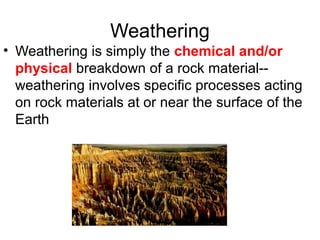
• Weathering is simply the chemical and/or
  physical breakdown of a rock material--
  weathering involves specific processes acting
  on rock materials at or near the surface of the
  Earth
The Different Types of
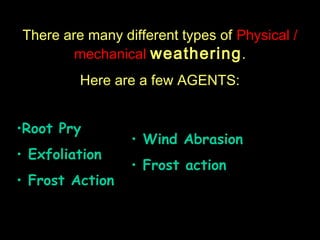
There are many different types of Physical /
            Weathering
        mechanical weathering .
         Here are a few AGENTS:


•Root Pry
                 • Wind Abrasion
• Exfoliation
                 • Frost action
• Frost Action
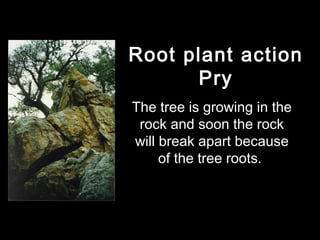
Root plant action
      Pry
The tree is growing in the
 rock and soon the rock
will break apart because
     of the tree roots.
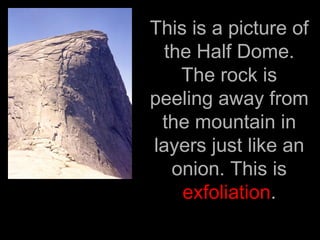
This is a picture of
  the Half Dome.
    The rock is
peeling away from
 the mountain in
layers just like an
   onion. This is
    exfoliation.
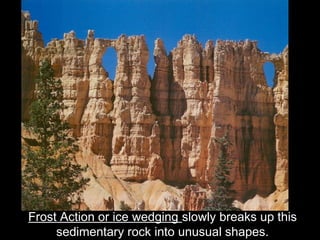
Frost Action or ice wedging slowly breaks up this
     sedimentary rock into unusual shapes.
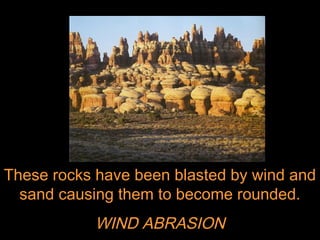
These rocks have been blasted by wind and
  sand causing them to become rounded.
           WIND ABRASION
Chemical weathering
         and AGENTS:

                   Living Organisms


• Acids in Groundwater
  • Karst Topography
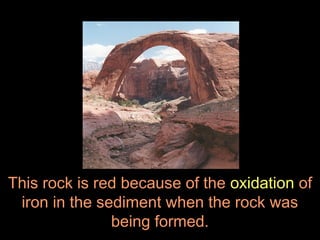
This rock is red because of the oxidation of
 iron in the sediment when the rock was
               being formed.
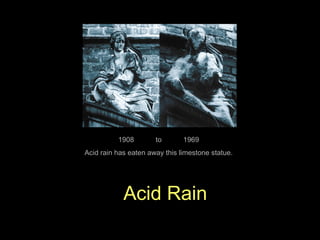
1908        to       1969
Acid rain has eaten away this limestone statue.


            Acid Rain
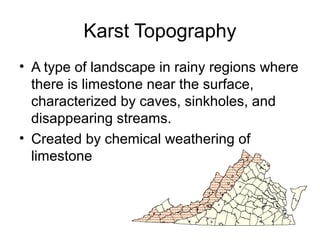
Karst Topography
• A type of landscape in rainy regions where
  there is limestone near the surface,
  characterized by caves, sinkholes, and
  disappearing streams.
• Created by chemical weathering of
  limestone
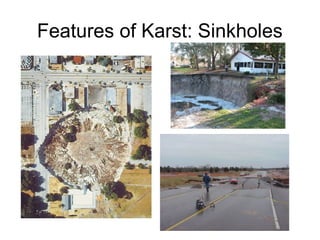
Features of Karst: Sinkholes
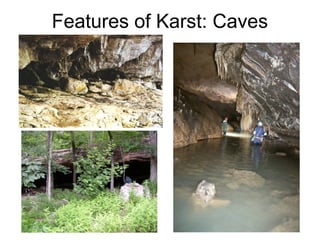
Features of Karst: Caves
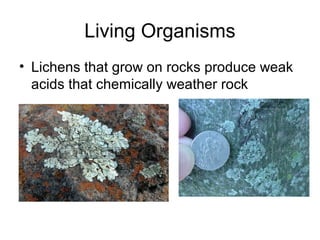
Living Organisms
• Lichens that grow on rocks produce weak
  acids that chemically weather rock
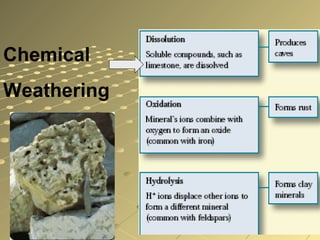
Chemical
Weathering
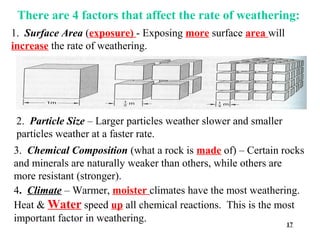
There are 4 factors that affect the rate of weathering:
1. Surface Area (exposure) - Exposing more surface area will
increase the rate of weathering.


 2. Particle Size – Larger particles weather slower and smaller
 particles weather at a faster rate.
3. Chemical Composition (what a rock is made of) – Certain rocks
and minerals are naturally weaker than others, while others are
more resistant (stronger).
4. Climate – Warmer, moister climates have the most weathering.
Heat & Water speed up all chemical reactions. This is the most
important factor in weathering.                                 17
Erosion is the process by which
soil and rock are moved from
one location to another on the
surface by natural processes
such as wind or water flow, and
then transported and deposited
in other locations.
Erosion
         There are many kinds of Erosion.
               Here are a few AGENTS:

• Wave Action       • Avalanche •Creep
• Running Water     •Glaciers   • Rock Fall
• Landslides        • Slump     • Mud Flow
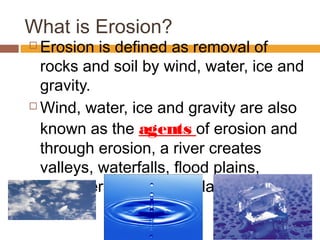
What is Erosion?
 Erosion is defined as removal of
  rocks and soil by wind, water, ice and
  gravity.
 Wind, water, ice and gravity are also

  known as the agents of erosion and
  through erosion, a river creates
  valleys, waterfalls, flood plains,
  meanders, and oxbow lakes
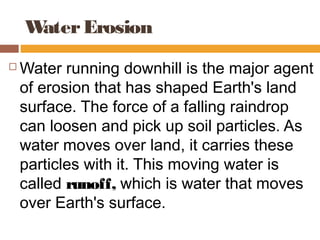
Water Erosion
   Water running downhill is the major agent
    of erosion that has shaped Earth's land
    surface. The force of a falling raindrop
    can loosen and pick up soil particles. As
    water moves over land, it carries these
    particles with it. This moving water is
    called runoff, which is water that moves
    over Earth's surface.
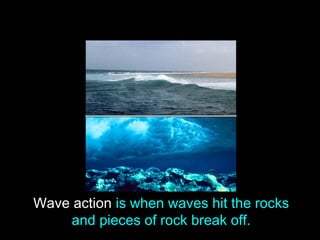
Wave action is when waves hit the rocks
     and pieces of rock break off.
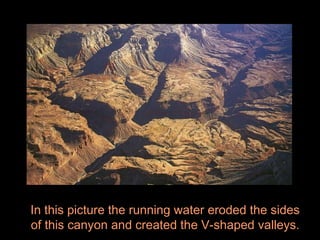
In this picture the running water eroded the sides
of this canyon and created the V-shaped valleys.
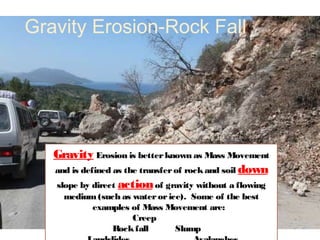
Gravity Erosion-Rock Fall


   Gravity Erosion is better known as Mass Movement
   and is defined as the transfer of rock and soil down
   slope by direct action of gravity without a flowing
     medium (such as water or ice). Some of the best
           examples of Mass Movement are:
                     Creep
               Rock fall        Slump
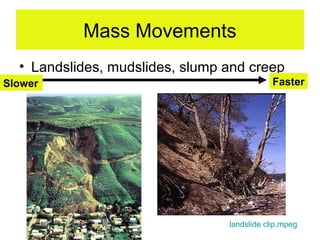
Mass Movements
  • Landslides, mudslides, slump and creep
Slower                                       Faster


                                 landslide clip.mpeg
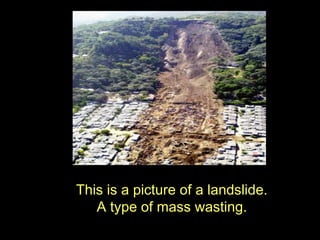
This is a picture of a landslide.
   A type of mass wasting.
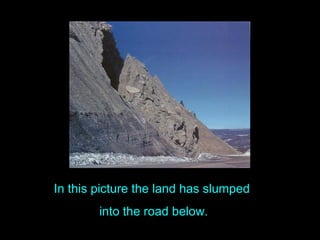
In this picture the land has slumped
        into the road below.
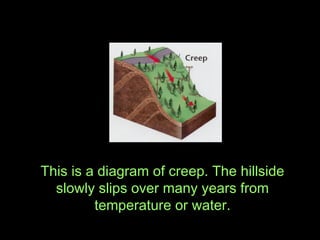
This is a diagram of creep. The hillside
  slowly slips over many years from
         temperature or water.
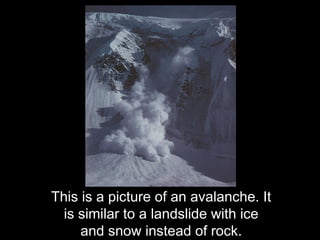
This is a picture of an avalanche. It
  is similar to a landslide with ice
     and snow instead of rock.
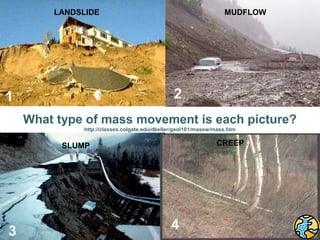
LANDSLIDE                                                MUDFLOW


1                                             2
    What type of mass movement is each picture?
             http://classes.colgate.edu/dkeller/geol101/massw/mass.htm


          SLUMP                                               CREEP


3                                            4
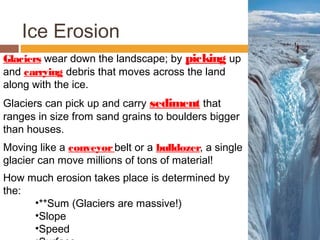
Ice Erosion
Glaciers wear down the landscape; by picking up
and carrying debris that moves across the land
along with the ice.
Glaciers can pick up and carry sediment that
ranges in size from sand grains to boulders bigger
than houses.
Moving like a conveyor belt or a bulldozer, a single
glacier can move millions of tons of material!
How much erosion takes place is determined by
the:
     •**Sum (Glaciers are massive!)
     •Slope
     •Speed
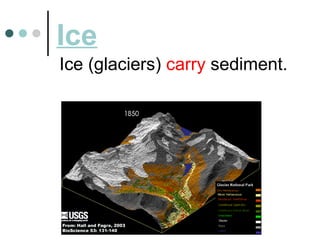
Ice
Ice (glaciers) carry sediment.
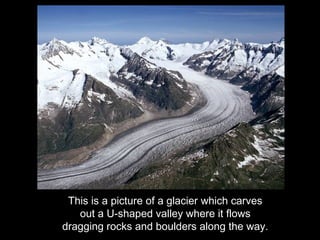
This is a picture of a glacier which carves
   out a U-shaped valley where it flows
dragging rocks and boulders along the way.
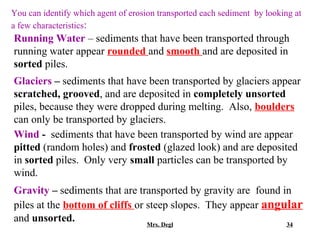
You can identify which agent of erosion transported each sediment by looking at
a few characteristics:
Running Water – sediments that have been transported through
running water appear rounded and smooth and are deposited in
sorted piles.
Glaciers – sediments that have been transported by glaciers appear
scratched, grooved, and are deposited in completely unsorted
piles, because they were dropped during melting. Also, boulders
can only be transported by glaciers.
Wind - sediments that have been transported by wind are appear
pitted (random holes) and frosted (glazed look) and are deposited
in sorted piles. Only very small particles can be transported by
wind.
Gravity – sediments that are transported by gravity are found in
piles at the bottom of cliffs or steep slopes. They appear angular
and unsorted.                    Mrs. Degl                     34
Factors that influence erosional rates (speed) in running
water and glacial ice:

1. Slope (gradient) of the land – as slope increases, the
water velocity increases, the particle size that the water
can carry also increases, therefore the amount of erosion
increases.
2. Volume (size of the water or glacier) – as the volume of
the water or glacier increases, their velocities increase,
the particle size that they can carry also increases,
therefore the amount of erosion increases.
3. Position within the running water – Water is traveling
faster around the outside of turns therefore that is
where more erosion occurs. Water is traveling slower on
the inside of turns; therefore deposition occurs on the
inside.                     Mrs. Degl                  35
Deposition
  Rock particles that are picked up and transported
      during erosion will ultimately be deposited
                    somewhere else

Deposition is the process by which sediments (small
  particles of rock) are laid down in new locations.
    • Together, Erosion and Deposition build new
                      landforms.
                      • Deltas
                     • Canyons
                    • Meanders
                   • Floodplains
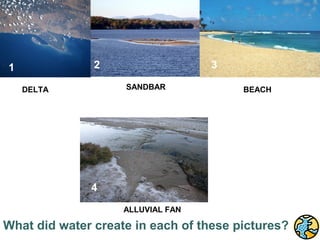
Water Deposition
   Deltas – slow river current drops sediment in fan-shaped
    pattern at end of river


   Sand Bars – offshore deposit of sand, gravel, or shell
    material


   Alluvial Fans


   Beaches – deposited sand
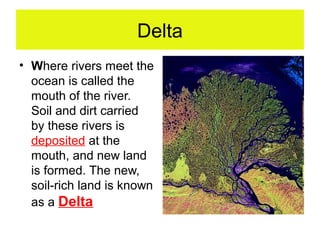
Delta
• Where rivers meet the
  ocean is called the
  mouth of the river.
  Soil and dirt carried
  by these rivers is
  deposited at the
  mouth, and new land
  is formed. The new,
  soil-rich land is known
  as a Delta
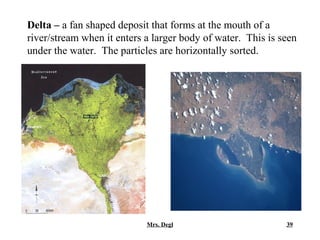
Delta – a fan shaped deposit that forms at the mouth of a
river/stream when it enters a larger body of water. This is seen
under the water. The particles are horizontally sorted.


                            Mrs. Degl                        39
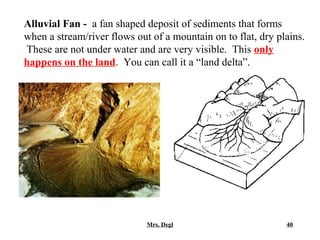
Alluvial Fan - a fan shaped deposit of sediments that forms
when a stream/river flows out of a mountain on to flat, dry plains.
These are not under water and are very visible. This only
happens on the land. You can call it a “land delta”.


                             Mrs. Degl                        40
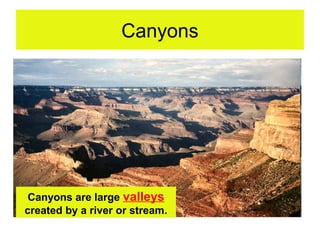
Canyons


 Canyons are large valleys
created by a river or stream.
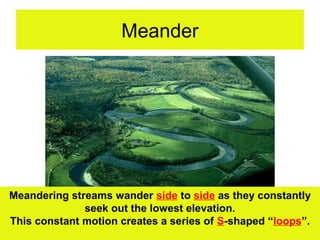
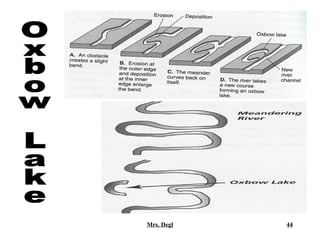
Meander


Meandering streams wander side to side as they constantly
              seek out the lowest elevation.
This constant motion creates a series of S-shaped “loops”.
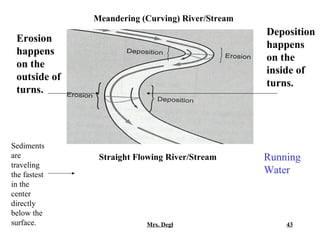
Meandering (Curving) River/Stream
                                                  Deposition
 Erosion
                                                  happens
 happens
                                                  on the
 on the
                                                  inside of
 outside of
                                                  turns.
 turns.


Sediments
are            Straight Flowing River/Stream      Running
traveling
the fastest                                       Water
in the
center
directly
below the
surface.                  Mrs. Degl                   43
Mrs. Degl   44
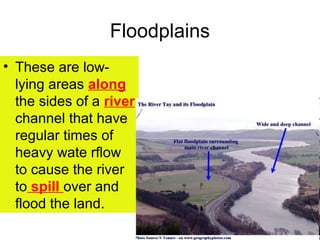
Floodplains
• These are low-
  lying areas along
  the sides of a river
  channel that have
  regular times of
  heavy wate rflow
  to cause the river
  to spill over and
  flood the land.
http://www.school-portal.co.uk/GroupDownloadFile.asp?file=21604


                                                                                 5
   1                                                  2                          3
                                                       2          SANDBAR
           DELTA                                                                         BEACH
   1


      4                                            4                                 6
                                                   4
                                                                  ALLUVIAL FAN

What did water create in each of these pictures?
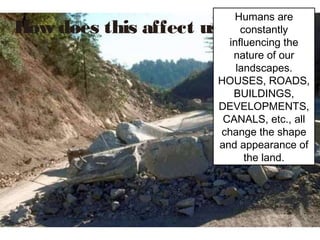
Humans are
How does this affect us?   constantly
                        influencing the
                         nature of our
                          landscapes.
                      HOUSES, ROADS,
                         BUILDINGS,
                      DEVELOPMENTS,
                       CANALS, etc., all
                      change the shape
                      and appearance of
                            the land.
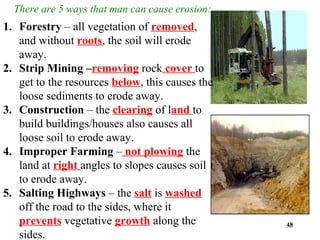
There are 5 ways that man can cause erosion:
1. Forestry – all vegetation of removed,
   and without roots, the soil will erode
   away.
2. Strip Mining –removing rock cover to
   get to the resources below, this causes the
   loose sediments to erode away.
3. Construction – the clearing of land to
   build buildings/houses also causes all
   loose soil to erode away.
4. Improper Farming – not plowing the
   land at right angles to slopes causes soil
   to erode away.
5. Salting Highways – the salt is washed
   off the road to the sides, where it
   prevents vegetative growth along the          48
   sides.
Summary please pick ONE
• Use at least two facts from your notes
to explain the question below.
• How does Erosion and Deposition
  Change the Surface of the Earth?
                 OR
• How does water and wind change the
  surface of the earth?
                                       49

Erosion & weathering change

  • 1.
    Weathering Types Weathering And And Erosion Erosion & Deposition
  • 2.
    Breaking it Downthe Real Earth surface! How does Erosion and Deposition Change the Surface of the Earth? S6E5. Students will investigate the scientific view of how the earth’s surface is formed. i. Explain the effects of human activity on the erosion of the earth’s surface. S6CS10. Students will enhance reading in all curriculum areas by: c. Building vocabulary knowledge Demonstrate an understanding of contextual vocabulary in various subjects. Use content vocabulary in writing and speaking. Explore understanding of new words found in subject area texts. Essential Question(s): How does water and wind change the surface of the earth?
  • 3.
    Weathering • Weathering issimply the chemical and/or physical breakdown of a rock material-- weathering involves specific processes acting on rock materials at or near the surface of the Earth
  • 4.
    The Different Typesof There are many different types of Physical / Weathering mechanical weathering . Here are a few AGENTS: •Root Pry • Wind Abrasion • Exfoliation • Frost action • Frost Action
  • 5.
    Root plant action Pry The tree is growing in the rock and soon the rock will break apart because of the tree roots.
  • 6.
    This is apicture of the Half Dome. The rock is peeling away from the mountain in layers just like an onion. This is exfoliation.
  • 7.
    Frost Action orice wedging slowly breaks up this sedimentary rock into unusual shapes.
  • 8.
    These rocks havebeen blasted by wind and sand causing them to become rounded. WIND ABRASION
  • 9.
    Chemical weathering and AGENTS: Living Organisms • Acids in Groundwater • Karst Topography
  • 10.
    This rock isred because of the oxidation of iron in the sediment when the rock was being formed.
  • 11.
    1908 to 1969 Acid rain has eaten away this limestone statue. Acid Rain
  • 12.
    Karst Topography • Atype of landscape in rainy regions where there is limestone near the surface, characterized by caves, sinkholes, and disappearing streams. • Created by chemical weathering of limestone
  • 13.
  • 14.
  • 15.
    Living Organisms • Lichensthat grow on rocks produce weak acids that chemically weather rock
  • 16.
  • 17.
    There are 4factors that affect the rate of weathering: 1. Surface Area (exposure) - Exposing more surface area will increase the rate of weathering. 2. Particle Size – Larger particles weather slower and smaller particles weather at a faster rate. 3. Chemical Composition (what a rock is made of) – Certain rocks and minerals are naturally weaker than others, while others are more resistant (stronger). 4. Climate – Warmer, moister climates have the most weathering. Heat & Water speed up all chemical reactions. This is the most important factor in weathering. 17
  • 18.
    Erosion is theprocess by which soil and rock are moved from one location to another on the surface by natural processes such as wind or water flow, and then transported and deposited in other locations.
  • 19.
    Erosion There are many kinds of Erosion. Here are a few AGENTS: • Wave Action • Avalanche •Creep • Running Water •Glaciers • Rock Fall • Landslides • Slump • Mud Flow
  • 20.
    What is Erosion? Erosion is defined as removal of rocks and soil by wind, water, ice and gravity.  Wind, water, ice and gravity are also known as the agents of erosion and through erosion, a river creates valleys, waterfalls, flood plains, meanders, and oxbow lakes
  • 21.
    Water Erosion  Water running downhill is the major agent of erosion that has shaped Earth's land surface. The force of a falling raindrop can loosen and pick up soil particles. As water moves over land, it carries these particles with it. This moving water is called runoff, which is water that moves over Earth's surface.
  • 22.
    Wave action iswhen waves hit the rocks and pieces of rock break off.
  • 23.
    In this picturethe running water eroded the sides of this canyon and created the V-shaped valleys.
  • 24.
    Gravity Erosion-Rock Fall Gravity Erosion is better known as Mass Movement and is defined as the transfer of rock and soil down slope by direct action of gravity without a flowing medium (such as water or ice). Some of the best examples of Mass Movement are: Creep Rock fall Slump
  • 25.
    Mass Movements • Landslides, mudslides, slump and creep Slower Faster landslide clip.mpeg
  • 26.
    This is apicture of a landslide. A type of mass wasting.
  • 27.
    In this picturethe land has slumped into the road below.
  • 28.
    This is adiagram of creep. The hillside slowly slips over many years from temperature or water.
  • 29.
    This is apicture of an avalanche. It is similar to a landslide with ice and snow instead of rock.
  • 30.
    LANDSLIDE MUDFLOW 1 2 What type of mass movement is each picture? http://classes.colgate.edu/dkeller/geol101/massw/mass.htm SLUMP CREEP 3 4
  • 31.
    Ice Erosion Glaciers weardown the landscape; by picking up and carrying debris that moves across the land along with the ice. Glaciers can pick up and carry sediment that ranges in size from sand grains to boulders bigger than houses. Moving like a conveyor belt or a bulldozer, a single glacier can move millions of tons of material! How much erosion takes place is determined by the: •**Sum (Glaciers are massive!) •Slope •Speed
  • 32.
  • 33.
    This is apicture of a glacier which carves out a U-shaped valley where it flows dragging rocks and boulders along the way.
  • 34.
    You can identifywhich agent of erosion transported each sediment by looking at a few characteristics: Running Water – sediments that have been transported through running water appear rounded and smooth and are deposited in sorted piles. Glaciers – sediments that have been transported by glaciers appear scratched, grooved, and are deposited in completely unsorted piles, because they were dropped during melting. Also, boulders can only be transported by glaciers. Wind - sediments that have been transported by wind are appear pitted (random holes) and frosted (glazed look) and are deposited in sorted piles. Only very small particles can be transported by wind. Gravity – sediments that are transported by gravity are found in piles at the bottom of cliffs or steep slopes. They appear angular and unsorted. Mrs. Degl 34
  • 35.
    Factors that influenceerosional rates (speed) in running water and glacial ice: 1. Slope (gradient) of the land – as slope increases, the water velocity increases, the particle size that the water can carry also increases, therefore the amount of erosion increases. 2. Volume (size of the water or glacier) – as the volume of the water or glacier increases, their velocities increase, the particle size that they can carry also increases, therefore the amount of erosion increases. 3. Position within the running water – Water is traveling faster around the outside of turns therefore that is where more erosion occurs. Water is traveling slower on the inside of turns; therefore deposition occurs on the inside. Mrs. Degl 35
  • 36.
    Deposition Rockparticles that are picked up and transported during erosion will ultimately be deposited somewhere else Deposition is the process by which sediments (small particles of rock) are laid down in new locations. • Together, Erosion and Deposition build new landforms. • Deltas • Canyons • Meanders • Floodplains
  • 37.
    Water Deposition  Deltas – slow river current drops sediment in fan-shaped pattern at end of river  Sand Bars – offshore deposit of sand, gravel, or shell material  Alluvial Fans  Beaches – deposited sand
  • 38.
    Delta • Where riversmeet the ocean is called the mouth of the river. Soil and dirt carried by these rivers is deposited at the mouth, and new land is formed. The new, soil-rich land is known as a Delta
  • 39.
    Delta – afan shaped deposit that forms at the mouth of a river/stream when it enters a larger body of water. This is seen under the water. The particles are horizontally sorted. Mrs. Degl 39
  • 40.
    Alluvial Fan -a fan shaped deposit of sediments that forms when a stream/river flows out of a mountain on to flat, dry plains. These are not under water and are very visible. This only happens on the land. You can call it a “land delta”. Mrs. Degl 40
  • 41.
    Canyons Canyons arelarge valleys created by a river or stream.
  • 42.
    Meander Meandering streams wanderside to side as they constantly seek out the lowest elevation. This constant motion creates a series of S-shaped “loops”.
  • 43.
    Meandering (Curving) River/Stream Deposition Erosion happens happens on the on the inside of outside of turns. turns. Sediments are Straight Flowing River/Stream Running traveling the fastest Water in the center directly below the surface. Mrs. Degl 43
  • 44.
  • 45.
    Floodplains • These arelow- lying areas along the sides of a river channel that have regular times of heavy wate rflow to cause the river to spill over and flood the land.
  • 46.
    http://www.school-portal.co.uk/GroupDownloadFile.asp?file=21604 5 1 2 3 2 SANDBAR DELTA BEACH 1 4 4 6 4 ALLUVIAL FAN What did water create in each of these pictures?
  • 47.
    Humans are How doesthis affect us? constantly influencing the nature of our landscapes. HOUSES, ROADS, BUILDINGS, DEVELOPMENTS, CANALS, etc., all change the shape and appearance of the land.
  • 48.
    There are 5ways that man can cause erosion: 1. Forestry – all vegetation of removed, and without roots, the soil will erode away. 2. Strip Mining –removing rock cover to get to the resources below, this causes the loose sediments to erode away. 3. Construction – the clearing of land to build buildings/houses also causes all loose soil to erode away. 4. Improper Farming – not plowing the land at right angles to slopes causes soil to erode away. 5. Salting Highways – the salt is washed off the road to the sides, where it prevents vegetative growth along the 48 sides.
  • 49.
    Summary please pickONE • Use at least two facts from your notes to explain the question below. • How does Erosion and Deposition Change the Surface of the Earth? OR • How does water and wind change the surface of the earth? 49