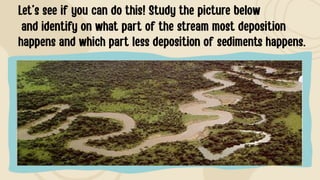
Deposition happens most at the shallow
part of the stream and when
water flows slowly like
Instructions: Prepare the materials ahead. Get a tray and look
for sands outside your home. Put the tray containing sands on the
table. Challenge yourself or think of as many ways as you can to
move the sand from one end of the tray to the other.
ANALYSIS
Instruction: After performing the
activity. Answer the following questions
intended really for you. Write your
answer on your notebook.
What causes these
sediments to form?
What is weathering?
How does this process
happen?
Once rocks undergo
weathering, what will
cause it to undergo
erosion?
Analysis
Using hands, by blowing, by scooping
Erosion
When rocks are broken into process 4. Breaking of rocks into pieces by natural process
or acted upon by chemical
What are the different
agents of erosion?
What causes the movement
of sediments from one place
to the other?
Can human hasten the
process of erosion?
In what ways?
10. What are the
different factors that
affect movement of
sediments?
Explain how the movement
of sediments affect and shapes
the formation of land masses.
1. Using hands, by blowing,
by scooping
1. 2. Erosion
3. When rocks are
broken into
process
1. 4. Breaking of rocks
into pieces by
natural process
or acted upon by
chemical
5. Mechanical
weathering
Chemical weathering
Biological weathering
6. Water, acids, salt, plants, animals
and changes in temperature
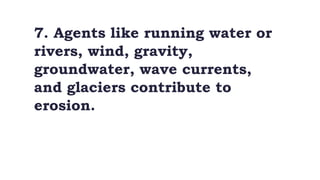
7. Agents like running water or
rivers, wind, gravity,
groundwater, wave currents,
and glaciers contribute to
erosion.
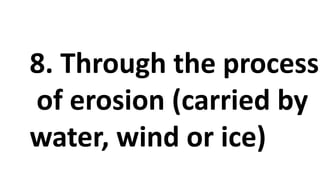
8. Through the process
of erosion (carried by
water, wind or ice)
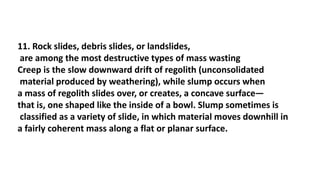
11. Rock slides, debris slides, or landslides,
are among the most destructive types of mass wasting
Creep is the slow downward drift of regolith (unconsolidated
material produced by weathering), while slump occurs when
a mass of regolith slides over, or creates, a concave surface—
that is, one shaped like the inside of a bowl. Slump sometimes is
classified as a variety of slide, in which material moves downhill in
a fairly coherent mass along a flat or planar surface.
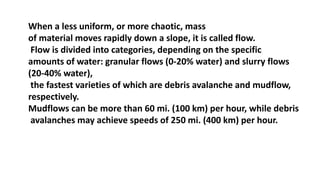
When a less uniform, or more chaotic, mass
of material moves rapidly down a slope, it is called flow.
Flow is divided into categories, depending on the specific
amounts of water: granular flows (0-20% water) and slurry flows
(20-40% water),
the fastest varieties of which are debris avalanche and mudflow,
respectively.
Mudflows can be more than 60 mi. (100 km) per hour, while debris
avalanches may achieve speeds of 250 mi. (400 km) per hour.
Abstraction and
Generalization
Shaping the Earth’s surface
involves a geological process
called weathering.
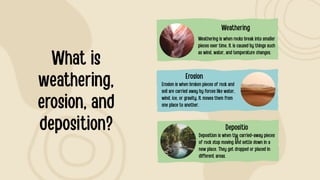
WEATHERING
-the process of breaking down
rocks into smaller pieces
called sediments.
Different Types of Weathering
All rocks undergo weathering, and it
takes a long period. There are three
different types of rock weathering:
mechanical weathering, chemical
weathering, and biological
weathering.
•is a process wherein rocks are broken
down into smaller pieces without
changing its chemical composition due to
different temperatures and water. Rocks
in the highway develop cracks and small
fractures because of too much exposure
to heat. This activity is an example of
mechanical weathering.
•is a process wherein rock
materials are changed into other
substances that have different
physical and chemical
compositions. Some agents of
chemical weathering include
water, strong acids, and oxygen.
CHEMICAL WEATHERING
Water hydrates and breaks the minerals in
the rocks through the process of hydrolysis.
Oxygen combines with metals to produce
oxides while acids from vents and volcanoes
increase the speed of weathering process.
One example of chemical weathering in
rocks is when rainwater hydrolyzed the
feldspar minerals to form clay minerals.
BIOLOGICAL WEATHERING
•a process when living
things, such as insects
and roots of the trees,
contribute to the
disintegration of rock
materials.
BIOLOGICAL WEATHERING
For example, mosses and
fungi that grow on rocks
produce weak acids that
can destroy or dissolve the
rocks.
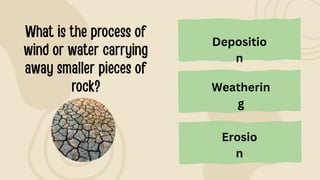
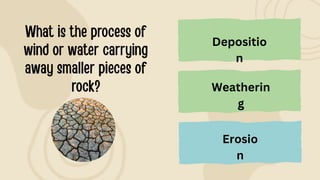
-the transportation of weathered
rocks. Agents like running water or
rivers, wind, gravity, groundwater,
wave currents, and glaciers
contribute to erosion.
is a type of
erosion where the water
carries the sediments to
different parts of the bodies
of water such as rivers.
happens
when light materials, such
as small rocks and
pebbles, are carried by
wind to different places.
happens when the
ice moves downhill and plucks out
chunks of rocks and causes
scraping between the ice and the
rock. Plucking and scraping can lead
to the development of other
landforms if, for example, the
glaciers hit a mountain and erode it.
happens when
the top soil is removed and
leaves the soil infertile.
This is caused by wind or
flood in an area.
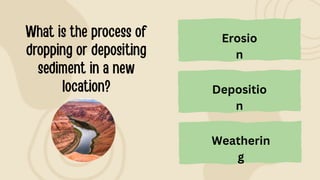
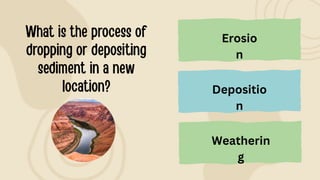
-the laying down of sediments
to its depositional environment
or final destination. The
depositional environment can
be continental, coastal, or
marine.
•Continental includes streams,
swamps, caves, and deserts.
•Coastal includes lagoons, estuaries,
and deltas.
•Marine includes slopes and bottom
of the ocean or abyssal zone.
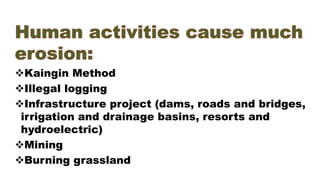
Kaingin Method
Illegal logging
Infrastructure project (dams, roads and bridges,
irrigation and drainage basins, resorts and
hydroelectric)
Mining
Burning grassland
ABCD
Weatherin
g
Erosio
n
Depositio
n
Weatherin
g
Erosio
n
Depositio
n
Weatherin
g
Erosio
n
Depositio
n
Weatherin
g
Erosio
n
Depositio
n
Weatherin
g
Erosio
n
Depositio
n
Weatherin
g
Erosio
n
Depositio
n
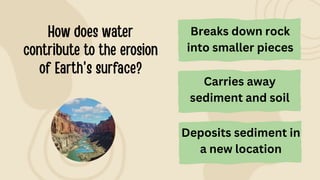
Deposits sediment in
a new location
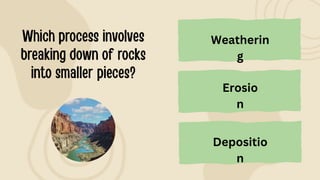
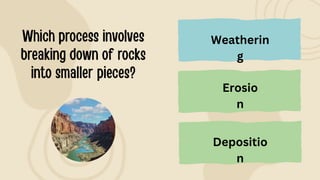
Breaks down rock
into smaller pieces
Carries away
sediment and soil
Deposits sediment in
a new location
Breaks down rock
into smaller pieces
Carries away
sediment and soil
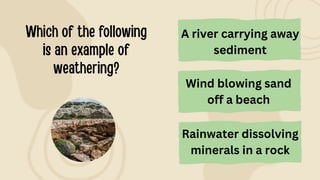
Rainwater dissolving
minerals in a rock
A river carrying away
sediment
Wind blowing sand
off a beach
Rainwater dissolving
minerals in a rock
A river carrying away
sediment
Wind blowing sand
off a beach
Waves crashing into
rocks
Sand and mud
creating a delta
Sand particles being
carried away by the
wind
Waves crashing into
rocks
Sand and mud
creating a delta
Sand particles being
carried away by the
wind
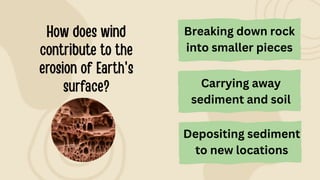
Depositing sediment
to new locations
Breaking down rock
into smaller pieces
Carrying away
sediment and soil
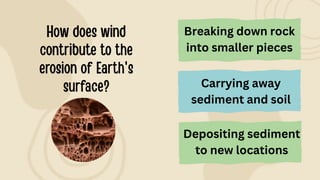
Depositing sediment
to new locations
Breaking down rock
into smaller pieces
Carrying away
sediment and soil
Deposition
Weathering
Erosion
Deposition
Weathering
Erosion
Weatherin
g
Erosio
n
Depositio
n
Weatherin
g
Erosio
n
Depositio
n
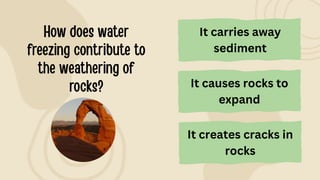
It creates cracks in
rocks
It carries away
sediment
It causes rocks to
expand
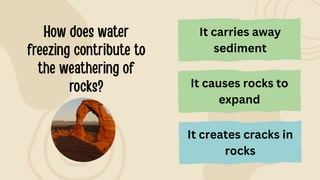
It creates cracks in
rocks
It carries away
sediment
It causes rocks to
expand
Q1_M2d_Weathering Erosion.pptx

Q1_M2d_Weathering Erosion.pptx