Chapter 15: Weathering and Mass Wasting Physical Geography Ninth Edition Robert E. Gabler James. F. Petersen L. Michael Trapasso Dorothy Sack
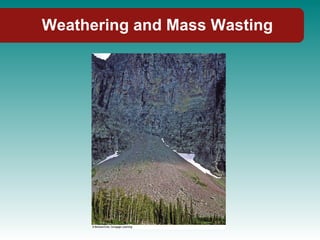
Weathering and Mass Wasting
Weathering and Mass Wasting Exogenic processes: Breakdown rocks  Erode rock materials Transport them Relocation by Gravity Geomorphic Agents Flowing water, wind Moving ice, waves
15.1 Nature of Exogenic Processes Weathering: breakdown of rock materials at and near Earth’s surface Mass wasting
15.1 Nature of Exogenic Processes Q: Can you identify evidence of the three phases shown in Figure 15.3?
15.2 Weathering 3 Types of Weathering Physical weathering Mechanical weathering Chemical weathering Q:  How might an animal cause physical weathering?
15.2 Weathering Physical Weathering Person breaking a rock Unloading Thermal Expansion and Contraction Freeze-Thaw Salt Crystal growth Hydration
15.2 Weathering Unloading Erosional stripping of overlying rocks and ultimate removal of overlying weight High elevation increases process
15.2 Weathering Unloading Exfoliation Exfoliation sheet  Exfoliation dome Stone Mountain, Georgia Half Dome (Yosemite)
15.2 Weathering Thermal Expansion and Contraction Granular disintegration Differential thermal expansion and contraction of individual mineral grains in coarse crystalline rocks
15.2 Weathering Freeze-Thaw Weathering Also called frost weathering (ice wedging) Water freezes it expands 9% Pipes bursting Angular blocks Effective in the upper-middle and lower-high latitudes
15.2 Weathering Salt Crystal Growth Water with dissolved salt accumulates in these spaces and then evaporates, and growing salt crystals wedge rocks apart Hydration
15.2 Weathering Chemical Weathering Most important catalysts and reactive agents: Water Oxygen Carbon dioxide 3 Types of chemical weathering: Oxidation Carbonation and Solution Hydrolysis
15.2 Weathering Oxidation Iron and aluminum oxides Very common Carbonation and Solution Occurs when carbon dioxide in water reacts with rock material to produce bicarbonate ions
15.3 Variability in Weathering Effectiveness of Weathering Climate Type of rock Nature and amount of fractures
15.3 Variability in Weathering Climate Q: In which weathering region would we find a site that has an annual mean temperature of 5 o C (41 o F) and an annual rainfall of 100 cm (40 in)?
15.3 Variability in Weathering Climate
15.3 Variability in Weathering Rock Type Differential weathering and erosion Strong rock may be easily eroded in a different environment Structural Weakness Joints and fractures Exposed rock, collect salts, accumulation of water, and plants
15.3 Variability in Weathering Structural Weakness Spheroidal weathering Q: With north at the top of this photo, what directions do the two most apparent joint sets trend?
15.3 Variability in Weathering Topography Related to Differential Weathering and Erosion Grand Canyon
15.3 Variability in Weathering Topography Related to Differential Weathering and Erosion Q: Can you see how the topography of the Ridge and Valley section influences human settlement patterns?
15.4 Mass Wasting Mass Movement Downslope transport of material due to gravity Q: What other kinds of problems on roads are related to mass wasting?
15.4 Mass Wasting Mass Movement Slope angle Creeping, falling, sliding, or flowing Gravity is the principal force Water is also a contributing factor
15.4 Mass Wasting Classification of Mass Wasting Types of Earth Material Soil Debris Mud Categorized by speed Slow mass wasting Fast mass wasting
15.4 Mass Wasting Slow mass wasting Creep Slow migration, but most persistent Heaving process Q: Are there places near where you live that show evidence of soil creep?
15.4 Mass Wasting Q: What other constructed features might be changed by creep?
15.4 Mass Wasting Slow mass wasting Solifluction Most common in high latitudes of high-elevation tundra Permafrost and active layer Summer thaw Tundra landscapes Q: How does solifluction differ from soil creep?
15.4 Mass Wasting Fast Mass Wasting Four Major Types: Falls Avalanches Slides  Flows Effects more dramatic than slow mass wasting
15.4 Mass Wasting Falls Rockfalls Due to: Weathering weakens the bonds between clasts and cliff Large rock masses that fall from a cliff face or an overhanging ledge
15.4 Mass Wasting Falls Talus slope Talus cone Angle of repose
15.4 Mass Wasting Falls Happy Isles Rockfall in Yosemite Valley, CA Traveled at an estimated 250 km/hr (160 mph)
15.4 Mass Wasting Avalanches Snow  Rock Debris
15.4 Mass Wasting Slides Water plays biggest role Rockslides Threaten lives and property Hebgen Lake rockslide Southwestern Montana (1959)  Killed 28 people
15.4 Mass Wasting Slides Debris slide Mudslide Slumps Landslide
15.4 Mass Wasting Flows Earthflow Slump-earthflow Debris flows Mudflows Flow levees
15.5 Weathering, Mass Wasting, and the Landscape Violent 1980 eruption of Mount St. Helens in Washington created lahars - mudflows
Physical Geography End of Chapter 15: Weathering and Mass Wasting

15

  • 1.
    Chapter 15: Weatheringand Mass Wasting Physical Geography Ninth Edition Robert E. Gabler James. F. Petersen L. Michael Trapasso Dorothy Sack
  • 2.
  • 3.
    Weathering and MassWasting Exogenic processes: Breakdown rocks Erode rock materials Transport them Relocation by Gravity Geomorphic Agents Flowing water, wind Moving ice, waves
  • 4.
    15.1 Nature ofExogenic Processes Weathering: breakdown of rock materials at and near Earth’s surface Mass wasting
  • 5.
    15.1 Nature ofExogenic Processes Q: Can you identify evidence of the three phases shown in Figure 15.3?
  • 6.
    15.2 Weathering 3Types of Weathering Physical weathering Mechanical weathering Chemical weathering Q: How might an animal cause physical weathering?
  • 7.
    15.2 Weathering PhysicalWeathering Person breaking a rock Unloading Thermal Expansion and Contraction Freeze-Thaw Salt Crystal growth Hydration
  • 8.
    15.2 Weathering UnloadingErosional stripping of overlying rocks and ultimate removal of overlying weight High elevation increases process
  • 9.
    15.2 Weathering UnloadingExfoliation Exfoliation sheet Exfoliation dome Stone Mountain, Georgia Half Dome (Yosemite)
  • 10.
    15.2 Weathering ThermalExpansion and Contraction Granular disintegration Differential thermal expansion and contraction of individual mineral grains in coarse crystalline rocks
  • 11.
    15.2 Weathering Freeze-ThawWeathering Also called frost weathering (ice wedging) Water freezes it expands 9% Pipes bursting Angular blocks Effective in the upper-middle and lower-high latitudes
  • 12.
    15.2 Weathering SaltCrystal Growth Water with dissolved salt accumulates in these spaces and then evaporates, and growing salt crystals wedge rocks apart Hydration
  • 13.
    15.2 Weathering ChemicalWeathering Most important catalysts and reactive agents: Water Oxygen Carbon dioxide 3 Types of chemical weathering: Oxidation Carbonation and Solution Hydrolysis
  • 14.
    15.2 Weathering OxidationIron and aluminum oxides Very common Carbonation and Solution Occurs when carbon dioxide in water reacts with rock material to produce bicarbonate ions
  • 15.
    15.3 Variability inWeathering Effectiveness of Weathering Climate Type of rock Nature and amount of fractures
  • 16.
    15.3 Variability inWeathering Climate Q: In which weathering region would we find a site that has an annual mean temperature of 5 o C (41 o F) and an annual rainfall of 100 cm (40 in)?
  • 17.
    15.3 Variability inWeathering Climate
  • 18.
    15.3 Variability inWeathering Rock Type Differential weathering and erosion Strong rock may be easily eroded in a different environment Structural Weakness Joints and fractures Exposed rock, collect salts, accumulation of water, and plants
  • 19.
    15.3 Variability inWeathering Structural Weakness Spheroidal weathering Q: With north at the top of this photo, what directions do the two most apparent joint sets trend?
  • 20.
    15.3 Variability inWeathering Topography Related to Differential Weathering and Erosion Grand Canyon
  • 21.
    15.3 Variability inWeathering Topography Related to Differential Weathering and Erosion Q: Can you see how the topography of the Ridge and Valley section influences human settlement patterns?
  • 22.
    15.4 Mass WastingMass Movement Downslope transport of material due to gravity Q: What other kinds of problems on roads are related to mass wasting?
  • 23.
    15.4 Mass WastingMass Movement Slope angle Creeping, falling, sliding, or flowing Gravity is the principal force Water is also a contributing factor
  • 24.
    15.4 Mass WastingClassification of Mass Wasting Types of Earth Material Soil Debris Mud Categorized by speed Slow mass wasting Fast mass wasting
  • 25.
    15.4 Mass WastingSlow mass wasting Creep Slow migration, but most persistent Heaving process Q: Are there places near where you live that show evidence of soil creep?
  • 26.
    15.4 Mass WastingQ: What other constructed features might be changed by creep?
  • 27.
    15.4 Mass WastingSlow mass wasting Solifluction Most common in high latitudes of high-elevation tundra Permafrost and active layer Summer thaw Tundra landscapes Q: How does solifluction differ from soil creep?
  • 28.
    15.4 Mass WastingFast Mass Wasting Four Major Types: Falls Avalanches Slides Flows Effects more dramatic than slow mass wasting
  • 29.
    15.4 Mass WastingFalls Rockfalls Due to: Weathering weakens the bonds between clasts and cliff Large rock masses that fall from a cliff face or an overhanging ledge
  • 30.
    15.4 Mass WastingFalls Talus slope Talus cone Angle of repose
  • 31.
    15.4 Mass WastingFalls Happy Isles Rockfall in Yosemite Valley, CA Traveled at an estimated 250 km/hr (160 mph)
  • 32.
    15.4 Mass WastingAvalanches Snow Rock Debris
  • 33.
    15.4 Mass WastingSlides Water plays biggest role Rockslides Threaten lives and property Hebgen Lake rockslide Southwestern Montana (1959) Killed 28 people
  • 34.
    15.4 Mass WastingSlides Debris slide Mudslide Slumps Landslide
  • 35.
    15.4 Mass WastingFlows Earthflow Slump-earthflow Debris flows Mudflows Flow levees
  • 36.
    15.5 Weathering, MassWasting, and the Landscape Violent 1980 eruption of Mount St. Helens in Washington created lahars - mudflows
  • 37.
    Physical Geography Endof Chapter 15: Weathering and Mass Wasting

Editor's Notes

  • #3 Insert cover image for Chapter 15 (p. 410).
  • #5 Insert Figure 15.1 and 15.2
  • #6 Insert Figure 15.3 and 15.4
  • #7 Insert Figure 15.5
  • #8 Insert Figure 15.5
  • #9 Insert Figure 15.6
  • #10 Insert Figure 15.7
  • #11 Insert Figure 15.8 and 15.9
  • #12 Insert Figure 15.10 and 15.11
  • #13 Insert Figure 15.12
  • #14 Insert Figure 15.13
  • #15 Insert Figure 15.13 and 15.14
  • #17 Insert Figure 15.16
  • #18 Insert Figure 15.17 and 15.18
  • #19 Insert Figure 15.19b and 15.20
  • #20 Insert Figure 15.21 and 15.22
  • #21 Insert Figure 15.23
  • #22 Insert Figure 15.24
  • #23 Insert Figure 15.25
  • #24 Insert Figure 15.26
  • #25 Insert Table 15.1
  • #26 Insert Figure 15.27
  • #27 Insert Figure 15.28
  • #28 Insert Figure 15.29
  • #30 Insert Figure 15.30
  • #31 Insert Figure 15.31 and 15.32
  • #32 Insert Figure 15.33
  • #33 Insert Figure 15.34
  • #34 Insert Figure 15.36
  • #35 Insert Figure 15.37 and 15.38
  • #36 Insert Figure 15.39 and 15.40
  • #37 Insert Figure 15.41