WEATHERING,EROSION,DEPOSITION
Due Date: Dec. 10th
WEATHERING
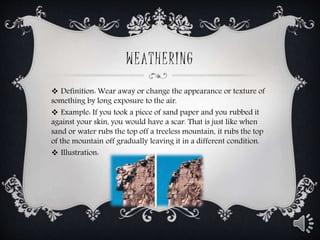
 Definition: Wear away or change the appearance or texture of
something by long exposure to the air.
 Example: If you took a piece of sand paper and you rubbed it
against your skin, you would have a scar. That is just like when
sand or water rubs the top off a treeless mountain, it rubs the top
of the mountain off gradually leaving it in a different condition.
 Illustration:
CHEMICAL WEATHERING
 Definition: The erosion or disintegration of rocks, building
materials, etc., caused by chemical reactions.
 Types: water, oxygen, carbon dioxide, living organisms and
acid rain.
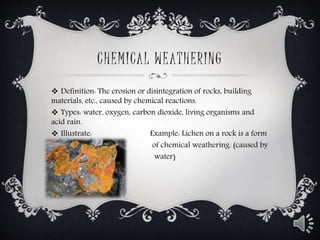
 Illustrate: Example: Lichen on a rock is a form
 of chemical weathering. (caused by
 water)
MECHANICAL WEATHERING
 Mechanical weathering is the process of breaking big rocks
into little ones. The cool nights and hot days always cause things
to expand and contract. That movement can cause rocks to crack
and break apart.
 Mechanical weathering may occur due to thermal fractioning,
frost wedging, hydration shattering, exfoliation and abrasion.
During mechanical weathering, external forces cause solid rock
material to break into smaller sediments.
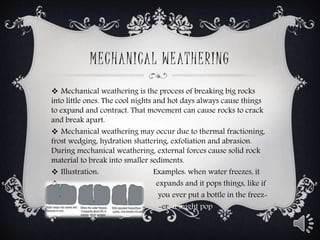
 Illustration: Examples: when water freezes, it
 expands and it pops things, like if
 you ever put a bottle in the freez-
 -er it might pop..

EROSION
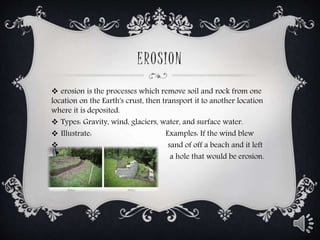
 erosion is the processes which remove soil and rock from one
location on the Earth's crust, then transport it to another location
where it is deposited.
 Types: Gravity, wind, glaciers, water, and surface water.
 Illustrate: Examples: If the wind blew
 sand of off a beach and it left
 a hole that would be erosion.
DEPOSITION
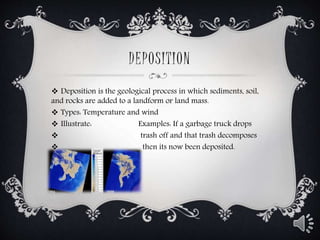
 Deposition is the geological process in which sediments, soil,
and rocks are added to a landform or land mass.
 Types: Temperature and wind
 Illustrate: Examples: If a garbage truck drops
 trash off and that trash decomposes
 then its now been deposited.
THE END
 Citation:
 Pidwirny, M. (2013). Soil erosion and deposition. Retrieved
from http://www.eoearth.org/view/article/156085

Weathering,erosion,deposition

  • 1.
  • 2.
    WEATHERING  Definition: Wearaway or change the appearance or texture of something by long exposure to the air.  Example: If you took a piece of sand paper and you rubbed it against your skin, you would have a scar. That is just like when sand or water rubs the top off a treeless mountain, it rubs the top of the mountain off gradually leaving it in a different condition.  Illustration:
  • 3.
    CHEMICAL WEATHERING  Definition:The erosion or disintegration of rocks, building materials, etc., caused by chemical reactions.  Types: water, oxygen, carbon dioxide, living organisms and acid rain.  Illustrate: Example: Lichen on a rock is a form  of chemical weathering. (caused by  water)
  • 4.
    MECHANICAL WEATHERING  Mechanicalweathering is the process of breaking big rocks into little ones. The cool nights and hot days always cause things to expand and contract. That movement can cause rocks to crack and break apart.  Mechanical weathering may occur due to thermal fractioning, frost wedging, hydration shattering, exfoliation and abrasion. During mechanical weathering, external forces cause solid rock material to break into smaller sediments.  Illustration: Examples: when water freezes, it  expands and it pops things, like if  you ever put a bottle in the freez-  -er it might pop.. 
  • 5.
    EROSION  erosion isthe processes which remove soil and rock from one location on the Earth's crust, then transport it to another location where it is deposited.  Types: Gravity, wind, glaciers, water, and surface water.  Illustrate: Examples: If the wind blew  sand of off a beach and it left  a hole that would be erosion.
  • 6.
    DEPOSITION  Deposition isthe geological process in which sediments, soil, and rocks are added to a landform or land mass.  Types: Temperature and wind  Illustrate: Examples: If a garbage truck drops  trash off and that trash decomposes  then its now been deposited.
  • 7.
    THE END  Citation: Pidwirny, M. (2013). Soil erosion and deposition. Retrieved from http://www.eoearth.org/view/article/156085